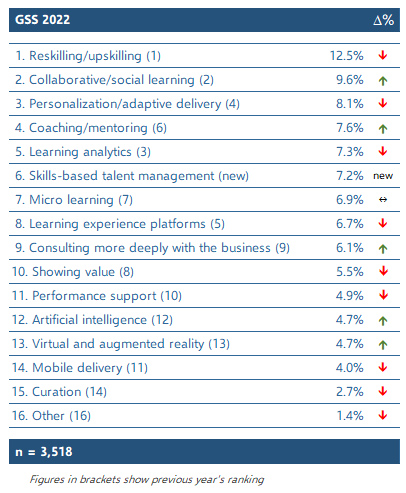
The 2022 L&D Global Sentiment Survey — from donaldtaylor.co.uk by Donald Taylor

Excerpt:

This year’s L&D Global Sentiment Survey, the ninth, shows L&D at a turning point, as the result of two forces. One is the demands of organisations, as they emerge from the pandemic, for more training delivery, very often with unchanged or reduced resources for L&D. The other is the need to deal with the emergency measures put in place in 2020 to deal with the immediate impact of COVID-19.

This sense of practitioners being under pressure is amply illustrated by responses to the free text question ‘What is your biggest L&D challenge in 2022?’ 40% of respondents answered, with the answers painting a picture of practitioners being asked to do more, in difficult circumstances, to support the learning of overworked employees and uninterested employers.

It is tempting to see this as a return to business-as-usual for L&D. Hasn‘t it always been the case that the department needed to fight for the attention of both executives and employees? Behind this undeniable reality, however, there are definite signs of longer-term trends emerging.


Facebook Seems to Be Adding Video-Course Features. For Edtech, That Raises Old Fears. — from edsurge.com by Daniel Mollenkamp

Excerpts:

The tech giant Meta, widely known under its previous name Facebook, seems to be eyeing a way to allow users to offer video classes.

Since at least last year, Meta has experimented with Facebook Classes, a program designed to make online instruction through its platform smoother. A consultant recently noticed a company announcement about the features in the U.K. version of the platform and shared a screenshot on Twitter.

The company did not respond to questions about the program. But recent reports have speculated that the company could “bootstrap an online course ecosystem.”

Meta’s learning offering could be most trouble for other tech behemoths like Google Classroom and Microsoft Teams, according to some speculations.

Either way, Meta’s possible entrance into the market plays into a long-standing fear of big tech in the edtech industry.


Slido Lesson Plan — from techlearning.com by Stephanie Smith Budhai, Ph.D.
This Slido Lesson Plan is designed to help educators implement the digital tool into their instruction

Excerpt:

Slido is an exciting online engagement edtech tool that can be used to connect all students with academic content while getting them involved in the lesson.

While Slido is often used to incorporate polling into virtual workshops and presentations, there are a wide range of student engagement features within the Slido platform that can be used by teachers during lessons.

Also see:

Slido -- your go-to interaction app for hybrid meetings


GreenLight Means Go: Where Learner and Employment Records Are Headed — from gettingsmart.com by Getting Smart Staff

Excerpt:

New solutions present a unique solution to these challenges by providing a user-controlled technology to store, share, search, and match acquired competency with opportunity. One of the key players in this space is GreenLight Credentials, a frictionless, user-controlled talent search and credential-communicator that addresses these issues. On the outbound side, institutions and their learners can store any type of verified record including transcripts, credentials, badges, or other documentation of learning. These learning experiences are then translated into data – competencies, skills, interests, and accomplishments that are then matched with scholarship, university and employment opportunities. Universities and employers can join the network to discover and connect with prospective students or employees.

The vast majority of students who graduate from high school in the United States typically have their learning diluted to a single one-page transcript that lists courses and grades – and often a GPA.

What young people need now are repetitions in design thinking – to repeatedly find, frame, address complex problems and deliver value to a community.

— Getting Smart Staff

Also relevant/see from Getting Smart:

Innovating Together: the Geopolitical and Educational Path Forward — by Tom Vander Ark

Key Points

  • The new mission of school is cultivating curiosity, purpose and problem solving by inviting learners into real world challenges in diverse teams using smart tools.
  • The path forward is innovating together.

The VUCA world (volatile, uncertain, complex, and ambiguous) is now hyper-connected (VUCAH).

Also relevant/see:


From DSC:
The report below contains some great examples of a few of the elements in a learning ecosystem! Though there are many other elements in a learning ecosystem, tools and technologies are certainly two key components of one.

Some of the topics in this report at:

  • Knowledge bases and knowledge management technology
  • Microlearning
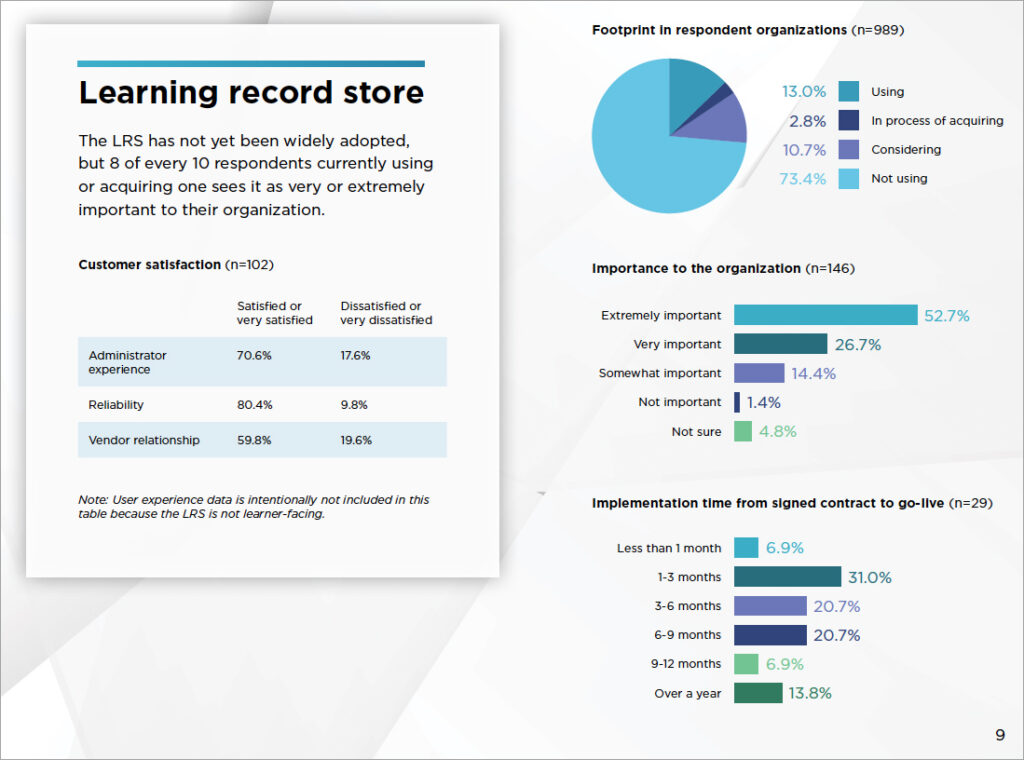
  • Learning record store
  • Learning Experience Platform (LXP)
  • Augmented reality / Virtual reality (AR/VR)
  • Adaptive learning / Intelligent tutor
  • Technology stack

2022 Trends in Learning Technology — from learningguild.com by Steve Foreman

Excerpt:

In this research report, Steve Foreman analyzes recent survey findings to examine eight learning technologies and explore how they impact the L&D space, organizations, customer satisfaction, and more.

This image contains some information regarding the learning record store


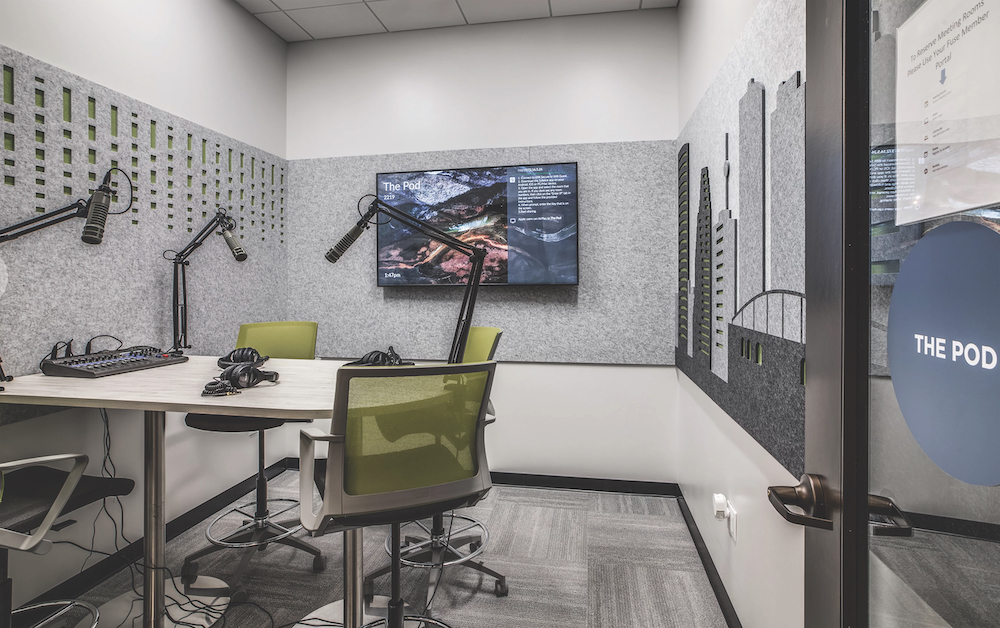
What The Future Of Technology In The Workplace Means For Office Design And Operations — from workdesign.com by Mara Hauser

Excerpt:

Advances in technology continue to influence the workplace as corporate entities and coworking operators are confronted with modern challenges surrounding productivity and collaboration. We lead teams to execute intentional designs that reflect brand vision and produce lively, productive workspaces. With the growing demand from employees for workplace flexibility, these technological advancements must be reflected in both office design and business practices in order to add value and ultimately achieve operational excellence.

.

Podcasting studio at FUSE Workspace in Houston, TX.


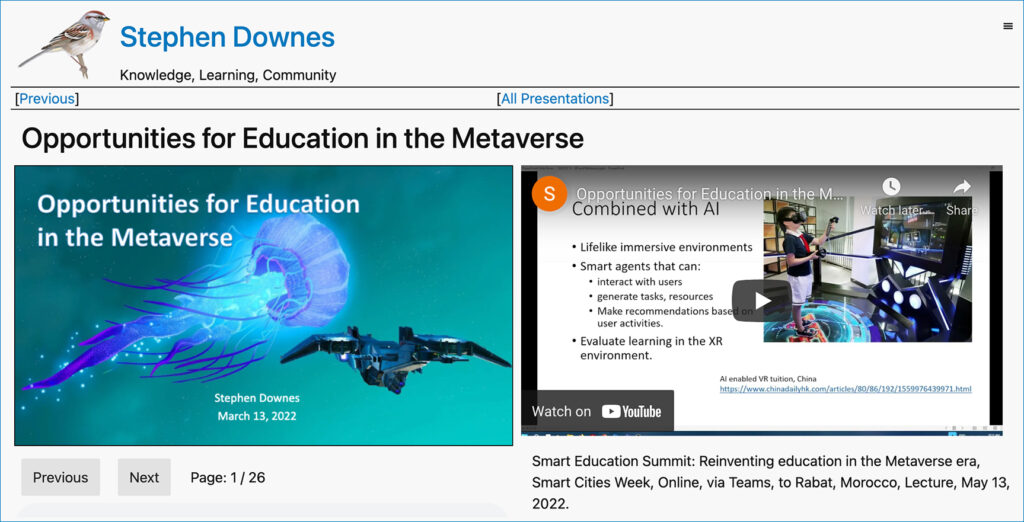
Opportunities for Education in the Metaverse -- from downes.ca by Stephen Downes

Opportunities for Education in the Metaverse — from downes.ca by Stephen Downes

Excerpt:

This short presentation introduces major elements of the metaverse, outlines some applications for education, discusses how it may be combined with other technologies for advanced applications, and outlines some issues and concerns.

Also relevant/see:

What Should Higher Ed in the Metaverse Look like? – from linkedin.com by Joe Schaefer

Excerpt:

The Metaverse is coming whether we like it or not, and it is time for educators to think critically about how it can benefit students. As higher education continues to evolve, I believe every learning product and platform working with or within the Metaverse should, at least, have these functionalities:


Addendum on 5/23/22:


Entrepreneur Education Platform GeniusU Raises $1.5M Seed Funding at $250M Valuation — from edtechreview.in ed by Stephen Soulunii

Excerpt (emphasis DSC):

Genius Group has recently announced that its EdTech arm, GeniusU Ltd, has raised $1.5 million in a seed round to support the development of its Genius Metaversity virtual learning plans.

With the fresh funding, GeniusU plans to extend its courses and programs to interactive learning environments in the metaverse, with students and faculty connecting and learning in global classrooms and virtual 3D environments. It also plans to integrate each student’s AI-based virtual assistant ‘Genie’ into the metaverse as 3D virtual assistants that accompany each student on their personalized journey and integrate its GEMs (Genius Education Merits) student credits into the metaverse. GEMs are earned by students as they learn and can be spent on products and services within GeniusU and counting towards their certifications.


Five steps to getting higher ROI on your learning content — from chieflearningofficer.com by Anindita Gupta

Excerpt:

Both scenarios point toward the fact that organizations are investing a disproportionate amount of time and money on their star content while the supporting content assets are left languishing.  In the long run, this skewed handling makes it extremely difficult for L&D teams to manage and maintain not just their content but also their budget. They could do better, be leaner, get more out of their investments, and experience smarter if they did just one thing differently.
.

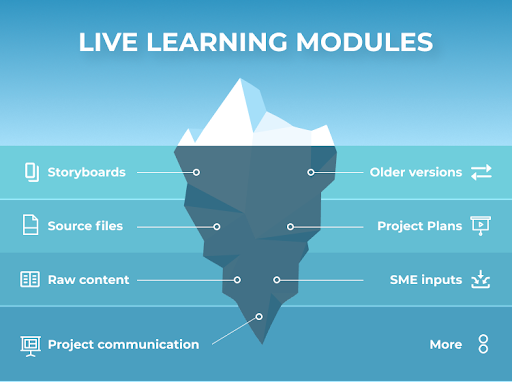
Live learning modules are only the tip of the iceberg of what is involved in creating them


Also relevant/see:

Addendum on 5/16/22:


24 ideas for creating a discussion-rich classroom — from ditchthattextbook.com by Matt Miller
Discussion can engage students and help them to see different perspectives. Here are strategies you can use to create a discussion-rich classroom.

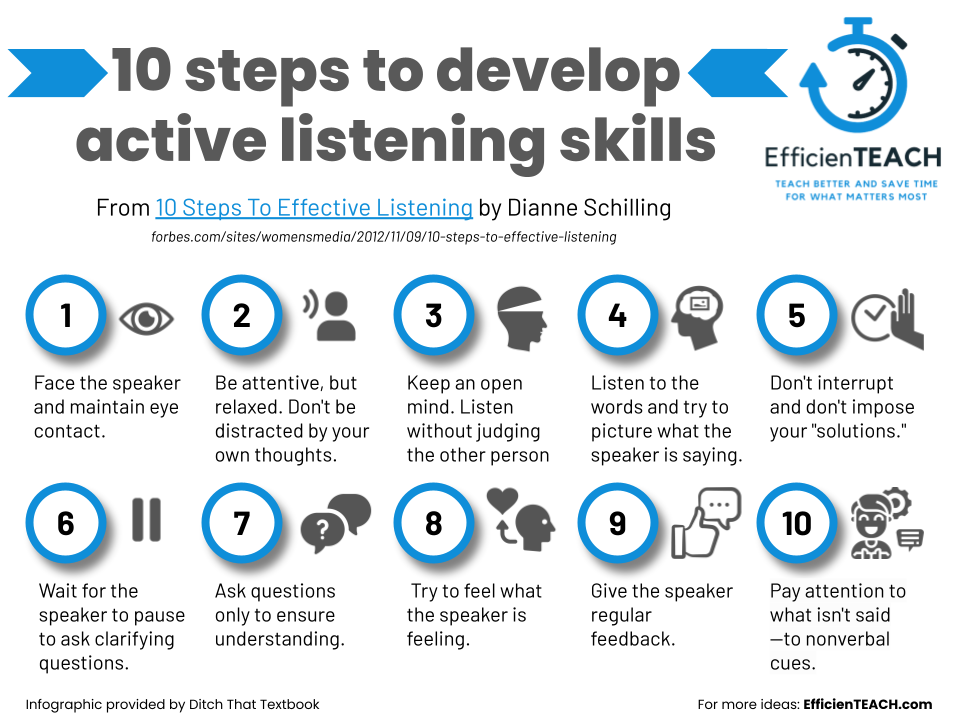
10 ways to teach active listening in the classroom

Also relevant/see:


A Turning Point for Prison Education — from chronicle.com by Taylor Swaak
With reinstatement of Pell Grants imminent, the programs weigh technology’s long-term role.

Excerpts:

Incarcerated people who participate in postsecondary-education programs are 48 percent less likely to return to prison, according to a 2018 study from the RAND Corporation.

Three colleges that The Chronicle spoke with are in varying stages of adding technology to their prison-ed programs.

Addendum on 5/11/22:

It was a proud, and somewhat routine commencement ceremony for Calvin University on Monday, May 9, though held in the confines of a state prison.

Calvin University and Calvin Theological Seminary joined the Michigan Department of Corrections Monday to host the graduation ceremony for Calvin Prison Initiative (CPI) students at the state’s Richard A. Handlon Correctional Facility in Ionia.

Addendums on 5/16/22:


The AR Roundup: April 2022 — from linkedin.com by Tom Emrich

Excerpts:

Every month I round up what you may have missed in Augmented Reality including the latest stats, funding news and launch announcements and more. Here is what happened in augmented reality between April 1-30, 2022.


Remote court transcription technology enables virtual court appearances — from abajournal.com by Nicole Black

Excerpts:

That’s why it’s imperative to make certain remote options are available for all aspects of legal work since doing so is the only way to guarantee the justice system doesn’t come to a grinding halt. One way to prevent that is to take advantage of the virtual deposition transcription tools I discussed in last month’s column. In that article, I provided an overview of virtual deposition transcription products and services that rely on videoconferencing tools and software platforms to facilitate remote depositions.

Another way business continuity has been maintained since March 2020 is via virtual court proceedings. Remote court appearances are now more common since courts periodically shifted to partial or fully remote operations throughout the pandemic. Many judges have become accustomed to and appreciate the convenience of virtual court proceedings, and many expect them to continue even after the pandemic ends.

Because all signs point to the continuation of virtual court proceedings, I promised in last month’s article that I would focus on remote court proceeding options in this column. These include software platforms and artificial intelligence language-processing tools that facilitate remote court proceedings.

Nicole’s article mentioned the following vendor/product:

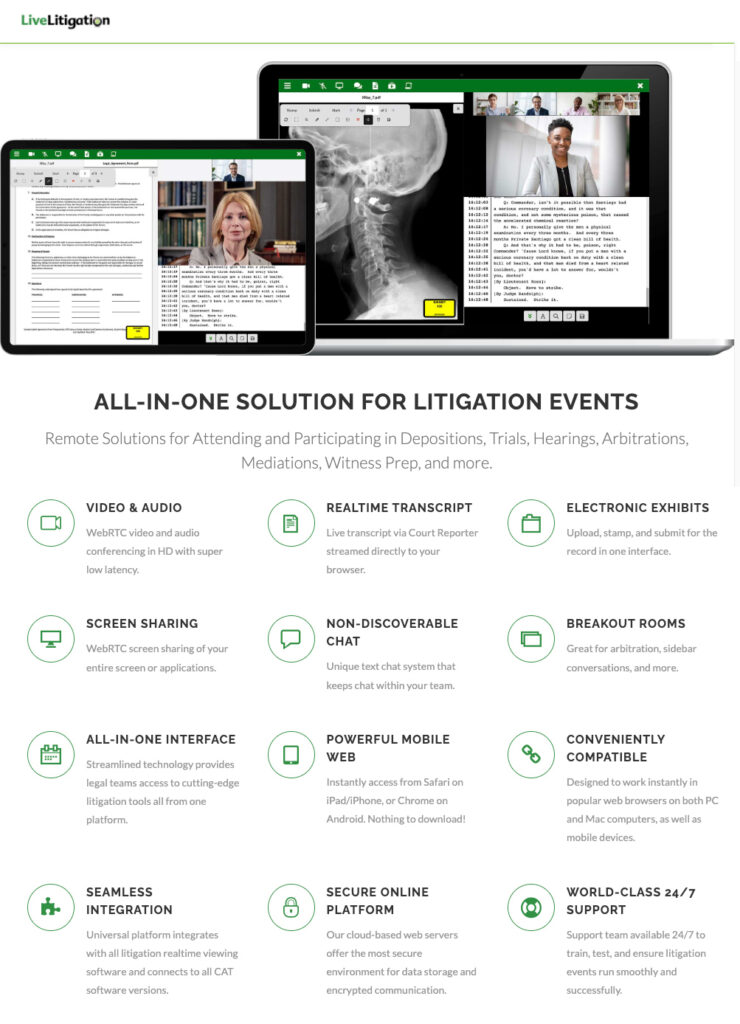
Live Litigation -- Remote Solutions for Attending and Participating in Depositions, Trials, Hearings, Arbitrations, Mediations, Witness Prep, and more.


The amazing opportunities of AI in the future of the educational metaverse [Darbinyan]

The amazing opportunities of AI in the future of the educational metaverse — from forbes.com by Rem Darbinyan

Excerpt:

Looking ahead, let’s go over several potential AI-backed applications of the metaverse that can empower the education industry in many ways.

Multilingual Learning Opportunities
Language differences may be a real challenge for students from different cultures as they may not be able to understand and keep up with the materials and assignments. Artificial intelligence, VR and AR technologies can enhance multilingual accessibility for learners no matter where they are in the world. Speech-to-text, text-to-speech and machine translation technologies enrich the learning process and create more immersive learning environments.

AI can process multiple languages simultaneously and provide real-time translations, enabling learners to engage with the materials in the language of their choice. With the ability to instantly transcribe speech across multiple languages, artificial intelligence removes any language barriers for students, enabling them to be potentially involved, learn and communicate in any language.

Artificial Intelligence (AI) in Education Market size exceeded USD 1 billion in 2020 and is expected to grow at a CAGR of over 40% between 2021 and 2027. (source)

Along the lines of innovation within our educational learning ecosystems, see:

3 Questions for Coursera’s Betty Vandenbosch & U-M’s Lauren Atkins Budde on XR — from insidehighered.com by Joshua Kiim
How might extended reality shape the future of learning?

Excerpts (emphasis DSC):

[Lauren Atkins Budde] “Being able to embed quality, effective extended reality experiences into online courses is exponentially a game-changer. One of the persistent constraints of online learning, especially at scale, is how do learners get hands-on practice? How do they experience specific contexts and situations? How do they learn things that are best experienced? XR provides that opportunity for actively doing different kinds of tasks, in various environments, in ways that would otherwise not be possible. It will open up  Lauren Atkins Buddeboth how we teach online and also what we teach online.”

These courses are really exciting and cover a broad range of disciplines, which is particularly important. To choose the right subjects, we did an extensive review of insights from industry partners, learners and market research on in-demand and emerging future-of-work skills and then paired that with content opportunities where immersive learning is really a value-add and creates what our learning experience designers call “embodied learning.”

Addendum on 5/1/22:
Can the Metaverse Improve Learning? New Research Finds Some Promise — from edsurge.com by Jeffrey R. Young

“The findings support a deeper understanding of how creating unique educational experiences that feel real (i.e., create a high level of presence) through immersive technology can influence learning through different affective and cognitive processes including enjoyment and interest,” Mayer and his colleagues write.

 
© 2025 | Daniel Christian