AI & Schools: 4 Ways Artificial Intelligence Can Help Students — from the74million.org by W. Ian O’Byrne
AI creates potential for more personalized learning

I am a literacy educator and researcher, and here are four ways I believe these kinds of systems can be used to help students learn.

  1. Differentiated instruction
  2. Intelligent textbooks
  3. Improved assessment
  4. Personalized learning


5 Skills Kids (and Adults) Need in an AI World — from oreilly.com by Raffi Krikorian
Hint: Coding Isn’t One of Them

Five Essential Skills Kids Need (More than Coding)
I’m not saying we shouldn’t teach kids to code. It’s a useful skill. But these are the five true foundations that will serve them regardless of how technology evolves.

  1. Loving the journey, not just the destination
  2. Being a question-asker, not just an answer-getter
  3. Trying, failing, and trying differently
  4. Seeing the whole picture
  5. Walking in others’ shoes

The AI moment is now: Are teachers and students ready? — from iblnews.org

Day of AI Australia hosted a panel discussion on 20 May, 2025. Hosted by Dr Sebastian Sequoiah-Grayson (Senior Lecturer in the School of Computer Science and Engineering, UNSW Sydney) with panel members Katie Ford (Industry Executive – Higher Education at Microsoft), Tamara Templeton (Primary School Teacher, Townsville), Sarina Wilson (Teaching and Learning Coordinator – Emerging Technology at NSW Department of Education) and Professor Didar Zowghi (Senior Principal Research Scientist at CSIRO’s Data61).


Teachers using AI tools more regularly, survey finds — from iblnews.org

As many students face criticism and punishment for using artificial intelligence tools like ChatGPT for assignments, new reporting shows that many instructors are increasingly using those same programs.


Addendum on 5/28/25:

A Museum of Real Use: The Field Guide to Effective AI Use — from mikekentz.substack.com by Mike Kentz
Six Educators Annotate Their Real AI Use—and a Method Emerges for Benchmarking the Chats

Our next challenge is to self-analyze and develop meaningful benchmarks for AI use across contexts. This research exhibit aims to take the first major step in that direction.

With the right approach, a transcript becomes something else:

  • A window into student decision-making
  • A record of how understanding evolves
  • A conversation that can be interpreted and assessed
  • An opportunity to evaluate content understanding

This week, I’m excited to share something that brings that idea into practice.

Over time, I imagine a future where annotated transcripts are collected and curated. Schools and universities could draw from a shared library of real examples—not polished templates, but genuine conversations that show process, reflection, and revision. These transcripts would live not as static samples but as evolving benchmarks.

This Field Guide is the first move in that direction.


Boys Are Struggling in School. What Can Be Done? — from edweek.org by Rick Hess
Scholar Richard Reeves says it’s time to take a hard look at gender equity

Rick: What kinds of strategies do you think would help?

Richard: In education, we should expand the use of male-friendly teaching methods, such as more hands-on and active learning approaches. We should also consider redshirting boys—starting them in school a year later—to account for developmental differences between boys and girls. We should also introduce more male mentors and role models in schools, particularly in elementary education, where male teachers are scarce. In the workforce, apprenticeship and vocational training programs need to be expanded to create pathways into stable employment for young men who may not pursue a four-year degree. Career counseling should also emphasize diverse pathways to ensure that boys who may not thrive in a traditional academic setting still have opportunities for success. Additionally, fatherhood policies should recognize the importance of male engagement in family life, supporting fathers in their role as caregivers and providers.


While on the topic of K12 education, also see:

How Electives Help All Students Succeed — from edutopia.org by Miriam Plotinsky
Giving students a choice of electives increases engagement and allows them to develop skills outside of core academic subjects.

I recently conducted a student focus group on the topic of school attendance. One of the participants, a high school junior who admitted to being frequently late or absent, explained why she still came to school: “I never want to miss Drama. My teacher is awesome. Her class is the reason I show up every day.” As the rest of the focus group chimed in with similar thoughts, I reflected on the power that elective courses hold for students of all ages.

These courses, from jazz band to yoga, cement students’ sense of self not just in their primary and secondary years, but also in their journey toward adulthood. In these tight economic times, schools or districts often slash electives to save money on staffing, which is highly detrimental to student success. Instead, not only should budget cuts be made elsewhere, but also elective offerings should increase to heighten student choice and well-being.


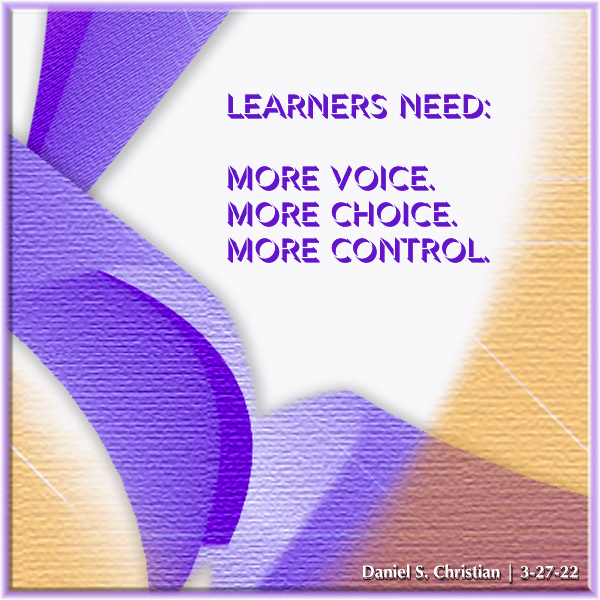
Learners need: More voice. More choice. More control. -- this image was created by Daniel Christian


“Student Guide to AI”; “AI Isn’t Just Changing How We Work — It’s Changing How We Learn”; + other items re: AI in our LE’s

.Get the 2025 Student Guide to Artificial Intelligence — from studentguidetoai.org
This guide is made available under a Creative Commons license by Elon University and the American Association of Colleges and Universities (AAC&U).
.


AI Isn’t Just Changing How We Work — It’s Changing How We Learn — from entrepreneur.com by Aytekin Tank; edited by Kara McIntyre
AI agents are opening doors to education that just a few years ago would have been unthinkable. Here’s how.

Agentic AI is taking these already huge strides even further. Rather than simply asking a question and receiving an answer, an AI agent can assess your current level of understanding and tailor a reply to help you learn. They can also help you come up with a timetable and personalized lesson plan to make you feel as though you have a one-on-one instructor walking you through the process. If your goal is to learn to speak a new language, for example, an agent might map out a plan starting with basic vocabulary and pronunciation exercises, then progress to simple conversations, grammar rules and finally, real-world listening and speaking practice.

For instance, if you’re an entrepreneur looking to sharpen your leadership skills, an AI agent might suggest a mix of foundational books, insightful TED Talks and case studies on high-performing executives. If you’re aiming to master data analysis, it might point you toward hands-on coding exercises, interactive tutorials and real-world datasets to practice with.

The beauty of AI-driven learning is that it’s adaptive. As you gain proficiency, your AI coach can shift its recommendations, challenge you with new concepts and even simulate real-world scenarios to deepen your understanding.

Ironically, the very technology feared by workers can also be leveraged to help them. Rather than requiring expensive external training programs or lengthy in-person workshops, AI agents can deliver personalized, on-demand learning paths tailored to each employee’s role, skill level, and career aspirations. Given that 68% of employees find today’s workplace training to be overly “one-size-fits-all,” an AI-driven approach will not only cut costs and save time but will be more effective.


What’s the Future for AI-Free Spaces? — from higherai.substack.com by Jason Gulya
Please let me dream…

This is one reason why I don’t see AI-embedded classrooms and AI-free classrooms as opposite poles. The bone of contention, here, is not whether we can cultivate AI-free moments in the classroom, but for how long those moments are actually sustainable.

Can we sustain those AI-free moments for an hour? A class session? Longer?

Here’s what I think will happen. As AI becomes embedded in society at large, the sustainability of imposed AI-free learning spaces will get tested. Hard. I think it’ll become more and more difficult (though maybe not impossible) to impose AI-free learning spaces on students.

However, consensual and hybrid AI-free learning spaces will continue to have a lot of value. I can imagine classes where students opt into an AI-free space. Or they’ll even create and maintain those spaces.


Duolingo’s AI Revolution — from drphilippahardman.substack.com by Dr. Philippa Hardman
What 148 AI-Generated Courses Tell Us About the Future of Instructional Design & Human Learning

Last week, Duolingo announced an unprecedented expansion: 148 new language courses created using generative AI, effectively doubling their content library in just one year. This represents a seismic shift in how learning content is created — a process that previously took the company 12 years for their first 100 courses.

As CEO Luis von Ahn stated in the announcement, “This is a great example of how generative AI can directly benefit our learners… allowing us to scale at unprecedented speed and quality.”

In this week’s blog, I’ll dissect exactly how Duolingo has reimagined instructional design through AI, what this means for the learner experience, and most importantly, what it tells us about the future of our profession.


Are Mixed Reality AI Agents the Future of Medical Education? — from ehealth.eletsonline.com

Medical education is experiencing a quiet revolution—one that’s not taking place in lecture theatres or textbooks, but with headsets and holograms. At the heart of this revolution are Mixed Reality (MR) AI Agents, a new generation of devices that combine the immersive depth of mixed reality with the flexibility of artificial intelligence. These technologies are not mere flashy gadgets; they’re revolutionising the way medical students interact with complicated content, rehearse clinical skills, and prepare for real-world situations. By combining digital simulations with the physical world, MR AI Agents are redefining what it means to learn medicine in the 21st century.


4 Reasons To Use Claude AI to Teach — from techlearning.com by Erik Ofgang
Features that make Claude AI appealing to educators include a focus on privacy and conversational style.

After experimenting using Claude AI on various teaching exercises, from generating quizzes to tutoring and offering writing suggestions, I found that it’s not perfect, but I think it behaves favorably compared to other AI tools in general, with an easy-to-use interface and some unique features that make it particularly suited for use in education.


In many traditional school buildings, the design sends an unspoken message: “Sit down. Follow instructions. Stay within the lines.”

But imagine what students might believe about themselves and the world if their learning environment said instead:

“You belong here. Your ideas matter. Explore freely.”


For another item related to learning spaces, see:

Choosing the Right Technology for Today’s HyFlex Classroom — from edtechmagazine.com by Gaurav Bradoo
Long-lasting adoption of the HyFlex learning modality means higher education institutions shouldn’t be afraid to invest in tools that can enhance the student experience.

The answer? Solutions built for quick and easy installation, designed to work across multiple platforms and equipped with remote update and troubleshooting features. Anything we can do to reduce the number of cords, components and required steps during installation will assist AV staff. Prioritizing user-friendly design will cut down on help tickets across the lifespan of a device, and choosing features such as remote update capability can streamline maintenance. The bottom line is that simplicity and ease of deployment are not nice-to-haves. They are essential.

I’ve visited universities where instructors are faced with control panels with laminated cheat sheets next to them. These panels are often overloaded, acting as the room system as well, and not designed with simplicity or teaching flow in mind as it relates to capturing and streaming content for HyFlex teaching.


Along the lines of learning and working/office spaces…I’d like to thank Daan van Rossum for this next article (below emphasis from DSC). Daan mentioned that:

  • Phil Kirschner (ex-McKinsey, WeWork, JLL, Forbes contributor) just published a sharp piece on The Workline entitled Vibe Officing: The Antidote to Office Mandates.
  • In it, Phil introduces “Vibe Officing”—challenges the mandate-vs-flexibility debate with a third way: designing office spaces people want to return to, not because they’re told to, but because they actually enjoy being there. He also touches on how AI can enable personalized nudges to improve workplace journeys.


A new kind of high school diploma trades chemistry for carpentry — from hechingerreport.org by Ariel Gilreath
Starting this fall, Alabama high school students can choose to take state-approved career and technical education courses in place of upper level math and science, such as Algebra 2 or chemistry.

Alabama state law previously required students to take at least four years each of English, math, science and social studies to graduate from high school. The state is now calling that track the “Option A” diploma. The new “Option B” workforce diploma allows students to replace two math and two science classes with a sequence of three CTE courses of their choosing. The CTE courses do not have to be related to math or science, but they do have to be in the same career cluster. Already, more than 70 percent of Alabama high school students take at least one CTE class, according to the state’s Office of Career and Technical Education/Workforce Development.

***

BIRMINGHAM, Ala. — In a corner of Huffman High School, the sounds of popping nail guns and whirring table saws fill the architecture and construction classroom.

Down the hall, culinary students chop and saute in the school’s commercial kitchen, and in another room, cosmetology students snip mannequin hair to prepare for the state’s natural hair stylist license.

Starting this fall, Alabama high school students can choose to take these classes — or any other state-approved career and technical education courses — in place of upper level math and science, such as Algebra 2 or chemistry.

From DSC:
This is excellent. Provide more choice. Engage all kinds of students with all kinds of interests, gifts, and abilities. Make learning fun and enjoyable and practical for students. The setup in this article mentions that “many universities, including the state’s flagship University of Alabama, require at least three math credits for admission. The workforce diploma would make it more difficult for students on that track to get into those colleges.” But perhaps college is not where these students want to go. Or perhaps the colleges and universities across our land should offer some additional pathways into them as well as new sorts of curricula and programs.


From DSC:
After seeing Sam’s posting below, I can’t help but wonder:

  • How might the memory of an AI over time impact the ability to offer much more personalized learning?
  • How will that kind of memory positively impact a person’s learning-related profile?
  • Which learning-related agents get called upon?
  • Which learning-related preferences does a person have while learning about something new?
  • Which methods have worked best in the past for that individual? Which methods didn’t work so well with him or her?


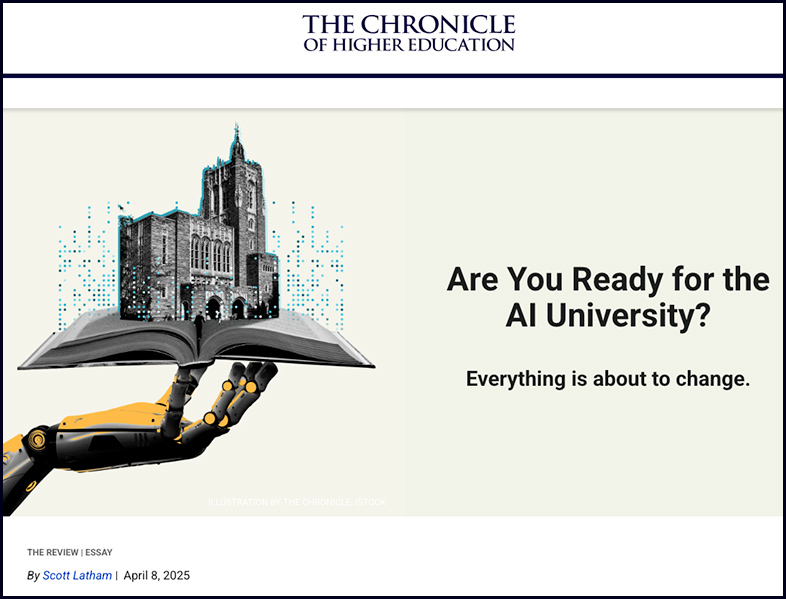
Reflections on “Are You Ready for the AI University? Everything is about to change.” [Latham]

.
Are You Ready for the AI University? Everything is about to change. — from chronicle.com by Scott Latham

Over the course of the next 10 years, AI-powered institutions will rise in the rankings. US News & World Report will factor a college’s AI capabilities into its calculations. Accrediting agencies will assess the degree of AI integration into pedagogy, research, and student life. Corporations will want to partner with universities that have demonstrated AI prowess. In short, we will see the emergence of the AI haves and have-nots.

What’s happening in higher education today has a name: creative destruction. The economist Joseph Schumpeter coined the term in 1942 to describe how innovation can transform industries. That typically happens when an industry has both a dysfunctional cost structure and a declining value proposition. Both are true of higher education.

Out of the gate, professors will work with technologists to get AI up to speed on specific disciplines and pedagogy. For example, AI could be “fed” course material on Greek history or finance and then, guided by human professors as they sort through the material, help AI understand the structure of the discipline, and then develop lectures, videos, supporting documentation, and assessments.

In the near future, if a student misses class, they will be able watch a recording that an AI bot captured. Or the AI bot will find a similar lecture from another professor at another accredited university. If you need tutoring, an AI bot will be ready to help any time, day or night. Similarly, if you are going on a trip and wish to take an exam on the plane, a student will be able to log on and complete the AI-designed and administered exam. Students will no longer be bound by a rigid class schedule. Instead, they will set the schedule that works for them.

Early and mid-career professors who hope to survive will need to adapt and learn how to work with AI. They will need to immerse themselves in research on AI and pedagogy and understand its effect on the classroom. 

From DSC:
I had a very difficult time deciding which excerpts to include. There were so many more excerpts for us to think about with this solid article. While I don’t agree with several things in it, EVERY professor, president, dean, and administrator working within higher education today needs to read this article and seriously consider what Scott Latham is saying.

Change is already here, but according to Scott, we haven’t seen anything yet. I agree with him and, as a futurist, one has to consider the potential scenarios that Scott lays out for AI’s creative destruction of what higher education may look like. Scott asserts that some significant and upcoming impacts will be experienced by faculty members, doctoral students, and graduate/teaching assistants (and Teaching & Learning Centers and IT Departments, I would add). But he doesn’t stop there. He brings in presidents, deans, and other members of the leadership teams out there.

There are a few places where Scott and I differ.

  • The foremost one is the importance of the human element — i.e., the human faculty member and students’ learning preferences. I think many (most?) students and lifelong learners will want to learn from a human being. IBM abandoned their 5-year, $100M ed push last year and one of the key conclusions was that people want to learn from — and with — other people:

To be sure, AI can do sophisticated things such as generating quizzes from a class reading and editing student writing. But the idea that a machine or a chatbot can actually teach as a human can, he said, represents “a profound misunderstanding of what AI is actually capable of.” 

Nitta, who still holds deep respect for the Watson lab, admits, “We missed something important. At the heart of education, at the heart of any learning, is engagement. And that’s kind of the Holy Grail.”

— Satya Nitta, a longtime computer researcher at
IBM’s Watson
Research Center in Yorktown Heights, NY
.

By the way, it isn’t easy for me to write this. As I wanted AI and other related technologies to be able to do just what IBM was hoping that it would be able to do.

  • Also, I would use the term learning preferences where Scott uses the term learning styles.

Scott also mentions:

“In addition, faculty members will need to become technologists as much as scholars. They will need to train AI in how to help them build lectures, assessments, and fine-tune their classroom materials. Further training will be needed when AI first delivers a course.”

It has been my experience from working with faculty members for over 20 years that not all faculty members want to become technologists. They may not have the time, interest, and/or aptitude to become one (and vice versa for technologists who likely won’t become faculty members).

That all said, Scott relays many things that I have reflected upon and relayed for years now via this Learning Ecosystems blog and also via The Learning from the Living [AI-Based Class] Room vision — the use of AI to offer personalized and job-relevant learning, the rising costs of higher education, the development of new learning-related offerings and credentials at far less expensive prices, the need to provide new business models and emerging technologies that are devoted more to lifelong learning, plus several other things.

So this article is definitely worth your time to read, especially if you are working in higher education or are considering a career therein!


Addendum later on 4/10/25:

U-M’s Ross School of Business, Google Public Sector launch virtual teaching assistant pilot program — from news.umich.edu by Jeff Karoub; via Paul Fain

Google Public Sector and the University of Michigan’s Ross School of Business have launched an advanced Virtual Teaching Assistant pilot program aimed at improving personalized learning and enlightening educators on artificial intelligence in the classroom.

The AI technology, aided by Google’s Gemini chatbot, provides students with all-hours access to support and self-directed learning. The Virtual TA represents the next generation of educational chatbots, serving as a sophisticated AI learning assistant that instructors can use to modify their specific lessons and teaching styles.

The Virtual TA facilitates self-paced learning for students, provides on-demand explanations of complex course concepts, guides them through problem-solving, and acts as a practice partner. It’s designed to foster critical thinking by never giving away answers, ensuring students actively work toward solutions.


From DSC:
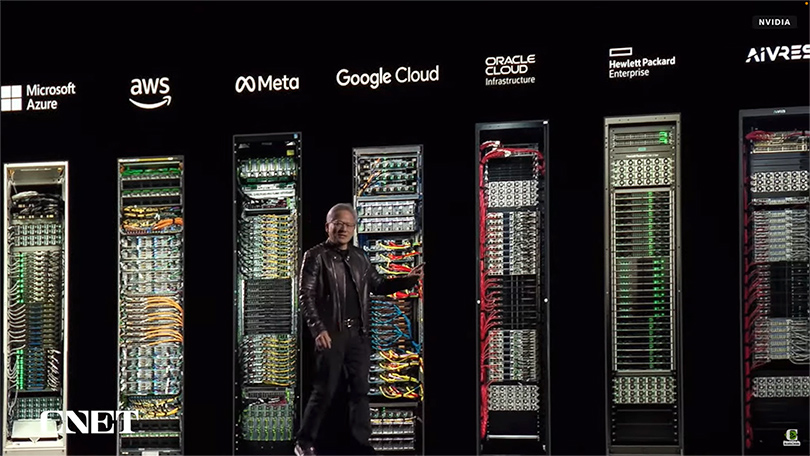
Look out Google, Amazon, and others! Nvidia is putting the pedal to the metal in terms of being innovative and visionary! They are leaving the likes of Apple in the dust.

The top talent out there is likely to go to Nvidia for a while. Engineers, programmers/software architects, network architects, product designers, data specialists, AI researchers, developers of robotics and autonomous vehicles, R&D specialists, computer vision specialists, natural language processing experts, and many more types of positions will be flocking to Nvidia to work for a company that has already changed the world and will likely continue to do so for years to come. 


NVIDIA’s AI Superbowl — from theneurondaily.com by Noah and Grant
PLUS: Prompt tips to make AI writing more natural

That’s despite a flood of new announcements (here’s a 16 min video recap), which included:

  1. A new architecture for massive AI data centers (now called “AI factories”).
  2. A physics engine for robot training built with Disney and DeepMind.
  3. partnership with GM to develop next-gen vehicles, factories and robots.
  4. A new Blackwell chip with “Dynamo” software that makes AI reasoning 40x faster than previous generations.
  5. A new “Rubin” chip slated for 2026 and a “Feynman” chip set for 2028.

For enterprises, NVIDIA unveiled DGX Spark and DGX Station—Jensen’s vision of AI-era computing, bringing NVIDIA’s powerful Blackwell chip directly to your desk.


Nvidia Bets Big on Synthetic Data — from wired.com by Lauren Goode
Nvidia has acquired synthetic data startup Gretel to bolster the AI training data used by the chip maker’s customers and developers.


Nvidia, xAI to Join BlackRock and Microsoft’s $30 Billion AI Infrastructure Fund — from investopedia.com by Aaron McDade
Nvidia and xAI are joining BlackRock and Microsoft in an AI infrastructure group seeking $30 billion in funding. The group was first announced in September as BlackRock and Microsoft sought to fund new data centers to power AI products.


Nvidia CEO Jensen Huang says we’ll soon see 1 million GPU data centers visible from space — from finance.yahoo.com by Daniel Howley
Nvidia CEO Jensen Huang says the company is preparing for 1 million GPU data centers.


Nvidia stock stems losses as GTC leaves Wall Street analysts ‘comfortable with long term AI demand’ — from finance.yahoo.com by Laura Bratton
Nvidia stock reversed direction after a two-day slide that saw shares lose 5% as the AI chipmaker’s annual GTC event failed to excite investors amid a broader market downturn.


Microsoft, Google, and Oracle Deepen Nvidia Partnerships. This Stock Got the Biggest GTC Boost. — from barrons.com by Adam Clark and Elsa Ohlen


The 4 Big Surprises from Nvidia’s ‘Super Bowl of AI’ GTC Keynote — from barrons.com by Tae Kim; behind a paywall

AI Super Bowl. Hi everyone. This week, 20,000 engineers, scientists, industry executives, and yours truly descended upon San Jose, Calif. for Nvidia’s annual GTC developers’ conference, which has been dubbed the “Super Bowl of AI.”


Who does need college anymore? About that book title … — from Education Design Lab

As you may know, Lab founder Kathleen deLaski just published a book with a provocative title: Who Needs College Anymore? Imagining a Future Where Degrees Won’t Matter.

Kathleen is asked about the title in every media interview, before and since the Feb. 25 book release. “It has generated a lot of questions,” she said in our recent book chat. “I tell people to focus on the word, ‘who.’ Who needs college anymore? That’s in keeping with the design thinking frame, where you look at the needs of individuals and what needs are not being met.”

In the same conversation, Kathleen reminded us that only 38% of American adults have a four-year degree. “We never talk about the path to the American dream for the rest of folks,” she said. “We currently are not supporting the other really interesting pathways to financial sustainability — apprenticeships, short-term credentials. And that’s really why I wrote the book, to push the conversation around the 62% of who we call New Majority Learners at the Lab, the people for whom college was not designed.” Watch the full clip

She distills the point into one sentence in this SmartBrief essay:  “The new paradigm is a ‘yes and’ paradigm that embraces college and/or other pathways instead of college or bust.”

What can colleges do moving forward?
In this excellent Q&A with Inside Higher Ed, Kathleen shares her No. 1 suggestion: “College needs to be designed as a stepladder approach, where people can come in and out of it as they need, and at the very least, they can build earnings power along the way to help afford a degree program.”

In her Hechinger Report essay, Kathleen lists four more steps colleges can take to meet the demand for more choices, including “affordability must rule.”

From white-collar apprenticeships and micro-credential programs at local community colleges to online bootcamps, self-instruction using YouTube, and more—students are forging alternative paths to GREAT high-paying jobs. (source)


6 Characteristics of an Education that Students Want — from gettingsmart.com by IDEA (School of Industrial Design, Engineering and Arts) Students in Tacoma Washington

As current high school students, we want:

  1. Education for the Real World
  2. Personalized and Flexible Education
  3. Cultivating Agency
  4. Creativity and Divergent Thinking
  5. Joyful Learning and Community Building
  6. Empathy and Emotional Growth

Also from gettingsmart.com

Diving into the Evidence: Virtual and Hybrid Models as High-Quality School Choice Options

Key Points

  • The Learning Accelerator is building an evidence base of what high-quality virtual and hybrid learning looks like and how it can be a catalyst for expanding access to powerful learning opportunities.
  • An analysis of 64 high-quality models revealed that virtual and hybrid learning occurs in various contexts, from state-based, fully-virtual programs to individual, hybrid schools and meets the needs of different student populations, including those underserved or disengaged by traditional education systems as well as looking for increased flexibility and course access.
 

AI in K12: Today’s Breakthroughs and Tomorrow’s Possibilities (webinar)
How AI is Transforming Classrooms Today and What’s Next


Audio-Based Learning 4.0 — from drphilippahardman.substack.com by Dr. Philippa Hardman
A new & powerful way to leverage AI for learning?

At the end of all of this my reflection is that the research paints a pretty exciting picture – audio-based learning isn’t just effective, it’s got some unique superpowers when it comes to boosting comprehension, ramping up engagement, and delivering feedback that really connects with learners.

While audio has been massively under-used as a mode of learning, especially compared to video and text, we’re at an interesting turning point where AI tools are making it easier than ever to tap into audio’s potential as a pedagogical tool.

What’s super interesting is how the solid research backing audio’s effectiveness is and how well this is converging with these new AI capabilities.

From DSC:
I’ve noticed that I don’t learn as well via audio-only based events. It can help if visuals are also provided, but I have to watch the cognitive loads. My processing can start to get overloaded — to the point that I have to close my eyes and just listen sometimes. But there are people I know who love to listen to audiobooks and prefer to learn that way. They can devour content and process/remember it all. Audio is a nice change of pace at times, but I prefer visuals and reading often times. It needs to be absolutely quiet if I’m tackling some new information/learning. 


In Conversation With… Ashton Cousineau — from drphilippahardman.substack.com by Dr. Philippa Hardman
A new video series exploring how L&D professionals are working with AI on the ground

In Conversation With… Ashton Cousineau by Dr Philippa Hardman

A new video series exploring how L&D professionals are working with AI on the ground

Read on Substack


The Learning Research Digest vol. 28 — from learningsciencedigest.substack.com by Dr. Philippa Hardman

Hot Off the Research Press This Month:

  • AI-Infused Learning Design – A structured approach to AI-enhanced assignments using a three-step model for AI integration.
  • Mathematical Dance and Creativity in STEAM – Using AI-powered motion capture to translate dance movements into mathematical models.
  • AI-Generated Instructional Videos – How adaptive AI-powered video learning enhances problem-solving and knowledge retention.
  • Immersive Language Learning with XR & AI – A new framework for integrating AI-driven conversational agents with Extended Reality (XR) for task-based language learning.
  • Decision-Making in Learning Design – A scoping review on how instructional designers navigate complex instructional choices and make data-driven decisions.
  • Interactive E-Books and Engagement – Examining the impact of interactive digital books on student motivation, comprehension, and cognitive engagement.
  • Elevating Practitioner Voices in Instructional Design – A new initiative to amplify instructional designers’ contributions to research and innovation.

Deep Reasoning, Agentic AI & the Continued Rise of Specialised AI Research & Tools for Education — from learningfuturesdigest.substack.com by Dr. Philippa Hardman

Here’s a quick teaser of key developments in the world of AI & learning this month:

  • DeepSeek R-1, OpenAI’s Deep Seek & Perplexity’s ‘Deep Research’ are the latest additions to a growing number of “reasoning models” with interesting implications for evidence-based learning design & development.
  • The U.S. Education Dept release an AI Toolkit and a fresh policy roadmap enabling the adoption of AI use in schools.
  • Anthropic Release “Agentic Claude”, another AI agent that clicks, scrolls, and can even successfully complete e-learning courses…
  • Oxford University Announce the AIEOU Hub, a research-backed research lab to support research and implementation on AI in education.
  • “AI Agents Everywhere”: A Forbes peek at how agentic AI will handle the “boring bits” of classroom life.
  • [Bias klaxon!] Epiphany AI: My own research leads to the creation of a specialised, “pedagogy first” AI co-pilot for instructional design marking the continued growth of specialised AI tools designed for specific industries and workflows.

AI is the Perfect Teaching Assistant for Any Educator — from unite.ai by Navi Azaria, CPO at Kaltura

Through my work with leading educational institutions at Kaltura, I’ve seen firsthand how AI agents are rapidly becoming indispensable. These agents alleviate the mounting burdens on educators and provide new generations of tech-savvy students with accessible, personalized learning, giving teachers the support they need to give their students the personalized attention and engagement they deserve.


Learning HQ — from ai-disruptor-hq.notion.site

This HQ includes all of my AI guides, organized by tool/platform. This list is updated each time a new one is released, and outdated guides are removed/replaced over time.


How AI Is Reshaping Teachers’ Jobs — from edweek.org

Artificial intelligence is poised to fundamentally change the job of teaching. AI-powered tools can shave hours off the amount of time teachers spend grading, lesson-planning, and creating materials. AI can also enrich the lessons they deliver in the classroom and help them meet the varied needs of all students. And it can even help bolster teachers’ own professional growth and development.

Despite all the promise of AI, though, experts still urge caution as the technology continues to evolve. Ethical questions and practical concerns are bubbling to the surface, and not all teachers feel prepared to effectively and safely use AI.

In this special report, see how early-adopter teachers are using AI tools to transform their daily work, tackle some of the roadblocks to expanded use of the technology, and understand what’s on the horizon for the teaching profession in the age of artificial intelligence.


A Community College’s Guide to Building Strong Partnerships — from eddesignlab.org

This November 2024 guidebook offers higher education practitioners actionable strategies for building and sustaining partnerships that both meet regional needs and support students, families, and communities. This work was based on the design and delivery of dual enrollment pathways as part of the Lab’s Designers in Residence 2.0: Accelerating Pathways project.

The practices and case studies shared here are informed by higher education leaders across six community colleges as part of the Lab’s Designers in Residence program.

We have organized the guidebook based on core elements of a strong partnerships strategy, alongside how to establish a strong foundation and sustain and maintain the partnerships you’ve built. Through our research, we’ve identified four key elements of strong partnerships:

+ Communication and collaboration
+ Shared vision
+ Adaptive and responsive
+ Action-oriented

You will find guiding questions, tools, and case studies within each of the four elements.
.


Also from The Education Design Lab:


The Rise of the Heretical Leader — from ditchthattextbook.com; a guest post by Dan Fitzpatrick

Now is the time for visionary leadership in education. The era of artificial intelligence is reshaping the demands on education systems. Rigid policies, outdated curricula, and reliance on obsolete metrics are failing students. A recent survey from Resume Genius found that graduates lack skills in communication, collaboration, and critical thinking. Consequently, there is a growing trend in companies hiring candidates based on skills instead of traditional education or work experience. This underscores the urgent need for educational leaders to prioritize adaptability and innovation in their systems. Educational leaders must embrace a transformative approach to keep pace.

[Heretical leaders] bring courage, empathy, and strategic thinking to reimagine education’s potential. Here are their defining characteristics:

  • Visionary Thinking: They identify bold, innovative paths to progress.
  • Courage to Act: These leaders take calculated risks to overcome resistance and inertia.
  • Relentless Curiosity: They challenge assumptions and seek better alternatives.
  • Empathy for Stakeholders: Understanding the personal impact of change allows them to lead with compassion.
  • Strategic Disruption: Their deliberate actions ensure systemic improvements.
    These qualities enable Heretical leaders to reframe challenges as opportunities and drive meaningful change.

From DSC:
Readers of this blog will recognize that I believe visionary leadership is extremely important — in all areas of our society, but especially within our learning ecosystems. Vision trumps data, at least in my mind. There are times when data can be used to support a vision, but having a powerful vision is more lasting and impactful than relying on data to drive the organization.

So while I’d vote for a different term other than “heretical leaders,” I get what Dan is saying and I agree with him. Such leaders are going against the grain. They are swimming upstream. They are espousing perspectives that others often don’t buy into (at least initially or for some time). 

Such were the leaders who introduced online learning into the K-16 educational systems back in the late ’90s and into the next two+ decades. The growth of online-based learning continues and has helped educate millions of people. Those leaders and the people who worked for such endeavors were going against the grain.

We haven’t seen the end point of online-based learning. I think it will become even more powerful and impactful when AI is used to determine which jobs are opening up, and which skills are needed for those jobs, and then provide a listing of sources of where one can obtain that knowledge and develop those skills. People will be key in this vision. But so will AI and personalized learning. It will be a collaborative effort.

By the way, I am NOT advocating for using AI to outsource our thinking. Also, having basic facts and background knowledge in a domain is critically important, especially to use AI effectively. But we should be teaching students about AI (as we learn more about it ourselves). We should be working collaboratively with our students to understand how best to use AI. It’s their futures at stake.


AI educators are coming to this school – and it’s part of a trend — from techradar.com by Eric Hal Schwartz
Two hours of lessons, zero teachers

  • An Arizona charter school will use AI instead of human teachers for two hours a day on academic lessons.
  • The AI will customize lessons in real-time to match each student’s needs.
  • The company has only tested this idea at private schools before but claims it hugely increases student academic success.

One school in Arizona is trying out a new educational model built around AI and a two-hour school day. When Arizona’s Unbound Academy opens, the only teachers will be artificial intelligence algorithms in a perfect utopia or dystopia, depending on your point of view.


AI in Instructional Design: reflections on 2024 & predictions for 2025 — from drphilippahardman.substack.com by Dr. Philippa Hardman
Aka, four new year’s resolutions for the AI-savvy instructional designer.


Debating About AI: A Free Comprehensive Guide to the Issues — from stefanbauschard.substack.com by Stefan Bauschard

In order to encourage and facilitate debate on key controversies related to AI, I put together this free 130+ page guide to the main arguments and ideas related to the controversies.


Universities need to step up their AGI game — from futureofbeinghuman.com by Andrew Maynard
As Sam Altman and others push toward a future where AI changes everything, universities need to decide if they’re going to be leaders or bystanders in helping society navigate advanced AI transitions

And because of this, I think there’s a unique opportunity for universities (research universities in particular) to up their game and play a leadership role in navigating the coming advanced AI transition.

Of course, there are already a number of respected university-based initiatives that are working on parts of the challenge. Stanford HAI (Human-centered Artificial Intelligence) is one that stands out, as does the Leverhulm Center for the Future of Intelligence at the University of Cambridge, and the Center for Governance of AI at the University of Oxford. But these and other initiatives are barely scratching the surface of what is needed to help successfully navigate advanced AI transitions.

If universities are to be leaders rather than bystanders in ensuring human flourishing in an age of AI, there’s an urgent need for bolder and more creative forward-looking initiatives that support research, teaching, thought leadership, and knowledge mobilization, at the intersection of advanced AI and all aspects of what it means to thrive and grow as a species.


How AI Is Changing Education: The Year’s Top 5 Stories — from edweek.org by Alyson Klein

Ever since a new revolutionary version of chat ChatGPT became operable in late 2022, educators have faced several complex challenges as they learn how to navigate artificial intelligence systems.

Education Week produced a significant amount of coverage in 2024 exploring these and other critical questions involving the understanding and use of AI.

Here are the five most popular stories that Education Week published in 2024 about AI in schools.


What’s next with AI in higher education? — from msn.com by Science X Staff

Dr. Lodge said there are five key areas the higher education sector needs to address to adapt to the use of AI:

1. Teach ‘people’ skills as well as tech skills
2. Help all students use new tech
3. Prepare students for the jobs of the future
4. Learn to make sense of complex information
5. Universities to lead the tech change


5 Ways Teachers Can Use NotebookLM Today — from classtechtips.com by Dr. Monica Burns

 
© 2025 | Daniel Christian