The 2025 Changing Landscape of Online Education (CHLOE) 10 Report — from qualitymatters.org; emphasis below from DSC

Notable findings from the 73-page report include: 

  • Online Interest Surges Across Student Populations: 
  • Institutional Preparedness Falters Amid Rising Demand: Despite accelerating demand, institutional readiness has stagnated—or regressed—in key areas.
  • The Online Education Marketplace Is Increasingly Competitive: …
  • Alternative Credentials Take Center Stage: …
  • AI Integration Lacks Strategic Coordination: …

Just 28% of faculty are considered fully prepared for online course design, and 45% for teaching. Alarmingly, only 28% of institutions report having fully developed academic continuity plans for future emergency pivots to online.


Also relevant, see:


Great Expectations, Fragile Foundations — from onedtech.philhillaa.com by Glenda Morgan
Lessons about growth from the CHLOE & BOnES reports

Cultural resistance remains strong. Many [Chief Online Learning Officers] COLOs say faculty and deans still believe in-person learning is “just better,” creating headwinds even for modest online growth. As one respondent at a four-year institution with a large online presence put it:

Supportive departments [that] see the value in online may have very different levels of responsiveness compared to academic departments [that] are begrudgingly online. There is definitely a growing belief that students “should” be on-ground and are only choosing online because it’s easy/ convenient. Never mind the very real and growing population of nontraditional learners who can only take online classes, and the very real and growing population of traditional-aged learners who prefer online classes; many faculty/deans take a paternalistic, “we know what’s best” approach.


Ultimately, what we need is not just more ambition but better ambition. Ambition rooted in a realistic understanding of institutional capacity, a shared strategic vision, investments in policy and infrastructure, and a culture that supports online learning as a core part of the academic mission, not an auxiliary one. It’s time we talked about what it really takes to grow online learning , and where ambition needs to be matched by structure.

From DSC:
Yup. Culture is at the breakfast table again…boy, those strategies taste good.

I’d like to take some of this report — like the graphic below — and share it with former faculty members and members of a couple of my past job families’ leadership. They strongly didn’t agree with us when we tried to advocate for the development of online-based learning/programs at our organizations…but we were right. We were right all along. And we were LEADING all along. No doubt about it — even if the leadership at the time said that we weren’t leading.

The cultures of those organizations hurt us at the time. But our cultivating work eventually led to the development of online programs — unfortunately, after our groups were disbanded, they had to outsource those programs to OPMs.


Arizona State University — with its dramatic growth in online-based enrollments.


The future of L&D is here, and it’s powered by AI. — from linkedin.com by Josh Cavalier


4 Ways I Use AI to Think Better — from wondertools.substack.com by Jeremy Caplan
How AI helps me learn, decide, and create

Learn something new.
Map out a personalized curriculum

Try this: Give an AI assistant context about what you want to learn, why, and how.

  • Detail your rationale and motivation, which may impact your approach.
  • Note your current knowledge or skill level, ideally with examples.

Summarize your learning preferences

  • Note whether you prefer to read, listen to, or watch learning materials.
  • Mention if you like quizzes, drills, or exercises you can do while commuting or during a break at work.
  • If you appreciate learning games, task your AI assistant with generating one for you, using its coding capabilities detailed below.
  • Ask for specific book, textbook, article, or learning path recommendations using the Web search or Deep Research capabilities of PerplexityChatGPT, Gemini or Claude. They can also summarize research literature about effective learning tactics.
  • If you need a human learning partner, ask for guidance on finding one or language you can use in reaching out.

The Ends of Tests: Possibilities for Transformative Assessment and Learning with Generative AI


GPT-5 for Instructional Designers — from drphilippahardman.substack.com by Dr Philippa Hardman
10 Hacks to Work Smarter & Safer with OpenAI’s Latest Model

The TLDR is that as Instructional Designers, we can’t afford to miss some of the very real benefits of GPT-5’s potential, but we also can’t ensure our professional standards or learner outcomes if we blindly accept its outputs without due testing and validation.

For this reason, I decided to synthesise the latest GPT-5 research—from OpenAI’s technical documentation to independent security audits to real-world user testing—into 10 essential reality checks for using GPT-5 as an Instructional Designer.

These aren’t theoretical exercises; they’re practical tests designed to help you safely unlock GPT-5’s benefits while identifying and mitigating its most well-documented limitations.


Grammarly launches new specialist AI agents providing personalized assistance for students — from edtechinnovationhub.com by Rachel Lawler
Grammarly, an AI communication tool, has announced the launch of eight new specialized AI agents. The new assistants can support specific writing challenges such as finding credible sources and checking originality. 

Students will now be offered “responsible AI support” through Grammarly, with the eight new agents:

  • Reader Reactions agent …
  • AI Grader agent …
  • Citation Finder agent …
  • Expert Review agent …
  • Proofreader agent …
  • AI Detector agent …
  • Plagiarism Checker agent …
  • Paraphraser agent …


Why Perplexity AI Is My Go-To Research Tool as a Higher Education CIO — from mikekentz.substack.com; a guest post from Michael Lyons, CIO at MassBay Community College

While I regularly use tools like ChatGPT, Grammarly, Microsoft Copilot, and even YouTube Premium (I would cancel Netflix before this), Perplexity has earned a top spot in my toolkit. It blends AI and real-time web search into one seamless, research-driven platform that saves time and improves the quality of information I rely on every day.


These ChatGPT Prompts Will Fast-Track Your Job Search — from builtin.com by Jeff Rumage
Used correctly, ChatGPT could help you land your dream job — but used incorrectly, it can cost you the offer. Here’s how you can make ChatGPT your secret weapon for research help, resume writing, interview prep and more.

Example prompt: Here are several bullet points from my resume: [paste bullets]. Rewrite them so each one begins with a strong action verb, clearly states what I did, and quantifies results or outcomes wherever possible. If metrics are missing, suggest realistic ways they could be added.

Example prompt: Here is my resume [paste resume]. Here’s the job description of a job I’m applying for [paste job description]. Highlight the most important skills and qualifications for this job. Without making up information, revise my resume to match these requirements. Include action verbs for each accomplishment on the resume, and highlight which accomplishments could be quantified.

Example prompt: What are the current trends impacting companies in the [industry]? How would [company name] be affected by these trends, and what might it do to adjust to/capitalize on these trends?

Example prompt: I’m a [current role] but want to become a [dream role]. Create a detailed career development plan outlining:

      • Skills I should develop
      • Relevant experiences I need to gain
      • Educational or certification needs
      • Recommended resources or programs
      • A realistic timeline with milestones for the next 1-3 years.
 

Bringing the best of AI to college students for free — from blog.google by Sundar Pichai

Millions of college students around the world are getting ready to start classes. To help make the school year even better, we’re making our most advanced AI tools available to them for free, including our new Guided Learning mode. We’re also providing $1 billion to support AI education and job training programs and research in the U.S. This includes making our AI and career training free for every college student in America through our AI for Education Accelerator — over 100 colleges and universities have already signed up.

Guided Learning: from answers to understanding
AI can broaden knowledge and expand access to it in powerful ways, helping anyone, anywhere learn anything in the way that works best for them. It’s not about just getting an answer, but deepening understanding and building critical thinking skills along the way. That opportunity is why we built Guided Learning, a new mode in Gemini that acts as a learning companion guiding you with questions and step-by-step support instead of just giving you the answer. We worked closely with students, educators, researchers and learning experts to make sure it’s helpful for understanding new concepts and is backed by learning science.


BREAKING: Google introduces Guided Learning — from aieducation.substack.com by Claire Zau
Some thoughts on what could make Google’s AI tutor stand out

Another major AI lab just launched “education mode.”

Google introduced Guided Learning in Gemini, transforming it into a personalized learning companion designed to help you move from quick answers to real understanding.

Instead of immediately spitting out solutions, it:

  • Asks probing, open-ended questions
  • Walks learners through step-by-step reasoning
  • Adapts explanations to the learner’s level
  • Uses visuals, videos, diagrams, and quizzes to reinforce concepts

This Socratic style tutor rollout follows closely behind similar announcements like OpenAI’s Study Mode (last week) and Anthropic’s Claude for Education (April 2025).


How Sci-Fi Taught Me to Embrace AI in My Classroom — from edsurge.com by Dan Clark

I’m not too naive to understand that, no matter how we present it, some students will always be tempted by “the dark side” of AI. What I also believe is that the future of AI in education is not decided. It will be decided by how we, as educators, embrace or demonize it in our classrooms.

My argument is that setting guidelines and talking to our students honestly about the pitfalls and amazing benefits that AI offers us as researchers and learners will define it for the coming generations.

Can AI be the next calculator? Something that, yes, changes the way we teach and learn, but not necessarily for the worse? If we want it to be, yes.

How it is used, and more importantly, how AI is perceived by our students, can be influenced by educators. We have to first learn how AI can be used as a force for good. If we continue to let the dominant voice be that AI is the Terminator of education and critical thinking, then that will be the fate we have made for ourselves.


AI Tools for Strategy and Research – GT #32 — from goodtools.substack.com by Robin Good
Getting expert advice, how to do deep research with AI, prompt strategy, comparing different AIs side-by-side, creating mini-apps and an AI Agent that can critically analyze any social media channel

In this issue, discover AI tools for:

  • Getting Expert Advice
  • Doing Deep Research with AI
  • Improving Your AI Prompt Strategy
  • Comparing Results from Different AIs
  • Creating an AI Agent for Social Media Analysis
  • Summarizing YouTube Videos
  • Creating Mini-Apps with AI
  • Tasting an Award-Winning AI Short Film

GPT-Building, Agentic Workflow Design & Intelligent Content Curation — from drphilippahardman.substack.com by Dr. Philippa Hardman
What 3 recent job ads reveal about the changing nature of Instructional Design

In this week’s blog post, I’ll share my take on how the instructional design role is evolving and discuss what this means for our day-to-day work and the key skills it requires.

With this in mind, I’ve been keeping a close eye on open instructional design roles and, in the last 3 months, have noticed the emergence of a new flavour of instructional designer: the so-called “Generative AI Instructional Designer.”

Let’s deep dive into three explicitly AI-focused instructional design positions that have popped up in the last quarter. Each one illuminates a different aspect of how the role is changing—and together, they paint a picture of where our profession is likely heading.

Designers who evolve into prompt engineers, agent builders, and strategic AI advisors will capture the new premium. Those who cling to traditional tool-centric roles may find themselves increasingly sidelined—or automated out of relevance.


Google to Spend $1B on AI Training in Higher Ed — from insidehighered.com by Katherine Knott

Google’s parent company announced Wednesday (8/6/25) that it’s planning to spend $1 billion over the next three years to help colleges teach and train students about artificial intelligence.

Google is joining other AI companies, including OpenAI and Anthropic, in investing in AI training in higher education. All three companies have rolled out new tools aimed at supporting “deeper learning” among students and made their AI platforms available to certain students for free.


5 Predictions for How AI Will Impact Community Colleges — from pistis4edu.substack.com by Feng Hou

Based on current technology capabilities, adoption patterns, and the mission of community colleges, here are five well-supported predictions for AI’s impact in the coming years.

  1. Universal AI Tutor Access
  2. AI as Active Teacher
  3. Personalized Learning Pathways
  4. Interactive Multimodal Learning
  5. Value-Centric Education in an AI-Abundant World


BREAKING: OpenAI Releases Study Mode — from aieducation.substack.com by Claire Zau
What’s New, What Works, and What’s Still Missing

What is Study Mode?
Study Mode is OpenAI’s take on a smarter study partner – a version of the ChatGPT experience designed to guide users through problems with Socratic prompts, scaffolded reasoning, and adaptive feedback (instead of just handing over the answer).

Built with input from learning scientists, pedagogy experts, and educators, it was also shaped by direct feedback from college students. While Study Mode is designed with college students in mind, it’s meant for anyone who wants a more learning-focused, hands-on experience across a wide range of subjects and skill levels.

Who can access it? And how?
Starting July 29, Study Mode is available to users on Free, Plus, Pro, and Team plans. It will roll out to ChatGPT Edu users in the coming weeks.


ChatGPT became your tutor — from theneurondaily.com by Grant Harvey
PLUS: NotebookLM has video now & GPT 4o-level AI runs on laptop

Here’s how it works: instead of asking “What’s 2+2?” and getting “4,” study mode asks questions like “What do you think happens when you add these numbers?” and “Can you walk me through your thinking?” It’s like having a patient tutor who won’t let you off the hook that easily.

The key features include:

  • Socratic questioning: It guides you with hints and follow-up questions rather than direct answers.
  • Scaffolded responses: Information broken into digestible chunks that build on each other.
  • Personalized support: Adjusts difficulty based on your skill level and previous conversations.
  • Knowledge checks: Built-in quizzes and feedback to make sure concepts actually stick.
  • Toggle flexibility: Switch study mode on and off mid-conversation depending on your goals.

Try study mode yourself by selecting “Study and learn” from tools in ChatGPT and asking a question.


Introducing study mode — from openai.com
A new way to learn in ChatGPT that offers step by step guidance instead of quick answers.

[On 7/29/25, we introduced] study mode in ChatGPT—a learning experience that helps you work through problems step by step instead of just getting an answer. Starting today, it’s available to logged in users on Free, Plus, Pro, Team, with availability in ChatGPT Edu coming in the next few weeks.

ChatGPT is becoming one of the most widely used learning tools in the world. Students turn to it to work through challenging homework problems, prepare for exams, and explore new concepts. But its use in education has also raised an important question: how do we ensure it is used to support real learning, and doesn’t just offer solutions without helping students make sense of them?

We’ve built study mode to help answer this question. When students engage with study mode, they’re met with guiding questions that calibrate responses to their objective and skill level to help them build deeper understanding. Study mode is designed to be engaging and interactive, and to help students learn something—not just finish something.


From DSC:
In looking at
 
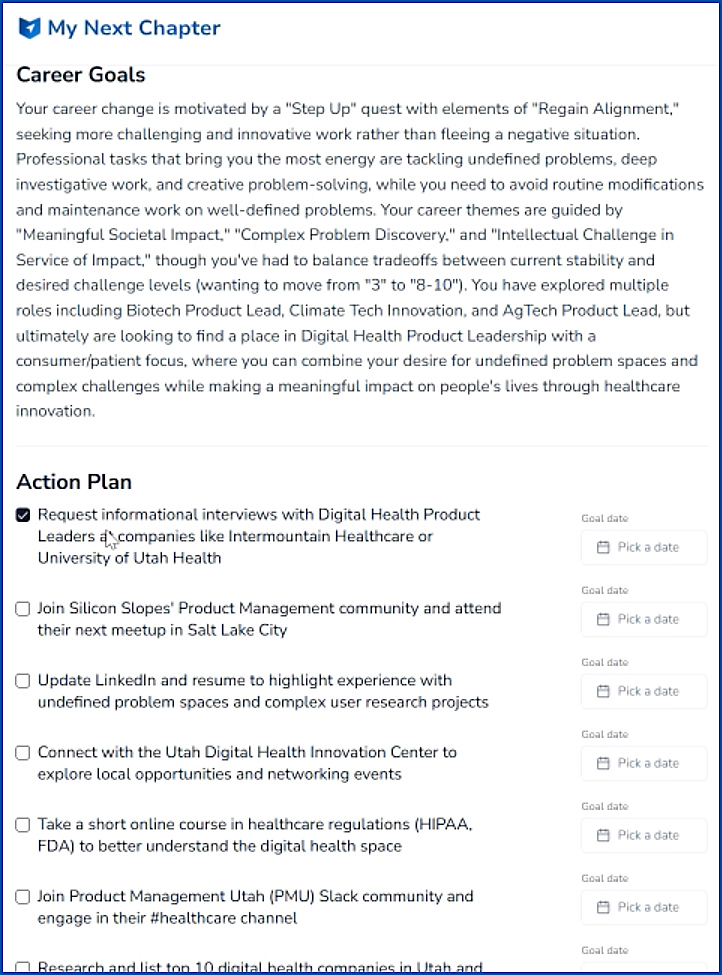
MyNextChapter.ai — THIS TYPE OF FUNCTIONALITY of an AI-based chatbot talking to you re: good fits for a future job — is the kind of thing that could work well in this type of vision/learning platform. The AI asks you relevant career-oriented questions, comes up with some potential job fits, and then gives you resources about how to gain those skills, who to talk with, organizations to join, next steps to get your foot in the door somewhere, etc.

The next gen learning platform would provide links to online-based courses, blogs, peoples’ names on LinkedIn, courses from L&D organizations or from institutions of higher education or from other entities/places to obtain those skills (similar to the ” Action Plan” below from MyNextChapter.ai).


AI is rewiring how we learn, and it’s a game-changer for L&D— from chieflearningofficer.com by Josh Bersin
As AI becomes central to learner engagement, L&D leaders are being urged to fundamentally rethink corporate training, says global industry analyst Josh Bersin.

What are people really doing with ChatGPT? They’re learning. They’re asking questions, getting immediate answers, digging deeper, analyzing information and ultimately making themselves more productive. So, one could argue that simply by shifting to a “learn by inquiry” model, we may triple our value to the business.

From my experience, there are two main learning models in this industry. The first is “what you need to know”—linear or prescriptive things that every employee needs to understand about the company, its products and their role. This kind of content is well handled by existing L&D models.

The second, and far more important, is “what you’d like to know”—questions, curiosities and explorations about how the company works, what customers truly need and how we can each go further in our careers. Thanks to AI, this kind of learning is now explosive and transformative.

Imagine a sales rep who loses a deal. Naturally, they may ask, “What could I have done to be more successful?” A well-designed AI-powered learning system would take that question, give the employee an initial answer and chat with the individual to dig into the problem.

The system would then surface relevant sales training material and recommend videos, tips or case studies for help. And the employee, assuming they like the experience, would likely keep exploring until they feel they’ve learned what they need.

This “curiosity-based” learning is now possible, and its benefits extend far beyond traditional training.


From DSC:
This one is for the youth out there. Learn these lessons NOW, before you go too much further in your journey here on Earth. If you do, you will reap the benefits of this learning for the rest of your days.

As I mentioned to our own kids when I forwarded this article to them:


My dad passed along a bit of wisdom to me when he told me what *his* dad (my Grandpa Christian) had told him:
“If a job is worth doing, it’s worth doing well.” 
I’ve always remembered that and I *try* to do quality work.
The following article is worth your time. It touches upon a similar idea:
.
You’re Always Building Your Own House— from sahilbloom.com by Sahil Bloom; with thanks to Roberto Ferraro for this resource
.
I pass it along to help us *try* to do quality things and work…but NOT to load up unrealistic expectations on ourselves or create a harried, perfectionistic lifestyle. 

Excerpt:

An old carpenter told his boss that he planned to retire. The boss was sad to lose the carpenter, but understood.

He asked if he’d stick around for one last job—to build one final house.

The carpenter reluctantly agreed, figuring he could get it done quickly. He cut corners, used cheap materials, and rushed through the work.

When the house was done, his boss arrived for the final inspection. But instead of walking the house, he reached into his pocket, and handed the carpenter the keys.

“This is your house,” his boss smiled, “My retirement gift to you.”

The carpenter was stunned. If he’d known he was building his own house, he would have done it differently. Now he’d have to live in a house he had built none too well.

The lesson: You’re always building your own house.


Adulting and Career Exploration — from the-job.beehiiv.com by Paul Fain
Junior Achievement helps high school grads learn life skills and gain work experience while figuring out what comes next.

Bridging the Gap Between School and Careers
Junior Achievement has stepped into the blur space between high school and what comes next. The nonprofit’s 5th Year program gives young adults a structured year to live on a college campus and explore careers, gain work experience, and build life skills.

An initial cohort of 24 students graduated this May from a trial run of the program based in Toledo, Ohio. Each participant held two internships—one in the fall and one in the spring. They also visited 60 employers across the metro area. Represented industries included law, engineering, construction, accounting, healthcare, higher education, and nonprofit organizations.

The program is focused on helping students find a clear path forward, by guiding them to match their interests and abilities with in-demand careers and local job opportunities.

“We’re giving them the space to just pause,” he says. “To discover, to explore, to grow personally, to grow socially.”


Agentic AI use cases in the legal industry — from legal.thomsonreuters.com
What legal professionals need to know now with the rise of agentic AI

While GenAI can create documents or answer questions, agentic AI takes intelligence a step further by planning how to get multi-step work done, including tasks such as consuming information, applying logic, crafting arguments, and then completing them.? This leaves legal teams more time for nuanced decision-making, creative strategy, and relationship-building with clients—work that machines can’t do.


The AI Legal Landscape in 2025: Beyond the Hype — from akerman.com by Melissa C. Koch

What we’re witnessing is a profession in transition where specific tasks are being augmented or automated while new skills and roles emerge.

The data tells an interesting story: approximately 79% of law firms have integrated AI tools into their workflows, yet only a fraction have truly transformed their operations. Most implementations focus on pattern recognition tasks such as document review, legal research, contract analysis. These implementations aren’t replacing lawyers; they’re redirecting attention to higher-value work.

This technological shift doesn’t happen in isolation. It’s occurring amid client pressure for efficiency, competition from alternative providers, and the expectations of a new generation of lawyers who have never known a world without AI assistance.


LexisNexis and Harvey team up to revolutionize legal research with artificial intelligence — from abajournal.com by Danielle Braff

Lawyers using the Harvey artificial intelligence platform will soon be able to tap into LexisNexis’ vast legal research capabilities.

Thanks to a new partnership announced Wednesday, Harvey users will be able to ask legal questions and receive fast, citation-backed answers powered by LexisNexis case law, statutes and Shepard’s Citations, streamlining everything from basic research to complex motions. According to a press release, generated responses to user queries will be grounded in LexisNexis’ proprietary knowledge graphs and citation tools—making them more trustworthy for use in court or client work.


10 Legal Tech Companies to Know — from builtin.com
These companies are using AI, automation and analytics to transform how legal work gets done.
.


Four months after a $3B valuation, Harvey AI grows to $5B — from techcrunch.com by Marina Temkin

Harvey AI, a startup that provides automation for legal work, has raised $300 million in Series E funding at a $5 billion valuation, the company told Fortune. The round was co-led by Kleiner Perkins and Coatue, with participation from existing investors, including Conviction, Elad Gil, OpenAI Startup Fund, and Sequoia.


The billable time revolution — from jordanfurlong.substack.com by Jordan Furlong
Gen AI will bring an end to the era when lawyers’ value hinged on performing billable work. Grab the coming opportunity to re-prioritize your daily activities and redefine your professional purpose.

Because of Generative AI, lawyers will perform fewer “billable” tasks in future; but why is that a bad thing? Why not devote that incoming “freed-up” time to operating, upgrading, and flourishing your law practice? Because this is what you do now: You run a legal business. You deliver good outcomes, good experiences, and good relationships to clients. Humans do some of the work and machines do some of the work and the distinction that matters is not billable/non-billable, it’s which type of work is best suited to which type of performer.


“Using AI Right Now: A Quick Guide” [Molnick] + other items re: AI in our learning ecosystems

Thoughts on thinking — from dcurt.is by Dustin Curtis

Intellectual rigor comes from the journey: the dead ends, the uncertainty, and the internal debate. Skip that, and you might still get the insight–but you’ll have lost the infrastructure for meaningful understanding. Learning by reading LLM output is cheap. Real exercise for your mind comes from building the output yourself.

The irony is that I now know more than I ever would have before AI. But I feel slightly dumber. A bit more dull. LLMs give me finished thoughts, polished and convincing, but none of the intellectual growth that comes from developing them myself. 


Using AI Right Now: A Quick Guide — from oneusefulthing.org by Ethan Mollick
Which AIs to use, and how to use them

Every few months I put together a guide on which AI system to use. Since I last wrote my guide, however, there has been a subtle but important shift in how the major AI products work. Increasingly, it isn’t about the best model, it is about the best overall system for most people. The good news is that picking an AI is easier than ever and you have three excellent choices. The challenge is that these systems are getting really complex to understand. I am going to try and help a bit with both.

First, the easy stuff.

Which AI to Use
For most people who want to use AI seriously, you should pick one of three systems: Claude from Anthropic, Google’s Gemini, and OpenAI’s ChatGPT.

Also see:


Student Voice, Socratic AI, and the Art of Weaving a Quote — from elmartinsen.substack.com by Eric Lars Martinsen
How a custom bot helps students turn source quotes into personal insight—and share it with others

This summer, I tried something new in my fully online, asynchronous college writing course. These classes have no Zoom sessions. No in-person check-ins. Just students, Canvas, and a lot of thoughtful design behind the scenes.

One activity I created was called QuoteWeaver—a PlayLab bot that helps students do more than just insert a quote into their writing.

Try it here

It’s a structured, reflective activity that mimics something closer to an in-person 1:1 conference or a small group quote workshop—but in an asynchronous format, available anytime. In other words, it’s using AI not to speed students up, but to slow them down.

The bot begins with a single quote that the student has found through their own research. From there, it acts like a patient writing coach, asking open-ended, Socratic questions such as:

What made this quote stand out to you?
How would you explain it in your own words?
What assumptions or values does the author seem to hold?
How does this quote deepen your understanding of your topic?
It doesn’t move on too quickly. In fact, it often rephrases and repeats, nudging the student to go a layer deeper.


The Disappearance of the Unclear Question — from jeppestricker.substack.com Jeppe Klitgaard Stricker
New Piece for UNESCO Education Futures

On [6/13/25], UNESCO published a piece I co-authored with Victoria Livingstone at Johns Hopkins University Press. It’s called The Disappearance of the Unclear Question, and it’s part of the ongoing UNESCO Education Futures series – an initiative I appreciate for its thoughtfulness and depth on questions of generative AI and the future of learning.

Our piece raises a small but important red flag. Generative AI is changing how students approach academic questions, and one unexpected side effect is that unclear questions – for centuries a trademark of deep thinking – may be beginning to disappear. Not because they lack value, but because they don’t always work well with generative AI. Quietly and unintentionally, students (and teachers) may find themselves gradually avoiding them altogether.

Of course, that would be a mistake.

We’re not arguing against using generative AI in education. Quite the opposite. But we do propose that higher education needs a two-phase mindset when working with this technology: one that recognizes what AI is good at, and one that insists on preserving the ambiguity and friction that learning actually requires to be successful.


Leveraging GenAI to Transform a Traditional Instructional Video into Engaging Short Video Lectures — from er.educause.edu by Hua Zheng

By leveraging generative artificial intelligence to convert lengthy instructional videos into micro-lectures, educators can enhance efficiency while delivering more engaging and personalized learning experiences.


This AI Model Never Stops Learning — from link.wired.com by Will Knight

Researchers at Massachusetts Institute of Technology (MIT) have now devised a way for LLMs to keep improving by tweaking their own parameters in response to useful new information.

The work is a step toward building artificial intelligence models that learn continually—a long-standing goal of the field and something that will be crucial if machines are to ever more faithfully mimic human intelligence. In the meantime, it could give us chatbots and other AI tools that are better able to incorporate new information including a user’s interests and preferences.

The MIT scheme, called Self Adapting Language Models (SEAL), involves having an LLM learn to generate its own synthetic training data and update procedure based on the input it receives.


Edu-Snippets — from scienceoflearning.substack.com by Nidhi Sachdeva and Jim Hewitt
Why knowledge matters in the age of AI; What happens to learners’ neural activity with prolonged use of LLMs for writing

Highlights:

  • Offloading knowledge to Artificial Intelligence (AI) weakens memory, disrupts memory formation, and erodes the deep thinking our brains need to learn.
  • Prolonged use of ChatGPT in writing lowers neural engagement, impairs memory recall, and accumulates cognitive debt that isn’t easily reversed.
 

“The AI-enhanced learning ecosystem” [Jennings] + other items re: AI in our learning ecosystems

The AI-enhanced learning ecosystem: A case study in collaborative innovation — from chieflearningofficer.com by Kevin Jennings
How artificial intelligence can serve as a tool and collaborative partner in reimagining content development and management.

Learning and development professionals face unprecedented challenges in today’s rapidly evolving business landscape. According to LinkedIn’s 2025 Workplace Learning Report, 67 percent of L&D professionals report being “maxed out” on capacity, while 66 percent have experienced budget reductions in the past year.

Despite these constraints, 87 percent agree their organizations need to develop employees faster to keep pace with business demands. These statistics paint a clear picture of the pressure L&D teams face: do more, with less, faster.

This article explores how one L&D leader’s strategic partnership with artificial intelligence transformed these persistent challenges into opportunities, creating a responsive learning ecosystem that addresses the modern demands of rapid product evolution and diverse audience needs. With 71 percent of L&D professionals now identifying AI as a high or very high priority for their learning strategy, this case study demonstrates how AI can serve not merely as a tool but as a collaborative partner in reimagining content development and management.
.


How we use GenAI and AR to improve students’ design skills — from timeshighereducation.com by Antonio Juarez, Lesly Pliego and Jordi Rábago who are professors of architecture at Monterrey Institute of Technology in Mexico; Tomas Pachajoa is a professor of architecture at the El Bosque University in Colombia; & Carlos Hinrichsen and Marietta Castro are educators at San Sebastián University in Chile.
Guidance on using generative AI and augmented reality to enhance student creativity, spatial awareness and interdisciplinary collaboration

Blend traditional skills development with AI use
For subjects that require students to develop drawing and modelling skills, have students create initial design sketches or models manually to ensure they practise these skills. Then, introduce GenAI tools such as Midjourney, Leonardo AI and ChatGPT to help students explore new ideas based on their original concepts. Using AI at this stage broadens their creative horizons and introduces innovative perspectives, which are crucial in a rapidly evolving creative industry.

Provide step-by-step tutorials, including both written guides and video demonstrations, to illustrate how initial sketches can be effectively translated into AI-generated concepts. Offer example prompts to demonstrate diverse design possibilities and help students build confidence using GenAI.

Integrating generative AI and AR consistently enhanced student engagement, creativity and spatial understanding on our course. 


How Texas is Preparing Higher Education for AI — from the74million.org by Kate McGee
TX colleges are thinking about how to prepare students for a changing workforce and an already overburdened faculty for new challenges in classrooms.

“It doesn’t matter if you enter the health industry, banking, oil and gas, or national security enterprises like we have here in San Antonio,” Eighmy told The Texas Tribune. “Everybody’s asking for competency around AI.”

It’s one of the reasons the public university, which serves 34,000 students, announced earlier this year that it is creating a new college dedicated to AI, cyber security, computing and data science. The new college, which is still in the planning phase, would be one of the first of its kind in the country. UTSA wants to launch the new college by fall 2025.

But many state higher education leaders are thinking beyond that. As AI becomes a part of everyday life in new, unpredictable ways, universities across Texas and the country are also starting to consider how to ensure faculty are keeping up with the new technology and students are ready to use it when they enter the workforce.


In the Room Where It Happens: Generative AI Policy Creation in Higher Education — from er.educause.edu by Esther Brandon, Lance Eaton, Dana Gavin, and Allison Papini

To develop a robust policy for generative artificial intelligence use in higher education, institutional leaders must first create “a room” where diverse perspectives are welcome and included in the process.


Q&A: Artificial Intelligence in Education and What Lies Ahead — from usnews.com by Sarah Wood
Research indicates that AI is becoming an essential skill to learn for students to succeed in the workplace.

Q: How do you expect to see AI embraced more in the future in college and the workplace?
I do believe it’s going to become a permanent fixture for multiple reasons. I think the national security imperative associated with AI as a result of competing against other nations is going to drive a lot of energy and support for AI education. We also see shifts across every field and discipline regarding the usage of AI beyond college. We see this in a broad array of fields, including health care and the field of law. I think it’s here to stay and I think that means we’re going to see AI literacy being taught at most colleges and universities, and more faculty leveraging AI to help improve the quality of their instruction. I feel like we’re just at the beginning of a transition. In fact, I often describe our current moment as the ‘Ask Jeeves’ phase of the growth of AI. There’s a lot of change still ahead of us. AI, for better or worse, it’s here to stay.


AI-Generated Podcasts Outperform Textbooks in Landmark Education Study — form linkedin.com by David Borish

A new study from Drexel University and Google has demonstrated that AI-generated educational podcasts can significantly enhance both student engagement and learning outcomes compared to traditional textbooks. The research, involving 180 college students across the United States, represents one of the first systematic investigations into how artificial intelligence can transform educational content delivery in real-time.


What can we do about generative AI in our teaching?  — from linkedin.com by Kristina Peterson

So what can we do?

  • Interrogate the Process: We can ask ourselves if we I built in enough checkpoints. Steps that can’t be faked. Things like quick writes, question floods, in-person feedback, revision logs.
  • Reframe AI: We can let students use AI as a partner. We can show them how to prompt better, revise harder, and build from it rather than submit it. Show them the difference between using a tool and being used by one.
  • Design Assignments for Curiosity, Not Compliance: Even the best of our assignments need to adapt. Mine needs more checkpoints, more reflective questions along the way, more explanation of why my students made the choices they did.

Teachers Are Not OK — from 404media.co by Jason Koebler

The response from teachers and university professors was overwhelming. In my entire career, I’ve rarely gotten so many email responses to a single article, and I have never gotten so many thoughtful and comprehensive responses.

One thing is clear: teachers are not OK.

In addition, universities are contracting with companies like Microsoft, Adobe, and Google for digital services, and those companies are constantly pushing their AI tools. So a student might hear “don’t use generative AI” from a prof but then log on to the university’s Microsoft suite, which then suggests using Copilot to sum up readings or help draft writing. It’s inconsistent and confusing.

I am sick to my stomach as I write this because I’ve spent 20 years developing a pedagogy that’s about wrestling with big ideas through writing and discussion, and that whole project has been evaporated by for-profit corporations who built their systems on stolen work. It’s demoralizing.


Astronaut one day, artist the next: How to help children explore the world of careers — from apnews.com by Cathy Bussewitz

Sometimes career paths follow a straight line, with early life ambitions setting us on a clear path to training or a degree and a specific profession. Just as often, circumstance, luck, exposure and a willingness to adapt to change influence what we do for a living.

Developmental psychologists and career counselors recommend exposing children to a wide variety of career paths at a young age.

“It’s not so that they’ll pick a career, but that they will realize that there’s lots of opportunities and not limit themselves out of careers,” said Jennifer Curry, a Louisiana State University professor who researches career and college readiness.

Preparing for a world of AI
In addition to exposing children to career routes through early conversations and school courses, experts recommend teaching children about artificial intelligence and how it is reshaping the world and work.


Cultivating a responsible innovation mindset among future tech leaders — from timeshighereducation.com by Andreas Alexiou from the University of Southampton
The classroom is a perfect place to discuss the messy, real-world consequences of technological discoveries, writes Andreas Alexiou. Beyond ‘How?’, students should be asking ‘Should we…?’ and ‘What if…?’ questions around ethics and responsibility

University educators play a crucial role in guiding students to think about the next big invention and its implications for privacy, the environment and social equity. To truly make a difference, we need to bring ethics and responsibility into the classroom in a way that resonates with students. Here’s how.

Debating with industry pioneers on incorporating ethical frameworks in innovation, product development or technology adoption is eye-opening because it can lead to students confronting assumptions they hadn’t questioned before.

Students need more than just skills; they need a mindset that sticks with them long after graduation. By making ethics and responsibility a key part of the learning process, educators are doing more than preparing students for a career; they’re preparing them to navigate a world shaped by their choices.

 
© 2025 | Daniel Christian