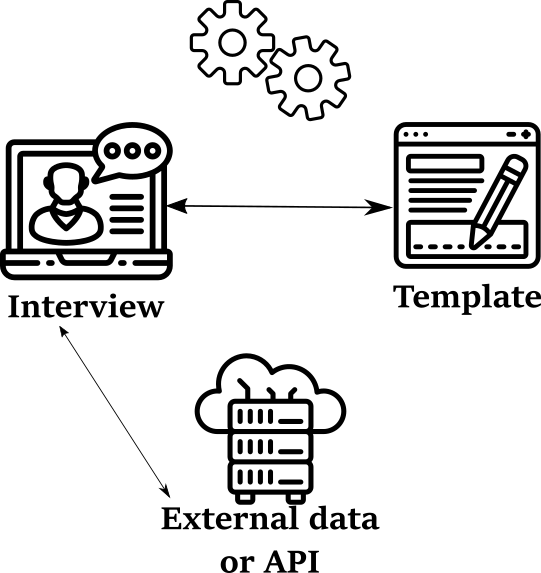
Basic elements of an interactive legal application — from nonprofittechy.com by Quinten Steenhuis

Excerpt:

So, you want to create your first interactive legal application (sometimes also called guided interview or wizard). Congratulations! Whether you are creating the next TurboTax for drafting a will or a blockbuster access to justice app for pro se debtors, there are some standard elements of the application that it will help you to understand, whether you are a developer yourself or managing an outsourced project. This will be the first in a small series of blogs about getting started in interactive app building. As I’ve built these apps both for non-profits and law firms over the last few years, I realized it can help for everyone to share the same vocabulary. This guide applies to one kind of legal app–a linear wizard-like interview that helps a pro se user create a letter, fill out a form, or perhaps complete an intake.

For the most part, these concepts apply whether you are using Docassemble, HotDocs, A2J Author, Contract Express, or any of a number of different platforms. Of course, they also hold true for platforms built on Docassemble, such as Documate and Community.Lawyer.


Top eLearning Gamification Companies 2019 — from elearningindustry.com by Christopher Pappas

Excerpt:

The Top Performing eLearning Gamification Companies 2019
As community leaders, here at eLearning Industry, we have evaluated hundreds of eLearning content development companies in the past. As we are constantly on the lookout for new advancements and trends in the eLearning field that are relevant to the industry, we decided to take a very close look at outstanding providers of gamification. We have focused on prestige, influence, application of gamification tools, activity in the eLearning field, gamification innovations, and many more subcategories.

For the list of the Top eLearning Gamification Companies 2019, we chose and ranked the best gamification companies based on the following 7 criteria:

  • Gamification eLearning quality
  • Customer reviews
  • eLearning expertise
  • Niche specialization on gamification
  • Gamification industry innovation
  • Company’s social responsibility
  • Gamification features and capabilities
 

The 7 biggest technology trends in 2020 everyone must get ready for now — from forbes.com by Bernard Marr

Excerpts:

  • AI-as-a-service
  • 5G data networks
  • Autonomous Driving
  • Personalized and predictive medicine
  • Computer Vision
  • Extended Reality
  • Blockchain Technology


From DSC:
I appreciate this list from Bernard. I would also add voice-enabled interfaces/products (NLP) to this list, as well as more integration of AI into learning-related applications and services. 

For the federal agencies, state representatives, senators, law schools, students in law school, lawyers, legislators, CIO’s, and CEO’s etc. out there: Are you/we ready for these? Given the pace of exponential change, how are you seeking to keep a pulse-check on these types of emerging technologies and their impacts on our society? How are you/we guiding the development of these emerging technologies?


The blinding of justice: Technology, journalism and the law — from thehill.com by Kristian Hammond and Daniel Rodriguez

Excerpts:

The legal profession is in the early stages of a fundamental transformation driven by an entirely new breed of intelligent technologies and it is a perilous place for the profession to be.

If the needs of the law guide the ways in which the new technologies are put into use they can greatly advance the cause of justice. If not, the result may well be profits for those who design and sell the technologies but a legal system that is significantly less just.
…
We are entering an era of technology that goes well beyond the web. The law is seeing the emergence of systems based on analytics and cognitive computing in areas that until now have been largely immune to the impact of technology. These systems can predict, advise, argue and write and they are entering the world of legal reasoning and decision making.

Unfortunately, while systems built on the foundation of historical data and predictive analytics are powerful, they are also prone to bias and can provide advice that is based on incomplete or imbalanced data.
…
We are not arguing against the development of such technologies. The key question is who will guide them. The transformation of the field is in its early stages. There is still opportunity to ensure that the best intentions of the law are built into these powerful new systems so that they augment and aid rather than simply replace.


From DSC:
This is where we need more collaborations between those who know the law and those who know how to program, as well as other types of technologists.


How augmented reality will overhaul our most crucial industries — from singularityhub.com by Peter Diamandis

Excerpts:

Healthcare
(1) Surgeons and physicians
(2) Assistance for those with disabilities
(3) Biometric displays

Retail & Advertising
(1) Virtual shopping
(2) Advertising

Education & Travel
(1) Customized, continuous learning

Within the classroom, Magic Leap One’s Lumin operating system allows multiple wearers to share in a digital experience, such as a dissection or historical map. And from a collaborative creation standpoint, students can use Magic Leap’s CAD application to join forces on 3D designs.

In success, AR’s convergence with biometric sensors and AI will give rise to an extraordinarily different education system: one comprised of delocalized, individually customizable, responsive, and accelerated learning environments.

(2) Training
(3) Travel

Manufacturing
(1) Design
(2) Supply chain optimization
(3) Quality assurance & accessible expertise

Transportation & Navigation
(1) Autonomous vehicles
(2) Navigation

Entertainment
(1) Gaming
(2) Art


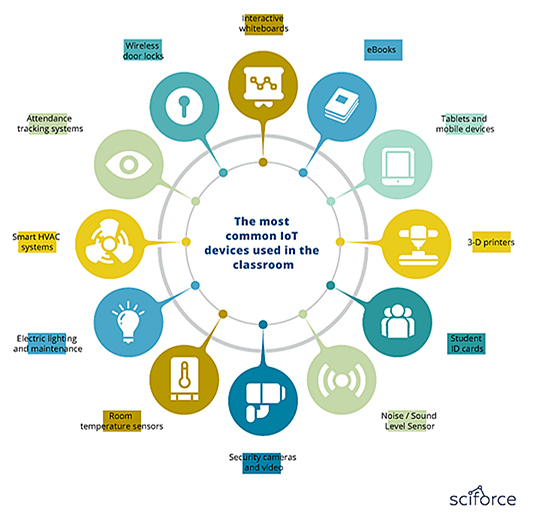
Internet of Things in the World of School— from datafloq.com

Excerpt:

In this blog post, we’ll discuss the benefits of the IoT for education — the sphere that remains farther to the background in terms of the IoT application but can benefit from it at all stages. Besides, schools are meant to prepare students for entry into the adult world. As the IoT changes the landscape of their futures, it is crucial to change the space where students spend their formative years.


From DSC:
The two postings below show the need for more collaboration and the use of teams:


The future of law and computational technologies: Two sides of the same coin — from legaltechlever.com by Daniel Linna Jr.

Excerpt (emphasis DSC):

An increasing number of lawyers today work with allied professionals to improve processes, better manage projects, embrace data-driven methods, and leverage technology to improve legal services and systems. Legal-services and lawyer regulations are evolving. And basic technologies and AI are slowly making their way into the legal industry, from legal aid organizations and courts to large law firms, corporate legal departments, and governments.

If we are to realize the potential to improve society with computational technologies, law, regulation, and ethical principles must be front and center at every stage, from problem definition, design, data collection, and data cleaning to training, deployment, and monitoring and maintenance of products and systems. To achieve this, technologists and lawyers must collaborate and share a common vocabulary. Lawyers must learn about technology, and technologists must learn about law. Multidisciplinary teams with a shared commitment to law, regulation, and ethics can proactively address today’s AI challenges, and advance our collaborative problem-solving capabilities to address tomorrow’s increasingly complex problems. Lawyers and technologists must work together to create a better future for everyone.


From DSC:
As with higher education in general, we need more team-based efforts in the legal realm as well as more TrimTab Groups.



Excerpts:

Why does this distinction matter? Because law—like so many industries—is undergoing a tectonic shift. It is morphing from a lawyer dominated, practice-centric, labor-intensive guild to a tech-enabled, process and data-driven, multi-disciplinary global industry. The career paths, skills, and expectations of lawyers are changing. So too are how, when, and on what financial terms they are engaged; with whom and from what delivery models they work; their performance metrics, and the resources—human and machine—they collaborate with.  Legal practice is shrinking and the business of delivering legal services is expanding rapidly.

Law is no longer the exclusive province of lawyers. Legal knowledge is not the sole element of legal delivery—business and technological competencies are equally important. It’s a new ballgame—one that most lawyers are unprepared for.
…
How did we get here and are legal careers  for most a dead end? Spoiler alert: there’s tremendous opportunity in the legal industry. The caveat: all lawyers must have basic business and technological competency whether they pursue practice careers or leverage their legal knowledge as a skill in legal delivery and/or allied professional careers.

Upskilling the legal profession is already a key issue, a requisite for career success. Lawyers must learn new skills like project management, data analytics, deployment of technology, and process design to leverage their legal knowledge. Simply knowing the law will not cut it anymore.


From DSC:
I really appreciate the work of the above two men whose articles I’m highlighting here. I continue to learn a lot from them and am grateful for their work.

That said, just like it’s a lot to expect a faculty member (in higher ed) who teaches online to not only be a subject matter expert, but also to be skilled in teaching, web design, graphic design, navigation design, information design, audio design, video editing, etc…it’s a lot to expect for a lawyer to be a skilled lawyer, business person, and technician. I realize that Mark was only saying a basic level of competency…but even that can be difficult to achieve at times. Why? Because people have different skillsets, passions, and interests. One might be a good lawyer, but not a solid technician…or vice versa. One might be a solid professor, but isn’t very good with graphic design. 


A new curriculum that helps children understand how algorithms are designed will keep them safe and motivate them to help shape the technology’s future.


The Geek in Review Ep. 53 – Makerspaces in Law Schools with Ashley Matthews and Sharon Bradley  — from geeklawblog.com by Greg Lambert & Marlene Gebauer

NOTE: Sharon Bradley was a librarian at
WMU-Cooley before she moved to Georgia.

Excerpt:

Makerspaces are becoming very popular in libraries, and today we talk with two librarians who are ready to bring the collaborative thinking and working spaces into the law school library environment. Ashley Matthews is at George Mason’s Antonin Scalia Law School, and Sharon Bradley is at the University of Georgia School of Law. Both believe there is a great benefit in carving out spaces within the law school library to allow students and faculty the ability to tinker and experiment with their creative sides, and potentially come up with the next big idea in the legal market.


Matthews and Bradley think that the law school library environment can be the perfect place to teach law students the analytical skills they’ll need in their practice to truly understand how a legal issue can benefit from technology, and how to issue spot, reason, analyze, and resolve legal issues more effectively with technology.


Walgreens to test drone delivery service with Alphabet’s Wing — from cnbc.com by Jasmine Wu

Key Points:

  • Walgreens is working with Alphabet’s drone delivery service Wing to test a new service.
  • The pilot program will deliver food and beverage, over-the-counter medications and other items, but not prescriptions.
  • Amazon said in June its new delivery drone should be ready “within months” to deliver packages to customers.


Add that to these other robots, drones, driverless pods, etc.:


From DSC:
Is a wild, wild west developing? It appears so. What does the average citizen do in these cases if they don’t want such drones constantly flying over their heads, neighborhoods, schools, etc.?

I wonder what the average age is of people working on these projects…?

Just because we can…


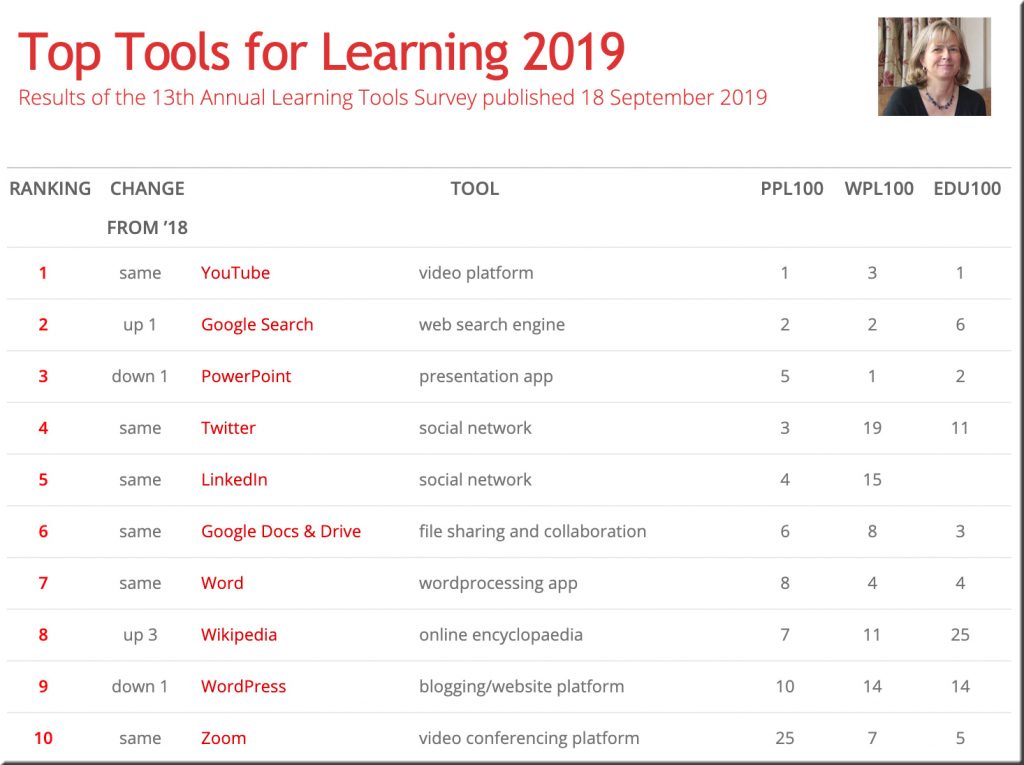
Per Jane Hart on LinkedIn:

Top 200 Tools for Learning 2019 is now published, together with:

PLUS analysis of how these tools are being used in different context, new graphics, and updated comments on the tools’ pages that show how people are using the tools.


A momentous change in the legal industry garnering little attention — from forbes.com by Hendrik Pretorius

Excerpt:

The needed evolution in legal service delivery may receive a big push in the near future. Surprisingly, this issue seems to be flying under the radar for many in the legal industry.

The California Bar, through its Task Force on Access Through Innovation of Legal Services, created in 2018, seeks to “identify possible regulatory changes to enhance the delivery of, and access to, legal services through the use of technology, including artificial intelligence and online legal service delivery models.”

A report commissioned by this task force stated that “[m]odifying the ethics rules to facilitate greater collaboration across law and other disciplines will (1) drive down costs; (2) improve access; (3) increase predictability and transparency of legal services; (4) aid the growth of new businesses; and (5) elevate the reputation of the legal profession.”


Herein lies one of the fundamental challenges within the legal industry: viewing the law as the delivery of a legal product, and understanding that this delivery needs to revolve around the user, not the lawyer. There is a real and growing divide between the current model of legal service delivery put forth by a traditional law firm model and what the public wants. Consumers have raised the bar based on what they are experiencing in interacting with other businesses in other industries.
…
I love what many of these legal tech companies are doing: They are applying standards from outside the entrenched legal industry and changing entire delivery models. This should be a real wake-up call. But how can law firms truly compete and play a role?


5 emerging tech trends impacting the enterprise — from campustechnology.com by Rhea Kelly

Excerpts:

Gartner’s Emerging Technologies Hype Cycle focuses specifically on new technologies (not previously highlighted in past Hype Cycles) that “show promise in delivering a high degree of competitive advantage over the next five to 10 years.” The five most impactful trends to watch this year are:

  1. Sensing and mobility.
  2. Augmented human.
  3. Postclassical compute and comms.
  4. Digital ecosystems.
  5. Advanced AI and analytics.
 

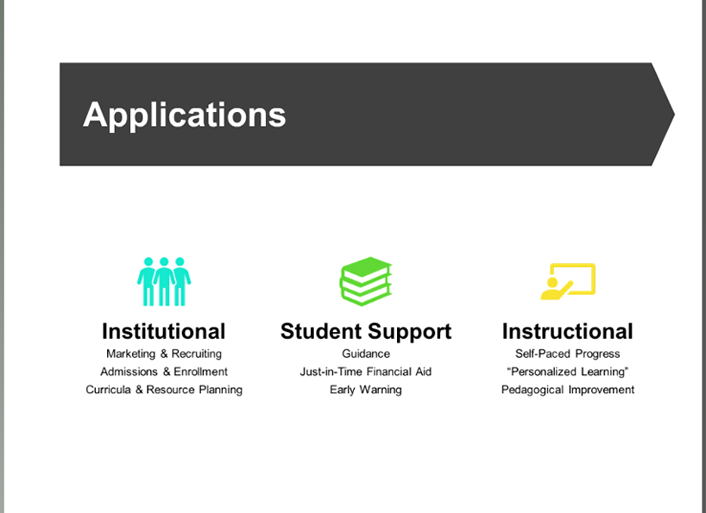
Artificial Intelligence in Higher Education: Applications, Promise and Perils, and Ethical Questions — from er.educause.edu by Elana Zeide
What are the benefits and challenges of using artificial intelligence to promote student success, improve retention, streamline enrollment, and better manage resources in higher education?

Excerpt:

The promise of AI applications lies partly in their efficiency and partly in their efficacy. AI systems can capture a much wider array of data, at more granularity, than can humans. And these systems can do so in real time. They can also analyze many, many students—whether those students are in a classroom or in a student body or in a pool of applicants. In addition, AI systems offer excellent observations and inferences very quickly and at minimal cost. These efficiencies will lead, we hope, to increased efficacy—to more effective teaching, learning, institutional decisions, and guidance. So this is one promise of AI: that it will show us things we can’t assess or even envision given the limitations of human cognition and the difficulty of dealing with many different variables and a wide array of students.
…
A second peril in the use of artificial intelligence in higher education consists of the various legal considerations, mostly involving different bodies of privacy and data-protection law. Federal student-privacy legislation is focused on ensuring that institutions (1) get consent to disclose personally identifiable information and (2) give students the ability to access their information and challenge what they think is incorrect.7 The first is not much of an issue if institutions are not sharing the information with outside parties or if they are sharing through the Family Educational Rights and Privacy Act (FERPA), which means an institution does not have to get explicit consent from students. The second requirement—providing students with access to the information that is being used about them—is going to be an increasingly interesting issue.8 I believe that as the decisions being made by artificial intelligence become much more significant and as students become more aware of what is happening, colleges and universities will be pressured to show students this information. People are starting to want to know how algorithmic and AI decisions are impacting their lives.

My short advice about legal considerations? Talk to your lawyers. The circumstances vary considerably from institution to institution.

 
© 2025 | Daniel Christian