


HAPPENING FINALLY! You can now schedule to multiple classes in Google Classroom!
(New features roll out over 2 weeks) #googleEDU #googleClassroom pic.twitter.com/qij4X3MD3B
— Alice Keeler ?? CUE Booth 319 (@alicekeeler) March 18, 2022
What is Legal Tech, and How Is It Changing the Legal Industry? — from startup.info
Excerpt:
Legal technology is a branch of technological innovation that targets and affects the legal sector specifically. The considerable pace of new invention in tech sectors – bolstered by government investment in UK-based innovation and growth – has highlighted some avenues of innovation that could change the face of the legal profession, streamlining judicial processes and helping firms during discovery.
However, in concert with the rapid pace of new technology that benefits legal practise, the technology’s legal implications are also being raised. With a technological landscape that has far outstripped the remit of conventional law, demand for technology lawyers has increased to enable businesses and lawmakers to navigate new tech possibilities.
Four Important Technology Trends for Law Firms in 2022 — from jdsupra.com
Excerpt:
It is easy to say (two years now into the pandemic) that COVID-19 changed the legal profession forever. After a massive shift in 2020 and 2021 to working and conducting court proceedings remotely, with the help of many remote technologies, many legal professionals may wonder what lies ahead from a technology standpoint. After such a dramatic shift, are there even more disruptions to embrace?
The answer is yes! The world turns, technology keeps evolving, and so too will the legal services industry. Below are predictions of technology trends that will continue to be important in 2022 and help shape the industry in the years ahead.
With RemoteDepo™ by U.S. Legal Support, everyone can participate in a remote deposition and interact as if they were in the same conference room. With an internet connection and webcam-equipped device, you can communicate in realtime, observe witness body language and seamlessly facilitate questioning.

How Legal AI Technology Adoption Leads to Real-World Results — from jdsupra.com
Excerpt:
Contracting is just one area where in-house lawyers and legal ops professionals are seeing real-world results by implementing AI. As innovation continues to disrupt the legal tech world, AI is being introduced into nearly every aspect of practice and business. But now, AI has evolved beyond a buzzword to provide meaningful – and impactful – results.
Ironclad’s New Connect Tool ‘Cuts Contracting Time By 40% — from artificiallawyer.com
Excerpt:
CLM Ironclad has launched a new tool called Connect, which creates a centralised view of the contracting process for all parties and, they claim, can reduce contract completion times by over 40% – which is a lot whether you are a busy inhouser, or a law firmer on the billable hour.
The new capability allows you to store all communications about a deal in one place, ‘even attachments and months-long email threads’ and allows you to keep everyone involved in negotiating a contract ‘in the loop’.
Math worksheets for the learning process — from intelligenthq.com
Excerpt:
If you want to master the subject of mathematics, constant practice of various topics is a must. To ensure that you have the proper grasp of all the topics of the subject, solving worksheets for math is one of the best techniques. Worksheets for math facilitate the stepwise mechanism which enhances the learning process and helps students identify their mistakes. Once they can recognize what their mistakes are, they can work on improving them. Worksheets for math also have visual problems that help in the visualization process of students and make their analyzing and strategic capability high. Take worksheets for math from Cuemath and excel in math.
Also see:

Also relevant/see:
In New Math Proofs, Artificial Intelligence Plays to Win — from quantamagazine.org; with thanks to Alec Lazarescu on Twitter for this resource
A new computer program fashioned after artificial intelligence systems like AlphaGo has solved several open problems in combinatorics and graph theory.
Universities reimagine teaching labs for a virtual future — from edtechmagazine.com by Renee Morad
Schools are replacing take-home lab kits with more advanced virtual options that allow students to access industry-grade equipment.
Excerpt:
Soon after, engineering professors at Morgan State began using more advanced virtual lab options, which allowed students to access industry-grade lab equipment. The students could use an oscilloscope, a digital multimeter, a power supply and a function generator. The students logged on remotely to a cloud-based platform and followed the instructor’s video feed to get real-time guidance and feedback.
As the global pandemic forced professors and department chairs to adapt to a new learning frontier, it shined a spotlight on new methods to remotely replicate the in-person lab experience. It shifted the university lab from a traditional learning center to a futuristic innovation hub.
From DSC:
Also interesting here, see:

Also relevant here, see:
Best from the brightest: Key ideas & insights for L&P Professionals — from tier1performance.com by Will Thalheimer; with thanks to Christy Tucker for this resource
Gather your learning and performance team together, share conversations with your friends in the field—this trove of gold from 2021 is the bedrock for our evolving and improving work in 2022.
To help fight our FOMO (fear of missing out), I’ve asked 48 thought leaders in the L&P field to share their favorite content from 2021—stuff they created or were involved in, ideas they think are critically important to folks like you and me as L&P professionals. They shared articles, blog posts, podcast episodes, videos, and eLearnings. They also shared their recommendations for other thought leaders and other content—and the most important trends impacting our work for 2022.
I looked at every one of their recommendations and I am blown away by the insights you’ll find in the content shared below. This is a formidable treasure trove from some of the best minds in our field.
Will Thalheimer
Sticky learning: Digital brain dumps with Flipgrid and Socrative — from ditchthattextbook.com
Excerpt:
Retrieval practice is powerful. It can be an easy practice to incorporate in class. Plus, there are some great digital tools that are made for this kind of practice.
In this post, you’ll learn …
The Metaverse Will Radically Change Content Creation Forever — from forbes.com by Falon Fatemi
Excerpt:
Although the metaverse promises to touch nearly every person in our society, there’s one demographic that will almost certainly see disproportionately strong disruption: creators. The metaverse has the potential to fundamentally disrupt the content creation process.
The metaverse is slated to help creators make more interactive and immersive content, thanks in large part to advances in VR and AR. The stakes will be raised as creators will be expected to build more immersive and interactive content than ever before.
Also related/see:
The Amazing Possibilities Of Healthcare In The Metaverse — from forbes.com by Bernard Marr
Excerpts:
What’s generally agreed on, however, is that it’s effectively the next version of the internet – one that will take advantage of artificial intelligence (AI), augmented reality (AR), virtual reality (VR), and ever-increasing connectivity (for example, 5G networks) to create online environments that are more immersive, experiential and interactive than what we have today.
Metaverse involves the convergence of three major technological trends, which all have the potential to impact healthcare individually. Together, though, they could create entirely new channels for delivering care that have the potential to lower costs and vastly improve patient outcomes. These are telepresence (allowing people to be together virtually, even while we’re apart physically), digital twinning, and blockchain (and its ability to let us create a distributed internet).
From DSC:
That last paragraph could likely apply to our future learning ecosystems as well. Lower costs. A greater sense of presence. Getting paid for one’s teaching…then going to learn something new and paying someone else for that new training/education.

Excerpt:
The use of telehealth has soared during the pandemic, broadening access to care while also allowing providers, patients, and payers to consider possibilities, from expanding care at home to managing costs. But stakeholders have starkly different views on this next wave of healthcare: In a recent McKinsey survey, two-thirds of physicians and 60 percent of patients said they agreed that virtual health is more convenient than in-person care for patients, but only 36 percent of physicians find it more convenient for themselves. Explore these insights to understand the ongoing transition of IRL (in real life) to URL (virtual) medical care offerings…
Also from McKinsey, see:
What technology trends will—and should—lead business agendas in 2022?
Excerpt:
We asked leaders in industry, academia, and at McKinsey to share their perspectives on the technology trends likely to headline business agendas this year, the ones that could—but shouldn’t—slip through the cracks, and what executives should think about when considering new technologies. Here is what they told us.
Metaverse. Web3. Crypto. 5G.
These are just a few of the technologies grabbing headlines at the start of 2022. But what technology trends truly sit atop business agendas this year? Which might be under executives’ radars but should be surfaced? And what should business leaders keep in mind as they consider these trends?
AI Could Power the Next Generation of Smart Glasses — from lifewire.com by Mayank Sharma. I’d like to thank Mayank for letting me contribute some thoughts to this article.
Making the bigger picture clearer
Key Takeaways

The best lighting for video conferencing, according to experts— from blog.webex.com

Contents:
Why the World’s First Virtual Reality High School Changes Everything — from steve-grubbs.medium.com by Steve Grubs
Excerpts:
The recipe required key ingredients to happen. In addition to an accredited school to manage students, admissions and the for-credit learning, it also needed a platform. That’s where EngageVR comes in. There are other platforms that will ultimately host schools, perhaps AltSpace, Horizon or others, but the first is on Engage.
…
The bottom line is this: creators, coders, educators, entrepreneurs, investors, corporations, parents and students all played a role in finally bringing the first global virtual reality high school to life. It won’t be the last school to open in the metaverse, but to all those involved in this inaugural launch — the Neil Armstrongs of your age — a special tip of the hat today for having the vision and the willingness to launch a better and more equitable era of education.
Also see:

The doctor is in—the video call — from mckinsey.com
Excerpt:
More patients than ever were willing to try virtual health services after COVID-19 emerged. Last year, the use of telehealth care was 38 times higher than prepandemic levels, as appointments such as follow-ups could easily be delivered remotely. A recent McKinsey survey shows that up to $265 billion in Medicare spending could shift to patients’ homes by 2025, with greater physician participation in the transition from telehealth to at-home care.
From facility to home: How healthcare could shift by 2025 — from mckinsey.com by Oleg Bestsennyy, Michelle Chmielewski, Anne Koffel, and Amit Shah
Also see the other charts via their daily chart feature:
Using Telehealth to Expand Student Access to Care — from techlearning.com by Erik Ofgang
Renee Kotsopoulo, director of health services for the Garland ISD in Texas, helped bring telehealth to her students and believes technology can help keep kids healthy and in school.
Can Teletherapy Companies Ease the Campus Mental-Health Crisis? — from chronicle.com by Kate Hidalgo Bellows
From DSC:
Telehealth has been booming during the pandemic. I think telelegal will ride on the coattails of telehealth.
The innovation imperative: Lessons from high-growth companies — from deloitte.com by Khalid Kark, Tim Smith, Lou DiLorenzo Jr, and Mike Bechtel
Successful innovation functions display unique characteristics, one of them being technology’s prominent role in driving these initiatives. How can CIOs and technology leaders seize this opportunity and ensure they play a pivotal role in their company’s growth?
Excerpt:
Many enterprises now have an innovation function, whether it be a team that is dedicated to seeking out new opportunities or an executive tasked with finding new ways of working. But according to the latest Deloitte survey, only half of innovation efforts are achieving their desired value, and companies with successful innovation functions have unique characteristics. The study revealed that most leading companies view innovation as something both new—which can include new applications of existing tools—and improved—which may mean simply a measurable advance over legacy alternatives. This covers everything from incremental gains to moonshots.
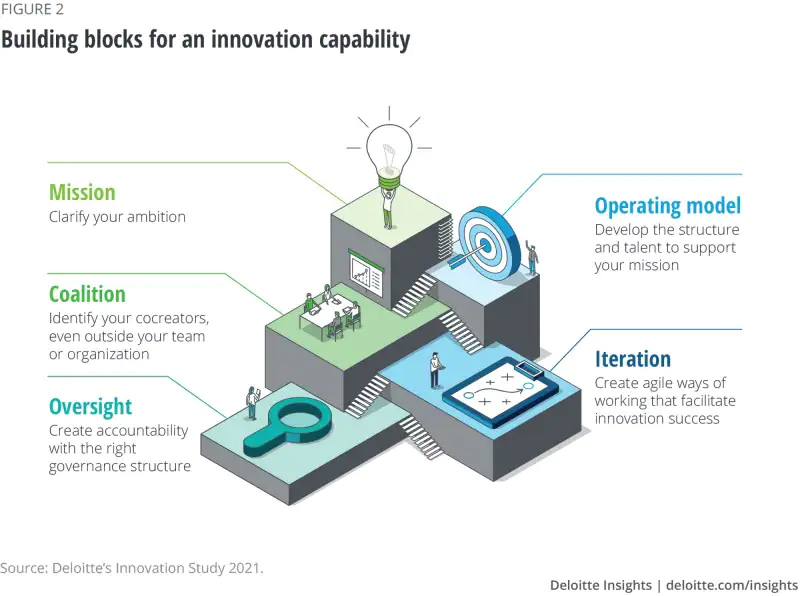
Also see Deloitte’s Ten Types of Innovations.