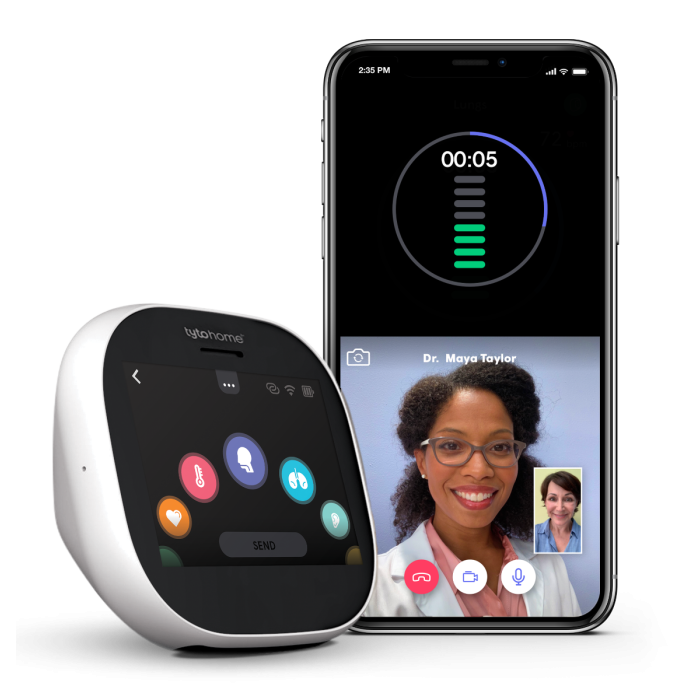
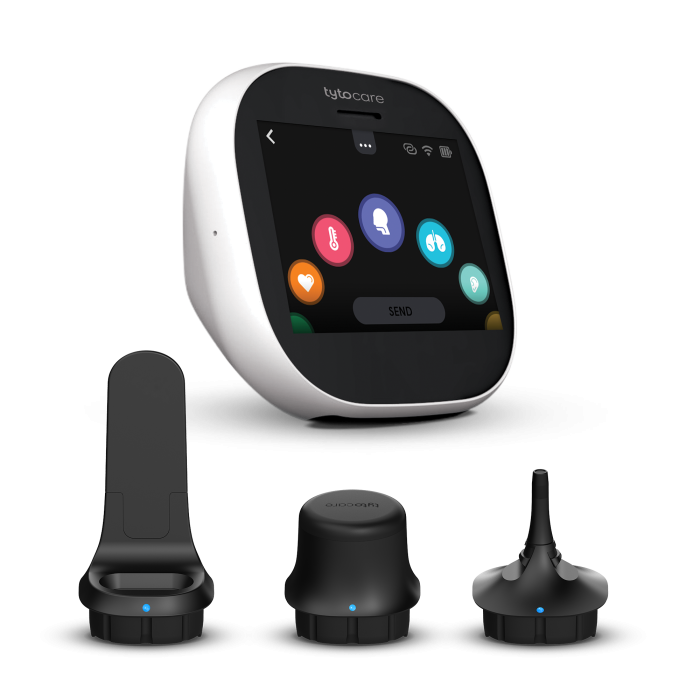
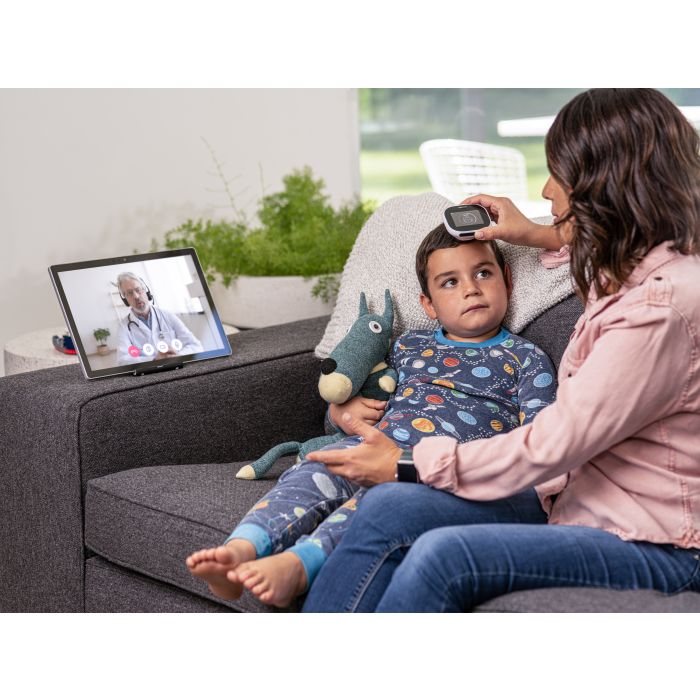
From DSC: I received an email the other day re: aTytoCare Exam Kit.It said (with some emphasis added by me):
With a TytoCare Exam Kit connected to Spectrum Health’s 24/7 Virtual Urgent Care, you and your family can have peace of mind and a quick, accurate diagnosis and treatment plan whenever you need it without having to leave your home.
Your TytoCare Exam Kit will allow your provider to listen to your lungs, look inside your ears or throat, check your temperature, and more during a virtual visit.
Why TytoCare?
Convenience – With a TytoCare Exam Kit and our 24/7/365 On-Demand Virtual Urgent Care there is no drive, no waiting room, no waiting for an appointment.
Peace of Mind – Stop debating about whether symptoms are serious enough to do something about them.
Savings – Without the cost of gas or taking off work, you get the reliable exams and diagnosis you need. With a Virtual Urgent Care visit you’ll never pay more than $50. That’s cheaper than an in-person urgent care visit, but the same level of care.
From DSC:
It made me reflect on what #telehealth has morphed into these days. Then it made me wonder (again), what #telelegal might become in the next few years…? Hmmm. I hope the legal field can learn from the healthcare industry. It could likely bring more access to justice (#A2J), increased productivity (for several of the parties involved), as well as convenience, peace of mind, and cost savings.
Drew Builds Stuff has an office in the basement of his parents’ house. Because of its subterranean location, it doesn’t get much light. To brighten things up, he built a window wall out of three 75? 4K TVs, resulting in a 12-foot diagonal image. Since he can load up any video footage, he can pretend to be anywhere on Earth.
From DSC: Perhaps some ideas here for learning spaces!
OpenAI has built the best Minecraft-playing bot yet by making it watch 70,000 hours of video of people playing the popular computer game. It showcases a powerful new technique that could be used to train machines to carry out a wide range of tasks by binging on sites like YouTube, a vast and untapped source of training data.
The Minecraft AI learned to perform complicated sequences of keyboard and mouse clicks to complete tasks in the game, such as chopping down trees and crafting tools. It’s the first bot that can craft so-called diamond tools, a task that typically takes good human players 20 minutes of high-speed clicking—or around 24,000 actions.
The result is a breakthrough for a technique known as imitation learning, in which neural networks are trained to perform tasks by watching humans do them.
…
The team’s approach, called Video Pre-Training (VPT), gets around the bottleneck in imitation learning by training another neural network to label videos automatically.
“Most language learning software can help with the beginning part of learning basic vocabulary and grammar, but gaining any degree of fluency requires speaking out loud in an interactive environment,” Zwick told TechCrunch in an email interview. “To date, the only way people can get that sort of practice is through human tutors, which can also be expensive, difficult and intimidating.”
Speak’s solution is a collection of interactive speaking experiences that allow learners to practice conversing in English. Through the platform, users can hold open-ended conversations with an “AI tutor” on a range of topics while receiving feedback on their pronunciation, grammar and vocabulary.
It’s one of the top education apps in Korea on the iOS App Store, with over 15 million lessons started annually, 100,000 active subscribers and “double-digit million” annual recurring revenue.
If you last checked in on AI image makers a month ago & thought “that is a fun toy, but is far from useful…” Well, in just the last week or so two of the major AI systems updated.
You can now generate a solid image in one try. For example, “otter on a plane using wifi” 1st try: pic.twitter.com/DhiYeVMEEV
So, is this a cool development that will become a fun tool for many of us to play around with in the future? Sure. Will people use this in their work? Possibly. Will it disrupt artists across the board? Unlikely. There might be a few places where really generic artwork is the norm and the people that were paid very little to crank them out will be paid very little to input prompts. Look, PhotoShop and asset libraries made creating company logos very, very easy a long time ago. But people still don’t want to take the 30 minutes it takes to put one together, because thinking through all the options is not their thing. You still have to think through those options to enter an AI prompt. And people just want to leave that part to the artists. The same thing was true about the printing press. Hundreds of years of innovation has taught us that the hard part of the creation of art is the human coming up with the ideas, not the tools that create the art.
A quick comment from DSC: Possibly, at least in some cases. But I’ve seen enough home-grown, poorly-designed graphics and logos to make me wonder if that will be the case.
How to Teach With Deep Fake Technology — from techlearning.com by Erik Ofgang Despite the scary headlines, deep fake technology can be a powerful teaching tool
Excerpt:
The very concept of teaching with deep fake technology may be unsettling to some. After all, deep fake technology, which utilizes AI and machine learning and can alter videos and animate photographs in a manner that appears realistic, has frequently been covered in a negative light. The technology can be used to violate privacy and create fake videos of real people.
However, while these potential abuses of the technology are real and concerning that doesn’t mean we should turn a blind eye to the technology’s potential when using it responsibly, says Jaime Donally, a well-known immersive learning expert.
From DSC: I’m still not sure about this one…but I’ll try to be open to the possibilities here.
Recently, we spoke with three more participants of the AI Explorations program to learn about its ongoing impact in K-12 classrooms. Here, they share how the program is helping their districts implement AI curriculum with an eye toward equity in the classroom.
A hitherto stealth legal AI startup emerged from the shadows today with news via TechCrunch that it has raised $5 million in funding led by the startup fund of OpenAI, the company that developed advanced neural network AI systems such as GPT-3 and DALL-E 2.
The startup, called Harvey, will build on the GPT-3 technology to enable lawyers to create legal documents or perform legal research by providing simple instructions using natural language.
The company was founded by Winston Weinberg, formerly an associate at law firm O’Melveny & Myers, and Gabriel Pereyra, formerly a research scientist at DeepMind and most recently a machine learning engineer at Meta AI.
A class-action lawsuit filed in a federal court in California this month takes aim at GitHub Copilot, a powerful tool that automatically writes working code when a programmer starts typing. The coder behind the suit argues that GitHub is infringing copyright because it does not provide attribution when Copilot reproduces open-source code covered by a license requiring it.
…
Programmers have, of course, always studied, learned from, and copied each other’s code. But not everyone is sure it is fair for AI to do the same, especially if AI can then churn out tons of valuable code itself, without respecting the source material’s license requirements. “As a technologist, I’m a huge fan of AI ,” Butterick says. “I’m looking forward to all the possibilities of these tools. But they have to be fair to everybody.”
Whatever the outcome of the Copilot case, Villa says it could shape the destiny of other areas of generative AI. If the outcome of the Copilot case hinges on how similar AI-generated code is to its training material, there could be implications for systems that reproduce images or music that matches the style of material in their training data.
Also related to AI and art/creativity from Wired.com, see:
Picture Limitless Creativity at Your Fingertips— by Kevin Kelly Artificial intelligence can now make better art than most humans. Soon, these engines of wow will transform how we design just about everything.
Who Will Own the Art of the Future? — by Jessica Rizzo OpenAI has announced that it’s granting Dall-E users the right to commercialize their art. For now.
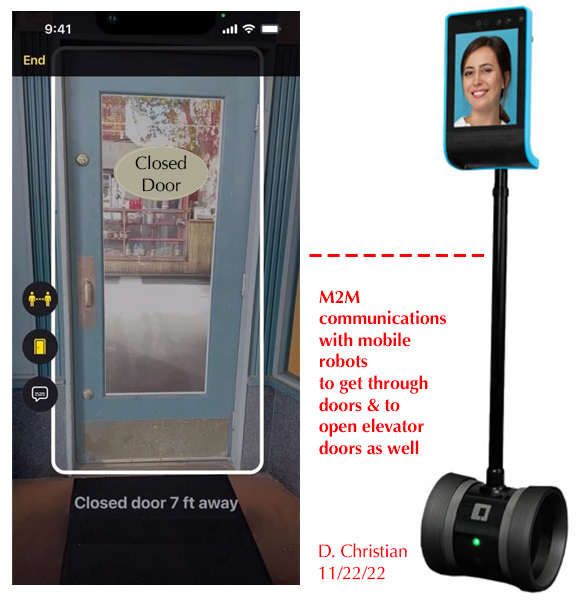
Magnifier has a new Door Detection optionon iOS 16, which helps blind and low-vision users locate entryways when they arrive at their destination. The tool can tell you how far away the door is, if the door is open or closed, how to open it (push it, turn the knob, pull the handle, etc.), what any signs say (like room numbers), what any symbols mean (like people icons for restrooms), and more.
From DSC: By the way, this kind of feature would be great to work in tandem with devices such as the Double Robotics Telepresence Robot — i.e., using Machine-to-Machine (M2M) communications to let the robot and automatic doors communicate with each other so that remote students can “get around on campus.”
Along the lines of accessibility-related items, also relevant/see:
Microsoft has announced a sign language view for Teams to help signers and others who use sign language. The information on screen will be prioritised on centre stage, in a consistent location, throughout every meeting.
When sign language view is enabled, the prioritised video streams automatically appear at the right aspect ratio and at the highest available quality. Like pinning and captioning, sign language view is personal to each user and will not impact what others see in the meeting.
It would be an understatement to say that lecturing is frowned upon in modern teaching. At this point it’s almost become a cliché: Don’t be the sage on the stage; be the guide on the side. Ideally, we should stick to supporting students through inquiry learning, cooperative learning, project-based learning, and so on. I have personally advocated for ALL of these approaches, over and over again. And I do believe that students need to be active in their learning.
But does that mean we dump lectures altogether? At a time when TED Talks and online courses are incredibly popular, when our students get at least some portion of their instruction through video-based, blended learning platforms, and when most people reading this have probably learned something useful or interesting in the last month from YouTube, aren’t we all learning from lectures all the time?
I’d argue that two factors have given lectures a bad name: overuse and poor execution. Let’s look at these issues one at a time.
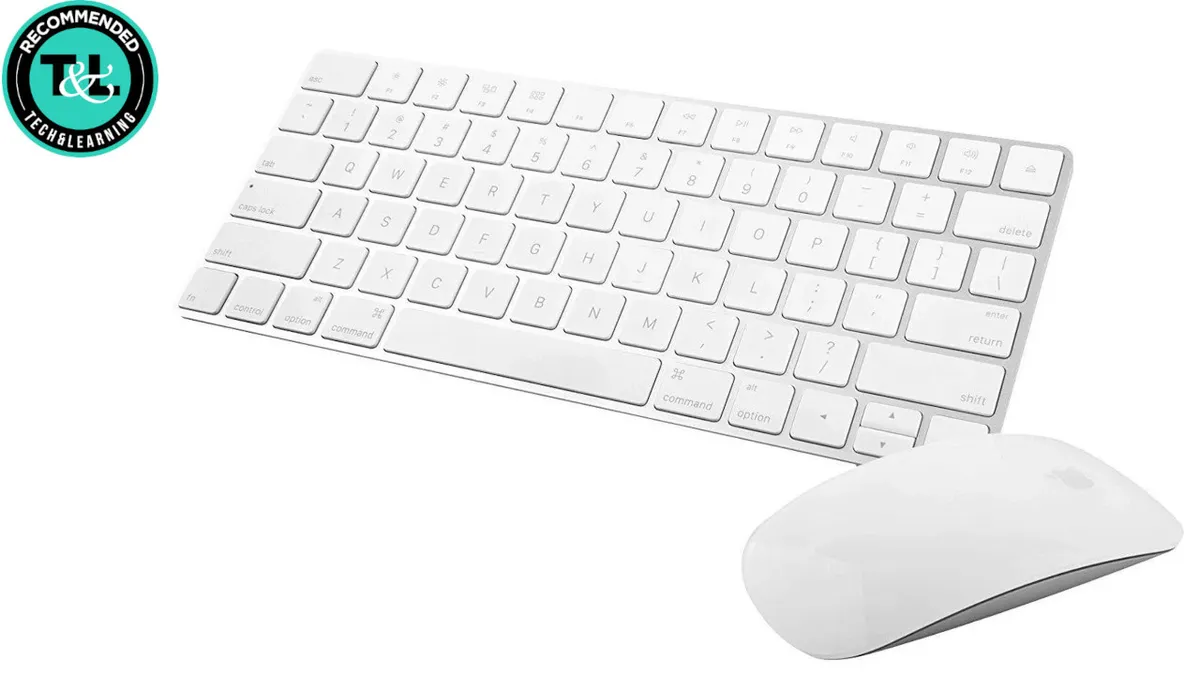
Best Webcams for Teachers and Students — from techlearning.com by Luke Edwards Get the best webcams for teachers and students to help with hybrid learning and more
The Impact of Storytelling on Learning— from campustechnology.com by Ruth Reynard The benefits of storytelling in teaching and learning are well established — and digital tools can help make stories more interactive, boost engagement, and convey ideas more effectively. Here’s how to make the most of technology and sidestep common mistakes in the use of storytelling for learning.
Excerpts:
Research.com provides a lot of helpful information on digital storytelling, including a breakdown of the tools and media used to tell stories or present ideas: audio capture devices (e.g. microphones and voice recorders), image capture devices (such as digital cameras and scanners), computers (with multimedia capabilities and ample storage), and digital media software (for creating and editing image, video, and audio).
…
While digital tools evolve rapidly, there are several useful tools listed for teachers and students by Med Kharbach (2022). These include:
StoryboardThat – this storyboard design tool helps to support good design and planning for effective storytelling.
Canva – this provides already developed templates to use in any story design and development.
Adobe Spark – useful if you are already familiar with Adobe products.
While the future of legal innovation remains unclear, it is apparent that law schools must evolve to meet students’ technological needs. At the very least, lawyers and legal professionals must have more collaborative conversations on the broader educational need for legal technology.
Legal operations professionals have a unique opportunity to emphasize the importance of designing and implementing a business solution ecosystem to guide greater efficiency and decision-making. If data and trends tell us anything, law firms and corporate law departments must adapt to achieve better business outcomes, while law schools have to change the way they teach in our modern digital economy.
In this article, we will discuss some of the most prominent and up-and-coming companies that provide these automated solutions that break down the language barrier.
Addendum on 11/17/22:
The State of Multilingual AI — from ruder.io This post takes a closer look at the state of multilingual AI. How multilingual are current models in NLP, computer vision, and speech? What are the main recent contributions in this area? What challenges remain and how we can we address them?
Clusiv is an online learning platform for the blind and visually impaired that teaches occupational training, technology skills, and educational courses to empower employment. We help remove barriers to successful employment by teaching the skills you need to be equipped for the modern workforce.
Educause used to be THE EdTech conference, and the LMS market news tended to deliberately coincide with the fall event – with vendors releasing news that week. The conference competition has heated up and Educause is now one among several EdTech conferences, but it does tend to remain the premier event in North American higher ed in terms of combined exhibitor booths and marketing presence.
Having seen so many LMS vendors at #Edu22 (Instructure Canvas, Google Classroom sort of, D2L Brightspace, Anthology Learn, Open LMS, Sakai, and Cypher Learning), it is worth collecting some items in one place after the conference, organized this time around market wins of significance.
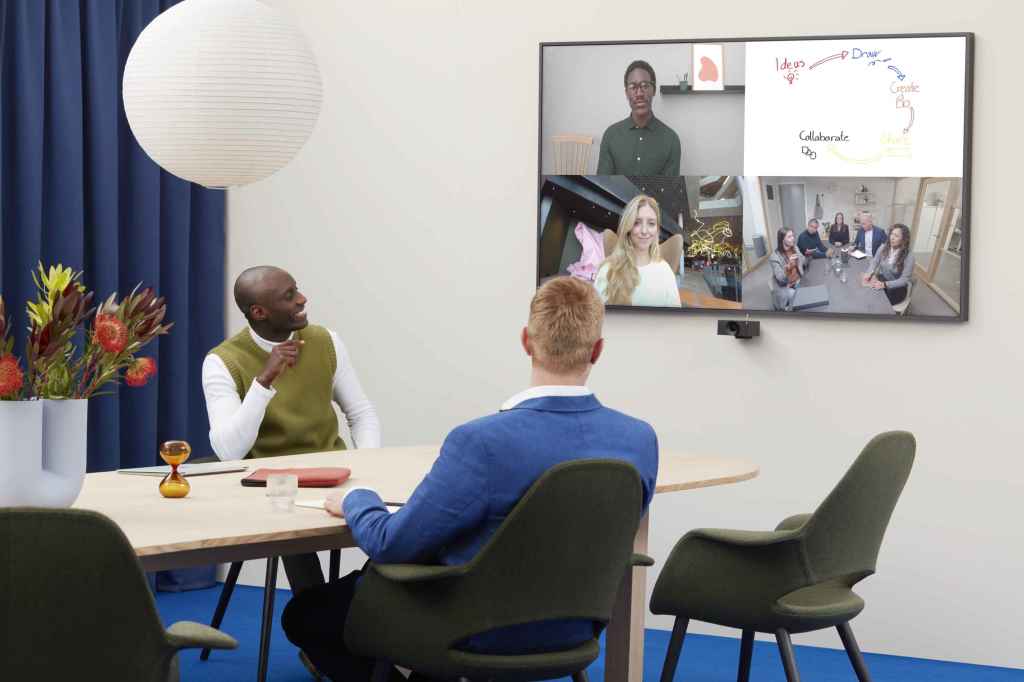
The hybrid approach to remote work can meet the needs of diverse teams of people, but too often those who sign in from afar can feel left out, absent from impromptu hallway discussions or outright ignored on Zoom calls.
When you’re on the outside it’s tempting to just stay quiet and hope things will improve, but if your team isn’t aware of your struggles, things will only get worse. I spoke with three experts in remote work and here are their pro tips on how to survive and even thrive.
A report commissioned by Crestron has found that 84% of employees regularly have at least one remote participant in their meetings.
The report, titled Tackling the Modern Workplace by the Numbers, explores employee behaviors and preferences in a hybrid workplace, the technology tools they need and lack, and what employers are (and could be) doing to enable more consistently productive collaboration remotely and in-office.
“The findings of this report reveal that for the first time in years, we have a reliable sense of what to expect from the enterprise workplace in terms of where work is done and how meetings have to be held,” said Brad Hintze, exec VP, global marketing, Crestron. “If every meeting isn’t equipped to be hybrid, the data unequivocally shows teams will experience challenges in staying connected to each other, to leadership, and to the company culture, no matter where they’re working.”
But where in the conversation are the people implementing those tools: the teachers? And how much say do they—or should they—have in edtech decisions?
For both questions, as it turns out, it depends on who you ask.
In a survey released earlier this year, the edtech company Clever found that 85 percent of administrators say teachers are involved in choosing tools. When the company asked teachers, more than 60 percent said they were hardly ever—or never—involved in those choices.
As we started asking educators, administrators and experts about the issue as part of an investigation into how teachers inform the development of edtech products, everyone agreed: teacher voice should be part of edtech decisions.
The primary point, of course, is this: unused features in exercise technologies and educational technologies can improve neither fitness nor learning. From this perspective, one might argue:
The most important feature in educational technology products is the nudge – the feature that persuades you to actually use the features that will improve learning.
Duolingo is a great example here. On its surface, the language learning app may appear rather straightforward. But there are some pretty sophisticated things happening behind the scenes that make your language learning more effective.
You’ve likely been reading for the last few minutes my arguments for why AI is going to change education. You may agree with some points, disagree with others…
Only, those were not my words.
An AI has written every single word in this essay up until here.
The only thing I wrote myself was the first sentence: Artificial Intelligence is going to revolutionize education. The images too, everything was generated by AI.