You are not a parrot — from nymag.com by Elizabeth Weil and Emily M. Bender

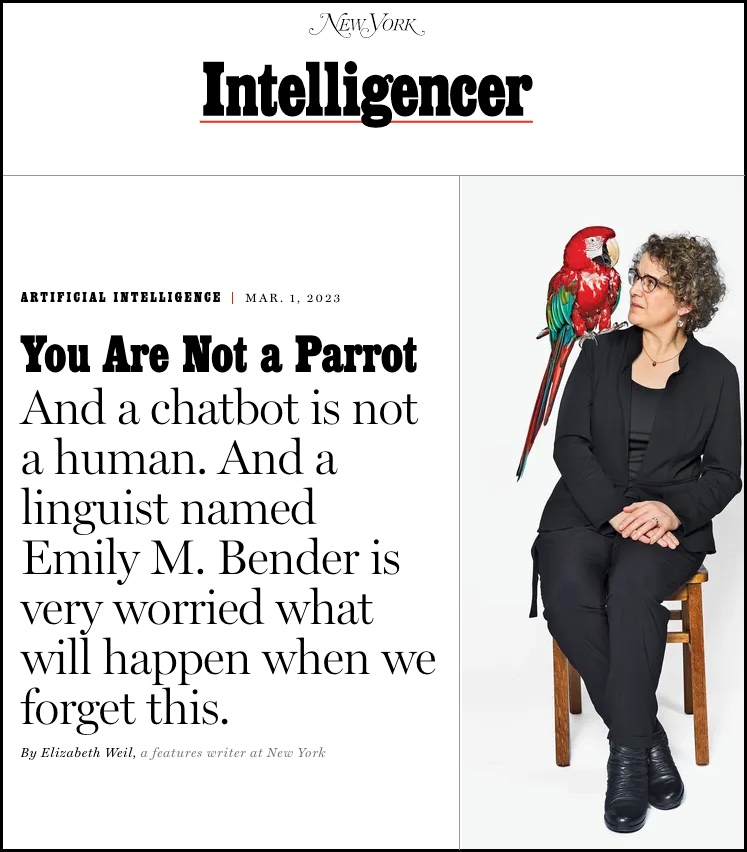
You Are Not a Parrot. And a chatbot is not a human. And a linguist named Emily M. Bender is very worried what will happen when we forget this.

Excerpts:

A handful of companies control what PricewaterhouseCoopers called a “$15.7 trillion game changer of an industry.” Those companies employ or finance the work of a huge chunk of the academics who understand how to make LLMs. This leaves few people with the expertise and authority to say, “Wait, why are these companies blurring the distinction between what is human and what’s a language model? Is this what we want?”
…
Bender knows she’s no match for a trillion-dollar game changer slouching to life. But she’s out there trying. Others are trying too. LLMs are tools made by specific people — people who stand to accumulate huge amounts of money and power, people enamored with the idea of the singularity. The project threatens to blow up what is human in a species sense. But it’s not about humility. It’s not about all of us. It’s not about becoming a humble creation among the world’s others. It’s about some of us — let’s be honest — becoming a superspecies. This is the darkness that awaits when we lose a firm boundary around the idea that humans, all of us, are equally worthy as is.


Introducing Q-Chat, the world’s first AI tutor built with OpenAI’s ChatGPT — from quizlet.com by Lex Bayer

Excerpt:

Modeled on research demonstrating that the most effective form of learning is one-on-one tutoring1, Q-Chat offers students the experience of interacting with a personal AI tutor in an effective and conversational way. Whether they’re learning French vocabulary or Roman History, Q-Chat engages students with adaptive questions based on relevant study materials delivered through a fun chat experience. Pulling from Quizlet’s massive educational content library and using the question-based Socratic method to promote active learning, Q-Chat has the ability to test a student’s knowledge of educational content, ask in-depth questions to get at underlying concepts, test reading comprehension, help students learn a language and encourage students on healthy learning habits.

Quizlet's Q-Chat -- choose a study prompt to be quizzed on the material, to deepen your understanding or to learn through a story.


How ChatGPT is going to change the future of work and our approach to education — from livemint.com

From DSC: 
I thought that the article made a good point when it asserted:

The pace of technological advancement is booming aggressively and conversations around ChatGPT snatching away jobs are becoming more and more frequent. The future of work is definitely going to change and that makes it clear that the approach toward education is also demanding a big shift.
…
A report from Dell suggests that 85% of jobs that will be around in 2030 do not exist yet. The fact becomes important as it showcases that the jobs are not going to vanish, they will just change and most of the jobs by 2030 will be new.

The Future of Human Agency — from pewresearch.org by Janna Anderson and Lee Rainie

Excerpt:

Thus the question: What is the future of human agency? Pew Research Center and Elon University’s Imagining the Internet Center asked experts to share their insights on this; 540 technology innovators, developers, business and policy leaders, researchers, academics and activists responded. Specifically, they were asked:

By 2035, will smart machines, bots and systems powered by artificial intelligence be designed to allow humans to easily be in control of most tech-aided decision-making that is relevant to their lives?

The results of this nonscientific canvassing:

    • 56% of these experts agreed with the statement that by 2035 smart machines, bots and systems will not be designed to allow humans to easily be in control of most tech-aided decision-making.
    • 44% said they agreed with the statement that by 2035 smart machines, bots and systems will be designed to allow humans to easily be in control of most tech-aided decision-making.

What are the things humans really want agency over? When will they be comfortable turning to AI to help them make decisions? And under what circumstances will they be willing to outsource decisions altogether to digital systems?

The next big threat to AI might already be lurking on the web — from zdnet.com by Danny Palmer; via Sam DeBrule
Artificial intelligence experts warn attacks against datasets used to train machine-learning tools are worryingly cheap and could have major consequences.

Excerpts:

Data poisoning occurs when attackers tamper with the training data used to create deep-learning models. This action means it’s possible to affect the decisions that the AI makes in a way that is hard to track.

By secretly altering the source information used to train machine-learning algorithms, data-poisoning attacks have the potential to be extremely powerful because the AI will be learning from incorrect data and could make ‘wrong’ decisions that have significant consequences.

Why AI Won’t Cause Unemployment — from pmarca.substack.com by Marc Andreessen

Excerpt:

Normally I would make the standard arguments against technologically-driven unemployment — see good summaries by Henry Hazlitt (chapter 7) and Frédéric Bastiat (his metaphor directly relevant to AI). And I will come back and make those arguments soon. But I don’t even think the standand arguments are needed, since another problem will block the progress of AI across most of the economy first.

Which is: AI is already illegal for most of the economy, and will be for virtually all of the economy.

How do I know that? Because technology is already illegal in most of the economy, and that is becoming steadily more true over time.

How do I know that? Because:


From DSC:
And for me, it boils down to an inconvenient truth: What’s the state of our hearts and minds?

AI, ChatGPT, Large Language Models (LLMs), and the like are tools. How we use such tools varies upon what’s going on in our hearts and minds. A fork can be used to eat food. It can also be used as a weapon. I don’t mean to be so blunt, but I can’t think of another way to say it right now.

  • Do we care about one another…really?
  • Has capitalism gone astray?
  • Have our hearts, our thinking, and/or our mindsets gone astray?
  • Do the products we create help or hurt others? It seems like too many times our perspective is, “We will sell whatever they will buy, regardless of its impact on others — as long as it makes us money and gives us the standard of living that we want.” Perhaps we could poll some former executives from Philip Morris on this topic.
  • Or we will develop this new technology because we can develop this new technology. Who gives a rat’s tail about the ramifications of it?


How Does Your Firm Stack Up When It Comes To Legal Tech? A Look Through the 2022 ABA Legal Technology Survey Report — from jdsupra.com

Excerpt:

The 2022 ABA Legal Technology Survey Report measures current legal technology trends. How does your firm compare to the rest?

Lawyers are rarely accused of rushing into change, but current legal technology trends show a few glimmers of hope that (slowly but surely) law firms are realizing the significance of incorporating technology into their litigation practice to remain relevant and competitive. The 2022 ABA Legal Technology Survey Report: Vol. 5 – Litigation Technology & E-Discovery reveals that law firms went through a belt-tightening phase in 2020 and 2021 but then made investments in 2022 to improve their litigation offerings.


ChatGPT Writes Our February 2023 FPI Newsletter Blog Post — from .law.upenn.edu by the Future of the Profession Initiative (FPI) at Penn Carey Law

Excerpt:

For our February 2023 FPI Newsletter, we used ChatGPT, the advanced chatbot, to help us write this blog post. Below, our prompts are in bold, with ChatGPT responses following.

Write the introduction to a newsletter focused on the legal implications of ChatGPT. Include implications for legal education, law firms, and clients.


Trends and Highlights from the 2023 Midsize Law Firm Priorities Report — from lawtechnologytoday.org Taylor Young

Excerpt:

Earlier this month, Actionstep released the results of the 2023 Midsize Law Firm Priorities Report, an inaugural survey of legal and administrative staff from midsize US law firms focused on identifying their key priorities, challenges, goals, and opportunities heading into 2023.

Trends and insights that rose to the top…


23 Legal Tech Insights for 2023 — New Report with Input from Industry Experts — from lawtechnologytoday.org Taylor Young

Excerpt:

If you are in legal tech, change is constant. This means staying on top of emerging trends (yes, even beyond the latest ChatGPT craze) is vital — not because you need to sign up for every new, shiny thing, but because you want to harness the advantages technology creates and prepare your organization for the future. That’s why tech-savvy practitioners will soon be heading to the ABA TECHSHOW.

As you head into conference-mode to dig into the latest in legal technology at TECHSHOW, our team thought this is the perfect time to share trends and industry insights to give you some food for thought and areas to investigate at the show.

Last year, we shared 10 legal tech trends driving success in the legal industry. Because what we shared was so well received, we’ve expanded the content with our latest report, 23 Legal Technology Insights for 2023, which includes thoughtful analysis of major trends, comments from industry experts, and tips to help you make the most of the tech in your organization. Here’s a snapshot of some of the key technology trends for 2023.


9 ways ChatGPT will help CIOs — from enterprisersproject.com by Katie Sanders
What are the potential benefits of this popular tool? Experts share how it can help CIOs be more efficient and bring competitive differentiation to their organizations.

Excerpt:

Don’t assume this new technology will replace your job. As Mark Lambert, a senior consultant at netlogx, says, “CIOs shouldn’t view ChatGPT as a replacement for humans but as a new and exciting tool that their IT teams can utilize. From troubleshooting IT issues to creating content for the company’s knowledge base, artificial intelligence can help teams operate more efficiently and effectively.”


Would you let ChatGPT control your smart home? — from theverge.com by

While the promise of an inherently competent, eminently intuitive voice assistant — a flawless butler for your home — is very appealing, I fear the reality could be more Space Odyssey than Downton Abbey. But let’s see if I’m proven wrong.


How ChatGPT Is Being Used To Enhance VR Training — from vrscout.com by Kyle Melnick

Excerpt:

The company claims that its VR training program can be used to prepare users for a wide variety of challenging scenarios, whether you’re a recent college graduate preparing for a difficult job interview or a manager simulating a particularly tough performance review. Users can customize their experiences depending on their role and receive real-time feedback based on their interactions with the AI.


From DSC:
Below are some example topics/articles involving healthcare and AI. 


Role of AI in Healthcare — from doctorsexplain.media
The role of Artificial Intelligence (AI) in healthcare is becoming increasingly important as technology advances. AI has the potential to revolutionize the healthcare industry, from diagnosis and treatment to patient care and management. AI can help healthcare providers make more accurate diagnoses, reduce costs, and improve patient outcomes.

60% of patients uncomfortable with AI in healthcare settings, survey finds — from healthcaredive.com by Hailey Mensik

Dive Brief:

  • About six in 10 U.S. adults said they would feel uncomfortable if their provider used artificial intelligence tools to diagnose them and recommend treatments in a care setting, according to a survey from the Pew Research Center.
  • Some 38% of respondents said using AI in healthcare settings would lead to better health outcomes while 33% said it would make them worse, and 27% said it wouldn’t make much of a difference, the survey found.
  • Ultimately, men, younger people and those with higher education levels were the most open to their providers using AI.

The Rise of the Superclinician – How Voice AI Can Improve the Employee Experience in Healthcare — from medcitynews.com by Tomer Garzberg
Voice AI is the new frontier in healthcare. With its constantly evolving landscape, the healthcare […]

Excerpt:

Voice AI can generate up to 30% higher clinician productivity, by automating these healthcare use cases

  • Updating records
  • Provider duress
  • Platform orchestration
  • Shift management
  • Client data handoff
  • Home healthcare
  • Maintenance
  • Equipment ordering
  • Meal preferences
  • Case data queries
  • Patient schedules
  • Symptom logging
  • Treatment room setup
  • Patient condition education
  • Patient support recommendations
  • Medication advice
  • Incident management
  • … and many more

ChatGPT is poised to upend medical information. For better and worse. — from usatoday.com by Karen Weintraub

Excerpt:

But – and it’s a big “but” – the information these digital assistants provide might be more inaccurate and misleading than basic internet searches.

“I see no potential for it in medicine,” said Emily Bender, a linguistics professor at the University of Washington. By their very design, these large-language technologies are inappropriate sources of medical information, she said.

Others argue that large language models could supplement, though not replace, primary care.

“A human in the loop is still very much needed,” said Katie Link, a machine learning engineer at Hugging Face, a company that develops collaborative machine learning tools.

Link, who specializes in health care and biomedicine, thinks chatbots will be useful in medicine someday, but it isn’t yet ready.


Planning for AGI and beyond — from OpenAI.org by Sam Altman

Excerpt:

There are several things we think are important to do now to prepare for AGI.

First, as we create successively more powerful systems, we want to deploy them and gain experience with operating them in the real world. We believe this is the best way to carefully steward AGI into existence—a gradual transition to a world with AGI is better than a sudden one. We expect powerful AI to make the rate of progress in the world much faster, and we think it’s better to adjust to this incrementally.

A gradual transition gives people, policymakers, and institutions time to understand what’s happening, personally experience the benefits and downsides of these systems, adapt our economy, and to put regulation in place. It also allows for society and AI to co-evolve, and for people collectively to figure out what they want while the stakes are relatively low.

*AGI stands for Artificial General Intelligence


It’s Not Just Our Students — ChatGPT Is Coming for Faculty Writing — from chronicle.com by Ben Chrisinger (behind a paywall)
And there’s little agreement on the rules that should govern it.

Excerpt:

While we’ve been busy worrying about what ChatGPT could mean for students, we haven’t devoted nearly as much attention to what it could mean for academics themselves. And it could mean a lot. Critically, academics disagree on exactly how AI can and should be used. And with the rapidly improving technology at our doorstep, we have little time to deliberate.

Already some researchers are using the technology. Among only the small sample of my work colleagues, I’ve learned that it is being used for such daily tasks as: translating code from one programming language to another, potentially saving hours spent searching web forums for a solution; generating plain-language summaries of published research, or identifying key arguments on a particular topic; and creating bullet points to pull into a presentation or lecture.


Some Ideas for Using ChatGPT in Middle and High School Classes — from edutopia.org by Geoff Richman
Teachers can use tools like ChatGPT as one strategy in their efforts to teach students how to think critically and write effectively.

Excerpts:

There can be an upside, however.  In a social studies classroom, students might craft a prompt about a topic they’ve been considering and then examine the machine’s response in forensic detail. This may involve a sentence-by-sentence dissection of what the AI has written. By unearthing possible inconsistencies or straight-up inaccuracies, students reinforce their correct understanding of the topic.
…
For a playful exercise, share two or three pieces of human writing from the past year or two and slip in an example from ChatGPT, and have students discuss what makes these examples human—or decidedly not. Nuance, passion, and, perhaps, even fallibility will be clues that students can investigate.


AI starter tools for video content creation — from techthatmatters.beehiiv.com by Harsh Makadia

Excerpt:

One of the most exciting applications of AI is in the realm of content creation. What if I told you there are tools to generate videos in mins?

Try these tools today:

  • Supercreator AI: Create short form videos 10x faster
  • Lumen5: Automatically turn blog posts into videos
  • InVideo: Idea to YouTube video
  • Synthesia: Create videos from plain text in minutes
  • Narakeet: Get a professionally sounding audio or video in minutes
  • Movio: Create engaging video content
 

Allen & Overy breaks the internet (and new ground) with co-pilot Harvey — from legaltechnology.com by Caroline Hill

Excerpt (emphasis DSC):

We’re told that at the end of the trial, around 3,500 of A&O’s lawyers had asked Harvey around 40,000 queries for their day-to-day client work. MIG head David Wakeling said in a statement yesterday: “I have been at the forefront of legal tech for 15 years but I have never seen anything like Harvey. It is a game-changer that can unleash the power of generative AI to transform the legal industry. Harvey can work in multiple languages and across diverse practice areas, delivering unprecedented efficiency and intelligence. In our trial, we saw some amazing results.”

Also related/see:

OpenAI-backed startup brings chatbot technology to first major law firm — from reuters.com by Sara Merken

Summary:

  • Allen & Overy partners with legal startup Harvey
  • Harvey received $5 million in a funding round led by the OpenAI Startup Fund last year


Global Firm Allen & Overy Rolling Out Harvey.ai — from legallydisrupted.com by Zach Abramowitz

Excerpt:

Here’s another way to think about what it can do: read, understand, analyze, issue spot and draft responsive documents. Does that apply to a lot of contract work? Sure. Litigation? Yep, that too. The reason this is hard to swallow is that we’re stuck in a framework where there are contract tools for contracts, eDiscovery tools for discovery, drafting tools for drafting etc. The AI revolution could potentially change that paradigm.


The Top Legal Tech Startups to Watch in 2023 — from gritdaily.com by Spencer Hulse

Excerpt:

There are certain industries that have been slower to embrace technology than others, and the legal profession is one of those at the very top. However, legal tech startups have been gaining ground in recent years, with the market expected to reach around $32 billion in 2025. There is also a significant rise in legal department spending on legal tech, which is only going to rise in the coming years.

Legal tech offers numerous solutions, which include everything from offering legal advice digitally to AI and automating some of the time-consuming processes formerly handled with pen and paper.

The following list includes legal tech startups and companies of all sorts, from those that have been around for years to up-and-coming innovators.


Embracing The Tectonic Shift: How Technology Is Transforming The Legal Profession — from livelaw.in by Khushboo Luthra

According to a Gartner Report, 4 of 5 legal departments plan to increase technology spending. By 2024, legal departments will replace one out of five lawyers with a nonlawyer staff, and 1/4th of the expenditure on corporate legal applications will go to non-specialist technology providers. By 2025, legal departments will have automated 50% of legal work related to significant corporate transactions.


Generative AI Is Coming For the Lawyers — from wired.com by Chris Stokel-Walker
Large law firms are using a tool made by OpenAI to research and write legal documents. What could go wrong?

Excerpt:

The rise of AI and its potential to disrupt the legal industry has been forecast multiple times before. But the rise of the latest wave of generative AI tools, with ChatGPT at its forefront, has those within the industry more convinced than ever.

“I think it is the beginning of a paradigm shift,” says Wakeling. “I think this technology is very suitable for the legal industry.”

Generative AI is having a cultural and commercial moment, being touted as the future of search, sparking legal disputes over copyright, and causing panic in schools and universities.


Addendum on 3/6/23:

Will artificial intelligence replace your lawyer–and will its name be Harvey? — from fortunes.com by Aron Solomon


ChatGPT for Spanish Classrooms — from rdene915.com by Nicole Biscotti, M. Ed.

Excerpt:

ChatGPT is just what the busy Spanish teacher necesita – no wasted time searching for the perfect “lectura” (text). Effective language instruction is coupled with learning about culture and now I’m able to generate texts in seconds AND I can even center them around a Latin American country, cultural point of interest, holiday, grammatical structure, etc.  Differentiation and personalized learning, those lofty teaching ideals that can feel a bit heavy when you mean well but have 35 kids in your room, have become that much easier to attain with ChatGPT.  It’s possible to generate texts about diverse aspects of culture in seconds and make adjustments for interests, length, rigor, etc. (Kuo & Lai, 2006) (Salaberry, 1999; Rost, 2002).

CURATING YOUR CLASSROOM WITH 9 MUST-HAVE TOOLS FOR RESOURCE COLLECTION – EASY EDTECH PODCAST 202 — from classtechtips.com by Monica Burns

Description:

How do you share resources with students? In this episode, we’ll focus on what happens after you find the very best resources to share with students. You’ll also hear about nine digital tools to help educators build a resource collection for students. So whether you have ten great resources on endangered species to share with your fourth graders or a dozen tutorial videos to share with your eleventh graders, this episode is for you!

50+ Useful AI Writing Tools to Know (2023) — from hongkiat.com

Excerpt:

AI writing tools generate content based on the keywords or prompt provided by users. You can then improve upon the output and make it suitable according to your own requirements.

There are different types of AI writing tools and in this post we are featuring some of the best ones. From content generators and editors to translators and typing assistants, there’s a whole gamut of AI-powered writing tools in the list. Take a look and see if one (or more) catches your interest.

How to Use Minecraft as a Teaching Tool — from intelligenthq.com

Excerpt:

Kids today have grown up with Minecraft, so it’s easy to get them enthusiastic about lessons using it. They can build anything they like, and use Minecraft skins to make the characters they create uniquely their own, getting them especially enthusiastic and involved in their lessons.

Teachers who learn how to use Minecraft as a teaching tool have found that it noticeably improves problem solving, creativity, and the ability to work together. It teaches both 21st century skills and timeless lessons.


On a somewhat related note, also see:


Blogs are back baby — from blog.edtechie.net by Martin Weller

Excerpt:

The conclusion I take from all this (which I carefully assembled so I could draw the conclusion I want), is that there is a desire to have a core place on the net, that is not subject to the whims of billionaires, institutions or markets, where you can engage in a range of dialogue, from personal to professional, and that you enjoy revisiting. Ladies and gentleman, I give you, the blog.

From DSC:
I hope you’re right Martin!!! I still really appreciate blogs, as readers of this Learning Ecosystems blog might have guessed. 


ChatGPT: 30 incredible ways to use the AI-powered chatbot — from interestingengineering.com by Christopher McFadden
You’ve heard of ChatGPT, but do you know how to use it? Or what to use it for? If not, then here are some ideas to get you started.

Excerpts:

  • It’s great at writing CVs and resumes
  • It can also read and improve the existing CV or resume
  • It can help you prepare for a job interview
  • ChatGPT can even do some translation work for you
  • Have it draft you an exam

Chatbots’ Time Has Come. Why Now? — from every.to by Nathan Baschez
Narratives have network effects

Excerpt:

There are obvious questions like “Are the AI’s algorithms good enough?” (probably not yet) and “What will happen to Google?” (nobody knows), but I’d like to take a step back and ask some more fundamental questions: why chat? And why now?

Most people don’t realize that the AI model powering ChatGPT is not all that new. It’s a tweaked version of a foundation model, GPT-3, that launched in June 2020. Many people have built chatbots using it before now. OpenAI even has a guide in its documentation showing exactly how you can use its APIs to make one.

So what happened? The simple narrative is that AI got exponentially more powerful recently, so now a lot of people want to use it. That’s true if you zoom out. But if you zoom in, you start to see that something much more complex and interesting is happening.

This leads me to a surprising hypothesis: perhaps the ChatGPT moment never would have happened without DALL-E 2 and Stable Diffusion happening earlier in the year!


The Most Important Job Skill of This Century — from theatlantic.com by Charlie Warzel
Your work future could depend on how well you can talk to AI.

Excerpt:

Like writing and coding before it, prompt engineering is an emergent form of thinking. It lies somewhere between conversation and query, between programming and prose. It is the one part of this fast-changing, uncertain future that feels distinctly human.


The ChatGPT AI hype cycle is peaking, but even tech skeptics don’t expect a bust — from cnbc.com by Eric Rosenbaum

Key Points:

  • OpenAI’s ChatGPT, with new funding from Microsoft, has grown to over one million users faster than many of dominant tech companies, apps and platforms of the past decade.
  • Unlike the metaverse concept, which had a hype cycle based on an idea still nebulous to many, generative AI as tech’s next big thing is being built on top of decades of existing machine learning already embedded in business processes.
  • We asked top technology officers, specifically reaching out to many at non-tech sector companies, to break down the potential and pitfalls of AI adoption.

ChatGPT and the college curriculum — out at youtube.com by Bryan Alexander with Maria Anderson


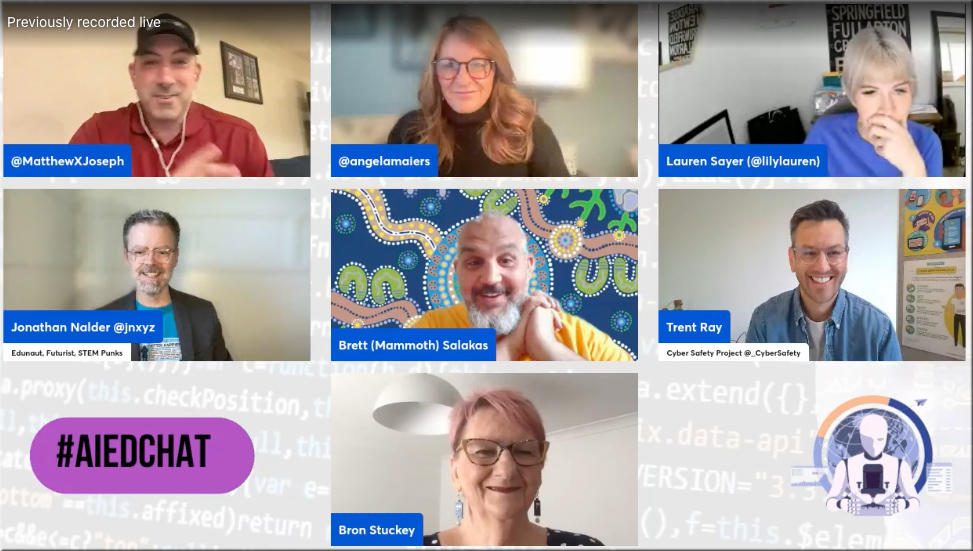
AI in EDU: Know the Risks –– from linkedin.com by Angela Maiers

AI in EDU -- Know the Risks


Along the lines of tools, also see:

6 Apps and Websites to Make Video Journals — from classtechtips.com by Monica Burns

Excerpt:

Have you made video journals with your students? Earlier this year on the blog, I shared some of the reasons why this medium is worth considering. Today on the blog, we’ll look at six apps and websites to make video journals alongside a few more reasons why video journals are worth considering.

There are several reasons why a teacher might introduce video journals to their students. First, video journals can be a powerful tool for self-reflection and personal growth. By creating and reflecting on videos of themselves, students can better understand their own thoughts, feelings, and behaviors and identify areas for improvement.

Video journals can also provide a creative outlet for students to express themselves. Students may enjoy experimenting with different video-editing techniques and sharing their work with their peers. This experience using video tools can transfer to additional learning experiences, especially because video journals can help students practice their communication skills in speaking and visual storytelling.


And speaking of tools and technologies, also see:

A Valentine for Education Technology — from campustechnology.com by Mary Grush and Gardner Campbell

Excerpt:

However, in making some adjustments for an online experience, I soon realized that I was able, actually, to enhance aspects of the Read-a-thon and thus the course as well. For the first time, I could choose to invite the wider Milton community to the event, encouraging people to join from many different points across the country and potentially around the globe!

I like certain kinds of management technologies that help me with record keeping and organization. But I don’t love them. I love technologies of communication because, I think, they’re at the heart of teaching and learning — creating opportunities for human beings to think together, to study something together.

 
© 2025 | Daniel Christian