The Ultimate Compilation of 101 GPT-4 L&D Prompts — from innovationlounge.notion.site

Examples:

  1. Design a personalized learning plan for a new employee joining a software development team, including onboarding, skill assessment, and ongoing development.
  2. Describe a strategy for implementing a mentorship program within an organization to improve employee development and retention.
  3. Suggest a framework for evaluating the effectiveness of a company’s existing learning and development programs.
  4. Propose a gamification strategy for engaging employees in a company-wide training program on diversity and inclusion.
  5. Identify potential barriers to effective remote learning and provide recommendations for overcoming them in a virtual training environment.
  6. Develop a plan for a “lunch-and-learn” series to encourage cross-functional collaboration and skill-sharing among employees.
  7. Recommend a variety of cost-effective resources (books, online courses, webinars, etc.) for training employees in project management skills.
  8. Design a three-month training program for a sales team to improve their negotiation and closing skills, including specific activities and milestones.
  9. Outline a strategy for integrating microlearning techniques into an organization’s existing training approach to boost knowledge retention and engagement.
  10. Suggest an approach for identifying and addressing skills gaps within a team or department, including assessment tools and targeted training resources.
 

Nvidia will bring AI to every industry, says CEO Jensen Huang in GTC keynote: ‘We are at the iPhone moment of AI’ — from venturebeat.com by Sharon Goldman

Excerpt:

As Nvidia’s annual GTC conference gets underway, founder and CEO Jensen Huang, in his characteristic leather jacket and standing in front of a vertical green wall at Nvidia headquarters in Santa Clara, California, delivered a highly-anticipated keynote that focused almost entirely on AI. His presentation announced partnerships with Google, Microsoft and Oracle, among others, to bring new AI, simulation and collaboration capabilities to “every industry.”

Introducing Mozilla.ai: Investing in trustworthy AI — from blog.mozilla.org by Mark Surman
We’re committing $30M to build Mozilla.ai: A startup — and a community — building a trustworthy, independent, and open-source AI ecosystem.

Excerpt (emphasis DSC):

We’re only three months into 2023, and it’s already clear what one of the biggest stories of the year is: AI. AI has seized the public’s attention like Netscape did in 1994, and the iPhone did in 2007.

New tools like Stable Diffusion and the just-released GPT-4 are reshaping not just how we think about the internet, but also communication and creativity and society at large. Meanwhile, relatively older AI tools like the recommendation engines that power YouTube, TikTok and other social apps are growing even more powerful — and continuing to influence billions of lives.

This new wave of AI has generated excitement, but also significant apprehension. We aren’t just wondering What’s possible? and How can people benefit? We’re also wondering What could go wrong? and How can we address it? Two decades of social media, smartphones and their consequences have made us leery.    

ChatGPT plugins — from openai.com

Excerpt:

Users have been asking for plugins since we launched ChatGPT (and many developers are experimenting with similar ideas) because they unlock a vast range of possible use cases. We’re starting with a small set of users and are planning to gradually roll out larger-scale access as we learn more (for plugin developers, ChatGPT users, and after an alpha period, API users who would like to integrate plugins into their products). We’re excited to build a community shaping the future of the human–AI interaction paradigm.


Bots like ChatGPT aren’t sentient. Why do we insist on making them seem like they are? — from cbc.ca by Matt Meuse
‘There’s no secret homunculus inside the system that’s understanding what you’re talking about’

Excerpt:

LLMs like ChatGPT are trained on massive troves of text, which they use to assemble responses to questions by analyzing and predicting what words could most plausibly come next based on the context of other words. One way to think of it, as Marcus has memorably described it, is “auto-complete on steroids.”

Marcus says it’s important to understand that even though the results sound human, these systems don’t “understand” the words or the concepts behind them in any meaningful way. But because the results are so convincing, that can be easy to forget.

“We’re doing a kind of anthropomorphization … where we’re attributing some kind of animacy and life and intelligence there that isn’t really,” he said.


10 gifts we unboxed at Canva Create — from canva.com
Earlier this week we dropped 10 unopened gifts onto the Canva homepage of 125 million people across the globe. Today, we unwrapped them on the stage at Canva Create.


Google Bard Plagiarized Our Article, Then Apologized When Caught — from tomshardware.com by Avram Piltch
The chatbot implied that it had conducted its own CPU tests.


How AI will revolutionize the practice of law — from brookings.edu by John Villasenor

Artificial intelligence (AI) is poised to fundamentally reshape the practice of law. 

Excerpt:

BROADENING ACCESS TO LEGAL SERVICES
AI also has the potential to dramatically broaden access to legal services, which are prohibitively expensive for many individuals and small businesses. As the Center for American Progress has written, “[p]romoting equal, meaningful access to legal representation in the U.S. justice system is critical to ending poverty, combating discrimination, and creating opportunity.”

AI will make it much less costly to initiate and pursue litigation. For instance, it is now possible with one click to automatically generate a 1000-word lawsuit against robocallers. More generally, drafting a well-written complaint will require more than a single click, but in some scenarios, not much more. These changes will make it much easier for law firms to expand services to lower-income clients.


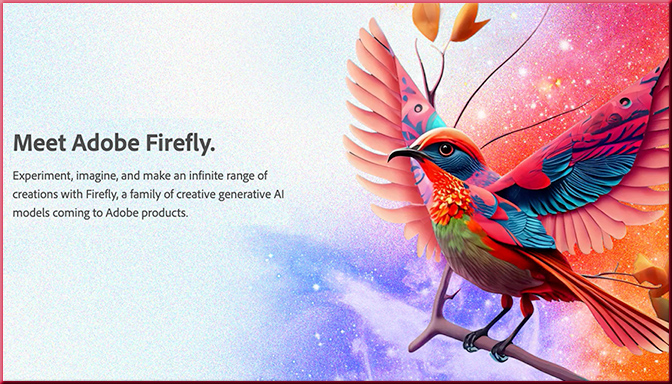
Meet Adobe Firefly. Experiment, imagine, and make an infinite range of creations with Firefly, a family of creative generative AI models coming to Adobe products.

Meet Adobe Firefly. — from adobe.com
Experiment, imagine, and make an infinite range of creations with Firefly, a family of creative generative AI models coming to Adobe products.

Generative AI made for creators.
With the beta version of the first Firefly model, you can use everyday language to generate extraordinary new content. Looking forward, Firefly has the potential to do much, much more.


Also relevant/see:

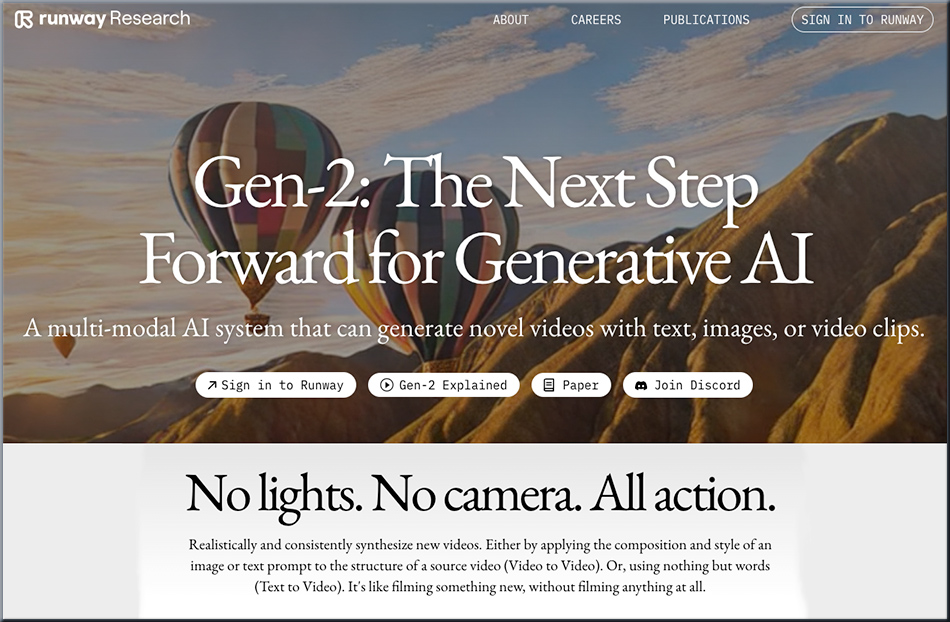
Gen-2 from runway Research -- the next step forward for generative AI

Gen-2: The Next Step Forward for Generative AI — from research.runwayml.com
A multi-modal AI system that can generate novel videos with text, images, or video clips.

Realistically and consistently synthesize new videos. Either by applying the composition and style of an image or text prompt to the structure of a source video (Video to Video). Or, using nothing but words (Text to Video). It’s like filming something new, without filming anything at all.


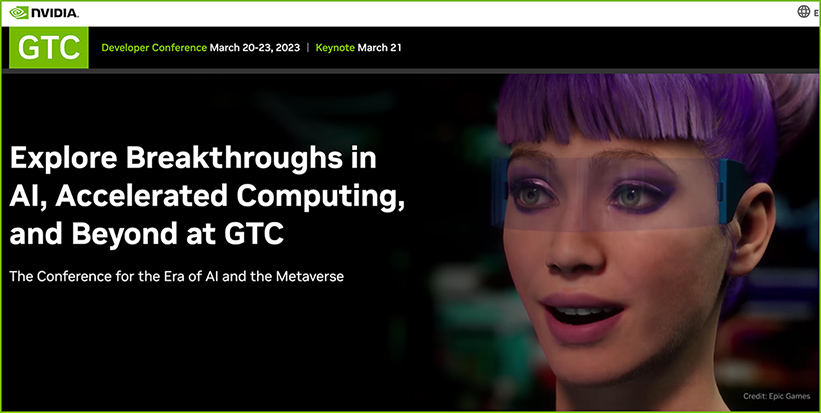
Explore Breakthroughs in AI, Accelerated Computing, and Beyond at NVIDIA's GTC -- keynote was held on March 21 2023

Explore Breakthroughs in AI, Accelerated Computing, and Beyond at GTC — from nvidia.com
The Conference for the Era of AI and the Metaverse


Addendums on 3/22/23:

Generative AI for Enterprises — from nvidia.com
Custom-built for a new era of innovation and automation.

Excerpt:

Impacting virtually every industry, generative AI unlocks a new frontier of opportunities—for knowledge and creative workers—to solve today’s most important challenges. NVIDIA is powering generative AI through an impressive suite of cloud services, pre-trained foundation models, as well as cutting-edge frameworks, optimized inference engines, and APIs to bring intelligence to your enterprise applications.

NVIDIA AI Foundations is a set of cloud services that advance enterprise-level generative AI and enable customization across use cases in areas such as text (NVIDIA NeMo™), visual content (NVIDIA Picasso), and biology (NVIDIA BioNeMo™). Unleash the full potential with NeMo, Picasso, and BioNeMo cloud services, powered by NVIDIA DGX™ Cloud—the AI supercomputer.


This AR Art App Helps You Paint Giant Murals — from vrscout.com by Kyle Melnick

This AR Art App Helps You Paint Giant Murals

Here’s another interesting item along the lines of emerging technologies:

AR-Powered Flashcards Offer A Fresh Spin On Learning — from vrscout.com by Kyle Melnick

Undergraduates Justin Nappi and Sudiksha Mallick developed SmartCards -- a new type of AR-powered flashcard

Excerpt:

Each SmartCard features a special marker that, when scanned with a tablet, unlocks informative virtual content students can interact with using basic hand gestures and buttons. According to its developers, Justin Nappi and Sudiksha Mallick, SmartCards can be especially useful for neurodivergent students, including those with attention-deficit/hyperactivity disorder (ADHD), autism, or dyslexia.


Introducing Microsoft 365 Copilot — your copilot for work

Copilot — A whole new way to work — from news.microsoft.com

  • Copilot in Word writes, edits, summarizes and creates right alongside people as they work.
  • Copilot in PowerPoint enables the creation process by turning ideas into a designed presentation through natural language commands.
  • Copilot in Excel helps unlock insights, identify trends or create professional-looking data visualizations in a fraction of the time.
  • Copilot in Outlook can help synthesize and manage the inbox to allow more time to be spent on actually communicating.
  • Copilot in Teams makes meetings more productive with real-time summaries and action items directly in the context of the conversation.
  • Copilot in Power Platform will help developers of all skill levels accelerate and streamline development with low-code tools with the introduction of two new capabilities within Power Apps and Power Virtual Agents.
  • Business Chat brings together data from across documents, presentations, email, calendar, notes and contacts to help summarize chats, write emails, find key dates or even write a plan based on other project files.

Introducing Microsoft 365 Copilot – your copilot for work — from blogs.microsoft.com by Jared Spataro

“Today marks the next major step in the evolution of how we interact with computing, which will fundamentally change the way we work and unlock a new wave of productivity growth,” said Satya Nadella, Chairman and CEO, Microsoft. “With our new copilot for work, we’re giving people more agency and making technology more accessible through the most universal interface — natural language.”

Introducing Microsoft 365 Copilot — A whole new way to work — from microsoft.com by Colette Stallbaumer

Excerpt:

Copilot is integrated into Microsoft 365 in two ways. It works alongside you, embedded in the Microsoft 365 apps you use every day—Word, Excel, PowerPoint, Outlook, Teams, and more—to unleash creativity, unlock productivity, and uplevel skills. Today, we’re also announcing an entirely new experience: Business Chat. Business Chat works across the LLM, the Microsoft 365 apps, and your data—your calendar, emails, chats, documents, meetings, and contacts—to do things you’ve never been able to do before. You can give it natural language prompts like “tell my team how we updated the product strategy” and it will generate a status update based on the morning’s meetings, emails, and chat threads.


A new era for AI and Google Workspace — from workspace.google.com by Johanna Voolich Wright

Excerpt:

As we embark on this next journey, we will be bringing these new generative-AI experiences to trusted testers on a rolling basis throughout the year, before making them available publicly.

With these features, you’ll be able to:

  • draft, reply, summarize, and prioritize your Gmail
  • brainstorm, proofread, write, and rewrite in Docs
  • bring your creative vision to life with auto-generated images, audio, and video in Slides
  • go from raw data to insights and analysis via auto-completion, formula generation, and
  • contextual categorization in Sheets
  • generate new backgrounds and capture notes in Meet
  • enable workflows for getting things done in Chat

Here’s a look at the first set of AI-powered features, which make writing even easier.


Description of video:

Sal Khan walks through Khan Academy’s GPT-4 integration (not generally available yet). Folks can join the waitlist at Khanacademy.org. To learn more about Khanmigo, visit: khanacademy.org/khan-labs

We believe that AI has the potential to transform learning in a positive way, but we are also keenly aware of the risks. To test the possibilities, we’re inviting our district partners to opt in to Khan Labs, a new space for testing learning technology. We want to ensure that our work always puts the needs of students and teachers first, and we are focused on ensuring that the benefits of AI are shared equally across society. In addition to teachers and students, we’re inviting the general public to join a waitlist to test Khanmigo. Teachers, students and donors will be our partners on this learning journey, helping us test AI to see if we can harness it as a learning tool for all.


GPT-4 has arrived. It will blow ChatGPT out of the water. — from washingtonpost.com by Drew Harwell and Nitasha Tiku
The long-awaited tool, which can describe images in words, marks a huge leap forward for AI power — and another major shift for ethical norms


Introducing Our Virtual Volunteer Tool for People who are Blind or Have Low Vision, Powered by OpenAI’s GPT-4 — from bemyeyes.com
We are thrilled to announce Be My Eyes Virtual Volunteer™, the first-ever digital visual assistant powered by OpenAI’s new GPT-4 language model.


For example, [GPT-4] passes a simulated bar exam with a score around the top 10% of test takers; in contrast, GPT-3.5’s score was around the bottom 10%. 

Source


ChatGPT as a teaching tool, not a cheating tool — from timeshighereducation.com by Jennifer Rose
How to use ChatGPT as a tool to spur students’ inner feedback and thus aid their learning and skills development

Excerpt:

Use ChatGPT to spur student’s inner feedback
One way that ChatGPT answers can be used in class is by asking students to compare what they have written with a ChatGPT answer. This draws on David Nicol’s work on making inner feedback explicit and using comparative judgement. His work demonstrates that in writing down answers to comparative questions students can produce high-quality feedback for themselves which is instant and actionable. Applying this to a ChatGPT answer, the following questions could be used:

  • Which is better, the ChatGPT response or yours? Why?
  • What two points can you learn from the ChatGPT response that will help you improve your work?
  • What can you add from your answer to improve the ChatGPT answer?
  • How could the assignment question set be improved to allow the student to demonstrate higher-order skills such as critical thinking?
  • How can you use what you have learned to stay ahead of AI and produce higher-quality work than ChatGPT?
 

Fostering sustainable learning ecosystems — from linkedin.com by Patrick Blessinger

Excerpt (emphasis DSC):

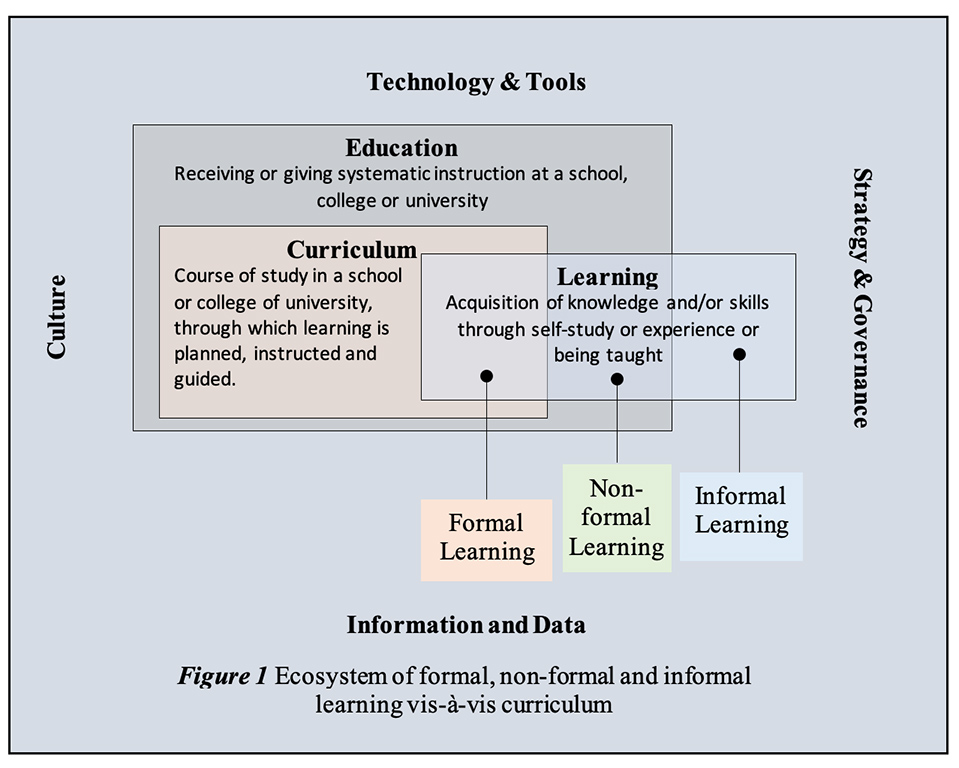
Learning ecosystems
As today’s global knowledge society becomes increasingly interconnected and begins to morph into a global learning society, it is likely that formal, nonformal, and informal learning will become increasingly interconnected. For instance, there has been an explosion of new self-directed e-learning platforms such as Khan Academy, Open Courseware, and YouTube, among others, that help educate billions of people around the world.

A learning ecosystem includes all the elements that contribute to a learner’s overall learning experience. The components of a learning ecosystem are numerous, including people, technology platforms, knowledge bases, culture, governance, strategy, and other internal and external elements that have an impact on learning. Therefore, moving forward, it is crucial to integrate learning across formal, nonformal, and informal learning processes and activities in a more strategic way.

Learning ecosystems -- formal, informal, and nonformal sources of learning will become more tightly integrated in the future


Working To Incorporate Legal Technology Into Your Practice Isn’t Just A Great Business Move – It’s Required — from abovethelaw.com by Chris Williams

Excerpt:

According to Model Rule 1.1 of the ABA Model Rules of Professional Conduct: “A lawyer shall provide competent representation to a client. Competent representation requires the legal knowledge, skill, thoroughness and preparation reasonably necessary for the representation.”

In 2012, the ABA House of Delegates voted to amend Comment 8 to Model Rule 1.1 to include explicit guidance on lawyers’ use of technology.

If Model Rule 1.1 isn’t enough of a motivator to dip your feet in legal tech, maybe paying off that mortgage is. As an extra bit of motivation, it may benefit you to pin the ABA House of Delegate’s call to action on your motivation board.

Also relevant/see:

While courts still use fax machines, law firms are using AI to tailor arguments for judges — from cbc.ca by Robyn Schleihauf

Excerpt (emphasis DSC):

What is different with AI is the scale by which this knowledge is aggregated. While a lawyer who has been before a judge three or four times may have formed some opinions about them, these opinions are based on anecdotal evidence. AI can read the judge’s entire history of decision-making and spit out an argument based on what it finds. 

The common law has always used precedents, but what is being used here is different — it’s figuring out how a judge likes an argument to be framed, what language they like using, and feeding it back to them.

And because the legal system builds on itself — with judges using prior cases to determine how a decision should be made in the case before them — these AI-assisted arguments from lawyers could have the effect of further entrenching a judge’s biases in the case law, as the judge’s words are repeated verbatim in more and more decisions. This is particularly true if judges are unaware of their own biases.

Cutting through the noise: The impact of GPT/large language models (and what it means for legal tech vendors) — from legaltechnology.com by Caroline Hill

Excerpts:

Given that we have spent time over the past few years telling people not to get to overestimate the capability of AI, is this the real deal?

“Yeah, I think it’s the real thing because if you look at why legal technologies have not had the adoption rate historically, language has always been the problem,” Katz said. “Language has been hard for machines historically to work with, and language is core to law. Every road leads to a document, essentially.”
…
Katz says: “There are two types of things here. They would call general models GPT one through four, and then there’s domain models, so a legal specific large language model.
…
“What we’re going to see are large-ish, albeit not the largest model that’s heavily domain tailored is going to beat a general model in the same way that a really smart person can’t beat a super specialist. That’s where the value creation and the next generation of legal technology is going to live.”

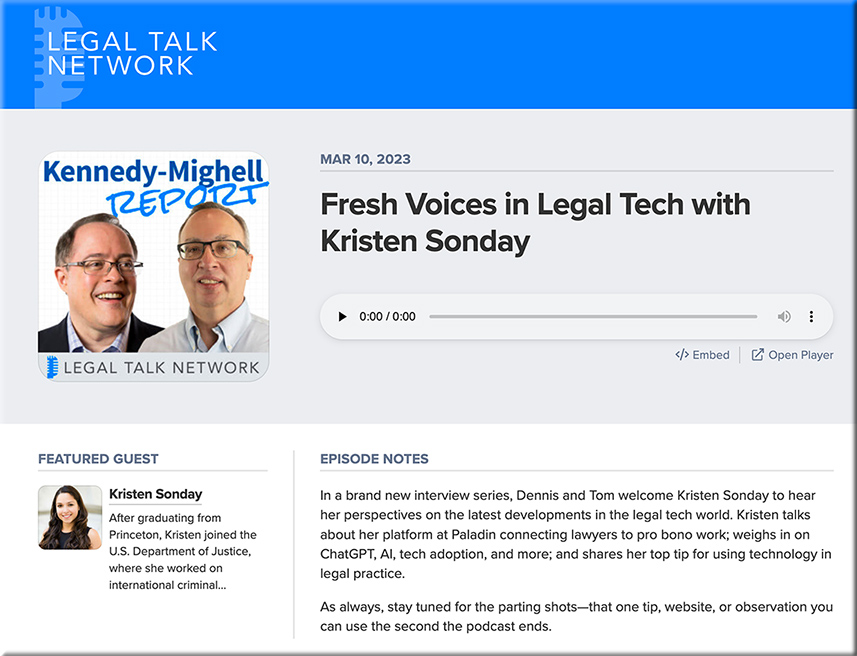
Fresh Voices in Legal Tech with Kristen Sonday — from legaltalknetwork.com by Dennis Kennedy and Tom Mighell with Kristen Sonday

In a brand new interview series, Dennis and Tom welcome Kristen Sonday to hear her perspectives on the latest developments in the legal tech world.


An inside look at a 5th grade classroom using ChatGPT — from abcnews.go.com
Kentucky teacher Donnie Piercey uses ChatGPT with his fifth frade students.

Excerpt:

“Like every other educator, I had that concern. Is this something that students are only going to use to cheat? So I started to think about like, ‘OK, what role is AI — artificial intelligence — going to play in the classroom?'” Piercey, the 2021 Kentucky Teacher of the Year, told “Good Morning America.” “And the more that I thought about it, I realized that there’s a lot more good that can come about through AI as opposed to negative things that can come in the classroom.”


The Librarian: Can we prompt ChatGPT to generate reliable references? — from drphilippahardman.substack.com by Dr. Philippa Hardman

Lessons Learned

  • Always assume that ChatGPT is wrong until you prove otherwise.
  • Validate everything (and require your students to validate everything too).
  • Google Scholar is a great tool for validating ChatGPT outputs rapidly.
  • The prompt works better when you provide a subject area, e.g. visual anthropology, and then a sub-topic, e.g. film making.
  • Ignore ChatGPT’s links – validate by searching for titles & authors, not URLs.
  • Use intentional repetition, e.g. of Google Scholar, to focus ChatGPT’s attention.
  • Be aware: ChatGPT’s outputs end at 2021. You need to fill in the blanks since then.
 

ChatGPT is Everywhere — from chronicle.com by Beth McMurtrie
Love it or hate it, academics can’t ignore the already pervasive technology.

Excerpt:

Many academics see these tools as a danger to authentic learning, fearing that students will take shortcuts to avoid the difficulty of coming up with original ideas, organizing their thoughts, or demonstrating their knowledge. Ask ChatGPT to write a few paragraphs, for example, on how Jean Piaget’s theories on childhood development apply to our age of anxiety and it can do that.

Other professors are enthusiastic, or at least intrigued, by the possibility of incorporating generative AI into academic life. Those same tools can help students — and professors — brainstorm, kick-start an essay, explain a confusing idea, and smooth out awkward first drafts. Equally important, these faculty members argue, is their responsibility to prepare students for a world in which these technologies will be incorporated into everyday life, helping to produce everything from a professional email to a legal contract.

“Artificial-intelligence tools present the greatest creative disruption to learning that we’ve seen in my lifetime.”

Sarah Eaton, associate professor of education at the University of Calgary


Artificial intelligence and academic integrity, post-plagiarism — from universityworldnews.com Sarah Elaine Eaton; with thanks to Robert Gibson out on LinkedIn for the resource

Excerpt:

The use of artificial intelligence tools does not automatically constitute academic dishonesty. It depends how the tools are used. For example, apps such as ChatGPT can be used to help reluctant writers generate a rough draft that they can then revise and update.

Used in this way, the technology can help students learn. The text can also be used to help students learn the skills of fact-checking and critical thinking, since the outputs from ChatGPT often contain factual errors.

When students use tools or other people to complete homework on their behalf, that is considered a form of academic dishonesty because the students are no longer learning the material themselves. The key point is that it is the students, and not the technology, that is to blame when students choose to have someone – or something – do their homework for them.

There is a difference between using technology to help students learn or to help them cheat. The same technology can be used for both purposes.

From DSC:
These couple of sentences…

In the age of post-plagiarism, humans use artificial intelligence apps to enhance and elevate creative outputs as a normal part of everyday life. We will soon be unable to detect where the human written text ends and where the robot writing begins, as the outputs of both become intertwined and indistinguishable.

…reminded me of what’s been happening within the filmmaking world for years (i.e., such as in Star Wars, Jurrasic Park, and many others). It’s often hard to tell what’s real and what’s been generated by a computer.
 

‘ChatGPT Already Outperforms a lot of Junior Lawyers’: An Interview With Richard Susskind — from law.com by Laura Beveridge
For the last 20 years, the U.K. author and academic has been predicting that technology will revolutionise the legal industry. With the buzz around generative AI, will his hypothesis now be proven true?

Excerpts:

For this generation of lawyers, their mission and legacy ought to be to build the systems that replace our old ways of working, he said. Moreover, Susskind identified new work for lawyers, such as legal process analyst or legal data scientist, emerging from technological advancement.

“These are the people who will be building the systems that will be solving people’s legal problems in the future.

“The question I ask is: imagine when the underpinning large language model is GPT 8.5.”

Blue J Legal co-founder Benjamin Alarie on how AI is powering a new generation of legal tech — from canadianlawyermag.com by Tim Wilbur

Excerpts:

We founded Blue J with the idea that we should be able to bring absolute clarity to the law everywhere and on demand. The name that we give to this idea is the legal singularity. I have a book with assistant professor Abdi Aidid called The Legal Singularity coming out soon on this idea.

The book paints the picture of where we think the law will go in the next several decades. Our intuition was not widely shared when we started the book and Blue J.

Since last November, though, many lawyers and journalists have been able to play with ChatGPT and other large language models. They suddenly understand what we have been excited about for the last eight years.

Neat Trick/Tip to Add To Your Bag! — from iltanet.org by Brian Balistreri

Excerpt:

If you need instant transcription of a Audio File, Word Online now allows you to upload a file, and it will transcribe, mark speaker changes, and provide time marks. You can use video files, just make sure they are small or office will kick you out.

Generative AI Is Coming For the Lawyers — from wired.com by Chris Stoken-Walker
Large law firms are using a tool made by OpenAI to research and write legal documents. What could go wrong?

Excerpts:

The rise of AI and its potential to disrupt the legal industry has been forecast multiple times before. But the rise of the latest wave of generative AI tools, with ChatGPT at its forefront, has those within the industry more convinced than ever.

“I think it is the beginning of a paradigm shift,” says Wakeling. “I think this technology is very suitable for the legal industry.”
…
The technology, which uses large datasets to learn to generate pictures or text that appear natural, could be a good fit for the legal industry, which relies heavily on standardized documents and precedents.

“Legal applications such as contract, conveyancing, or license generation are actually a relatively safe area in which to employ ChatGPT and its cousins,” says Lilian Edwards, professor of law, innovation, and society at Newcastle University. “Automated legal document generation has been a growth area for decades, even in rule-based tech days, because law firms can draw on large amounts of highly standardized templates and precedent banks to scaffold document generation, making the results far more predictable than with most free text outputs.”

But the problems with current generations of generative AI have already started to show.

 
© 2025 | Daniel Christian