Google Devising Radical Search Changes to Beat Back A.I. Rivals — from nytimes.com by Nico Grant
The tech giant is sprinting to protect its core business with a flurry of projects, including updates to its search engine and plans for an all-new one.

Excerpt:

Google’s employees were shocked when they learned in March that the South Korean consumer electronics giant Samsung was considering replacing Google with Microsoft’s Bing as the default search engine on its devices.

For years, Bing had been a search engine also-ran. But it became a lot more interesting to industry insiders when it recently added new artificial intelligence technology.
…
A.I. competitors like the new Bing are quickly becoming the most serious threat to Google’s search business in 25 years, and in response, Google is racing to build an all-new search engine powered by the technology. It is also upgrading the existing one with A.I. features, according to internal documents reviewed by The Times.

P.S. According to The Rundown’s take on this:

The bottom line: Google is replacing the old-school method of displaying 10 results per page with an intelligent chatbot that provides instant answers.


Also relevant/see:

Google planning new search engine while working on new search features under Project Magi — from searchengineland.com by Barry Schwartz
Project Magi will help searchers complete transactions while incorporating search ads on the page.


Also relevant/see:
 

A.I. Is Coming for Lawyers, Again — from nytimes.com by Steve Lohr (behind paywall)
Previous advances in A.I. inspired predictions that the law was the lucrative profession most likely to suffer job losses. It didn’t happen. Is this time different?

Excerpt:

But unless the past isn’t a guide, the impact of the new technology is more likely to be a steadily rising tide than a sudden tidal wave. New A.I. technology will change the practice of law, and some jobs will be eliminated, but it also promises to make lawyers and paralegals more productive, and to create new roles. That is what happened after the introduction of other work-altering technologies like the personal computer and the internet.

One new study, by researchers at Princeton University, the University of Pennsylvania and New York University, concluded that the industry most exposed to the new A.I. was “legal services.” Another research report, by economists at Goldman Sachs, estimated that 44 percent of legal work could be automated. Only the work of office and administrative support jobs, at 46 percent, was higher.

Lawyers are only one occupation in the path of A.I. progress. A study by researchers at OpenAI, the creator of ChatGPT, and the University of Pennsylvania found that about 80 percent of American workers would have at least 10 percent of their tasks affected by the latest A.I. software.

Also relevant/see:

039 | Micro-legal & AI Legal Help — from thebrainyacts.beehiiv.com

Keywords for Better ChatGPT Responses


AutoGPT is the next big thing in AI— from therundown.ai by Rowan Cheung

Excerpt:

AutoGPT has been making waves on the internet recently, trending on both GitHub and Twitter. If you thought ChatGPT was crazy, AutoGPT is about to blow your mind.

AutoGPT creates AI “agents” that operate automatically on their own and complete tasks for you. In case you’ve missed our previous issues covering it, here’s a quick rundown:

    • It’s open-sourced [code]
    • It works by chaining together LLM “thoughts”
    • It has internet access, long-term and short-term memory, access to popular websites, and file storage

.


From DSC:
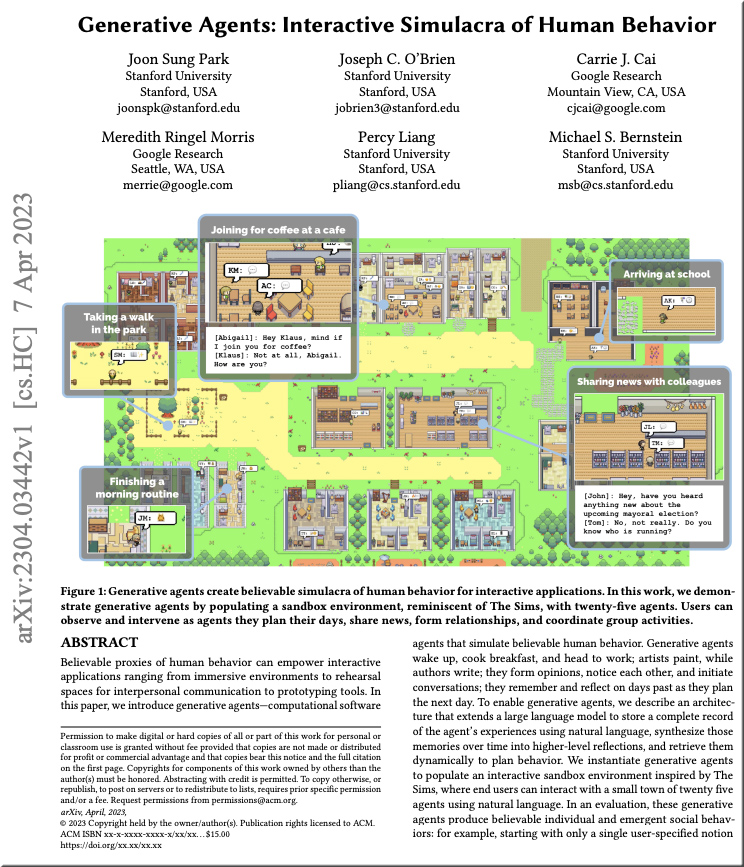
I want to highlight that paper from Stanford, as I’ve seen it cited several times recently:.

Generative Agents: Interactive Simulacra of Human Behavior -- a paper from Stanford from April 2023


From DSC:
And for a rather fun idea/application of these emerging technologies, see:

  • Quick Prompt: Kitchen Design — from linusekenstam.substack.com by Linus Ekenstam
    Midjourney Prompt. Create elegant kitchen photos using this starting prompt. Make it your own, experiment, add, remove and tinker to create new ideas.

…which made me wonder how we might use these techs in the development of new learning spaces (or in renovating current learning spaces).


From DSC:
On a much different — but still potential — note, also see:

A.I. could lead to a ‘nuclear-level catastrophe’ according to a third of researchers, a new Stanford report finds — from fortune.com by Tristan Bove

Excerpt:

Many experts in A.I. and computer science say the technology is likely a watershed moment for human society. But 36% don’t mean that as a positive, warning that decisions made by A.I. could lead to “nuclear-level catastrophe,” according to researchers surveyed in an annual report on the technology by Stanford University’s Institute for Human-Centered A.I., published earlier this month.


How Easy Is It/Will It Be to Use AI to Design a Course? — from wallyboston.com by Wally Boston

Excerpt:

Last week I received a text message from a friend to check out a March 29th Campus Technology article about French AI startup, Nolej. Nolej (pronounced “Knowledge”) has developed an OpenAI-based instructional content generator for educators called NolejAI.

Access to NolejAI is through a browser. Users can upload video, audio, text documents, or a website url. NolejAI will generate an interactive micro-learning package which is a standalone digital lesson including content transcript, summaries, a glossary of terms, flashcards, and quizzes. All the lesson materials generated is based upon the uploaded materials.


From DSC:
I wonder if this will turn out to be the case:

I am sure it’s only a matter of time before NolejAI or another product becomes capable of generating a standard three credit hour college course. Whether that is six months or two years, it’s likely sooner than we think.


Also relevant/see:

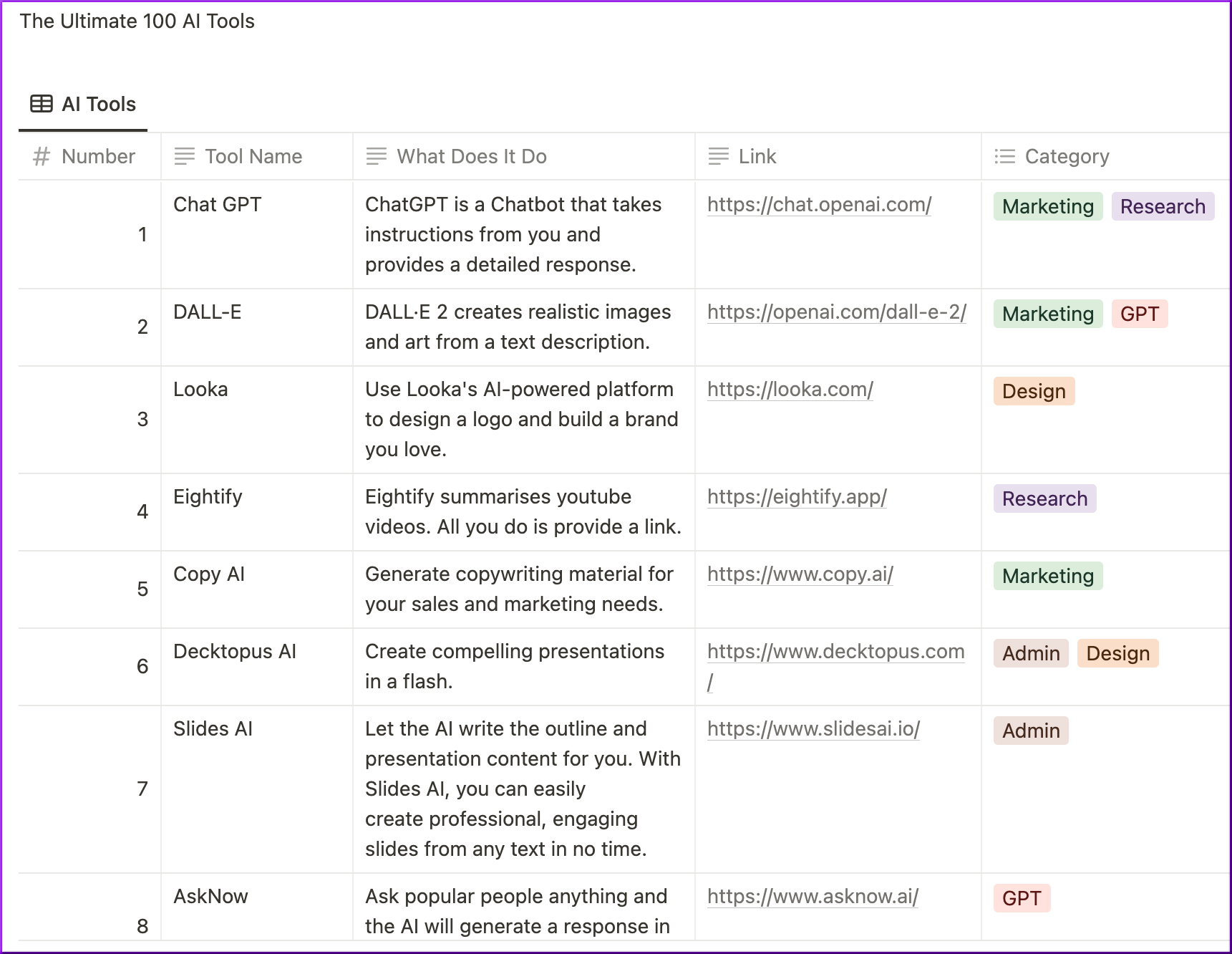
The Ultimate 100 AI Tools

The Ultimate 100 AI Tools -- as of 4-12-23


From DSC:
Before we get to Scott Belsky’s article, here’s an interesting/related item from Tobi Lutke:


Our World Shaken, Not Stirred: Synthetic entertainment, hybrid social experiences, syncing ourselves with apps, and more. — from implications.com by Scott Belsky
Things will get weird. And exciting.

Excerpts:

Recent advances in technology will stir shake the pot of culture and our day-to-day experiences. Examples? A new era of synthetic entertainment will emerge, online social dynamics will become “hybrid experiences” where AI personas are equal players, and we will sync ourselves with applications as opposed to using applications.

A new era of synthetic entertainment will emerge as the world’s video archives – as well as actors’ bodies and voices – will be used to train models. Expect sequels made without actor participation, a new era of ai-outfitted creative economy participants, a deluge of imaginative media that would have been cost prohibitive, and copyright wars and legislation.

Unauthorized sequels, spin-offs, some amazing stuff, and a legal dumpster fire: Now lets shift beyond Hollywood to the fast-growing long tail of prosumer-made entertainment. This is where entirely new genres of entertainment will emerge including the unauthorized sequels and spinoffs that I expect we will start seeing.


Also relevant/see:

Digital storytelling with generative AI: notes on the appearance of #AICinema — from bryanalexander.org by Bryan Alexander

Excerpt:

This is how I viewed a fascinating article about the so-called #AICinema movement.  Benj Edwards describes this nascent current and interviews one of its practitioners, Julie Wieland.  It’s a great example of people creating small stories using tech – in this case, generative AI, specifically the image creator Midjourney.

Bryan links to:

Artists astound with AI-generated film stills from a parallel universe — from arstechnica.com by Benj Edwards
A Q&A with “synthographer” Julie Wieland on the #aicinema movement.

An AI-generated image from an #aicinema still series called Vinyl Vengeance by Julie Wieland, created using Midjourney.


From DSC:
How will text-to-video impact the Learning and Development world? Teaching and learning? Those people communicating within communities of practice? Those creating presentations and/or offering webinars?

Hmmm…should be interesting!


The Future of Teaching is Here — from samchaltain.substack.com by Sam Chaltain

Excerpts (emphasis DSC):

It’s not sexy, but I feel like Sal Khan’s recent video introducing his Academy’s GPT-fueled AI tutor augurs the future of the teaching profession — and not just at Khan Academy.
…
The tutor is already fully capable of offering personalized feedback, hints and suggestions for just about any topic for which there are already clearly established answers — from solving math equations with parentheses to digesting John Locke’s political philosophy.
…
But now we’ve entered a new chapter — dare I say, a Technological Singularity (20 years early) — one in which Chat-GPT in particular, and the daily flood of AI tools more generally, has changed the nature of the teacher/student relationship even more irrevocably than before.

As a result, from this day forward, the job of a teacher REALLY needs to stop being about transmission.

So what should it start being instead?
…
In which case, the future of teaching is not about transmission, but it is about the other trans- words: transmedia exploration, transdisciplinary weaving, transcultural understanding, and, yes, personal and societal transformation.


How to Create Compelling Writing Assignments in a ChatGPT Age — from chronicle.com by James M. Lang
A recent book offers a road map to new kinds of assignments to inspire your students to write.

Excerpt:

A few days after I returned from the conference, I received a book in the mail that affirmed my newfound sense that 2023 has the potential to usher in an age of creative thinking about teaching and writing: Jessica Singer Early’s Next Generation Genres: Teaching Writing for Civic and Academic Engagement. Although her book doesn’t directly address ChatGPT, it offers exactly the kind of innovative ideas we need as we wrestle — or dance — with the implications of artificial intelligence for college teaching.
…
Clearly Jessica Singer Early has joined the leaning-into camp, seeing artificial intelligence as another invitation to reinvent ourselves in the classroom — just as she encourages readers to do in Next Generation Genres, and as this teacher plans to do in the fall.


Why some college professors are adopting ChatGPT AI as quickly as students — from cnbc.com by Carolyn Chun

Key Points:

  • A recent analysis by researchers at NYU, Princeton and the Wharton School finds that many of the jobs that will be most “exposed” to generative AI such as ChatGPT are in the college teaching profession.
  • One of the first narratives to emerge from the sudden explosion in usage of ChatGPT is the risk of students cheating on writing assignments.
  • But use by college teachers is growing quickly too, and adoption by educators may be critical to making the case that AI will augment the jobs humans are doing rather than replace them.

Also relevant/see:


Canva’s New AI Wonder Tools — from wondertools.substack.com  by Jeremy Caplan
A magic eraser, a branding kit, AI presentations, and more new features

Excerpt:

Canva launched a bunch of new features at a live event viewed by 1.5 million people globally. The Australian company is no longer an upstart. 125 million people use it monthly, including 13 million paid subscribers yielding $1.4 billion in revenue. Canva’s increasingly competing with Adobe to help people create eye-catching visuals. Here are its most useful new tricks.


From DSC:
After seeing this…

…I wondered:

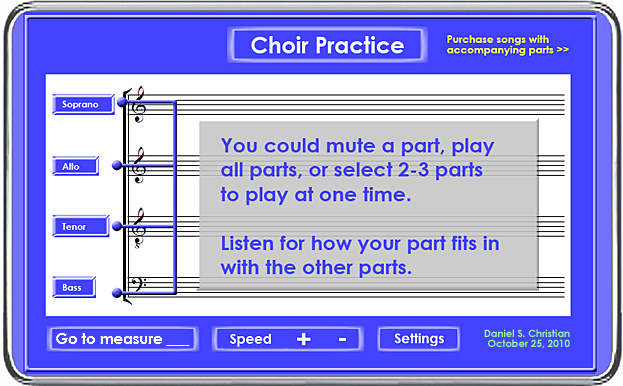
  • Could GPT-4 create the “Choir Practice” app mentioned below?
    (Choir Practice was an idea for an app for people who want to rehearse their parts at home)
  • Could GPT-4 be used to extract audio/parts from a musical score and post the parts separately for people to download/practice their individual parts?

This line of thought reminded me of this posting that I did back on 10/27/2010 entitled, “For those institutions (or individuals) who might want to make a few million.”

Choir Practice -- an app for people who want to rehearse at home

And I want to say that when I went back to look at this posting, I was a bit ashamed of myself. I’d like to apologize for the times when I’ve been too excited about something and exaggerated/hyped an idea up on this Learning Ecosystems blog. For example, I used the words millions of dollars in the title…and that probably wouldn’t be the case these days. (But with inflation being what it is, heh…who knows!? Maybe I shouldn’t be too hard on myself.) I just had choirs in mind when I posted the idea…and there aren’t as many choirs around these days.  🙂


Evolving Zoom IQ, our smart companion, with new features and a collaboration with OpenAI — from blog.zoom.us

Excerpt:

Today we’re announcing that we’re evolving the capabilities of Zoom IQ to become a smart companion that empowers collaboration and unlocks people’s potential by summarizing chat threads, organizing ideas, drafting content for chats, emails, and whiteboard sessions, creating meeting agendas, and more.


Also relevant/see:

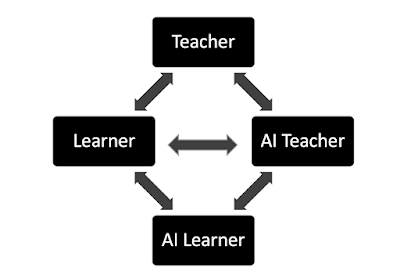
We have moved from Human Teachers and Human Learners, as a diad to AI Teachers and AI Learners as a tetrad.


Law has a magic wand now — from jordanfurlong.substack.com by Jordan Furlong
Some people think Large Language Models will transform the practice of law. I think it’s bigger than that.

Excerpts:

ChatGPT4 can also do things that only lawyers (used to be able to) do. It can look up and summarize a court decision, analyze and apply sections of copyright law, and generate a statement of claim for breach of contract.
…
What happens when you introduce a magic wand into the legal market? On the buyer side, you reduce by a staggering degree the volume of tasks that you need to pay lawyers (whether in-house or outside counsel) to perform. It won’t happen overnight: Developing, testing, revising, approving, and installing these sorts of systems in corporations will take time. But once that’s done, the beauty of LLMs like ChatGPT4 is that they are not expert systems. Anyone can use them. Anyone will.

But I can’t shake the feeling that someday, we’ll divide the history of legal services into “Before GPT4” and “After GPT4.” I think it’s that big.


From DSC:
Jordan mentions: “Some people think Large Language Models will transform the practice of law. I think it’s bigger than that.”

I agree with Jordan. It most assuredly IS bigger than that. AI will profoundly impact many industries/disciplines. The legal sector is but one of them. Education is another. People’s expectations are now changing — and the “ramification wheels” are now in motion.

I take the position that many others have as well (at least as of this point in time) that take the position that AI will supplement humans’ capabilities and activities. But those who know AI-driven apps will outcompete those who don’t know about such apps. 

 
© 2025 | Daniel Christian