By the end of this year, about 50 employees will have donned the Oculus Rift headsets and participated in the VR training program, said Farmers Insurance chief claims officer Keith Daly. The company plans for hundreds more to be trained using the next year, and, eventually, get all of its thousands of claims adjusters through the program, Daly said.
The goal is to build on the company’s existing two-to-three week training that workers attend before going into real world to inspect homes damaged in earthquakes, floods, and other major catastrophes.
What if a text or work of art is no longer read, but instead, experienced? What new questions are raised when it’s possible to visit an author’s home or stroll through the streets of an ancient city? How will our interpretations of literature, art, history and archaeology change when we are no longer passive recipients but co-constructors and actors in immersive experiences? How will this challenge us to think outside our current learning paradigms? These and other questions arise when we examine the impact of immersive technologies on the humanities and the social sciences.
Microsoft is launching its own answer to virtual reality today, taking on HTC and Oculus in the process. Windows Mixed Reality will be available in the Windows 10 Fall Creators Update, and headsets are now available to buy. Here’s everything you need to know about Windows Mixed Reality.
…
Microsoft is offering movement tracking (six degrees of freedom) without the need for traditional external sensors placed throughout a room. Windows Mixed Reality headsets have cameras and sensors to track the motion controllers.
…Walmart, the world’s largest retailer, is setting its sights on virtual reality. Imagine this, says Katie Finnegan, who heads Walmart’s tech incubator: You need a tent for your next camping trip. If all goes to plan, you could one day virtually swoop in to your campsite and see any given tent in action. “You could unzip it, lay down, look left and right and say, ‘Oh, this is supposed to be a two-person tent? It’s kind of tight,’ ” she said. And then you could move on to the next tent — without leaving your couch.
…
Here are the five ideas the Bentonville, Ark.-based company says could be making their way online:
3-D holograms at Bonobos.com, the male clothing site Walmart acquired this year for $310 million, that would make it possible for shoppers to try on virtual clothing for fit and style.
At ModCloth, the women’s clothing site Walmart took over in March, customers may one day be able to take 3-D photos of themselves using their smartphones, and use those images to get an idea of how something might look on.
An “interactive virtual store” for designer Rebecca Minkoff, whose items are sold at Walmart.com, would allow customers to sit in on fashion shows and shop directly from the runway.
Tired of shopping online alone? If Walmart gets its way, you may soon be interacting with other shoppers and experts as you pick out items for your virtual cart.
Electric outlets, stove tops and door handles can all be child safety hazards — and soon, an online tool could peek inside your home and tell you where the biggest risks are lurking.
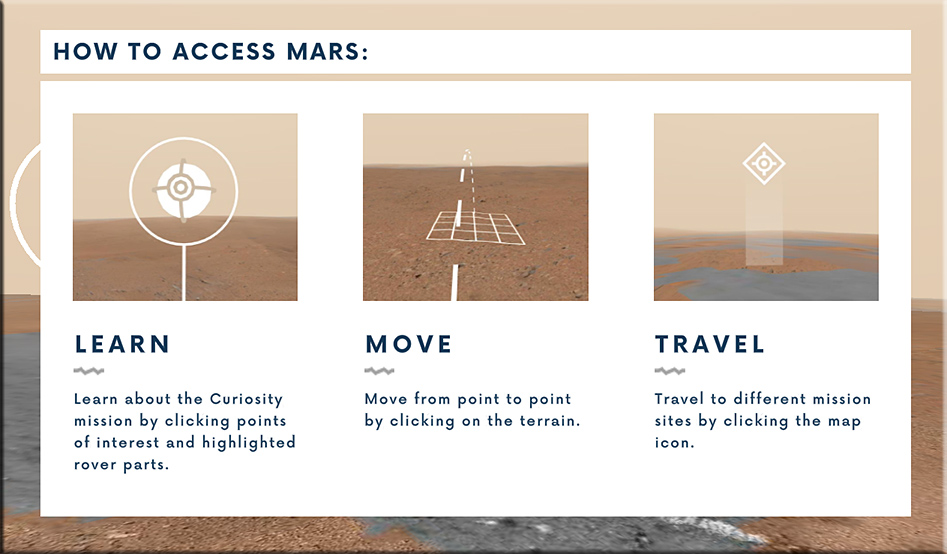
NASA and Google have teamed up to build a new virtual experience that lets space enthusiasts explore the red planet without having to leave their homes. Dubbed as “Access Mars”, the new project virtually transports users, wherever they are, to Earth’s neighboring planet in the solar system.
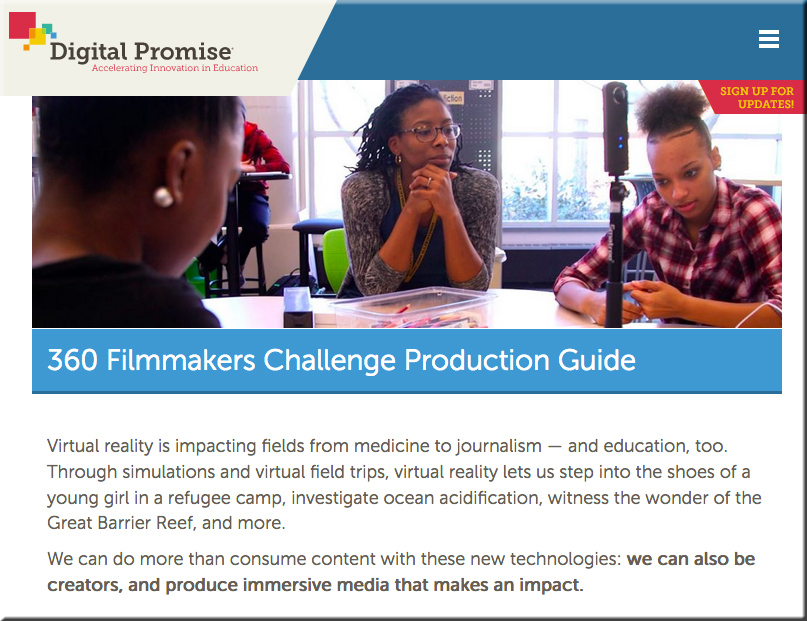
Now the two organizations have produced a free online guide that covers tools and resources to help students undertake 360-degree production. Among the topics: how to identify the “big ideas” worth exploring and personalize them; how to do 360-degree recording and handle pre-production, production and post-production; and how to share the film “with the world” and assess its impact. There’s also an educator resource on integrating video production into the curriculum.
EDU@2035 BIG SHIFTS ARE COMING! LOOKING BACK FROM 2035 Excerpt:
It’s hard for us to imagine a future that is not like the present. When looking at familiar terrain in the rear-view mirror, we must remind ourselves that – less than 50 years ago – two of the world’s biggest companies (Wal-Mart, Apple) had not yet incorporated or that 3 of the 5 largest companies in the world today are Chinese. Google is just preparing for its 20th anniversary, while global giants like Alibaba, Facebook and TenCent are not yet 15 years old! Worldwide, investors are pouring more than USD 3 Billion every year into educational technologies. How might innovations that flow from this investment change post-secondary education?
In 2035, will students choose among term-length and micro-courses from the Alibaba, Apple, Coursera, Sony, or YouTube catalogs? Will their instructors be at academies anywhere in the world, or might they be freelancers? Or chatbots? Will students wear prosthetic implants making it unnecessary to learn new languages? Will bionic devices give them augmented senses? Will we learn on campuses? In holodecks? At home? Using environmental scans, scenarios, probabilities and themes to fuel our imaginations, let’s envision what “automizing and digitizing” analysis, optimization, prophecy and customization might mean in and for post-secondary education’s mission!
From the rear-view mirror of 2035, our landscape might look as follows… .
Emerging Tech Boosts Online Education Growth Over Next 4 Years— from edtechmagazine.com by Meghan Bogardus Cortez A study finds that mobile devices, virtual reality and blending learning programs will spark innovation.
Excerpt: With millions of students enrolling in at least one online course, it should be no surprise that a recent Technavio study found that the online education market is forecasted to grow at a compound annual growth rate of 20 percent until 2021. As enrollment and investment in online education increases, the report claims that the industry owes a lot of this growth to mobile devices and increased desire for blended learning opportunities.
Oculus’ biggest event of the year, Oculus Connect 4, kicked off Wednesday morning with an opening keynote reveal from Facebook’s Mark Zuckerberg.
The Facebook owned Oculus unveiled on stage their first standalone VR headset. Dubbed Oculus Go, the VR headset is a all-in one mobile computer, which means you don’t need to slide in your phone or plug it into a beefy gaming PC. There’s also no cords. The best part of it all, Oculus Go is priced at $199 and will be available in 2018.
For jobs that are particularly dangerous or high-stress, introducing employees to the environment through virtual reality is a smart approach. In recent years, companies have created realistic VR applications that they have used to train people from surgeons to firefighters. Virtual reality gives new employees as close an approximation to their new workplace as they can have without actually needing to be physically present. The exposure to the simulated high-stress environment should, theoretically, make the VR users more comfortable when they actually face the real-world equivalent.
Tips for Adding VR to Onboarding
Start with shorter VR onboarding videos.
Add interactivity to generate a more memorable training experience.
Measure the effectiveness of VR onboarding.
From DSC: I appreciated that the article included the following sentence: “For industries without a lot of change, the VR training modules can be used for numerous years.” This hints at the need to start small and be sure that your content won’t be changing all the time. If it does, VR may not be a good fit. It’s at least something to consider — along with the costs of the hardware to review/experience the training-related content (which are changing all of the time these days…and will likely continue to change for a while yet).
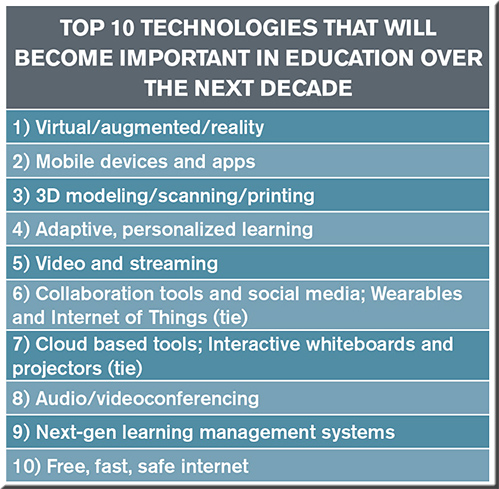
What technologies do faculty think will be important in education over the next decade? The most popular answer to that question by far was virtual/augmented/mixed reality, garnering 81 percent of responses (it topped the list last year as well). Mobile devices and apps, 3D modeling/scanning/printing, adaptive/personalized learning and video/streaming all rounded out the top five.
From DSC: Great to see several of these items made the list. I would also add:
The use of Natural Language Processing (NLP) to allow more voice-enabled and voice-driven applications
Learning agents/bots (for example, a learning-related bot could go find out the top 50-100 jobs that employers are hiring for and present a list of potential digital playlists from a variety of providers that would help potential employees be able to do the work in those positions)
Blockchain and the use of web-based learner profiles
Artificial Intelligence / cognitive computing (which could be argued is already mentioned in the item re: adaptive, personalized learning)
Moving towards providing up-to-date streams of content (for purposes of lifelong learning and microlearning)
Finally, it was great to see #9 on the list as I, too, believe that a next gen learning platform is needed:
The intelligent digital mesh is a foundation for future digital business and its ecosystems. To create competitive advantage, enterprise architecture and technology innovation leaders must evaluate these top trends to identify opportunities that their organizations can exploit.
Key Findings
Artificial intelligence (AI) delivers value to every industry, enabling new business models. It does so by supporting key initiatives such as customer engagement, digital production, smart cities, self-driving cars, risk management, computer vision and speech recognition.
As people, places, processes and “things” become increasingly digitalized, they will be represented by digital twins. This will provide fertile ground for new event-driven business processes and digitally enabled business models and ecosystems.
The way we interact with technology will undergo a radical transformation over the next five to 10 years. Conversational platforms, augmented reality, virtual reality and mixed reality will provide more natural and immersive interactions with the digital world.
A digital business is event-centric, which means it must be continuously sensing and adapting. The same applies to the security and risk infrastructure that supports it, which must focus on deceiving potential intruders and predicting security events.
Table of Contents
Analysis
Trend No. 1: AI Foundation
Today’s AI Is Narrow AI
Trend No. 2: Intelligent Apps and Analytics
Augmented Analytics Will Enable Users to Spend More Time Acting on Insights
Trend No. 3: Intelligent Things
Swarms of Intelligent Things Will Work Together
Trend No. 4: Digital Twins
Digital Twins Will Be Linked to Other Digital Entities
Trend No. 5: Cloud to the Edge
Edge Computing Brings Distributed Computing Into the Cloud Style
Trend No. 6: Conversational Platforms
Integration With Third-Party Services Will Further Increase Usefulness
Trend No. 7: Immersive Experience
VR and AR Can Help Increase Productivity
Trend No. 9: Event-Driven Model
Events Will Become More Important in the Intelligent Digital Mesh
Trend No. 10: Continuous Adaptive Risk and Trust
Barriers Must Come Down Between Security and Application Teams
Gartner Recommended Reading
Also see:
AI, Merging of Digital and Physical Worlds Among Top 10 Tech Trends for 2018 — from campustechnology.com by Joshua Bolkan Excerpt:
Gartner has released its list of top 10 strategic technology trends for 2018 with a focus for the coming year on technologies related to artificial intelligence and machine learning and those that blend the physical and digital worlds.
ASU students have set up Echo Dots, a hands-free, voice-controlled device the size of a hockey puck, in engineering residence halls.
Students can ask questions about topics ranging from the weather to campus sporting events to library hours to exam schedules.
“We’re continuing to add content as we’re learning what students want to learn about,” Rome said. “So there’s this feedback loop of what students want, and we monitor what questions are being asked.”
…
Amazon donated about 1,600 Dots to engineering students at ASU, so the technology belongs to the students, not to the school. The students can choose to use them or not, said John German, director for media relations and research communications.
“We have the largest engineering school in the country, and one of the things we’re trying to do is teach students the most advanced technology, the kinds of technology that are going to make them competitive in the job market when they get their degrees,” German said. “And voice technology is a field that’s growing. It’s going to play a role in the future.”
“Voice is becoming the new mobile of 10 years ago,” Rome said. “We’ve decided to be an early adopter of this technology.” … “There’s going to come some day when students can interact [with ASU’s student portal] via webpage or microphone on their mobile phones,” he said. “We think that’s inevitable.”
3 Ways AR Can Benefit the Enterprise: 1. Advanced ways to interact with data and training materials: In today’s world of Big Data, knowledge workers, manufacturing employees, and others are required to take on a number of data-intensive tasks: accessing, analyzing, and acting on large quantities of information, all while tackling the everyday collaboration and communication tasks of a normal work day. For employees in a number of industries, AR has the potential to be a game-changer in how employees interact with and share information because the technology overlays digital information over a user’s view of the real world.
…
2. Increased sales opportunities: For those brands who want to deliver richer customer experiences and increase sales, AR offers plenty of opportunities to transform the way that ustomers purchase products.
…
3. Enhanced model visualization: One useful ability of AR’s technological potential for the enterprise revolves around its 3D technology.
It’s something the theater is hoping to change with the help of Epson’s latest smart glasses. This week it launched a trial that will see deaf and hearing-impaired customers supplied with the eyewear, which displays subtitles in their field of vision wherever they’re sitting.
“The problem we’re aiming to solve is the lack of choice and the customer experience — it’s twofold,” Jonathan Suffolk, the theater’s technical director, said in an interview. The smart glass tech, he said, “gives customers the chance to come anytime they want, matinee or evening, and sit anywhere they want in any size theater.”
Like other technologies, AR has the potential to be a powerful constructivist learning technology that supports the personalized learning goals of students by bringing scannable content to life in an engaging and cost effective manner.
For a generation that’s been raised on interactive technologies, bringing AR into the classroom and curriculum can also help encourage active engagement and contribute to student retention.
…
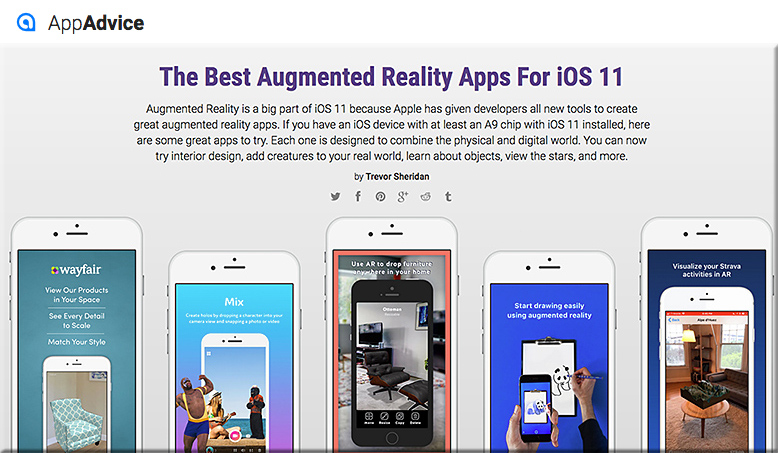
Here are a few top picks for introducing and creating AR experiences in the classroom.
I strongly believe that presence is the quality that makes Virtual Reality unique as a medium. Yet, analytical approaches to presence from a creative standpoint have been lacking. Let’s fix that.
With ARKit already baked into the mobile operating system of “hundreds of millions of iPhones and iPads,” the massive potential install base means there’s plenty of reasons for developers to start making new augmented reality apps for Apple’s App Store. Now Udacity, the for-profit online education site that was spawned from free Stanford University computer science classes, has created a course that says will take you one month to complete so you can start making your own AR apps for iOS.
From DSC: Again, how many of these types of courses/programs are in the works right now throughout traditional institutions of higher education? My guess? Very few.
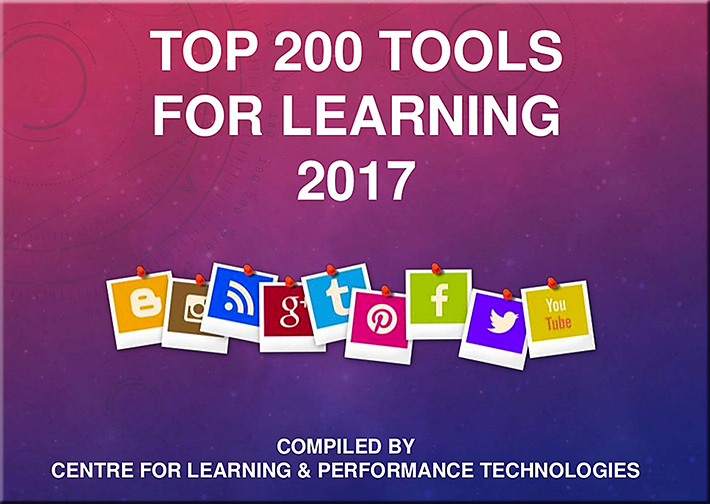
The Top 200 Tools for Learning 2017 (11th Annual Survey) has been compiled by Jane Hart of the Centre for Learning & Performance Technologies from the votes of 2,174 learning professionals worldwide, together with 3 sub-lists
Top 100 Tools for Personal & Professional Learning (PPL)
66 tools moved up the list. Top 3 risers are Unsplash (up 71 places), Grammarly (up 70 places) and Snapchat (up 64 places
Messaging apps and team tools are particularly on the rise: Slack is now up 8 places to #12, Trello is up 21 places to #22, Microsoft Teams is another new tool in at #79
52 NEW tools appear on the list this year – the highest entry is Typeform in at #55.
2 interesting new tools for augmented and virtual reality join the list – Aurasma, ENTiTi – as well as a chatbot system – Ultra Hal Assistant.
Some observations on what the Top Tools list tells us personal and professional learning As in previous years, individuals continue to using a wide variety of:
networks, services and platforms for professional networking, communication and collaboration
web resources and courses for self-improvement and self-development
tools for personal productivity
All of which shows that many individuals have become highly independent, continuous modern professional learners – making their own decisions about what they need to learn and how to do it.
If you are at all interesting in emerging technologies and what several pieces
of our future learning ecosystems — and meeting spaces — could easily look like,
you NEED to watch the entire presentation.
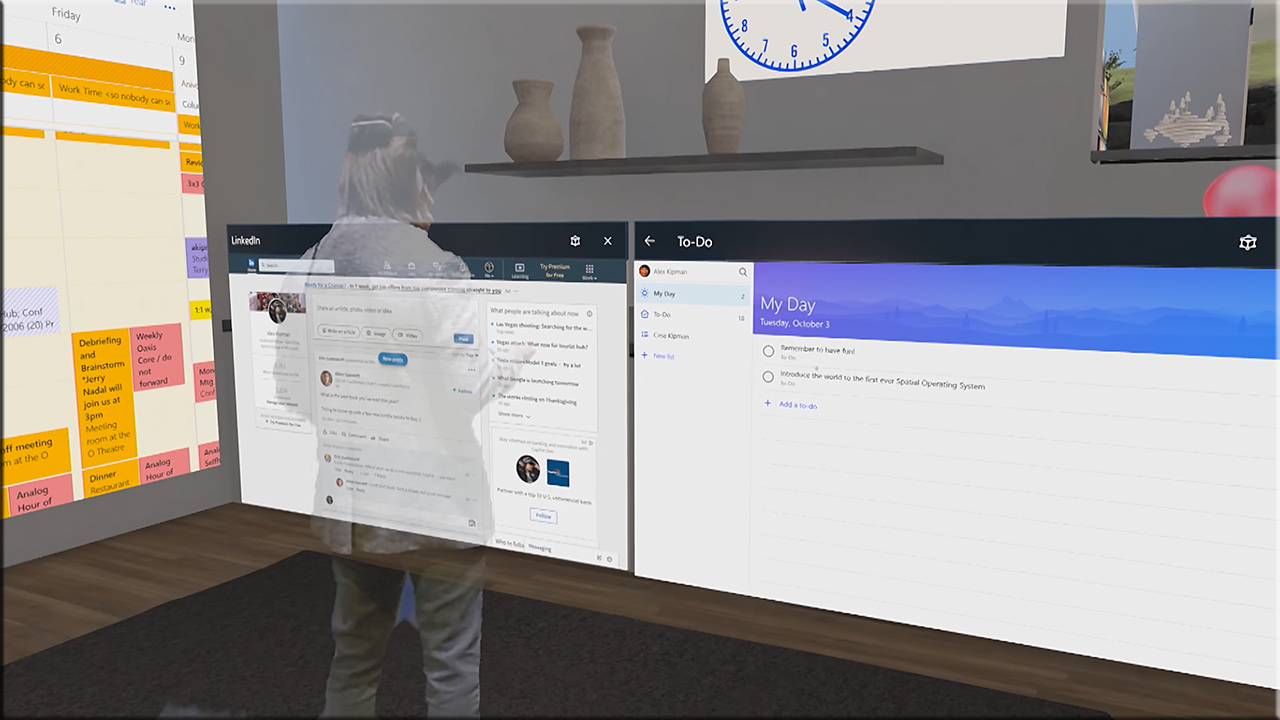
The era of Windows Mixed Reality begins October 17— from blogs.windows.com by Alex Kipman Samsung unveils Windows Mixed Reality headset, AltSpaceVR joins Microsoft, SteamVR catalog coming to Windows Mixed Reality this holiday.
At an event in San Francisco we unveiled our vision for Windows Mixed Reality, announced SteamVR and AltSpaceVR are coming to Windows Mixed Reality, introduced the new Samsung Odyssey HMD, and kicked off the holiday shopping season by announcing the availability of pre-orders for Windows Mixed Reality headsets at the Microsoft Store.
Microsoft held its long-awaited launch of Windows 10 Mixed Reality yesterday, and while most of the new devices and products had been leaked earlier, there were still some big takeaways. Here are some of them:
Mixed Reality: Microsoft gave a demo of what its new platform will do, covering the AR/VR spectrum with games, apps, and experiences. One such experience is Cliff House, a virtual work space and entertainment room.
Altspace VR: When the pioneering social VR app shut down this summer and was rescued by a “third party,” people wondered who that was. Turns out it was Microsoft, which acquired Altspace VR for an undisclosed amount. The acquisition was announced yesterday.
Steam VR and Halo: Microsoft had previously announced that its new Mixed Reality headsets would support Steam VR titles. Developers can now access that support, and consumers will be able to access it later this year. In addition to the hundreds of VR titles available on Steam, on Oct. 17, Microsoft will offer free downloads of Halo Recruit.
Odyssey and other headsets: The new Windows 10 platform is launching alongside a host of new headsets. In addition to the new Odyssey, which was made in partnership with Samsung, there are other headsets forthcoming from Acer, HP, Dell, Lenovo, and Asus.
2018 Olympics: This was announced previously in June, but yesterday Microsoft briefed the press that Intel is partnering with the International Olympic Committee to bring Windows Mixed Reality experiences to the 2018 games.
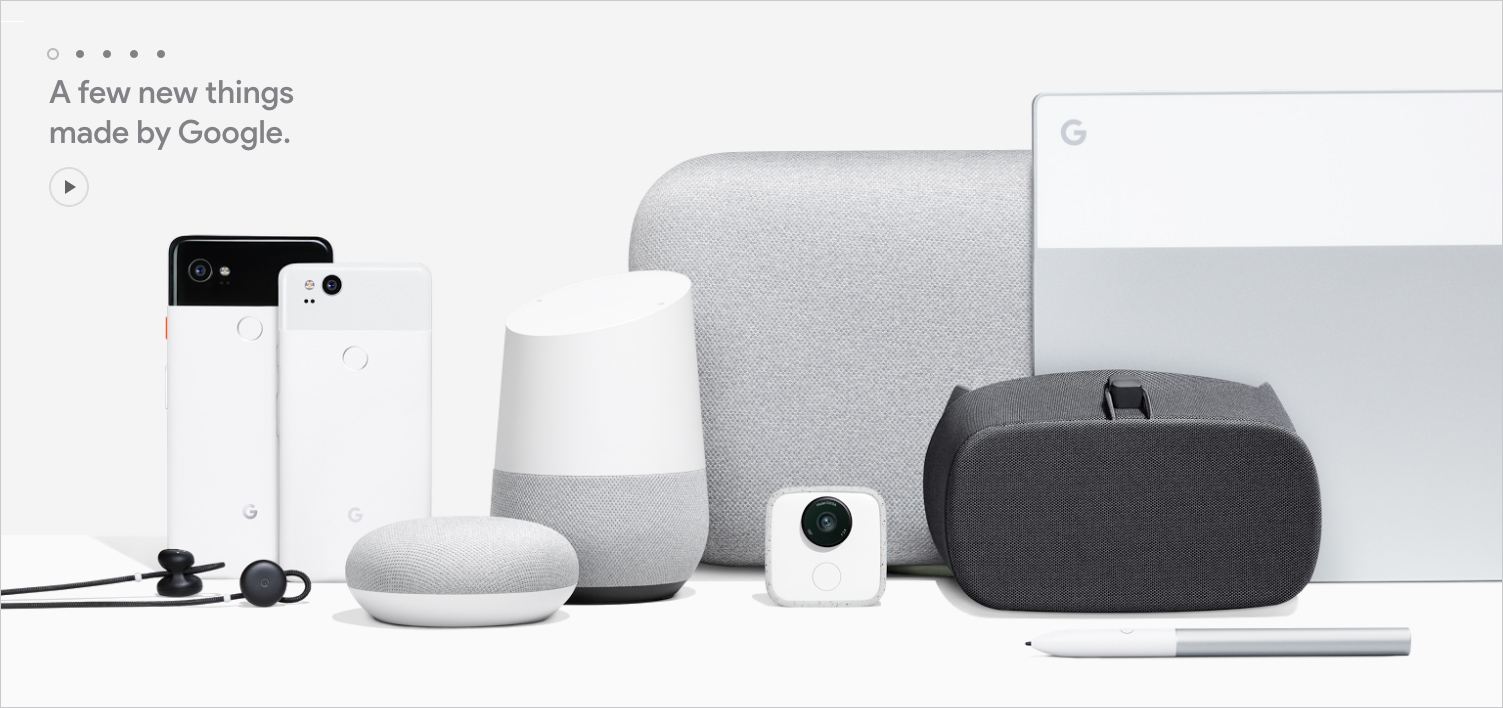
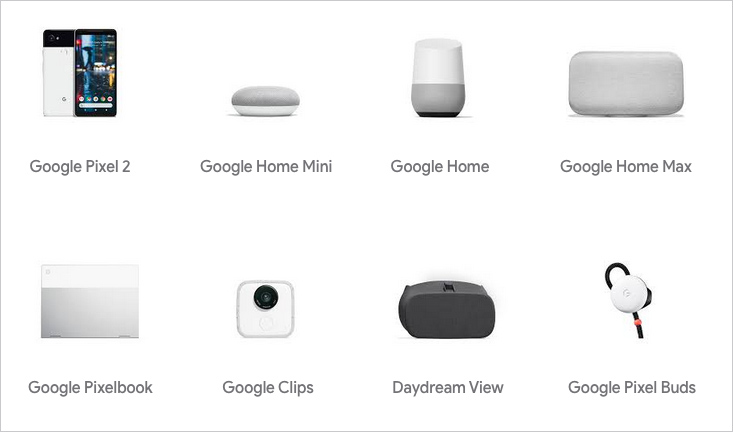
Watch the Google Pixel 2 event in 19 minutes — from the verge.com by Natt Garun The Google Pixel event has wrapped and we got a good look at a bunch of new hardware lineup this year: the second generation of Pixel smartphones, new Google Homes, a Pixelbook, and a surprise new Google camera that uses artificial intelligence to snap pictures and videos of your family. Is it as weird as it sounds? If you missed the keynote where Google presented everything, here’s a recap of everything Google announced in about two hours cut into a 19-minute video so you can see for yourself if these new products will make it to your shopping list this holiday season.
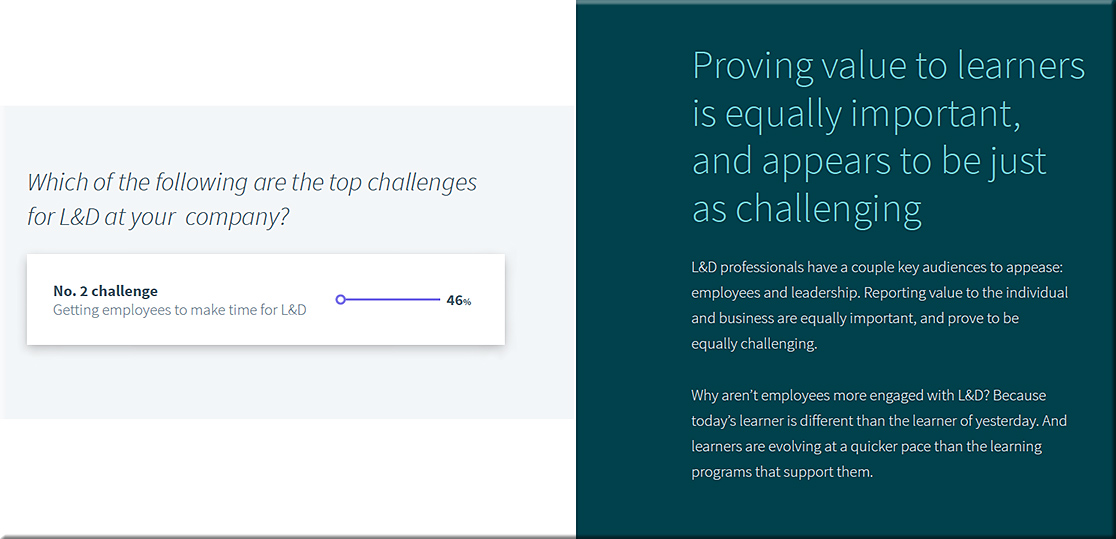
From DSC: Getting employees to make time for L&D needs to be based upon “what’s in it for them” — i.e., the main role of the L&D Team/Department should be to create the platforms and means by which employees can learn whatever they need to learn in order to do their jobs well (as well as to learn the skills necessary to move into those new areas that they’ve been wanting to move into). They’re going to find ways to do this anyway, why not give them the tools/knowledge of the tools and the platforms in order to better facilitate that learning to happen at a quicker pace?
An L&D Team could provide content curation services themselves and/or they could connect the employees with knowledgeable people. For example, give employees the key people to connect with who are doing their jobs really well.
For example, the L&D Team could maintain and provide a list of the top 10*:
Internal Sales employees to connect with and learn from, as well as the top 10 external Sales people to connect with and learn from (these people may or may not be in the same industry).
Internal Customer Service employees to connect with and learn from, as well as the top 10 external Customer Service people to connect with and learn from (these people may or may not be in the same industry).
Internal Marketing employees to connect with and learn from, as well as the top 10 external Marketing people to connect with and learn from (these people may or may not be in the same industry).
Etc.
* Or top 5, or top 50, or top whatever # that the L&D Team
thinks would be most beneficial to the organization
I think each employee in the workforce needs to know about the power of RSS feeds and feed aggregators such as Feedly. In fact, I advocate that same approach for most every student in middle school, high school, and college as well.We need to be able to connect with others and tap into streams of content being produced — as well as contribute to those streams of content as well. Blogs, Twitter, LinkedIn, CMSs/LMSs, etc. can provide beneficial streams of content.
“And learners are evolving at a quicker pace than the learning programs that support them.”
Also, based upon the above image, I find it interesting that the corporate L&D teams are struggling with what higher education has been struggling with as well — i.e., predicting which skills will be needed and responding as quickly as possible in order to develop the necessary learning modules/RSS feeds/content/etc. to remain up-to-date. Actually, I suspect that it’s not that the learners are evolving at a quicker pace than the learning programs that support them, rather its the required skills and needs of the positions that are evolving at a quicker pace than the learning programs that support them.
Our institutions and our L&D Departments are simply not used to this pace of change. No one is.
We need better mechanisms of dealing with this new pace of change.
One last random thought here…perhaps a portion of the L&D department will morph into creating bots for internal employees, helping answer questions at the point of need.
As L&D, we need to change the way we manage learning and training for our new and existing workforce. In fact, you should give up the idea of managing their learning at all! It is not your responsibility anymore. Instead, aim to create a culture of continuous learning and curiosity. Equip your employees with technology and tools that encourage them to collaborate, connect, and learn when they need to. You can no longer treat work and learning as different entities, because your employees need to learn all the time if you want to retain your competitive edge. They need to soak in all the information coming to them from all around and apply it to their work.
You will need to help build a technology-enabled learning ecosystem to support this trend of self-learning.
…
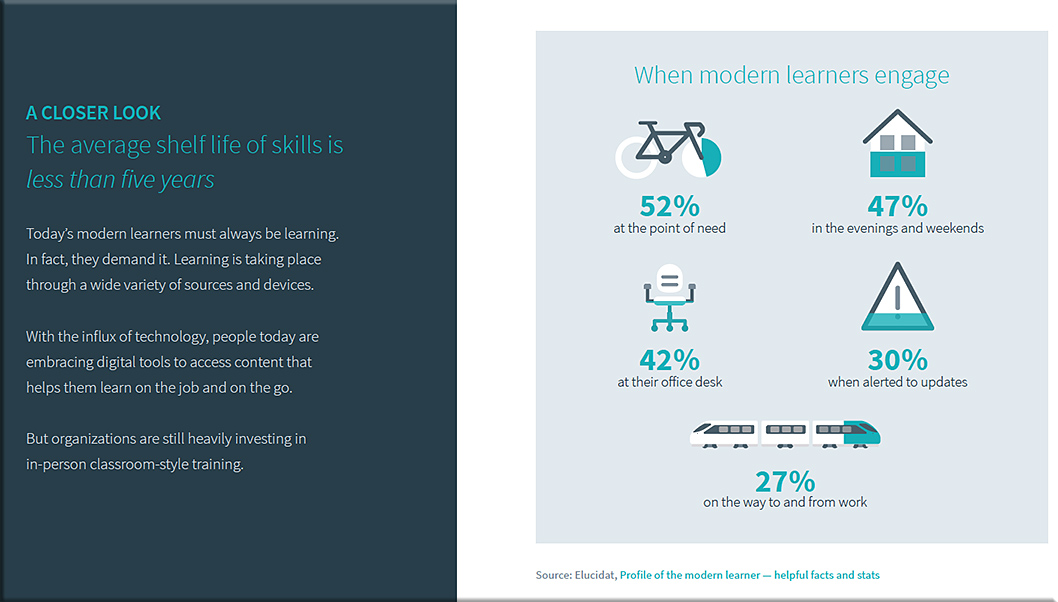
Your employees are no longer limited to learning at a specific time in a physical venue. Mobile devices and learning apps have ensured that learners can access learning content whenever and wherever they wish. They can choose their own learning path and mode of learning—videos, podcasts, text-based content, game-based modules, and so on. Learning should be a personal endeavor. If you allow your learners to choose what they wish to learn, then they can decide on the skills they need in order to excel in the real world. This gives more power to your content and makes learning meaningful to the learners.
Here are the top four trends that you should keep in mind while working on your corporate training strategy.