


Best Month Of Code 2020 Coding Kit Products — from techlearning.com by Luke Edwards
The best kits to get the most out of the Month of Code 2020

Best Month Of Code 2020 Coding Kit Products — from techlearning.com by Luke Edwards
The best kits to get the most out of the Month of Code 2020
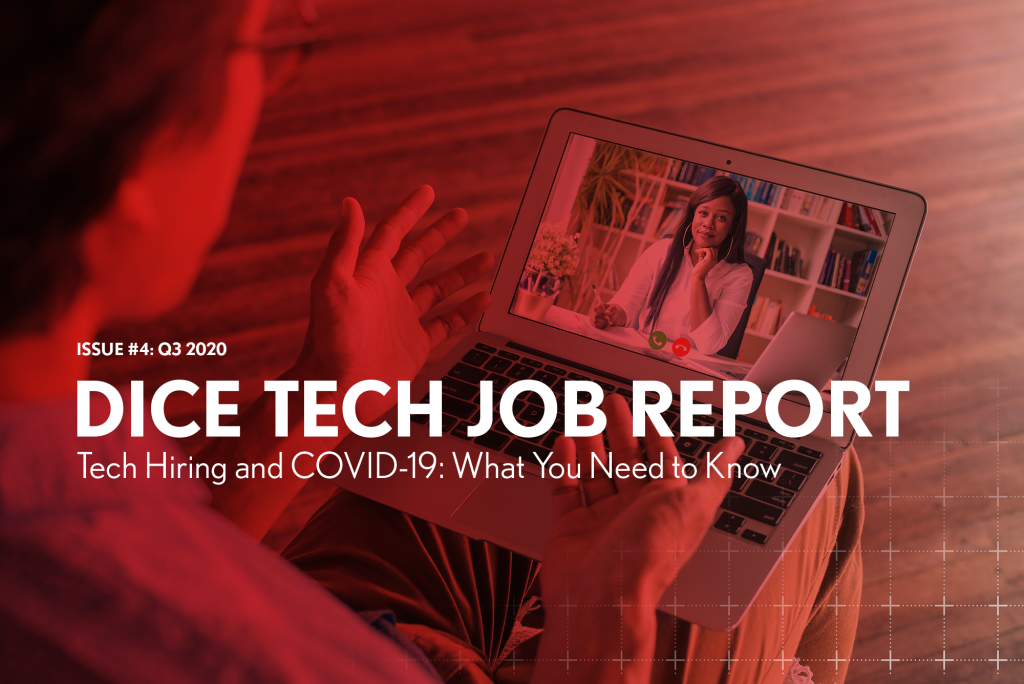
The Dice Q3 Tech Job Report: Tech Hiring and COVID-19: What You Need to Know — from techhub.dice.com
The report, issued quarterly by Dice, provides
From DSC:
One can quickly see how valuable this information would be as a data feed into an AI-based, next-generation learning platform.
The platform would connect the marketable skills with the courses, websites, blogs, RSS feeds/streams of content, etc. that would help a learner quickly and affordably build such in-demand skills. Given the shortening half-lives of many kinds of information, such a service is needed desperately…especially now with the impact of the Coronavirus.


Also relevant: See how ISTE built its upcoming virtual event!

On LawNext: Rocket Lawyer Founder Charley Moore — from lawsitesblog.com by Bob Ambrogi; with thanks to Gabe Teninbaum for this resource from his Lawtomatic Newsletter
Excerpt
In September, Rocket Lawyer became the first national company approved to participate in Utah’s regulatory sandbox, a pilot program for licensing new and alternative forms of legal providers and services. For Charley Moore, who founded Rocket Lawyer in 2008, it was yet another step in his quest to deliver high-value legal services at an affordable price.
…
In this episode of LawNext, Moore recounts the founding and development of Rocket Lawyer and its expansion into Europe starting in 2012. He also explains why he wanted the company to participate in the Utah sandbox and what he expects to happen there. Finally, as one of the few Black CEOs in legal tech, Moore discusses his thoughts on expanding diversity in the industry.
Also see:
Also from Gabe, see:
Justice-as-a-Service — from Henrik Zillmer
Excerpts:
There’s a new wave of customer empowerment coming. It’s called Justice-as-a-Service (JaaS), and you need to know about it because it benefits you – you just don’t know it yet.
Justice-as-a-Service is an on-demand service, powered by tech, that challenges private and public companies by representing the consumer in their fight for justice/compensation based on laws, consumers’ rights, and contract of carriage.
Why is there a need for JaaS?
Technologies that enable legal and compliance leaders to spot innovations — from helpnetsecurity.com
COVID-19 has accelerated the push toward digital business transformation for most businesses, and legal and compliance leaders are under pressure to anticipate both the potential improvements and possible risks that come with new legal technology innovations, according to Gartner.
Excerpt:
To address this challenge, Gartner lists the 31 must-watch legal technologies to allow legal and compliance leaders to identify innovations that will allow them to act faster. They can use this information for internal planning and prioritization of emerging innovations.
Also see:
(with a shoutout to Nicola Shaver for this resource)
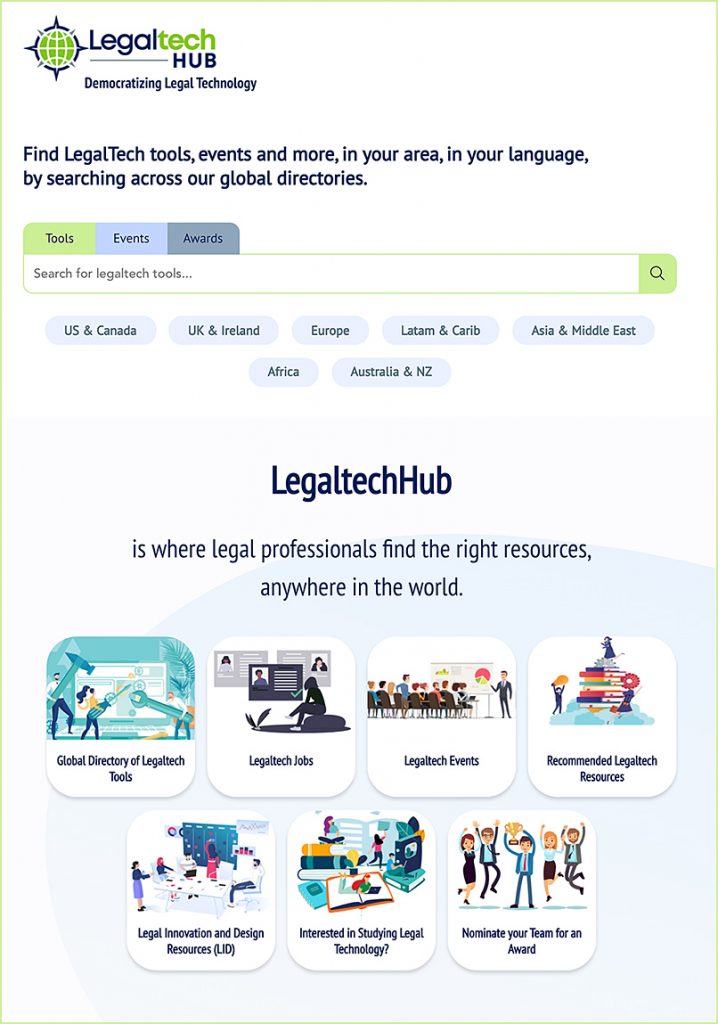
Also see:
Envisioning the future of law — from abovethelaw.com by Ken Crutchfield
We’ve seen a transformation underway within the legal industry for some time now, and the pandemic is continuing to accelerate these changes.
Excerpt:
We’ve seen a transformation underway within the legal industry for some time now, and the pandemic is continuing to accelerate these changes. From what we have observed in recent months, many of the technologies that were reshaping the practice of law have now become necessary, and resistance to digital workflows is no longer a viable option for many legal professionals. In the midst of this transformation, we can draw some observations about how the industry can cope with what’s next.
Civil Justice for All — from amacad.org
Excerpts:
This report calls for the legal profession, the courts, law schools, tech professionals, and partners from many other fields and disciplines to coordinate their efforts to provide necessary legal assistance to many more people in need. Past efforts to improve access to justice offer strong evidence that such an effort would have a profound effect on American society—measured in financial savings, greater trust in law and social institutions, and the safety and security of families and communities.
THE PROJECT’S SEVEN RECOMMENDATIONS ARE:
First, and above all, dedicate a consequential infusion of financial and human resources to closing the civil justice gap, and seek a significant shift in mindset—extending beyond lawyers the duty and capacity to assist those with legal need—to make genuine strides toward “justice for all”;
Second, increase the number of legal services lawyers who focus on the needs of low-income Americans;
Third, increase the number of lawyers providing pro bono and other volunteer assistance, to supplement the corps of legal services lawyers;
Fourth, bring many new advocates—service providers who are not lawyers—into the effort to solve civil justice problems;
Fifth, foster greater collaboration among legal services providers and other trusted professionals—such as doctors, nurses, and social workers;
Sixth, expand efforts to make legal systems easier to understand and use through the simplification of language, forms, and procedures and the wider use of technology; and
Seventh, create a national team, or even a new national organization, to coordinate the efforts listed above, collect much-needed data on the state of civil justice, and help identify and publicize effective innovations that improve access.
From DSC:
Per Wikipedia, this is a 1910 Model T that was photographed in Salt Lake City:


From DSC:
The Ford Model T didn’t start out looking like a Maserati Gran Turismo from 2021! Inventions take time to develop…to be improved…for new and further innovations and experiments to take place.
Thinking of this in terms of online-based learning, please don’t think we’ve reached the end of the road for online-based learning.
The truth is, we’ve barely begun our journey.
Two last thoughts here
1 ) It took *teams* of people to get us to the point of producing a Maserati like this. It will take *teams* of people to produce the Maserati of online-based learning.
2) In terms of online-based learning, it’s hard to say how close to the Maserati that we have come because I/we don’t know how far things will go. But this I do know: We have come a looooonnnnnggggg ways from the late 1990s! If that’s what happened in the last 20 years — with many denying the value of online-based learning — what might the next 5, 10, or 20 years look like when further interest, needs, investments, etc. are added? Then add to all of that the momentum from emerging technologies like 5G, Augmented Reality, Mixed Reality, Virtual Reality, Artificial Intelligence, bots, algorithms, and more!
From DSC:
To drive the point home, here’s an addendum on late 9/29/20:

Hear five chief justices read Goodnight Status Quo, a loving tribute to Goodnight Moon.https://t.co/hKWH8cQQiS
— Daniel Christian (@dchristian5) September 23, 2020
With thanks to Gabe Teninbaum for posting this in his Lawtomatic Newsletter| Issue #104, September 23, 2020
As Gabe points out, also see:
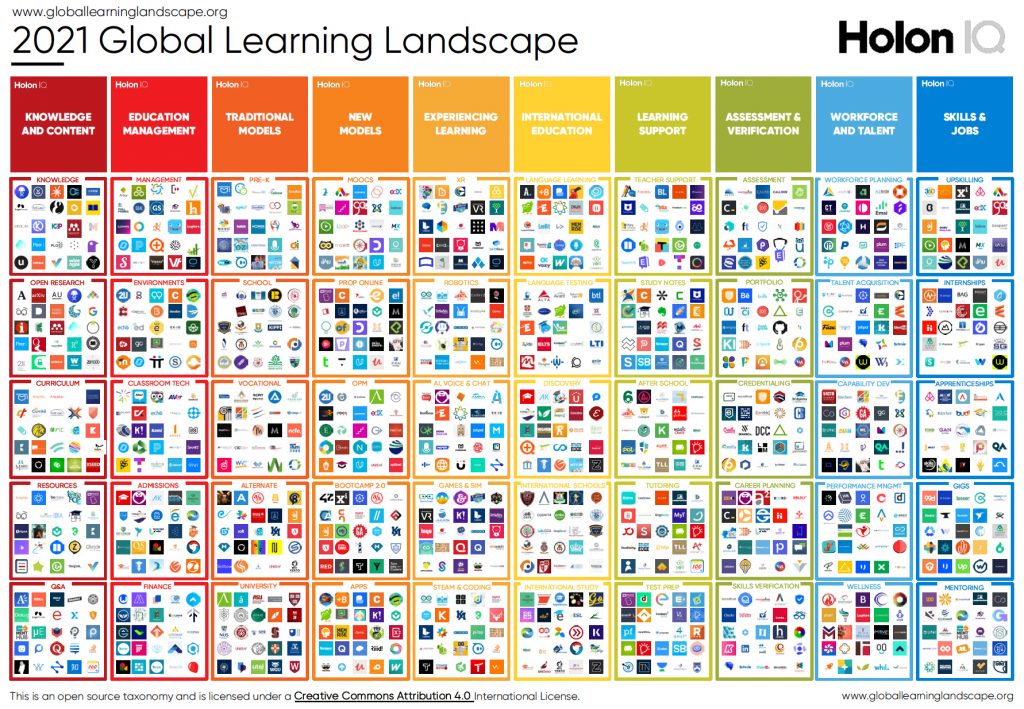
Also see:
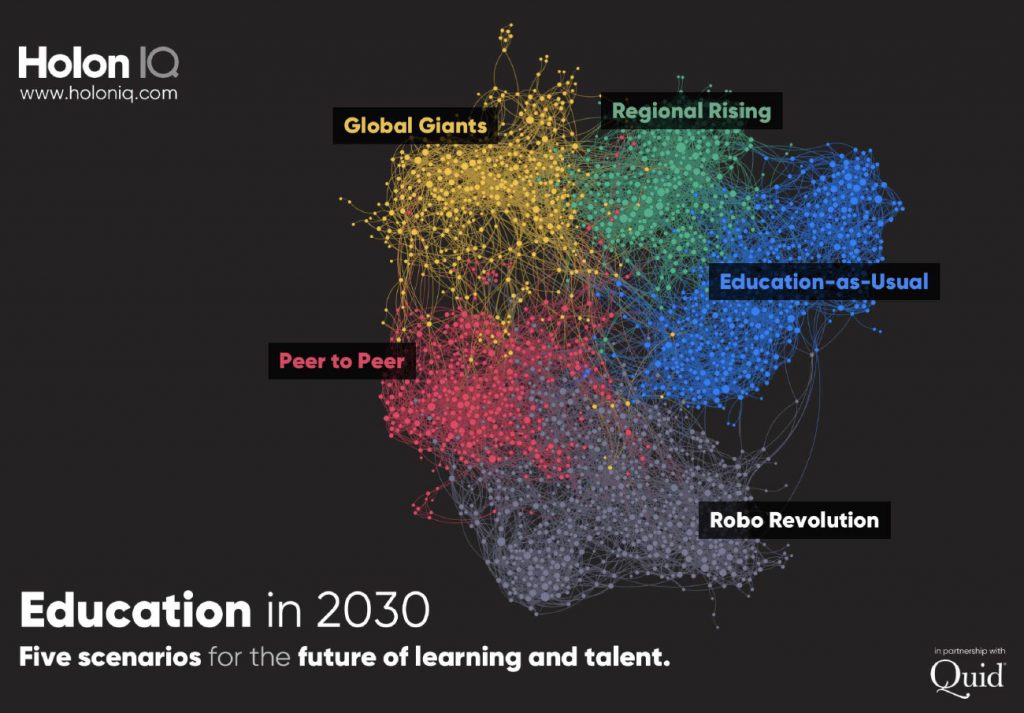
From DSC:
If this isn’t mind-blowing, I don’t know what is! Some serious morphing lies ahead of us!
Thanks to Jane Hart for the below diagram of a learning technology ecosystem! This diagram is accessible out at Jane’s recent posting entitled, “Back to Basics: 10 lessons for virtual L&D for 2021.“
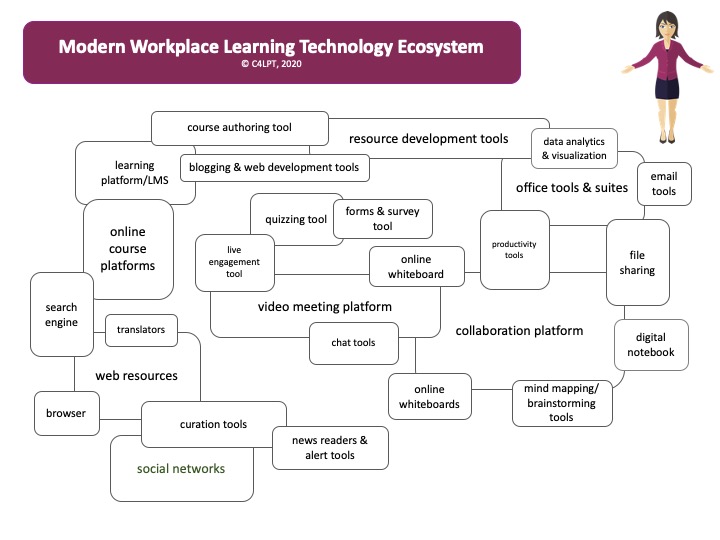
From DSC:
Notice how these tools, vendors, business relationships, etc. can — and do — morph over time. It’s not a static system…but an ever-changing system.
So what is the book about? — from donaldclarkplanb.blogspot.com by Donald Clark; which discusses his book entitled, Artificial Intelligence for Learning: How to use AI to Support Employee Development
Excerpt:
AI changes everything. It changes how we work, shop, travel, entertain ourselves, socialize, deal with finance and healthcare. When online, AI mediates almost everything – Google, Google Scholar, YouTube, Facebook, Twitter, Instagram, TikTok, Amazon, Netflix. It would be bizarre to imagine that AI will have no role to play in learning – it already has.
Both informally and formally, AI is now embedded in many of the tools real learners use for online learning – we search for knowledge using AI (Google, Google Scholar), we search for practical knowledge using AI (YouTube), Duolingo for languages, and CPD is becoming common on social media, almost all mediated by AI. It is everywhere, just largely invisible. This book is partly about the role of AI in informal learning but it is largely about its existing and potential role in formal learning – in schools, Universities and the workplace. AI changes the world, so it changes why we learn, what we learn and how we learn.
Also see:
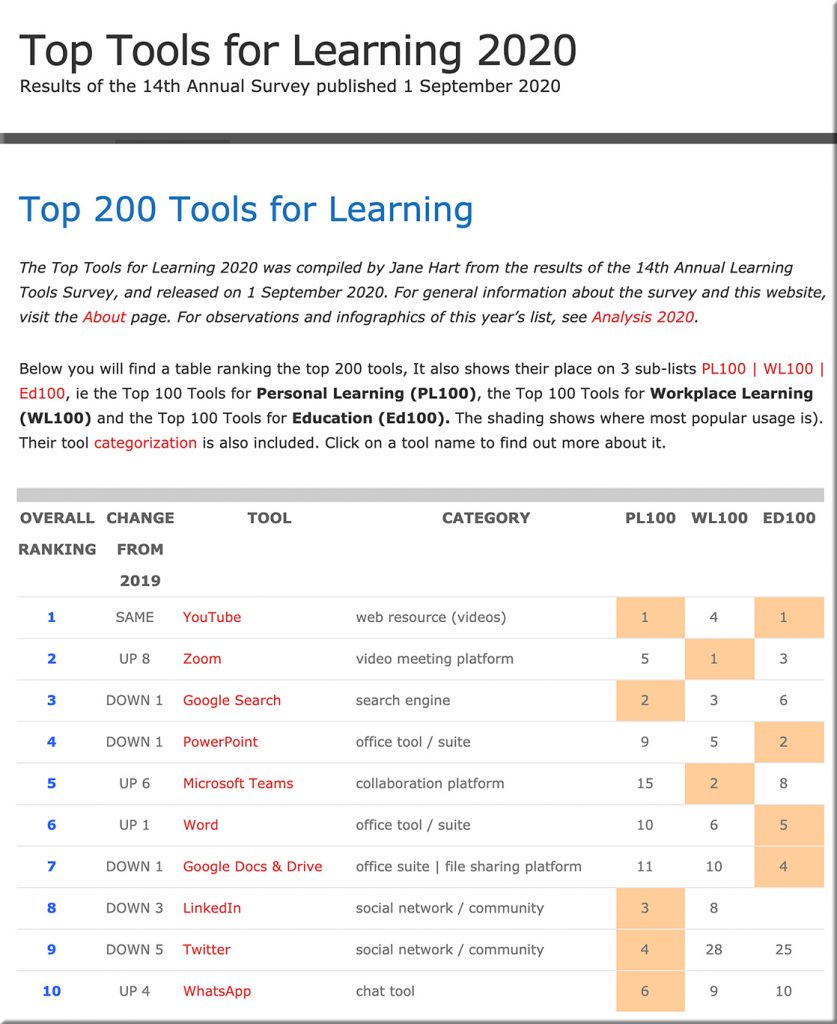
Top 200 Tools for Learning — from toptools4learning.com by Jane Hart
Excerpt:
The Top Tools for Learning 2020 was compiled by Jane Hart from the results of the 14th Annual Learning Tools Survey, and released on 1 September 2020. For general information about the survey and this website, visit the About page. For observations and infographics of this year’s list, see Analysis 2020.