Weighing the best strategies for reading intervention — from hechingerreport.org by Caralee Adams
Some schools are overhauling reading instruction and trying a variety of approaches to address the pandemic’s impact on learning

Excerpt:

But, some experts say, schools should also invest in deeper changes that tackle the root of the problem: Many teachers aren’t well versed in the science of reading and the best ways to teach to the widening range of abilities they are seeing in students.

Teachers need training on the science of reading research, guidance on leveraging data and ongoing support to help them target instruction.


From DSC:
I thought this was a powerful message as well. It was good for me to hear this — and not just for people who have Intellectual Disabilities (ID), but rather for all learners/people.


3 Things I Learned from the Country with Europe’s Best Schools — from medium.com by Eva Keiffenheim
You’ll marvel at Estonia’s education system.

Excerpt:

What’s interesting: While early childhood education is not compulsory, 95% of three to seven-year-olds attend it. Parents have the right to affordable childcare and education starting at three years old. There’s a national curriculum for early childhood education that includes reading, mathematical, and motor skills.
…
Agency for learners and educators is the greatest opportunity to transform learning institutions. And Estonian schools have the autonomy to affect change.

If there’s one thing I learned, it’s that education systems are not fixed. They can be redesigned and transformed for the better by all of us.


K-12 education in America is like quickly moving trains that stop for no one.

K-12 education in America is like quickly moving trains that stop for no one.

From DSC:
A family member struggles with spelling — big time. This causes her major amounts of anxiety in school.

Another family member had some learning disabilities and reflects back on school with some bad memories.

Another family member struggles with social graces and learns at a much different pace than her peers — the move to her education being (predominantly) done via homeschooling has helped significantly.

A friend of mine has Dyslexia. He recently said that school was hell for him.

Another person I know doesn’t understand his daughter’s learning disabilities — at all. He’s asking a fish to climb the tree and yells at his daughter when she doesn’t produce like the other kids do. Her school is for college-bound learners, and there’s always pressure to maintain the school’s “blue-ribbon” status (i.e., sorry if you don’t fit in…but please board the train anyway, as it’s about to depart).

These people and stories about their educations got me to reflect on all the people who went through the school systems in the United States (over the last few decades) that didn’t work well for them. In fact, not only did the systems not work well for them, they were the sources of a great deal of pain, anxiety, depression, anger, frustration, and embarrassment.  Instead of being a place of wonder or joy, school was a painful, constant struggle to get through.

For those who can keep up or even excel at the pace that the trains travel at, school isn’t that much of a problem. There are likely different levels of engagement involved here, but school is manageable and it doesn’t cause nearly the stress for someone who struggles with it.

For those with learning disabilities, I’d like to apologize to you on behalf of all the people who legislated or created rigid, one-size-fits-all school systems that didn’t understand and/or meet your needs. (Why we allow legislators — who aren’t the ones on the front lines — to control so much of what happens in our school systems is beyond me.) I’d like to apologize on behalf of all of the teachers, administrators, and staff who just accept the systems as they are.

Please help us reinvent our school systems. Help us develop the future of education. Help us develop a more personalized, customized approach. For those who are working to provide that, thank you! Thank you! Thank you!

To everyone working within Pre-K through 12th grade, help us offer: More voice. More choice. More control. The status quo has to go. School should not be a constant source of pain and anxiety.
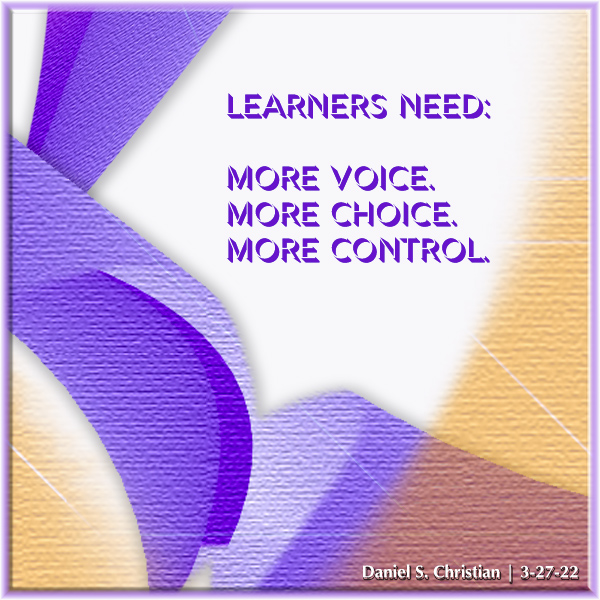
Learners need: More voice. More choice. More control. -- this image was created by Daniel Christian


What Educators Need to Know About Assistive Tech Tools: Q&A with Texthelp CEO — from thejournal.com by Kristal Kuykendall and Texthelp CEO Martin McKay

Excerpts (emphasis DSC):

THE Journal: What are some examples of the types of assistive technology tools now available for K–12 schools?
McKay: There are a broad range of disabilities, and accordingly, a broad range of learning and access difficulties that assistive technology can help with. Just considering students with dyslexia — since that is the largest group among students who can benefit from assistive tech tools — the main problems they have are around reading comprehension and writing. Assistive technology can provide text-to-speech, talking dictionaries, picture dictionaries, and text simplification tools to help with comprehension.
…
It’s important that these tools need to work everywhere — not just in their word processor. Assistive technology must work in their learning management systems, and must work in their online assessment environment, so that the student can use the assistive tech tools not only in class, but at home as they work on their homework, and perhaps most importantly on test day when they are using a secure assessment environment.


We need to use more tools — that go beyond screen sharing — where we can collaborate regardless of where we’re at. [Christian]

From DSC:
Seeing the functionality in Freehand — it makes me once again think that we need to use more tools where faculty/staff/students can collaborate with each other REGARDLESS of where they’re coming in to partake in a learning experience (i.e., remotely or physically/locally). This is also true for trainers and employees, teachers and students, as well as in virtual tutoring types of situations. We need tools that offer functionalities that go beyond screen sharing in order to collaborate, design, present, discuss, and create things.  (more…)


2022 EDUCAUSE Horizon Report | Teaching and Learning Edition


2022 EDUCAUSE Horizon Report | Teaching and Learning Edition — from library.educause.edu

Sections include:

  • Trends: Scanning the Horizon
  • Key Technologies & Practices
  • Scenarios
  • Implications: What Do We Do Now?

 Also relevant/see:


Also relevant/see:

2022 Educause Horizon Report Suggests Change Is Here to Stay; No Return to ‘Normal’ — from campustechnology.com by Rhea Kelly

Excerpt:

If the COVID-19 pandemic has been a time of unprecedented change in higher education — characterized by rapid pivots to remote work and learning and an explosion in the use of technology across the institution — the future is about reframing those changes into long-term realities, according to the 2022 Educause Horizon Report Teaching and Learning Edition, released this week. Colleges and universities are shifting their mindsets to “reflect an evolution from short-term ’emergency’ or ‘reactive’ modes of offering education during extraordinary circumstances to making strategic and sustainable investments in a future that will be very much unlike our past,” the report suggested.

6 Technologies and Practices Impacting the Future of Higher Education — from campustechnology.com by Rhea Kelly


5 Tips for Educators From The Superintendent of the Year — from techlearning.com by Erik Ofgang
Superintendent of the Year Curtis Cain advises educators to keep alive the spirit of innovation that emerged during the pandemic and to remember how important the work they do is.

Superintendent of the Year Curtis Cain

Excerpt:

Keep Alive the Spirit of Innovation 
“The brain, once stretched, never returns to its initial size,” says Cain of the ways that schools have changed. His advice to staff in his district and beyond is to keep alive the spirit of innovation that was born in the pandemic.

“The needs of students have absolutely become more complex and more nuanced. And in many ways more urgent than they have been in the past,” he says. “So we’re going to have to keep having the ability to demonstrate a willingness to sit at the table, to problem solve.”


Podcasts For High School Students — from teachthought.com by Dennis Lee,

Categories covered include:

  • Academic Related Podcasts
  • General and Special Interest Podcasts
  • Entrepreneurship
  • Inspirational & Motivational
 

Teaching: Fresh Approaches to Faculty Development — from chronicle.com by Beckie Supiano

Excerpt:

Baranovic can’t imagine returning to the old model: He’s sticking to panels in Zoom. Among the benefits, he says: “This arrangement breaks institutional silos, allows faculty to talk more about their experiences, shares effective practices from sources faculty trust (their peers), creates a stronger sense of community, makes it easy for panelists (they receive the questions ahead of time if they want to prepare, but because they’re speaking to experience, they don’t really have to prepare), and creates a form of support that works like therapy but doesn’t feel like therapy.”

Next, Baranovic hopes to turn the panels into a podcast format for professors unable to attend in real time.

From DSC:
As someone who had been involved with Teaching & Learning Centers for years, I can tell you that it’s very disheartening to put together a training session for faculty members and have very few — if any — people show up for it. It’s a waste of time and it leaves the T&L staff and/or IT staff members feeling discouraged and unvalued.

Over the years, I developed a preference for putting things into an asynchronous digital format for faculty members and adjunct faculty members to access per their own schedules. The institutions that I was working for got a greater ROI from those sessions and they were able to visit an internal “course” or website to reference those materials on-demand.

I also like the idea of podcasting here, but that takes a lot of time and effort — and isn’t always possible when you are one person trying to assist hundreds of faculty members (from a technical support and an LMS admin standpoint).

As an Instructional Designer, I also want to comment that it’s hard to help steer a car if you can’t even get into the car. Those institutions that are using team-based approaches will be far more successful in designing and developing more polished, effective, accessible learning experiences. Very few people can do it all.


The Re-Emergence of Competency-Based Education: What It Might Look Like and Why It’s Needed in Today’s Classrooms — from thejournal.com by Keith Look

Excerpt:

For the current or upcoming unit of instruction, identify three learning targets to be assessed. Have students show what they know through both traditional modes of assessment as well as through CBE experiences. Then, consider what the data shows:

  • For which learning targets is student competency better presented through traditional assessment? Through CBE?
    • Is that a factor of the learning target or the way in which the assessment (traditional or CBE) challenged students?
    • Based on this experience, what kinds of learning targets may lend themselves more to CBE? To traditional assessment?
  • Are there students who more effectively demonstrate competency through the CBE than the traditional assessment?
    • Why is CBE a more effective vehicle for those students?
    • Could the task itself be revised to unlock the same potential in other students?
 

Subject: Race on Campus: Pronouncing Students’ Names Correctly Is Important. Here’s How. — from chronicle.com by Fernanda Zamudio-Suarez

Excerpt:

When the pandemic moved classes online, Kohli said, platforms like Zoom helped the name-pronunciation process. On Zoom, users can change the way their name is displayed and include a phonetic spelling, making it simpler for everyone to get names right.

If the class is in person, Kohli says modeling behavior after the Zoom interface and asking students how their names are pronounced and how they’d like to be addressed.

For in-person classes, look at your roster ahead of time, Baker-Brown said. If you see a name you don’t recognize, break up the syllables and sound it out.

Then, practice. Repeat it until you get it right, and saying the name becomes second nature.

From DSC:
One other idea that I’m sure is out there, but it needs to be more commonly implemented:

  • Each learner should be able to record their name in the CMS/LMS for others to hear how their name is pronounced

#Canvas #Moodle #Blackboard #D2L #edtech #corporatetraining #L&D #vocationalprograms #K12 #HigherEducation


Play-based learning in your homeschool: It’s more than just board games — from raisinglifelonglearners.com by Colleen Kessler

Excerpts:

Play-based learning doesn’t have to fit in a box!  There are many wonderful resources in the homeschool community to help you discover what works best for your family.

In addition to the various suggestions I have included in today’s episode of the podcast, you’ll find excellent recommendations from these sites, dedicated to creating out of the box approaches to learning:

In a nutshell, this means that kids learn best when they’re mentally active, engaged socially, and when they can make connections to their lives.

Also relevant/see:

Financial literacy games provide fun ways for students of all ages to learn about finances on various topics. Some websites have grade bands with interactive ways for students to explore creating a bank account, setting a budget, applying for a loan, and many others. Many of the options available include financial literacy games for the classroom.

From DSC:
Although the following resource isn’t about learning, it reminds me of the topic of “play”:


10 Books Of Visual Ideas (from 2006 to 2012) — from theelearningcoach.com by Connie Malamed
Explanatory, Information and Data Visualization Graphics

Excerpt:

When the importance of visualization became popularized, an explosion of books were published for those who were hungry to understand and appreciate this graphic format. It was an obvious win for practitioners who were trying to improve communication and understanding. These books also served as inspiration for people who were needed visual ideas on demand, like instructional designers.

So that we don’t lose the value of these older books, I’m republishing this article listing ten compelling books from the early days of visualization: 2006 to 2012. The one exception, is Tufte’s book from 1990. I recommend these books for visual examples and for inspiring ways to visualize concepts, statistics and data. They are also a part of our graphic design history.

The list is organized into two categories. Books that feature explanatory graphics and those that portray information graphics and visualizations.


The Future Trends Forum Topics page — from forum.futureofeducation.us by Bryan Alexander

Excerpt:

The Future Trends Forum has explored higher education in depth and breadth. Over six years of regular live conversations we have addressed many aspects of academia.

On this page you’ll find a list of our topics.  Consider it a kind of table of contents, or, better yet, an index to the Forum’s themes.

Also see:

Since we launched in early February, 2016, the Forum has successfully published three hundred videos to YouTube.  Week after week, month by month, over more than six years we’ve held great conversations, then shared them with the world, free of charge.

 
© 2025 | Daniel Christian