Why Improving Student Learning is So Hard — from opencontent.org by David Wiley

Excerpt:

2. Student behavior will normally change only in response to changes in faculty behavior – specifically, the assignments faculty give and the support faculty provide.

For many students, the things-they-do-to-learn are all located within the relatively small universe of things their faculty assign them to do – read chapters, complete homework assignments, etc. For a variety of reasons, and many of them perfectly good reasons, “students don’t do optional” – they only do what they’re going to be graded on.

Therefore, students will likely engage in more effective learning behaviors ONLY IF their faculty assign them more effective learning activities. Faculty can further increase the likelihood of students engaging in more effective learning activities if they support them appropriately throughout the process.

From DSC:
I can put an “Amen” to the above excerpt. For years I managed a Teaching & Learning Digital Studio. Most of the students didn’t come into the Studio for help, because most of the faculty members assigned the normal kinds of things (papers, quizzes, and such). Had there been more digitally-created means of showing what students knew, there would have been more usage of the T&L Digital Studio. 

Also, if we want to foster more creativity and innovation — as well as give our learners more choice and more control over their learning — we should occasionally get away from the traditional papers.

Another comment here is that it’s hard to change what faculty members do, when Instructional Designers can’t even get in the car to help faculty members navigate. We need more team-based efforts in designing our learning experiences.
 

The Future of Work Is Flexible. Will Higher Ed Stay Stuck in the Past? — from edsurge.com by Kevin R. McClure (Columnist)

Excerpt (emphasis DSC):

We know that institutions are capable of making big changes. We pivoted in March 2020, then again in fall 2020, then again in fall 2021. Institutions have achieved things in the last two years that some considered unimaginable. Faculty and staff want to see that type of willpower and creativity directed at working conditions and cultures. They want the type of “reimagining” the Future of Work@Iowa report promised but didn’t deliver.

In a city full of adjunct faculty members, many struggle to get by — from washingtonpost.com by Lauren Lumpkin; with thanks to Ray Schroeder for this resource
Adjuncts across the region are protesting what they say are unfair working condition

7 Ways the Pandemic Changed Faculty Development — from er.educause.edu by Amy Kuntz, Sara Davis and Erica Fleming
Pandemic lessons about faculty development should be understood and factored into future offerings.

Excerpt (emphasis DSC):

Regarding this perspective shift, conference session participant Lindsay Wood, manager of instructional design at Penn State Abington, stated, “When reflecting on the impact of pandemic teaching, those of us working in faculty development and learning design know that there has never been and likely will never be another opportunity to upskill faculty and improve teaching and learning so broadly. It’s important … to really take a deep dive into how we meet the moment and ensure the positive changes are lasting. It would be a shame to squander a once-in-a-lifetime opportunity to adopt innovative practices because we didn’t adequately identify the lessons learned and apply them to the future.” This seemed to resonate with many participants; they want to see the positive changes from the past two years integrated at an institutional level.

Is Hybrid Learning Here to Stay in Higher Ed? — from edsurge.com by  Daniel Lempres

State of Continuing Education 2022 — from resources.moderncampus.com; with thanks to Amrit Ahluwalia for this resource

Universities Share Lessons Learned from Ransomware Attacks — from edtechmagazine.com by Chris Hayhurst
Universities that faced security breaches share advice from their experiences.


24 ideas for creating a discussion-rich classroom — from ditchthattextbook.com by Matt Miller
Discussion can engage students and help them to see different perspectives. Here are strategies you can use to create a discussion-rich classroom.

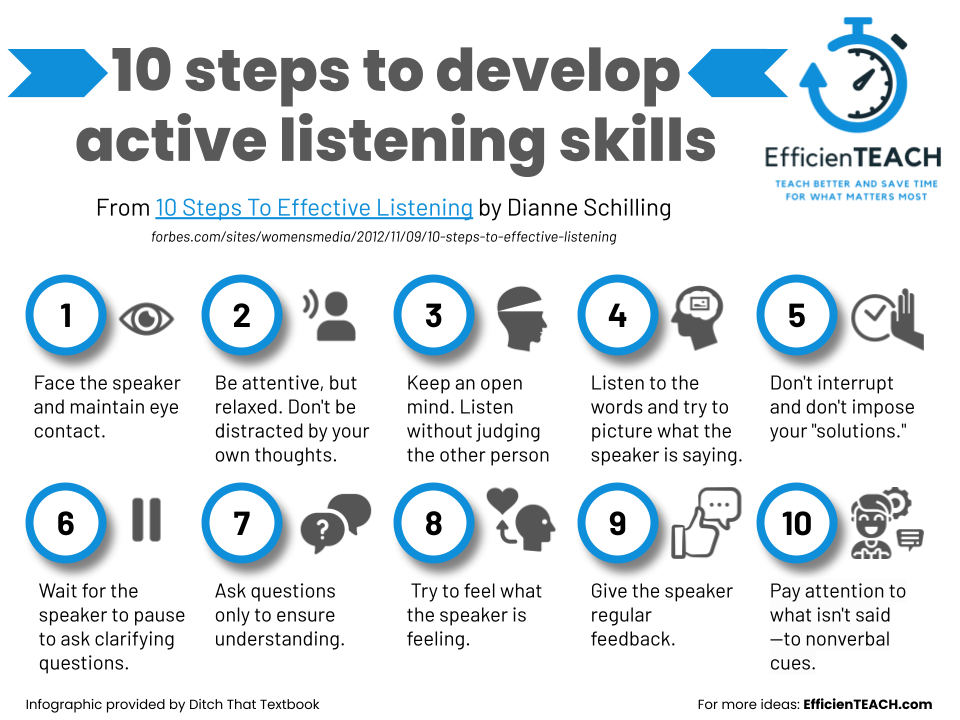
10 ways to teach active listening in the classroom

Also relevant/see:


Technology for HyFlex Classrooms: Major Considerations — from hyflexlearning.org by Brian Beatty

Excerpts:

This post describes four aspects of classroom technology that are very important to address when developing a HyFlex approach that can be effective at scale.
…

The classroom technology needs can be organized into four areas:

  1. two-way audio stream (connection),
  2. incoming video presentation of remote learners
  3. outgoing video presentation of classroom and learners
  4. interactive technology to support interaction, engagement, and formative assessment

Also re: hyflex teaching — where some students are physically present and some are coming into the class remotely– see:

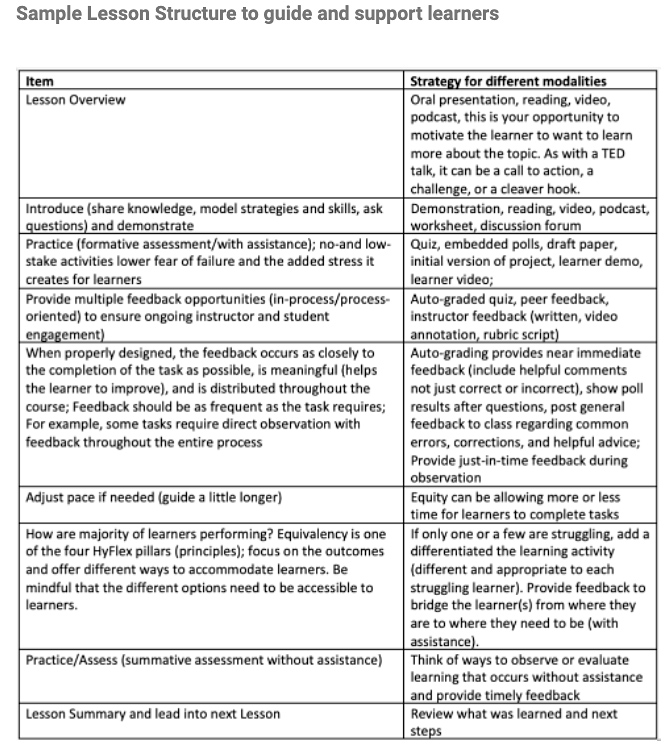
Part I – Motivating Learners by Building Efficacy (Confidence) through Scaffolding and Support— from hyflexlearning.org by Jeanne Samuel

Excerpts:

HyFlex delivery may be new to many learners. Therefore, it is important to provide them with the supports they need to be successful. Regardless of the delivery mode, learners are motivated by success and by instructor presence. In part one of this topic post, we will write about how instructor support and feedback (a form of guidance) can motivate learners and build learner confidence.

PART II- Feedback for Improving Student Success and Satisfaction — from hyflexlearning.org by Jeanne Samuel

Excerpt:

In part 1 of this post, we focused on how feedback and support promote learner confidence. Learner confidence can lead to improved learner retention, progression, and success regardless of the class delivery mode. In part 2, we focus on feedback strategies.


100 Universities established an OPM, Bootcamp or Pathways partnership in Q1 2022 — from holoniq.com
Bootcamps are directing more resources B2B and B2G, OPMs are growing existing partnerships further and evolving their technology and healthcare programs.

Excerpt:

Higher Education, like the broader economy, is awkwardly emerging from an almost exclusively digital, isolated and stimulus fuelled environment into… well it’s not clear yet. University Partnerships continued to be established at pace through Q1 2022, albeit at a much slower rate than through 2021.


Also relevant/see:

College contracts with OPMs need better oversight, watchdog says — from highereddive.com by Natalie Schwartz

Excerpt from Dive Brief:

  • The U.S. Department of Education should strengthen oversight of colleges’ relationships with companies that help them launch and build online programs, according to a new report from the U.S. Government Accountability Office, an auditing agency for Congress.

Addendum on 5/11/22:


From DSC:
For the last few years, I’ve been thinking that we need to make learning science-related information more accessible to students, teachers, professors, trainers, and employees — no matter what level they are at.

One idea on how to do this — besides putting posters up in the hallways, libraries, classrooms, conference rooms, cafeterias, etc. — is that we could put a How best to study/learn link in all of the global navigation bars and/or course navigation bars out there in organizations’ course management systems and learning management systems. Learners of all ages could have 24 x 7 x 365, easy, instant access as to how to be more productive as they study and learn about new things.

For example, they could select that link in their CMS/LMS to access information on:

  • Retrieval practice
  • Spacing
  • Interleaving
  • Metacognition
  • Elaboration
  • The Growth Mindset
  • Accessibility-related tools / assistive technologies
  • Links to further resources re: learning science and learning theories

What do you think? If we started this in K12, kept it up in higher ed and vocational programs, and took the idea into the corporate world, valuable information could be relayed and absorbed. This is the kind of information that is highly beneficial these days — as all of us need to be lifelong learners now.


Homework hotline gives K-12 students support for tricky assignments — from k12dive.com by Kara Arundel
College students offer free, on-demand help as younger students recover from pandemic-related setbacks or aim to get ahead.

Excerpt:

The college student-run resource saw an uptick in demand during the pandemic, and even though nearly all K-12 schools are now back to full-time, in-person learning, the calls to the hotline keep coming, said Gabriela Gamiz, founding Homework Hotline staff member and the college’s director of community engagement.


From DSC:
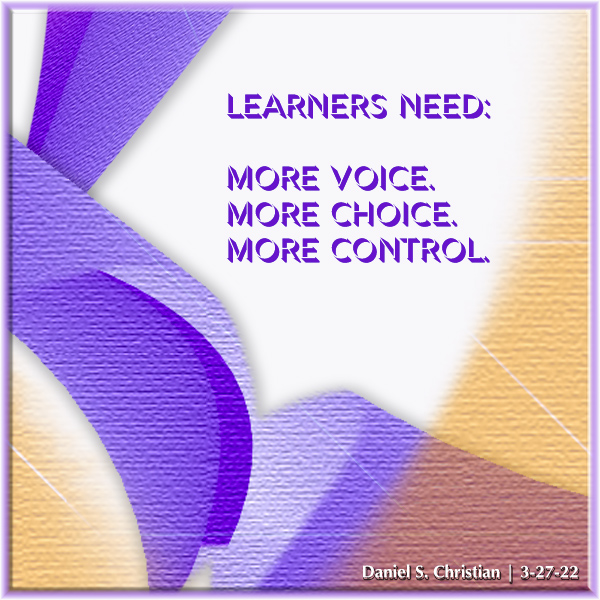
The resource below (from The Chronicle of Higher Education) is one of the best, most useful articles I’ve read in a long time. It’s full of innovative and/or powerful ideas. I like the part about seeking to give students “more voice, more choice, more control.”

Learners need: More voice. More choice. More control. -- this image was created by Daniel Christian


5 No-Cost or Low-Cost Ways to Improve Your Campus — from chronicle.com by Richard J. Light and Allison Jegla
Change doesn’t have to be expensive. It’s often sparked by a simple suggestion and a leader willing to give it a try.

Excerpts (emphasis DSC):

No. 1: Reward innovative teaching. Lynne Schofield, a professor of statistics at Swarthmore College, has fundamentally changed the way her students learn basic and intermediate statistics. She lectures and assigns problem sets but she also teams up with local Philadelphia organizations such as food banks and blood-donation centers to give students an opportunity to solve real-world problems using their classroom knowledge. The organizations benefit from data and analysis that they may not have had time or bandwidth to collect themselves, and the students see the practical application of what they might ordinarily have perceived as a dry subject.

No. 2: Solicit ideas from students. …
They met with a dean and proposed a public event called, “10 Big Ideas, 10 Professors, 10 Minutes Each.”

When the dean agreed, the students took the lead on selecting and inviting professors to each present the “most exciting new idea” in their academic field, in less than 10 minutes.


The Future Is Here: Assistive Technology for Learning Disabilities — from studycorgi.com; with thanks to Alysson Webb for this resource

Excerpt:

Equal learning and personal development opportunities help ensure everyone reaches their highest potential. However, it is important to look at comparable needs. People with learning disabilities can require individual or additional services from a school program. According to the National Center of Educational Statistics, in 2019 – 2020, 14% (7.3 million) of children from 3 to 21 received special education services in the US. One-third of them had various learning disabilities that required specific assistance and tools.

Table of Contents

  1. What Is a Learning Disability?
  2. Assistive Technology (AT) in the Classroom
  3. AT for Learning Disabilities: Benefits & Tools
  4. References
 

The amazing opportunities of AI in the future of the educational metaverse [Darbinyan]

The amazing opportunities of AI in the future of the educational metaverse — from forbes.com by Rem Darbinyan

Excerpt:

Looking ahead, let’s go over several potential AI-backed applications of the metaverse that can empower the education industry in many ways.

Multilingual Learning Opportunities
Language differences may be a real challenge for students from different cultures as they may not be able to understand and keep up with the materials and assignments. Artificial intelligence, VR and AR technologies can enhance multilingual accessibility for learners no matter where they are in the world. Speech-to-text, text-to-speech and machine translation technologies enrich the learning process and create more immersive learning environments.
…
AI can process multiple languages simultaneously and provide real-time translations, enabling learners to engage with the materials in the language of their choice. With the ability to instantly transcribe speech across multiple languages, artificial intelligence removes any language barriers for students, enabling them to be potentially involved, learn and communicate in any language.

Artificial Intelligence (AI) in Education Market size exceeded USD 1 billion in 2020 and is expected to grow at a CAGR of over 40% between 2021 and 2027. (source)

Along the lines of innovation within our educational learning ecosystems, see:

3 Questions for Coursera’s Betty Vandenbosch & U-M’s Lauren Atkins Budde on XR — from insidehighered.com by Joshua Kiim
How might extended reality shape the future of learning?

Excerpts (emphasis DSC):

[Lauren Atkins Budde] “Being able to embed quality, effective extended reality experiences into online courses is exponentially a game-changer. One of the persistent constraints of online learning, especially at scale, is how do learners get hands-on practice? How do they experience specific contexts and situations? How do they learn things that are best experienced? XR provides that opportunity for actively doing different kinds of tasks, in various environments, in ways that would otherwise not be possible. It will open up  Lauren Atkins Buddeboth how we teach online and also what we teach online.”
…
These courses are really exciting and cover a broad range of disciplines, which is particularly important. To choose the right subjects, we did an extensive review of insights from industry partners, learners and market research on in-demand and emerging future-of-work skills and then paired that with content opportunities where immersive learning is really a value-add and creates what our learning experience designers call “embodied learning.”

Addendum on 5/1/22:
Can the Metaverse Improve Learning? New Research Finds Some Promise — from edsurge.com by Jeffrey R. Young

“The findings support a deeper understanding of how creating unique educational experiences that feel real (i.e., create a high level of presence) through immersive technology can influence learning through different affective and cognitive processes including enjoyment and interest,” Mayer and his colleagues write.


Supporting Young Students as Writers, Before They Can Write — from edutopia.org by Madeleine Rogin
This activity allows young students to see themselves as storytellers and experience the magic when their classmates act out their stories.

…as the goal of these lessons is not to churn out fluent writers in kindergarten but to allow my students to become playwrights, to see themselves as storytellers, and to experience the magical feeling when their ideas come to life.


Also from Eva Keiffenheim (on Medium.com, on Twitter), see:

What Most People Get Dangerously Wrong About Building a Second Brain
And how to fix it.

Also relevant/see:

Analysis: 6 Brain-Based Learning Strategies and Study Skills That Help Teens Learn — from the74million.org by Hank Pellissier

Excerpt:

Teens zoning out during Euclidean geometry or citing TikTok influencers in an expository paper doesn’t always mean they are bored or lazy, argues neurologist and teacher Judy Willis, co-author of Research-Based Strategies to Ignite Student Learning: Insights from Neuroscience and the Classroom. “The demands on students are squishing their natural curiosity and joy of learning,” Willis says.

Brain scientists suggest that students absorb information best if they work in what’s known as the flow state. This mindset is reached when their consciousness is fully “in the zone,” entirely focused on activities they find so pleasurable that time flies and all distractions disappear. Try these brain-based learning strategies and study skills that can help teens enter this open state of more productive and enjoyable learning.


8 Principles for Supporting Students with ADHD — from cultofpedagogy.com by Jennifer Gonzalez

Excerpt:

Regardless of the subject area or age you teach, you’re likely to have at least a few students with ADHD in your classroom every school year, so a good working knowledge of it should be part of any teacher’s professional training.
…
This slim book is not meant to be comprehensive or in-depth. Barkley states outright that he’s not going to spend time on narrative prose and extensive research citations; his goal is to simply explain ADHD so that busy teachers can understand it, and tell them what they can do to help students who have it. His message is “Trust me, I know this stuff. Do this, not that.” And while this obviously leaves him open to criticism, the book certainly delivers on its promises, and it’s a great starting point for any teacher who wants a crash course on ADHD.

 
© 2025 | Daniel Christian