Using Virtual Reality for Career Training — from techlearning.com by Erik Ofgang
The Boys & Girls Clubs of Indiana have had success using virtual reality simulations to teach students about career opportunities.

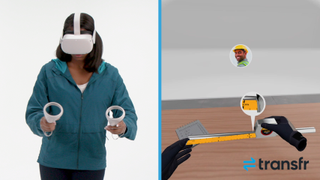
a Woman with a virtual reality set on occupies one half of the screen. The other shows virtual tools that she is controlling.

Excerpts:

Virtual reality can help boost CTE programs and teach students about potential careers in fields they may know nothing about, says Lana Taylor from the Indiana Alliance of Boys & Girls Clubs of America.
…
One of those other resources has been a partnership with Transfer VR to provide students access to headsets to participate in career simulations that can give them a tactile sense of what working in certain careers might be like.

“Not all kids are meant to go to college, not all kids want to do it,” Taylor says. “So it’s important to give them some exposure to different careers and workforce paths that maybe they hadn’t thought of before.” 


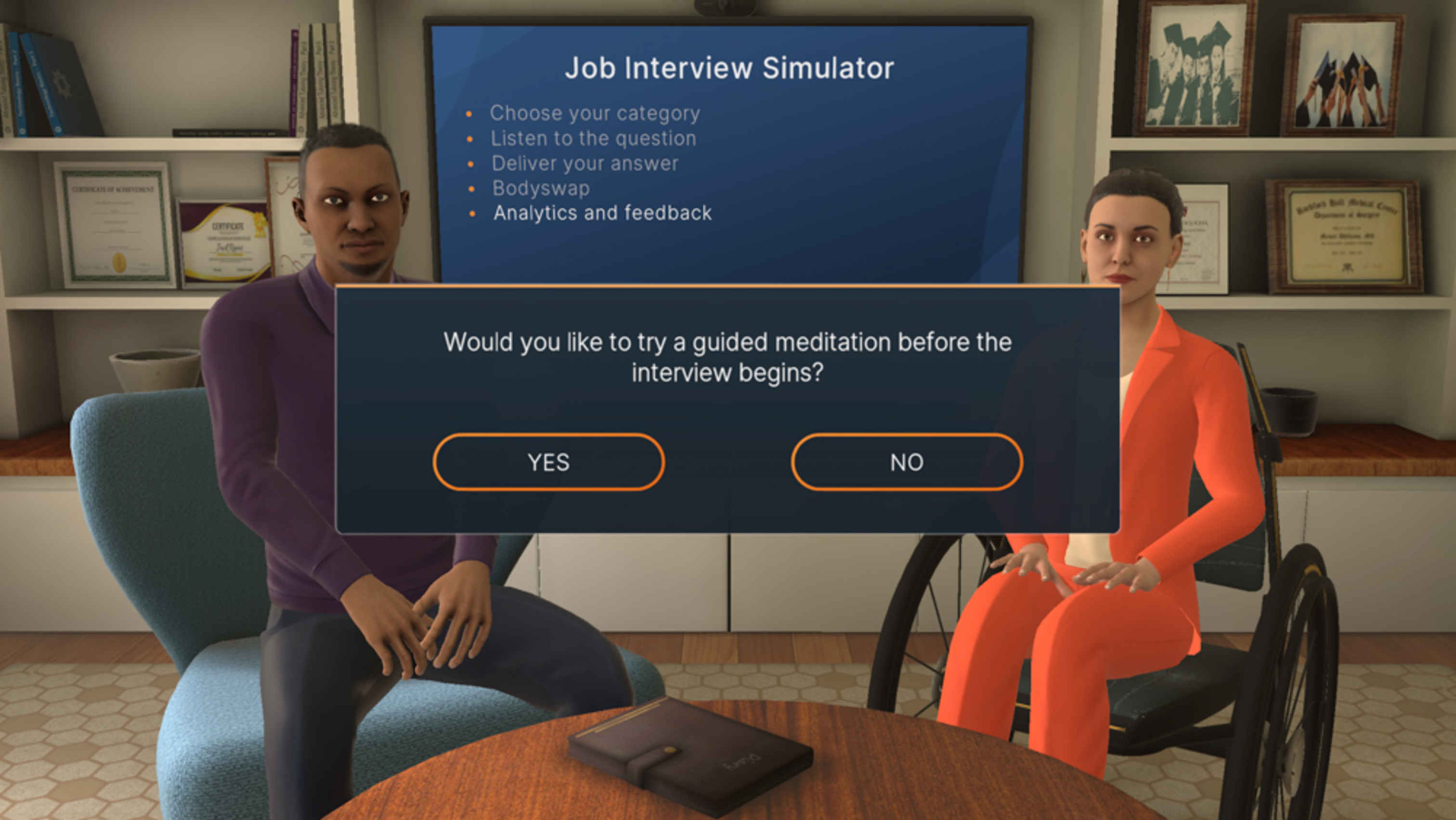
AI interviews in VR prepare students for real jobseeking — from inavateonthenet.net


A Brilliant MIT Professor Shared 10 Simple Rules That Will Teach You How to Give a Great Speech — from inc.com by Justin Bariso

Excerpts:

How much would your life change if people valued all of your ideas?

In a recorded lecture that’s been viewed over 13 million times, MIT professor Patrick Winston takes a deep dive into how to be a better speaker. He explains that your success in life depends on your ability to speak, your ability to write, and the quality of your ideas — in that order.

His point? No matter how amazing your ideas are, no one cares unless you can convey them in a clear, compelling manner — and with emotional intelligence.

Use an empowerment promise to explain to your listeners exactly what you can teach them, how they will benefit, and why it’s important.


Innova: A Revolution in Education? — from gettingsmart.com by Chris Terrill

Key Points

  • Innova Schools is designed to rapidly cut through the vast inequities that exist and be a lever for change in Latin America.
  • Innova has the potential to revolutionize education around the globe.

Excerpts (emphasis DSC):

The initial school start-up was funded by Carlos Rodriguez Pastor, a Peruvian businessman. He saw an opportunity to provide high-quality schools in areas where the government struggled to supply essential education services (Peru and Colombia consistently rank near the bottom on the global education survey). He enlisted the famed US design firm IDEO to develop a comprehensive program that would eventually be utilized in multiple countries.

From DSC:
Stop the presses. I love that idea of using IDEO to be involved here. It seems like that is a positive step towards implementing Design Thinking within our learning ecosystems.

In the original model, the founders designed a rigorous, engaging, personalized curriculum, with a heavy emphasis on Project-Based Learning. I wanted to know if and how that is actualized, and how that is enacted across multiple countries in schools thousands of miles apart.

Finally, IDEO’s work included a design for the physical structure of schools to be quickly and economically replicated at each location; how was that design working? The vision for Innova may be one of the most ambitious educational undertakings today. What lessons can I, as an individual educational leader, and we, as a global education community, learn from their work?

The Maker Space and the Gaming Lab demonstrate clearly how digital competency is a central element of their curriculum. I saw highly engaging lessons that were perfectly synced with classroom projects, pursuing a bigger goal of equipping Colombian students to fill the digital labor gap. 


nbsp;


Digest #166: Perfectionism in Education — from learningscientists.org by Carolina Kuepper-Tetzel

“Perfection is the opposite of done!” I came across this statement recently and it made me think about how perfectionism really affects one’s work and studying. Growing up, I always thought of perfectionism as a good thing, as something to aspire to. However, more recently I am questioning this thought. It adds unnecessary pressure that it difficult to live up to and sustain. I see that many issues that my students are experiencing can be traced back to perfectionism. To incredibly high goals and standards that are impossible to achieve and that makes your work not being “good enough” – when it actually is. The consequences of high perfectionism can be manifold and in today’s digest, I’d like to offer an overview of resources on perfectionism in education.

From DSC:
Somewhere along the lines, I heard that if an interviewer asks you to state a negative characteristic, choose something like perfectionism — to turn something that could be a negative into a positive. And back in my earlier days, I thought that made sense.

But I have to agree with Carolina here. The older I get, the more my empathy levels would rise if someone gave me that answer today. I’m a perfectionist and I can truly say that perfectionism is a joy-robber! It can destroy a good day. It can destroy a good mood. It can destroy joy. I don’t recommend it.


How to Stanch Enrollment Loss — from chronicle.com by Jeff Selingo
It’s time to stop pretending the problem will fix itself.

Excerpt:

The latest enrollment numbers from the National Student Clearinghouse Research Center, for the fall of 2022, paint an ominous picture for higher education coming out of the pandemic. Even in what many college leaders have called a “normal” fall on campuses, enrollment was down 1.1 percent across all sectors. And while the drop was smaller than the past two Covid-stricken fall semesters, colleges across every sector still have lost more than a million students since the fall of 2019.

At some point, colleges need to stop blaming the students who sat out the pandemic or the economic factors and social forces buffeting higher education for enrollment losses. Instead, institutions should look at whether the student experience they’re offering and the outcomes they’re promising provide students with a sense of belonging in the classroom and on campus and ultimately a purpose for their education.


The Key Podcast | Ep.91: The Pros and Cons of HyFlex Instruction — from insidehighered.com with Doug Lederman, Enilda Romero-Hall and Alanna Gillis

Excerpt:

During the pandemic, many colleges and universities embraced a form of blended learning called HyFlex, to mixed reviews. Is it likely to be part of colleges’ instructional strategy going forward?

This week’s episode of The Key explores HyFlex, in which students in a classroom learn synchronously alongside a cohort of peers studying remotely. HyFlex moved from a fringe phenomenon to the mainstream during the COVID-19 pandemic, and the experience was imperfect at best, for professors and students alike.

This conversation about the teaching modality features two professors who have both taught in the HyFlex format and done research on its impact.

From DSC:
When I worked for a law school, we had a Weekend Blended Learning Program.  Student evaluations of these courses constantly mentioned that these WBLP-based courses saved many students hundreds of dollars for each particular class that we offered online (i.e., cost savings in flights, hotels, meals, rental cars, parking fees, etc.).

Another thought/idea:

  • What if traditional institutions of higher education were to offer tiered pricing? That is, perhaps students participating remotely could listen in and even audit classes, but pay less.

Colleges should use K-12 performance assessments for course placement, report says — from highereddive.com by Jeremy Bauer-Wolf

Dive Brief:

  • Colleges should use K-12 performance assessments like capstone papers or portfolios for student course placements and advising, according to a recent report.
  • Typical methods of determining students’ placement in early college classes — like standardized tests — don’t fully illustrate their interests and academic potential, according to the report, which was published by postsecondary education access group Complete College America. Conversely, K-12 performance assessments ask students to demonstrate real-world skills, often in a way that ends with a tangible product.
  • The organizations recommend colleges and K-12 schools mesh their processes, such as by mutually developing a high school graduation requirement around performance assessments. This would help strengthen the K-12 school-college relationship and ease students’ transition from high school to college, the report states.

From DSC:
I post this particular item because I like the tighter integration that’s being recommended between K12 and higher education. It seems like better overall learning ecosystems design, design thinking, and on-ramping.

Along these lines, also see:

How Higher Ed Can Help Remedy K-12 Learning Losses — from insidehighered.com by Johanna Alonso
Low national scores have spurred discussion of how K-12 schools can improve student performance. Experts think institutions of higher education can help.

Excerpt:

Now educators at all levels are talking about ways to reverse the declines. Higher education leaders have already added supports for college students who suffered pandemic-related learning losses; many now aim to expand their efforts to help K-12 students who will eventually arrive on their campuses potentially with even more ground to make up.

It’s hard to tell yet what these supports will look like, but some anticipate they will involve strengthening the developmental education infrastructure that already exists for underprepared students. Others believe universities must play a role in the interventions currently ongoing at the K-12 level.


Also see:

CIN EdTech Student Survey | October 2022 — from wgulabs.org

Excerpt:

Our report shares three key takeaways:

  1. Students’ experiences with technology-enabled learning have improved since 2021.
  2. Students want online learning but institutions must overcome perceptions of lower learning quality.
  3. Students feel generally positive about an online-enabled future for higher education, but less so for themselves..

5 things colleges can do to help save the planet from climate change — from highereddive.com by Anthony Knerr
A strategy consultant explores ways colleges can improve sustainability.

Overwhelming demand for online classes is reshaping California’s community colleges — from latimes.com by Debbie Truongs; with thanks to Ray Schroeder out on LinkedIn for this resource

Excerpt:

Gallegos is among the thousands of California community college students who have changed the way they are pursuing higher education by opting for online classes in eye-popping numbers. The demand for virtual classes represents a dramatic shift in how instruction is delivered in one of the nation’s largest systems of public higher education and stands as an unexpected legacy of the pandemic.

Labster Hits Milestone of 300 Virtual Science Lab Simulations — from businesswire.com
Award-winning edtech pioneer adds new STEM titles and extensive product enhancements for interactive courseware for universities, colleges, and high schools

Excerpt:

Labster provides educators with the ability to digitally explore and enhance their science offerings and supplement their in-classroom activities. Labster virtual simulations in fields such as biology, biochemistry, genetics, biotechnology, chemistry, and physics are especially useful for pre- and post-lab assignments, so science department leads can fully optimize the time students spend on-site in high-demand physical laboratories.

AAA partners with universities to develop tech talent — from ciodive.com by Lindsey Wilkinson
Through tech internships and for-credit opportunities, the auto club established a talent pipeline that has led to new feature development.

5 enrollment trends to keep an eye on for fall 2022 — from highereddive.com by Natalie Schwartz
Although undergraduate and graduate enrollment are both down, some types of institutions saw notable increases, including HBCUs and online colleges.


Great leaders ask great questions: Here are 3 steps to up your questioning game. — from bigthink.com by Christopher J. Frank, Oded Netzer, and Paul F. Magnone; with thanks to Roberto Ferraro for this resource
Questioning isn’t just a way to get the right answer — it’s also a means for sustaining relationships and creative thinking.

Excerpt:

Building an inquisitive team
One of the best LinkedIn profiles starts with “I am insatiably curious.” What would it take to build a team of insatiably curious, truly inquisitive people? Building an inquisitive culture involves a combination of what and how. The what is a combination of the types of questions previously outlined, and the how is the environment you create. Great leaders create great cultures. There are three basic steps to building an inquisitive culture:

  1. Start with an open-ended question.
  2. Respond, don’t react. Embrace silence.
  3. Ask a stream of questions.

Also relevant/see:


Addendum on 10/29/22:

Innovation starts with the quality of your questions — from edte.ch by Tom Barrett
In the final publication of the October throughline we explore how to build a culture of innovation one question at a time.

Snapshot
A quick synthesis of this issue to share

  • Innovation starts with the quality of your questions. Asking the right questions leads to new possibilities and innovative solutions.
  • We are often drawn to ideas because we want to fix problems; starting with an idea feels safe and more fun than starting with a problem.
  • If we want an innovative culture in our teams, we need to start with questions instead of ideas.
  • Trust and psychological safety create the culture for collective negative capability, which John Keats coined as “the ability to live with ambiguity and uncertainty.”
  • Commit to action by being aware of your need for certainty, make space for ambiguity and uncertainty in development work, and build trust by encouraging questions.


Returning Joy to Teaching & Learning — from gettingsmart.com by Trace Pickering

Key Points

  • Too many school-based reform efforts continue to have educators implicitly standing with the standards against the students.
  • Pivot your perspective for a moment to the opposite.
  • What does a school where its educators stand with the students against the standards look like?

From DSC:
My hunch is that we need to cut — or significantly weaken the ties — between the state legislative bodies out there and our public school systems. We shouldn’t let people who know little to nothing about teaching and learning make decisions about how and what to teach students. Let those on the front lines — ie., the teachers and local school system leaders/staff — collaborate with the community on those items.


How Might Engineering Education Transition From In-Person To Hybrid and Online Modalities? — from insidehighered.com by Joshua Kim
Three questions for Rick Hill, professor of mechanical engineering at the University of Detroit Mercy.

Excerpts:

Tools I use in my classroom, including MATLAB and Simulink, are key to recreating the in-person lab experience and giving engineering students access to the same equipment as engineers in the field. Students can gain experience analyzing data, developing algorithms and creating models. They’re developing skills in the design of systems with multidomain models, simulation and deployment without the need for code.

Virtual labs allow an instructor to easily introduce “experiments” into nonlab classes, either in the middle of a lecture or in homework. I do this with live scripts and simulation models. It saves me and the students the time of having to set up and debug the lab hardware and saves the cost and space of the physical laboratory while providing a very quick and controlled environment for doing experiments.


Higher Education in Motion: The Digital and Cultural Transformations Ahead — from er.educause.edu by John O’Brien

Excerpts (emphasis DSC):

In 2015 when Janet Napolitano, then president of the University of California, responded to what she saw as a steadily growing “chorus of doom” predicting the demise of higher education, she did so with a turn of phrase that captured my imagination and still does. She said that higher education is not in crisis. “Instead, it is in motion, and it always has been.”

A brief insert by DSC:
Yes. In other words, it’s a learning ecosystem — with constant morphing & changing going on.

“We insisted then, and we continue to insist now, that digital transformation amounts to deep and coordinated change that substantially reshapes the operations, strategic directions, and value propositions of colleges and universities and that this change is enabled by culture, workforce, and technology shifts.
…
The tidal movement to digital transformation is linked to a demonstrably broader recognition of the strategic role and value of technology professionals and leaders on campus, another area of long-standing EDUCAUSE advocacy. For longer than we have talked about digital transformation, we have insisted that technology must be understood as a strategic asset, not a utility, and that senior IT leaders must be part of the campus strategic decision-making. But the idea of a strategic role for technology had disappointing traction among senior campus leaders before 2020.

From DSC:
The Presidents, Provosts, CIO’s, board members, influential faculty members, and other members of institutions’ key leadership positions who didn’t move powerfully forward with online-based learning over the last two+ decades missed the biggest thing to hit societies’ ability to learn in 500+ years — the Internet. Not since the invention of the printing press has learning had such an incredible gust of wind put in its sails. The affordances have been staggering, with millions of people now being educated in much less expensive ways (MOOCs, YouTube, LinkedIn Learning, other). Those who didn’t move forward with online-based learning in the past are currently scrambling to even survive. We’ll see how many close their doors as the number of effective alternatives increases.

Instead of functioning as a one-time fix during the pandemic, technology has become ubiquitous and relied upon to an ever-increasing degree across campus and across the student experience.

Moving forward, best of luck to those organizations who don’t have their CIOs at the decision-making table and reporting directly to the Presidents — and hopefully those CIO’s are innovative and visionary to begin with. Best of luck to those institutions who refuse to look up and around to see that the world has significantly changed from the time they got their degrees.

The current mix of new realities creates an opportunity for an evolution and, ideally, a synchronized reimagination of higher education overall. This will be driven by technology innovation and technology professionals—and will be made even more enduring by a campus culture of care for students, faculty, and staff.

Time will tell if the current cultures within many traditional institutions of higher education will allow them to adapt/change…or not.


Along the lines of transformations in our learning ecosystems, also see:


OPINION: Let’s use the pandemic as a dress-rehearsal for much-needed digital transformation — from hechingerreport.org by Jean-Claude Brizard
Schools must get ready for the next disruption and make high-quality learning available to all

Excerpts:

We should use this moment to catalyze a digital transformation of education that will prepare schools for our uncertain future.

What should come next is an examination of how schools can more deeply and deliberately harness technology to make high-quality learning accessible to every learner, even in the wake of a crisis. That means a digital transformation, with three key levers for change: in the classroom, in schools and at the systems level.
…
Platforms like these help improve student outcomes by enhancing teachers’ ability to meet individual students’ needs. They also allow learners to master new skills at their own pace, in their own way.

As Digital Transformation in Schools Continues, the Need for Enterprising IT Leaders Grows — from edtechmagazine.com by Ryan Petersen

K-12 IT leaders move beyond silos to make a meaningful impact inside and outside their schools.According to Korn Ferry’s research on enterprise leadership, “Enterprise leaders envision and grow; scale and create. They go beyond by going across the enterprise, optimizing the whole organization and its entire ecosystem by leading outside what they can control. These are leaders who see their role as being a participant in diverse and dynamic communities.”


2022 EDUCAUSE Horizon Action Plan: Hybrid Learning — from library.educause.edu

Excerpts:

Building on the trends, technologies, and practices described in the 2022 Horizon Report: Teaching and Learning Edition, the panel crafted its vision of the future along with practical action items the teaching and learning community can employ to make this future a reality. Any stakeholder in higher education who teaches in or supports hybrid learning modalities will find this report helpful in preparing for the future of hybrid learning. The future we want is within reach, but only if we work together.

Asked to describe the goals and elements of hybrid learning that they would like to see 10 years from now, panelists collaboratively constructed their preferred future for institutions, students, instructors, and staff.

Institutions

  • Higher education is available on demand.
  • Learning is not measured by seat time.
  • Collaboration across institutions facilitates advancement.
  • College and university campuses are not the sole locations for learning spaces.

Students, Instructors, and Staff

  • Everything is hybrid.
  • Student equity is centered in all modalities.
  • Professional development is ongoing, integrated, and valued.
 

Student Preference for Online Learning Up 220% Since Pre-Pandemic — from campustechnology.com by Rhea Kelly

Excerpt:

According to a recent Educause survey, the number of students expressing preferences for courses that are mostly or completely online has increased 220% since the onset of the pandemic, from 9% in 2020 (before March 11) to 29% in 2022. And while many students still prefer learning mostly or completely face-to-face, that share has dropped precipitously from 65% in 2020 to 41% this year.

“These data point to student demand for online instructional elements, even for fully face-to-face courses,” Educause stated.

Also relevant/see:

  • A Surge in Young Undergrads, Fully Online — from insidehighered.com by Susan D’Agostino
    Tens of thousands of 18- to 24-year-olds are now enrolling at Western Governors, Southern New Hampshire and other national online institutions. Does this represent a change in student behavior?
 

How to Cope With Presentation Anxiety — from chronicle.com by James M. Lang
Here’s how a professor and experienced public speaker has learned to deal with the academic version of stage fright.

Excerpts:

Build a pause into the initial minutes of a presentation, so that you can stop and catch your breath. I don’t mean the kind of brief pause you might make between two sentences. I mean a substantive pause in which you are able to stop speaking — for at least 30 seconds — because you have given your audience something to view, think about, or discuss.
…
The remedy: Don’t envision yourself speaking for 45 minutes. Instead, soothe your brain and nervous system by persuading them that you only have to get through the next five minutes.

Your audience wants to learn from you. But real learning requires active thought from the learner. So use those early moments of your talk to start them thinking and take some of the pressure off you.


Students Are Calling BS on High School and Opportunity Knocks — from gettingsmart.com by Trace Pickering

Excerpts:

Let’s be clear. These students are not wrong. The pandemic showed students that much of what they were required to do and endure during pre-pandemic high school was a lot of busywork and tasks that held little relevance or interest to them, and apparently didn’t really matter since they were able to be successful without all that extra work. When schools lost their ability to command and control a student’s time, it forced a different economy for schools and educators. It required the curriculum to be pared down to only the essential standards and information. It now had a very real and powerful competitor for the student’s time – a job, a hobby, sports, music, sleep…

Students are no longer a captive audience. They have more options and choices. To avoid obsolescence, perhaps schools should focus on making school a place where kids see value and want to come to each day.

This is a wonderful opportunity to put in place the things that really drive 21st-century skills and give students the keys to their own learning and growth. To truly personalize learning for students, and unlock teacher professionalism and creativity in the process. That extra time could allow students to pursue areas of passion and interest, to dive deep into a subject that interests them, pursue job shadows and internships, and earn and learn on a job.


How Long Should a Branching Scenario Be?— from christytuckerlearning.com by Christy Tucker
How long should a branching scenario be? Is 45 minutes too long? Is there an ideal length for a branching scenario?

Excerpt:

Most of the time, the branching scenarios and simulations I build are around 10 minutes long. Overall, I usually end up at 5-15 minutes for branching scenarios, with interactive video scenarios being at the longer end.

From DSC:
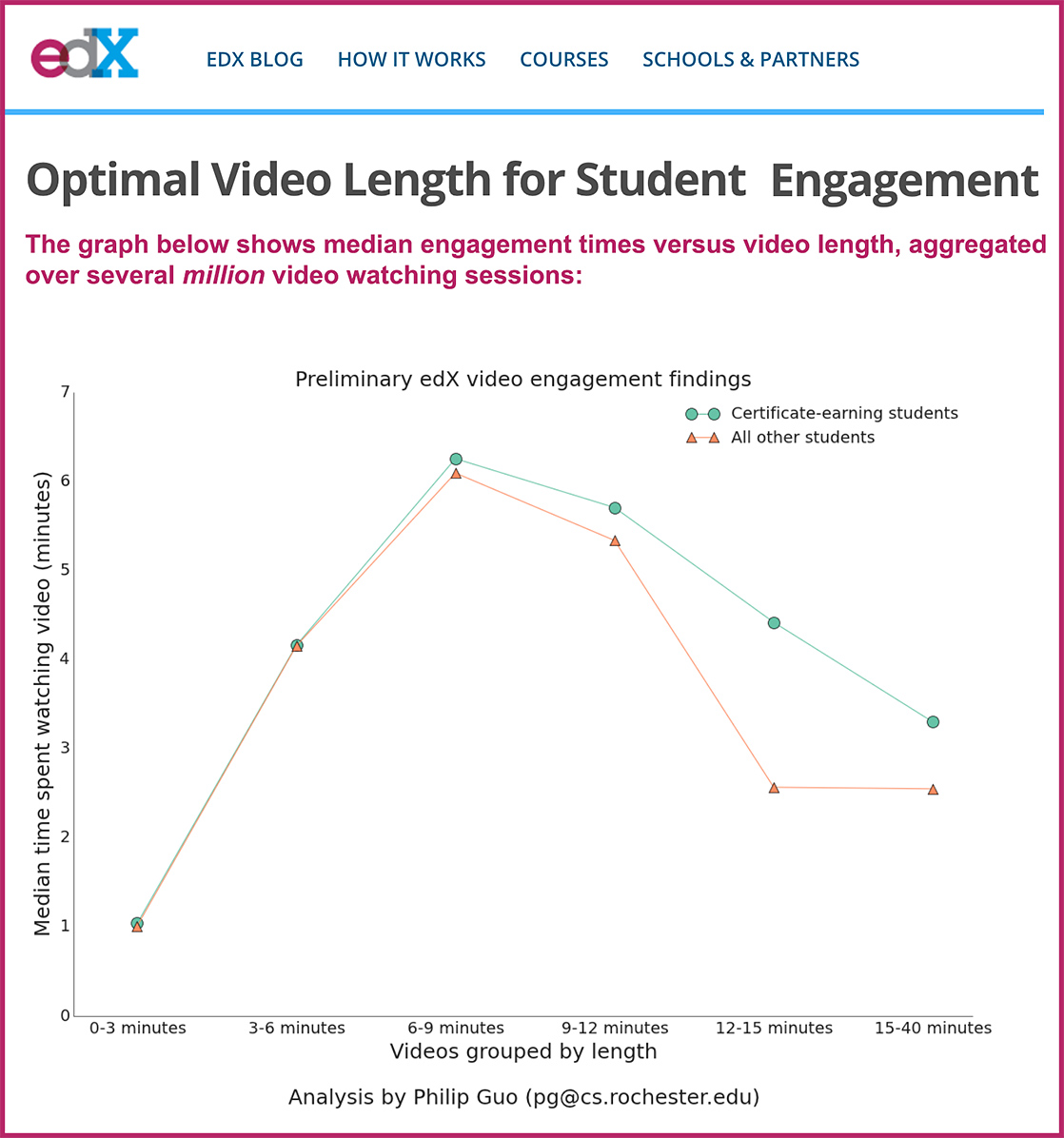
This makes sense to me, as (up to) 6 minutes turned out to be an ideal length for videos.

Excerpt from Optimal Video Length for Student Engagement — from blog.edx.org

The optimal video length is 6 minutes or shorter — students watched most of the way through these short videos. In fact, the average engagement time of any video maxes out at 6 minutes, regardless of its length. And engagement times decrease as videos lengthen: For instance, on average students spent around 3 minutes on videos that are longer than 12 minutes, which means that they engaged with less than a quarter of the content. Finally, certificate-earning students engaged more with videos, presumably because they had greater motivation to learn the material. (These findings appeared in a recent Wall Street Journal article, An Early Report Card on Massive Open Online Courses and its accompanying infographic.)

The take-home message for instructors is that, to maximize student engagement, they should work with instructional designers and video producers to break up their lectures into small, bite-sized pieces.

 
© 2025 | Daniel Christian