Take a step inside the classroom of tomorrow — from techradar.com by Nicholas Fearn
Making learning fun


Excerpt:

But the classroom of tomorrow will look very different. The latest advancements in technology and innovation are paving the way for an educational space that’s interactive, engaging and fun.

The conventions of learning are changing. It’s becoming normal for youngsters to use games like Minecraft to develop skills such as team working and problem solving, and for teachers to turn to artificial intelligence to get a better understanding of how their pupils are progressing in lessons.

Virtual reality is also introducing new possibilities in the classroom. Gone are the days of imagining what an Ancient Egyptian tomb might look like – now you can just strap on a headset and transport yourself there in a heartbeat.

The potential for using VR to teach history, geography and other subjects is incredible when you really think about it – and it’s not the only tech that’s going to shake things up.
…

Artificial intelligence is already doing groundbreaking things in areas like robotics, computer science, neuroscience and linguistics, but now they’re now entering the world of education too.

London-based edtech firm Digital Assess has been working on an AI app that has the potential to revolutionise the way youngsters learn.

With the backing of the UK Government, the company has been trialing its web-based application Formative Assess in schools in England.

Using semantic indexing and natural language processing in a similar way to social networking sites, an on-screen avatar – which can be a rubber duck or robot – quizzes students on their knowledge and provides them with individual feedback on their work.


What are the learning-related ramifications of technologies that provide virtual personal assistants? [Christian]

Everything Siri can do for you and your Apple TV — from imore.com by Lory Gill

Excerpt:

When you ask Siri what it can search for, it will respond, “I can search by title, people (actor, director, character name, guest star, producer, or writer), ratings (like PG or TV-G), reviews (such as best or worst), dates (like 2012 or the 80s), age (like kid-friendly or teen), seasons, episodes, and studio. And of course, I can search by genre.”

But, what else can Siri do?
…
Siri has a fairly robust search feature with multi-layer filtering.
…
While you are watching a movie or TV show, or listening to music, you can get a little extra help from Siri. It’s like having a buddy sitting next to you — but they don’t shush you when you ask a question.
…
You can search for content in the Music app on Apple TV by artist, album, or song title. With a little know-how, you can also turn Siri into your personal deejay.
…
While you may normally look to your smartphone for your weather predictions, Siri can be just as helpful about the conditions around the world as your local weatherman or app. All you have to do is ask.


From DSC:
Following this trajectory out a bit into the future — and in light of significant developments that continue to occur with artificial intelligence, the development and use of algorithms, the potential use of web-based learner profiles (think LinkedIn.com/Lynda.com, MOOCs, the use of nanodegrees), second screen-based apps, and the like — one has to wonder:

“What are the ramifications of this for learning-related applications?!”


The Living [Class] Room -- by Daniel Christian -- July 2012 -- a second device used in conjunction with a Smart/Connected TV


From DSC:
Currently, you can add interactivity to your digital videos. For example, several tools allow you to do this, such as:

So I wonder…what might interactivity look like in the near future when we’re talking about viewing things in immersive virtual reality (VR)-based situations?  When we’re talking about videos made using cameras that can provide 360 degrees worth of coverage, how are we going to interact with/drive/maneuver around such videos? What types of gestures and/or input devices, hardware, and software are we going to be using to do so? 

What new forms of elearning/training/education will we have at our disposal? How will such developments impact instructional design/designers? Interaction designers? User experience designers? User interface designers? Digital storytellers?

Hmmm…

The forecast?  High engagement, interesting times ahead.

Also see:

  • Interactive video is about to get disruptive — from kineo.com by James Cory-Wright
    Excerpt:
    Seamless and immersive because it all happens within the video
    We can now have embedded hotspots (motion tags) that move within the video; we can use branching within the video to change the storyline depending on the decisions you make; we can show consequences of making that decision; we can add video within video to share expert views, link directly to other rich media or gather real-time data via social media tools – all without leaving the actual video. A seamless experience.
    .
  • Endless learning: Virtual reality in the classroom — from pixelkin.org by David Jagneaux
    Excerpt:
    What if you could be part of the audience for Martin Luther King Jr.’s riveting “I Have a Dream” speech? What if you could stand in a chemistry lab and experiment without any risk of harm or danger? What if you could walk the earth millions of years ago and watch dinosaurs? With virtual reality technology, these situations could become real. Virtual reality (VR) is a hot topic in today’s game industry, but games are only one aspect of the technology. I’ve had fun putting  on a headset and shooting  down ships in outer space. But VR also has the potential to enhance education in classrooms.
    .
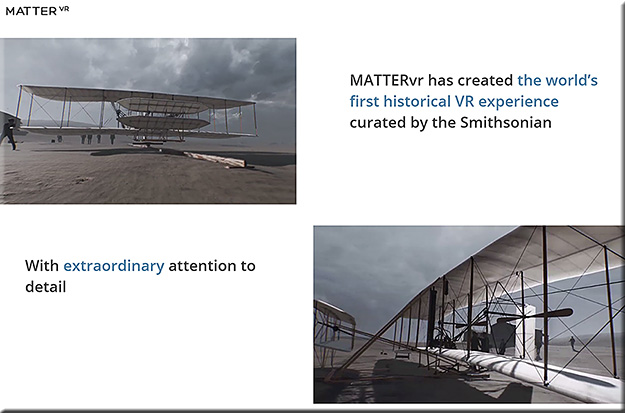
  • Matter VR


MatterVR-Jan2016


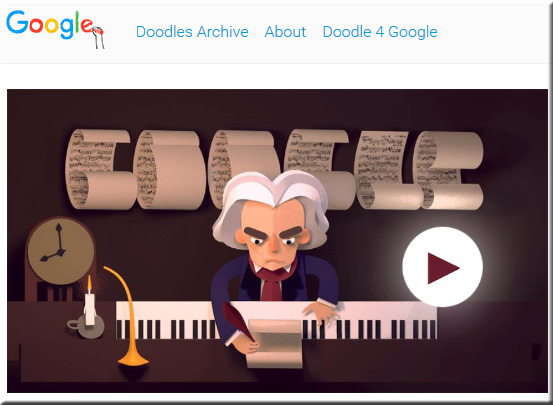
Celebrating Ludwig van Beethoven’s 245th Year <– a fun Google Doodle


beethoven-dec2015


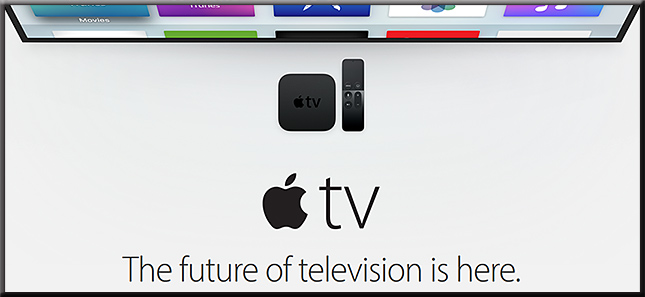
FutureOfTV-Apple-Oct2015


The New Apple TV Invigorates the Set-Top Box — from nytimes.com by Brian Chen

Excerpt:

I NEVER imagined I would get hooked on reading comic books on a TV screen. That changed last week after I picked up a new Apple TV.

The new device, which is similar to a set-top box and brings video and music from the Internet to a television, now has an app store. So I downloaded Madefire, one of the first apps available for the new device. Madefire adds a twist to digital comics with sound effects, music and motion, bringing the panels to life on the big screen. Within minutes, I was bingeing on a series about Superman turning into a corrupt dictator.

Playing with apps is just one new feature of the revamped Apple TV, which will ship this week. It’s that plethora of innovations and apps that leads me to conclude that the upgraded $149 box is now the best TV streaming device you can get for your money.


Apple TV challenges developers to take apps to the big screen — from http://finance.yahoo.com by Julia Love

Excerpt:

(Reuters) – Apple’s loyal army of software developers is joining the tech giant in its bid to conquer the living room with a new version of Apple TV, creating apps for the big screen that they hope will attract users and unlock a rich source of revenue.

A long-awaited update to Apple TV, which launched in 2007, will start shipping in 80 countries on Friday.

Apple views apps as the future of television. An App Store is the centerpiece of the new device, and hundreds of apps will be ready at launch, including gaming, shopping and photography.

Although developers have already been able to make apps for smart TV rivals, Apple’s vast base of developers will set the device apart, analysts say. And developers say they relish the opportunity to reach users in a more intimate setting.


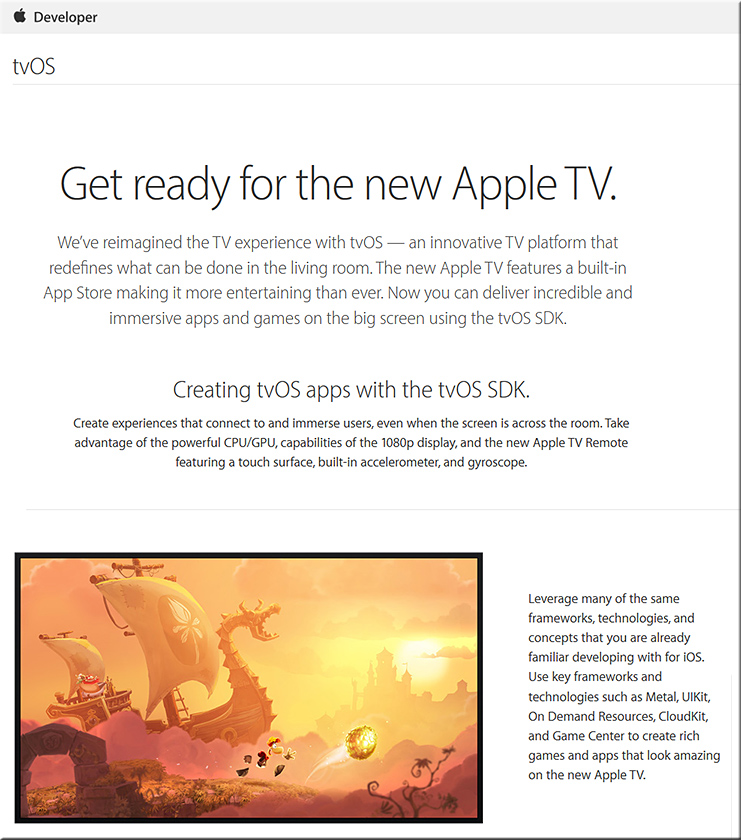
tvOS > Developer information


AppleTV-tvOS-Oct2015


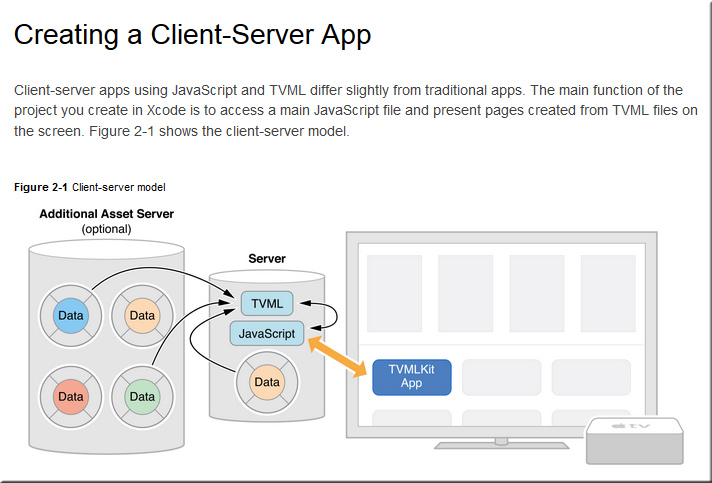
Building Apple TV Apps > Creating a Client-Server App


ClientServerApp-tvOS-Oct2015


Which Apple TV Should You Buy? — from wired.com

Excerpt:

Pre-orders for the new Apple TV have begun. Well, technically, the new Apple TVs; the latest model comes in two sizes. Oh, and the previous version remains available too. For the first time in Apple TV history, you’ve got options. Now it’s time to figure out which one’s right for you.


‘Aerial’ brings beautiful Apple TV video screensavers to your Mac — from 9to5mac.com


screensavers-oct2015


Addendum:


tvOS: The days of developing for a “TV”-based OS are now upon us.

Apple puts out call for Apple TV apps — from bizjournals.com by Gina Hall

Excerpt:

The company put out the call for app submissions on Wednesday for tvOS. The Apple TV App Store will debut as Apple TV units are shipped out next week.
…
The main attraction of Apple TV is a remote with a glass touch surface and a Siri button that allows users to search by voice. Apple tvOS is capable of running apps ranging from Airbnb to Zillow and games like Crossy Road. Another major perk of Apple TV will be universal search, which allows users to scan for movies and television shows and see results from multiple sources, instead of having to conduct the same search within multiple apps.

Apple CEO Tim Cook hopes the device will simplify how viewers consume content.


From DSC:
The days of developing for a “TV”-based OS are now upon us:  tvOS is here.  I put “TV” in quotes because what we know of the television in the year 2015 may look entirely different 5-10 years from now.

Once developed, things like lifelong learning, web-based learner profiles, badges and/or certifications, communities of practice, learning hubs, smart classrooms, virtual tutoring, virtual field trips, AI-based digital learning playlists, and more will never be the same again.


The Living [Class] Room -- by Daniel Christian -- July 2012 -- a second device used in conjunction with a Smart/Connected TV


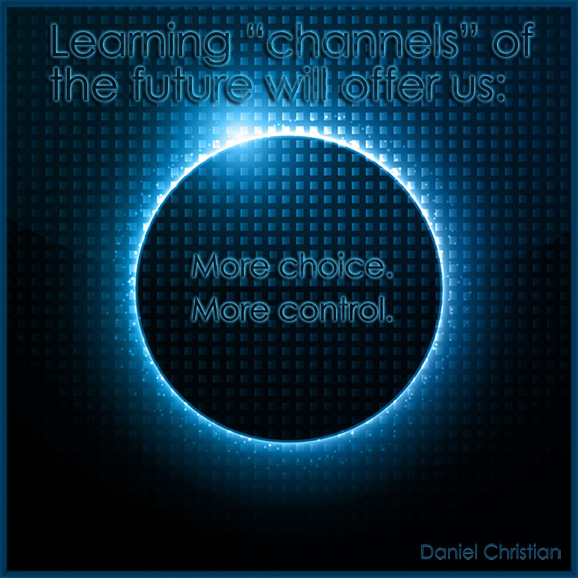
MoreChoiceMoreControl-DSC


Also see:


Addendum on 10/26/15:
The article below discusses one piece of the bundle of technologies that I’m trying to get at via my Learning from the Living [Class] Room Vision:

  • No More Pencils, No More Books — from by Will Oremus
    Artificially intelligent software is replacing the textbook—and reshaping American education.
    Excerpt:
    ALEKS starts everyone at the same point. But from the moment students begin to answer the practice questions that it automatically generates for them, ALEKS’ machine-learning algorithms are analyzing their responses to figure out which concepts they understand and which they don’t. A few wrong answers to a given type of question, and the program may prompt them to read some background materials, watch a short video lecture, or view some hints on what they might be doing wrong. But if they’re breezing through a set of questions on, say, linear inequalities, it may whisk them on to polynomials and factoring. Master that, and ALEKS will ask if they’re ready to take a test. Pass, and they’re on to exponents—unless they’d prefer to take a detour into a different topic, like data analysis and probability. So long as they’ve mastered the prerequisites, which topic comes next is up to them.
 

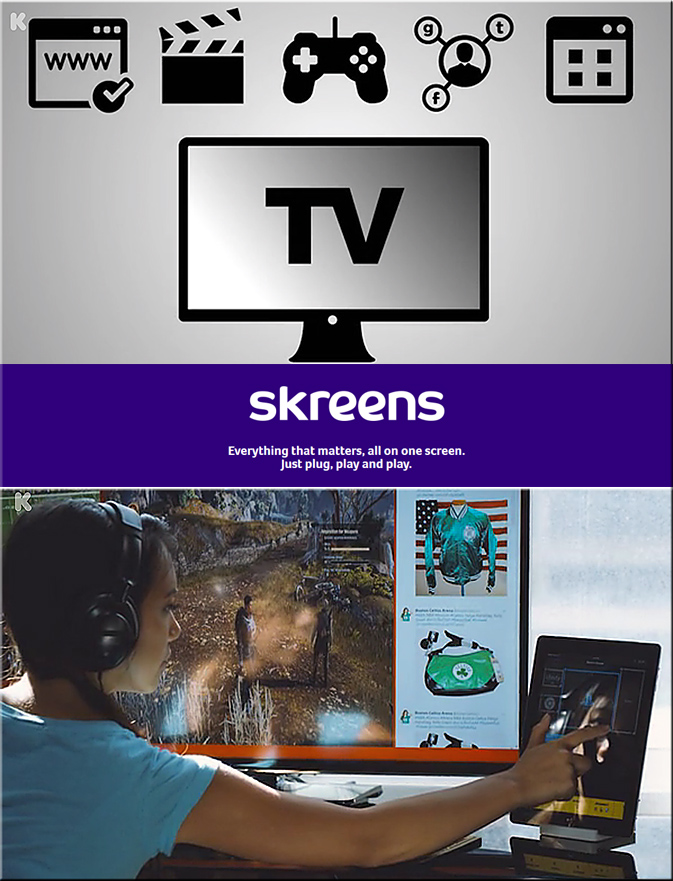
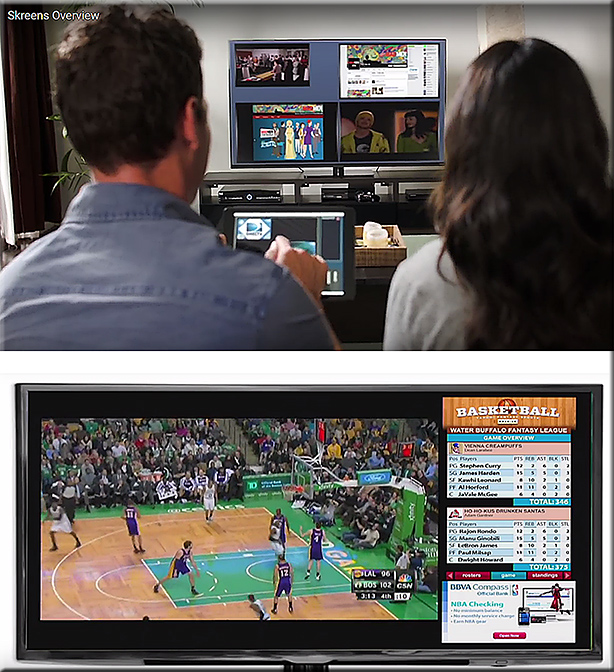
Imagine what learning could look like w/ the same concepts found in Skreens!


From DSC:
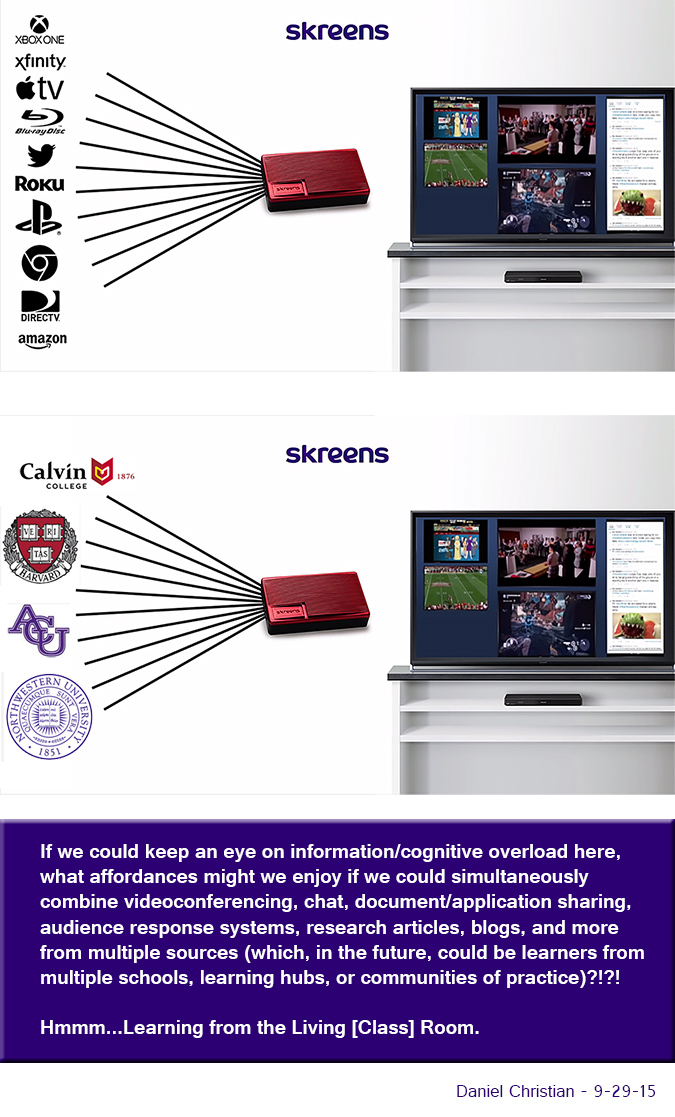
Imagine what learning could look like w/ the same concepts found in the
Skreens kickstarter campaign?  Where you can use your mobile device to direct what you are seeing and interacting with on the larger screen?  Hmmm… very interesting indeed! With applications not only in the home (and on the road), but also in the active classroom, the boardroom, and the training room.


See
Skreens.com
&
Learning from the Living [Class] Room


DanielChristian-AVariationOnTheSkreensTheme-9-29-15


Skreens-Sept2015Kickstarter


Skreens2-Sept2015Kickstarter


The Living [Class] Room -- by Daniel Christian -- July 2012 -- a second device used in conjunction with a Smart/Connected TV

From DSC:
Some of the phrases and concepts that come to my mind:

  • tvOS-based apps
  • Virtual field trips while chatting or videoconferencing with fellow learners about that experience
  • Virtual tutoring
  • Global learning for K-12, higher ed, the corporate world
  • Web-based collaborations and communications
  • Ubiquitous learning
  • Transmedia
  • Analytics / data mining / web-based learner profiles
  • Communities of practice
  • Lifelong learning
  • 24×7 access
  • Reinvent
  • Staying relevant
  • More choice. More control.
  • Participation.
  • MOOCs — or what they will continue to morph into
  • Second screens
  • Mobile learning — and the ability to quickly tie into your learning networks
  • Ability to contact teachers, professors, trainers, specialists, librarians, tutors and more
  • Language translation
  • Informal and formal learning, blended learning, active learning, self-directed learning
  • The continued convergence of the telephone, the television, and the computer
  • Cloud-based apps for learning
  • Flipping the classroom
  • Homeschooling
  • Streams of content
  • …and more!


Addendum:

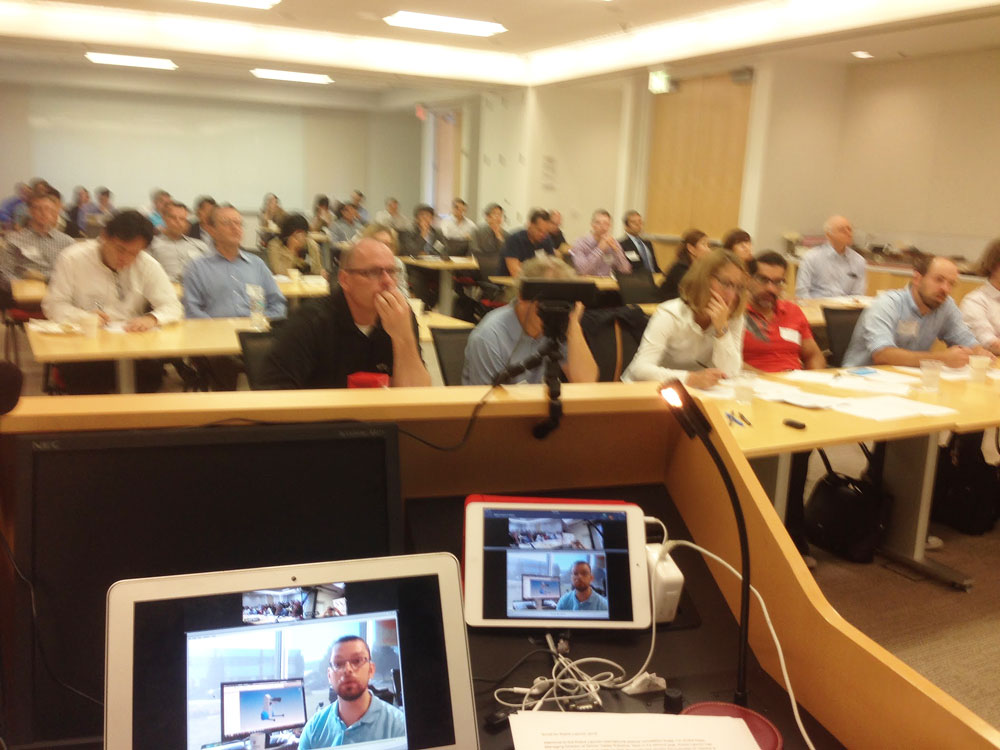
Check out this picture from Meet the winners of #RobotLaunch2015

Packed house at WilmerHale for the Robot Launch 2015 judging – although 2/3rds of the participants were attending and pitching remotely via video and web conferencing.


Empowering Students Through Multimedia Storytelling — from edutopia.org by Michael Hernandez


Excerpt:

Recent studies have proven that stories can change perceptions and even make people more tolerant. Rather than wait to be defined by others, it’s important that students learn to create understanding by sharing their story, their worldview, their concerns, and their triumphs with others.

Groups like Youth Radio and Cause Beautiful are empowering teens in poor and minority-majority neighborhoods to become multimedia journalists. Kids in these programs learn how to tell and share their own stories with a local or national audience.

No matter your class demographics or grade level, ELA and social studies teachers should integrate similar projects in their own classrooms, because every student will benefit from learning to craft a compelling visual story backed by persuasive facts and ideas.

What Is Multimedia Storytelling?
Students use video, audio, photography, web, and social media to craft documentaries and nonfiction stories about the world around them. These interdisciplinary projects allow students to focus on creating an authentic product that many people outside the classroom and their neighborhoods will see.


From DSC:
I am passionate about multimedia because the components of it — digital audio, digital video, text, graphics, animations, digital photography, and more — can create hugely powerful pieces of communication. Students need to be able to communicate — online. But it’s not just students. Each one of us needs to have an online-based footprint now in order to remain marketable.  Multimedia can help relay our stories, our work, our dreams.  It unleashes enormous amounts of energy and creativity inside of us.

I wish that more teachers and faculty members would seek to integrate multimedia-based assignments into their courses — or at least encourage the idea that this can be one of the acceptable ways that assignments can be turned in. At the same time, it can be one of the more interesting ways to assess learning and comprehension. Online-based resources like Lynda.com can help get students, teachers, and professors up the learning curves.


The future of education demands more questions, not answers — from edsurge.com by Jay Silver; with thanks to EDTECH@UTRGV for their Scoop on this resource

Excerpts (emphasis DSC):

Technology alone can’t educate students. It’s not some mystical, magical ingredient one sprinkles over core curricula like salt on a meal. The magic is inside the child.
…
A Pedagogy of Answers
Too many schools apply a paint-by-numbers approach to tech: “Let’s cover this fixed information, in this exact way, in this set amount of time, and judge ourselves as educators and students based on standardized test results.”
…
A Pedagogy of Questions
Our national teaching model has for too long been a pedagogy of answers. In its place I’d like to suggest a new pedagogy of questions—one that prizes interest-driven, project-based, exploratory studies. Personal gardens of learning with no single pathway through them. More open play and less rote memorization. More learning by discovery than following set instructions.
…
As an inventor and father, my advice to those looking to make digital in-roads into our nation’s schools is this: promote learning that encourages kids to choose their own problems and solutions rather than a single, siloed system.
…
Tech isn’t the answer, but it can help us create a new pedagogy of questions.


From DSC:
I can relate to Jay’s thoughts and perspectives here — we need to provide our young learners with more choice, more control. More play. More time for experimentation. More project-based learning that’s based upon what students want to learn about.

How many parents wouldn’t give their left leg (well…almost) to hear their kids say, “I can’t wait to go to school — I love going to school! I love learning about new things that I want to know about!”?  To see such excitement, engagement, and a love for learning would be mind-blowing, right? If your son or daughter has that perspective, I’d guess that you value that attitude and that learning situation a great deal.

This morning a faculty member said something that’s relevant here. [Paraphrasing what he said:] “There’s a paradigm shift occurring these days in how to get information. We need our students to understand and react to this paradigm shift and we need to help them make that shift. They need to be more proactive in how they get information; and not go along with the “Feed me! Feed me!” approach.”

A final comment here…my kids balk at having to learn so many things that they have little interest in; it’s force-fed learning surrounded by — and shaped by — standardized tests. The list of things they actually want to learn about is either very short or non-existent (depending upon their grade levels).  I understand that they are at different stages in their ability to make judgments about what they need to learn about; they need foundational skills to build upon…and that they don’t know what they don’t know.  That said, it would be an interesting experiment for each of them indeed, for them to be able to self-select/choose some more topics, projects, and assignments and then pursue them on their own or with other small groups of other students. How might that impact their engagement levels? How might that improve their views of learning? Perhaps I’m off here..and too Hallmarkish, too Pollyannaish; but I’m tired of hearing the moaning and groaning again about having to do this or that piece of homework.


————–

Addendums on 9/16/15:
I just ran across this item from Larry Ferlazzo out at edutopia.org that has a section in it —
Autonomy — that addresses ways that more choice, more control can be introduced.

The idea of asking better questions doesn’t just belong in K-12. Check out Jack Uldrich’s posting, A Framework for Questioning the Future.

Excerpt:

In today’s era of accelerating change, “answers” about the future are becoming more scarce. As a result, a premium is being placed on asking better questions about the future.

Unfortunately, because most business leaders, CEO’s and senior executives view themselves as action-oriented “problem-solvers,” they have a bias for “answers” instead of “questions.” As such, they don’t really know how to ask better questions.

In an effort to help individuals and organizations overcome this bias–and in the firm belief that it is better to have an imprecise answer to the right question than an exact answer to the wrong question,–I have put together a simple framework to help companies, businesses and organizations begin asking better questions about the future.

The eleven questions posted below are design to jumpstart the thinking–and questioning–process:


The future of learning spaces is open ended — from eschoolnews.com by Lucien Vattel

Excerpt (emphasis DSC):

The spaces we inhabit have a profound effect on how we inhabit them. Space induces a particular way of feeling, of being. What are we saying to our children with we line them up in 5×8 rows facing the same direction toward a voice of authority? What do we say about desks that lock us in place, where the majority of movement within our gaze is eyes forward, eyes down? I remember my surprise when I walked into first grade for the very first time. The change from kindergarten to first grade was extreme. I looked at the arrangement of desks and thought, “what game is this?” It was a game I would play for the rest of my developing years. I was disappointed. I knew it could be better than this.

We look inside current learning spaces and look at the world; there is a big disconnect. It’s not reflective. We as a society have agreed by doctrine that our children will come together in a building and learn, and yet we allow our kids to be behind desks for a majority of their developing years. We evolve behind desks. Think of that! Students don’t need places to sit, listen and write. Instead, they need places to connect, explore, discover and relate. They need places of support. We spend over a decade being conditioned to receive and compete, imagine if space invoked us to support each other, everyday and in every way.

We need environments that help realize that within us there are unbounded treasures. We need environments that shine a light on our potential and provide opportunities to express ourselves.


Schools at their heart should be human potentiality incubators.


From Zeina Chalich:


Tech Toys (and Tools) for Learning – from edutopia.org by Jayne Clare

Excerpt (emphasis DSC):

A whole new trend is about to explode in the educational app world. You may be familiar with the new tech that allows for apps to interact with tangible objects. This enhanced interactive technology is undoubtedly one that will change educational apps as we know them. Soon, the pairing of augmented reality with extensive curriculum guides will be commonplace in the classroom. Indie developers are producing a wide range of products that focus on spatial awareness, language development, number sense, problem solving, and motor skills, as well as an introduction to literacy, math, and the sciences.

What I find most exciting about this trend is the ability to get manipulatives back in the hands of children while simultaneously allowing them to interact with digital tools. As an educator, I’m relieved to know that learning through virtual technologies is able to occur in conjunction with physical play, all while fostering creativity. Suddenly there has emerged a balance between digital play and physical, imaginative, and cognitively engaging play. Kids have always learned best when they have the ability to engage all of their senses during play. The most powerful learning happens when the integration of body, mind, and brain are incorporated simultaneously. Promoting active learning can teach and model concepts and skills; children can then generalize those skills into real-time experiences and their daily routines off-screen.


Surprising insights: How teachers use games in the classroom — from ww2.kqed.org (MindShift) by Holly Korbey

Excerpt:

More teachers are using digital games in the classroom, and they’re using them more frequently, according to a new teacher survey just released by the Joan Ganz Cooney Center. But more surprisingly, the study reveals that teachers are finding that one of the most impactful use of games is for motivating and rewarding students, specifically those who are low-performing.

The survey, which interviewed 694 K-8 teachers with an average of 14.5 years of teaching experience, aims to understand how and why teachers are using digital games in the classroom.
…
Almost half the teachers surveyed — 47 percent — said low-performing students who’ve been struggling in traditional school settings benefited the most from using games. Conversely, only 15 percent of teachers said that high-performing students benefited from playing games.


How digital games can help kids learn — from thedianerehmshow.org

Description:
For as long as there have been schools, teachers have tried to find ways to keep children engaged in the classroom. Today a growing number of schools are using video and other digital games as teaching tools. Many of the games incorporate incentives and rewards to keep students engaged. Experts say the best of them are challenging as well as fun. But critics question whether game designers are promising too much. Some say not enough is known about how these games can affect the learning skills and developing brains of children. A discussion of the role of digital play in schools.

Guests

  • Greg Toppo national education and demographics reporter, USA Today; author of a new book, “The Game Believes in You: How Digital Play Can Make Our Kids Smarter.”
  • Keith Devlin mathematician and co-founder and executive director of Stanford University’s H-STAR institute; he’s the co-founder and president of BrainQuake,an educational technology company. He’s also the “Math Guy” on NPR.
  • Leah Hirsch science teacher and curriculum designer at Quest to Learn, a public middle school in New York City.
  • Robert Pondiscio senior fellow with the Thomas B. Fordham Institute, an education policy think tank.


Also see:

Games vs Game-based Learning vs Gamification - Key Differences


Addendum on 6/29/15:


Addendum on 6/30/15:

  • Top 6 Benefits Of Gamification In eLearning — from elearningindustry.com by Asha Pandey
    Gamification in eLearning helps create an effective learning system that enables learners to rehearse real-life scenarios and challenges in a safe environment. In this article, I will walk you through some of the benefits of Gamification for learners and how the experience of learning (recall and retention) can be enhanced through Gamification.


7 things parents and teachers should know about teens — from edutopia.org by Maurice Elias; with a shout out to Brian Bailey for his Tweet on this

Excerpt:

What Teens Think About
Generally speaking, Rachael believed we give adolescents far too little credit. The passages in their lives are moments when they ask themselves important questions, such as these:

  • How does my life have meaning and purpose?
  • What gifts do I have that the world wants and needs?
  • To what or whom do I feel most deeply connected?
  • How can I rise above my fears and doubts?
  • What or who awakens or touches the spirit within me?

…

What Can Parents and Educators Do?
While parents and educators may have a hard time addressing issues of soul and spirit with their teens, it can help to be aware of some ways into the hearts and minds of young people that can make a difference. Here is what Rachael Kessler suggests in her landmark book, The Soul of Education.

  1. Positive Belonging
  2. Silence and Solitude
  3. Reflections on Life
  4. Joy and Play
  5. Creativity
  6. Linking to the Large
  7. Shape the Passages


From DSC:
Along these lines, please see:


whatiflearning.co.uk -- Examples of connecting Christian faith and teaching across various ages and subjects.


…and also:


VisionsOfVocation-2014

 
© 2025 | Daniel Christian