When I saw this tweet…


It made me wonder:

How might iBeacon scavenger hunts apply to education? To field trips? To learning around a school?


Talk about engagement! Anticipation! A sense of play! Making learning fun!


———–

A related addendum on 5/22/15:

  • Play in Education — from hybridpedagogy.com by Chris Friend, Stephanie Vie, Kyle Stedman and Jesse Stommel
    Excerpt:
    Why isn’t school more fun?

    Fred Rogers, famous in America for creating Mister Rogers’ Neighborhood, said, “Play is often talked about as if it were a relief from serious learning. But for children, play is serious learning. Play is really the work of childhood.” Why do we assume, though, that adults don’t also learn from play? In this episode, I assert that “serious learning” happens through play at any age, and that a playful approach to classes, professions, and identity has benefits that too often get ignored in academia.

    Unfortunately, school is often anything but playful. Between compulsory attendance, state-mandated testing, and the regimented routine of bell schedules, students are often expected to conform and comply, rather than to improvise and experiment. It seems there should be a way to incorporate play into education, making school something that students enjoy, look forward to, and find productive.

    Adeline Koh writes that “play is serious business,” and this episode explores that assertion and tests the ways in which it can be applied to today’s educational environments.


Lance Weiler’s must-read story about the future of storytelling — from kidscreen.com by Wendy Smolen

Excerpt:

As the founder of the Columbia University Digital Storytelling Lab, and its Director of Experiential Learning and Applied Creativity, you’ve convinced some major powers that work and learning begin with a story. What does that mean to those in the industry who make products for kids? 

My work at Columbia University explores how story, play and design can be harnessed to create collaborative work and learning environments. A key takeaway from our experiments so far is the value of a diversity of perspectives. We often strive to embrace a designing “with” and “for” methodology. This is a fundamental shift for the entertainment industry but the reality is the audience has evolved into storytellers. They are now their own little media companies able to push-button publish for the world to see.

As creation and consumption blend, story and code continue to collide.  At Columbia we are exploring new forms and functions of storytelling. How can stories be used as a discovery method? How can they enable people to connect to the world around them? How can they become a utility that can solve everyday challenges?

Story and Code have different development cycles and require different set of skills. So at Columbia and within my own work I often benefit from assembling a kind of 21st Century Writer’s Room. My core team has expanded to include creative technologists, data researchers and systems designers. What connects the team is a series of stories that we use to ensure that everyone is on the same page and that the core vision and goals are communicated.

…

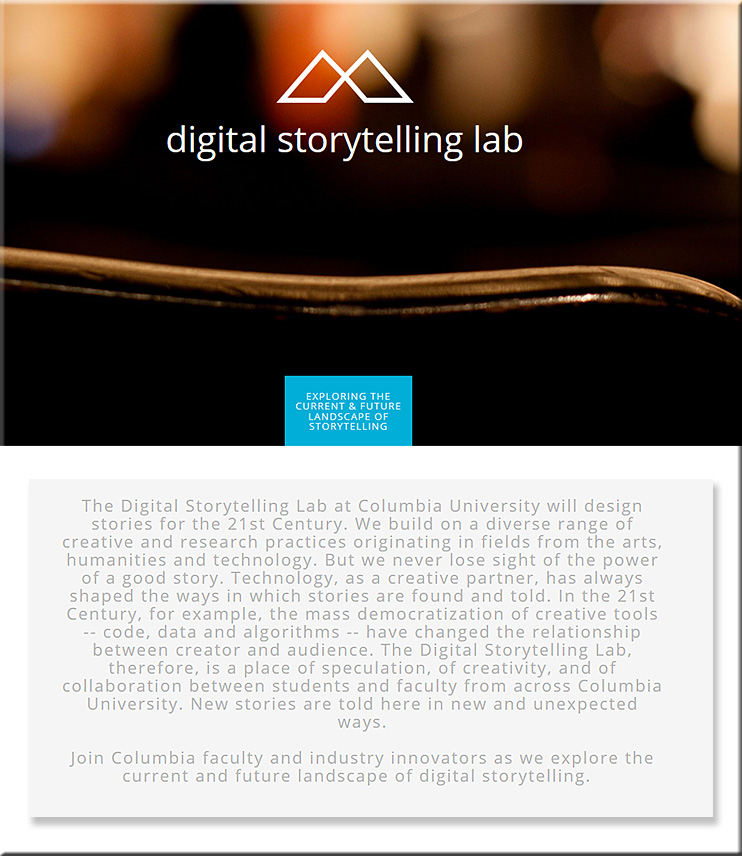
The Digital Storytelling Lab, therefore, is a place of speculation, of creativity, and of collaboration between students and faculty from across Columbia University. New stories are told here in new and unexpected ways.


Also see:


digitalstorytellinglab-may2015


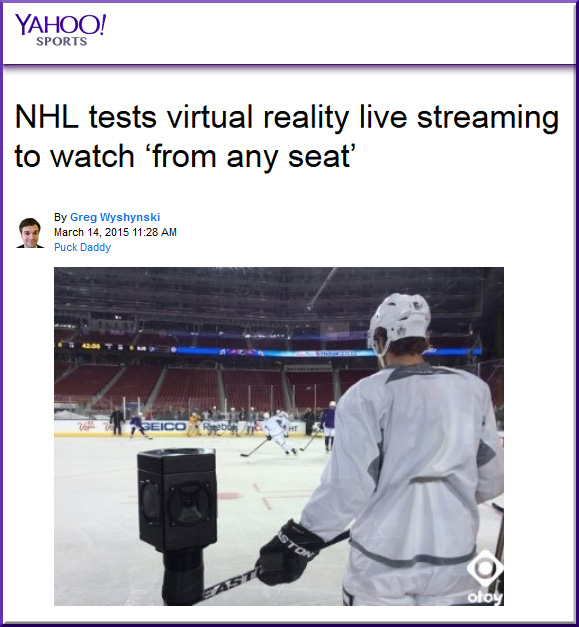
NHL-VirtualReality-WatchFromAnySeat-3-14-15

Excerpt:

AUSTIN, TX – Virtual reality is featured prominently at South By Southwest Sports this year, from using it to better train athletes with Oculus Rift to how it could transform the fan experience watching basketball, football and hockey at home.
…
The NHL had its first successful test of a 360-degree virtual reality experience at its Stadium Series game between the San Jose Sharks and Los Angeles Kings last month, mounting cameras around the glass that filmed HD images in the round.


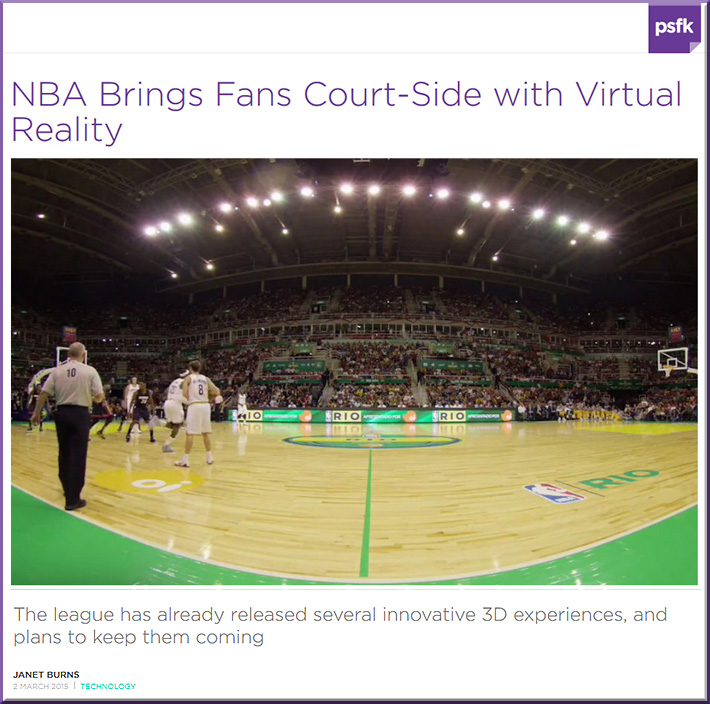
NBA-VirtualReality-WatchFromAnySeat-3-14-15

Excerpt:

When basketball lovers aren’t able to trek to stadiums near and far to follow their favorite teams, it’s possible that watching games on a bar’s widescreen TV from behind bowls of wings is the next best thing. This may no longer be true, however, as a wave of court-side, 3D virtual game experiences is becoming available to superfans with Oculus gear.

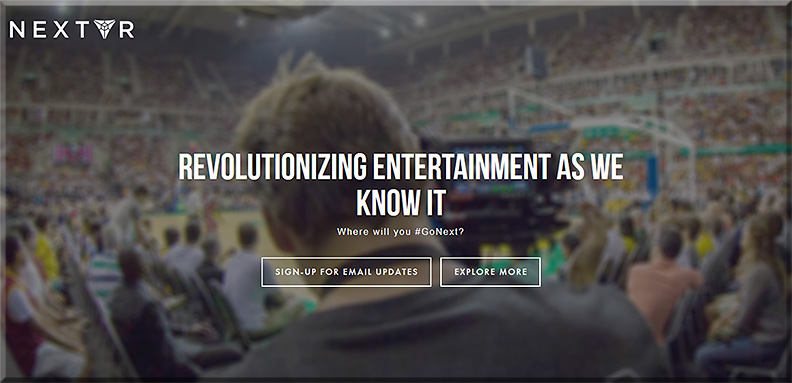
Earlier this month, NextVR showed off its new enhanced spectator experiences at the 2015 NBA All-Star Technology Summit with virtual reality (VR) footage of an October 2014 Miami Heat and Cleveland Cavaliers match-up in Rio de Janeiro. The NBA also already announced plans to record VR sessions of the NBA All-Star Game, the Foot Locker Three-Point Contest, and the Sprite Slam Dunk event and practice.


NEXTVR-March2015


OculusRift-InSportsSXSW-2015


From DSC:
In the future, will you be able to “pull up a seat” at any lecture — throughout the globe — that you want to?


Alternatively, another experiment might relate to second screening lectures — i.e., listening to the lecture on the main/large screen — in your home or office — and employing social-based learning/networking going on via a mobile device.

Consider this article:

TV-friendly social network Twitter is testing a new Social TV service on iPhones which provides users with content and interaction about only one TV show at a time.

The aim is to give users significantly better engagement with their favourite shows than they presently experience when they follow a live broadcast via a Twitter hashtag.

This radical innovation in Social TV design effectively curates just relevant content (screening out irrelevant tweets that use a show’s hashtag) and presents it in an easy-to-use interface.

If successful, the TV Timeline feature will better position Twitter as it competes with Facebook to partner with the television industry and tap advertising revenue related to TV programming.


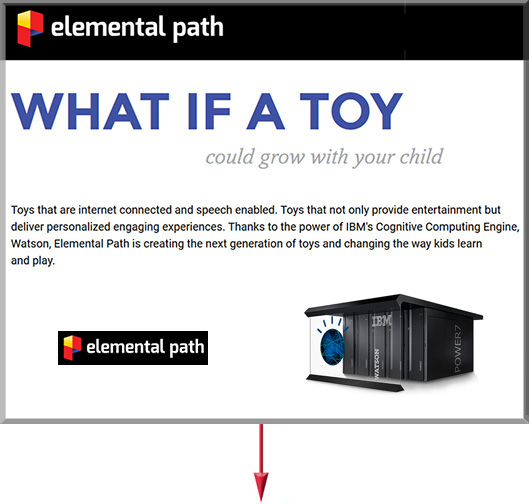
Cognitoy-ElementalPath-March2015
CognitoyFramed-March2015


From DSC:
Given the above…what are the ramifications of that in our/your work?


Also see:


A related addendum on 3/11/15
Look at the different expectations of the generations found in this article:


A related addendum on 3/17/15:

Excerpt:
The overall goal for DragonBot (which, as far as I can tell, is a common platform used for many different projects) is to develop “personalized learning companions” for children. In other words, MIT is finding ways in which robots like DragonBot can effectively help kids learn.

DragonBot isn’t intended to work like that IBM Watson-based dinosaur robot; it’s not a primary source of knowledge, and it’s not actively teaching a whole bunch of new facts to kids who use it. Rather, DragonBot is intended to help with the process of learning itself, encouraging kids to be interactively engaged in whatever they happen to be learning about.


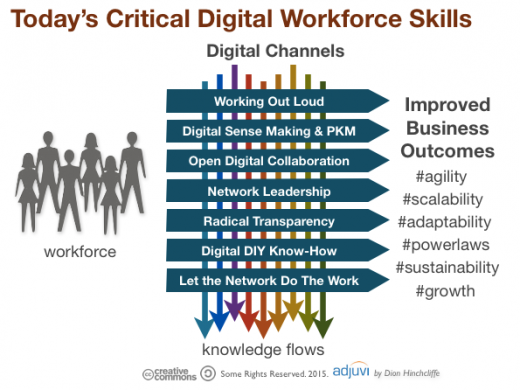
digital workforce skills — from jarche.com by Harold Jarche

Excerpt:

Behaviour change comes through small, but consistent, changes in practice. So how do we move from responsibility, to creativity, and potentially to innovation? Play, explore, and converse. But first we need to build a space to practice. This is where management plays a key role: providing the space to ‘Do it Yourself’.


todays_digital_workforce_skills2


Our employer-employee marriages need counseling — from forbes.com by Dov Seidman

Excerpt (emphasis DSC):

Our Big Asks of employees have become so pervasive that they’re transforming into competencies. A report by Palo Alto-based non-profit research firm Institute for the Future identifies 10 increasingly important work skills. These include talents like: The ability to critically assess and develop content that uses new media forms, and to leverage these media for persuasive communication; cross-cultural competency; proficiency at thinking and coming up with solutions and responses beyond that which is rote or rules-based; and the ability to translate vast amounts of data into abstract concepts and to understand data-based reasoning.


Andrew McAfee: The Second Machine Age is approaching. Here’s how we can prepare. — from huffingtonpost.com by Dawn Nakagawa , EVP, Berggruen Institute

Excerpt:

Nakagawa: Inequality is already a problem. How much worse will inequality get in this new future?

McAfee: The stratospheric wealth of the 1 percent presents some challenges. But I think it’s largely a distraction from the more important challenge, which is not about the people at the top pulling away. It is about the 50th-percentile worker or the 25th-percentile worker. It is about the stagnation in the prospects and earnings of the middle class. We need to focus on how to improve the prospects for the middle and the bottom, people who are finding themselves stagnating or sliding backwards. It could well be that higher marginal tax rates on top levels of income and wealth are part of the solution, but we need to broaden the conversation to look for comprehensive solutions to a complex problem.

…

Nakagawa: How do we need to change the education system, not to address the labor force skills gap we see today but to prepare our younger generation for the economy that is coming?

McAfee: Our education system is in need of an overhaul. It is frustrating that our primary education system is doing a pretty good job at turning out the kinds of workers we needed 50 years ago. Basic skills, the ability to follow instructions, execute defined tasks with some level of consistency and reliability. Machines can do all those things better than we can. What they can’t do, at least not yet, are things like negotiate, provide loving and compassionate care, motivate a team of people, design a great experience, realize what people want or need, figure out the next problem to work on and how to solve it and so on. And not all the items on that list require advanced degrees. We’re going to need people with all kinds of skills and training for some time to come, so let’s rethink our education system so that it provides the required variety.


Educators and trainers take note!
Take a moment to check out “Weird Al” Yankovic’s “Word Crimes” video.  Then take a moment to reflect about the elements that “Weird Al” and Jarrett Heather used in this piece…what comes to your mind?


WierdAls-WordCrimes-2014


For me — and regardless what you think of his music here — “Weird Al” and Jarrett have come up with a solid piece of pedagogy here.  In fact, this could be a fun intro piece to several classes out there!

I say this because it’s a clever, fun way to introduce and discuss grammar. It illustrates some examples of the sorts of mistakes we make in our use of language and words, but it does so via the creative use of animation, music, video, social media, text, graphics and more!  Folks (of all ages!) will find themselves learning while they’re having some fun.  This playful use of multimedia gets your attention.  In fact, for me, the elements in this piece provide a recipe for maximum engagement.


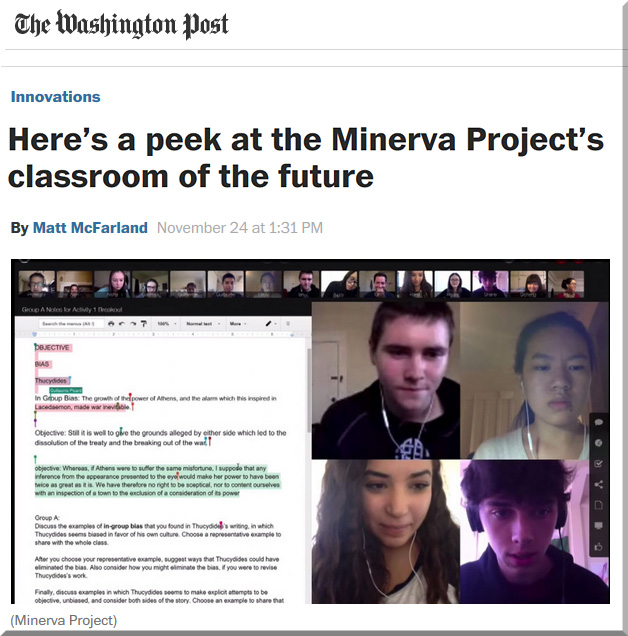
MinervasClassroomOfTheFuture-11-24-14


Here’s a peek at the Minerva Project’s classroom of the future — from washingtonpost.com by Matt McFarland
Check out five ideas that could impact the way we live, work and play.

Excerpt:

“Think of the fanciest version of Google Hangouts or Skype designed to be a classroom,” explains a student. “It’s very different than a traditional classroom, but in a way it’s what a traditional classroom distilled down to its purest form I feel like would look like,” says another.


Also see:


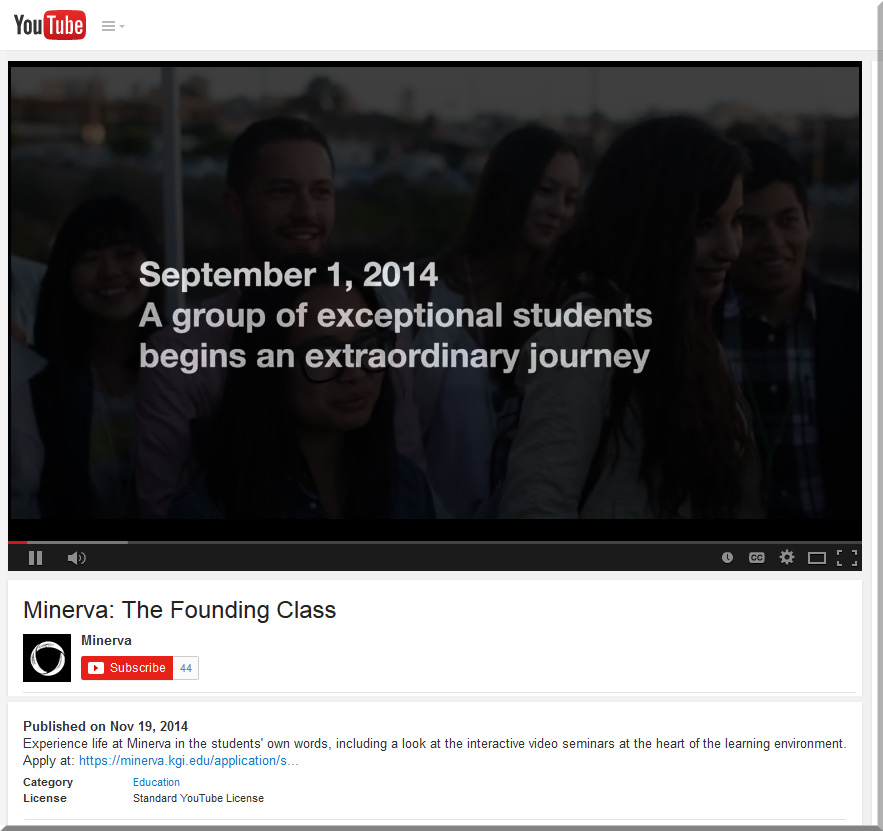
Minerva-Sep2014


Last week I attended the 20th Annual Online Learning Consortium International Conference.  While there, I was inspired by an excellent presentation entitled, “A Disruptive Innovation: MSU’s Surviving the Coming Zombie Apocalypse – Are You Ready to Survive a New Way of Learning?“   The four team members from Michigan State University included:

  • Glenn R. Stutzky | Course Instructor
  • Keesa V. Muhammad | Instructional Designer
  • Christopher Irvin | Instructional Designer
  • Hailey Mooney | Course Librarian

Check out the intro clip on the website about the course:
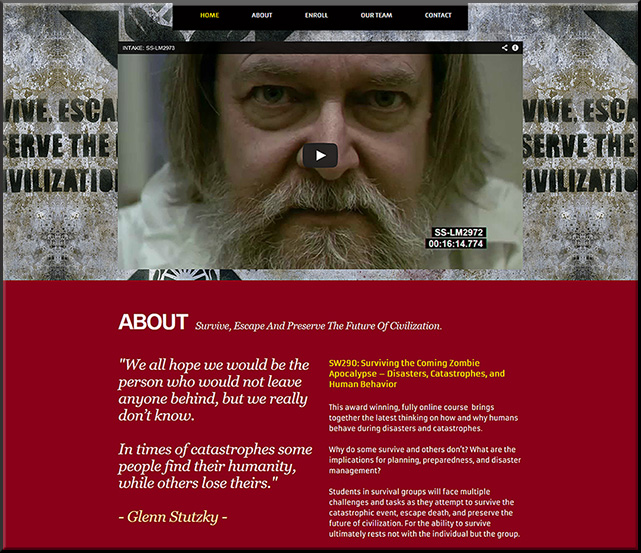
 

MSUZombie-Oct2014


From the description for the presentation:

This session highlights MSU’s award winning, groundbreaking online course that fuses social theory, filmmaking, social media, and viral marketing while students survive an apocalyptic event. http://zombie.msu.edu/

MSU created and used powerful digital storytelling and multimedia to overlay real, experiential, immersive learning. Important content was relayed, but in a way that drew upon your emotions, your ability to solve problems and navigate in a world where you didn’t have all of the information, your ability to work with others, and more.

“This innovative course integrates current research and science on catastrophes and human behavior together with the idea of a zombie apocalypse. In doing so, we actively engage with students as they think about the nature, scope, and impact of catastrophic events on individuals, families, societies, civilizations, and the Earth itself.”

“Our innovative approach to teaching and learning features: students as active participants, the instructor becomes the facilitator, storytelling replaces lectures, zombies become the catalyst of teaching, a “zombrarian” (librarian) drives research, and the students emerge as digital storytellers as a way of assessing their own learning.”

Others outside MUS have found out about the course and have requested access to it. As a result of this, they’ve opened it up to non-credit seeking participants and now various people from police forces, Centers for Disease Control, and others are able to take the course. To make this learning experience even more accessible, the cost has been greatly reduced: from $1600+ to just $500. (So this talented team is not only offering powerful pedagogies, but also significant monetary contributions to the university as well.)

For me, the key thing here is that this course represents what I believe is the direction that’s starting to really pull ahead of the pack and, if done well, will likely crush most of the other directions/approaches.  And that is the use of teams to create, deliver, teach, and assess content – i.e., team-based learning approaches.

So many of the sessions involved professional development for professors and teachers – and much of this is appropriate. However, in the majority of cases, individual efforts aren’t enough anymore.  Few people can bring to the table what a talented, experienced group of specialists are able to bring.  Individual efforts aren’t able to compete with team-based content creation and delivery anymore — and this is especially true online, whereby multiple disciplines are immediately invoked once content hits the digital realm.

In this case, the team was composed of:

  • The professor
  • Two Instructional Designers
  • and a librarian

The team:

  • Developed websites
  • Designed their own logo
  • Marketed the course w/ a zombie walking around campus w/ brochures and a walking billboard
  • Used a Twitter stream
  • Used a tool called Pensu for their students’ individual journals
  • Made extensive use of YouTube and digital storytelling
  • Coined a new acronym called MOLIE – multimedia online learning immersive experience
  • Used game-like features, such as the development of a code that was found which revealed key information (which was optional, but was very helpful to those who figured it out).  The team made it so that the course ended differently for each group, depending upon what the teams’ decisions were through the weeks
  • Used some 3D apps to make movies more realistic and to create new environments
  • Continually presented new clues for students to investigate.  Each team had a Team Leader that posted their team’s decisions on YouTube.

They encouraged us to:
THINK BIG!  Get as creative as you can, and only pull back if the “suits” make you!  Step outside the box!  Take risks!  “If an idea has life, water it. Others will check it out and get involved.”

In their case, the idea originated with an innovative, risk-taking professor willing to experiment – and who started the presentation with the following soliloquy:

Syllabi are EVIL

Syllabi are EVIL and they must die!
Listen to me closely and I’ll tell you why.
Just want students to know what is known?
See what’s been seen?
Go – where we’ve been going?
Then the Syllabus is your friend,
cuz you know exactly where you’ll end.
But if you want to go somewhere new,
see colors beyond Red, Green, and Blue.
Then take out your Syllabus and tear-it-in-half,
now uncertainty has become your path.
Be not afraid because you’ll find,
the most amazing things from Creative Minds,
who have been set free to FLY,
once untethered from the Syllabi.

Glenn Stutzky
Premiered at the 2014
Online Learning Consortium International Conference
October 29, 2014


They started with something that wasn’t polished, but it’s been an iterative approach over the semesters…and they continue to build on it.

I congratulated the team there — and do so again here. Excellent, wonderful work!


By the way, what would a creative movie-like trailer look like for your course?


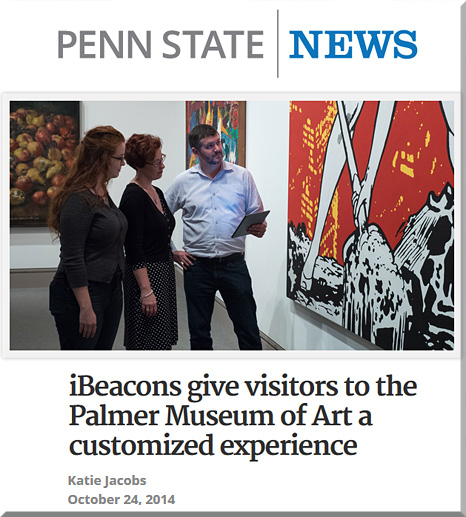
iBeacons-PennSt-Art-Oct2014


iBeacons give visitors to the Palmer Museum of Art a customized experience — from news.psu.edu by Katie Jacobs

Excerpt:

Soon, there will be new, high-tech additions to the Palmer Museum’s galleries — small electronic devices that will be stuck to walls behind paintings, hidden under shelves or concealed in corners. You won’t be able to see them, but your mobile devices will.

The devices ares iBeacons, small transmitters created by Apple that communicate with nearby smartphones. If a visitor has the correct mobile app installed, content will be automatically sent to the phone with more information about the nearby artwork.

…

“Sometimes I’ll lead tours with visitors and focus on the works of art I think are particularly fascinating,” says Kletchka. “I thought it would be wonderful if everyone could have that experience here — they can learn more about the objects they are interested in on their own terms.”


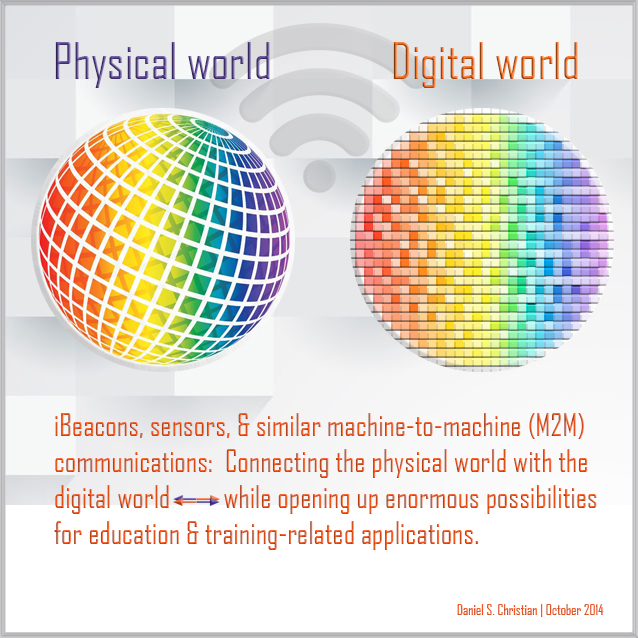
DanielChristian-Combining-Digital-Physical-Worlds-Oct2014


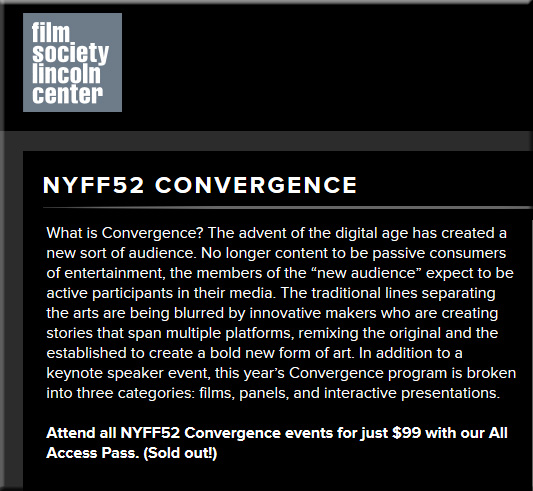
It’s Not Film. It’s Not TV. It’s Convergence. Here’s What It’s All About. –– from indiewire.com by Paula Bernstein
A new wave of creators is blurring the lines of storytelling to span multiple platforms. Here, a handful of those creators from this year’s New York Film Festival Convergence program explain what convergence means to them.


NYFFConvergence-Sept2014


Comment from DSC:
If this trend continues, I would guess that it would affect education as well.  That is, students no longer want to be passive consumers, but active participants.  Hmmm…sounds very familiar to me.  Aren’t we already there (i.e., active learning, project-based learning, makerspaces, and more)?


Also see:


Opening minds to critical knowledge on play, creativity and learning — from legofoundation.com

Cultures of Creativity (foundation research) — from legofoundation.com
Cultures develop when people find ways to play, make, and share. This report describes how human cultures can be characterised by their similarities rather than their differences, and emphasises the importance of recognising playfulness and creativity to develop societies prepared to accommodate the rapid changes associated with technology and globalisation.

Cultures of Creativity, nurturing creative mindsets (video)  — from legofoundation.com
Creativity is one of the most important competencies of the 21st Century. Yet, the puzzling question is how to nurture it? Children are creative from the day they are born and the film describes how to support creativity across cultures. The content is based on the report, Cultures of Creativity, published by the LEGO Foundation, 2013.  Authors: David Gauntlett and Bo Stjerne Thomsen and 20 leading international experts on play, learning and creativity.com

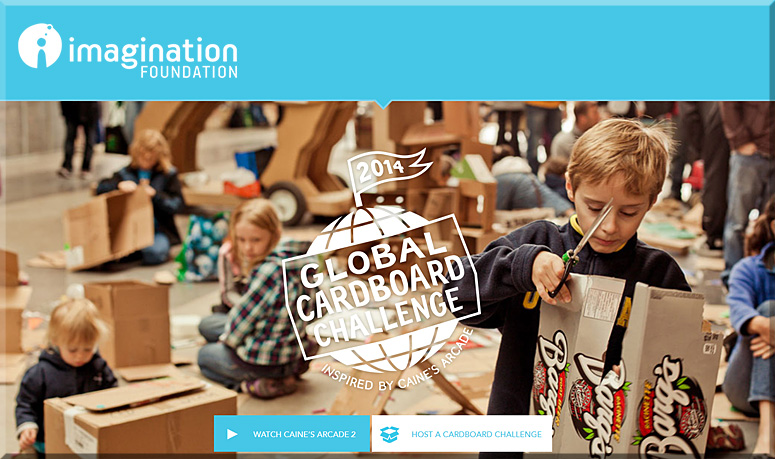
Inviting the world to play –– from cardboardchallenge.com/
This fall, the Imagination Foundation invites the world to participate in our 3rd Annual Global Cardboard Challenge.

.

2014GlobalCardboardChallenge


With a shout out to Mitch Resnick for posting
these resources on Twitter. Mitch is
going to be talking about
“Sowing the Seeds for a More Creative Society” this Wednesday w/ Adobe.


From Calvin College-based staff and faculty:

  • A whack on the side of the head : how to unlock your mind for innovation / Roger von Oech ; foreword by Nolan Bushnell ; illustrated by George Willett.
    Von Oech, Roger. (Author)
  • Sparks of genius : the thirteen thinking tools of the world’s most creative people by Robert and Michele Root-Bernstein
  • The learner-directed classroom : developing creative thinking skills through art — edited by Diane B. Jaquith, Nan E. Hathaway ; foreword by Patrick Fahey.
    Jaquith, Diane B. (Added Author). Hathaway, Nan E. (Added Author).
  • Nurturing creativity in the classroom — edited by Ronald A. Beghetto, James C. Kaufman.
    Beghetto, Ronald A., 1969- (Added Author). Kaufman, James C. (Added Author).
  • Improving Learning of Computational Thinking Using Creative Thinking Exercises in CS-1 Computer Science Courses —  by Miller, Soh, Chiriacescu, et al. (2013)
  • Fostering the Creative Development of Computer Science Students in Programming and Interaction Design — by Ferreira (2013)
  • Integrating Creativity into Computer Networks Course Teaching — by Hsiao, Liang, & Lin (2003)
  • Pixar Cofounder Ed Catmull on failure and why fostering a fearless culture is the key to groundbreaking creative work – from brainpickings.org by Maria Popova
    Why the greatest enemy of creative success is the attempt to fortify against failure.
    Excerpt:
    We need to think about failure differently. I’m not the first to say that failure, when approached properly, can be an opportunity for growth. But the way most people interpret this assertion is that mistakes are a necessary evil. Mistakes aren’t a necessary evil. They aren’t evil at all. They are an inevitable consequence of doing something new (and, as such, should be seen as valuable; without them, we’d have no originality). And yet, even as I say that embracing failure is an important part of learning, I also acknowledge that acknowledging this truth is not enough. That’s because failure is painful, and our feelings about this pain tend to screw up our understanding of its worth. To disentangle the good and the bad parts of failure, we have to recognize both the reality of the pain and the benefit of the resulting growth.
  • How Disney’s Imagineers keep the magic ideas coming – from fastcompany.com by Rebecca Greenfield
    Peter Rummell, the former chairman of Disney’s Imagineers, shares inside stories and secrets about how Disney’s teams work together to make magic happen again and again.
  • 10 ways to teach innovation — from blogs.kqed.org/mindshift by Thom Markham
    Excerpt:
    One overriding challenge is now coming to the fore in public consciousness: We need to reinvent just about everything. Whether scientific advances, technology breakthroughs, new political and economic structures, environmental solutions, or an updated code of ethics for 21st century life, everything is in flux—and everything demands innovative, out of the box thinking. The burden of reinvention, of course, falls on today’s generation of students. So it follows that education should focus on fostering innovation by putting curiosity, critical thinking, deep understanding, the rules and tools of inquiry, and creative brainstorming at the center of the curriculum. This is hardly the case, as we know. In fact, innovation and the current classroom model most often operate as antagonists. The system is evolving, but not quickly enough to get young people ready for the new world. But there are a number of ways that teachers can bypass the system and offer students the tools and experiences that spur an innovative mindset. Here are ten ideas…
  • How schools kill creativity — from TED.com by Sir Ken Robinson
  • Barriers to Creativity in Education: Educators and Parents Grade the System [Adobe]
  • Perhaps some ideas at a Do It Yourself (DIY) type of site could be relevant, such as org/skills/innovator
  • Perhaps have the students use digital storytelling in an assignment, see:
  • Digital Storytelling Helps Students Practice Essential Skills – from elearningindustry.com by Tiziana Saponaro
  • 5 reasons why you should be using storytelling in training – from dashe.com by Ben Nesvig
    Excerpt:
    Storytelling has been a popular tool for learning since the dawn of civilization, but thanks to technology bringing new mediums for storytelling, it has been on the rise in training in the workplace. Despite the fact that storytelling is a powerful vehicle for teaching, some still prefer to do a “data dump” because it’s easier than constructing a narrative, though not more effective. Below I provide 5 reasons why storytelling should be used more frequently in the workplace.
  • Mesmerizing fairy tale on the power of transmedia storytelling – from frametales.com by DRAFTFCB Madrid and posted by Filip Coertjens
  • Expanding learning opportunities with transmedia practices – Parts 1-6 [Laura Fleming]
  • erikjohanssonphoto.com


AdobeMax2013-ErikJohansson


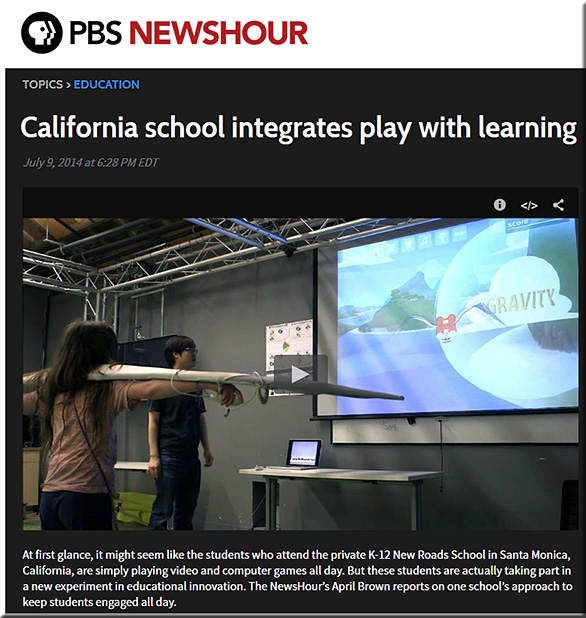
CASchoolIntegratesPlayWithLearning-PBS-July2014


California school integrates play with learning — from pbs.org

Excerpts:

STUDENT: I really like school now. Like, I’m actually psyched to come.

STUDENT: It just makes me feel good.

STUDENT: I wake up every morning and I’m just like, yes.

APRIL BROWN: These students have been taking part in a new experiment in educational innovation known as the PlayMaker School. PlayMaker is, thus far, only for sixth graders who attend the private K-12 New Roads school in Santa Monica, California. You won’t find desks, seating charts or even a normal grading system in their classroom.

…

APRIL BROWN: And, if nothing else, they have figured out how to make kids like Isaac Prevatt look forward to school.

ISAAC PREVATT, Student: At my old school, I dreaded it every single day. I really just didn’t like it. You know, I would fake stomach aches. I have not faked any sicknesses this year.


From DSC:
Tony Wagner’s recent keynote mentions the importance of play, passion, and purpose in education.  There’s engagement here. There’s focus here.  There might even be a love of learning here — but at least a liking to learn and a stronger sense of actually enjoying learning about something.

I have it that we need to create learning environments and pedagogies that cultivate situations whereby students at least like to learn.

Why?

Because most of us are now required to be lifelong learners in order to remain marketable. (I could also address the love of learning for its own sake, as there’s huge value just in that as well.)

If a student drops out of high school or if they make it through college but end up hating school, those negative experiences that they associate with learning may prove to be obstacles to overcome for them.  They may not want to go back to a learning environment again.  They may have a “bad taste in their mouth” about education/learning.  Becoming a lifelong learner may sound more like a prison sentence to them.

So I celebrate the above approach and experimentation with pedagogy.  Hearing the excitement in the students’ voices and words is simply excellent.  (I wonder if we’re hearing that sort of excitement from them taking all of these standardized tests…?)

I could also relate to the part of the video where one of the teachers said that the students were very uncomfortable with this type of learning environment — that they just wanted to be told what to do. Where’s my test?!  I just want to be told what to do and to take tests.

Many of our students may not like open/unanswered questions or “less structured” activities and learning environments.  But such experimentation could easily help them with their creativity and with developing more innovative thinking.  The work world won’t always tell them each step to take on something; the “tests” will be found in how they can problem solve and if they can think critically, innovatively.


With thanks to Jim Lerman  for his Scoop on this.

.

Also see:

.

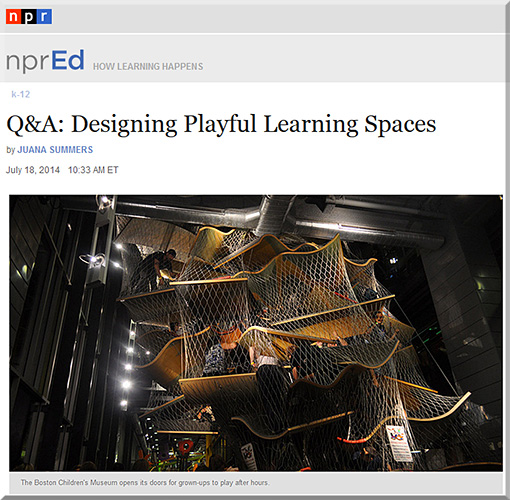
DesigningPlayfulLearningSpaces-NPR-7-18-14


From DSC:
I ran across Manish Mohan’s blog posting — Seven Survival Skills in Today’s World — which focused on Tony Wagner’s keynote address at the IFC’s International Private Education Conference: Rethinking Education, Shaping the Future.

So I read the blog posting and then I listened to Tony Wagner’s address. Below are my notes from his talk.


What’s the problem we need to solve in education?

Challenges

  1. Education today has become a commodity. Knowledge is free; it’s like water or air.  Educators once had the corner on the market. Knowledge had to come through the teacher. Not true today. You can acquire knowledge via the Internet. Teachers are no longer the gatekeepers. Where, then, is the value that teachers/schools are providing?
  2. Work is being transformed around the world. Routine jobs being automated/replaced by computers or in other countries for far less $$. World cares about what you can DO with what you know. Not just acquiring knowledge. Skill and will are other legs of the stool (in addition to knowledge).
  3. The longer students are in school (in the U.S.), the more bored they are. Less engaged as time goes on. The Internet is their preferred source of learning.

Tony focused on skill (adding value) and will in this keynote. Need to be a continuous learner.

Tony talked to senior executives — what skills do you need today? Where are the gaps?

7 survival skills/competencies a person needs before they reach the end of their secondary school:

  1. Critical thinking and problem solving — how to ask the right questions
  2. Collaboration across networks — how are we going to teach
  3. Agility and adaptability
  4. Initiative and entrepreneurship
  5. Effective oral and written communication — need to be able to write with “voice” — own passion and perspective, to be convincing
  6. Accessing and analyzing information
  7. Curiosity and imagination

New achievement gap — these 7 survival skills vs what is being taught around the world.

Growing unemployment of college graduates compels us to look at goals of education.  Academically adrift — communication skills not growing in college.

One person to Tony:
“I want young people who can ‘Just go figure it out.'”

Want graduates who have a sense of mission.  Autonomy.

How do we prepare kids to “Just go figure it out.”

We need innovators — creative problem solvers. People who ask the right questions.

The teachers (of innovative individuals) who made the greatest difference were outliers in their respective institutional settings but were remarkably alike in their patterns of teaching and learning.  The culture of schooling, as we continue to practice it, is fundamentally and radically at odds with the culture of learning to be an innovator in 5 respects:

  1. Culture of schooling is about rewarding individual achievement vs being a team player
  2. Compartmentalizing knowledge; innovations happens at the margins of academic disciplines, not within them; interdisciplinary courses needed
  3. Passivity and consumption — students listen, consume information; only 1 expert.  VS creating information. Teacher as coach who empowers students.
  4. How failure is viewed — fear of failure creates risk aversion. But innovation requires risk and failure. Trial and error. Iteration — systematically reflecting on what worked and what didn’t.
  5. Grades and what they represent in school. Often a motivational tool. Rely on extrinsic motivation. But intrinsic motivation is key amongst innovative individuals. They want to make a difference.

Parents and teachers of these innovative individuals emphasized 3 things:

  1. Play
  2. Passion
  3. Purpose

Provided a buffet of opportunities to discover interests. But did not pigeonhole the person.

We have some responsibility to others — to give back — and to make a difference.

So much of our thinking revolves around delivery systems, but what about the GOALS of education? All too often assumed.

Need to be differently prepared vs. students/graduates of 50 years ago.

How do we motivate students to want to be continuous learners?

A merit badge approach to learning. Evidence. Digital portfolios.

In Finland and Singapore one can see the massive importance of — and investment in — teaching as a profession.  Elite group of teachers. Trust through professionalism.

Collective human judgement is key. High stakes testing is completely distorting education system. What gets tested is what gets taught.

Preparation for citizenship is equally important (as skills development for earning a living).

Why not specifically teach about entrepreneurship?

Finland — much less homework, and far more opportunities to discover interests and to be entrepreneurial. Start-up like culture.


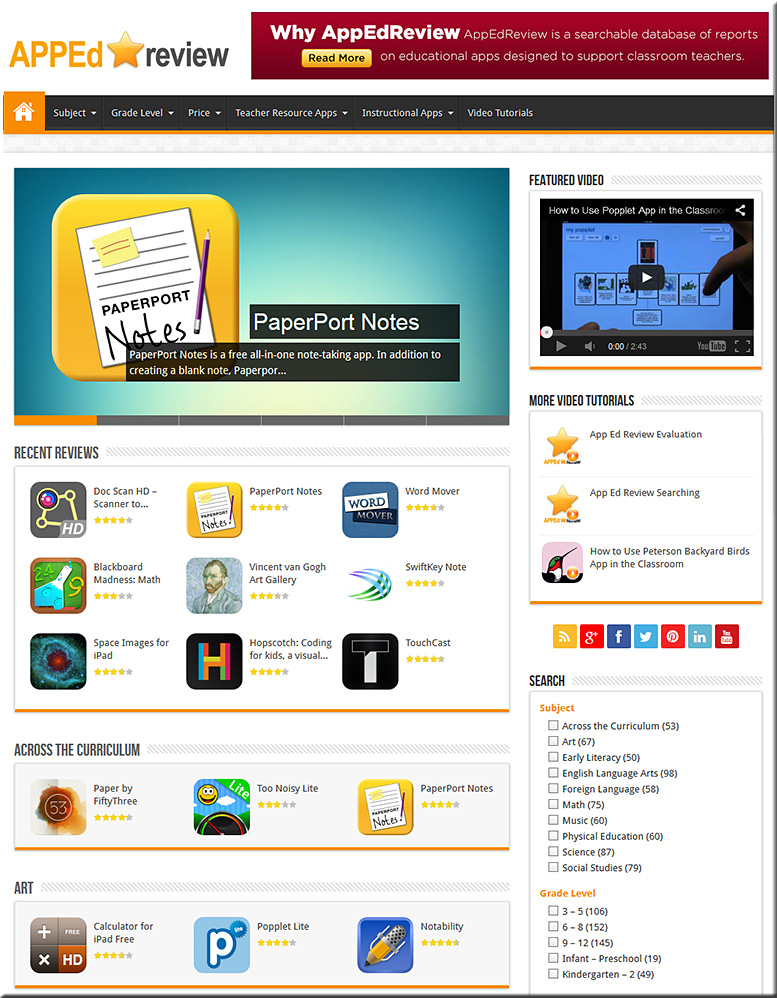
App Ed Review


APPEdReview-April2014


From the About Us page (emphasis DSC):

App Ed Review is a free searchable database of educational app reviews designed to support classroom teachers finding and using apps effectively in their teaching practice. In its database, each app review includes:

  • A brief, original description of the app;
  • A classification of the app based on its purpose;
  • Three or more ideas for how the app could be used in the classroom;
  • A comprehensive app evaluation;
  • The app’s target audience;
  • Subject areas where the app can be used; and,
  • The cost of the app.


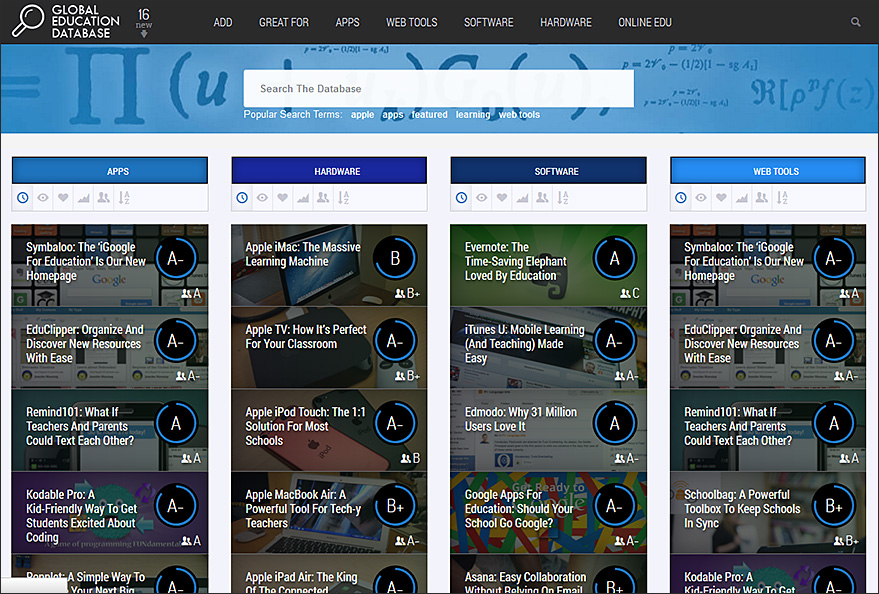
Also see the Global Education Database:


GlobalEducationDatabase-Feb2014


From the About Us page:

It’s our belief that digital technologies will utterly change the way education is delivered and consumed over the next decade. We also reckon that this large-scale disruption doesn’t come with an instruction manual. And we’d like GEDB to be part of the answer to that.

It’s the pulling together of a number of different ways in which all those involved in education (teachers, parents, administrators, students) can make some sense of the huge changes going on around them. So there’s consumer reviews of technologies, a forum for advice, an aggregation of the most important EdTech news and online courses for users to equip themselves with digital skills. Backed by a growing community on social media (here, here and here for starters).

It’s a fast-track to digital literacy in the education industry.

GEDB has been pulled together by California residents Jeff Dunn, co-founder of Edudemic, and Katie Dunn, the other Edudemic co-founder, and, across the Atlantic in London, Jimmy Leach, a former habitue of digital government and media circles.


Addendum:

Favorite educational iPad apps that are also on Android — from the Learning in Hand blog by Tony Vincent

 
© 2025 | Daniel Christian