Imagine this. You’re several chapters into a captivating novel when a character from an earlier book makes a surprise appearance. You swipe your finger across their name on the page at which point their entire backstory is displayed on a nearby smartphone, allowing you to refresh your memory before moving forward.
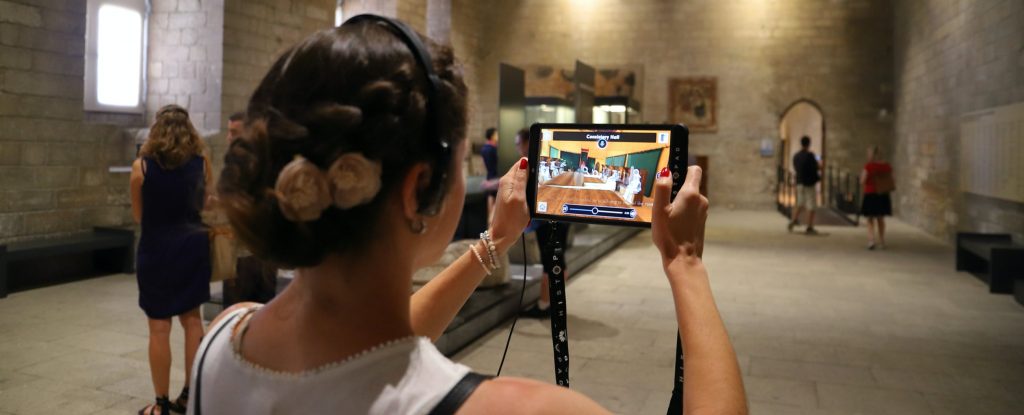
This may sound like science fiction, but researchers at the University of Surrey in England say that the technology described above is already here in the form of “a-books” (augmented reality books).
The potential use-cases for such a technology are virtually endless. As previously mentioned, a-books could be used to deliver character details and plot points for a variety of fictional works. The same technology could also be applied to textbooks, allowing students to display helpful information on their smartphones, tablets, and smart TVs with the swipe of a finger.
From DSC:
How might instructional designers use this capability?
Knowing you have to create new content for multiple social media channels every day can feel a little daunting, especially when you consider the range of disciplines needed to be successful.
Nowadays, every marketer and business owner has to be part designer, photographer, videographer, copywriter, and editor, among other jobs.
Thankfully, there are now a lot of easy-to-use tools out there to make these jobs more seamless for us all. What’s even better, with the right apps, you can create, publish, and analyze the performance of all your content with just one device – your phone.
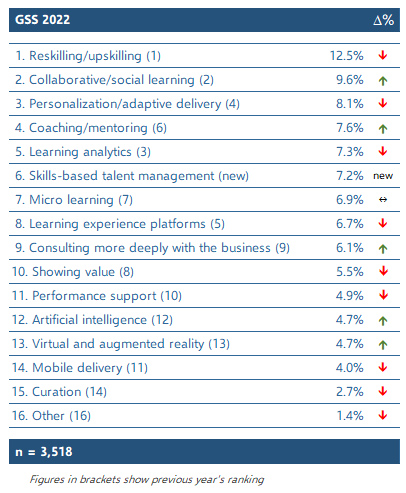
This year’s L&D Global Sentiment Survey, the ninth, shows L&D at a turning point, as the result of two forces. One is the demands of organisations, as they emerge from the pandemic, for more training delivery, very often with unchanged or reduced resources for L&D. The other is the need to deal with the emergency measures put in place in 2020 to deal with the immediate impact of COVID-19.
This sense of practitioners being under pressure is amply illustrated by responses to the free text question ‘What is your biggest L&D challenge in 2022?’ 40% of respondents answered, with the answers painting a picture of practitioners being asked to do more, in difficult circumstances, to support the learning of overworked employees and uninterested employers.
It is tempting to see this as a return to business-as-usual for L&D. Hasn‘t it always been the case that the department needed to fight for the attention of both executives and employees? Behind this undeniable reality, however, there are definite signs of longer-term trends emerging.
The rise of the self-service delivery model
Self-service for legal clients was already a trend before COVID, a trend that accelerated during the shutdowns. Clients now expect to be able to find answers themselves to many of their basic legal questions. Call it the Google-fication of legal service delivery. Clients also want to be able to see their matter statuses without having to take the time to call their lawyers, possibly incurring a charge.
Below are some other legal-related items:
Law Schools Are Changing Thanks To Legal Tech— from lawyer-monthly.com New digital skills courses are rapidly being added to undergraduate law degrees in the UK. While the first students are currently studying the digital skills course, it’s expected that further students will take part over the coming months. Here, we explore what digital skills courses in law schools are covering.
For anyone following the rapidly evolving area of legal technology, today’s guest will be a familiar voice. Bob Ambrogi—lawyer, journalist, media consultant, and blogger—has been working at the intersection of law, media, and technology for 40 years. He is known internationally for his expertise in legal technology, legal practice, and legal ethics. He’s won numerous awards for his blog and his leading role on the cutting edge of change in the industry, including being named to Fastcase 50 and Legal Rebels Trailblazers. Before entering the blogosphere, Bob was an editor at a number of mainstream legal publications.
In today’s conversation, we talk about Bob’s journey as a journalist, his views on the current state of mainstream media, the potential of regulatory reform to further disrupt the industry, and the growing diversity of the legal technology industry.
***
>$425M in investment has poured into #contractmanagement in 2022. Here’s a ? on (i) possible reasons this is happening and (ii) where this market is going /1https://t.co/bYaWxOiY4Y
Bohills said: “Most tech businesses require flexible legal services that don’t fit the traditional law firm model. I designed the firm to scale with the ambitious startups we support. This new investment will enable us to further recruit and satisfy the growing demand from the tech sector and its need for a new way to access legal advice.
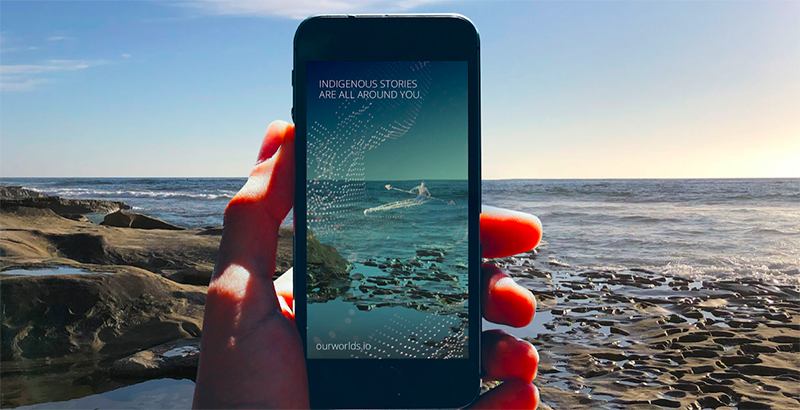
Take a stroll along the La Jolla Shores Beach in San Diego, and you might find sand between your toes. But users of the new Our Worlds app, winner of the 2022 SXSW EDU Launch Competition, might also find much more. Through augmented reality, they can look at that same stretch of beach and see handmade tule boats from the local Kumeyaay tribe.
Our Worlds launched to highlight Native American history via modern-day technology, putting what founder and CEO Kilma Lattin calls “code to culture” and pushing Native American civilization forward. Lattin says Our Worlds offers a full suite of technology — virtual reality, augmented reality, artificial intelligence — to capture all the components that make a culture.
Apple’s first AR/VR headset inches closer to launch — from protocol.com by Nat Rubio-Licht The company reportedly showed off the device to board members as it makes progress on the headset’s operating system.
Nvidia has launched a new mapping platform that will provide the autonomous vehicle industry with ground truth mapping coverage of over 300,000 miles of roadway in North America, Europe and Asia by 2024, founder and CEO Jensen Huang said at the company’s GTC event on Tuesday.
Nvidia is doubling down on artificial-intelligence technology that CEO Jensen Huang predicts will revolutionize every industry.
In the keynote speech for the annual Nvidia GTC conference—the acronym once stood for GPU Technology Conference, a reference to the company’s roots in graphics processing chips—Huang focused specifically on expanding the company’s portfolio of AI-focused chips and software applications.
Nvidia CEO lays out plans after Arm deal fell through, reveals new Hopper GPU — from marketwatch.com by Jeremy C. Owens Roadmap seems little changed after chip maker ditched $40 billion acquisition of designer Arm, with new GPUs and first server CPU still on track as EV makers sign on for autonomous-driving tech
Last fall, Facebook announced it was opening an office in Lagos, Nigeria, which would provide the company with a hub in the region and the first office on the continent staffed with a team of engineers. We’ve now spotted one of the first products to emerge from this office: an education-focused mobile app called Sabee, which means “to know” in Nigerian Pidgin. The app aims to connect learners and educators in online communities to make educational opportunities more accessible.
When the subject of AR and it’s potential came up, Cook said “You and I are having a great conversation right now. Arguably, it could even be better if we were able to augment our discussion with charts or other things to appear.”
In Cook’s opinion, AR will change the way we communicate with our friends, colleagues, and family. It’ll reshape communication in fields such as health, education, gaming, and retail. “I’m already seeing AR take off in some of these areas with use of the phone. And I think the promise is even greater in the future,” said Cook.
And it is not enough to try to use existing VR/XR applications and tailor them to educational scenarios. These tools can and should be created with pedagogy, student experience, and learning outcomes as the priority.
The ease-of-use and engagement factor of an iPad can really liven up a lesson.
Combine that with an app’s ability to simulate reality in br, such as chemical reactions, and you have a tool that is both safe and fun for your students.
Below, we’ve gathered 20 of the best free science apps currently available for iPhone/iPad/iOS. Note, many of the science apps below have in-app purchases but are free to download and use. The main criteria here was that it’s a science app and is worth using/teaching and learning with without making any additional purchases.
In this episode staff writer Sara Weissman shares a story that focuses on the digital divide for Native Americans by bringing in voices of tribal college leaders and their students during the COVID 19 pandemic.
Many don’t know but Native American colleges and universities have long struggled with the worst internet connectivity in the nation while ironically paying the highest rates for service. Hear first-hand how students from Diné College and other institutions are currently affected. Carrie Billie (Big Water Clan), President & CEO of the American Indian Higher Education Consortium (AIHEC) and Dr. Cynthia Lindquist (Star Horse Woman), President of Cankdeska Cikana Community College in North Dakota, break down the data and lay out critical next steps necessary to address the digital divide.
Many don’t know but Native American colleges and universities have long struggled with the worst internet connectivity in the nation while ironically paying the highest rates for service.
From DSC: When will there be justice!? Let’s join in and make amends and provide the funding, concrete assistance, products, and services to Native American colleges, universities, and communities. Some potential ideas:
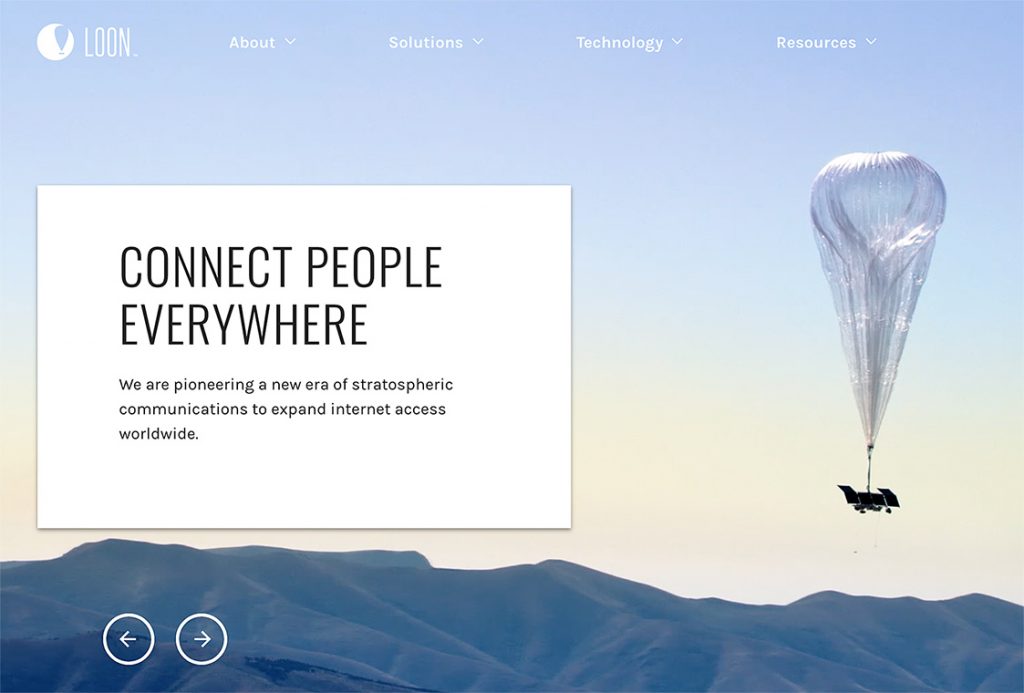
For the short term, could there be Loon balloons deployed immediately to provide free and stronger access to the Internet?
Could our Federal Government make amends and do the right thing here? (e-rate program, put Internet access in, make policy changes, offer more grants, other?)
Could Silicon Valley assist with hardware and software? For example:
Can Apple, HP, Microsoft, and others donate hardware and software?
Can Zoom, Adobe, Cisco Webex, Microsoft Teams, and others donate whatever these communities need to provide videoconferencing licenses?
Could telecom providers provide free internet access?
Could MOOCs offer more free courses?
Could furniture makers such as Steelcase, Herman Miller, and others donate furniture and help establish connected learning spaces?
How might faculty members and staff within higher education contribute?
How could churches, synagogues, and such get involved?
Could the rest of us locate and donate to charities that aim to provide concrete assistance to Native American schools, colleges, universities, and communities?
We need to do the right thing here. This is another area* where our nation can do much better.
The Dice Q3 Tech Job Report: Tech Hiring and COVID-19: What You Need to Know— from techhub.dice.com The report, issued quarterly by Dice, provides exclusive statistics and analysis on the tech hiring landscape, including top cities and states, top employers and the most sought-after skills and occupations.
The platform would connect the marketable skills with the courses, websites, blogs, RSS feeds/streams of content, etc. that would help a learner quickly and affordably build such in-demand skills. Given the shortening half-lives of many kinds of information, such a service is needed desperately…especially now with the impact of the Coronavirus.
Also relevant: See how ISTE built its upcoming virtual event!
The new feature on the iPhone 12 Pro promises much improved AR features, like what’s pitched as helping improve photo quality as well as instantaneous placement of virtual content into your environment. It also may make 3D scanning of objects or places in the real world a more common practice.
From DSC: Per Wikipedia, this is a 1910 Model T that was photographed in Salt Lake City:
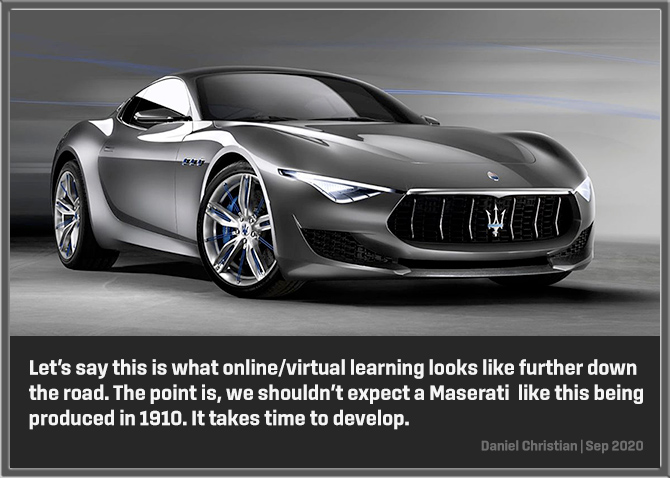
From DSC: The Ford Model T didn’t start out looking likea Maserati Gran Turismo from 2021!Inventions take time to develop…to be improved…for new and further innovations and experiments to take place.
Thinking of this in terms of online-based learning, please don’t think we’ve reached the end of the road for online-based learning.
The truth is, we’ve barely begun our journey.
Two last thoughts here
1 ) It took *teams* of people to get us to the point of producing a Maserati like this. It will take *teams* of people to produce the Maserati of online-based learning.
2) In terms of online-based learning, it’s hard to say how close to the Maserati that we have come because I/we don’t know how far things will go. But this I do know: We have come a looooonnnnnggggg ways from the late 1990s!If that’s what happened in the last 20 years — with many denying the value of online-based learning — what might the next 5, 10, or 20 years look like when further interest, needs, investments, etc. are added? Then add to all of that the momentum from emerging technologies like 5G, Augmented Reality, Mixed Reality, Virtual Reality, Artificial Intelligence, bots, algorithms, and more!
From DSC:
To drive the point home, here’s an addendum on late 9/29/20:
From DSC: What if each learner/person/student could have a lifelong, cloud-based “tribute” site?
What if you could hire a career coach to sift through the tributes to find common themes?
From DSC: I recently asked friends and family to help me celebrate a significant birthday for my wife by creating a tribute for her — using a service calledTribute.co.It was a fun, meaningful, relational experience — it opened the doors to some great communications.
Here’s a video that describes what aTributeis (from the company of that same name).
So I put out potential suggestions for what I hoped that we could relay to my wife, and people contributed their videos. Then a person at Tribute edited the videos to come up with a highlight reel. They also presented to my wife all of the videos, not just the highlight reel.
That got me to wonder,“What if each learner had a cloud-based, lifelong tribute site that parents, guardians, grandparents, teachers, coaches, musical directors, pastors, friends, and others could leave encouraging and instructive messages on? Or when they note something that might be of use later on in terms of career selection, they could “jot it down.” For example:
[First-grade teacher] “I noticed Anne that when we did the art projects, you were enthralled with any sort of creative endeavor or project. We almost lost you in another world!”
[Family member] “Tony, I’ve noticed ____. Here’s something to consider for your future pathways. Would you be interested in exploring _____ — such as if we signed you up for some lessons in that area?”
[Eight grade teacher] “Eloise, I saw that your engagement level skyrocket when we studied ____, especially when you did the project on ___.”
[Basketball coach] “Chan, I appreciated your hard work in practice today. Keep up the good work and you will be a super player! You are fast, strong, and seem to have a competitive spirit about you. Consider making a workout chart and charting out the workouts that you do each day. Monitor your progress over time. As of today, here are some apps to do just that: ___.
[Pastor] “So glad Amanda that you were able to join us on our youth group visit to ___. I appreciated your end-of-the-day reflections on the experiences of the day. I also appreciated your hard work helping others.”
[Friend] “It was great horsing around on Garageband with you today Zach. I look forward to diving into iMovie next with you. Let’s create a movie for each other. You seem to have a very creative side to you.”
[High school CS Teacher] “Keep up the good work programming Jeremy! I hope that you will consider going into some type of job that uses critical thinking, mathematics, problem-solving — perhaps it will be programming, perhaps it will be engineering, or something else.”
[College professor/advisor] “You mentioned that you hate college to me the last two times we met. You don’t seem happy studying ___. Have you considered ____?”
[Tennis coach] Remember to bend those knees…get low. Keep your eyes on the seams of the ball.”
The idea behind such a service would be to offer encouragement, feedback, (if carefully put) constructive criticism, a message that “I’m on your team”…and/or…”Here’s what I see in you.”
Additional functionality/options
Contributors:
Like Twitter imposes a limit on characters, there could be options to impose a time limit on the length of a video, ability to add more than one video, and/or set a limit on how many videos someone can upload
If submitting a written piece, the option would be there to limit the number of characters and/or the word count.
From learners themselves (to their own tribute)
No time limit, no word count or character limit
Would act like a multimedia-based diary/journal of learning
Option to select whether might be worth re-listening to for career selection purposes.
Lawyers deal with confidential client information and we have a duty to secure that information. But it doesn’t matter who you are or how you use your technology. No one would want to donate, sell or give away a computer or phone without making certain your personal information is wiped. There is just too much information, like remembered passwords and saved text messages.
…
Today the respected tech website Wirecutter published an excellent guide How to Securely Wipe Your Computer, Phone, or Tablet. You may want to bookmark this guide so you will have it handy when you need it.