CIO Explainer: What is blockchain? — from blogs.wsj.com by Steve Norton

Excerpt:

Known by many as the technology underpinning the bitcoin digital currency, blockchain has acquired a new identity in the enterprise. At a time when companies face new challenges in data management and security, it’s emerging as a way to let companies make and verify transactions on a network instantaneously without a central authority. Today, more than 40 top financial institutions and a growing number of firms across industries are experimenting with distributed ledger technology as a secure and transparent way to digitally track the ownership of assets, a move that could speed up transactions and cut costs while lowering the risk of fraud. Some companies see an opportunity to use blockchain to track the movement of assets throughout their supply chains or electronically initiate and enforce contracts.

Blockchain remains in the experimental phase inside many large firms and there are few tested use cases, experts and analysts caution. Here’s a look at how this emerging technology works:


Why is the financial industry so interested in Blockchain? — from dcebrief.com

Executive Brief:
With huge money and effort being put into blockchain research by almost the entire financial industry, many have wondered what the reasoning behind it is. To investigate this, Goldman Sachs, the global banking business, has used its research division to put together a report on the effects of blockchain implementation will have on the industry itself. Showing massive cost savings, improved security and a wide range of suitability for other market sectors, the report identifies the many benefits of blockchain technology and emphasizes the robust nature of the foundation of digital currency itself.


Opinion: What Blockchain means for higher education — from edsurge.com by Kerri Lemoie

Excerpt:

Originally created as the underlying database for bitcoin (the peer-to-peer digital asset and payment system), blockchain’s technology is now being seen as valuable and purposeful beyond the financial sector. The advantages blockchain provides to store information on a secure, permanent, historical ledger that can be both public and private will change how edtech applications approach student data.

In higher ed this means that student data could be shared across many institutions—rather than a single one—and also include data from online learning tools, co-curricular activities, employment history and other learning experiences. This would allow the data to be exchanged, understood and validated amongst many parties. Imagine the pictures of students’ learning experiences that this could provide and how these pictures could help develop and improve upon course design, facilitate transferring credits, or prove qualifications for a job to a potential employer.


“The learner could have a record of their learning from MOOCs, professional development activities and universities.”


How blockchain will disrupt the higher education transcript — from campustechnology.com by David Raths
Blockchain technology could offer a more learner-centered alternative to traditional credentialing.

Excerpt:

Last year, the MIT Media Lab began issuing digital certificates to the participants in its Director’s Fellows program. The authentication behind the certificates relies on blockchain technology, best known for its connection to the cryptocurrency bitcoin.

In a blog post, Philipp Schmidt, director of learning innovation at the Media Lab, described how blockchain works: “In essence, it is a just a distributed ledger to record transactions. What makes it special is that it is durable, time-stamped, transparent and decentralized. Those characteristics are equally useful for managing financial transactions as for a system of reputation. In fact, you can think of reputation as a type of currency for social capital, rather than financial capital.”

The technology has tremendous potential for higher education, according to Phil Long, chief innovation officer and associate vice provost for learning sciences at the University of Texas at Austin. In a May 12 Future Trends Forum video chat hosted by consultant and futurist Bryan Alexander, Long pointed to credentialing as an obvious first place to apply blockchain in higher ed.


From DSC:
Could blockchain be the tech to create cloud-based learner profiles?


Addendum on 6/7/16:

  • Blockchain Revolution| Is the future of business a company without workers, managers, or a CEO? — from qz.com
    Excerpt:
    These days, it’s hardly surprising to hear that a hot new startup has received gobs of money from eager investors. But a new company called the DAO (short for “decentralized autonomous organization”) is not your average startup. The DAO, designed to serve as a kind of venture capital fund for the cryptocurrency community, is the first of a new breed of business. It has no CEO and no staff; indeed, it has no human management at all. The company itself is simply software that runs on a blockchain, the technology that powers digital currencies like bitcoin. Through its first three weeks, the DAO raised over $130 million from tens of thousands of global investors, and it’s not done yet. But regardless of how the company fares, its mere existence portends profound changes for business, government, and the roles that people play in our economy. Analysts have questioned whether the DAO is legal or viable. Like any startup, it may fail. It may have attracted investors who don’t understand the risks. Some investors may be speculators in it for a quick buck, in turn, reducing the size of the fund. It may be attracting criminals or terrorists masquerading as entrepreneurs. To be sure, these are important concerns. But the DAO’s debut is a watershed moment in the history of financial services. It demonstrates that autonomous entities can raise huge sums of money without traditional intermediaries. How will venture capitalists and investment banks respond to these blockchain IPOs that crowd-source hundreds of millions of dollars from a global investor base?


Addendums on 6/8/16:

  • Blockchain’s hype exceeds its grasp – for now — from cio.com by Clint Boulton
    Broad adoption of blockchain technology is likely years away as companies struggle to understand how to apply the digital ledger technology to practical scenarios amid regulatory, governance and standards obstacles.

Excerpt:
Blockchain has been touted by venture capitalists, technophiles and pundits as the Next Big Thing in computer science. The reality, however, is that the digital ledger software at the heart of Bitcoin and other cryptocurrencies has a long way to go before it gains mainstream adoption.

That was a key takeaway from a blockchain panel at last month’s MIT Sloan CIO Symposium. Noting that blockchain enables parties to ferry financial transactions, contracts and other digital records over the Internet, MIT professor Christian Catalini asked the panel about potential enterprise applications for the technology.


  • Credentials | MIT Media Lab, Learning Machine Partner on Blockchain-Based Credentials — from campustechnology.com by Joshua BolkanExcerpt:
    The MIT Media Lab’s Learning Initiative has partnered with Learning Machine to release the initial version of an open-source project designed to build an ecosystem for creating, sharing and verifying education credentials based on blockchain technology.Using the Bitcoin blockchain, the certificates can be shared with anyone who requires documentation as simply as sending a link and future versions will add features to improve real-world usability, such as versioning, revocation, cohort issuance, document encryption and cost reducation. “The goal of our collaboration with the MIT Media Lab is to empower individuals with shareable credentials that can be used peer-to-peer and verified as authentic,” said Chris Jagers, co-founder and CEO of Learning Machine, in a prepared statement.
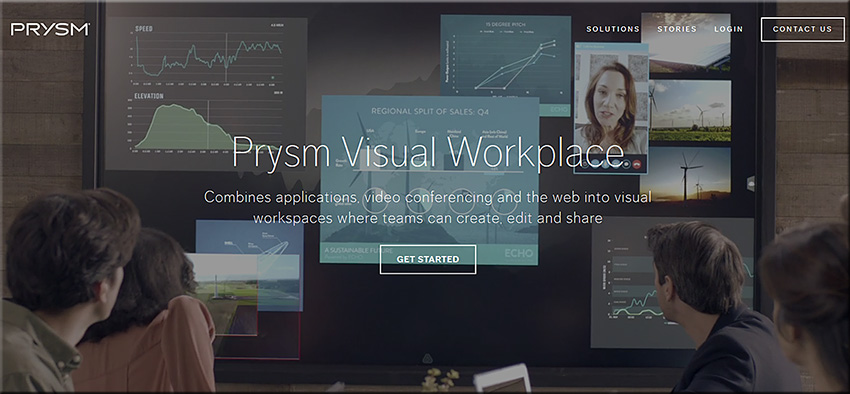
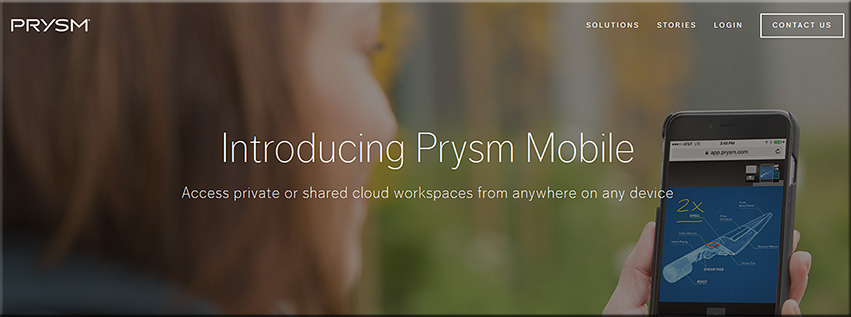


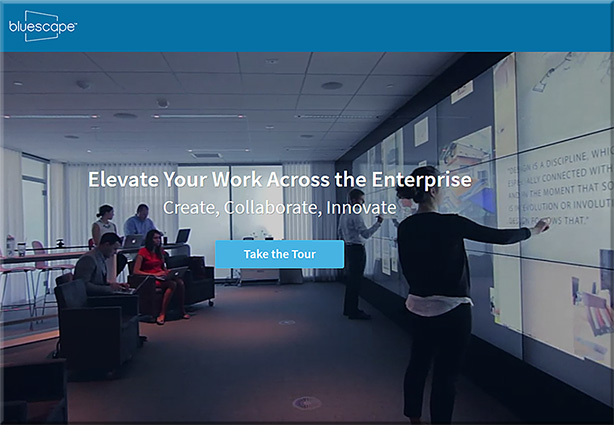
Will “class be in session” soon on tools like Prysm & Bluescape? If so, there will be some serious global interaction, collaboration, & participation here! [Christian]

From DSC:
Below are some questions and thoughts that are going through my mind:

  • Will “class be in session” soon on tools like Prysm & Bluescape?
  • Will this type of setup be the next platform that we’ll use to meet our need to be lifelong learners? That is, will what we know of today as Learning Management Systems (LMS) and Content Management Systems (CMS) morph into this type of setup?
  • Via platforms/operating systems like tvOS, will our connected TVs turn into much more collaborative devices, allowing us to contribute content with learners from all over the globe?
  • Prysm is already available on mobile devices and what we consider a television continues to morph
  • Will second and third screens be used in such setups? What functionality will be assigned to the main/larger screens? To the mobile devices?
  • Will colleges and universities innovate into such setups?  Or will organizations like LinkedIn.com/Lynda.com lead in this space? Or will it be a bit of both?
  • How will training, learning and development groups leverage these tools/technologies?
  • Are there some opportunities for homeschoolers here?

Along these lines, are are some videos/images/links for you:


PrysmVisualWorkspace-June2016


PrysmVisualWorkspace2-June2016


BlueScape-2016


BlueScape-2015


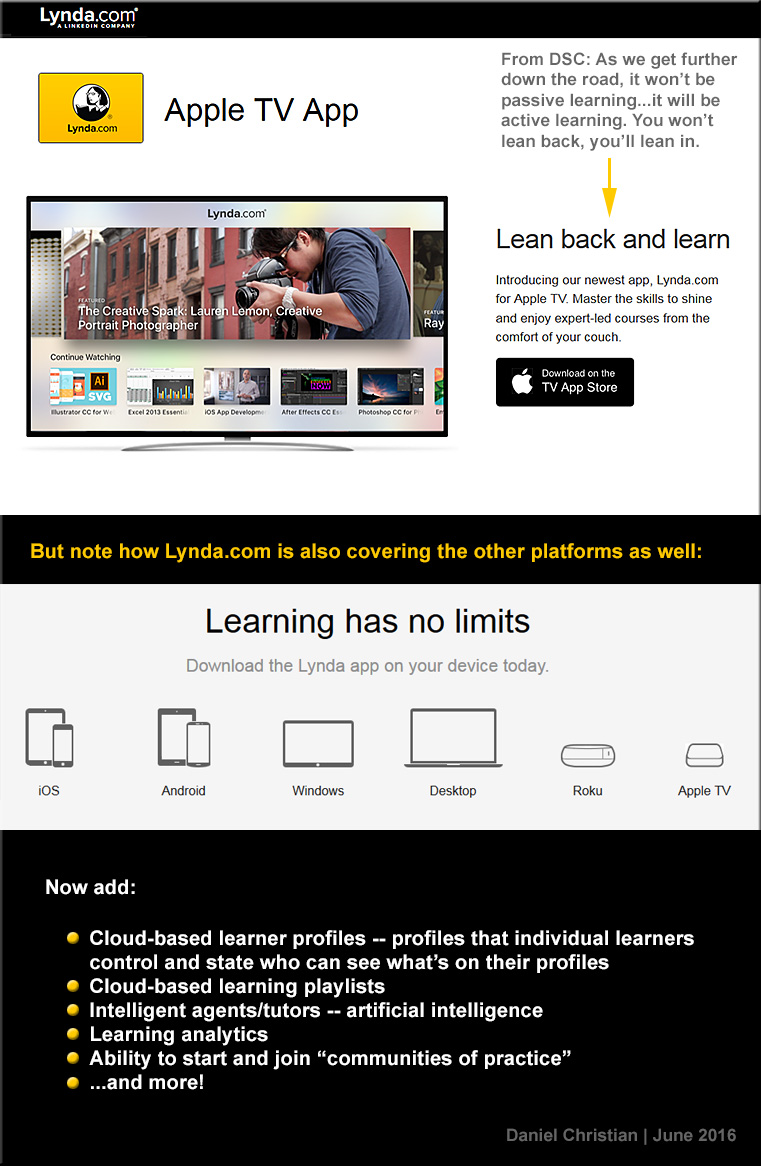
DSC-LyndaDotComOnAppleTV-June2016


The Living [Class] Room -- by Daniel Christian -- July 2012 -- a second device used in conjunction with a Smart/Connected TV


Also see:

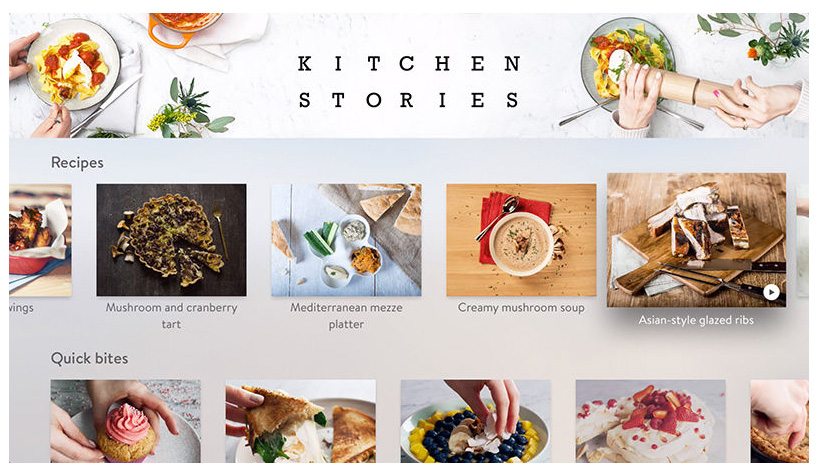
kitchenstories-AppleTV-May2016


Also see:


Prysm Adds Enterprise-Wide Collaboration with Microsoft Applications — from ravepubs.com by Gary Kayye

Excerpt:

To enhance the Prysm Visual Workplace, Prysm today announced an integration with Microsoft OneDrive for Business and Office 365. Using the OneDrive for Business API from Microsoft, Prysm has made it easy for customers to connect Prysm to their existing OneDrive for Business environments to make it a seamless experience for end users to access, search for, and sync with content from OneDrive for Business. Within a Prysm Visual Workplace project, users may now access, work within and download content from Office 365 using Prysm’s built-in web capabilities.


Sesame Workshop, IBM launch early-childhood education initiative — from yahoo.com by Todd Spangler

Excerpt:

Cookie Monster, Elmo and friends are about to hit a new digital learning curve.

Sesame Workshop, the not-for-profit org that produces “Sesame Street,” and tech giant IBM have entered into a partnership to develop new personalized educational products and platforms for preschool-age kids — with the goal of transforming the ways children learn and teachers teach.

Under the three-year agreement, Sesame Workshop and Big Blue will design interactive educational experiences for use in homes and schools that adapt to the learning preferences and aptitude levels of individual preschoolers.

For now, the organizations are treating the project as an R&D investment. IBM and Sesame Street will deploy engineers, educators and researchers to work side-by-side in classrooms and in their own labs and learning facilities. Later this year, they plan to test and share prototypes with leading teachers, academics, researchers, technologists, gamers, performers and media execs to solicit feedback and brainstorm ways in which cognitive computing can best help preschoolers learn.


From DSC:
This will be an important experiment to watch. If it shows promise, it could help parents, pre-school teachers, and the pre-schoolers themselves. Then, the trajectory could make its way to helping early elementary students, to middle school students, to high school students and beyond.

If successful, this is exactly the sort of thing that I could see as one of the key ingredients in the Learning from the [Class] Room vision. Teachers, parents, coaches, etc. will still be critical. But these type of tools and technologies could be running in the background within a blended learning environment — one that can operate at a distance if need be.


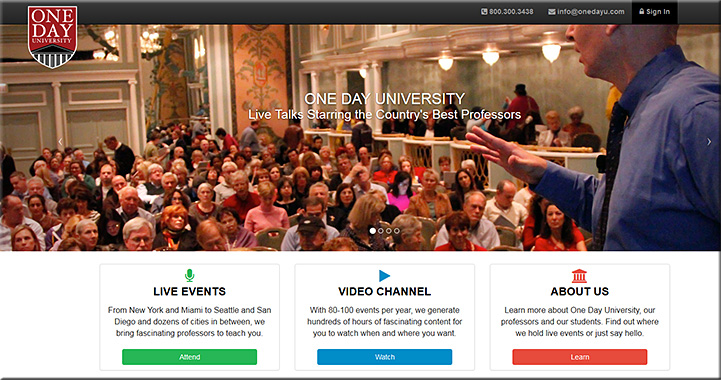
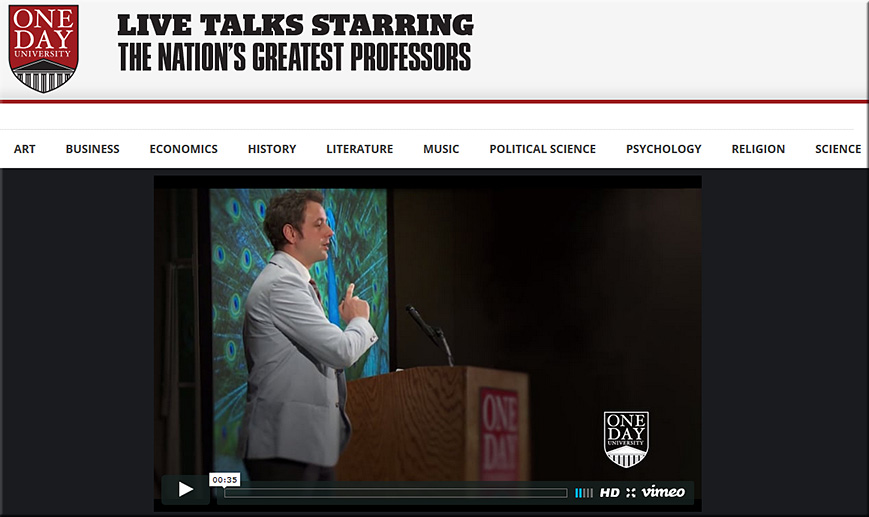
Why can’t the “One Day University” come directly into your living room — 24×7? [Christian]

  • An idea/question from DSC:
    Looking at the article below, I wonder…“Why can’t the ‘One Day University‘ come directly into your living room — 24×7?”


The Living [Class] Room -- by Daniel Christian -- July 2012 -- a second device used in conjunction with a Smart/Connected TV


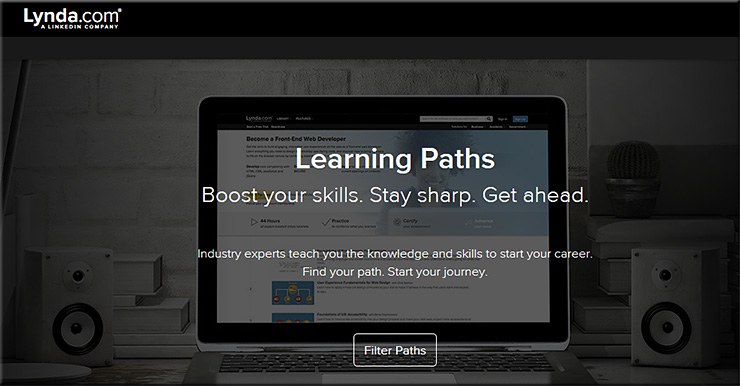
This is why I’m so excited about the “The Living [Class] Room” vision. Because it is through that vision that people of all ages — and from all over the world — will be able to constantly learn, grow, and reinvent themselves (if need be) throughout their lifetimes. They’ll be able to access and share content, communicate and discuss/debate with one another, form communities of practice, go through digital learning playlists (like Lynda.com’s Learning Paths) and more.  All from devices that represent the convergence of the television, the telephone, and the computer (and likely converging with the types of devices that are only now coming into view, such as Microsoft’s Hololens).


LearningPaths-LyndaDotCom-April2016


You won’t just be limited to going back to college for a day — you’ll be able to do that 24×7 for as many days of the year as you want to.

Then when some sophisticated technologies are integrated into this type of platform — such as artificial intelligence, cloud-based learner profiles, algorithms, and the ability to setup exchanges for learning materials — we’ll get some things that will blow our minds in the not too distant future! Heutagogy on steroids!


Want to go back to college? You can, for a day. — from washingtonpost.com by Valerie Strauss

Excerpt:

Have you ever thought about how nice it would be if you could go back to college, just for the sake of learning something new, in a field you don’t know much about, with no tests, homework or studying to worry about? And you won’t need to take the SAT or the ACT to be accepted? You can, at least for a day, with something called One Day University, the brainchild of a man named Steve Schragis, who about a decade ago brought his daughter to Bard College as a freshman and thought that he wanted to stay.

One Day University now financially partners with dozens of newspapers — including The Washington Post — and a few other organizations to bring lectures to people around the country. The vast majority of the attendees are over the age 50 and interested in continuing education, and One Day University offers them only those professors identified by college students as fascinating. As Schragis says, it doesn’t matter if you are famous; you have to be a great teacher. For example, Schragis says that since Bill Gates has never shown to be one, he can’t teach at One Day University.

We bring together these professors, usually four at at a time, to cities across the country to create “The Perfect Day of College.” Of course we leave out the homework, exams, and studying! Best if there’s real variety, both male and female profs, four different schools, four different subjects, four different styles, etc. There’s no one single way to be a great professor. We like to show multiple ways to our students.

Most popular classes are history, psychology, music, politics, and film. Least favorite are math and science.


See also:


OneDayUniversity-1-April2016


OneDayUniversity-2-April2016


Addendum:


lyndaDotcom-onAppleTV-April2016


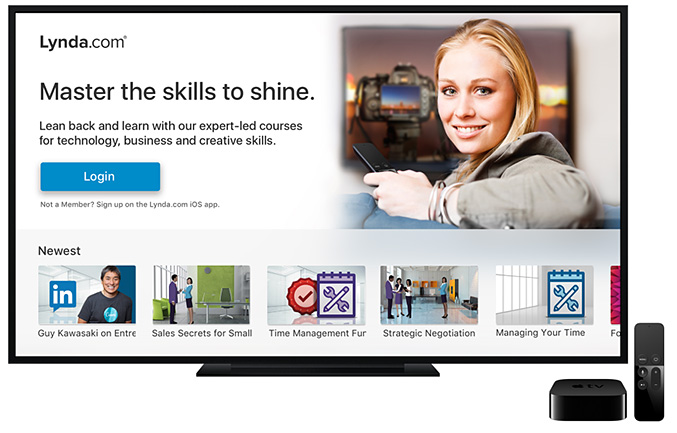
We know the shelf-life of skills are getting shorter and shorter. So whether it’s to brush up on new skills or it’s to stay on top of evolving ones, Lynda.com can help you stay ahead of the latest technologies.


From DSC:
Let’s take some of the same powerful concepts (as mentioned below) into the living room; then let’s talk about learning-related applications.


Google alum launches MightyTV for cable cord-cutters — from bizjournals.com by Anthony Noto

Excerpts (emphasis DSC):

MightyTV, which has raised more than $2 million in venture funding to date, launched today with a former Google exec at the helm. The startup’s technology incorporates machine learning with computer-generated recommendations in what is being touted as a “major step up” from other static list-making apps.

In this age of Roku and Apple TV, viewers can choose what to watch via the apps they’ve downloaded. MightyTV curates those programs — shows, movies and YouTube videos — into one app without constantly switching between Amazon, HBO, Netflix or Hulu.

Among the features included on MightyTV are:

*  A Tinder-like interface that allows users to swipe through content, allowing the service to learn what you’d like to watch
*  An organizer tool that lists content via price range
A discovery tool to see what friends are watching
*  Allows for group viewings and binge watching


From DSC:
What if your Apple TV could provide these sorts of functionalities for services and applications that are meant for K-12 education, higher education, and/or corporate training and development?

Instead of Amazon, HBO, Netflix or Hulu — what if the interface would present you with a series of learning modules, MOOCs, and/or courses from colleges and universities that had strong programs in the area(s) that you wanted to learn about?

That is, what if a tvOS-based system could learn more about you and what you are trying to learn about? It could draw upon IBM Watson-like functionality to provide you with a constantly morphing, up-to-date recommendation list of modules that you should look at.  Think microlearning. Reinventing oneself. Responding to the exponential pace of change. Pursuing one’s passions. More choice/more control. Lifelong learning. Staying relevant. Surviving.

…all from a convenient, accessible room in your home…your living room.

A cloud-based marketplace…matching learners with providers.

Now tie those concepts in with where LinkedIn.com and Lynda.com are going and how people will get jobs in the future.


The Living [Class] Room -- by Daniel Christian -- July 2012 -- a second device used in conjunction with a Smart/Connected TV


BlueJeans Unveils Enterprise Video Cloud as Businesses Hang Up on Audio-Only Communications
Global Enterprises Adopt Video as a First-Line Communications Strategy

Excerpt (emphasis DSC):

April 12, 2016 — Mountain View, CA—BlueJeans Network, the global leader in cloud-based video communication services, today unveiled the Enterprise Video Cloud, a comprehensive platform built for today’s globally distributed, modern workforce with video communications at the core. New global research shows that 85% of employees are already using video in the workplace and 72% believe that video will transform the way they communicate at work.

“There is a transformation happening among business today – face-to-face video is quickly rising as the preferred communications medium, offering new opportunities for deeper personal relations and outreach, as well as for improved internal and external collaboration,” said Krish Ramakrishnan, CEO of BlueJeans. “Once people experience the power of video, they ‘hang-up’ on traditional conference calling. We are seeing this happen with the emergence of video cultures that power the most innovative cultures—from Facebook and Netflix to Viacom and Del Monte.”


From DSC:
I wonder if we’ll see video communication vendors such as BlueJeans or The Video Call Center merge with vendors like Bluescape, Mezzanine, or T1V with their collaboration tools. If so, some serious collaboration could all happen…again, right from within your living room!


What are the learning-related ramifications of technologies that provide virtual personal assistants? [Christian]

Everything Siri can do for you and your Apple TV — from imore.com by Lory Gill

Excerpt:

When you ask Siri what it can search for, it will respond, “I can search by title, people (actor, director, character name, guest star, producer, or writer), ratings (like PG or TV-G), reviews (such as best or worst), dates (like 2012 or the 80s), age (like kid-friendly or teen), seasons, episodes, and studio. And of course, I can search by genre.”

But, what else can Siri do?

Siri has a fairly robust search feature with multi-layer filtering.

While you are watching a movie or TV show, or listening to music, you can get a little extra help from Siri. It’s like having a buddy sitting next to you — but they don’t shush you when you ask a question.

You can search for content in the Music app on Apple TV by artist, album, or song title. With a little know-how, you can also turn Siri into your personal deejay.

While you may normally look to your smartphone for your weather predictions, Siri can be just as helpful about the conditions around the world as your local weatherman or app. All you have to do is ask.


From DSC:
Following this trajectory out a bit into the future — and in light of significant developments that continue to occur with artificial intelligence, the development and use of algorithms, the potential use of web-based learner profiles (think LinkedIn.com/Lynda.com, MOOCs, the use of nanodegrees), second screen-based apps, and the like — one has to wonder:

“What are the ramifications of this for learning-related applications?!”


The Living [Class] Room -- by Daniel Christian -- July 2012 -- a second device used in conjunction with a Smart/Connected TV


Cognii launches virtual learning assistant for the education market — from edtechreview.in

Excerpt:

BOSTON, MA, January 27, 2016 ­­
Cognii, a leading provider of educational assessment technologies, today announces the launch of Virtual Learning Assistant (VLA), a next­ generation personalized adaptive learning platform for the Education and Training market. Cognii’s VLA uses Artificial Intelligence and Natural Language Processing technologies to engage students in real­time adaptive tutoring conversations and provides instant formative assessment on their constructed response (short essay) answers with guidance towards conceptual mastery. It also provides rich learning analytics to the teachers based on students’ conceptual understanding or difficulties, for better instructional support.


From the Cognii website:

At Cognii, we’re developing leading edge assessment technology to evaluate essay-type answers for online learning platforms. Our exclusive natural language processing technology can also give customized feedback, not just a score, to engage students in an active learning process and improving their knowledge retention. We’re offering Cognii’s solution through an API for all online learning platforms, including LMS (Learning Management System), MOOCs (Massive Online Open Course), and more.


Addendum / a somewhat related posting:


Holograms are coming to a high street near you — from telegraph.co.uk by Rebecca Burn-Callander
Can you tell what’s real and what’s not?

Excerpt:

Completely realistic holograms, that will be generated when you pass a sensor, are coming to the high street.

Some will be used to advertise, others will have the ability to interact with you, and show you information. In shops, when you find a shirt you like, the technology is now here to bring up a virtual clothes rail showing you that same shirt in a variety of colours, and even tell you which ones are in stock, all using the same jaw-dropping imaging we have previously only experienced wearing 3D glasses at the cinema.

Holograms, augmented reality – which superimposes technology over the real world – and virtual reality (VR), its totally immersive counterpart, are tipped to be the hot trends in retail next year. Pioneers of the technology are set to find increasingly entertaining, useful and commercially viable ways of using it to tempt people into bricks-and-mortar stores, and fight back against the rise of online shopping.


WaveOptics’ technology could bring physical objects, such as books, to life in new ways


Completely realistic holograms, that will be generated when you pass a sensor, are coming to the high street.


From DSC:
What might our learning spaces offer us in the not-too-distant future when:

  • Sensors are built into most of our wearable devices?
  • Our BYOD-based devices serve as beacons that use machine-to-machine communications?
  • When artificial intelligence (AI) gets integrated into our learning spaces?
  • When the Internet of Things (IoT) trend continues to pick up steam?

Below are a few thoughts/ideas on what might be possible.

A faculty member walks into a learning space, the sensors/beacons communicate with each other, and the sections of lights are turned down to certain levels while the main display is turned on and goes to a certain site (the latter part occurred because the beacons had already authenticated the professor and had logged him or her into the appropriate systems in the background). Personalized settings per faculty member.

A student walks over to Makerspace #1 and receives a hologram that relays some 30,000-foot level instructions on what the initial problem to be solved is about. This has been done using the student’s web-based learner profile — whereby the sensors/beacons communicate who the student is as well as some basic information about what that particular student is interested in. The problem presented takes these things into consideration. (Think IBM Watson, with the focus being able to be directed towards each student.) The student’s interest is piqued, the problem gets their attention, and the stage is set for longer lasting learning. Personalized experiences per student that tap into their passions and their curiosities.

The ramifications of the Internet of Things (IoT) will likely involve the classroom at some point.  At least I hope they do. Granted, the security concerns are there, but the IoT wave likely won’t be stopped by security-related concerns. Vendors will find ways to address them, hackers will counter-punch, and the security-related wars will simply move/expand to new ground. But the wave won’t be stopped.

So when we talk about “classrooms of the future,” let’s think bigger than we have been thinking.


ThinkBiggerYet-DanielChristian-August282013


Also see:

What does the Internet of Things mean for meetings? — from meetingsnet.stfi.re by Betsy Bair

Excerpt:

The IoT has major implications for our everyday lives at home, as well as in medicine, retail, offices, factories, worksites, cities, or any structure or facility where people meet and interact.

The first application for meetings is the facility where you meet: doors, carpet, lighting, can all be connected to the Internet through sensors. You can begin to track where people are going, but it’s much more granular.

Potentially you can walk into a meeting space, it knows it’s you, it knows what you like, so your experience can be customized and personalized.

Right now beacons are fairly dumb, but Google and Apple are working on frameworks, building operating systems, that allow beacons to talk to each other.


Addendum on 1/14/16:

  • Huddle Space Products & Trends for 2016 — from avnetwork.com by Cindy Davis
    Excerpt:
    “The concept is that you should be able to walk into these rooms, and instead of being left with a black display, maybe a cable on the table, or maybe nothing, and not know what’s going on; what if when you walked into the room, the display was on, and it showed you what meeting room it was, who had the meeting room scheduled, and is it free, can just walk in and I use it, or maybe I am in the wrong room? Let’s put the relevant information up there, and let’s also put up the information on how to connect. Although there’s an HDMI cable at the table, here’s the wireless information to connect.
 

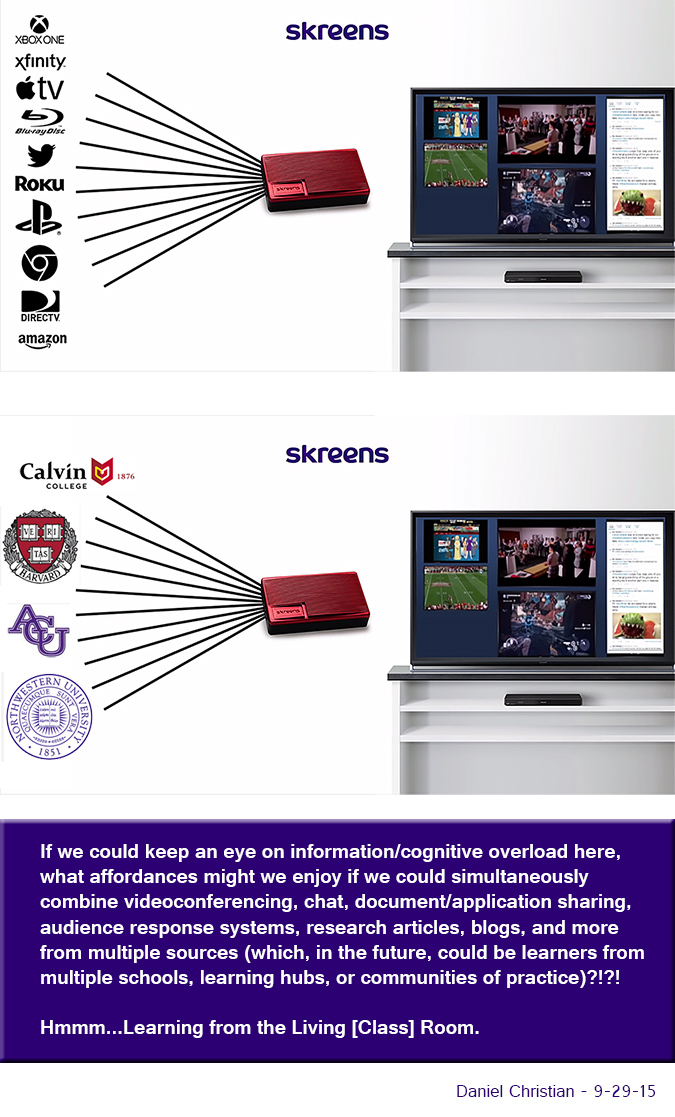
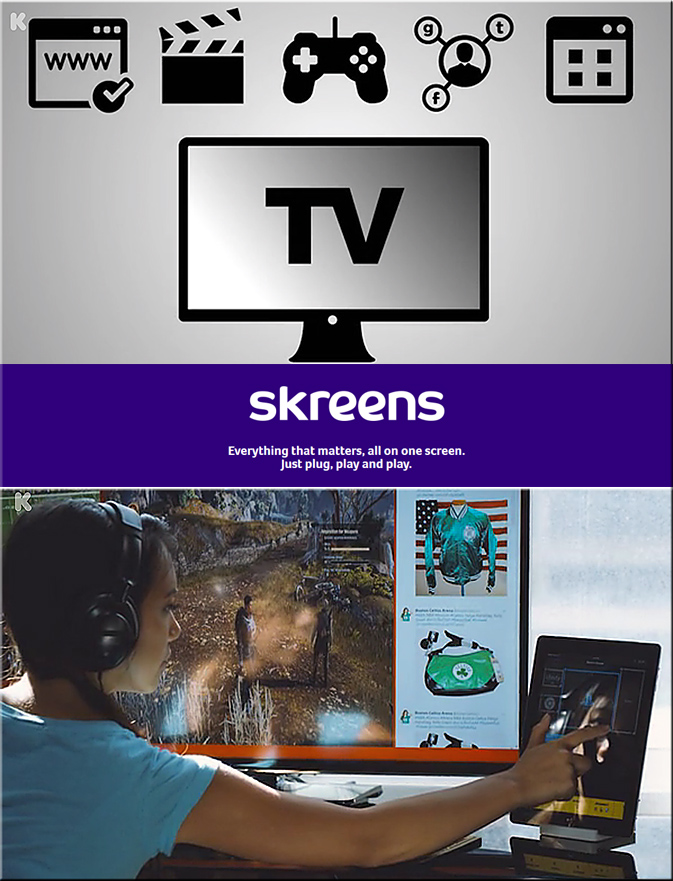
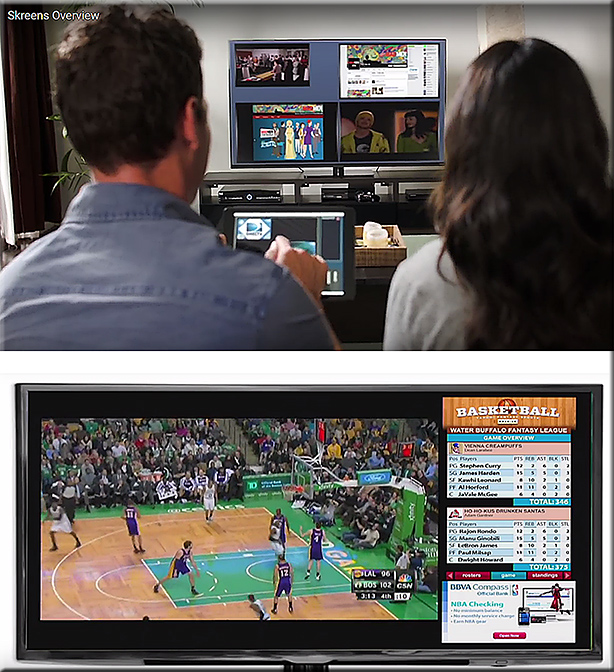
Imagine what learning could look like w/ the same concepts found in Skreens!


From DSC:
Imagine what learning could look like w/ the same concepts found in the
Skreens kickstarter campaign?  Where you can use your mobile device to direct what you are seeing and interacting with on the larger screen?  Hmmm… very interesting indeed! With applications not only in the home (and on the road), but also in the active classroom, the boardroom, and the training room.


See
Skreens.com
&
Learning from the Living [Class] Room


DanielChristian-AVariationOnTheSkreensTheme-9-29-15


Skreens-Sept2015Kickstarter


Skreens2-Sept2015Kickstarter


The Living [Class] Room -- by Daniel Christian -- July 2012 -- a second device used in conjunction with a Smart/Connected TV

From DSC:
Some of the phrases and concepts that come to my mind:

  • tvOS-based apps
  • Virtual field trips while chatting or videoconferencing with fellow learners about that experience
  • Virtual tutoring
  • Global learning for K-12, higher ed, the corporate world
  • Web-based collaborations and communications
  • Ubiquitous learning
  • Transmedia
  • Analytics / data mining / web-based learner profiles
  • Communities of practice
  • Lifelong learning
  • 24×7 access
  • Reinvent
  • Staying relevant
  • More choice. More control.
  • Participation.
  • MOOCs — or what they will continue to morph into
  • Second screens
  • Mobile learning — and the ability to quickly tie into your learning networks
  • Ability to contact teachers, professors, trainers, specialists, librarians, tutors and more
  • Language translation
  • Informal and formal learning, blended learning, active learning, self-directed learning
  • The continued convergence of the telephone, the television, and the computer
  • Cloud-based apps for learning
  • Flipping the classroom
  • Homeschooling
  • Streams of content
  • …and more!


Addendum:

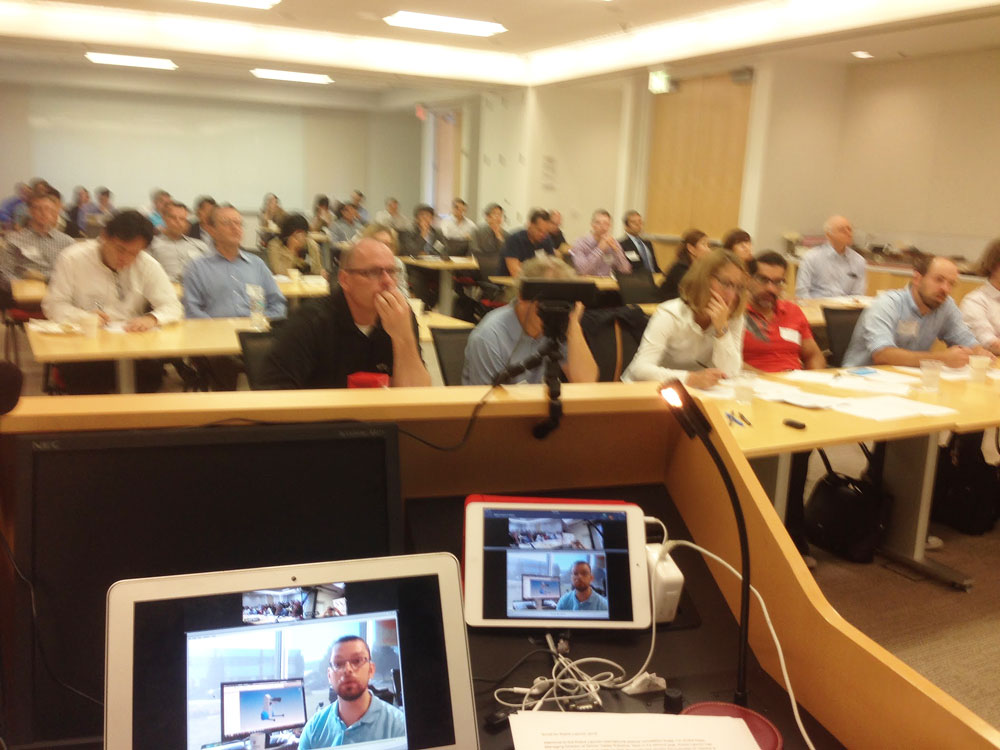
Check out this picture from Meet the winners of #RobotLaunch2015

Packed house at WilmerHale for the Robot Launch 2015 judging – although 2/3rds of the participants were attending and pitching remotely via video and web conferencing.


IBM Expands Watson Platform for Next Generation of Builders; Extends Industry’s Largest Portfolio of Cognitive APIs — from ibm.com

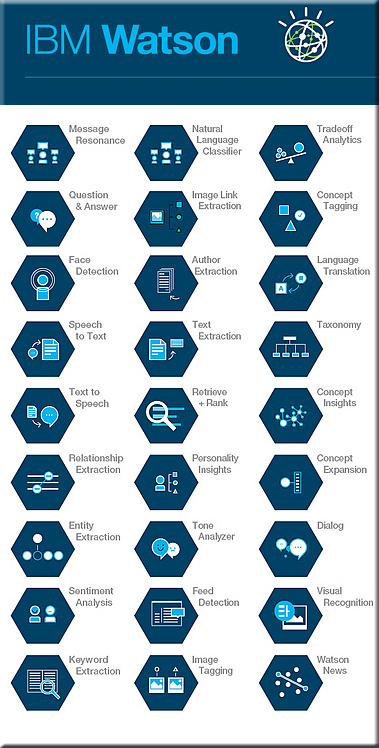
– New APIs Broaden Watson’s Language, Vision and Speech Capabilities
– Developer Tools Simplify Combining APIs and Data
– Upcoming Platform Innovations Previewed including Industry Data Sets & Robotics Integration
– New Watson Hub to Open in San Francisco

Excerpt:

SAN FRANCISCO – 24 Sep 2015: IBM (NYSE: IBM) today expanded the industry’s largest and most diverse set of cognitive APIs, technologies and tools for developers who are creating products, services and applications embedded with Watson.

The announcement was made by IBM during its forum on cognitive computing and Artificial Intelligence, where the company announced a new Watson location in San Francisco. IBM also previewed new platform innovations and research projects that will extend its industry-leading cognitive portfolio.


Excerpts from IBM Watson Ecosystem Partners in Market Building Businesses:

Student Career Counseling: Carney Labs is an education technology company that provides a platform embedded with Watson language capabilities to help schools learn about a student’s personality characteristics in order to build them a career roadmap. The Commonwealth of Virginia adopted a policy for all high schools in the state to leverage this app to use with students entering their freshman year.

Knowledge Management: Bloomfire  is a cloud-based knowledge network platform that helps employees within a company easily find the information they need to do their jobs. By scanning posts within the platform and automatically creating tags via the Watson data insights API, employees at companies including Whole Foods, Dun & Bradstreet and Etsy spend less time searching for information and more time doing meaningful work to improve company performance.

Research & Development: Inno360, an enterprise research and innovation management platform provider, is embedding a powerful combination of 7 Watson APIs for language and data insights into its SaaS platform to transform the way its clients, including Fortune 50 companies, conduct research and process big data. Inno360 is able to provide its clients advanced analysis of their R&D data to resolve product issues quickly and bring new products to market more rapidly.

Talent Sourcing and Matching: UnitesUs is a cloud based hiring & recruitment platform utilizing cognitive computing and big data analysis to match prospective employees to hiring organizations based on personality, company cultural fit, and core qualifications. By analyzing the personalities of job candidates leveraging Watson language capabilities and characterizing a company’s work environment, UnitesUs uses proprietary, automated matching algorithms to help companies, including imaging and electronics company Ricoh USA and fitness gym chain 24 Hour Fitness, make better hiring decisions.


ibmwatson-sept2015


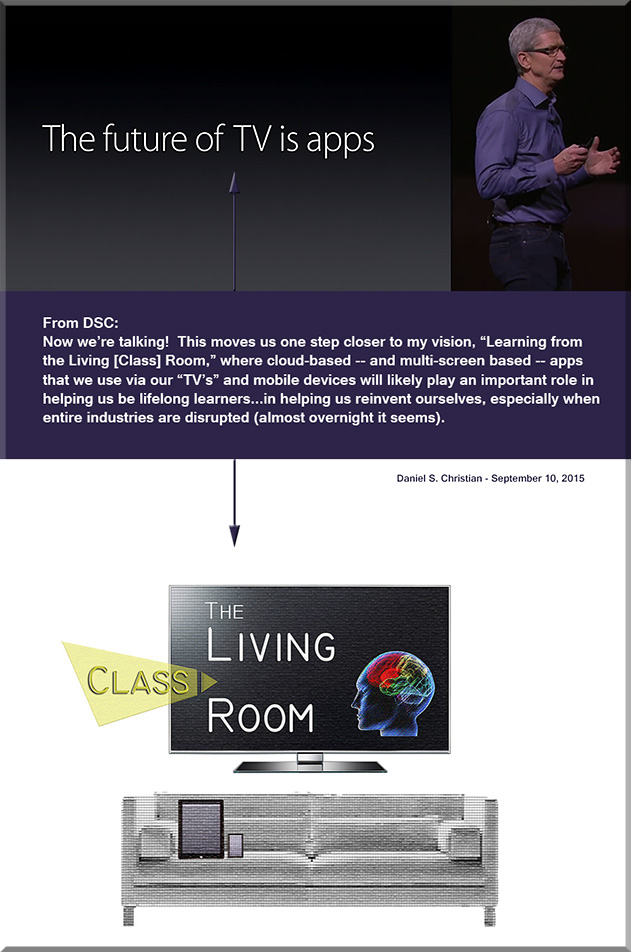
Now we’re talking! One step closer! “The future of TV is apps.” — per Apple’s CEO, Tim Cook

OneStepCloser-DanielChristian-Sept2015


From DSC:
We’ll also be seeing the integration of the areas listed below with this type of “TV”-based OS/platform:

  • Artificial Intelligence (AI)
  • Data mining and analytics
  • Learning recommendation engines
  • Digital learning playlists
  • New forms of Human Computer Interfaces (HCI)
  • Intelligent tutoring
  • Social learning / networks
  • Videoconferencing with numerous other learners from across the globe
  • Virtual tutoring, virtual field trips, and virtual schools
  • Online learning to the Nth degree
  • Web-based learner profiles
  • Multimedia (including animations, simulations, and more)
  • Advanced forms of digital storytelling
  • and, most assuredly, more choice & more control.

Competency-based education and much lower cost alternatives could also be possible with this type of learning environment. The key will be to watch — or better yet, to design and create — what becomes of what we’re currently calling the television, and what new affordances/services the “TV” begins to offer us.


MoreChoiceMoreControl-DSC


From Apple’s website:

Apple Brings Innovation Back to Television with The All-New Apple TV
The App Store, Siri Remote & tvOS are Coming to Your Living Room

Excerpt:

SAN FRANCISCO — September 9, 2015 — Apple® today announced the all-new Apple TV®, bringing a revolutionary experience to the living room based on apps built for the television. Apps on Apple TV let you choose what to watch and when you watch it. The new Apple TV’s remote features Siri®, so you can search with your voice for TV shows and movies across multiple content providers simultaneously.

The all-new Apple TV is built from the ground up with a new generation of high-performance hardware and introduces an intuitive and fun user interface using the Siri Remote™. Apple TV runs the all-new tvOS™ operating system, based on Apple’s iOS, enabling millions of iOS developers to create innovative new apps and games specifically for Apple TV and deliver them directly to users through the new Apple TV App Store™.

tvOS is the new operating system for Apple TV, and the tvOS SDK provides tools and APIs for developers to create amazing experiences for the living room the same way they created a global app phenomenon for iPhone® and iPad®. The new, more powerful Apple TV features the Apple-designed A8 chip for even better performance so developers can build engaging games and custom content apps for the TV. tvOS supports key iOS technologies including Metal™, for detailed graphics, complex visual effects and Game Center, to play and share games with friends.


Addendum on 9/11/15:


Question for the day:

What if each college and university created their own version of Lynda.com?

Lifelong learning.

Career development.

Developing and offering low cost, relevant, up-to-date streams of content.

Tracking of which modules a learner has taken and how they performed — the data from which are then fed into his or her web-based learner profile.

Courses that create new revenue streams for our institutions of higher education.

Hmmm…just throwing this idea out there…thinking out loud again…


linkedin_lynda


What might our learning ecosystems look like by 2025? [Christian]

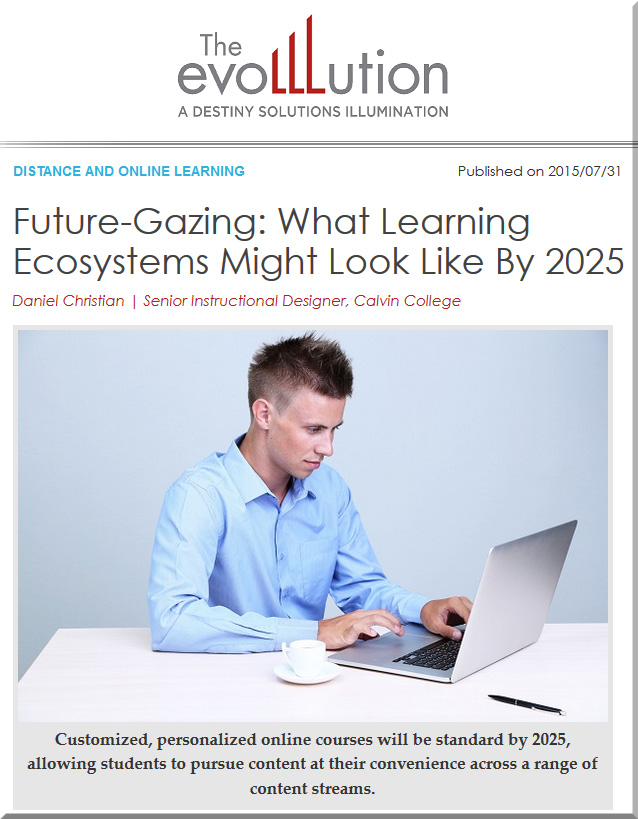
This posting can also be seen out at evoLLLution.com (where LLL stands for lifelong learning):

DanielChristian-evoLLLutionDotComArticle-7-31-15


From DSC:
What might our learning ecosystems look like by 2025?

In the future, learning “channels” will offer more choice, more control.  They will be far more sophisticated than what we have today.


MoreChoiceMoreControl-DSC


That said, what the most important aspects of online course design end up being 10 years from now depends upon what types of “channels” I think there will be and what might be offered via those channels. By channels, I mean forms, methods, and avenues of learning that a person could pursue and use. In 2015, some example channels might be:

  • Attending a community college, a college or a university to obtain a degree
  • Obtaining informal learning during an internship
  • Using social media such as Twitter or LinkedIn
  • Reading blogs, books, periodicals, etc.

In 2025, there will likely be new and powerful channels for learning that will be enabled by innovative forms of communications along with new software, hardware, technologies, and other advancements. For examples, one could easily imagine:

  • That the trajectory of deep learning and artificial intelligence will continue, opening up new methods of how we might learn in the future
  • That augmented and virtual reality will allow for mobile learning to the Nth degree
  • That the trend of Competency Based Education (CBE) and microcredentials may be catapulted into the mainstream via the use of big data-related affordances

Due to time and space limitations, I’ll focus here on the more formal learning channels that will likely be available online in 2025. In that environment, I think we’ll continue to see different needs and demands – thus we’ll still need a menu of options. However, the learning menu of 2025 will be more personalized, powerful, responsive, sophisticated, flexible, granular, modularized, and mobile.


Highly responsive, career-focused track


One part of the menu of options will focus on addressing the demand for more career-focused information and learning that is available online (24×7). Even in 2015, with the U.S. government saying that 40% of today’s workers now have ‘contingent’ jobs and others saying that percentage will continue climbing to 50% or more, people will be forced to learn quickly in order to stay marketable.  Also, the 1/2 lives of information may not last very long, especially if we continue on our current trajectory of exponential change (vs. linear change).

However, keeping up with that pace of change is currently proving to be out of reach for most institutions of higher education, especially given the current state of accreditation and governance structures throughout higher education as well as how our current teaching and learning environment is set up (i.e., the use of credit hours, 4 year degrees, etc.).  By 2025, accreditation will have been forced to change to allow for alternative forms of learning and for methods of obtaining credentials. Organizations that offer channels with a more vocational bent to them will need to be extremely responsive, as they attempt to offer up-to-date, highly-relevant information that will immediately help people be more employable and marketable. Being nimble will be the name of the game in this arena. Streams of content will be especially important here. There may not be enough time to merit creating formal, sophisticated courses on many career-focused topics.


StreamsOfContent-DSC


With streams of content, the key value provided by institutions will be to curate the most relevant, effective, reliable, up-to-date content…so one doesn’t have to drink from the Internet’s firehose of information. Such streams of content will also offer constant potential, game-changing scenarios and will provide a pulse check on a variety of trends that could affect an industry. Social-based learning will be key here, as learners contribute to each other’s learning. Subject Matter Experts (SMEs) will need to be knowledgeable facilitators of learning; but given the pace of change, true experts will be rare indeed.

Microcredentials, nanodegrees, competency-based education, and learning from one’s living room will be standard channels in 2025.  Each person may have a web-based learner profile by then and the use of big data will keep that profile up-to-date regarding what any given individual has been learning about and what skills they have mastered.

For example, even currently in 2015, a company called StackUp creates their StackUp Report to add to one’s resume or grades, asserting that their services can give “employers and schools new metrics to evaluate your passion, interests, and intellectual curiosity.” Stackup captures, categorizes, and scores everything you read and study online. So they can track your engagement on a given website, for example, and then score the time spent doing so. This type of information can then provide insights into the time you spend learning.

Project teams and employers could create digital playlists that prospective employees or contractors will have to advance through; and such teams and employers will be watching to see how the learners perform in proving their competencies.

However, not all learning will be in the fast lane and many people won’t want all of their learning to be constantly in the high gears. In fact, the same learner could be pursuing avenues in multiple tracks, traveling through their learning-related journeys at multiple speeds.


The more traditional liberal arts track


To address these varied learning preferences, another part of the menu will focus on channels that don’t need to change as frequently.  The focus here won’t be on quickly-moving streams of content, but the course designers in this track can take a bit more time to offer far more sophisticated options and activities that people will enjoy going through.

Along these lines, some areas of the liberal arts* will fit in nicely here.

*Speaking of the liberal arts, a brief but important tangent needs to be addressed, for strategic purposes. While the following statement will likely be highly controversial, I’m going to say it anyway.  Online learning could be the very thing that saves the liberal arts.

Why do I say this? Because as the price of higher education continues to increase, the dynamics and expectations of learners continue to change. As the prices continue to increase, so do peoples’ expectations and perspectives. So it may turn out that people are willing to pay a dollar range that ends up being a fraction of today’s prices. But such greatly reduced prices won’t likely be available in face-to-face environments, as offering these types of learning environment is expensive. However, such discounted prices can and could be offered via online-based environments. So, much to the chagrin of many in academia, online learning could be the very thing that provides the type of learning, growth, and some of the experiences that liberal arts programs have been about for centuries. Online learning can offer a lifelong supply of the liberal arts.

But I digress…
By 2025, a Subject Matter Expert (SME) will be able to offer excellent, engaging courses chocked full of the use of:

  • Engaging story/narrative
  • Powerful collaboration and communication tools
  • Sophisticated tracking and reporting
  • Personalized learning, tech-enabled scaffolding, and digital learning playlists
  • Game elements or even, in some cases, multiplayer games
  • Highly interactive digital videos with built-in learning activities
  • Transmedia-based outlets and channels
  • Mobile-based learning using AR, VR, real-world assignments, objects, and events
  • …and more.

However, such courses won’t be able to be created by one person. Their sophistication will require a team of specialists – and likely a list of vendors, algorithms, and/or open source-based tools – to design and deliver this type of learning track.


Final reflections


The marketplaces involving education-related content and technologies will likely look different. There could be marketplaces for algorithms as well as for very granular learning modules. In fact, it could be that modularization will be huge by 2025, allowing digital learning playlists to be built by an SME, a Provost, and/or a Dean (in addition to the aforementioned employer or project team).  Any assistance that may be required by a learner will be provided either via technology (likely via an Artificial Intelligence (AI)-enabled resource) and/or via a SME.

We will likely either have moved away from using Learning Management Systems (LMSs) or those LMSs will allow for access to far larger, integrated learning ecosystems.

Functionality wise, collaboration tools will still be important, but they might be mind-blowing to us living in 2015.  For example, holographic-based communications could easily be commonplace by 2025. Where tools like IBM’s Watson, Microsoft’s Cortana, Google’s Deepmind, and Apple’s Siri end up in our future learning ecosystems is hard to tell, but will likely be there. New forms of Human Computer Interaction (HCI) such as Augmented Reality (AR) and Virtual Reality (VR) will likely be mainstream by 2025.

While the exact menu of learning options is unclear, what is clear is that change is here today and will likely be here tomorrow. Those willing to experiment, to adapt, and to change have a far greater likelihood of surviving and thriving in our future learning ecosystems.


IRIS.TV Finds Adaptive Video Personalization Increases Consumption by 50% — from appmarket.tv by Richard Kastelein

Excerpt (emphasis DSC):

IRIS.TV, the leading in-player video recommendation engine, reports that its programmatic video delivery technology, Adaptive StreamTM, has increased video consumption by 50% across all its clients. The results of these findings just further solidifies that consumption of online video is significantly enhanced by a personalized user experience.

By integrating Adaptive StreamTM in their video players and mobile apps, IRIS.TV’s clients are able to deliver the most relevant streams of video to their viewers, just like TV. Yet unlike TV, viewers’ feedback is captured in real-time through interactive buttons, allowing the stream to dynamically adapt to the changing preferences.


IRIS-dot-TV-Julne2015


Press Release: IRIS.TV Launches Personalized End-screen for Online Video with Kaltura — from iris.tv
IRIS.TV Partners with Kaltura to offer programmatic content delivery and in-player thumbnail recommendations

Excerpt:

Los Angeles, May 4, 2015 – IRIS.TV the leading programmatic content delivery system, today announced a new dynamic, personalized end-screen plugin for Kaltura, provider of the leading video technology platform.

IRIS.TV’s new plugin for Kaltura will offer clients of both a personalized and dynamic stream of video along with a personalized end-screen framework. Publishers can now provide users with both dynamic streams of video – powered by consumption and interaction – along with thumbnail choices specific to their real-time consumption habits. This new integration supplies publishers with additional tools to deliver a more personalized viewing experience in order to maximize viewer retention and video views. The partnership is aimed to help consumers discover relevant and engaging content while viewing across all connected devices.


From DSC:
Now imagine these same concepts of providing recommendation engines and personalized/dynamic/interactive streams of content, but this time apply those same concepts to delivering personalized, digital learning playlists on topics that you want to learn about. With the pace of change and a shrinking 1/2 life for many pieces of information, this could be a powerful way to keep abreast of any given topic. Team these concepts up with the idea of learning hubs — whereby some of the content is delivered electronically and some of the content is discussed/debated in a face-to-face manner — and you have some powerful, up-to-date opportunities for lifelong learning. Web-based learner profiles and services like Stack Up could continually populate one’s resume and list of skills — available to whomever you choose to make it available to.


The Living [Class] Room -- by Daniel Christian -- July 2012 -- a second device used in conjunction with a Smart/Connected TV


StreamsOfContent-DSC


Along these lines, also see:

  • Nearly 1 billion TV sets Internet connected by 2020 — from appmarket.tv
    Excerpt:

    The number of TV sets connected to the Internet will reach 965 million by 2020, up from 103 million at end-2010 and the 339 million expected at end-2014, according to a new report from Digital TV Research.Covering 51 countries, the Connected TV Forecasts report estimates that the proportion of TV sets connected to the Internet will rocket to 30.4% by 2020, up from only 4.2% at end-2010 and the 12.1% expected by end-2014. South Korea (52.7%) will have the highest proportion by 2020, followed by the UK (50.6%), Japan (48.6%) and the US (47.0%). – See more at: http://www.appmarket.tv/connected-tv/2572-nearly-1-billion-tv-sets-internet-connected-by-2020.html#sthash.BJWdCgbv.dpuf


  • McDonnell – HTML5 is the true Second Screen, Social TV winner — from appmarket.tv
    Excerpt:
    After years of evolution, the W3C has finally declared the HTML5 standard complete. When Steve Jobs “declared war on Flash” he gave HTML5 a fighting chance of dominance. In parallel, businesses started to recognise the potential of Social TV or “Second Screen” behaviour to re-invigorate old media and drive revenue to newer social platforms like Twitter. The ensuing debate centred on winners and losers, but with such a diverse global broadcasting market and no social network with dominance in all countries, could the web standard be the ultimate winner? I think it already is.


Every learner is different but not because of their learning styles — from clive-shepherd.blogspot.com by Clive Sheperd

Excerpt:

I’ve been reading Make it Stick: The Science of Successful Learning by Peter Brown and Henry Roediger (Harvard University Press, 2014). What a great book! It provides a whole load of useful tips for learners, teachers and trainers based on solid research.

Finishing this book coincides with The Debunker Club’s Debunk Learning Styles Month. And learning styles really do need debunking, not because we, as learners, don’t have preferences, but because there is no model out there which has been proven to be genuinely helpful in predicting learner performance based on their preferences.


Learning Styles are NOT an Effective Guide for Learning Design — from debunker.club

Excerpt:

Strength of Evidence Against
The strength of evidence against the use of learning styles is very strong. To put it simply, using learning styles to design or deploy learning is not likely to lead to improved learning effectiveness. While it may be true that learners have different learning preferences, those preference are not likely to be a good guide for learning. The bottom line is that when we design learning, there are far better heuristics to use than learning styles.

The weight of evidence at this time suggests that learning professionals should avoid using learning styles as a way to design their learning events. Still, research has not put the last nail in the coffin of learning styles. Future research may reveal specific instances where learning-style methods work. Similarly, learning preferences may be found to have long-term motivational effects.

Debunking Resources — Text-Based Web Pages


Learning Styles Or Learning Preference? — from learndash.com by Justin Ferriman

Excerpts (emphasis DSC):

There are fewer buzzwords in the elearning industry that result in a greater division than “learning style”. I know from experience. There have been posts on this site related to the topic which resulted in a few passionate comments (such as this one).

As such, my intent isn’t to discuss learning styles. Everyone has their mind made up already. It’s time to move the discussion along.

Learner Preference & Motivation
If we bring the conversation “up” a level, we all ultimately agree that every learner has preferences and motivation. No need to cite studies for this concept, just think about yourself for a moment.

You enjoy certain things because you prefer them over others.

You do certain things because you are motivated to do so.

In the same respect, people prefer to learn information in a particular way. They also find some methods of learning more motivating than others. Whether you attribute this to learning styles or not is completely up to you.


How to respond to learning-style believers – from Cathy Moore

Excerpt:

First, the research
These resources link to or summarize research that debunks learning styles:


Are Learning Styles Going out of Style? — from mindtools.com by Bruce Murray

Excerpt (emphasis DSC):

Their first conclusion was that learners do indeed differ from one another. For example, some learners may have more ability, more interest, or more background than their classmates. Second, students do express preferences for how they like information to be presented to them… Third, after a careful analysis of the literature, the researchers found no evidence showing that people do in fact learn better when an instructor tailors their teaching style to mesh with their preferred learning style.

The idea of matching lessons to learning styles may be a fashionable trend that will go out of style itself. In the meantime, what are teachers and trainers to do? My advice is to leave the arguments to the academics. Here are some common-sense guidelines in planning a session of learning.

Follow your instincts. If you’re teaching music or speech, for example, wouldn’t auditory-based lessons make the most sense? You wouldn’t teach geography with lengthy descriptions of a coastline’s contours when simply showing a map would capture the essence in a heartbeat, right?

Since people clearly express learning style preferences, why not train them in their preferred style? If you give them what they want, they’ll be much more likely to stay engaged and expand their learning.


Do Visual, Auditory, and Kinesthetic Learners Need Visual, Auditory, and Kinesthetic Instruction? — from aft.org by Daniel T. Willingham

Excerpt (emphasis DSC):

Question: What does cognitive science tell us about the existence of visual, auditory, and kinesthetic learners and the best way to teach them?

The idea that people may differ in their ability to learn new material depending on its modality—that is, whether the child hears it, sees it, or touches it—has been tested for over 100 years. And the idea that these differences might prove useful in the classroom has been around for at least 40 years.

What cognitive science has taught us is that children do differ in their abilities with different modalities, but teaching the child in his best modality doesnt affect his educational achievement. What does matter is whether the child is taught in the contents best modality. All students learn more when content drives the choice of modality. In this column, I will describe some of the research on matching modality strength to the modality of instruction. I will also address why the idea of tailoring instruction to a students best modality is so enduring—despite substantial evidence that it is wrong.


From DSC:
Given the controversies over the phrase “learning styles,” I like to use the phrase “learning preferences” instead.  Along these lines, I think our goal as teachers, trainers, professors, SME’s should be to make learning enjoyable — give people more choice and more control. Present content in as many different formats as possible.  Give them multiple pathways to meet the learning goals and objectives.  If we do that, learning can be more enjoyable and the engagement/motivation levels should rise — resulting in enormous returns on investment over learners’ lifetimes.


Addendum on 6/17/15:


Addendum on 7/14/15:

 
© 2025 | Daniel Christian