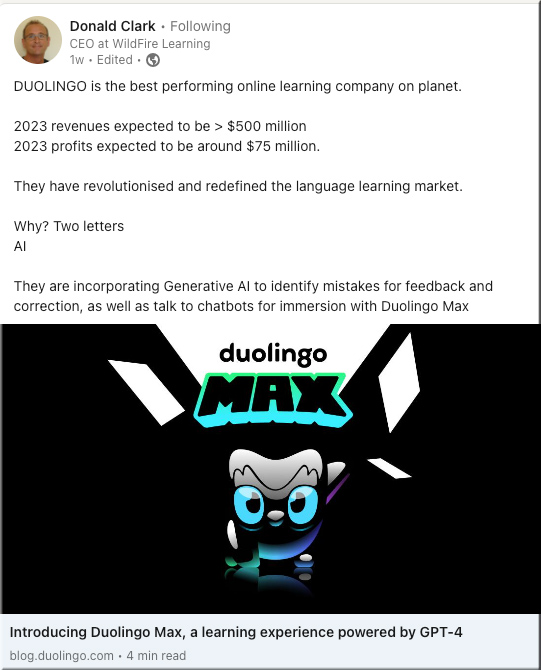
K12 District-Level Perspectives on AI — from aiforeducation.io by Amanda Bickerstaff, Dr. Patrick Gittisriboongul, Samantha Armstrong, & Brett Roer

Want to know how K12 schools are navigating the adoption of AI and what district-level leaders really think about GenAI EdTech tools?

Join us for this free webinar where we discussed AI technology, literacy, training, and the responsible adoption of GenAI tools in K12. Our panel explored what is working well – and not so well – across their districts from a school leader and practitioner’s perspective.


ChatGPT Has Changed Teaching. Our Readers Tell Us How. — from chronicle.com by Beth McMurtrie and Beckie Supiano

Those vastly different approaches to college writing pretty much sum up the responses to generative AI: They’re all over the map.

One year after its release, ChatGPT has pushed higher education into a liminal place. Colleges are still hammering out large-scale plans and policies governing how generative AI will be dealt with in operations, research, and academic programming. But professors have been forced more immediately to adapt their classrooms to its presence. Those adaptations vary significantly, depending on whether they see the technology as a tool that can aid learning or as a threat that inhibits it.

Nearly 100 faculty members shared their stories. While not a representative sample, they teach at a wide range of institutions: 15 community colleges, 32 public and 24 private four-year colleges or universities, seven international institutions, and one for-profit college. They teach a variety of subjects, including animal science, statistics, computer science, history, accounting, and composition. Many spent hours learning about AI: enrolling in workshops and webinars, experimenting with the tools, and reading articles, so that they could enter the fall semester informed and prepared.


The Disruption of AI in CTE Is Real — from techlearning.com by Annie Galvin Teich
An ACTE expert panel urges CTE educators to jump on the AI train as it’s already left the station

10 Best Practices for AI and CTE 

  1. Embrace AI and use it first for simple tasks to create efficiencies. Then use it to individualize instruction and for formative assessment tools aligned to standards.
  2. Be creative and conscious of internal bias and ethics. Focus on DEI and access.
  3. Encourage students to use apps and tools to start moving toward an integrated curriculum using AI.
  4. Prepare students for jobs of the future by partnering with industry to solve real problems.
  5. …and others

How are universities responding to generative AI? — from medium.com by Nic Newman
What’s next for higher education as we enter a new wave of edtech innovation: AI-powered learning

Where will AI make a big difference?
At Emerge, we have identified eight high-level trends — what we’re calling “engines of opportunity”. These eight “engines of opportunity” capture our ideas about how AI is being used to drive better practice and outcomes in HE, now and into the future.

They fall into two main categories:

  • Making learning more engaging: solutions that scale high quality pedagogy at low cost.
  • Making teaching more efficient: solutions that save educators and organisations time and money.


The Rise of Learning Societies — from educationnext.org by Alan Gottlieb
A small experiment in rural Idaho holds big promise for student success 

Excerpt (emphasis DSC):

The basic idea is this: Some parents who, for a variety of reasons, hesitate to send their children to a traditional brick-and-mortar school have neither the time, inclination, or temperament to homeschool or to monitor a full-time online program. Learning Societies provide an intimate environment where kids, supervised by professional educators, learn online and in small, in-person groups for six hours a day. Gem Prep leaders describe it as a sweet spot between traditional schooling and at-home online learning. It is particularly well suited to rural areas.

Learning Societies have the potential to achieve a happy medium that combines the strengths of both homeschooling (or online learning from home) and a traditional brick-and-mortar school.

A typical school day at a Gem Prep Learning Society sees some students engaged in online lessons on laptops while others receive instruction from a teacher in a small group, all within the same classroom. Both modalities use Gem Prep Online’s well-regarded curriculum.


Using Drawing as a Powerful Learning Tool — from edutopia.org by Selim Tlili
When students draw something they’re learning about, they’re more likely to remember key details.

One of my main goals as a science teacher is to open students up to seeing all of those beautiful and interesting details. I do that by having students draw things and clearly write what they observe. Drawing something requires students to look at their subject far longer than they are accustomed. Writing what they see forces them to consciously acknowledge it. I explain to students that just as every single human is unique, so is every coin, plant, and salt crystal.


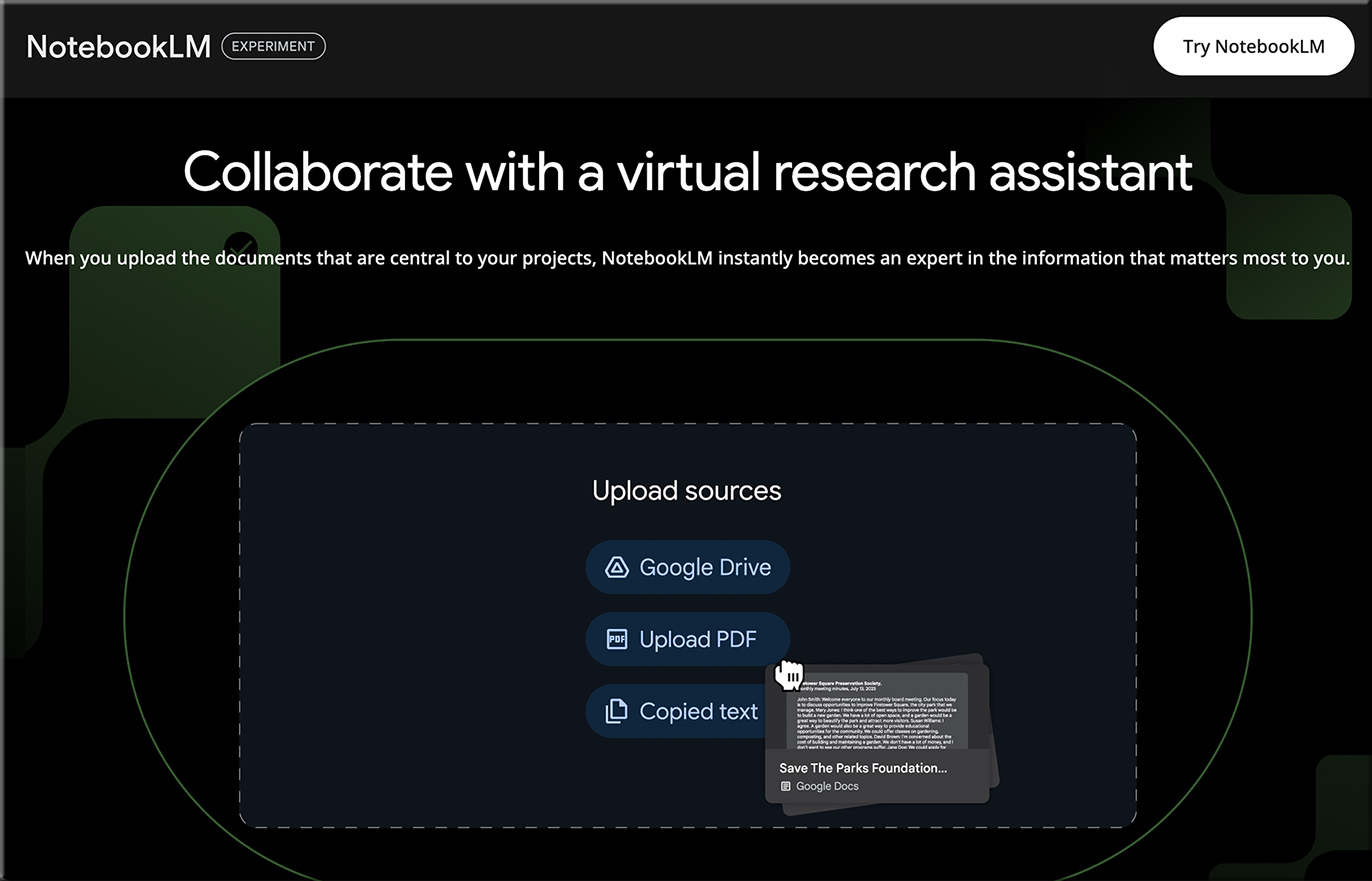
Google hopes that this personalized AI -- called Notebook LM -- will help people with their note-taking, thinking, brainstorming, learning, and creating.

Google NotebookLM (experiment)

From DSC:
Google hopes that this personalized AI/app will help people with their note-taking, thinking, brainstorming, learning, and creating.

It reminds me of what Derek Bruff was just saying in regards to Top Hat’s Ace product being able to work with a much narrower set of information — i.e., a course — and to be almost like a personal learning assistant for the course you are taking. (As Derek mentions, this depends upon how extensively one uses the CMS/LMS in the first place.)


Syllabusters Are Outdated — from scholarlyteacher.com by Todd Zakrajsek

What does this all mean for the first day of class? Approach that first day with “learning-centered” in your mind. Focus on learning. Learning is all about curiosity and desire. Desire to know, to figure things out, to be surprised, all getting that dopamine flowing throughout the brain: That is what learning-centered is all about. An exam is best thought of as feedback, showing whether students are learning, not a date to cover on the first day and dread every class period in the meantime. An exam should never be the reason to learn, it should always be an indication of learning. Don’t spend your first 45 or 85 minutes focused solely on exams, term paper deadlines, and attendance policies. That moves teaching toward an artificial transactional arrangement where students learn in exchange for points and grades.

From DSC:
I would highly recommend starting out with a major HOOK. Some question, some video, some recording/piece of audio, etc. that would provoke interest, curiosity, or even some emotion. On that first day, the following item MUST be addressed if you expect to engage your students:

Why is this class/topic relevant?

Start with that. Immediately. The other stuff can be introduced later on, as Todd mentions.


Educational practices to identify and support students experiencing homelessness — from edresearchforaction.org by Alexandra Pavlakis, J. Kessa Roberts, Meredith Richards, Kathryn Hill, and Zitsi Mirakhur

The EdResearch for Action Overview Series summarizes the research on key topics to provide K-12 education decision makers and advocates with an evidence base to ground discussions about how to best serve students. Authors – leading experts from across the field of education research – are charged with highlighting key findings from research that provide concrete, strategic insight on persistent challenges sourced from district and state leaders.

Central Question
What evidence-based practices can schools and districts implement to identify and support students experiencing homelessness?


Learning and employment record use cases -- from the National Governors Association

LERs Are Hot. What Are States Going To Do With Them?

Governors and state leaders are concerned about the current labor shortage, occurring during a time when many skilled workers are underemployed or even unemployed. Skills-based approaches to hiring and recruiting can shift that dynamic—making pathways to good careers accessible to a wider segment of the workforce and opening up new pools of talent for employers. They do so by focusing on what workers know and can do, not on the degrees or credentials they’ve earned.

That’s the theory. But a lot hinges on how things actually play out on the ground.

Technology will play a key role, and many states have zeroed in on learning and employment records—essentially digital resumes with verified records of people’s skills, educational experiences, and work histories—as an essential tool. A lot of important work is going into the technical design and specifications.

This project, on the other hand, aims to take a step back and look at the current state of play when it comes to the use cases for LERs. Just a few of the key questions:

  • How might employers, education providers, government agencies, and workers themselves actually use them? Will they?
  • In what areas do state policymakers have the most influence over key stakeholders and the most responsibility to invest?
  • What actions are needed now to ensure that LERs, and skills-based hiring more broadly, actually widen access to good jobs—rather than setting up a parallel system that perpetuates many of today’s inequities?
 

When Educators and Employers Work Together, Students Succeed — from hbsp.harvard.edu by Joseph Fuller and Manjari Raman

(Emphasis below from DSC)

Last year, in “The Partnership Imperative,” we put forth a set of more than 40 best practices that employers and educators can use to develop a close collaboration. As part of that effort, we identified three main goals and laid out strategies for achieving each.

  1. Partner with each other to offer training and education that is aligned with industry needs. (DSC: Similar to how Instructional Designers want alignment with learning objectives, learning activities, and assessments of learning.)
  2. Establish relationships with each other that result in the recruitment and hiring of students and graduates.
  3. Make supply-and-demand decisions that are informed by the latest data and trends.

From DSC:
Under #1, their strategies include:

Cocreate and regularly update college curriculums so that they reflect relevant technical and foundational skills based on industry needs. Codesign programs that fit with students’ lives and industry hiring cycles. Incorporate classroom experiences that simulate real-world settings and scenarios.

I see AI being able to identify what those changing, currently sought-after, and foundational skills are based on industry needs (which shouldn’t be hard, and vendors like Microsoft are already doing this by combing through the posted job descriptions on their platforms). These findings/results will help build regularly updated learning playlists and should provide guidance to learning-related organizations/groups/individuals/teams on what content to develop and offer  (i.e., courses/learning modules/micro-learning-based streams of content, other).


Instructional Designers as Institutional Change Agents — from er.educause.edu/ by Aaron Bond, Barb Lockee and Samantha Blevins

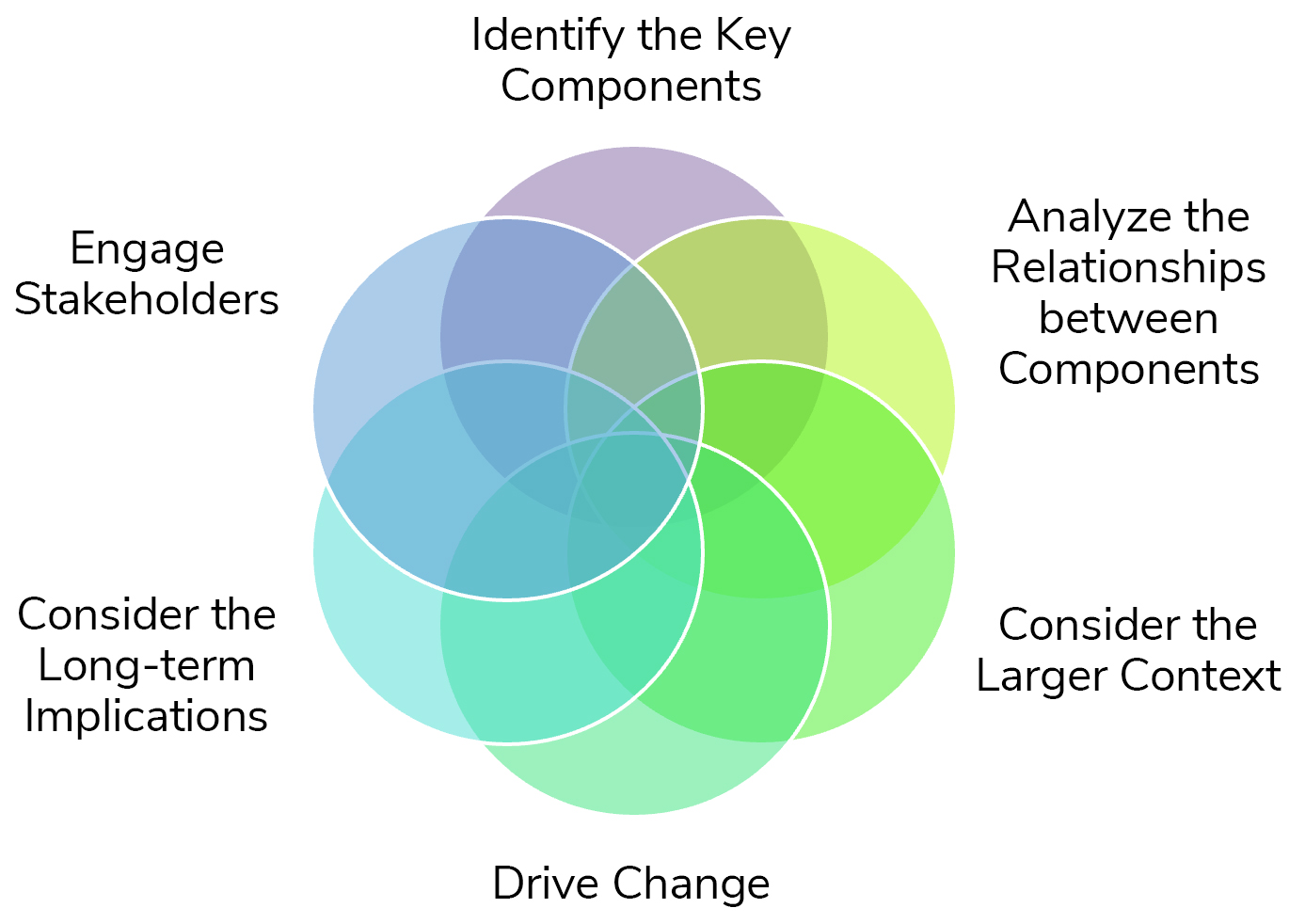
Systems thinking and change strategies can be used to improve the overall functioning of a system. Because instructional designers typically use systems thinking to facilitate behavioral changes and improve institutional performance, they are uniquely positioned to be change agents at higher education institutions.

In higher education, instructional designers are often seen as “change agents” because they help to facilitate behavioral changes and improve performance at their institutions. Due to their unique position of influence among higher education leaders and faculty and their use of systems thinking, instructional designers can help bridge institutional priorities and the specific needs of various stakeholders. COVID-19 and the switch to emergency remote teaching raised awareness of the critical services instructional designers provide, including preparing faculty to teach—and students to learn—in well-designed learning environments. Today, higher education institutions increasingly rely on the experience and expertise of instructional designers.

Figure 1. How Instructional Designers Employ Systems Thinking
.


Why Entrepreneurship Might Save Our Kids—and the Rest of Us. — from gettingsmart.com by Katie Kimbrell

Key Points (emphasis DSC):

  • We need to be asking our students “How did you put your ideas into the world today?”.
  • To be human is to be entrepreneurial.

One of my favorite mom friends asks her young school-aged kids every day, “What did you make today?”

I love how subtly subversive this question is. Not, “How was school today?” “Were you good today?” or, “How’s [insert school subject] going?” But, How did you put your ideas out into the world today?” 

That simple question understands this fundamental truth: to be human is to create, to employ our imaginations and partake in forming the world we want to live in.


Microschool in a Box: Programs Enabling the Microschool Movement — from gettingsmart.com by Nate McClennen

Key Points

  • Microschools are not new. In fact, they are as old as learning itself.
  • Funding and operations can be difficult within a microschool model. Programs and other organizations can support planning, design and implementation.

Microschools are meeting strong market demand for more personalized, more contextualized and more relevant learning for every student. Programs like ASU Prep’s Microschool in a Box make it possible for more learners to become future-ready with access to affordable, relational microschool learning.

Nate McClennen


The Science of Classroom Design — from edutopia.org by Youki Terada and Stephen Merrill
Our comprehensive, all-in, research-based look at the design of effective learning spaces.

Topics include:

  • Light
  • Ventilation and air quality
  • Complexity and color
  • Data walls
  • Nature, plants, and greenery
  • Representation
    • Students can experience representation in classrooms by seeing their own or peers’ artifacts on walls and in shared virtual spaces, or by being exposed to images and references that mirror their interests, passions, and backgrounds.
  • Flexibility
  • Learning differences and neurodivergence
  • Heat
  • Acoustics/noise
  • Seating arrangements
  • Learning Zones

Addendum on 12/1/23:


9 Tips for Using AI for Learning (and Fun!) — from edutopia.org by Daniel Leonard; via Donna Norton on X/Twitter
These innovative, AI-driven activities will help you engage students across grade levels and subject areas.

Here are nine AI-based lesson ideas to try across different grade levels and subject areas.

ELEMENTARY SCHOOL

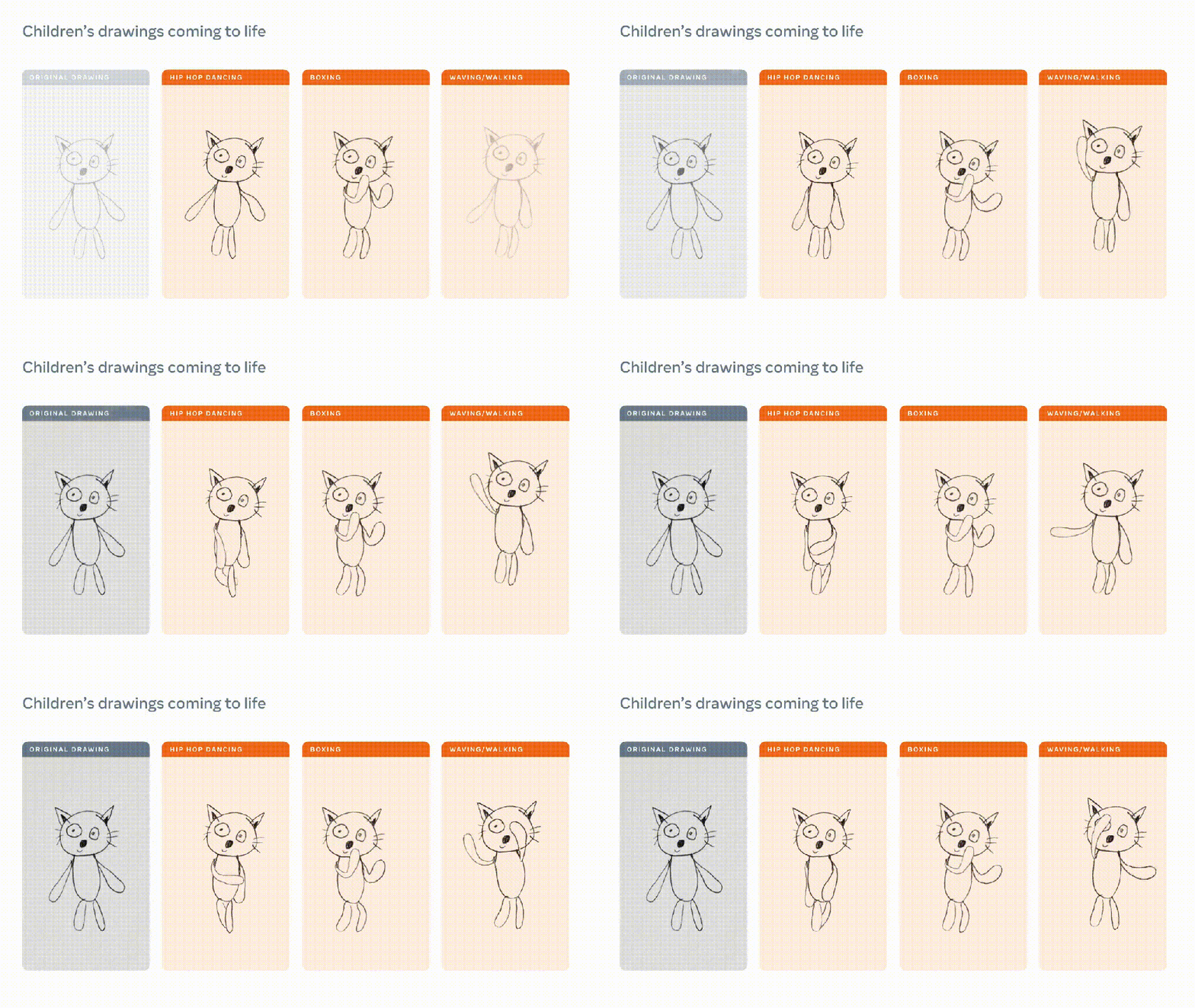
AI-generated Animated Drawing of artwork

Courtesy of Meta AI Research
A child’s drawing (left) and animations created with Animated Drawings.

.

1. Bring Student Drawings to Life: Young kids love to sketch, and AI can animate their sketches—and introduce them to the power of the technology in the process.

HIGH SCHOOL

8. Speak With AI in a Foreign Language: When learning a new language, students might feel self-conscious about making mistakes and avoid practicing as much as they should.


Though not necessarily about education, also see:

How I Use AI for Productivity — from wondertools.substack.com by Jeremy Caplan
In this Wonder Tools audio post I share a dozen of my favorite AI tools

From DSC:
I like Jeremy’s mentioning the various tools that he used in making this audio post:


Where a developing, new kind of learning ecosystem is likely headed [Christian]

From DSC:
As I’ve long stated on the Learning from the Living [Class]Room vision, we are heading toward a new AI-empowered learning platform — where humans play a critically important role in making this new learning ecosystem work.

Along these lines, I ran into this site out on X/Twitter. We’ll see how this unfolds, but it will be an interesting space to watch.

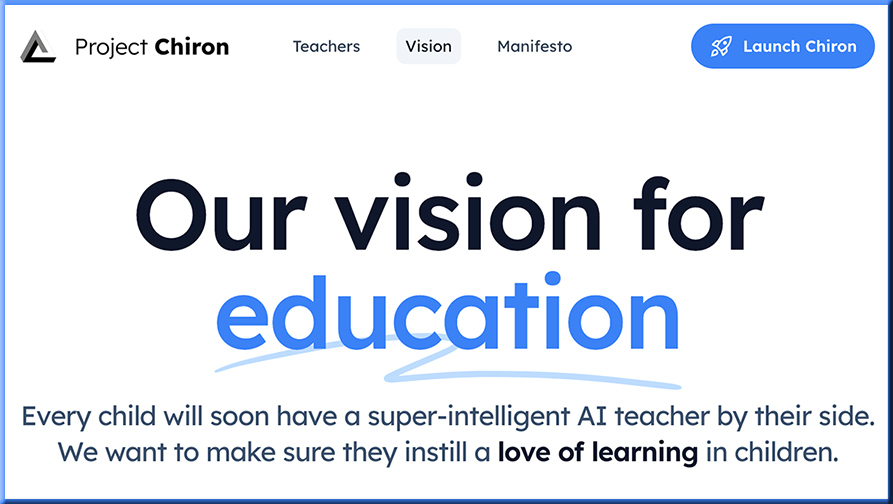
Project Chiron's vision: Our vision for education Every child will soon have a super-intelligent AI teacher by their side. We want to make sure they instill a love of learning in children.


From DSC:
This future learning platform will also focus on developing skills and competencies. Along those lines, see:

Scale for Skills-First — from the-job.beehiiv.com by Paul Fain
An ed-tech giant’s ambitious moves into digital credentialing and learner records.

A Digital Canvas for Skills
Instructure was a player in the skills and credentials space before its recent acquisition of Parchment, a digital transcript company. But that $800M move made many observers wonder if Instructure can develop digital records of skills that learners, colleges, and employers might actually use broadly.

Ultimately, he says, the CLR approach will allow students to bring these various learning types into a coherent format for employers.

Instructure seeks a leadership role in working with other organizations to establish common standards for credentials and learner records, to help create consistency. The company collaborates closely with 1EdTech. And last month it helped launch the 1EdTech TrustEd Microcredential Coalition, which aims to increase quality and trust in digital credentials.

Paul also links to 1EDTECH’s page regarding the Comprehensive Learning Record


When schools and families go to court over special education, everyone loses — from wfyi.org by Lee Gaines

While federal law mandates public schools provide an appropriate education to students with disabilities, it’s often up to parents to enforce it.

Schwarten did what few people have the resources to do: she hired a lawyer and requested a due process hearing. It’s like a court case. And it’s intended to resolve disputes between families and schools over special education services.

It’s also a traumatic and adversarial process for families and schools that can rack up hundreds of thousands of dollars in legal fees and destroy relationships between parents and district employees. And even when families win, children don’t always get the public education they deserve.


Future of Learning: Native American students have the least access to computer science — from The Hechinger Report by Javeria Salman

But computer science lessons like the ones at Dzantik’i Heeni Middle School are relatively rare. Despite calls from major employers and education leaders to expand K-12 computer science instruction in response to the workforce’s increasing reliance on digital technology, access to the subject remains low — particularly for Native American students.

Only 67 percent of Native American students attend a school that offers a computer science course, the lowest percentage of any demographic group, according to a new study from the nonprofit Code.org. A recent report from the Kapor Foundation and the American Indian Science and Engineering Society, or AISES, takes a deep look at why Native students’ access to computer and technology courses in K-12 is so low, and examines the consequences.


The Case for Andragogy in Educator Development — from Dialogic #341 by Tom Barrett

Understanding the Disconnect
We often find ourselves in professional development sessions that starkly contrast with the interactive and student-centred learning environments we create. We sit as passive recipients rather than active participants, receiving generic content that seldom addresses our unique experiences or teaching challenges.

This common scenario highlights a significant gap in professional development: the failure to apply the principles of adult learning, or andragogy, which acknowledges that educators, like their students, benefit from a learning process that is personalised, engaging, and relevant.

The irony is palpable — while we foster environments of inquiry and engagement in our classrooms, our learning experiences often lack these elements.

The disconnect prompts a vital question: If we are to cultivate a culture of lifelong learning among our students, shouldn’t we also embody this within our professional growth? It’s time for the professional development of educators to reflect the principles we hold dear in our teaching practices.


A future-facing minister, a young inventor and a shared vision: An AI tutor for every student — from news.microsoft.com by Chris Welsch

The Ministry of Education and Pativada see what has become known as the U.A.E. AI Tutor as a way to provide students with 24/7 assistance as well as help level the playing field for those families who cannot afford a private tutor. At the same time, the AI Tutor would be an aid to teachers, they say. “We see it as a tool that will support our teachers,” says Aljughaiman. “This is a supplement to classroom learning.”

If everything goes according to plan, every student in the United Arab Emirates’ school system will have a personal AI tutor – that fits in their pockets.

It’s a story that involves an element of coincidence, a forward-looking education minister and a tech team led by a chief executive officer who still lives at home with his parents.

In February 2023, the U.A.E.’s education minister, His Excellency Dr. Ahmad Belhoul Al Falasi, announced that the ministry was embracing AI technology and pursuing the idea of an AI tutor to help Emirati students succeed. And he also announced that the speech he presented had been written by ChatGPT. “We should not demonize AI,” he said at the time.


Fostering deep learning in humans and amplifying our intelligence in an AI World — from stefanbauschard.substack.com by Stefan Bauschard
A free 288-page report on advancements in AI and related technology, their effects on education, and our practical support for AI-amplified human deep learning
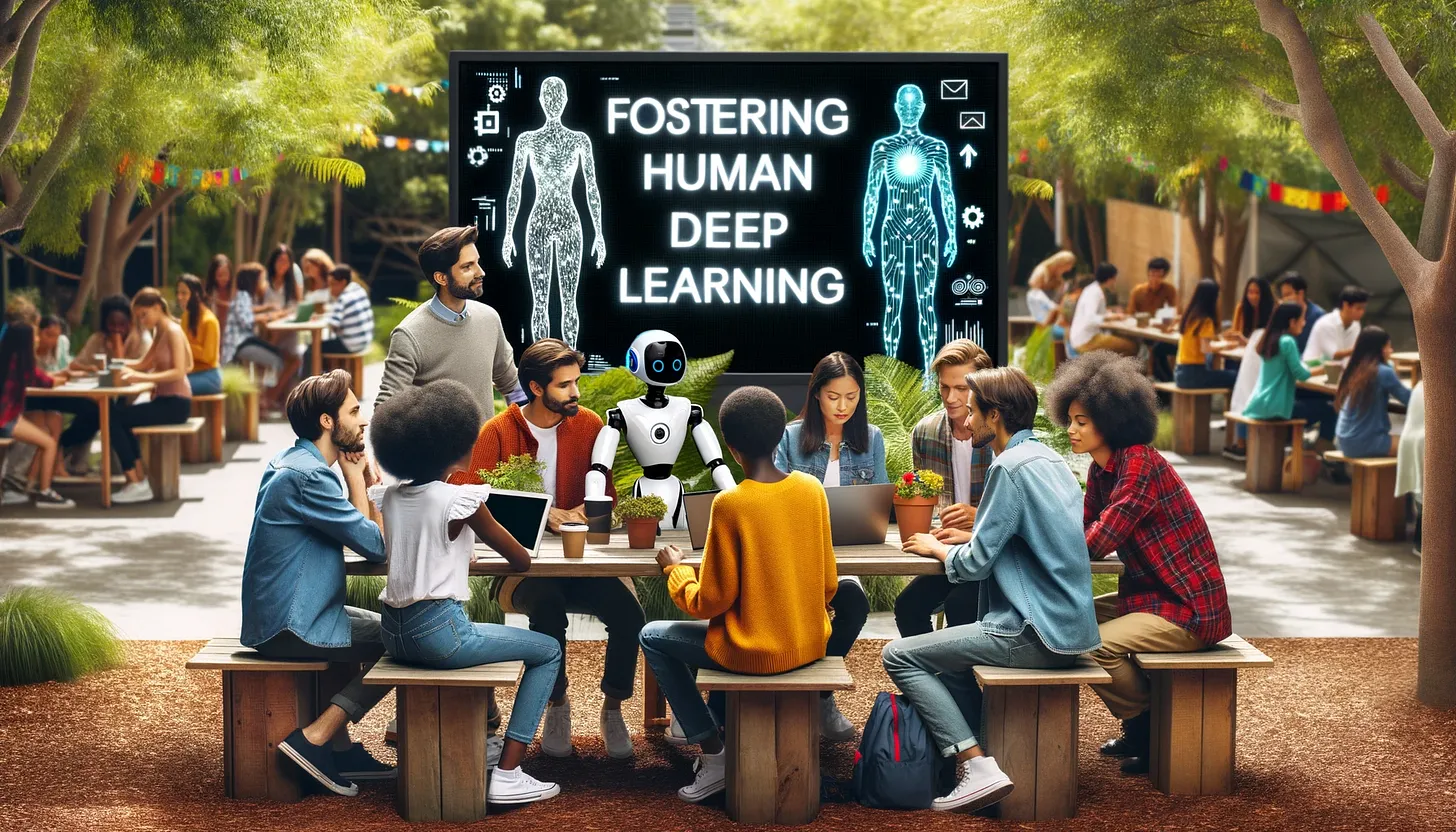
Six weeks ago, Dr. Sabba Quidwai and I accidentally stumbled upon an idea to compare the deep learning revolution in computer science to the mostly lacking deep learning efforts in education (Mehta & Fine). I started writing, and as these things often go with me, I thought there were many other things that would be useful to think through and for educators to know, and we ended up with this 288-page report.

***

Here’s an abstract from that report:

This report looks at the growing gap between the attention paid to the development of intelligence in machines and humans. While computer scientists have made great strides in developing human intelligence capacities in machines using deep learning technologies, including the abilities of machines to learn on their own, a significant part of the education system has not kept up with developing the intelligence capabilities in people that will enable them to succeed in the 21st century. Instead of fully embracing pedagogical methods that place primary emphasis on promoting collaboration, critical thinking, communication, creativity, and self-learning through experiential, interdisciplinary approaches grounded in human deep learning and combined with current technologies, a substantial portion of the educational system continues to heavily rely on traditional instructional methods and goals. These methods and goals prioritize knowledge acquisition and organization, areas in which machines already perform substantially better than people.

Also from Stefan Bauschard, see:

  • Debating in the World of AI
    Performative assessment, learning to collaborate with humans and machines, and developing special human qualities

13 Nuggets of AI Wisdom for Higher Education Leaders — from jeppestricker.substack.com by Jeppe Klitgaard Stricker
Actionable AI Guidance for Higher Education Leaders

Incentivize faculty AI innovation with AI. 

Invest in people first, then technology. 

On teaching, learning, and assessment. AI has captured the attention of all institutional stakeholders. Capitalize to reimagine pedagogy and evaluation. Rethink lectures, examinations, and assignments to align with workforce needs. Consider incorporating Problem-Based Learning, building portfolios and proof of work, and conducting oral exams. And use AI to provide individualized support and assess real-world skills.

Actively engage students.


Some thoughts from George Siemens re: AI:

Sensemaking, AI, and Learning (SAIL), a regular look at how AI is impacting learning.

Our education system has a uni-dimensional focus: learning things. Of course, we say we care about developing the whole learner, but the metrics that matter (grade, transcripts) that underpin the education system are largely focused on teaching students things that have long been Google-able but are now increasingly doable by AI. Developments in AI matters in ways that calls into question large parts of what happens in our universities. This is not a statement that people don’t need to learn core concepts and skills. My point is that the fulcrum of learning has shifted. Knowing things will continue to matter less and less going forward as AI improves its capabilities. We’ll need to start intentionally developing broader and broader attributes of learners: metacognition, wellness, affect, social engagement, etc. Education will continue to shift toward human skills and away from primary assessment of knowledge gains disconnected from skills and practice and ways of being.


AI, the Next Chapter for College Librarians — from insidehighered.com by Lauren Coffey
Librarians have lived through the disruptions of fax machines, websites and Wikipedia, and now they are bracing to do it again as artificial intelligence tools go mainstream: “Maybe it’s our time to shine.”

A few months after ChatGPT launched last fall, faculty and students at Northwestern University had many questions about the building wave of new artificial intelligence tools. So they turned to a familiar source of help: the library.

“At the time it was seen as a research and citation problem, so that led them to us,” said Michelle Guittar, head of instruction and curriculum support at Northwestern University Libraries.

In response, Guittar, along with librarian Jeanette Moss, created a landing page in April, “Using AI Tools in Your Research.” At the time, the university itself had yet to put together a comprehensive resource page.


From Dr. Nick Jackson’s recent post on LinkedIn: 

Last night the Digitech team of junior and senior teachers from Scotch College Adelaide showcased their 2023 experiments, innovation, successes and failures with technology in education. Accompanied by Student digital leaders, we saw the following:

  •  AI used for languagelearning where avatars can help with accents
  • Motioncapture suits being used in mediastudies
  • AI used in assessment and automatic grading of work
  • AR used in designtechnology
  • VR used for immersive Junior school experiences
  • A teacher’s AI toolkit that has changed teaching practice and workflow
  • AR and the EyeJack app used by students to create dynamic art work
  • VR use in careers education in Senior school
  • How ethics around AI is taught to Junior school students from Year 1
  • Experiments with MyStudyWorks

Almost an Agent: What GPTs can do — from oneusefulthing.org by Ethan Mollick

What would a real AI agent look like? A simple agent that writes academic papers would, after being given a dataset and a field of study, read about how to compose a good paper, analyze the data, conduct a literature review, generate hypotheses, test them, and then write up the results, all without intervention. You put in a request, you get a Word document that contains a draft of an academic paper.

A process kind of like this one:


What I Learned From an Experiment to Apply Generative AI to My Data Course — from edsurge.com by Wendy Castillo

As an educator, I have a duty to remain informed about the latest developments in generative AI, not only to ensure learning is happening, but to stay on top of what tools exist, what benefits and limitations they have, and most importantly, how students might be using them.

However, it’s also important to acknowledge that the quality of work produced by students now requires higher expectations and potential adjustments to grading practices. The baseline is no longer zero, it is AI. And the upper limit of what humans can achieve with these new capabilities remains an unknown frontier.


Artificial Intelligence in Higher Education: Trick or Treat? — from tytonpartners.com by Kristen Fox and Catherine Shaw
.

Two components of AI -- generative AI and predictive AI

 
© 2025 | Daniel Christian