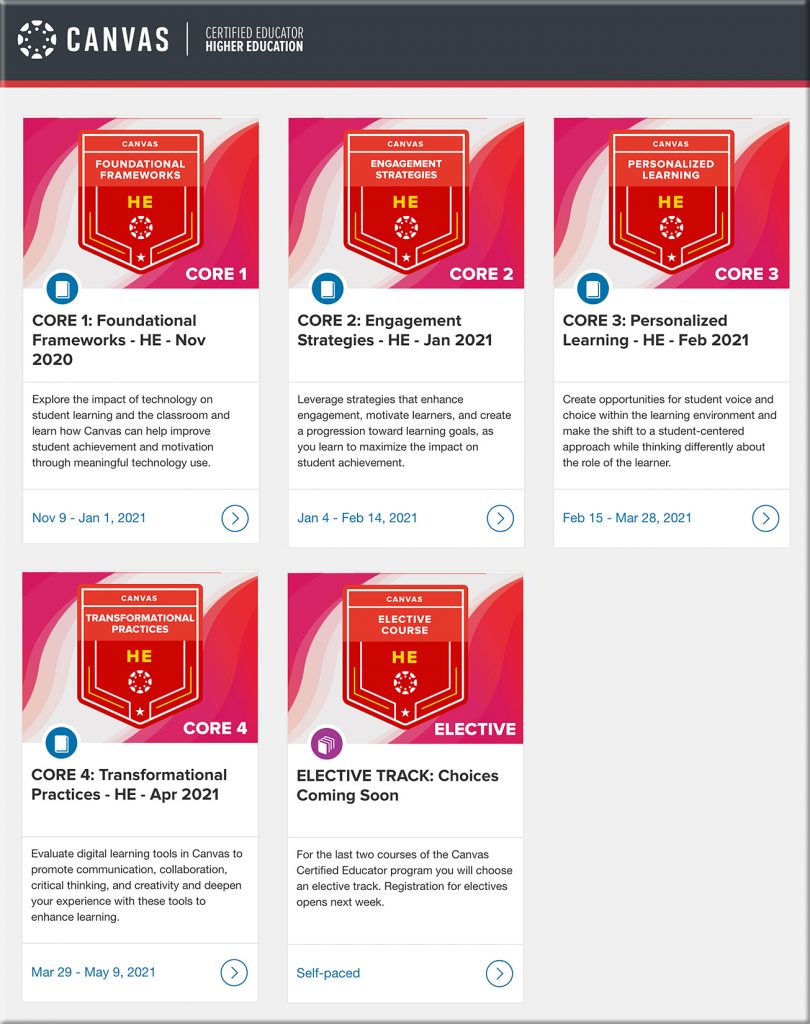
Each course is expected to take about four weeks to finish. They include:
Core 1: Foundational frameworks, which explores the impact of technology on student learning and the classroom and how Canvas can be used to help educators boost student achievement, motivation and engagement;
Core 2: Engagement strategies, to examine how Canvas can help enrich teaching practices and maximize student achievement;
Core 3: Personalized learning, to dive into personalized learning and learn how to create opportunities for student voice and choice within the learning environment;
Core 4: Transformational practices, to help participants learn how to evaluate open standard digital learning tools that can enhance learning through Canvas; and
Electives, described as a series of optional courses that can be selected by educators based on interests and needs.
California school districts are required to provide both devices and high-speed internet connection to any student learning from home, but between 300,000 and 1 million remain disconnected, EdSource reports. A backlog of computer orders and weak broadband infrastructure in remote areas are contributing factors.
At a state assembly education committee hearing Wednesday, California education leaders, teachers and lawmakers discussed how to close the digital divide. Though most households have enough broadband to handle some video calls, many family networks don’t have the strength for multiple students to be connected at once.
Nationwide, approximately one-third of households with annual incomes under $30,000 and with children under 18 don’t have high-speed internet connection at home, impacting roughly 9.7 million students, according to a Pew Research Center report. A quarter of teens within that socio-economic bracket lack access to a computer at home.
Educators have come to realize that videos are highly effective and engaging ways to create online course content. One of the most engaging forms uses a green-screen backdrop to project images or videos behind or next to the speaker. Barbara Oakley used this technique in her famous course Learning How to Learn, where she brought in images to illustrate and amplify her message during course videos. Take a look at this example and consider the fact that Oakley shot the videos in her basement using only a couple hundred dollars’ worth of supplies. Today most colleges already have green-screen studios set up for marketing or other uses.
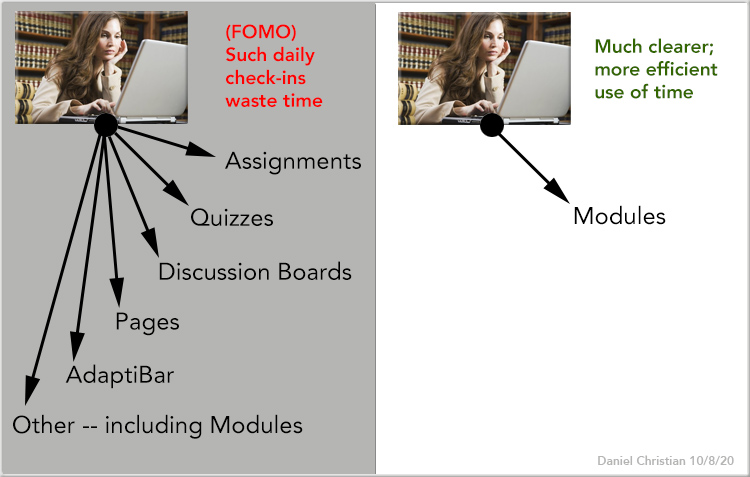
From DSC: Put yourself in the place of the conscientious/thorough learner. If you come into a course on Canvas & see Quizzes, Assignments, Discussion Boards, as well as other items listed on the Course Navigation Bar — in addition to the Modules selection — you might find yourself going to check many of those selections Every. Single. Day.
From DSC: By the way, this is whyRSS feedsandfeed aggregatorswere implemented. Have updates/content flow to the person, instead of the person wasting time trying to find what’s been updated on 100+ websites.
From Honeycutt & Robinson: Dr. Sheila Robinson shares how she uses the "4 Corners" activity in a virtual environment to break up long lectures & increase student engagement. https://t.co/MaLqEYybj0
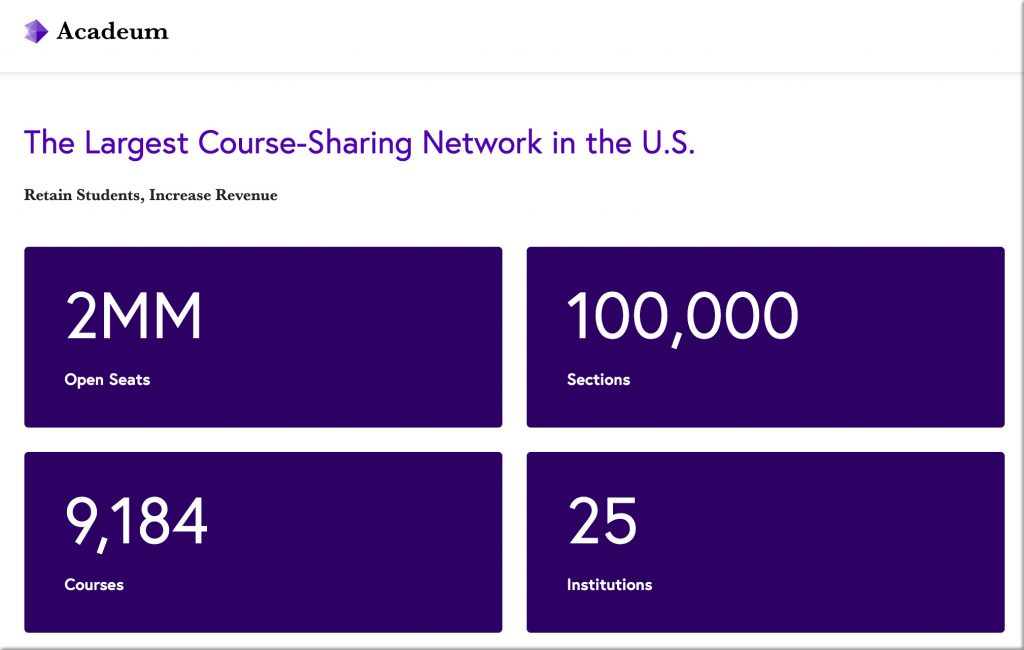
The shift online has colleges looking to share courses — from educationdive.com by Alia Wong Dozens of institutions have joined consortia for exchanging online classes since the pandemic began, and new options have sprung up.
Excerpts:
Dozens of other small, private institutions followed thanks to the Council of Independent Colleges’ (CIC’s) Online Course Sharing Consortium, which was formed in late 2018 and today is the largest of the dozen or so networks on Acadeum.
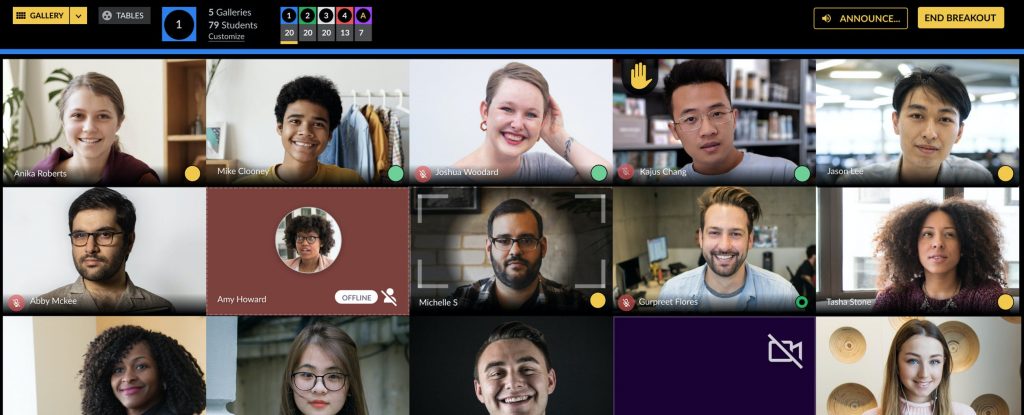
To keep students engaged, the synchronous sessions include small-group breakout sessions and on-the-spot activities like having students name compounds; balance chemical equations; predict the outcomes of experiments; and calculate masses, amounts and concentrations for the chemicals used.
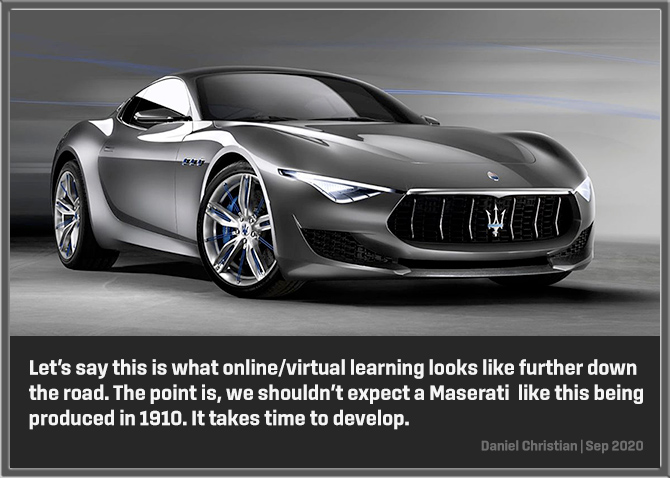
From DSC: Per Wikipedia, this is a 1910 Model T that was photographed in Salt Lake City:
From DSC: The Ford Model T didn’t start out looking likea Maserati Gran Turismo from 2021!Inventions take time to develop…to be improved…for new and further innovations and experiments to take place.
Thinking of this in terms of online-based learning, please don’t think we’ve reached the end of the road for online-based learning.
The truth is, we’ve barely begun our journey.
Two last thoughts here
1 ) It took *teams* of people to get us to the point of producing a Maserati like this. It will take *teams* of people to produce the Maserati of online-based learning.
2) In terms of online-based learning, it’s hard to say how close to the Maserati that we have come because I/we don’t know how far things will go. But this I do know: We have come a looooonnnnnggggg ways from the late 1990s!If that’s what happened in the last 20 years — with many denying the value of online-based learning — what might the next 5, 10, or 20 years look like when further interest, needs, investments, etc. are added? Then add to all of that the momentum from emerging technologies like 5G, Augmented Reality, Mixed Reality, Virtual Reality, Artificial Intelligence, bots, algorithms, and more!
From DSC:
To drive the point home, here’s an addendum on late 9/29/20:
From DSC: What if each learner/person/student could have a lifelong, cloud-based “tribute” site?
What if you could hire a career coach to sift through the tributes to find common themes?
From DSC: I recently asked friends and family to help me celebrate a significant birthday for my wife by creating a tribute for her — using a service calledTribute.co.It was a fun, meaningful, relational experience — it opened the doors to some great communications.
Here’s a video that describes what aTributeis (from the company of that same name).
So I put out potential suggestions for what I hoped that we could relay to my wife, and people contributed their videos. Then a person at Tribute edited the videos to come up with a highlight reel. They also presented to my wife all of the videos, not just the highlight reel.
That got me to wonder,“What if each learner had a cloud-based, lifelong tribute site that parents, guardians, grandparents, teachers, coaches, musical directors, pastors, friends, and others could leave encouraging and instructive messages on? Or when they note something that might be of use later on in terms of career selection, they could “jot it down.” For example:
[First-grade teacher] “I noticed Anne that when we did the art projects, you were enthralled with any sort of creative endeavor or project. We almost lost you in another world!”
[Family member] “Tony, I’ve noticed ____. Here’s something to consider for your future pathways. Would you be interested in exploring _____ — such as if we signed you up for some lessons in that area?”
[Eight grade teacher] “Eloise, I saw that your engagement level skyrocket when we studied ____, especially when you did the project on ___.”
[Basketball coach] “Chan, I appreciated your hard work in practice today. Keep up the good work and you will be a super player! You are fast, strong, and seem to have a competitive spirit about you. Consider making a workout chart and charting out the workouts that you do each day. Monitor your progress over time. As of today, here are some apps to do just that: ___.
[Pastor] “So glad Amanda that you were able to join us on our youth group visit to ___. I appreciated your end-of-the-day reflections on the experiences of the day. I also appreciated your hard work helping others.”
[Friend] “It was great horsing around on Garageband with you today Zach. I look forward to diving into iMovie next with you. Let’s create a movie for each other. You seem to have a very creative side to you.”
[High school CS Teacher] “Keep up the good work programming Jeremy! I hope that you will consider going into some type of job that uses critical thinking, mathematics, problem-solving — perhaps it will be programming, perhaps it will be engineering, or something else.”
[College professor/advisor] “You mentioned that you hate college to me the last two times we met. You don’t seem happy studying ___. Have you considered ____?”
[Tennis coach] Remember to bend those knees…get low. Keep your eyes on the seams of the ball.”
The idea behind such a service would be to offer encouragement, feedback, (if carefully put) constructive criticism, a message that “I’m on your team”…and/or…”Here’s what I see in you.”
Additional functionality/options
Contributors:
Like Twitter imposes a limit on characters, there could be options to impose a time limit on the length of a video, ability to add more than one video, and/or set a limit on how many videos someone can upload
If submitting a written piece, the option would be there to limit the number of characters and/or the word count.
From learners themselves (to their own tribute)
No time limit, no word count or character limit
Would act like a multimedia-based diary/journal of learning
Option to select whether might be worth re-listening to for career selection purposes.
As I was reflecting on the magnitude of what is happening in K-12 education, I wanted to figure out a way to help the teaching community. It dawned on me that Laurel Springs has just over 150 teachers and almost 30 years of distance learning experience as a school. So, I asked our expert teaching faculty—what are your best practices for teaching online? I was overwhelmed by the responses and goodwill from my team. I am excited to share with you a guide to help with working remotely, communicating with students and families, and the best tips and resources for lower, middle, and upper school.
I hope that you find this information useful and share it with your colleagues. Feel free to pass it on and share—we are all in this together. As a parent, teacher, and leader, I appreciate you and all of the wonderfully creative things you are doing to do what you do best: TEACHING.
Please feel free to contact me for any additional support!