Xbox, watch TV: inside Microsoft’s audacious plan to take over the living room — from by Nilay Patel
Can the Xbox One finally kickstart the TV revolution?


msft lede


Excerpt (emphasis DSC):

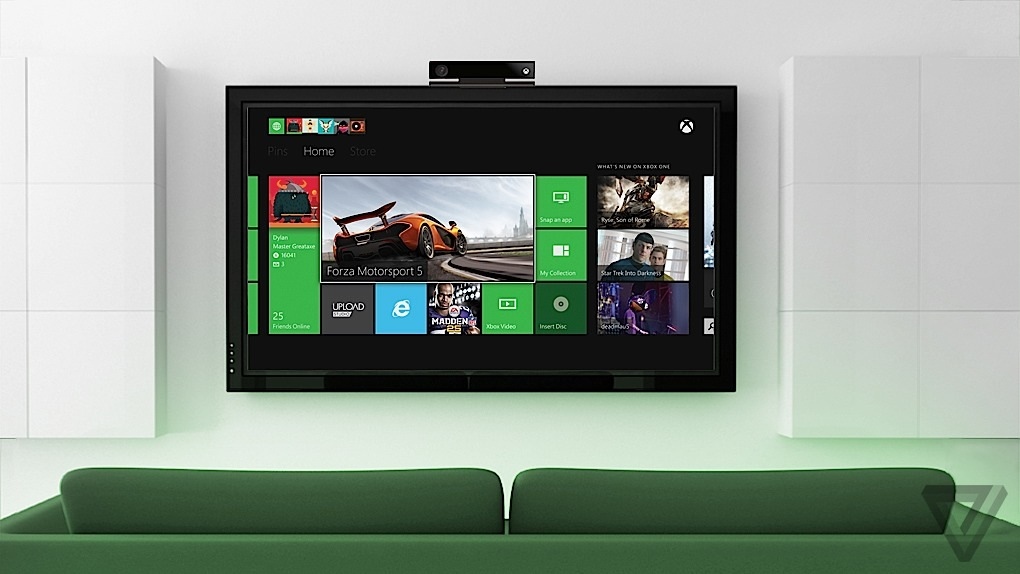
Taking over your cable box also means the Xbox can overlay your TV signal with interesting information: a voice-activated channel guide, pop-up notifications when you get a Skype call and Xbox Live invites, a new NFL app that shows you real-time fantasy stats. You can even snap the TV window to the side of the screen while you play games. Your nasty cable interface is still there, but it allows the Xbox One to replace the cable box as the primary living-room entertainment device and go from gaming console to major new computing platform.

So the entire Xbox One is designed around what you might call a bold compromise: instead of directly integrating TV, the system hijacks it. Rather than plugging your cable box and Xbox into the TV separately, you first plug the cable box into the Xbox, and then the Xbox into the TV. Your cable box is still there, and still doing all the heavy lifting of providing TV, but now it’s doing it in service of the overall Xbox One experience. Smith describes it as “augmenting” the cable box experience in an effort to eliminate the friction of switching between games, apps, and TV.


From DSC:
The battle for the living room continues.  I hope that we can eventually leverage these developments not just for entertainment, but for creating, contributing, sharing, absorbing, and discussing streams of content. The creative possibilities involving transmedia-based storytelling are exciting in this type of environment as well.


5 ways to reduce cognitive load in eLearning — from elearningindustry.com by by  Matthew Guyan

Excerpt:

  1. Present some information via the visual channel and some via the verbal channel
  2. Break content into smaller segments and allow the learner to control the pace
  3. Remove non-essential content
  4. Words should be placed close as possible to the corresponding graphics
  5. Don’t narrate on-screen text word-for-word


From DSC:
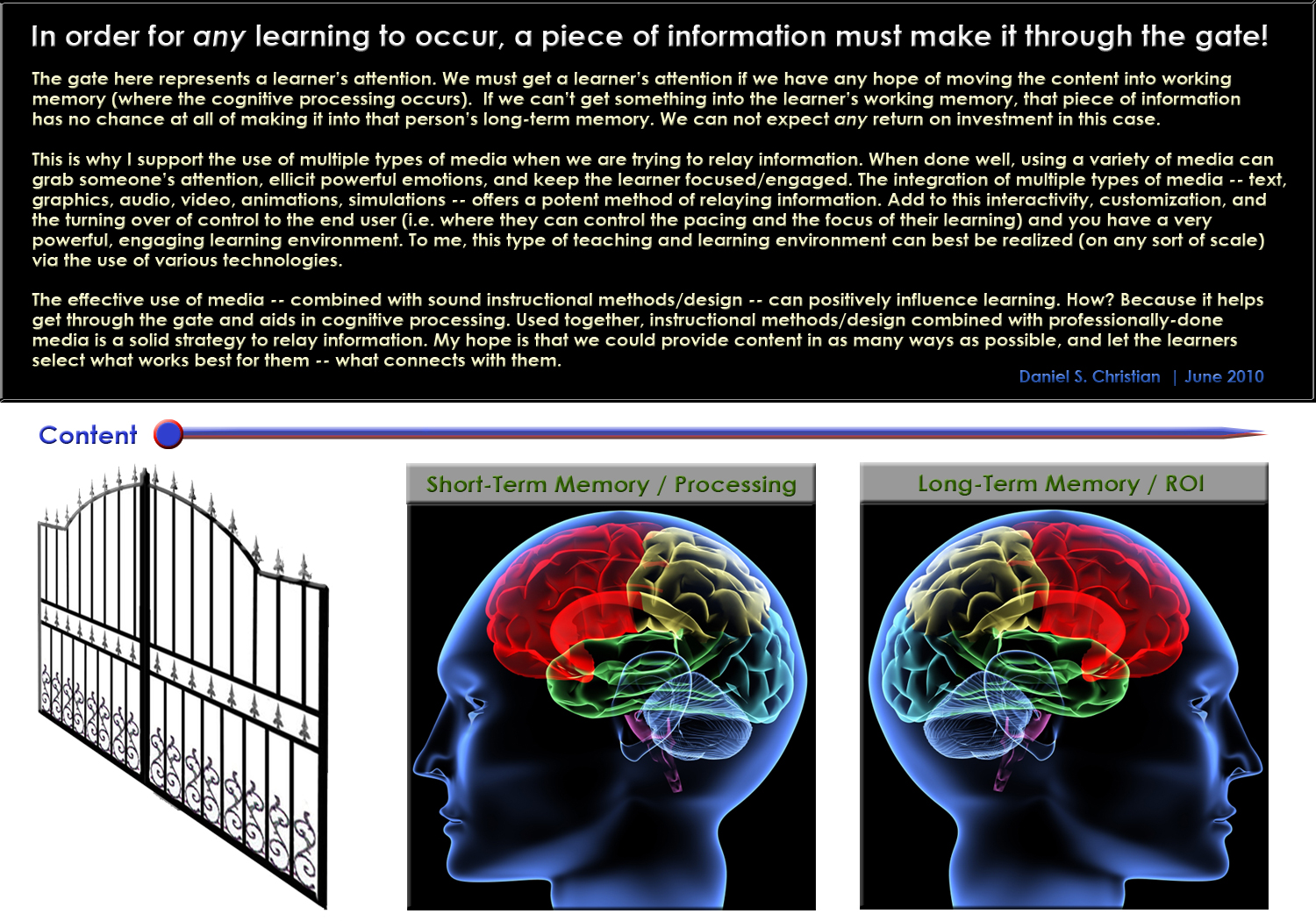
Thanks Matt for a well-written, concise, beneficial posting here.  I especially appreciated the quick review of the Cognitive Load Theory (CLT) as well as the 5 suggestions to reduce cognitive load (with the goal being to move content into peoples’ long term memories).


GottaMakeItThoughTheGate


Faculty Coalition: Forget About Cost Savings with Online Programs — from CampusTechnology.com by Dian Schaffhauser

Excerpts:

Cost savings promised by the expansion of online education are tough to pinpoint, including those programs that promise to be free for students.

According to the Campaign, there are no guarantees that online courses save students money.

The Campaign declared the idea that MOOCs could lower the cost of college degrees a “pipe dream.”

But even as public institutions introduce their own online programs, they frequently charge students more for those courses, the report said.


From DSC:
(Dian, these thoughts are not aimed at you. Keep up the excellent work out there!)

The only way that online education costs as much as a face-to-face offering is if such a course/offering is ***highly*** sophisticated — that is, that it incorporates a ***significant*** amount of programing, educational gaming, deep analytics and sophisticated reporting, home-grown animations and/or simulations, etc.

Otherwise, there is no way in the world that an online course costs as much to produce and offer as a face-to-face course.  Consider two key things:

  1. Ask any Director of Physical Plant to lay out their annual budget and expenses ***just to keep their campus(es) up and running*** — let alone enhance them further — and you’ll quickly see what I mean!
  2. In many cases, the infrastructures already exist to serve the face-to-face students (i.e. systems like the CMS’s/LMS’s, Student Information Systems, etc.). So offering online courses only serves to increase the ROI for this infrastructure. (If one couldn’t use the existing systems, then I could see where there would be additional expenses; with that said, the bottom lines are still not the same.)

Many colleges and universities are using the increased demand for online courses to keep the prices up; they are not passing along the savings to the students. (BTW, for those who claim higher education isn’t a business, how do you explain this?  The argument that higher education isn’t a business holds no water at all; such viewpoints can no longer be taken seriously.)

By keeping the costs of online courses as high or higher than F2F courses, such colleges and universities are making a big mistake.  By doing so, they are only causing the existing bubble in higher education to expand even further.  It will pop.  In fact, with the increased use of incentives and lowering the tuition that’s actually being paid by the students (vs. the “list” price), one can’t help but wonder if the bubble hasn’t already popped at many colleges and universities.

We need to start passing along more of the savings to our students.  I can’t think of a good reason why everyuniversity and college in the U.S. should not offer a spectrum/variety of pricing structures.  If you want to take a face-to-face course, you will need to pay more for that course, as there are greater expenses involved in providing that type of learning environment.

Last thoughts:

  • While I think that MOOCs are half-baked, they continue to improve.
  • If MOOCs morph into something that uses technologies like IBM’s Watson, that will be a game-changer for sure.  We will still need SME’s, but the prices that can be offered will be drastically less.  See this recent posting for further thoughts on this perspective.


CenterForDigitalEducation-2013Yearbook


Description:

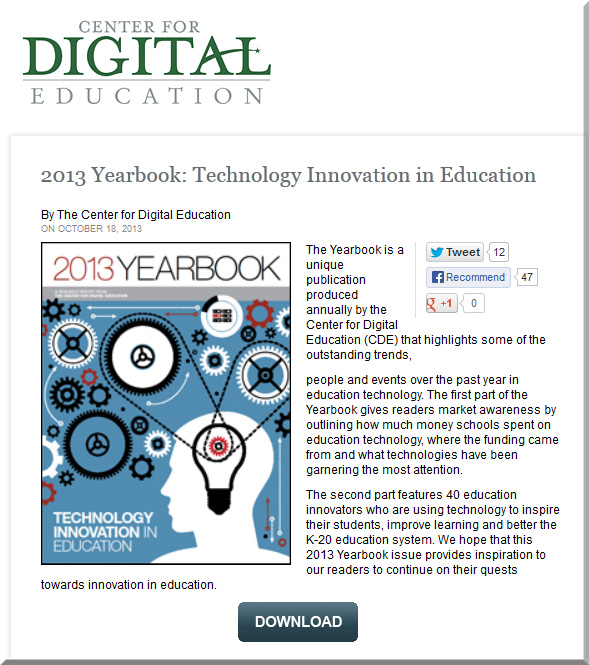
The Yearbook is a unique publication produced annually by the Center for Digital Education (CDE) that highlights some of the outstanding trends,

people and events over the past year in education technology. The first part of the Yearbook gives readers market awareness by outlining how much money schools spent on education technology, where the funding came from and what technologies have been garnering the most attention.

The second part features 40 education innovators who are using technology to inspire their students, improve learning and better the K-20 education system. We hope that this 2013 Yearbook issue provides inspiration to our readers to continue on their quests towards innovation in education.


From DSC:
My quote in the Center for Digital Education’s 2013 Yearbook reads:


“Educational technologists need to be bold, visionary and creative. They need to be in tune with the needs, missions and visions of their organizations. We have the opportunity — and responsibility — to make lasting and significant contributions within our fields and for the organizations that we work for.”


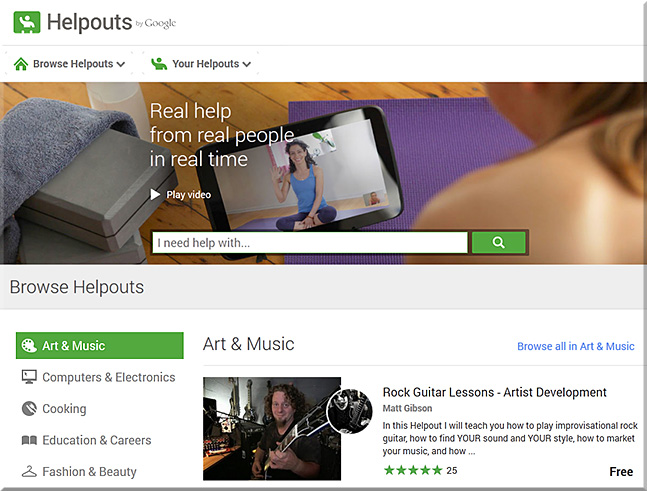
Items re: Helpouts by Google, which was just introduced on Monday, November 4th, 2013:


HelpoutsByGoogle-IntroducedNov-4-2013


From DSC:
This type of thing goes hand and hand with what I’m saying in the Learning from the Living Room vision/concept:  “More choice. More control.”   This type of thing may impact K-12, higher ed, and corporate training/L&D departments.

It this how we are going to make a living in the future?  If so, what changes do we need to make:

  • To the curricula out there?
  • To the “cores” out there?
  • In helping people build their digital/online-based footprints?
  • In helping people market themselves?


A new pedagogy is emerging..and online learning is a key contributing factor — from Contact North ; with thanks to Stephen Downes (@oldaily) for putting this on The MOOC Newsletter

Excerpt (emphasis DSC):

What is clear is that major changes in the way we teach post-secondary students are being triggered by online learning and the new technologies that increase flexibility in, and access to, post-secondary education.

What drives the development of this new pedagogy? Changes in society, student expectations, and technology are motivating innovative university and college professors and instructors to re-think pedagogy and teaching methods.

As professors and instructors become more familiar with digital technologies for teaching and learning, pedagogical challenges and strategies are emerging. The developments listed below have had an impact on how teaching is structured and how and where learning happens.


Streaming International: How the Internet has made TV a global medium — from sparksheet.com by Maura McWalters

Excerpt:

Television used to be one of America’s biggest exports. But the internet is bringing content from Asia, India and the Middle East into U.S. homes – and new advertising opportunities along with it, reports TV columnist Maura McWalters.


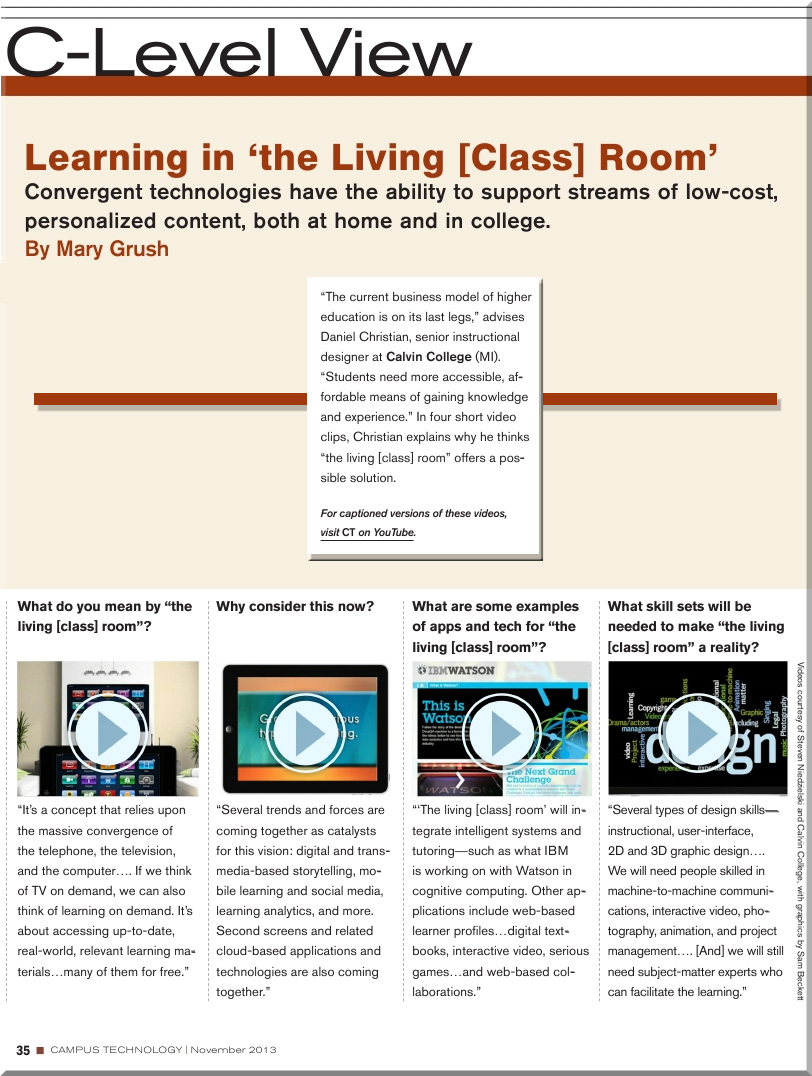
“Learning in the Living [Class] Room” — as explained by Daniel Christian [Campus Technology]

Learning from the Living [Class] Room  — from Campus Technology by Daniel Christian and Mary Grush; with a huge thanks also going out to Mr. Steven Niedzielski (@Marketing4pt0) and to Mr. Sam Beckett (@SamJohnBeck) for their assistance and some of the graphics used in making these videos.

From DSC:
These 4 short videos explain what I’m trying to relay with a vision I’m entitling, Learning from the Living [Class] Room.  I’ve been pulse checking a variety of areas for years now, and the pieces of this vision continue to come into fruition.  This is what I see Massive Open Online Courses (MOOCs) morphing into (though there may be other directions/offshoots that they go in as well).

After watching these videos, I think you will see why I think we must move to a teambased approach.

(It looks like the production folks for Campus Technology had to scale things way back in terms of video quality to insure an overall better performance for the digitally-based magazine.) 


To watch these videos in a higher resolution, please use these links:


  1. What do you mean by “the living [class] room”?
  2. Why consider this now?
  3. What are some examples of apps and tech for “the living [class] room”?
  4. What skill sets will be needed to make “the living [class] room” a reality?


Alternatively, these videos can be found at:


DanielSChristianLearningFromTheLivingClassRoom-CampusTechnologyNovember2013

.


Innovation imperative: Change everything  — from nytimes.com by Clayton Christensen and Michael Horn; with a special thanks to Mr. Joel Adams at Calvin College for the resource here

Online education as an agent of transformation

Excerpt (emphasis DSC):

Like steam, online education is a disruptive innovation — one that introduces more convenient and affordable products or services that over time transform sectors. Yet many bricks-and-mortar colleges are making the same mistake as the once-dominant tall ships: they offer online courses but are not changing the existing model. They are not saving students time and money, the essential steps to disruption. And though their approach makes sense in the short term, it leaves them vulnerable as students gravitate toward less expensive colleges.

Still, the theory predicts that, be it steam or online education, existing consumers will ultimately adopt the disruption, and a host of struggling colleges and universities — the bottom 25 percent of every tier, we predict — will disappear or merge in the next 10 to 15 years.  Already traditional universities are showing the strains of a broken business model, reflecting demand and pricing pressures previously unheard-of in higher education.


To serve them, it will enlist operators to create mini-campuses around the globe where clusters of its students will live and socialize together in residence halls, as well as take online courses and work together on projects.


Citrix-Mobile-Education-10-31-13


Citrix-Mobile-Education-TOC-10-31-13


Description:

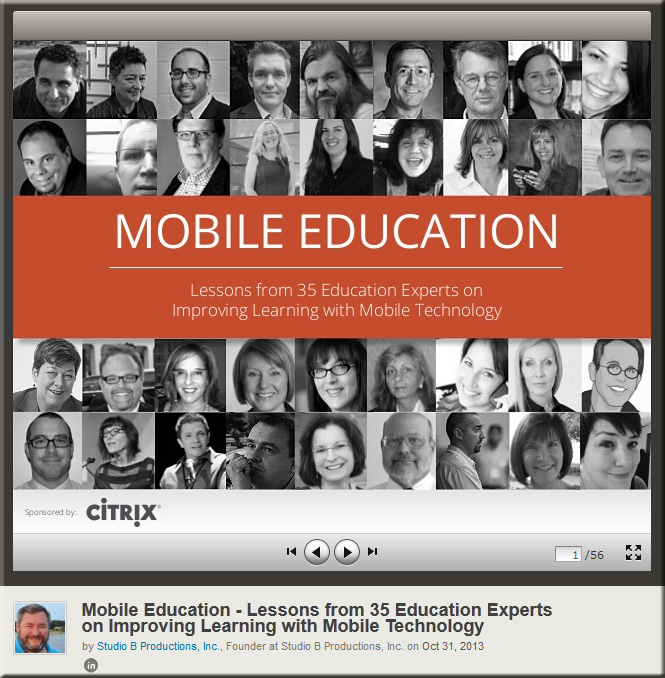
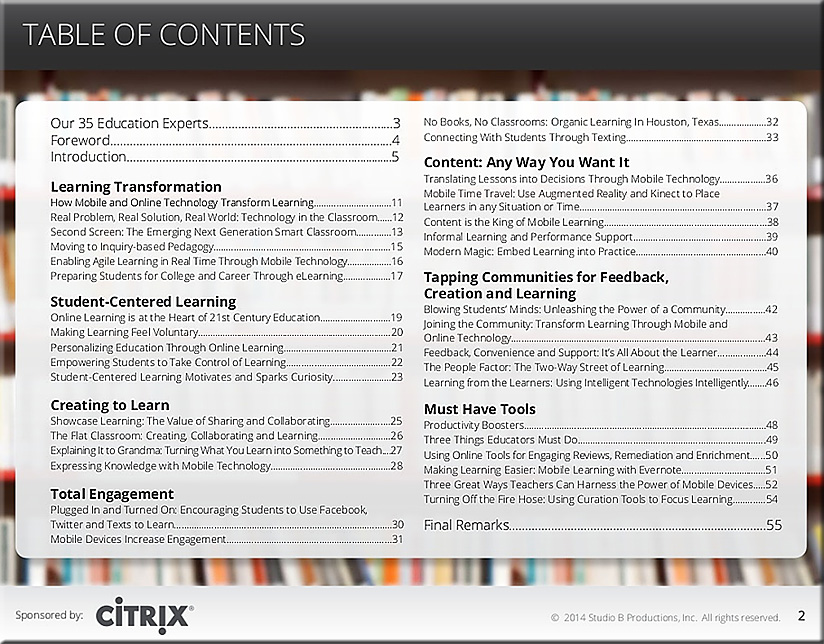
Education is at a tipping point. From the rising cost of a college education and the financial pressures upon local districts and state agencies to fund K-12 schools and programs, to the questions of how to employ mobile technologies and leverage social platforms to support the growing trend toward mobile, collaborative learning models, educators face an almost overwhelming set of challenges. While there are no easy answers to these and other issues, Citrix believes strongly that online learning technologies can help enhance and extend the teaching and learning process and provide greater, more wide-spread access to education to students. We are committed to developing and delivering learning solutions that will meet the evolving needs of teachers and students in this changing landscape. We hope that our sponsorship of this ebook and other projects will help you, the reader, gain a better understanding of the opportunities that online learning technologies provide, increase your mastery of these solutions, and enable you to put them to productive use. We look forward to working with you as we explore new and effective ways to help teachers teach and learners learn.

CaIlin Pitcher
Product Line Director, Collaboration, Citrix


Comments/disclosure from DSC:
I do not work for Citrix — I have been at Calvin College since
March 2007.  I was not paid to develop/contribute this piece.

I’d like to thank David Rogelberg for his work on this project.


Readmill makes each and every book its own self-contained social network, allowing readers to discuss, share and review from inside of the e-book.


Readmill: Redefining the Ebook

Excerpt:

The books of the modern-day have progressed far beyond just containing stories, they are now social networks in their own right – generating vast reams of data offering insight into not only what we read, but how, when and where we are reading it. At the forefront of this movement is Readmill, an app staking its future on being the great reading app.

Readmill makes each and every book its own self-contained social network, allowing readers to discuss, share and review from inside of the e-book. If you find a passage you like, you can highlight it and comment on it right from within the book. Other users reading the book and even the author can see these comments and add their own thoughts, starting a discussion within the book, without ever having to leave it.

Readmill has positioned itself as a company which detaches itself from ‘the selling of the book” to focus on the “social experience.”


Connected! Readmill redefines ebooks as social networks — from futureofthebook.blogspot.com


From DSC:
Two things come to mind when I read this:

1)  What if we applied the same concept towards electronically-delivered streams of content? What if, instead of an e-book, we presented a particular topic of discussion or a particular lesson to kick things off and then have Communities of Practice take over from there?  (This could fit nicely into the “Learning from the Living Class [Room] vision, enabled by the Smart/Connected TV.)

2)  What if we could have “layers” on a digital “textbook”?


DanielSChristian-TextbookConcept-May2011-Layers


Some items re: Steam and OUYA — with a thanks going out to Mr. Steven Chevalia for the information here

For the past 20 years, the video game industry has been controlled by three primary companies:

  1. Nintendo (Nintendo, Gamecube, Wii)
  2. Sony (Playstation)
  3. Microsoft (Xbox)

However, the past two years have shown an increased interest in hardware solutions from 3rd parties, such as:

  • OUYA is a 3rd party console that was designed to be a gaming system with a lower cost and was meant for all open-source games.
    (Further details at wikipedia.org)
     
  • Steam is a 3rd party that sells and updates all their games digitally. They offer all the same games as most of the consoles (listed above) and will soon be offering their own console, which will connect to the internet and allow you to play any game that you own on their service.
    (Further details at wikipedia.org)


STEAM-Expanding2014


These smaller, lesser known devices are prime targets for educational and kid-friendly material. (NOTE: Not all of the games available via these sites are appropriate for kids, as many of the games therein are meant for older audiences.) It is likely that iTunes U, YouTube, etc. will all be viewable on these consoles and the games made for them will be able to be made by smaller companies that can’t compete on the market with Nintendo, Playstation, or Xbox-based games.


U.S. teams up with operator of 0nline courses to plan a global network — from nytimes.com by Tamar Lewin

Excerpt (emphasis DSC):

Coursera, a California-based venture that has enrolled five million students in its free online courses, announced on Thursday a partnership with the United States government to create “learning hubs” around the world where students can go to get Internet access to free courses supplemented by weekly in-person class discussions with local teachers or facilitators.

The learning hubs represent a new stage in the evolution of “massive open online courses,” or MOOCs, and address two issues: the lack of reliable Internet access in some countries, and the growing conviction that students do better if they can discuss course materials, and meet at least occasionally with a teacher or facilitator.

“Our mission is education for everyone, and we’ve seen that when we can bring a community of learners together with a facilitator or teacher who can engage the students, it enhances the learning experience and increases the completion rate,” said Lila Ibrahim, the president of Coursera. “It will vary with the location and the organization we’re working with, but we want to bring in some teacher or facilitator who can be the glue for the class.”


From DSC:
Some thoughts here:

1)  When institutions of higher education cling to the status quo and disregard the disturbing trajectories at play*…when we don’t respond, people — and governments it seems — will find other options/alternatives.

* Such as middle class incomes that continue to decline
while the price of higher education continues to escalate

2)  I wonder if this type of setup might predominate in some countries.
i.e. blended learning types of setups in learning centers around the world where people can come in at any time to learn with a relevant Community of Practice, aided by faculty, teachers, trainers, coaches, etc.   Some of the content is “beamed in” and shared electronically, while some of the learning involves face-to-face discussions/work. Will schools become more community centers where we will pool resources and offer them to people 24×7?

Also see:

  • The New Innovator’s Dilemma — from huffingtonpost.com by Michael Moe and Ben Wallerstein; with thanks to Lisa Duty for the Tweet on this
    Excerpt (emphasis DSC):
    Increasingly, we’re worried that a generation of entrepreneurs is facing a “new innovators dilemma” — where innovation is stymied by regulatory and political environments focused on outdated needs and the wrong set of “customers.” The truth is, Silicon Valley investors and techies will get by just fine without addressing our big, societal problems. But if we encourage our nation’s top entrepreneurs to join search engines and social networks, we will miss the opportunity to apply their genius to solving society’s most pressing problems.

    This isn’t about the classic political divide of right versus left. This is about policies and regulations written in a different era that are not easily translated to modern technology. It’s no secret that the challenge stems, in part, from the motivations of regulators and the politics of protecting the status quo.

    Change is difficult. And no one is arguing that the transportation, hospitality, and higher education industries don’t need to be regulated. New approaches, in particular, warrant close scrutiny. But if we are ever going to experience the sort of revolutionary change that technology might afford to virtually every sector of the American economy, we need to be willing to rethink the traditional ways of regulation to make innovation easier and more responsive to the consumers and students these regulations were originally enacted to protect.


Addendum 11/1/13:


23 iPad alternatives to the book report — from ipadders.eu by Suzanne Lustenhouwer; with thanks to Jackie Gerstein for the tweet this.

Excerpt:

  1. If a journey was involved, draw a map with explanatory notes of significant places. (Google Earth, Notability, Showme)
  2. Dramatize a scene from the book. Write a script and have several rehearsals before performing it to the class or recording it. Include stage directions in your script. (Screenplay, iMoviePuppet Pals)
  3. Lead a small group discussion with other readers of the same book. Focus on a specific topic and report your group’s conclusion to the class. (Notability)


© 2025 | Daniel Christian