COVID-19 Intensifies Need to Tackle Digital Accessibility — from campustechnology.com by By Glenda Sims
More learning content than ever before has migrated online, bringing accessibility concerns to the forefront. Here’s how higher ed institutions are making progress toward equitable access.

Excerpt:

Accessibility lawsuits in education are not new. However, with colleges and universities undertaking their own digital transformations (moving more content and services online), lawsuits targeted at equitable access to physical facilities (like bathrooms) have logically expanded to digital offerings for students relying on assistive technologies to access them. The current COVID-19 crisis is likely to exacerbate this, as more learning content than ever before has migrated online in these unprecedented times. Persons with disabilities will demand nothing less than completely equitable access, particularly when it comes to their safety. While many higher ed institutions still have much to do for their accessibility initiatives, there have been many promising developments…
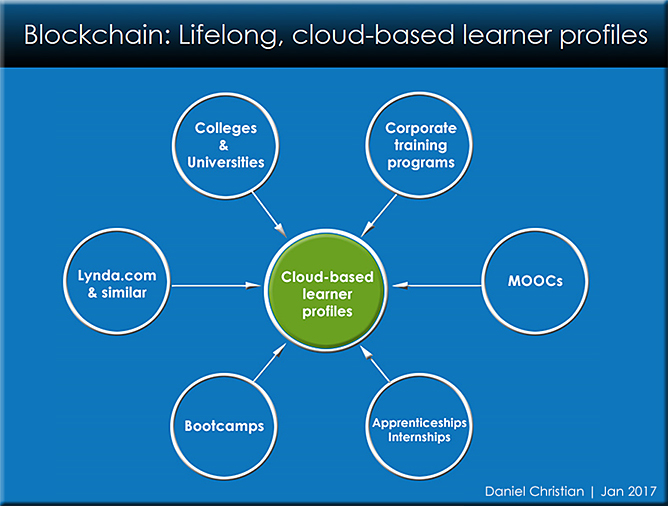


Blockchain Can Disrupt Higher Education Today, Global Labor Market Tomorrow — from cointelegraph.com by Andrew Singer
Blockchain can play its part in the education sector — record-keeping in 2–3 years and then adoption by the labor market?

Excerpt (emphasis DSC):

In the post-pandemic world, individuals will need to seize ownership and control of their educational credentials — documents like degrees and transcripts — from schools, universities and governments. That notion received key support last week from the American Council on Education in a study funded by the United States Department of Education focusing on the use of blockchain in higher education.

“Blockchain, in particular, holds promise to create more efficient, durable connections between education and work,” wrote Ted Mitchell, the president of ACE, in the foreword to the study published on June 8, adding: “In the wake of the COVID-19 crisis, learners will be more mobile, moving in and out of formal education as their job, health, and family situations change.”

A key theme of the report is personal data agency — i.e., how “distributed ledger technologies [DLT] can ‘democratize’ data and empower individuals with agency over their personal information.”


Blockchain has been described as a hammer in search of a nail. If so, academic credentialing appears to be as obvious a nail as one can find. The current international trade in fake academic degrees, after all, is “staggering,” as the BBC reported, and with a global labor market increasingly mobile, the world could badly use a decentralized, borderless, tamper-free ledger of verifiable credentials — both for education and the broader labor market.


Per Kim O’Leary, here are some resources re: the topic of giving/receiving feedback:


Other items re: feedback worth checking out:

How ‘Learning Engineering’ Hopes to Speed Up Education — from edsurge.com by Jeff Young

Excerpt (emphasis DSC):

One insight Lepper brought is that when education software tools simply list all the errors students made and points out what they should have done instead, what many end up hearing is, “You’re wrong, you’re wrong, you’re wrong.” For students, this is a discouraging engagement, Lepper says.

“That kind of feedback would be perfect if you had a robot learner on the other end,” he says. “The robot learner would be delighted to have you say, ‘Okay, you made three errors in problem number one,’ and being a robot learner, they’d be able to take out those bugs and do better the next time. Real kids, especially real kids who are kind of phobic about math and who think they can’t do it, they leave and say, ‘See I can’t do it.’”

Don’t water down feedback to your student — from teachingprofessor.com by John Orlando

RetrievalPractice.org/feedback

From OLC session “Carl Rogers, Teaching Presence, and Student Engagement in Online Learning” Cheng-Chia (Brian) Chen, Denise Bockmier-Sommers, & Karen Swan (emphasis DSC)

  • Use student’s first name in feedback
  • Speak directly to them
  • Paraphrase their words
  • Provide video feedback
  • Sandwich method — Include the strengths of student’s reasoning or responses in addition to your constructive critique(s)
  • Acknowledge student contributions
  • Let them know you care and appreciate them
  • What’s timely feedback? The quicker the better, but whatever your availability is, tell what students can expect, and stick to that. Put that into your syllabus along with communication methods (email, LMS message, phone, other)

Leveraging Feedback Experiences in Online Learning — from er.educause.edu by Erin Crisp

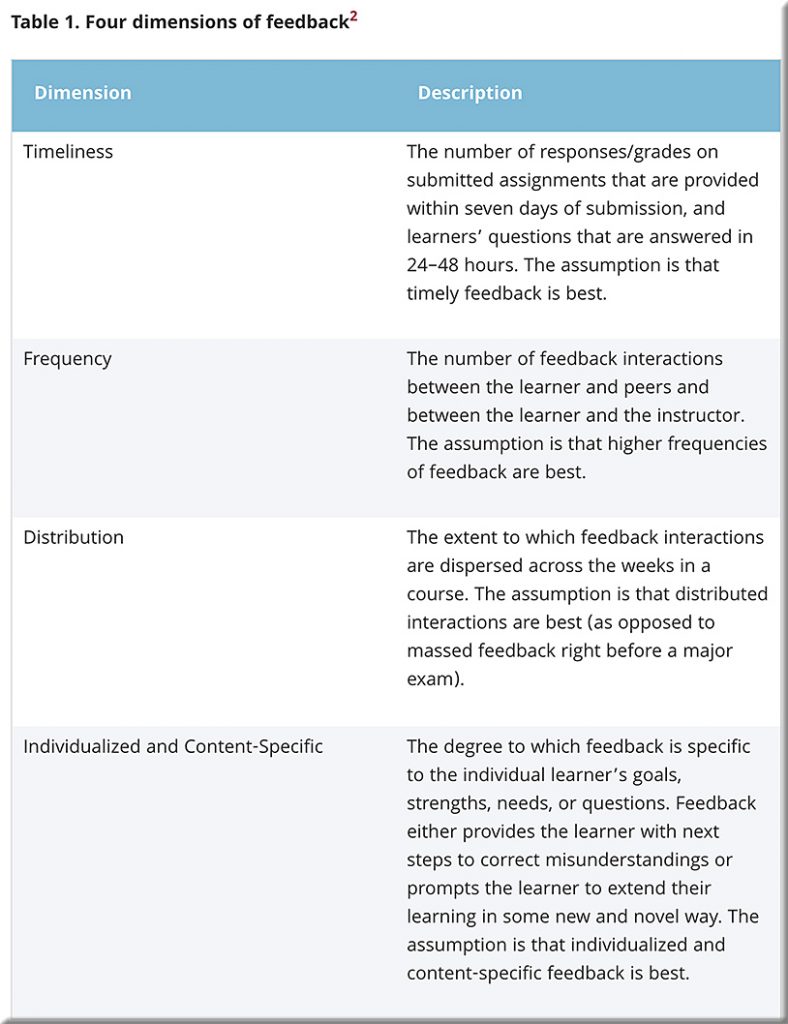
4 dimensions of feedback

Here are some design tips to increase the probability for success.

  • Structure the course so that there are opportunities for instructors and peers to provide formative feedback several weeks before final projects/papers are due.
  • Identify key time frames in the course when instructors will be heavily engaged in providing written or video feedback that is individualized and moves the learning forward.
  • Create a bank of content-specific feedback comments that instructors can use for common issues and errors.
  • If end-of-course survey evaluations are low, implement strategies to provide feedback that directly connects to learners as individuals.
  • If you teach and grade papers in a professional discipline, provide feedback related to the course and program learning outcomes, and focus less on grammar and language usage.
 

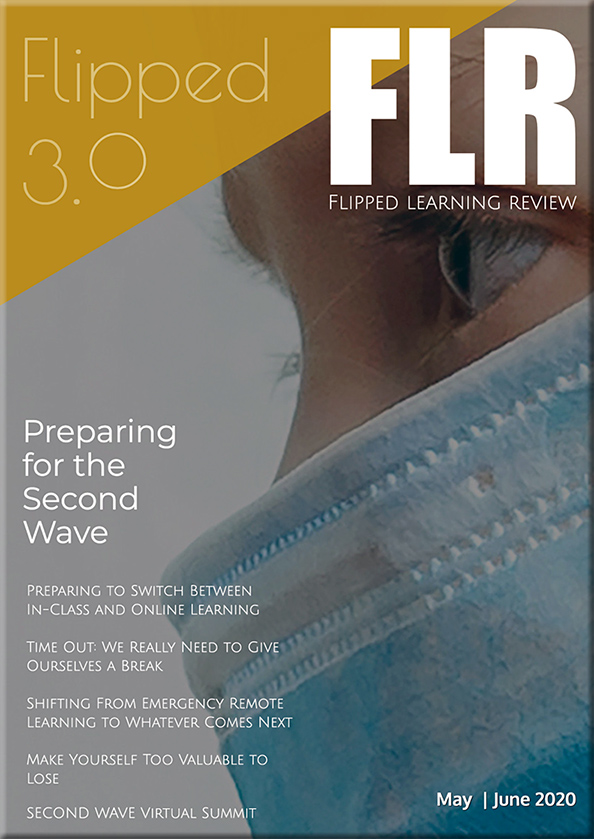
Flipped Learning Review -- May/June 2020


Flipped Learning Review — May | June 2020

Except from one of the articles entitled, “Preparing to switch between in-class and online learning — from flr.flglobal.org by Thomas Mennella

“I claim that Flipped Learning is the perfect bridge between face-to-face, on-ground instruction, and an online format. It excels in both worlds and makes transitioning between the two seamless. I am not over-reaching. I am not extrapolating. And I claim to be no expert. I simply showed you the data.”


Remote collaboration and virtual conferences, the future of work — from forces.com by Charlie Fink

Excerpts:

Ten weeks ago, Jesse Damiani, writing on Forbes.com, told the story of a college professor who turned his course about XR into a research project about remote collaboration and virtual conferences.
…
He and his students reimagined the course as an eight-week research sprint exploring how XR tools will contribute to the future of remote work—and the final product will be a book, tentatively titled, Remote Collaboration & Virtual Conferences: The End of Distance and the Future of Work.”

This is a chapter of that book. It will be available on June 15.

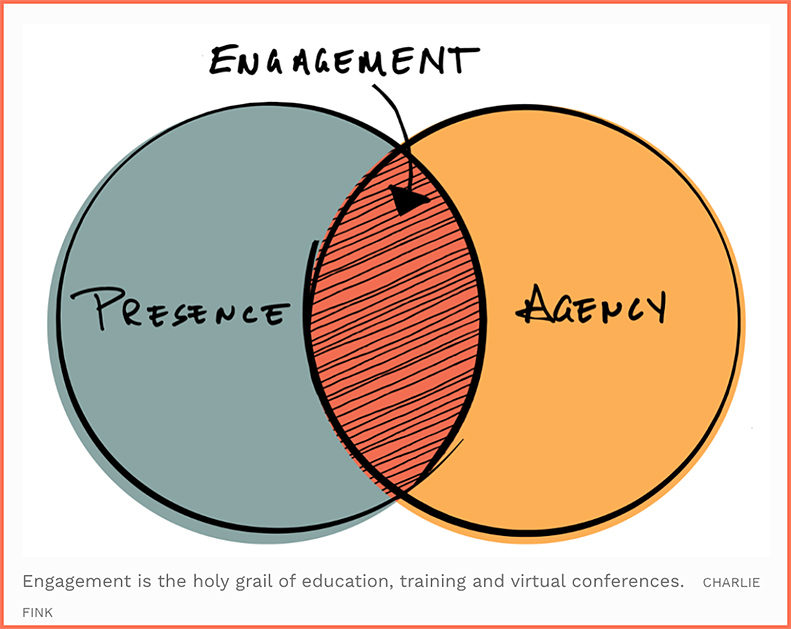
The thing everyone wants is not a technology, it’s engagement. The same kind of engagement that you would have in real life, but better, faster, cheaper *and safer* than it was before.

Also see:


The Post-Pandemic Outlook for Edtech — from edsurge.com by Rebecca Koenig

Excerpts:

For the edtech industry, the pandemic poses a paradox. Never before have schools and colleges so urgently needed digital tools and services to facilitate remote learning—and been less able to afford them.
…
Consumer edtech, then, may be where the market is hottest moving forward. And experts say a new key audience has emerged in the sector: parents. Many have been thrust—begrudgingly—into the role of homeschool teacher, and they’re looking for ways to keep kids on track academically that don’t require them to spend hours brushing up on fractions.

“The new audience for edtech companies, whether they sell directly to consumers or not, is the parent. That’s a major and permanent change,” he explains. “Whether it’s needed all the time or not, it needs to be built in.” 

— Frank Catalano

Online Tutoring Services
It’s been a hot few years for companies that connect students with tutors who teach online. Between 2016 and 2019, online tutoring services raised more than $1.2 billion in venture capital.


XR for Learning – June 3, 2020 — from twist.learningguild.net

Excerpt:

Augmented, Virtual, and other mixed reality technologies are rapidly emerging and advancing, creating new and exciting opportunities for training and education. XR for Learning collects some of the best XR content that learning professionals can learn from.

Here’s this week’s recommended content.


From DSC:
After reading the following item from Jeremy Caplan’s most recent e-newsletter entitled, “Tiny Stuff I Love“…

Alfred = Saves me time on copying and pasting
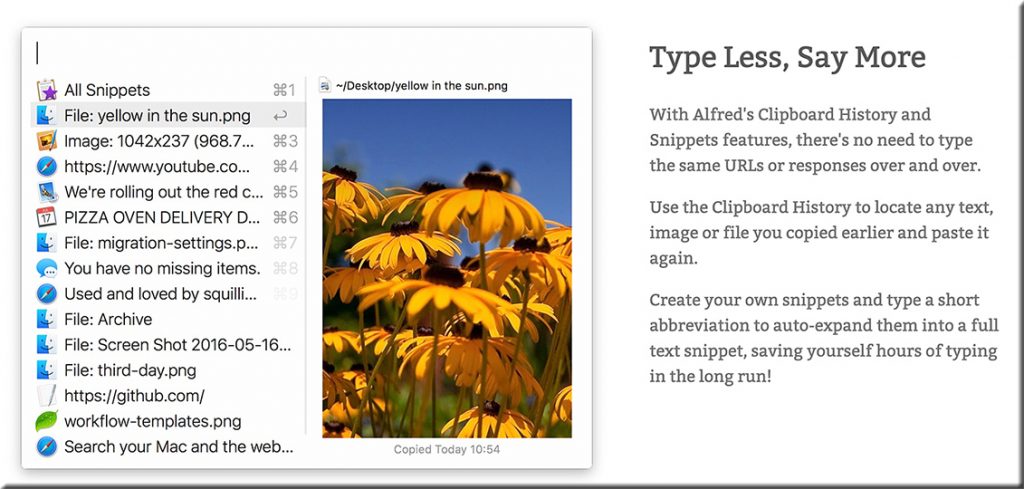
If you copy and paste stuff frequently, get a clipboard manager. I use Alfred throughout every workday. It keeps the last 100+ things I’ve copied in a neat list so I can paste anything I’ve used recently into a browser, document, or wherever else.

This is super-handy when I’m copying and pasting things repeatedly from one place to another. Sometimes I’m moving a bunch of stuff from a document into an email. Or putting several links or notes into a Zoom chat window.

Lots of tools do something similar. I also like the Copied App, $8 on the Mac App store. It has a companion iPhone app.


…I instantly thought of how useful this type of tool would be for teachers, professors, and perhaps trainers as well — especially when grading!

From this page (emphasis DSC):

What Does a Clipboard Manager Do?
The default clipboard in Windows works well, but it’s quite basic. The biggest limitation is that it can only hold one item at a time. If you copy a piece of text, forget to use it, then copy an image later, the text will be gone. Another hassle is that you can’t view what you’ve copied without pasting it.

For anyone who copies and pastes all the time, these are big problems. Thankfully, this is where clipboard managers come in. They greatly expand the functionality of your clipboard by remembering dozens of entries, allowing you to pin frequently used snippets for easy access, and much more.


Afred 4 for the Mac

Alfred is a clipboard manager for the Mac


Readers of this blog might also be interested in some of the other tools that Jeremy mentions, including:

  • Toby = Save and share my browser tabs

Toby -- save and load sets of browser tabs


Coursera Makes Certificate Programs Free to College Students During Pandemic — from campustechnology.com by Rhea Kelly

Excerpt:

Online learning provider Coursera has opened up its certificate programs to current undergraduate, graduate or recently graduated college and university students. Students with a verified school e-mail address can sign up for free access to more than 3,800 courses, 150 guided projects, 400 specializations and 11 professional certificates on the platform. They must enroll before July 31, and have until Sept. 30, 2020 to complete the programs.


From DSC:
I saw the piece below from Graham Brown-Martin’s solid, thought-provoking posting entitled, “University as a Service (UaaS)” out at medium.com. My question is: “What happens if Professor Scott Galloway is right?!”

Excerpt:

Prof Scott Galloway predicts lucrative future partnerships between the FAANG mega-corporations and major higher education brands emerging as a result of current disruptions. Galloway wonders what a partnership between MIT and Apple would look like?


The education conveyor belt of the last century that went school to university to work and a job for life just doesn’t work in an era of rapid transformation. Suppose we truly embrace the notion of continuous or lifelong learning and apply that to the university model. It wouldn’t just stop in your twenties would it?

University as a Service (UaaS), where higher education course and degree modules are unbundled and accessed via a monthly subscription, could be a landing spot for the future of higher education and lifelong learners. 


Below are some other items
regarding the future of higher education.


Also relevant/see:

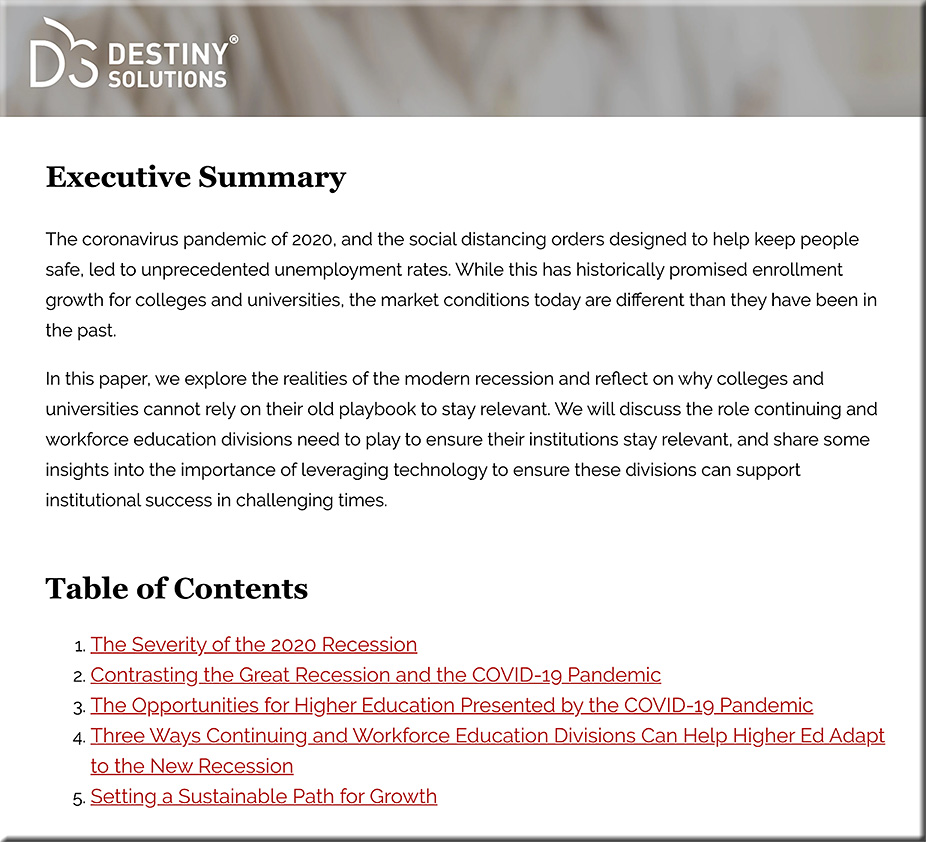
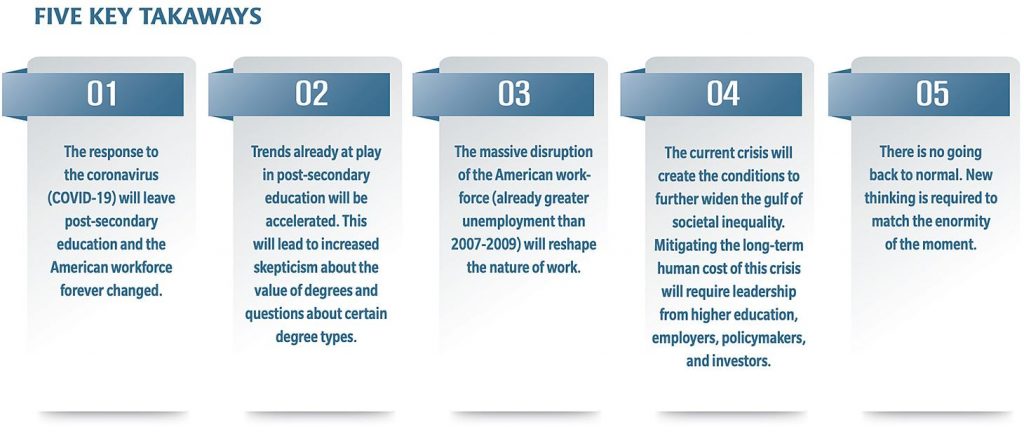
https://info.destinysolutions.com/lp-updating-the-higher-education-playbook-to-stay-relevant-in-2020

Also relevant/see:


Also relevant/see:


Also relevant/see:

  • Fast Forward: Looking to the Future Workforce and Online Learning — from evolllution.com by Joann Kozyrev (VP Design and Development, Western Governors University) and Amrit Ahluwalia
    Excerpt:
    With employers and students looking to close the gap in workforce skills, it’s critical for them to know what skills are in need the most. Postsecondary institutions need to be the resource to provide learners with the education the workforce needs and to make both parties understand the value of the students’ education. With the remote and online shift, it’s a new territory for institutions handle. In this interview, Joann Kozyrev discusses the impact remote learning has on an online institution, concerns about the future of online learning and how to get people back into the workforce fast and efficiently. 


Tech conferences are going virtual, and it feels like Netflix content on demand — from .marketwatch.com by Jon Swartz

Excerpt:

Such is the new world of tech conferences in the age of COVID-19. They’ve gone all-digital, like Build and GTC Digital, and may never be the same. Absent a vaccine, the days of thousands of people herded into hotel ballrooms and convention centers like cattle, sharing cabs and eating in cramped quarters, are gone.

Far from crippling the tech industry, however, virtual shows could lead to democratization of what had once been an exclusive, pricey privilege for tech movers and shakers. In the new climate, consumers have free access to valuable technical content whenever they wish to view it.

“Last year, I paid several thousand dollars to attend, and if I was late for a session, I couldn’t rewind it. This year, I could.”


From DSC:
I, for one, am glad that we made the investments in the telecommunications and networking infrastructures, in the PCs, Macs, laptops, tablets, other items in the #edtech realm, as well as investing in a variety of technologies through the years. Given the need to move online due to the Coronavirus, I’d say such investments offered many a solid ROI throughout K-12, higher education, as well as in the corporate world. But I realize that not everyone has access to these things…which is something we must work on as a nation.

But had we not made those investments, where we would be now?

Also see:

Teaching during COVID-19: Why We’re Fortunate — from er.educause.edu by Gardner Campbell


Not in the Future—Now — from er.educause.edu by John O’Brien

Excerpts:

…technology can no longer be seen as a utility working quietly in the background. Now more than ever, technology is a strategic asset that is vital to the success of every higher education institution.
…
Digital transformation (Dx) can no longer be considered an aspirational concept. It must be understood as an imperative. And that well-worn, precious notion of campus technology professionals doing work that is noticed only when there is an outage? This too is a thing of the past.

…
[Technology] is not just a lifeline that got us through a tricky situation. It is and must increasingly be understood as an integral, strategic part of the successful college or university. Not in the future. Now.


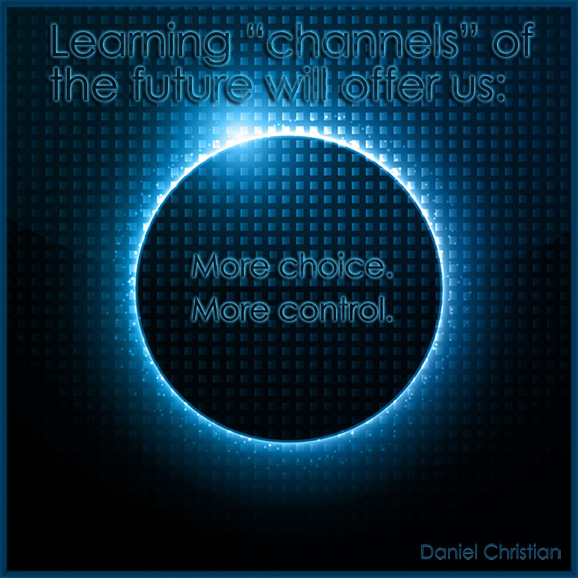
Learning channels of the future will offer us more choice. More control. [Christian]


From DSC:
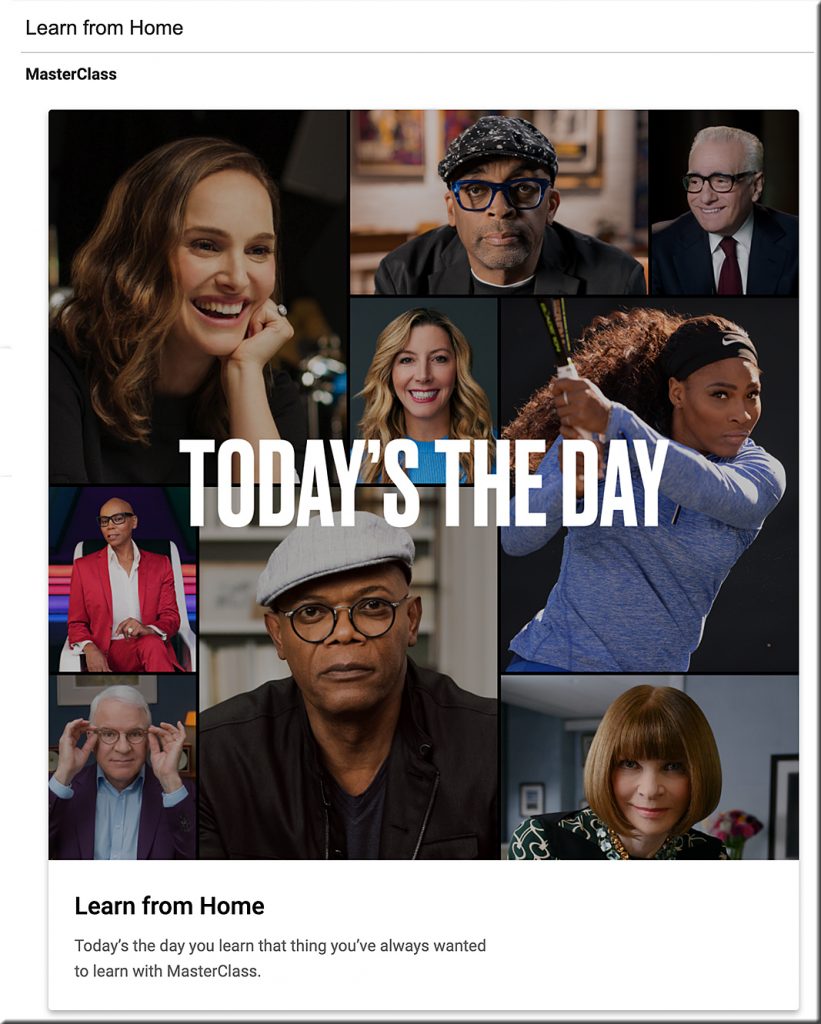
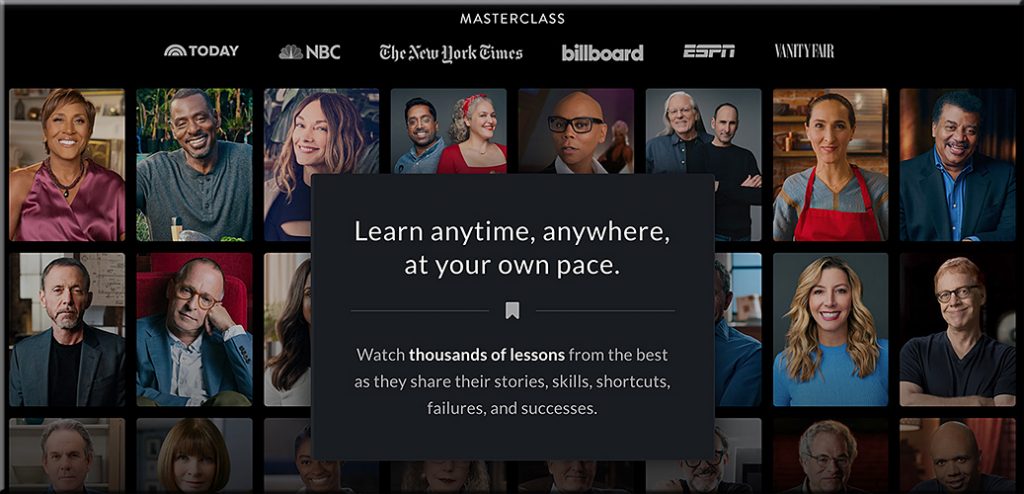
And this phenomenon of learning from the living [class] room will likely pick up steam; some learning-related services are already heading that way.


Learning from home -- masterclass dot com

Learning from home -- masterclass dot com


Also see:

Preparing Students for a Lifelong Disruptive Future: The 60-Year Curriculum — from evolllution.com by Chris Dede | Professor of Learning Technologies in the Graduate School of Education, Harvard University and John Richards | Professor in the Graduate School of Education, Harvard University

Although written before the pandemic, a just-published book, The 60-Year Curriculum: New Models for Lifelong Learning in the Digital Economy (Dede and Richards, 2020), describes the looming challenge/opportunity of a coming, epic half-century whose intensity of disruption will rival the historic period civilization faced from 1910-1960: two world wars, a global pandemic, a long-lasting economic depression and unceasing conflicts between capitalism and communism.
…
In our tactical responses to moving teaching online because of the pandemic, we have the strategic opportunity to develop a new model that blends higher and continuing education and realizes the potential of next-generation methods of instruction and assessment (National Academy of Sciences, Engineering and Medicine, 2018) to focus on lifelong learning.


Six Practical Approaches for Teaching Writing Online — from facultyfocus.com by Christian Aguiar and Albert Pearsall; with a shoutout to Bill Knapp from GRCC for posting this on Twitter

Six practical approaches for teaching writing online -- from faculty focus dot com

 
© 2025 | Daniel Christian