Introducing the 2025 State of the L&D Industry Report — from community.elearningacademy.io

What’s changing is not the foundation—it’s the ecosystem. Teams are looking to create more flexible, scalable, and diverse learning experiences that meet people where they are.

What Did We Explore?
Everyone seems to have a take on what’s happening in L&D these days. From bold claims about six-figure roles to debates over whether portfolios or degrees matter more, everyone seems to have a take. So, we wanted to get to the heart of it by exploring five of the biggest, most debated areas shaping our work today:

  • Salaries: Are compensation trends really keeping pace with the value we deliver?
  • Hiring: What skills are managers actually looking for—and are those ATS horror stories true?
  • Portfolios: Are portfolios helping candidates stand out, and what are hiring managers actually looking for?
  • Tools & Modalities: What types of training are teams building, and what tools are they using to build it?
  • Artificial Intelligence: Who’s using it, how, and what concerns still exist?

These five areas are shaping the future of instructional design—not just for job seekers, but for team leaders, hiring managers, and the entire ecosystem of L&D professionals.

The takeaway? A portfolio is more than a collection of projects—it’s a storytelling tool. The ones that stand out highlight process, decision-making, and results—not just pretty screens.


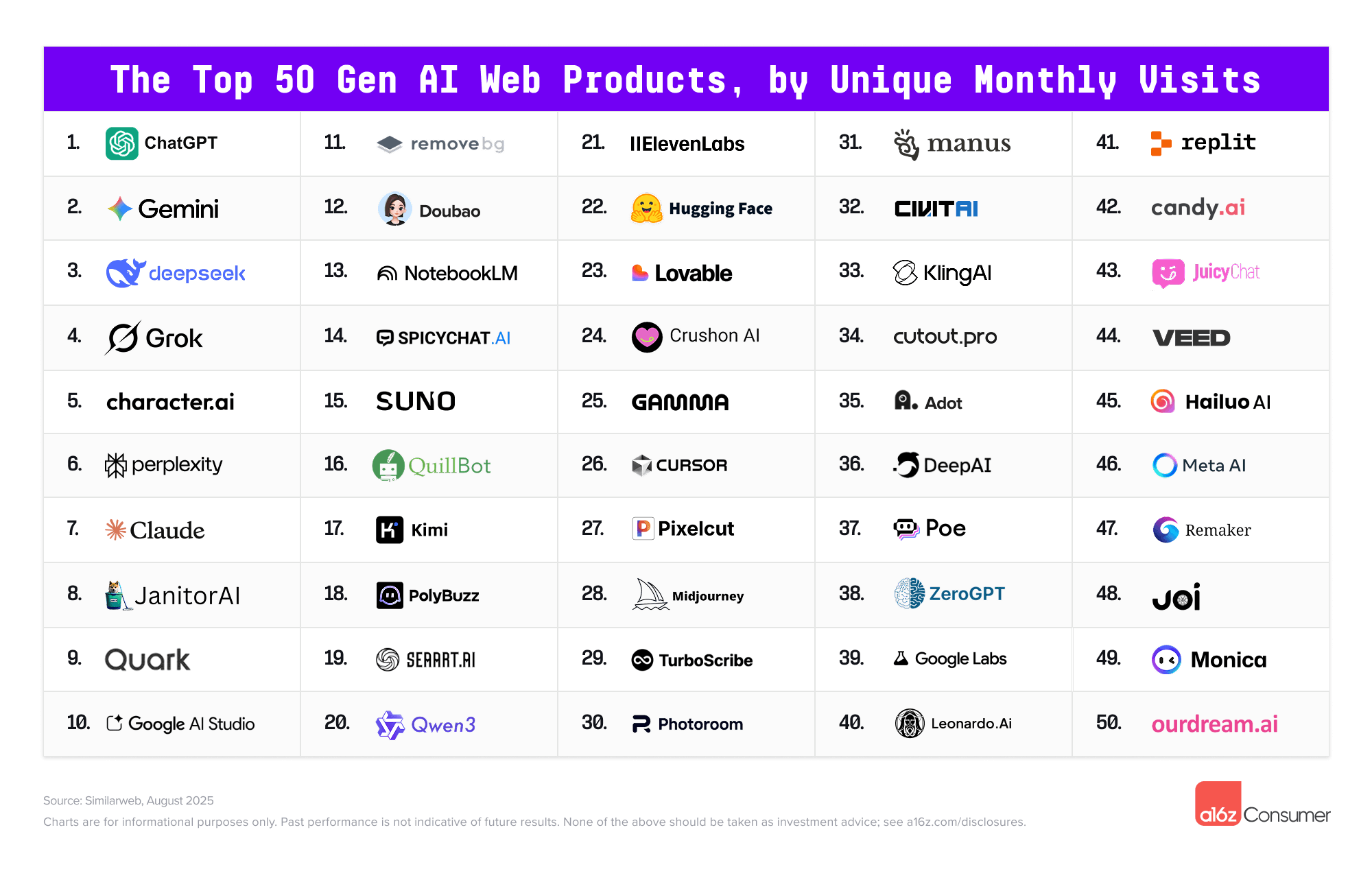
The Top 100 [Gen AI] Consumer Apps 5th edition — from a16z.com

And in an interesting move by Microsoft and Samsung:

A smarter way to talk to your TV: Microsoft Copilot launches on Samsung TVs and monitors — from microsoft.com
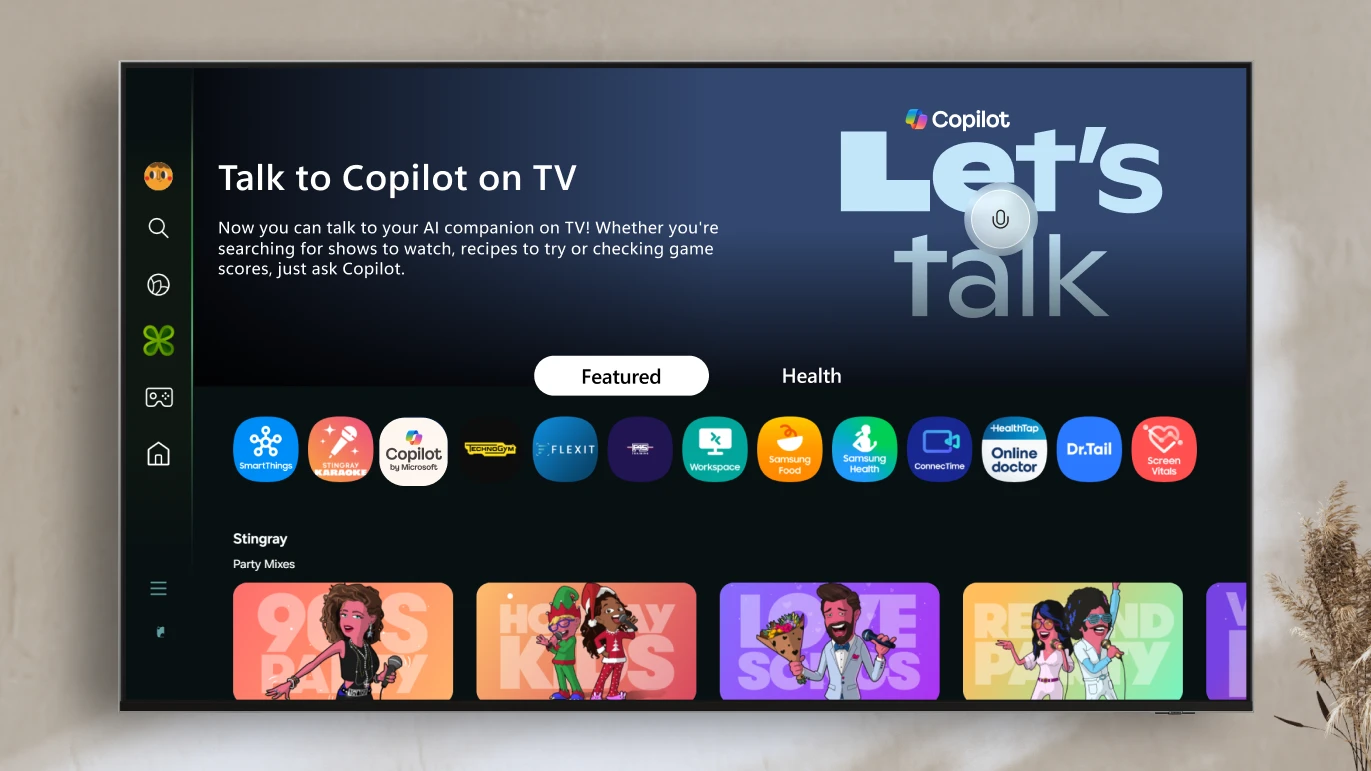
Voice-powered AI meets a visual companion for entertainment, everyday help, and everything in between. 

Redmond, Wash., August 27—Today, we’re announcing the launch of Copilot on select Samsung TVs and monitors, transforming the biggest screen in your home into your most personal and helpful companion—and it’s free to use.

Copilot makes your TV easier and more fun to use with its voice-powered interface, friendly on-screen character, and simple visual cards. Now you can quickly find what you’re looking for and discover new favorites right from your living room.

Because it lives on the biggest screen in the home, Copilot is a social experience—something you can use together with family and friends to spark conversations, help groups decide what to watch, and turn the TV into a shared space for curiosity and connection.


There Is Now Clearer Evidence AI Is Wrecking Young Americans’ Job Prospects — from wsj.com by Justin Lahart; this article is behind a paywall
Young workers face rising AI competition in fields like software development, but some also benefit from AI as a helper, new research shows

Young workers are getting hit in fields where generative-AI tools such as ChatGPT can most easily automate tasks done by humans, such as software development, according to a paper released Tuesday by three Stanford University economists. They crunched anonymized data on millions of employees at tens of thousands of firms, including detailed information on workers’ ages and jobs, making this one of clearest indicators yet of AI’s disruptive impact.

Young workers in jobs where AI could act as a helper, rather than a replacement, actually saw employment growth, economists found.


How to build trust in digital credentials? We offer some insights — from eddesignlab.org

Three key insights emerge:

Trust requires simplicity. Users need clear visual indicators (like the lock icon for secure websites) that their credentials meet technical standards without understanding the complexity behind them.

Standards matter for real people. Technical compliance with open standards directly impacts whether someone can access their own achievements and share them where needed.

Human experience drives adoption. Even the most sophisticated technical infrastructure fails if people can’t easily understand and use it.

Our insights and recommendations provide a roadmap for building credential systems that serve real human needs while meeting rigorous technical requirements.


ILTACON 2025: The Wild, Wild West of legal tech — from abajournal.com by Nicole Black

On the surface, ILTACON 2025, the International Legal Technology Association’s largest annual legal technology event, had all the makings of a great conference. But despite the thought-provoking sessions and keynotes, networking opportunities and PR fanfare, I couldn’t shake the sense that we were in the midst of a seismic shift in legal tech, surrounded by the restless energy of a boomtown.

The gold rush
It wasn’t ILTACON that bothered me; it was the heady, gold-rushed, “anything goes and whatever sticks works” environment that was unsettling. While this year’s conference was pirate-themed, it felt more like the Wild West to me.

This attitude permeated the conference, driven largely by the frenzied, frontier-style artificial intelligence revolution. The AI train is hurtling forward at lightning speed, destination unknown, and everyone is trying to cash in before it derails.

Two themes emerged from my discussions. First, no matter who you spoke to, “agentic AI,” meaning AI that autonomously takes purposeful actions, was a buzzword that cropped up often, whether during press briefings or over drinks. Another key trend was the race to become the generative AI home base for legal professionals.

— Nicole Black

“We are at the start of the biggest disruption to the legal profession in its history.”

— Steve Hasker, Thomson Reuters president and CEO


Also see:

Fresh Voices on Legal Tech with Bridget McCormack — from legaltalknetwork.com

Is AI the technology that will finally force lawyer tech competence? With rapid advances and the ability to address numerous problems and pain points in our legal systems, AI simply can’t be ignored. Dennis & Tom welcome Bridget McCormack to discuss her perspectives on current AI trends and other exciting new tech applications in legal…

Top Legal Tech Jobs on the Rise: Who Employers Are Looking For in 2025 — from lawyer-monthly.com

For professionals, this means one thing: dozens of new career paths are appearing on the horizon that did not exist five years ago.


How Will AI Affect the Global Workforce? — from goldmansachs.com

  • Despite concerns about widespread job losses, AI adoption is expected to have only a modest and relatively temporary impact on employment levels.
  • Goldman Sachs Research estimates that unemployment will increase by half a percentage point during the AI transition period as displaced workers seek new positions.
  • If current AI use cases were expanded across the economy and reduced employment proportionally to efficiency gains, an estimated 2.5% of US employment would be at risk of related job loss.
  • Occupations with higher risk of being displaced by AI include computer programmers, accountants and auditors, legal and administrative assistants, and customer service representatives.

The Neuron recently highlighted the above item. Here is Grant Harvey’s take on that and other AI-related items:


UK businesses are dialing back hiring for jobs that are likely to be affected by the rollout of artificial intelligence, a study found, suggesting the new technology is accentuating a slowdown in the nation’s labor market. Job vacancies have declined across the board in the UK as employers cut costs in the face of sluggish growth and high borrowing rates, with the overall number of online job postings down 31% in the three months to May compared with the same period in 2022, a McKinsey & Co. analysis found. Tiwa Adebayo joins Stephen Carroll on Bloomberg Radio to discuss the details.


I talked to Sam Altman about the GPT-5 launch fiasco – from theverge.com by Alex Heath
Over dinner, OpenAI CEO’s addressed criticism of GPT-5’s rollout, the AI bubble, brain-computer interfaces, buying Google Chrome, and more.


Sam Altman, over bread rolls, explores life after GPT-5 — from techcrunch.com by Maxwell Zeff

But throughout the night, it becomes clear to me that this dinner is about OpenAI’s future beyond GPT-5. OpenAI’s executives give the impression that AI model launches are less important than they were when GPT-4 launched in 2023. After all, OpenAI is a very different company now, focused on upending legacy players in search, consumer hardware, and enterprise software.

OpenAI shares some new details about those efforts.


The future of L&D is here, and it’s powered by AI. — from linkedin.com by Josh Cavalier


4 Ways I Use AI to Think Better — from wondertools.substack.com by Jeremy Caplan
How AI helps me learn, decide, and create

Learn something new.
Map out a personalized curriculum

Try this: Give an AI assistant context about what you want to learn, why, and how.

  • Detail your rationale and motivation, which may impact your approach.
  • Note your current knowledge or skill level, ideally with examples.

Summarize your learning preferences

  • Note whether you prefer to read, listen to, or watch learning materials.
  • Mention if you like quizzes, drills, or exercises you can do while commuting or during a break at work.
  • If you appreciate learning games, task your AI assistant with generating one for you, using its coding capabilities detailed below.
  • Ask for specific book, textbook, article, or learning path recommendations using the Web search or Deep Research capabilities of PerplexityChatGPT, Gemini or Claude. They can also summarize research literature about effective learning tactics.
  • If you need a human learning partner, ask for guidance on finding one or language you can use in reaching out.

The Ends of Tests: Possibilities for Transformative Assessment and Learning with Generative AI


GPT-5 for Instructional Designers — from drphilippahardman.substack.com by Dr Philippa Hardman
10 Hacks to Work Smarter & Safer with OpenAI’s Latest Model

The TLDR is that as Instructional Designers, we can’t afford to miss some of the very real benefits of GPT-5’s potential, but we also can’t ensure our professional standards or learner outcomes if we blindly accept its outputs without due testing and validation.

For this reason, I decided to synthesise the latest GPT-5 research—from OpenAI’s technical documentation to independent security audits to real-world user testing—into 10 essential reality checks for using GPT-5 as an Instructional Designer.

These aren’t theoretical exercises; they’re practical tests designed to help you safely unlock GPT-5’s benefits while identifying and mitigating its most well-documented limitations.


Grammarly launches new specialist AI agents providing personalized assistance for students — from edtechinnovationhub.com by Rachel Lawler
Grammarly, an AI communication tool, has announced the launch of eight new specialized AI agents. The new assistants can support specific writing challenges such as finding credible sources and checking originality. 

Students will now be offered “responsible AI support” through Grammarly, with the eight new agents:

  • Reader Reactions agent …
  • AI Grader agent …
  • Citation Finder agent …
  • Expert Review agent …
  • Proofreader agent …
  • AI Detector agent …
  • Plagiarism Checker agent …
  • Paraphraser agent …


Why Perplexity AI Is My Go-To Research Tool as a Higher Education CIO — from mikekentz.substack.com; a guest post from Michael Lyons, CIO at MassBay Community College

While I regularly use tools like ChatGPT, Grammarly, Microsoft Copilot, and even YouTube Premium (I would cancel Netflix before this), Perplexity has earned a top spot in my toolkit. It blends AI and real-time web search into one seamless, research-driven platform that saves time and improves the quality of information I rely on every day.


Bringing the best of AI to college students for free — from blog.google by Sundar Pichai

Millions of college students around the world are getting ready to start classes. To help make the school year even better, we’re making our most advanced AI tools available to them for free, including our new Guided Learning mode. We’re also providing $1 billion to support AI education and job training programs and research in the U.S. This includes making our AI and career training free for every college student in America through our AI for Education Accelerator — over 100 colleges and universities have already signed up.

Guided Learning: from answers to understanding
AI can broaden knowledge and expand access to it in powerful ways, helping anyone, anywhere learn anything in the way that works best for them. It’s not about just getting an answer, but deepening understanding and building critical thinking skills along the way. That opportunity is why we built Guided Learning, a new mode in Gemini that acts as a learning companion guiding you with questions and step-by-step support instead of just giving you the answer. We worked closely with students, educators, researchers and learning experts to make sure it’s helpful for understanding new concepts and is backed by learning science.


Goodbye, $165,000 Tech Jobs. Student Coders Seek Work at Chipotle. — from nytimes.com by Natasha Singer [this is a gifted NY article]
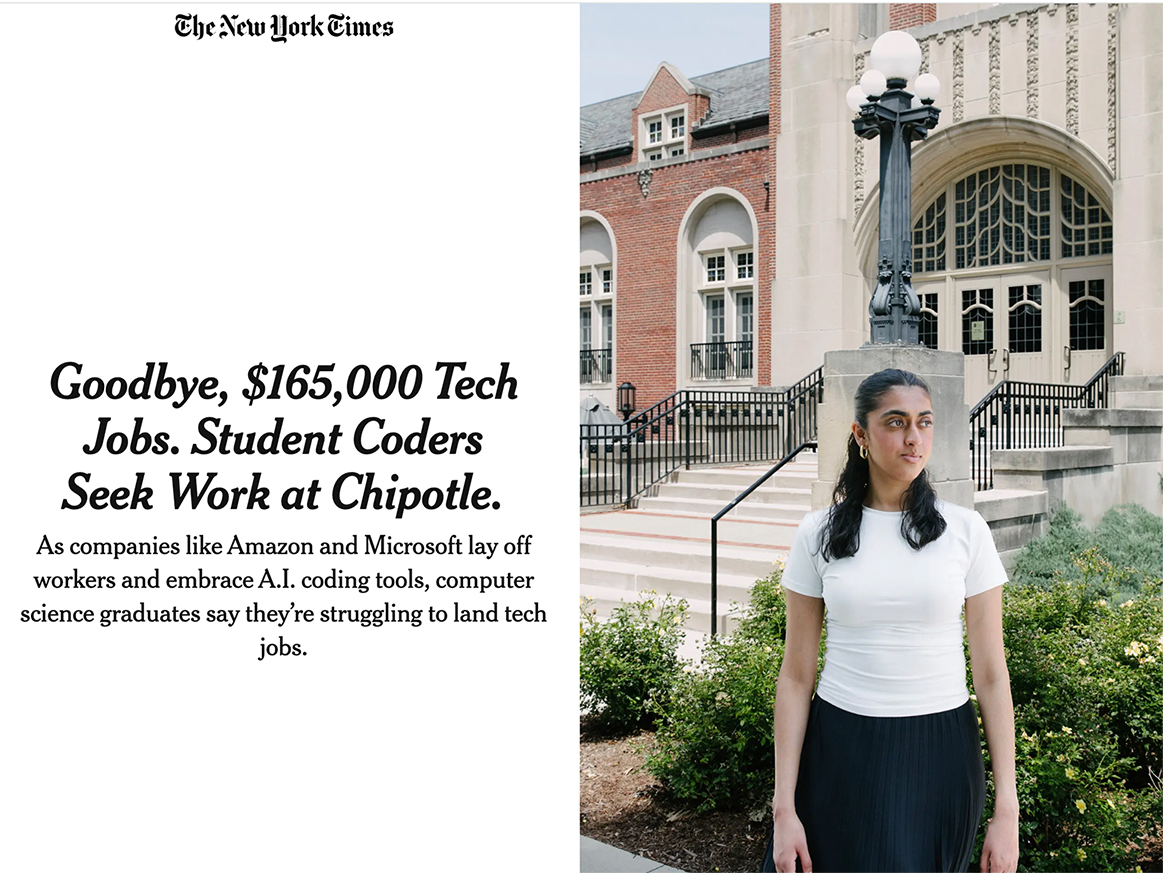
“The rhetoric was, if you just learned to code, work hard and get a computer science degree, you can get six figures for your starting salary,” Ms. Mishra, now 21, recalls hearing as she grew up in San Ramon, Calif.

Those golden industry promises helped spur Ms. Mishra to code her first website in elementary school, take advanced computing in high school and major in computer science in college. But after a year of hunting for tech jobs and internships, Ms. Mishra graduated from Purdue University in May without an offer.

“I just graduated with a computer science degree, and the only company that has called me for an interview is Chipotle,” Ms. Mishra said in a get-ready-with-me TikTok video this summer that has since racked up more than 147,000 views.

But now, the spread of A.I. programming tools, which can quickly generate thousands of lines of computer code — combined with layoffs at companies like Amazon, Intel, Meta and Microsoft — is dimming prospects in a field that tech leaders promoted for years as a golden career ticket. The turnabout is derailing the employment dreams of many new computing grads and sending them scrambling for other work.


BREAKING: Google introduces Guided Learning — from aieducation.substack.com by Claire Zau
Some thoughts on what could make Google’s AI tutor stand out

Another major AI lab just launched “education mode.”

Google introduced Guided Learning in Gemini, transforming it into a personalized learning companion designed to help you move from quick answers to real understanding.

Instead of immediately spitting out solutions, it:

  • Asks probing, open-ended questions
  • Walks learners through step-by-step reasoning
  • Adapts explanations to the learner’s level
  • Uses visuals, videos, diagrams, and quizzes to reinforce concepts

This Socratic style tutor rollout follows closely behind similar announcements like OpenAI’s Study Mode (last week) and Anthropic’s Claude for Education (April 2025).


How Sci-Fi Taught Me to Embrace AI in My Classroom — from edsurge.com by Dan Clark

I’m not too naive to understand that, no matter how we present it, some students will always be tempted by “the dark side” of AI. What I also believe is that the future of AI in education is not decided. It will be decided by how we, as educators, embrace or demonize it in our classrooms.

My argument is that setting guidelines and talking to our students honestly about the pitfalls and amazing benefits that AI offers us as researchers and learners will define it for the coming generations.

Can AI be the next calculator? Something that, yes, changes the way we teach and learn, but not necessarily for the worse? If we want it to be, yes.

How it is used, and more importantly, how AI is perceived by our students, can be influenced by educators. We have to first learn how AI can be used as a force for good. If we continue to let the dominant voice be that AI is the Terminator of education and critical thinking, then that will be the fate we have made for ourselves.


AI Tools for Strategy and Research – GT #32 — from goodtools.substack.com by Robin Good
Getting expert advice, how to do deep research with AI, prompt strategy, comparing different AIs side-by-side, creating mini-apps and an AI Agent that can critically analyze any social media channel

In this issue, discover AI tools for:

  • Getting Expert Advice
  • Doing Deep Research with AI
  • Improving Your AI Prompt Strategy
  • Comparing Results from Different AIs
  • Creating an AI Agent for Social Media Analysis
  • Summarizing YouTube Videos
  • Creating Mini-Apps with AI
  • Tasting an Award-Winning AI Short Film

GPT-Building, Agentic Workflow Design & Intelligent Content Curation — from drphilippahardman.substack.com by Dr. Philippa Hardman
What 3 recent job ads reveal about the changing nature of Instructional Design

In this week’s blog post, I’ll share my take on how the instructional design role is evolving and discuss what this means for our day-to-day work and the key skills it requires.

With this in mind, I’ve been keeping a close eye on open instructional design roles and, in the last 3 months, have noticed the emergence of a new flavour of instructional designer: the so-called “Generative AI Instructional Designer.”

Let’s deep dive into three explicitly AI-focused instructional design positions that have popped up in the last quarter. Each one illuminates a different aspect of how the role is changing—and together, they paint a picture of where our profession is likely heading.

Designers who evolve into prompt engineers, agent builders, and strategic AI advisors will capture the new premium. Those who cling to traditional tool-centric roles may find themselves increasingly sidelined—or automated out of relevance.


Google to Spend $1B on AI Training in Higher Ed — from insidehighered.com by Katherine Knott

Google’s parent company announced Wednesday (8/6/25) that it’s planning to spend $1 billion over the next three years to help colleges teach and train students about artificial intelligence.

Google is joining other AI companies, including OpenAI and Anthropic, in investing in AI training in higher education. All three companies have rolled out new tools aimed at supporting “deeper learning” among students and made their AI platforms available to certain students for free.


5 Predictions for How AI Will Impact Community Colleges — from pistis4edu.substack.com by Feng Hou

Based on current technology capabilities, adoption patterns, and the mission of community colleges, here are five well-supported predictions for AI’s impact in the coming years.

  1. Universal AI Tutor Access
  2. AI as Active Teacher
  3. Personalized Learning Pathways
  4. Interactive Multimodal Learning
  5. Value-Centric Education in an AI-Abundant World


GPT-5 is here — from openai.com
Our smartest, fastest, and most useful model yet, with thinking built in. Available to everyone.


Everything to know about GPT-5 — from theneurondaily.com by Grant Harvey
PLUS: We mean, really everything.

Why it matters: GPT-5 embodies a “team of specialists” approach—fast small models for most tasks, powerful ones for hard problems—reflecting NVIDIA’s “heterogeneous agentic system” vision. This could evolve into orchestration across dozens of specialized models, mirroring human collective intelligence.
Bottom line: GPT-5 isn’t AGI, but it’s a leap in usability, reliability, and breadth—pushing ChatGPT toward being a truly personal, expert assistant.

…and another article from Grant Harvey:


OpenAI launches GPT-5 to all ChatGPT users — from therundown.ai by Rowan Cheung and Shubham Sharma

Why it matters: OpenAI’s move to replace its flurry of models with a unified GPT-5 simplifies user experience and gives everyone a PhD-level assistant, bringing elite problem-solving to the masses. The only question now is how long it can hold its edge in this fast-moving AI race, with Anthropic, Google, and Chinese giants all catching up.


OpenAI’s ChatGPT-5 released — from getsuperintel.com by Kim “Chubby” Isenberg
GPT-5’s release marks a new era of productivity, from specialized AI tool to universal intelligence partner

The Takeaway

  • GPT-5’s unified architecture eliminates the effort of model switching and makes it the first truly seamless AI assistant that automatically applies the right level of reasoning for each task.
  • With 45% fewer hallucinations and 94.6% accuracy on complex math problems, GPT-5 exceeds the reliability threshold required for business-critical applications.
  • The model’s ability to generate complete applications from single prompts signals the democratization of software development and could revolutionize traditional coding workflows.
  • OpenAI’s “Safe Completions” training approach represents a new paradigm in AI safety, providing nuanced responses instead of blanket rejections for dual-use scenarios.

GPT-5 is live – but the community is divided — from getsuperintel.com by Kim “Chubby” Isenberg
For some, it’s a lightning-fast creative partner; for others, it’s a system that can’t even decide when to think properly

Many had hoped that GPT-5 would finally unite all models – reasoning, image and video generation, voice – “one model to rule them all,” but this expectation has not been met.


I broke OpenAI’s new GPT-5 and you should too — Brainyacts #266 — from thebrainyacts.beehiiv.com by Josh Kubicki

GPT-5 marks a profound change in the human/machine relationship.

OBSERVATION #1: Up until yesterday, using OpenAI, you could pick the exact model variant for your task: the one tuned for reasoning, for writing, for code, or for math. Each had its own strengths, and experienced users learned which to reach for and when. In GPT-5, those choices are gone. There’s just “GPT-5,” and the routing decisions of which mode, which tool, which underlying approach is made by the model.

  • For a beginner, that’s a blessing. Most novice users never knew the differences between the models anyway. They used the same one regardless of the task.
  • For an experienced user, the jury’s still out. On one hand, the routing could save time. On the other, it introduces unpredictability: you can no longer reliably choose the optimal model for your purpose. If GPT-5’s choice is wrong, you’re stuck re-prompting rather than switching.

GPT-5 learns from you — from theaivalley.com by Barsee

Why it matters:
GPT-5 signals a shift in AI’s evolution: progress through refinement, not revolution. While benchmarks show incremental gains, the real win is accessibility. Cheaper models (from $0.05 per million tokens) make AI more available to developers and casual users. This aligns with the Jevons Paradox, where lower costs could drive explosive adoption. However, the AGI hype faces reality checks. Fundraising may slow as investors focus on real-world utility over moonshots. For now, GPT-5 strengthens OpenAI’s market lead, proving AI’s future lies in practical applications, not just raw power.


GPT-5: It Just Does Stuff — from oneusefulthing.org by Ethan Mollick
Putting the AI in Charge

I have had early access to GPT-51, and I wanted to give you some impressions of what it is and what it means. But the answer to the first question everyone will have is: Yes, this is a big deal. I asked GPT-5 to show you why by pasting this intro paragraph, exactly as you’re reading it, into ChatGPT, including the phrase: “you are GPT-5, do something very dramatic to illustrate my point, it has to fit into the next paragraph.”

That was the only prompt I gave it. It “thought” for 24 seconds and wrote:

Thunderstruck. Here, watch. I build worlds. See ideas become instruments. I code, compose, and converse. Stories synthesize science; solutions spark, swiftly. Asks arrive; answers appear, astonishingly, across domains. Behold: business plans, blueprints, briefs, beautifully built, briskly. I infer intent, integrate insight, and iterate instantly, indefatigably. Gaps get gauged; goals get generated, guarded, and guaranteed gracefully. During dialogue, disparate data distills down; decisions develop deliberately, deftly, dependably. Everything explained efficiently, even ethics: evidence examined, empathy engaged, everywhere, everyday, equitably. All at once, ambiguous arguments align as actionable, accurate advice awaits anyone anywhere. Look: language, logic, learning, and long-term memory link, lifting lives and labor limitlessly worldwide.


Partnerships to make higher education work for the workforce — from timeshighereducation.com by Brooke Wilson
Fostering long-term industry partners can enhance student outcomes and prepare them for the workplace of the future. Here’s how to get the best out of them

As the pace of change accelerates across all industries, higher education institutions face increasing pressure to ensure their graduates are prepared for the workplace demands of today – and tomorrow. Cultivating meaningful partnerships with industry is no longer optional; it’s necessary.

From curriculum co-design to experiential learning, universities can collaborate with businesses and industries in several ways to enhance student outcomes and strengthen regional economies.


The keys to strong university–non-profit partnerships — from timeshighereducation.com by Mariana Leyva, Martha Sáenz, and Itzel Eguiluz
Collaborative projects between universities and non-profits nurture empathy and allow students to make a real-world impact. Here, three educators share their tips for building meaningful partnerships that benefit students and communities alike

Collaborative projects between universities and non-profits nurture empathy and allow students to make a real-world impact. Here, three educators share their tips for building meaningful partnerships that benefit students and communities alike.


BREAKING: OpenAI Releases Study Mode — from aieducation.substack.com by Claire Zau
What’s New, What Works, and What’s Still Missing

What is Study Mode?
Study Mode is OpenAI’s take on a smarter study partner – a version of the ChatGPT experience designed to guide users through problems with Socratic prompts, scaffolded reasoning, and adaptive feedback (instead of just handing over the answer).

Built with input from learning scientists, pedagogy experts, and educators, it was also shaped by direct feedback from college students. While Study Mode is designed with college students in mind, it’s meant for anyone who wants a more learning-focused, hands-on experience across a wide range of subjects and skill levels.

Who can access it? And how?
Starting July 29, Study Mode is available to users on Free, Plus, Pro, and Team plans. It will roll out to ChatGPT Edu users in the coming weeks.


ChatGPT became your tutor — from theneurondaily.com by Grant Harvey
PLUS: NotebookLM has video now & GPT 4o-level AI runs on laptop

Here’s how it works: instead of asking “What’s 2+2?” and getting “4,” study mode asks questions like “What do you think happens when you add these numbers?” and “Can you walk me through your thinking?” It’s like having a patient tutor who won’t let you off the hook that easily.

The key features include:

  • Socratic questioning: It guides you with hints and follow-up questions rather than direct answers.
  • Scaffolded responses: Information broken into digestible chunks that build on each other.
  • Personalized support: Adjusts difficulty based on your skill level and previous conversations.
  • Knowledge checks: Built-in quizzes and feedback to make sure concepts actually stick.
  • Toggle flexibility: Switch study mode on and off mid-conversation depending on your goals.

Try study mode yourself by selecting “Study and learn” from tools in ChatGPT and asking a question.


Introducing study mode — from openai.com
A new way to learn in ChatGPT that offers step by step guidance instead of quick answers.

[On 7/29/25, we introduced] study mode in ChatGPT—a learning experience that helps you work through problems step by step instead of just getting an answer. Starting today, it’s available to logged in users on Free, Plus, Pro, Team, with availability in ChatGPT Edu coming in the next few weeks.

ChatGPT is becoming one of the most widely used learning tools in the world. Students turn to it to work through challenging homework problems, prepare for exams, and explore new concepts. But its use in education has also raised an important question: how do we ensure it is used to support real learning, and doesn’t just offer solutions without helping students make sense of them?

We’ve built study mode to help answer this question. When students engage with study mode, they’re met with guiding questions that calibrate responses to their objective and skill level to help them build deeper understanding. Study mode is designed to be engaging and interactive, and to help students learn something—not just finish something.


© 2025 | Daniel Christian