Recurring Themes In Bob Ambrogi’s 30 Years of Legal Tech Reporting (A Guest Post By ChatGPT) — from lawnext.com by ChatGPT
#legaltech #innovation #law #legal #innovation #vendors #lawyers #lawfirms #legaloperations

  • Evolution of Legal Technology: From Early Web to AI Revolution
  • Challenges in Legal Innovation and Adoption
  • Law Firm Innovation vs. Corporate Legal Demand: Shifting Dynamics
  • Tracking Key Technologies and Players in Legal Tech
  • Access to Justice, Ethics, and Regulatory Reform

Also re: legaltech, see:

How LegalTech is Changing the Client Experience in 2025 — from techbullion.com by Uzair Hasan

A Digital Shift in Law
In 2025, LegalTech isn’t a trend—it’s a standard. Tools like client dashboards, e-signatures, AI legal assistants, and automated case tracking are making law firms more efficient and more transparent. These systems also help reduce errors and save time. For clients, it means less confusion and more control.

For example, immigration law—a field known for paperwork and long processing times—is being transformed through tech. Clients now track their case status online, receive instant updates, and even upload key documents from their phones. Lawyers, meanwhile, use AI tools to spot issues faster, prepare filings quicker, and manage growing caseloads without dropping the ball.

Loren Locke, Founder of Locke Immigration Law, explains how tech helps simplify high-stress cases:
“As a former consular officer, I know how overwhelming the visa process can feel. Now, we use digital tools to break down each step for our clients—timelines, checklists, updates—all in one place. One client recently told me it was the first time they didn’t feel lost during their visa process. That’s why I built my firm this way: to give people clarity when they need it most.”


While not so much legaltech this time, Jordan’s article below is an excellent, highly relevant posting for what we are going through — at least in the United States:

What are lawyers for? — from jordanfurlong.substack.com by Jordan Furlong
We all know lawyers’ commercial role, to be professional guides for human affairs. But we also need lawyers to bring the law’s guarantees to life for people and in society. And we need it right now.

The question “What are lawyers for?” raises another, prior and more foundational question: “What is the law for?”

But there’s more. The law also exists to regulate power in a society: to structure its distribution, create processes for its implementation, and place limits on its application. In a healthy society, power flows through the law, not around it. Certainly, we need to closely examine and evaluate those laws — the exercise of power through a biased or corrupted system will be illegitimate even if it’s “lawful.” But as a general rule, the law is available as a check on the arbitrary exercise of power, whether by a state authority or a private entity.

And above these two aspects of law’s societal role, I believe there’s also a third: to serve as a kind of “moral architecture” of society.
 

Blood in the Instructional Design Machine? — from drphilippahardman.substack.com by Dr. Philippa Hardman
The reality of AI, job degradation & the likely future of Instructional Design

This raises a very important, perhaps even existential question for our profession: do these tools free a designer from the mind-numbing drudgery of content conversion (the “augmented human”)? Or do they automate the core expertise of the learning professional’s role, e.g. selecting instructional startegies, structuring narratives and designing a learning flow, in the process reducing the ID’s role to simply finding the source file and pushing a button (the “inverted centaur”)?

The stated aspiration of these tool builders seems to be a future where AI means that the instructional designer’s value shifts decisively from production to strategy. Their stated goal is to handle the heavy lifting of content generation, allowing the human ID to provide the indispensable context, creativity, and pedagogical judgment that AI cannot replicate.

However, the risk of these tools lies in how we use them, and the “inverted centaur” model remains deeply potent and possible. In an organisation that prioritises cost above all, these same tools can be used to justify reducing the ID role to the functional drudgery of inputting a PDF and supervising the machine.

The key to this paradox lies in a crucial data point: spending on outside products and services has jumped a dramatic 23% to $12.4 billion. 

This signals a fundamental shift: companies are reallocating funds from large internal teams toward specialised consultants and advanced learning technologies like AI. L&D is not being de-funded; it is being re-engineered.


New Lightcast Report: AI Skills Command 28% Salary Premium as Demand Shifts Beyond Tech Industry — from lightcast.io; via Paul Fain
First-of-its-kind analysis reveals specific AI skills employers need most, enabling targeted workforce training strategies across all career areas

July 23, 2025 – Lightcast, the global leader in labor market intelligence, today released “Beyond the Buzz: Developing the AI Skills Employers Actually Need,” a comprehensive analysis revealing that artificial intelligence has fundamentally transformed hiring patterns across the world of work. The report, based on analysis of over 1.3 billion job postings, shows that job postings including AI skills offer 28% higher salaries—nearly $18,000 more per year—than those without such capabilities.

More importantly, the research analyzes specific skills based on their growth across job postings, their importance in the workforce, and their exposure to AI. This shows exactly which AI skills create value in which contexts, solving the critical challenge facing educators and workforce development leaders: moving beyond vague “AI literacy” to precise, targeted training that delivers measurable results.


Also via Paul Fain:


Despite growing awareness, however, participation in skill development is limited. In 2024, less than half of U.S. employees (45%) participated in training or education to build new skills for their current job. About one in three employees (32%) who are hoping to move into a new role within the next year strongly agree that they have the skills needed to be exceptional in that role.


Building a learning ecosystem that drives business results — from chieflearningofficer.com by Nick Romanowski
How SAX combined adaptive e-learning and experiential workshops to accelerate capability development and impact the bottom line.

At SAX, we know that to succeed in today’s market, we need professionals who can learn quickly, apply that learning effectively and continuously adapt as client needs evolve.

Yet traditional training methods were no longer enough. Our firm faced familiar challenges: helping staff meet continuing professional education requirements efficiently, uncovering knowledge gaps to guide development and building a more capable, more client-ready workforce.

We found our solution in a flipped learning model that blends adaptive e-learning with live, experiential workshops. The results were transformative. We accelerated CPE credit completion by more than 50 percent, reclaimed 173 billable hours and equipped our people with deeper capabilities.

Here’s how we did it, and what we learned along the way.

Blend technology and human touch: Adaptive e-learning addresses individual knowledge gaps efficiently. Live workshops enable skill development through practice and feedback. Together, they drive both learning efficiency and behavior change.


From DSC:
In looking at
 
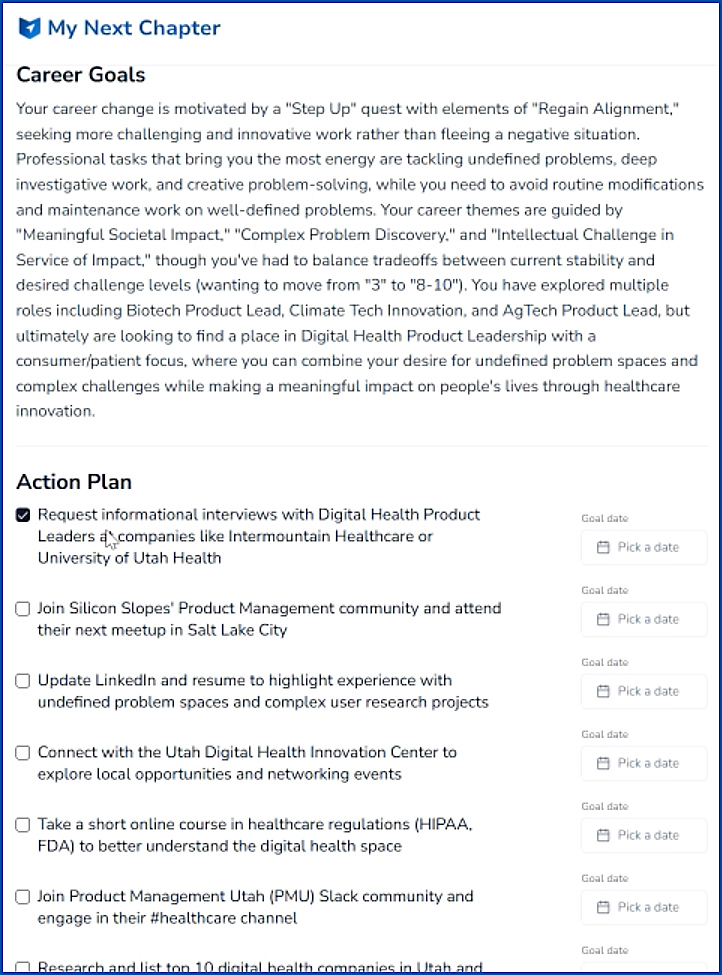
MyNextChapter.ai — THIS TYPE OF FUNCTIONALITY of an AI-based chatbot talking to you re: good fits for a future job — is the kind of thing that could work well in this type of vision/learning platform. The AI asks you relevant career-oriented questions, comes up with some potential job fits, and then gives you resources about how to gain those skills, who to talk with, organizations to join, next steps to get your foot in the door somewhere, etc.

The next gen learning platform would provide links to online-based courses, blogs, peoples’ names on LinkedIn, courses from L&D organizations or from institutions of higher education or from other entities/places to obtain those skills (similar to the ” Action Plan” below from MyNextChapter.ai).


Introducing ChatGPT agent: bridging research and action — from openai.com
ChatGPT now thinks and acts, proactively choosing from a toolbox of agentic skills to complete tasks for you using its own computer.

ChatGPT can now do work for you using its own computer, handling complex tasks from start to finish.

You can now ask ChatGPT to handle requests like “look at my calendar and brief me on upcoming client meetings based on recent news,” “plan and buy ingredients to make Japanese breakfast for four,” and “analyze three competitors and create a slide deck.” ChatGPT will intelligently navigate websites, filter results, prompt you to log in securely when needed, run code, conduct analysis, and even deliver editable slideshows and spreadsheets that summarize its findings.


Teach business students to write like executives — from timeshighereducation.com by José Ignacio Sordo Galarza
Many business students struggle to communicate with impact. Teach them to pitch ideas on a single page to build clarity, confidence and work-ready communication skills

Many undergraduate business students transition into the workforce equipped with communication habits that, while effective in academic settings, prove ineffective in professional environments. At university, students are trained to write for professors, not executives. This becomes problematic in the workplace where lengthy reports and academic jargon often obscure rather than clarify intent. Employers seek ideas they can absorb in seconds. This is where the one-pager – a single-page, high-impact document that helps students develop clarity of thought, concise expression and strategic communication – proves effective.


Also from Times Higher Education, see:


Is the dissertation dead? If so, what are the alternatives? — from timeshighereducation.com by Rushana Khusainova, Sarah Sholl, & Patrick Harte
Dissertation alternatives, such as capstone projects and applied group-based projects, could better prepare graduates for their future careers. Discover what these might look like

The traditional dissertation, a longstanding pillar of higher education, is facing increasing scrutiny. Concerns about its relevance to contemporary career paths, limitations in fostering practical skills and the changing nature of knowledge production in the GenAI age have fuelled discussions about its continued efficacy. So, is the dissertation dead?

The dissertation is facing a number of challenges. It can be perceived as having little relevance to career aspirations in increasingly competitive job markets. According to The Future of Jobs Report 2025 by the World Economic Forum, employers demand and indeed prioritise skills such as collaborative problem-solving in diverse and complex contexts, which a dissertation might not demonstrate.


AI is rewiring how we learn, and it’s a game-changer for L&D— from chieflearningofficer.com by Josh Bersin
As AI becomes central to learner engagement, L&D leaders are being urged to fundamentally rethink corporate training, says global industry analyst Josh Bersin.

What are people really doing with ChatGPT? They’re learning. They’re asking questions, getting immediate answers, digging deeper, analyzing information and ultimately making themselves more productive. So, one could argue that simply by shifting to a “learn by inquiry” model, we may triple our value to the business.

From my experience, there are two main learning models in this industry. The first is “what you need to know”—linear or prescriptive things that every employee needs to understand about the company, its products and their role. This kind of content is well handled by existing L&D models.

The second, and far more important, is “what you’d like to know”—questions, curiosities and explorations about how the company works, what customers truly need and how we can each go further in our careers. Thanks to AI, this kind of learning is now explosive and transformative.

Imagine a sales rep who loses a deal. Naturally, they may ask, “What could I have done to be more successful?” A well-designed AI-powered learning system would take that question, give the employee an initial answer and chat with the individual to dig into the problem.

The system would then surface relevant sales training material and recommend videos, tips or case studies for help. And the employee, assuming they like the experience, would likely keep exploring until they feel they’ve learned what they need.

This “curiosity-based” learning is now possible, and its benefits extend far beyond traditional training.


Tech check: Innovation in motion: How AI is rewiring L&D workflows — from chieflearningofficer.com by Gabrielle Pike
AI isn’t here to replace us. It’s here to level us up.

For today’s chief learning officer, the days of just rolling out compliance training are long gone. In 2025, learning and development leaders are architects of innovation, crafting ecosystems that are agile, automated and AI-infused. This quarter’s Tech Check invites us to pause, assess and get strategic about where tech is taking us. Because the goal isn’t more tools—it’s smarter, more human learning systems that scale with the business.

Sections include:

  • The state of AI in L&D: Hype vs. reality
  • AI in design: From static content to dynamic experiences
  • AI in development: Redefining production workflows
  • Strategic questions CLOs should be asking
  • Future forward: What’s next?
  • Closing thought

American Federation of Teachers (AFT) to Launch National Academy for AI Instruction with Microsoft, OpenAI, Anthropic and United Federation of Teachers — from aft.org

NEW YORK – The AFT, alongside the United Federation of Teachers and lead partner Microsoft Corp., founding partner OpenAI, and Anthropic, announced the launch of the National Academy for AI Instruction today. The groundbreaking $23 million education initiative will provide access to free AI training and curriculum for all 1.8 million members of the AFT, starting with K-12 educators. It will be based at a state-of-the-art bricks-and-mortar Manhattan facility designed to transform how artificial intelligence is taught and integrated into classrooms across the United States.

The academy will help address the gap in structured, accessible AI training and provide a national model for AI-integrated curriculum and teaching that puts educators in the driver’s seat.


Students Are Anxious about the Future with A.I. Their Parents Are, Too. — from educationnext.org by Michael B. Horn
The fast-growing technology is pushing families to rethink the value of college

In an era when the college-going rate of high school graduates has dropped from an all-time high of 70 percent in 2016 to roughly 62 percent now, AI seems to be heightening the anxieties about the value of college.

According to the survey, two-thirds of parents say AI is impacting their view of the value of college. Thirty-seven percent of parents indicate they are now scrutinizing college’s “career-placement outcomes”; 36 percent say they are looking at a college’s “AI-skills curriculum,” while 35 percent respond that a “human-skills emphasis” is important to them.

This echoes what I increasingly hear from college leadership: Parents and students demand to see a difference between what they are getting from a college and what they could be “learning from AI.”


This next item on LinkedIn is compliments of Ray Schroeder:


How to Prepare Students for a Fast-Moving (AI)World — from rdene915.com by Dr. Rachelle Dené Poth

Preparing for a Future-Ready Classroom
Here are the core components I focus on to prepare students:

1. Unleash Creativity and Problem-Solving.
2. Weave in AI and Computational Thinking.
3. Cultivate Resilience and Adaptability.


AI Is Reshaping Learning Roles—Here’s How to Future-Proof Your Team — from onlinelearningconsortium.org by Jennifer Mathes, Ph.D., CEO, Online Learning Consortium; via Robert Gibson on LinkedIn

Culture matters here. Organizations that foster psychological safety—where experimentation is welcomed and mistakes are treated as learning—are making the most progress. When leaders model curiosity, share what they’re trying, and invite open dialogue, teams follow suit. Small tests become shared wins. Shared wins build momentum.

Career development must be part of this equation. As roles evolve, people will need pathways forward. Some will shift into new specialties. Others may leave familiar roles for entirely new ones. Making space for that evolution—through upskilling, mobility, and mentorship—shows your people that you’re not just investing in AI, you’re investing in them.

And above all, people need transparency. Teams don’t expect perfection. But they do need clarity. They need to understand what’s changing, why it matters, and how they’ll be supported through it. That kind of trust-building communication is the foundation for any successful change.

These shifts may play out differently across sectors—but the core leadership questions will likely be similar.

AI marks a turning point—not just for technology, but for how we prepare our people to lead through disruption and shape the future of learning.


.


Is graduate employability a core university priority? — from timeshighereducation.com by Katherine Emms and Andrea Laczik
Universities, once judged primarily on the quality of their academic outcomes, are now also expected to prepare students for the workplace. Here’s how higher education is adapting to changing pressures

A clear, deliberate shift in priorities is under way. Embedding employability is central to an Edge Foundation report, carried out in collaboration with UCL’s Institute of Education, looking at how English universities are responding. In placing employability at the centre of their strategies – not just for professional courses but across all disciplines – the two universities that were analysed in this research show how they aim to prepare students for the labour market overall. Although the employability strategy is initialled by the universities’ senior leaders, the research showed that realising this employability strategy must be understood and executed by staff at all levels across departments. The complexity of offering insights into industry pathways and building relevant skills involves curricula development, student-centred teaching, careers support, partnership work and employer engagement.


Every student can benefit from an entrepreneurial mindset — from timeshighereducation.com by Nicolas Klotz
To develop the next generation of entrepreneurs, universities need to nurture the right mindset in students of all disciplines. Follow these tips to embed entrepreneurial education

This shift demands a radical rethink of how we approach entrepreneurial mindset in higher education. Not as a specialism for a niche group of business students but as a core competency that every student, in every discipline, can benefit from.

At my university, we’ve spent the past several years re-engineering how we embed entrepreneurship into daily student life and learning.

What we’ve learned could help other institutions, especially smaller or resource-constrained ones, adapt to this new landscape.

The first step is recognising that entrepreneurship is not only about launching start-ups for profit. It’s about nurturing a mindset that values initiative, problem-solving, resilience and creative risk-taking. Employers increasingly want these traits, whether the student is applying for a traditional job or proposing their own venture.


Build foundations for university-industry partnerships in 90 days— from timeshighereducation.com by Raul Villamarin Rodriguez and Hemachandran K
Graduate employability could be transformed through systematic integration of industry partnerships. This practical guide offers a framework for change in Indian universities

The most effective transformation strategy for Indian universities lies in systematic industry integration that moves beyond superficial partnerships and towards deep curriculum collaboration. Rather than hoping market alignment will occur naturally, institutions must reverse-engineer academic programmes from verified industry needs.

Our six-month implementation at Woxsen University demonstrates this framework’s practical effectiveness, achieving more than 130 industry partnerships, 100 per cent faculty participation in transformation training, and 75 per cent of students receiving industry-validated credentials with significantly improved employment outcomes.


How Do You Teach Computer Science in the A.I. Era? — from nytimes.com by Steve Lohr; with thanks to Ryan Craig for this resource
Universities across the country are scrambling to understand the implications of generative A.I.’s transformation of technology.

The future of computer science education, Dr. Maher said, is likely to focus less on coding and more on computational thinking and A.I. literacy. Computational thinking involves breaking down problems into smaller tasks, developing step-by-step solutions and using data to reach evidence-based conclusions.

A.I. literacy is an understanding — at varying depths for students at different levels — of how A.I. works, how to use it responsibly and how it is affecting society. Nurturing informed skepticism, she said, should be a goal.

At Carnegie Mellon, as faculty members prepare for their gathering, Dr. Cortina said his own view was that the coursework should include instruction in the traditional basics of computing and A.I. principles, followed by plenty of hands-on experience designing software using the new tools.

“We think that’s where it’s going,” he said. “But do we need a more profound change in the curriculum?”


In A Mega Deal, Clio Buys vLex for $1 Billion, Merging AI, Research and Practice Management — from lawnext.com by Bob Ambrogi

In a landmark deal that will undoubtedly reshape the legal tech landscape, law practice management company Clio has signed a definitive agreement to acquire the AI and legal research company vLex for $1 billion in cash and stock.

The companies say that the acquisition will “establish a new category of intelligent legal technology at the intersection of the business and practice of law, empowering legal professionals to seamlessly manage, research, and execute legal work within a unified system.”


The EU’s Legal Tech Tipping Point – AI Regulation, Data Sovereignty, and eDiscovery in 2025 — from jdsupra.com by Melina Efstathiou

The Good, the Braver and the Curious.
As we navigate through 2025, the European legal landscape is undergoing a significant transformation, particularly in the realms of artificial intelligence (AI) regulation and data sovereignty. These changes are reshaping how legal departments and more specifically eDiscovery professionals operate, compelling them to adapt to new compliance requirements and technological advancements.

Following on from our blog post on Navigating eDisclosure in the UK and Practice Direction 57AD, we are now moving on to explore AI regulation in the greater European spectrum, taking a contrasting glance towards the UK and the US as well, at the close of this post.


LegalTech’s Lingering Hurdles: How AI is Finally Unlocking Efficiency in the Legal Sector — from techbullion.co by Abdul Basit

However, as we stand in mid-2025, a new paradigm is emerging. Artificial Intelligence, once a buzzword, is now demonstrably addressing many of the core issues that have historically plagued LegalTech adoption and effectiveness, ushering in an era of unprecedented efficiency. Legal tech specialists like LegalEase are leading the way with some of these newer solutions, such as Ai powered NDA drafting.

Here’s how AI is making profound efficiencies:

    • Automated Document Review and Analysis:
    • Intelligent Contract Lifecycle Management (CLM):
    • Enhanced Legal Research:
    • Predictive Analytics for Litigation and Risk:
    • Streamlined Practice Management and Workflow Automation:
    • Personalized Legal Education and Training:
    • Improved Client Experience:

The AI Strategy Potluck: Law Firms Showing Up Empty-Handed, Hungry, And Weirdly Proud Of It — from abovethelaw.com by Joe Patrice
There’s a $32 billion buffet of time and money on the table, and the legal industry brought napkins.

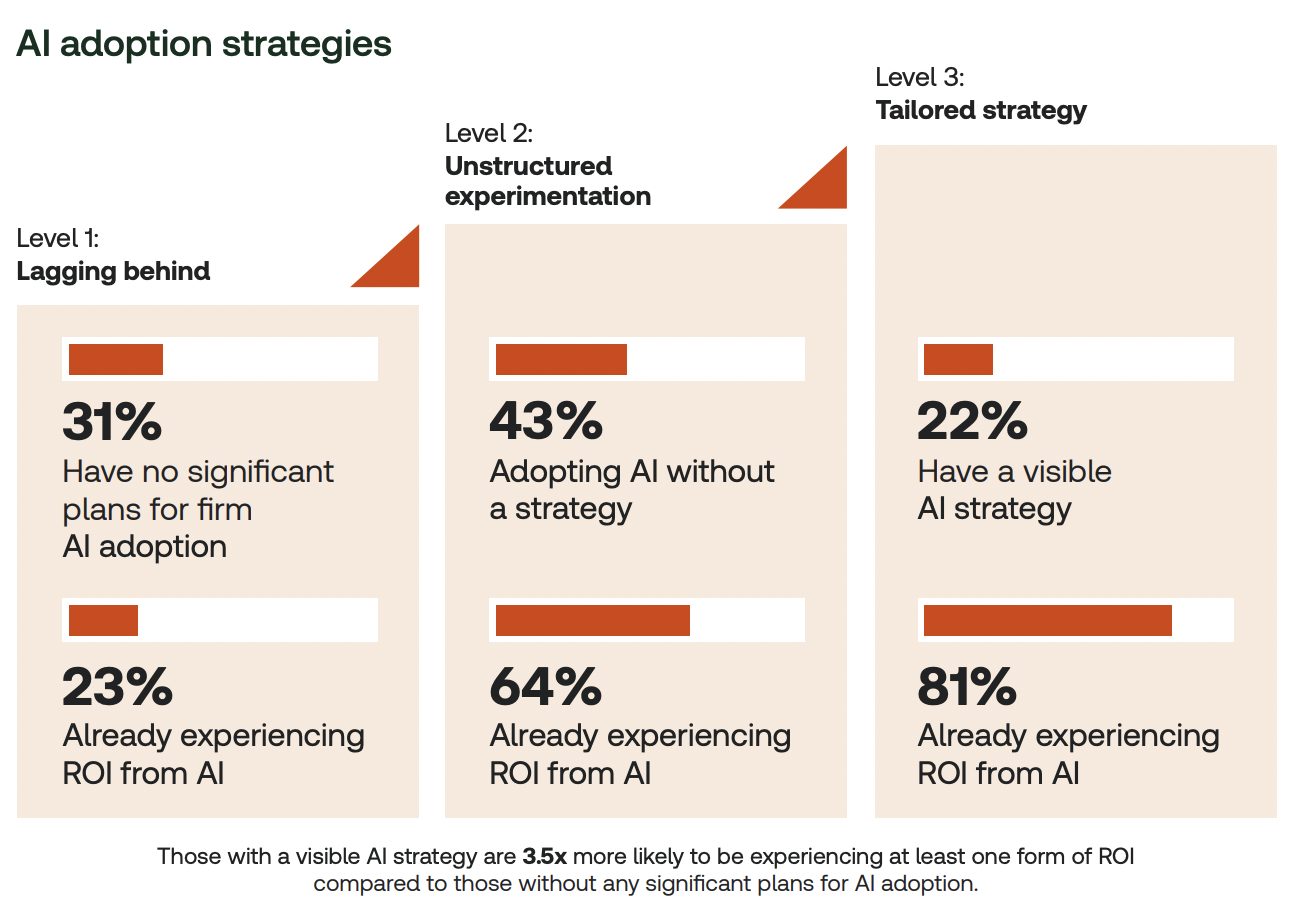
The Thomson Reuters “Future of Professionals” report(Opens in a new window) just dropped and one stat standing out among its insights is that organizations with a visible AI strategy are not only twice as likely to report growth, they’re also 3.5 times more likely to see actual, tangible benefits from AI adoption.

AI Adoption Strategies


Speaking of legal-related items as well as tech, also see:

  • Landmark AI ruling is a blow to authors and artists — from popular.info by Judd Legum
    This week, a federal judge, William Alsup, rejected Anthropic’s effort to dismiss the case and found that stealing books from the internet is likely a copyright violation. A trial will be scheduled in the future. If Anthropic loses, each violation could come with a fine of $750 or more, potentially exposing the company to billions in damages. Other AI companies that use stolen work to train their models — and most do — could also face significant liability.
 

2025 Learning System Top Picks — from elearninfo247.com by Craig Weiss

Who is leading the pack? Who is setting themselves apart here in the mid-year?

Are they an LMS? LMS/LXP? Talent Development System? Mentoring? Learning Platform?

Something else?

Are they solely customer training/education, mentoring, or coaching? Are they focused only on employees? Are they an amalgamation of all or some?

Well, they cut across the board – hence, they slide under the “Learning Systems” umbrella, which is under the bigger umbrella term – “Learning Technology.”

Categories: L&D-specific, Combo (L&D and Training, think internal/external audiences), and Customer Training/Education (this means customer education, which some vendors use to mean the same as customer training).


“Using AI Right Now: A Quick Guide” [Molnick] + other items re: AI in our learning ecosystems

Thoughts on thinking — from dcurt.is by Dustin Curtis

Intellectual rigor comes from the journey: the dead ends, the uncertainty, and the internal debate. Skip that, and you might still get the insight–but you’ll have lost the infrastructure for meaningful understanding. Learning by reading LLM output is cheap. Real exercise for your mind comes from building the output yourself.

The irony is that I now know more than I ever would have before AI. But I feel slightly dumber. A bit more dull. LLMs give me finished thoughts, polished and convincing, but none of the intellectual growth that comes from developing them myself. 


Using AI Right Now: A Quick Guide — from oneusefulthing.org by Ethan Mollick
Which AIs to use, and how to use them

Every few months I put together a guide on which AI system to use. Since I last wrote my guide, however, there has been a subtle but important shift in how the major AI products work. Increasingly, it isn’t about the best model, it is about the best overall system for most people. The good news is that picking an AI is easier than ever and you have three excellent choices. The challenge is that these systems are getting really complex to understand. I am going to try and help a bit with both.

First, the easy stuff.

Which AI to Use
For most people who want to use AI seriously, you should pick one of three systems: Claude from Anthropic, Google’s Gemini, and OpenAI’s ChatGPT.

Also see:


Student Voice, Socratic AI, and the Art of Weaving a Quote — from elmartinsen.substack.com by Eric Lars Martinsen
How a custom bot helps students turn source quotes into personal insight—and share it with others

This summer, I tried something new in my fully online, asynchronous college writing course. These classes have no Zoom sessions. No in-person check-ins. Just students, Canvas, and a lot of thoughtful design behind the scenes.

One activity I created was called QuoteWeaver—a PlayLab bot that helps students do more than just insert a quote into their writing.

Try it here

It’s a structured, reflective activity that mimics something closer to an in-person 1:1 conference or a small group quote workshop—but in an asynchronous format, available anytime. In other words, it’s using AI not to speed students up, but to slow them down.

The bot begins with a single quote that the student has found through their own research. From there, it acts like a patient writing coach, asking open-ended, Socratic questions such as:

What made this quote stand out to you?
How would you explain it in your own words?
What assumptions or values does the author seem to hold?
How does this quote deepen your understanding of your topic?
It doesn’t move on too quickly. In fact, it often rephrases and repeats, nudging the student to go a layer deeper.


The Disappearance of the Unclear Question — from jeppestricker.substack.com Jeppe Klitgaard Stricker
New Piece for UNESCO Education Futures

On [6/13/25], UNESCO published a piece I co-authored with Victoria Livingstone at Johns Hopkins University Press. It’s called The Disappearance of the Unclear Question, and it’s part of the ongoing UNESCO Education Futures series – an initiative I appreciate for its thoughtfulness and depth on questions of generative AI and the future of learning.

Our piece raises a small but important red flag. Generative AI is changing how students approach academic questions, and one unexpected side effect is that unclear questions – for centuries a trademark of deep thinking – may be beginning to disappear. Not because they lack value, but because they don’t always work well with generative AI. Quietly and unintentionally, students (and teachers) may find themselves gradually avoiding them altogether.

Of course, that would be a mistake.

We’re not arguing against using generative AI in education. Quite the opposite. But we do propose that higher education needs a two-phase mindset when working with this technology: one that recognizes what AI is good at, and one that insists on preserving the ambiguity and friction that learning actually requires to be successful.


Leveraging GenAI to Transform a Traditional Instructional Video into Engaging Short Video Lectures — from er.educause.edu by Hua Zheng

By leveraging generative artificial intelligence to convert lengthy instructional videos into micro-lectures, educators can enhance efficiency while delivering more engaging and personalized learning experiences.


This AI Model Never Stops Learning — from link.wired.com by Will Knight

Researchers at Massachusetts Institute of Technology (MIT) have now devised a way for LLMs to keep improving by tweaking their own parameters in response to useful new information.

The work is a step toward building artificial intelligence models that learn continually—a long-standing goal of the field and something that will be crucial if machines are to ever more faithfully mimic human intelligence. In the meantime, it could give us chatbots and other AI tools that are better able to incorporate new information including a user’s interests and preferences.

The MIT scheme, called Self Adapting Language Models (SEAL), involves having an LLM learn to generate its own synthetic training data and update procedure based on the input it receives.


Edu-Snippets — from scienceoflearning.substack.com by Nidhi Sachdeva and Jim Hewitt
Why knowledge matters in the age of AI; What happens to learners’ neural activity with prolonged use of LLMs for writing

Highlights:

  • Offloading knowledge to Artificial Intelligence (AI) weakens memory, disrupts memory formation, and erodes the deep thinking our brains need to learn.
  • Prolonged use of ChatGPT in writing lowers neural engagement, impairs memory recall, and accumulates cognitive debt that isn’t easily reversed.
 
© 2025 | Daniel Christian