Reading for delegates to the World Conference on Online Learning (taking place from 10/16/17 through 10/19/17 in Toronto, Canada)

Readings include:


Also see:

  • Emerging Tech Boosts Online Education Growth Over Next 4 Years — from edtechmagazine.com by Meghan Bogardus Cortez
    A study finds that mobile devices, virtual reality and blending learning programs will spark innovation.
    Excerpt:
    With millions of students enrolling in at least one online course, it should be no surprise that a recent Technavio study found that the online education market is forecasted to grow at a compound annual growth rate of 20 percent until 2021. As enrollment and investment in online education increases, the report claims that the industry owes a lot of this growth to mobile devices and increased desire for blended learning opportunities.

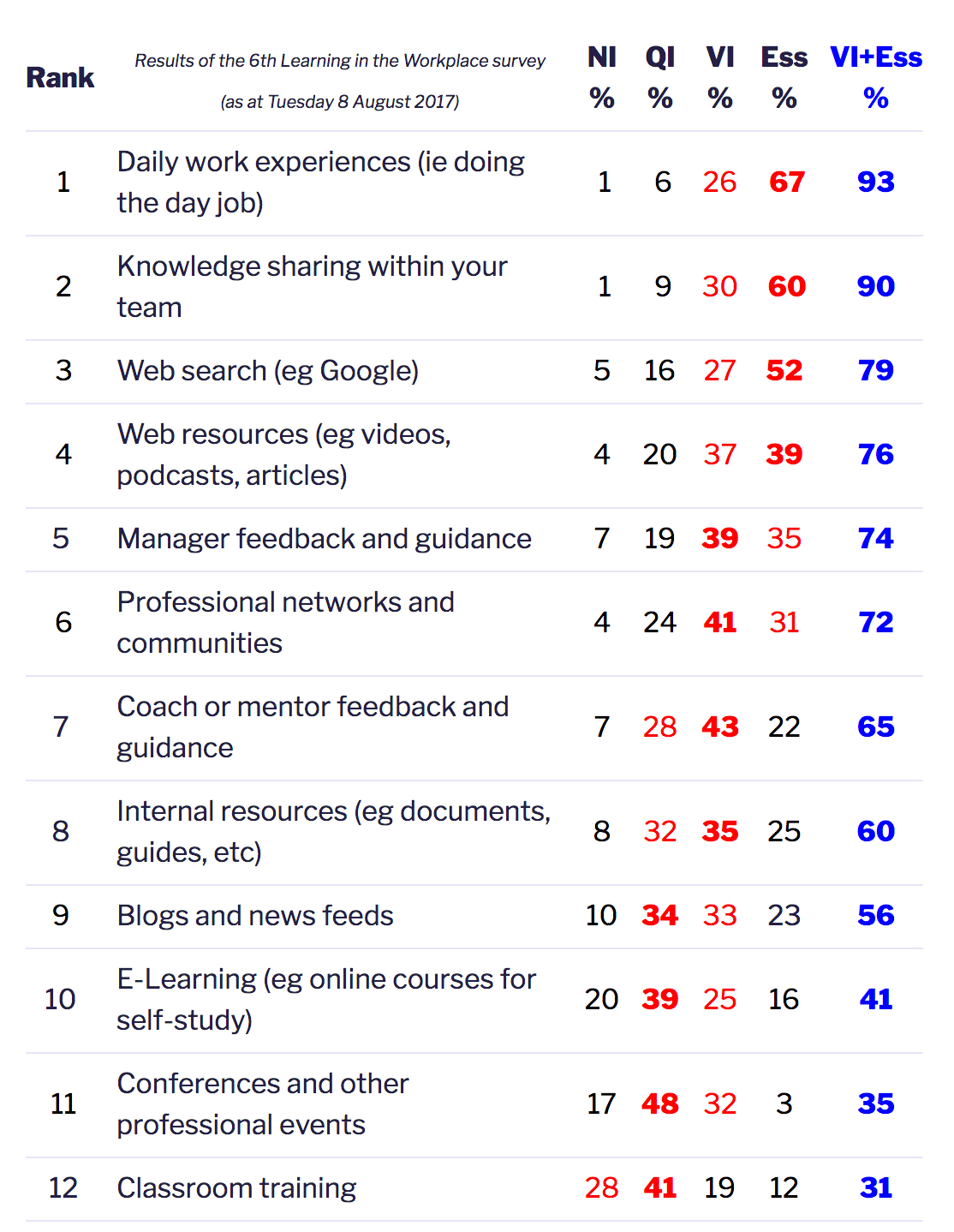


Global Human Capital Report 2017 — from the World Economic Forum

Excerpt from the Conclusion section (emphasis DSC):

Technological change and its impact on labour markets calls for a renewed focus on how the world’s human capital is invested in and leveraged for social well-being and economic prosperity for all. Many of today’s education systems are already disconnected from the skills needed to function in today’s labour markets and the exponential rate of technological and economic change is further increasing the gap between education and labour markets. Furthermore, the premise of current education systems is on developing cognitive skills, yet behavioural and non-cognitive skills that nurture an individual’s capacity to collaborate, innovate, self-direct and problem-solve are increasingly important. Current education systems are also time-compressed in a way that may not be suited to current or future labour markets. They force narrow career and expertise decisions in early youth. The divide between formal education and the labour market needs to be overcome, as learning, R&D, knowledge-sharing, retraining and innovation take place simultaneously throughout the work life cycle, regardless of the job, level or industry.


Insert from DSC…again I ask:

Is is time to back up a major step and practice design thinking on the entire continuum of lifelong learning?”


Education delivery and financing mechanisms have gone through little change over the last decades. In many countries, many youth and children may find their paths constrained depending on the type of education they are able to afford, while others may not have access to even basic literacy and learning. On the other hand, many developed world education systems have made enormous increases in spending—with little explicit return. Early childhood education and teacher quality remain neglected areas in many developed and developing countries, despite their proven impact on learning outcomes. Both areas also suffer from lack of objective, global data.

Generational shifts also necessitate an urgent focus by governments on human capital investments, one that transcends political cycles. Ageing economies will face a historical first, as more and more of their populations cross into the 65 and over age group and their workforces shrink further, necessitating a better integration of youth, female workers, migrants and older workers. Many emerging economies face change of a different kind as a very large cohort of the next generation—one that is more connected and globalized than ever before—enters the workforce with very different aspirations, expectations and worldviews than their predecessors.

The expansion of the digital economy is accelerating the presence of a new kind of productive entity, somewhere between human capital and physical capital—robots and intelligent algorithms. As a result, some experts expect a potential reduction in the use of human labour as part of economic value creation while others expect a restructuring of the work done by people across economies but stable or growing overall levels of employment.19 Yet others have cautioned of the risks to economic productivity of technological reticence at the cost of realizing the raw potential of new technological advancements unfettered.20 While in the immediate term the link between work and livelihoods remains a basic feature of our societies, the uncertainty around the shifts underway poses fundamental questions about the long-term future structure of economies, societies and work. However, for broad-based transition and successful adaptation towards any one of these or other long-term futures, strategic and deep investments in human capital will be even more—not less—important than before.


Google AR and VR: Get a closer look with Street View in Google Earth VR

Excerpt:

With Google Earth VR, you can go anywhere in virtual reality. Whether you want to stroll along the canals of Venice, stand at the summit of Mount Kilimanjaro or soar through the sky faster than a speeding bullet, there’s no shortage of things to do or ways to explore. We love this sense of possibility, so we’re bringing Street View to Earth VR to make it easier for you to see and experience the world.

This update lets you explore Street View imagery from 85 countries right within Earth VR. Just fly down closer to street level, check your controller to see if Street View is available and enter an immersive 360° photo. You’ll find photos from the Street View team and those shared by people all around the world.


Reef HQ Video Conferencing for Online Learning — from virtuallyinspired.org

Excerpt:

What are the chances that a majority of students will have the opportunity to explore an ocean far away or more importantly, with a top scientist or expert as a personal guide? A journey down under reveals an innovative online program that is swimming in delightful content and providing students (and instructors) around the world an experience they won’t soon forget.

The national aquarium of Australia, Reef HQ has taken video conferencing online to a new level. Students around the globe can experience the Australia’s Great Barrier Reef in true-to-life, high-definition sound and visuals while being taught from underwater.

In this case, Reef HQ is using videoconferencing to conduct virtual field trips connecting subject matter experts in a living coral reef to students in classrooms across the globe.

Scuba divers can see, hear and interact with students giving them a first-hand experience of the delicate marine ecosystem and habitats of the world’s largest living coral reef aquarium located in Townsville, North Queensland. “Students today have more options for education, both formally and informally. The scope for delivering education has broadened greatly with advances in technology and increased accessibility,” says Fred Nucifora, executive director at Reef HQ Aquarium.


Making the future work for everyone — from blog.google by Jacquelline Fuller

Excerpt:

Help ensure training is as effective and as wide-reaching as possible.
Millions are spent each year on work skills and technical training programs, but there isn’t much visibility into how these programs compare, or if the skills being taught truly match what will be needed in the future. So some of our funding will go into research to better understand which trainings will be most effective in getting the most people the jobs of the future. Our grantee Social Finance is looking at which youth training programs most effectively use contributions from trainees, governments and future employers to give people the best chance of
success.


Helping prepare for the future of work

Excerpt (emphasis DSC):

The way we work is changing. As new technologies continue to unfold in the workplace, more than a third of jobs are likely to require skills that are uncommon in today’s workforce. Workers are increasingly working independently. Demographic changes and shifts in labor participation in developed countries will mean future generations will find new ways to sustain economic growth. These changes create opportunities to think about how work can continue to be a source of not just income, but purpose and meaning for individuals and communities.Technology can help seize these opportunities. We recently launched Google for Jobs, which is designed to help better connect people to jobs, and today we’re announcing Google.org’s $50 million commitment to help people prepare for the changing nature of work. We’ll support nonprofits who are taking innovative approaches to tackling this challenge in three ways: (1) training people with the skills they need, (2) connecting job-seekers with positions that match their skills and talents, and (3) supporting workers in low-wage employment. We’ll start by focusing on the US, Canada, Europe, and Australia, and hope to expand to other countries over time.


Augmented reality ‘is virtually unlimited’ for Apple — from theaustralian.com.au by Chris Griffith

Excerpt:

Apple’s entry into augmented reality is gathering pace at an amazing rate, says one of its vice-presidents visiting Australia.

In an interview with The Australian yesterday, Apple vice-president of product marketing Greg “Joz” Joswiak said the enthusiasm of Apple’s development community building aug­mented reality (AR) applications had been “unbelievable”.

“They’ve built everything from virtual tape measures (to) ballerinas made out of wood dancing on floors. It’s absolutely incredible what people are doing in so little time.”


He said in the commercial space, AR applications would evolve for shopping, furniture placement, education, training and services.


Also see:

Excerpt:
Imagine being surrounded by a world of ghosts, things that aren’t there unless you look hard enough, and in the right way. With augmented reality technology, that’s possible—and museums are using it to their advantage. With augmented reality, museums are superimposing ther virtual world right over what’s actually in front of you, bringing exhibits and artifacts to life in new ways.

These five spots are great examples of how augmented reality is enhancing the museum experience.


Also see:


Winner takes all — from by Michael Moe, Luben Pampoulov, Li Jiang, Nick Franco, & Suzee Han


We did a lot of things that seemed crazy at the time. Many of those crazy things now have over a billion users, like Google Maps, YouTube, Chrome, and Android.

— Larry Page, CEO, Alphabet


Excerpt:

An alphabet is a collection of letters that represent language. Alphabet, accordingly, is a collection of companies that represent the many bets Larry Page is making to ensure his platform is built to not only survive, but to thrive in a future defined by accelerating digital disruption. It’s an “Alpha” bet on a diversified platform of assets.

If you look closely, the world’s top technology companies are making similar bets.


Technology in general and the Internet in particular is all about a disproportionate gains to the leader in a category. Accordingly, as technology leaders like Facebook, Alphabet, and Amazon survey the competitive landscape, they have increasingly aimed to develop and acquire emerging technology capabilities across a broad range of complementary categories.


Australian Library Design Awards 2017 — from
The Australian Library and Information Association has announced the five winners of its inaugural Library Design Awards at its conference in Melbourne.

Excerpt:

Thirty-three stunning libraries were entered in the awards and there is a winner in each category: public, school, academic and special libraries all feature in the entries.

The Australian Library Design Awards were created to showcase the best in contemporary library interiors and exteriors in Australia, and to celebrate the investment in libraries made by Australia’s institutions, corporations, local, state and territory governments.


Australian start-up taps IBM Watson to launch language translation earpiece — from prnewswire.com
World’s first available independent translation earpiece, powered by AI to be in the hands of consumers by July

Excerpts:

SYDNEY, June 12, 2017 /PRNewswire/ — Lingmo International, an Australian technology start-up, has today launched Translate One2One, an earpiece powered by IBM Watson that can efficiently translate spoken conversations within seconds, being the first of its kind to hit global markets next month.

Unveiled at last week’s United Nations Artificial Intelligence (AI) for Good Summit in Geneva, Switzerland, the Translate One2One earpiece supports translations across English, Japanese, French, Italian, Spanish, Brazilian Portuguese, German and Chinese. Available to purchase today for delivery in July, the earpiece carries a price tag of $179 USD, and is the first independent translation device that doesn’t rely on Bluetooth or Wi-Fi connectivity.


Lingmo International, an Australian technology start-up, has today launched Translate One2One, an earpiece powered by IBM Watson that can efficiently translate spoken conversations within seconds.


From DSC:
How much longer before this sort of technology gets integrated into videoconferencing and transcription tools that are used in online-based courses — enabling global learning at a scale never seen before? (Or perhaps NLP-based tools are already being integrated into global MOOCs and the like…not sure.) It would surely allow for us to learn from each other in a variety of societies throughout the globe.


Melbourne University to pilot blockchain based micro-credentialing system — from econotimes.com

Excerpt:

The University of Melbourne is all set to become the first Australian institution to trial blockchain technology.

Last week, the university announced that it is teaming up with Learning Machine, a US-based company associated with the Massachusetts Institute of Technology (MIT) Media Lab, to pilot a blockchain based micro-credentialing system, which will enable employers to verify those credentials quickly.

Speaking at the annual meeting of a data portability consortium in Melbourne last week, Pro Vice-Chancellor (Teaching and Learning) Professor Gregor Kennedy said the decision to pilot Learning Machine’s blockchain platform for micro-credentialing is based on supporting new types of learning recognition that are increasingly being demanded by students and employers in a globalised, digital world.


Augmented reality glasses could replace staff training — from stuff.co.nz by Madison Reidy

Excerpt (emphasis DSC):

In five years, anyone could put on a pair of augmented reality glasses and know how to work a factory, an augmented reality company claims.

Los Angeles based company Daqri International recently released its ‘smart glasses’ for factory floor staff.

Daqri general manager Paul Sweeney said that when the technology became mainstream, it would get rid of engineering education.

“In the next five years or so we will probably not have classroom training, they will just have training on their head, on the job.”

Auckland based Fisher & Paykel Production Machinery (PML) has taken to the trend and added augmented reality tasks to its factory’s maintenance system.

PML industry 4.0 technology manager John West said it made its unskilled factory floor workers “instant experts”.


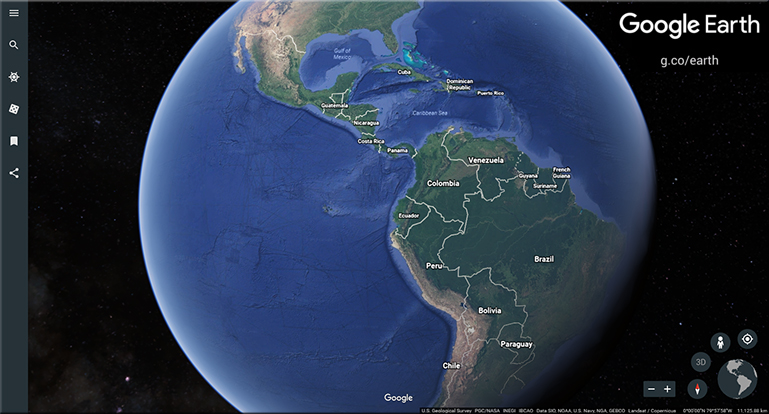
New Google Earth has exciting features for teachers — from thejournal.com by Richard Chang

Excerpt:

Google has recently released a brand new version of Google Earth for both Chrome and Android. This new version has come with a slew of nifty features teachers can use for educational purposes with students in class. Following is a quick overview of the most fascinating features…


The 82 Hottest EdTech Tools of 2017 According to Education Experts — from tutora.co.uk by Giorgio Cassella

Excerpt:

If you work in education, you’ll know there’s a HUGE array of applications, services, products and tools created to serve a multitude of functions in education.

Tools for teaching and learning, parent-teacher communication apps, lesson planning software, home-tutoring websites, revision blogs, SEN education information, professional development qualifications and more.

There are so many companies creating new products for education, though, that it can be difficult to keep up – especially with the massive volumes of planning and marking teachers have to do, never mind finding the time to actually teach!

So how do you know which ones are the best?

Well, as a team of people passionate about education and learning, we decided to do a bit of research to help you out.

We’ve asked some of the best and brightest in education for their opinions on the hottest EdTech of 2017. These guys are the real deal – experts in education, teaching and new tech from all over the world from England to India, to New York and San Francisco.

They’ve given us a list of 82 amazing, tried and tested tools…


From DSC:
The ones that I mentioned that Giorgio included in his excellent article were:

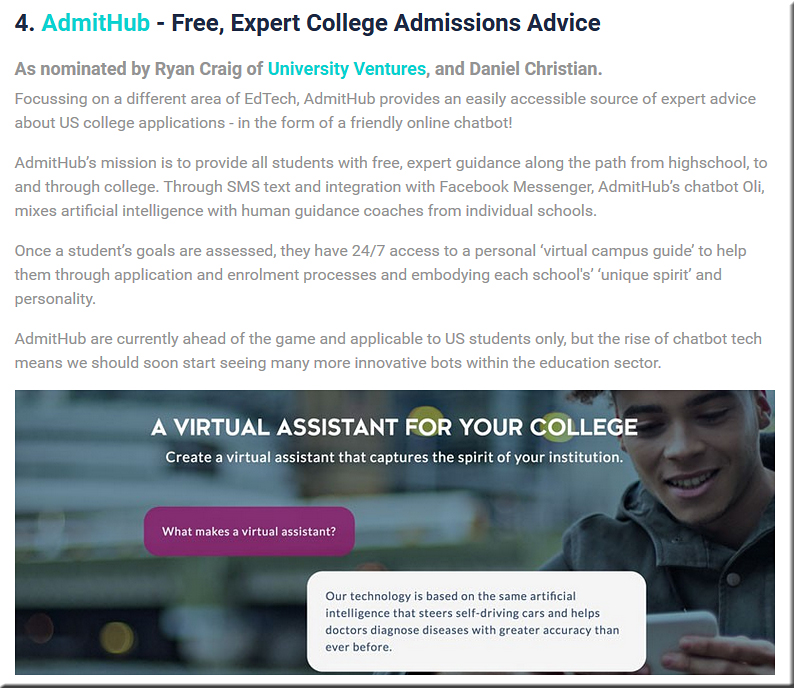
  • AdmitHub – Free, Expert College Admissions Advice
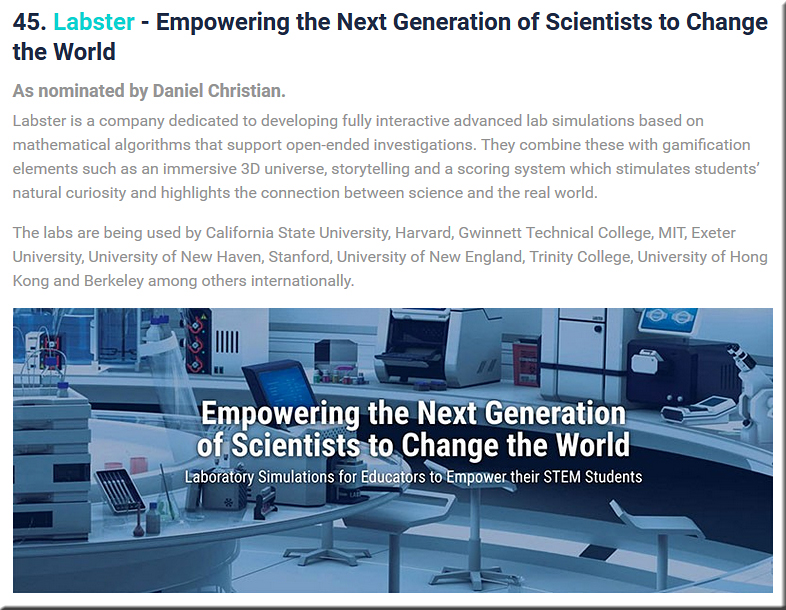
  • Labster – Empowering the Next Generation of Scientists to Change the World
  • Unimersiv – Virtual Reality Educational Experiences
  • Lifeliqe – Interactive 3D Models to Augment Classroom Learning


At the recent Next Generation Learning Spaces Conference, during one of the workshops, the question was asked:

What skills do your current facilities promote/develop?

A minority of workshop attendees said multidisciplinary collaboration, engagement, and creativity. One university had purposely designed and built a new ecosystem of spaces such that students had different experiences when moving into a variety of setups/rooms.  Thus, they viewed this new facility as helping the students adapt to change – which was one of the characteristics and skills they wanted their learning spaces to facilitate in their students.

That said, most of the answers were along the lines of:

  • listening
  • note-taking
  • memorization
  • regurgitating knowledge from lectures

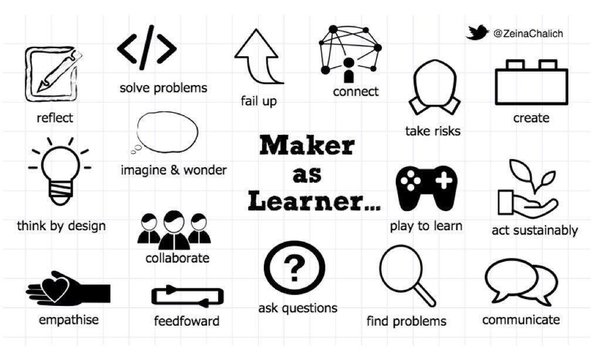
Then yesterday, I ran across a tweet from Zeina Chalich (from Sydney, Australia) — and I thought to myself, now THERE’s a great list of skills that our facilities should help develop!


© 2025 | Daniel Christian