I think right now it’s almost a waste of time to talk about a hybrid device because it’s not relevant. It’s two different devices and two different use cases. But like you said, sometime in the future, 15, 20, 50 years, I imagine a point where you could open your eyes to do AR, and close your eyes to do VR.
…
I think there’s always room for innovation, especially with spatial computing where we’re in the very early stages. We have to develop a new visual approach that I don’t think we have yet. What does it mean to interact in a world where everything is visual and around you, and not on a two-dimensional screen? So there’s a lot to do there.
A big part of mainstream adoption is education. Until you get into AR and VR, you don’t really know what you’re missing. You can’t really learn about it from videos. And that education takes time. So the education, plus the understanding of the need, will create a demand.
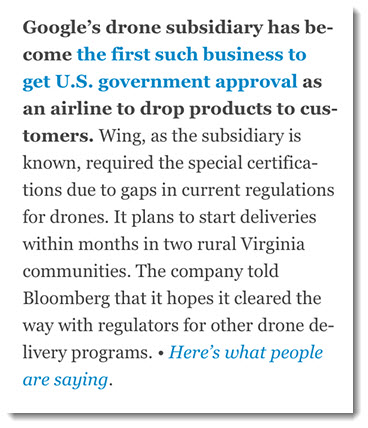
First drone delivery company gains approval in the U.S. — from futuretimeline.net A Google/Alphabet offshoot company, Wing Aviation, has become the first drone delivery service to receive Air Carrier Certification from the Federal Aviation Administration (FAA).
From DSC: I don’t like this at all. If this foot gets in the door, vendor after vendor will launch their own hordes of drones. In the future, where will we go if we want some piece and quiet? Will the air be filled with swarms of noisy drones? Will we be able to clearly see the sun? An exaggeration..? Maybe…maybe not.
But, now what? What recourse do citizens have? Readers of this blog know that I’m generally pro-technology. But the folks — especially the youth — working within the FAANG companies (and the like) need to do a far better job asking, “Just because we can do something, should we do it?”
As I’ve said before, we’ve turned over the keys to the $137,000 Maserati to drivers who are just getting out of driving school. Then we wonder….”How did we get to this place?”
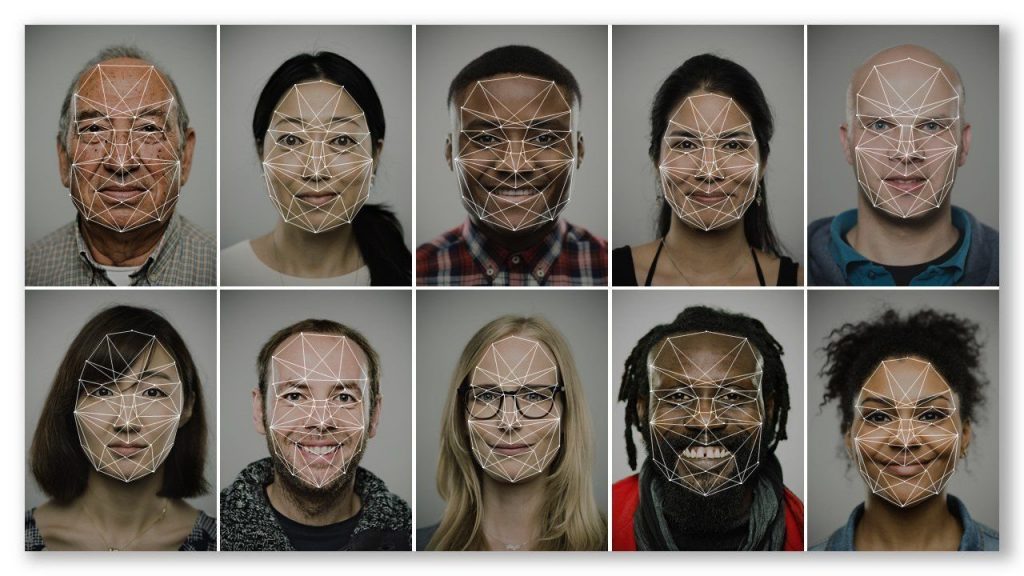
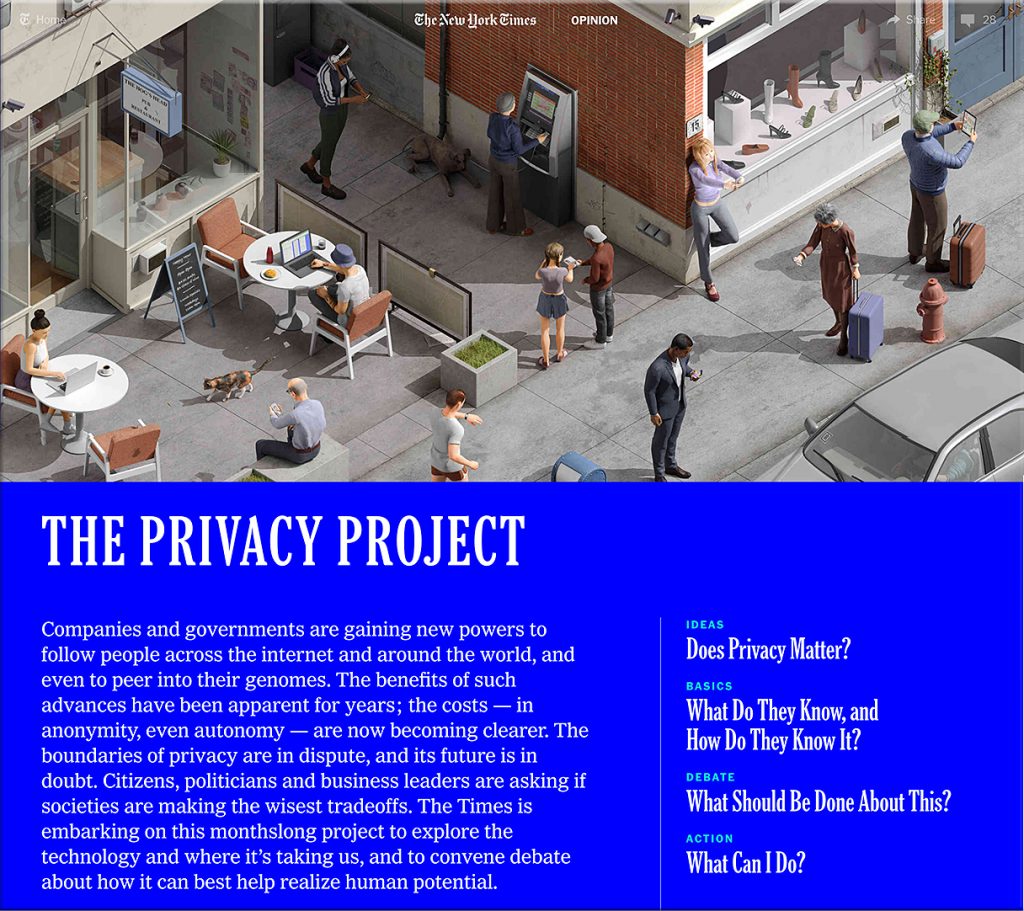
“The future of human flourishing depends upon facial recognition technology being banned,” wrote Woodrow Hartzog, a professor of law and computer science at Northeastern, and Evan Selinger, a professor of philosophy at the Rochester Institute of Technology, last year. ‘Otherwise, people won’t know what it’s like to be in public without being automatically identified, profiled, and potentially exploited.’ Facial recognition is categorically different from other forms of surveillance, Mr. Hartzog said, and uniquely dangerous. Faces are hard to hide and can be observed from far away, unlike a fingerprint. Name and face databases of law-abiding citizens, like driver’s license records, already exist. And for the most part, facial recognition surveillance can be set up using cameras already on the streets.”— Sahil Chinoy; per a weekly e-newsletter from Sam DeBrule at Machine Learnings in Berkeley, CA
Excerpt:
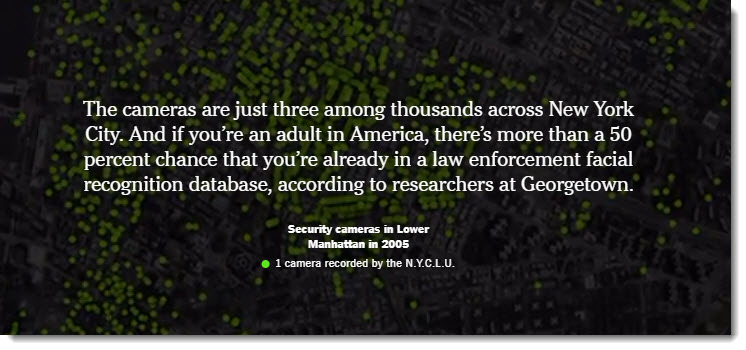
Most people pass through some type of public space in their daily routine — sidewalks, roads, train stations. Thousands walk through Bryant Park every day. But we generally think that a detailed log of our location, and a list of the people we’re with, is private. Facial recognition, applied to the web of cameras that already exists in most cities, is a threat to that privacy.
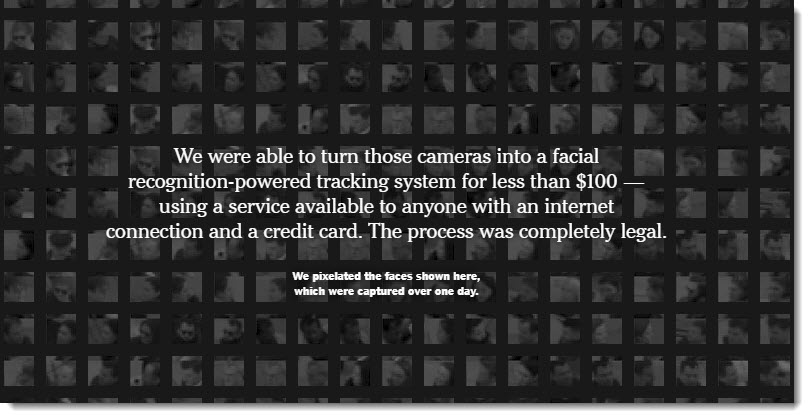
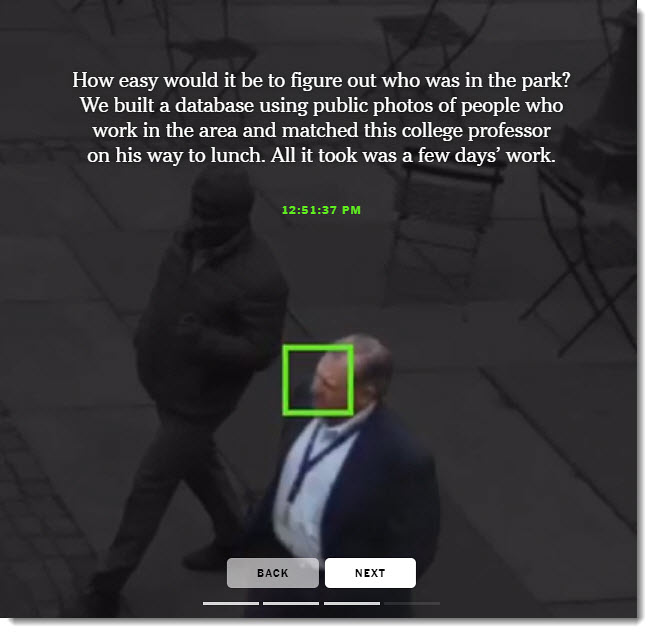
To demonstrate how easy it is to track people without their knowledge, we collected public images of people who worked near Bryant Park (available on their employers’ websites, for the most part) and ran one day of footage through Amazon’s commercial facial recognition service. Our system detected 2,750 faces from a nine-hour period (not necessarily unique people, since a person could be captured in multiple frames). It returned several possible identifications, including one frame matched to a head shot of Richard Madonna, a professor at the SUNY College of Optometry, with an 89 percent similarity score. The total cost: about $60.
From DSC: What do you think about this emerging technology and its potential impact on our society — and on other societieslike China? Again I ask…what kind of future do we want?
As for me, my face is against the use of facial recognition technology in the United States — as I don’t trust where this could lead.
This wild, wild, west situation continues to develop. For example, note how AI and facial recognition get their foot in the door via techs installed years ago:
The cameras in Bryant Park were installed more than a decade ago so that people could see whether the lawn was open for sunbathing, for example, or check how busy the ice skating rink was in the winter. They are not intended to be a security device, according to the corporation that runs the park.
So Amazon’s use of facial recognition is but another foot in the door.
This needs to be stopped. Now.
Facial recognition technology is a menace disguised as a gift. It’s an irresistible tool for oppression that’s perfectly suited for governments to display unprecedented authoritarian control and an all-out privacy-eviscerating machine.
We should keep this Trojan horse outside of the city. (source)
AI and the Healthcare Industry
This technology is evidently the game changer in the healthcare industry. According to the reports by Frost & Sullivan, the AI market for healthcare is likely to experience a CAGR of 40% by 2021, and has the potential to change industry outcomes by 30-40%, while cutting treatment costs in half.
In the words of Satya Nadella, “AI is the runtime that is going to shape all of what we do going forward in terms of the applications as well as the platform advances”.
Here are a few ways Microsoft’s Healthcare Bot will shape the Healthcare Industry…
Also see:
Why AI will make healthcare personal — from weforum.org by Peter Schwartz Excerpt: Digital assistants to provide a 24/7 helping hand The digital assistants of the future will be full-time healthcare companions, able to monitor a patient’s condition, transmit results to healthcare providers, and arrange virtual and face-to-face appointments. They will help manage the frequency and dosage of medication, and provide reliable medical advice around the clock. They will remind doctors of patients’ details, ranging from previous illnesses to past drug reactions. And they will assist older people to access the care they need as they age, including hospice care, and help to mitigate the fear and loneliness many elderly people feel.
Introducing New Alexa Healthcare Skills— from developer.amazon.com by Rachel Jiang Excerpts:
The new healthcare skills that launched today are:Express Scripts (a leading Pharmacy Services Organization)
Cigna Health Today (by Cigna, the global health service company)
My Children’s Enhanced Recovery After Surgery (ERAS) (by Boston Children’s Hospital, a leading children’s hospital)
Swedish Health Connect (by Providence St. Joseph Health, a healthcare system with 51 hospitals across 7 states and 829 clinics)
Atrium Health (a healthcare system with more than 40 hospitals and 900 care locations throughout North and South Carolina and Georgia)
Livongo (a leading consumer digital health company that creates new and different experiences for people with chronic conditions)
Voice as the Next Frontier for Conveniently Accessing Healthcare Services
Got health care skills? Big Tech wants to hire you — from linkedin.com Jaimy Lee Excerpt:
As tech giants like Amazon, Apple and Google place bigger and bigger bets on the U.S. health care system, it should come as no surprise that the rate at which they are hiring workers with health care skills is booming.We took a deep dive into the big tech companies on this year’s LinkedIn Top Companies list in the U.S., uncovering the most popular health care skills among their workers — and what that says about the future of health care in America.
1) Alphabet (Google); Internet
2) Facebook; Internet
3) Amazon; Internet
4) Salesforce; Internet
5) Deloitte; Management Consulting
6) Uber; Internet
7) Apple; Consumer Electronics
8) Airbnb; Internet
9) Oracle; Information Technology & Services
10) Dell Technologies; Information Technology & Services
Universities must create space in their programs for hybrid degrees. They should incentivize CS students to study comparative literature, world religions, microeconomics, cultural anthropology and similar courses in other departments. They should champion dual degree programs in computer science and international relations, theology, political science, philosophy, public health, education and the like. Ethics should not be taught as a stand-alone class, something to simply check off a list. Schools must incentivize even tenured professors to weave complicated discussions of bias, risk, philosophy, religion, gender, and ethics in their courses.
One of my biggest recommendations is the formation of GAIA, what I call the Global Alliance on Intelligence Augmentation. At the moment people around the world have very different attitudes and approaches when it comes to data collection and sharing, what can and should be automated, and what a future with more generally intelligent systems might look like. So I think we should create some kind of central organization that can develop global norms and standards, some kind of guardrails to imbue not just American or Chinese ideals inside AI systems, but worldviews that are much more representative of everybody.
Most of all, we have to be willing to think about this much longer-term, not just five years from now. We need to stop saying, “Well, we can’t predict the future, so let’s not worry about it right now.” It’s true, we can’t predict the future. But we can certainly do a better job of planning for it.
Facebook reportedly paid users between the ages of 13 and 35 $20 a month to download the app through beta-testing companies like Applause, BetaBound, and uTest.
…
Apple typically doesn’t allow app developers to go around the App Store, but its enterprise program is one exception. It’s what allows companies to create custom apps not meant to be downloaded publicly, like an iPad app for signing guests into a corporate office. But Facebook used this program for a consumer research app, which Apple says violates its rules. “Facebook has been using their membership to distribute a data-collecting app to consumers, which is a clear breach of their agreement with Apple,” a spokesperson said in a statement. “Any developer using their enterprise certificates to distribute apps to consumers will have their certificates revoked, which is what we did in this case to protect our users and their data.” Facebook didn’t respond to a request for comment.
Facebook needed to bypass Apple’s usual policies because its Research app is particularly invasive. First, it requires users to install what is known as a “root certificate.” This lets Facebook look at much of your browsing history and other network data, even if it’s encrypted. The certificate is like a shape-shifting passport—with it, Facebook can pretend to be almost anyone it wants.
To use a nondigital analogy, Facebook not only intercepted every letter participants sent and received, it also had the ability to open and read them. All for $20 a month!
Facebook’s latest privacy scandal is a good reminder to be wary of mobile apps that aren’t available for download in official app stores. It’s easy to overlook how much of your information might be collected, or to accidentally install a malicious version of Fortnite, for instance. VPNs can be great privacy tools, but many free ones sell their users’ data in order to make money. Before downloading anything, especially an app that promises to earn you some extra cash, it’s always worth taking another look at the risks involved.
The information below is per Laura Kelley (w/ Page 1 Solutions)
As you know, Apple has shut down Facebook’s ability to distribute internal iOS apps. The shutdown comes following news that Facebook has been using Apple’s program for internal app distribution to track teenage customers for “research.”
Dan Goldstein is the president and owner of Page 1 Solutions, a full-service digital marketing agency. He manages the needs of clients along with the need to ensure protection of their consumers, which has become one of the top concerns from clients over the last year. Goldstein is also a former attorney so he balances the marketing side with the legal side when it comes to protection for both companies and their consumers. He says while this is another blow for Facebook, it speaks volumes for Apple and its concern for consumers,
“Facebook continues to demonstrate that it does not value user privacy. The most disturbing thing about this news is that Facebook knew that its app violated Apples terms of service and continued to distribute the app to consumers after it was banned from the App Store. This shows, once again, that Facebook doesn’t value user privacy and goes to great lengths to collect private behavioral data to give it a competitive advantage.The FTC is already investigating Facebook’s privacy policies and practices.As Facebook’s efforts to collect and use private data continue to be exposed, it risks losing market share and may prompt additional governmental investigations and regulation,” Goldstein says.
“One positive that comes out of this story is that Apple seems to be taking a harder line on protecting user privacy than other tech companies. Apple has been making noises about protecting user privacy for several months. This action indicates that it is attempting to follow through on its promises,” Goldstein says.
A unanimous ruling by the Illinois Supreme Court says that companies that improperly gather people’s data can be sued for damages even without proof of concrete injuries, opening the door to legal challenges that Facebook, Google, and other businesses have resisted.
Schools may already use some form of artificial intelligence (AI), but hardly any have curricula designed to teach K-12 students how it works and how to use it, wrote EdSurge. However, organizations such as the International Society for Technology in Education (ISTE) are developing their own sets of lessons that teachers can take to their classrooms.
Members of “AI for K-12” — an initiative co-sponsored by the Association for the Advancement of Artificial Intelligence and the Computer Science Teachers Association — wrote in a paper that an AI curriculum should address five basic ideas:
Computers use sensors to understand what goes on around them.
Computers can learn from data.
With this data, computers can create models for reasoning.
While computers are smart, it’s hard for them to understand people’s emotions, intentions and natural languages, making interactions less comfortable.
AI can be a beneficial tool, but it can also harm society.
These kinds of lessons are already at play among groups including the Boys and Girls Club of Western Pennsylvania, which has been using a program from online AI curriculum site ReadyAI. The education company lent its AI-in-a-Box kit, which normally sells for $3,000, to the group so it could teach these concepts.
Artificial intelligence powers Amazon’s recommendations engine, Google Translate and Siri, for example. But few U.S. elementary and secondary schools teach the subject, maybe because there are so few curricula available for students. Members of the “AI for K-12” work group wrote in a recent Association for the Advancement of Artificial Intelligence white paper that “unlike the general subject of computing, when it comes to AI, there is little guidance for teaching at the K-12 level.”
But that’s starting to change. Among other advances, ISTE and AI4All are developing separate curricula with support from General Motors and Google, respectively, according to the white paper. Lead author Dave Touretzky of Carnegie Mellon has developed his own curriculum, Calypso. It’s part of the “AI-in-a-Box” kit, which is being used by more than a dozen community groups and school systems, including Carter’s class.
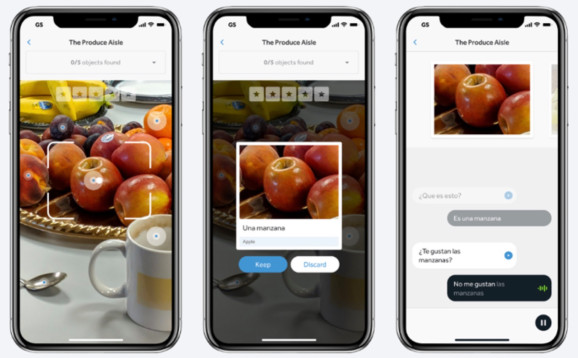
Today, language teaching developer Rosetta Stone is taking the next step forward by adding augmented reality and machine learning to its iPhone app, enabling users to identify and translate the names of real-world objects…
Apple CEO Tim Cook, who has said the U.S. should pass a federal data-privacy law, on Thursday said legislation should also give consumers more information about who buys and sells their data.
In a column published by Time, Cook said the Federal Trade Commission should set up a “clearinghouse” that requires data brokers to register and lets consumers “track the transactions that have bundled and sold their data from place to place, and giving users the power to delete their data on demand, freely, easily and…
SAN JOSE, Calif. — Silicon Valley ended 2018 somewhere it had never been: embattled.
Lawmakers across the political spectrum say Big Tech, for so long the exalted embodiment of American genius, has too much power. Once seen as a force for making our lives better and our brains smarter, tech is now accused of inflaming, radicalizing, dumbing down and squeezing the masses. Tech company stocks have been pummeled from their highs. Regulation looms. Even tech executives are calling for it.
…
The expansion underlines the dizzying truth of Big Tech: It is barely getting started.
“For all intents and purposes, we’re only 35 years into a 75- or 80-year process of moving from analog to digital,” said Tim Bajarin, a longtime tech consultant to companies including Apple, IBM and Microsoft. “The image of Silicon Valley as Nirvana has certainly taken a hit, but the reality is that we the consumers are constantly voting for them.”
Big Tech needs to be regulated, many are beginning to argue, and yet there are worries about giving that power to the government.
…
Which leaves regulation up to the companies themselves, always a dubious proposition.
Indeed, if you haven’t yet heard of the “AR Cloud”, it’s time to take serious notice. The term was coined by Ori Inbar, an AR entrepreneur and investor who founded AWE. It is, in his words, “a persistent 3D digital copy of the real world to enable sharing of AR experiences across multiple users and devices.”
“It’s not about how virtual reality functions. It’s about, ‘How does history function in virtual reality? How does biology function in virtual reality? How does psychology function with these new tools?’” he said.
The school hopes to prepare student for careers in a field with a market size projected to grow to $209.2 billion by 2022, according to Statista. Still at its advent, Whelan compared VR technology to the introduction of the personal computer.
From DSC: But even in that posting the message is mixed…some pros…some cons. Some things going well for XR-related techs…but for other things, things are not going very well.
…but on the other hand,
some things don’t look so good…
Four years later, things are starting to look decidedly bleak. Yes, there are about 5 million Gear VR units and 3 million Sony Playstation VR headsets in market, plus probably a few hundred thousand higher-end Oculus and HTC Vive systems. Yes, VR is still being demonstrated at countless conferences and events, and big corporations that want to seem innovative love to invest in a VR app or two. Yes, Facebook just cracked an important low-end price point with its $200 Oculus Go headset, theoretically making VR affordable for mainstream consumers. Plus, there’s even more hype about Augmented Reality, which in a way could be a gateway drug to VR.
But it’s hard to ignore a growing feeling that VR is not developing as the industry hoped it would. So is that it again, we’ve seen this movie before, let’s all wrap it up and wait for the next wave of VR to come along about five years from now?
There are a few signs that are really worrying…
From DSC:
My take is that it’s too early to tell. We need to give things more time.