


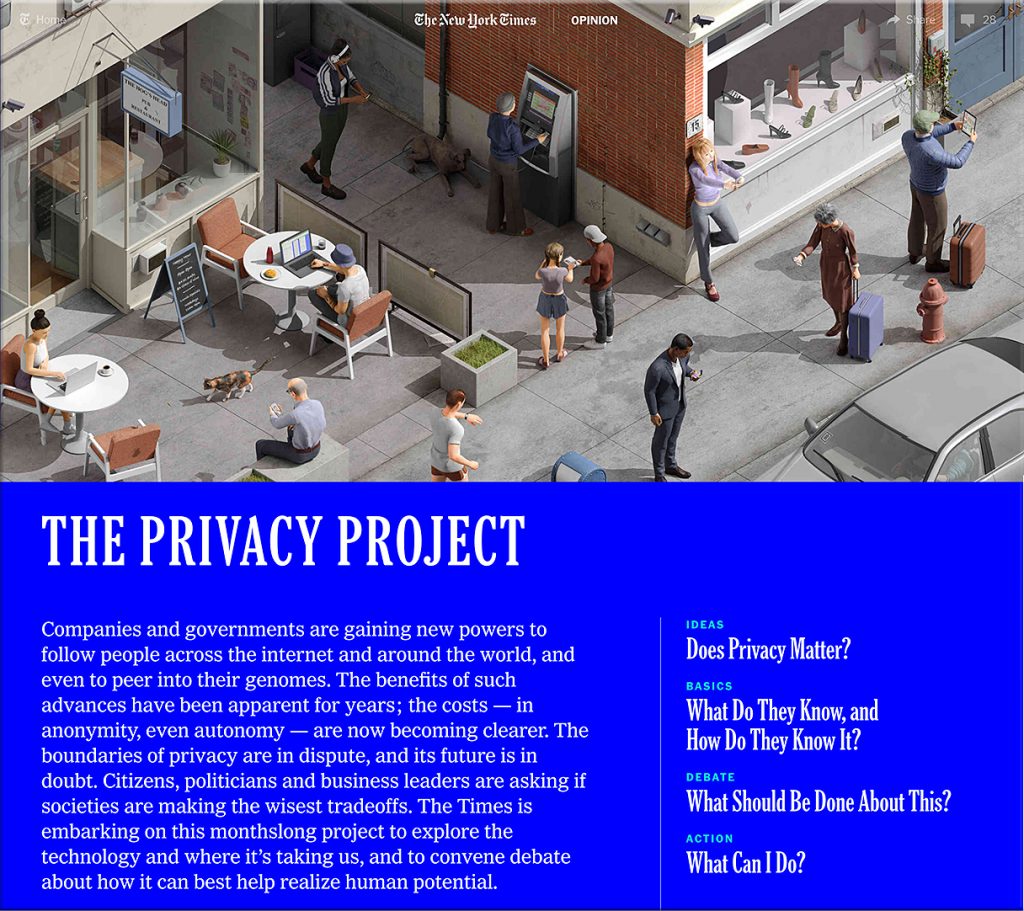
Example articles from the Privacy Project:
-
James Bennet: Do You Know What You’ve Given Up?
-
A. G. Sulzberger: How The Times Thinks About Privacy
-
Samantha Irby: I Don’t Care. I Love My Phone.
-
Tim Wu: How Capitalism Betrayed Privacy
Example articles from the Privacy Project:
DC: Wow. Another example of the growing impact/presence of tech in our lives.https://t.co/lHBnqDuUGO by @danroth
— Daniel Christian (@dchristian5) April 3, 2019
Check out the top 10:
1) Alphabet (Google); Internet
2) Facebook; Internet
3) Amazon; Internet
4) Salesforce; Internet
5) Deloitte; Management Consulting
6) Uber; Internet
7) Apple; Consumer Electronics
8) Airbnb; Internet
9) Oracle; Information Technology & Services
10) Dell Technologies; Information Technology & Services
From a fairly recent e-newsletter from edsurge.com — though I don’t recall the exact date (emphasis DSC):
New England is home to some of the most famous universities in the world. But the region has also become ground zero for the demographic shifts that promise to disrupt higher education.
This week saw two developments that fit the narrative. On Monday, Southern Vermont College announced that it would shut its doors, becoming the latest small rural private college to do so. Later that same day, the University of Massachusetts said it would start a new online college aimed at a national audience, noting that it expects campus enrollments to erode as the number of traditional college-age students declines in the coming years.
“Make no mistake—this is an existential threat to entire sectors of higher education,” said UMass president Marty Meehan in announcing the online effort.
The approach seems to parallel the U.S. retail sector, where, as a New York Times piece outlines this week, stores like Target and WalMart have thrived by building online strategies aimed at competing with Amazon, while stores like Gap and Payless, which did little to move online, are closing stores. Of course, college is not like any other product or service, and plenty of campuses are touting the richness of the experience that students get by actually coming to a campus. And it’s not clear how many colleges can grow online to a scale that makes their investments pay off.
“It’s predicted that over the next several years, four to five major national players with strong regional footholds will be established. We intend to be one of them.”
University of Massachusetts President Marty Meehan
From DSC:
That last quote from UMass President Marty Meehan made me reflect upon the idea of having one or more enormous entities that will provide “higher education” in the future. I wonder if things will turn out to be that we’ll have more lifelong learning providers and platforms in the future — with the idea of a 60-year curriculum being an interesting idea that may come into fruition.
Long have I predicted that such an enormous entity would come to pass. Back in 2008, I named it the Forthcoming Walmart of Education. But then as the years went by, I got bumbed out on some things that Walmart was doing, and re-branded it the Forthcoming Amazon.com of Higher Education. We’ll see how long that updated title lasts — but you get the point. In fact, the point aligns very nicely with what futurist Thomas Frey has been predicting for years as well:
“I’ve been predicting that by 2030 the largest company on the internet is going to be an education-based company that we haven’t heard of yet,” Frey, the senior futurist at the DaVinci Institute think tank, tells Business Insider. (source)
I realize that education doesn’t always scale well…but I’m thinking that how people learn in the future may be different than how we did things in the past…communities of practice comes to mind…as does new forms of credentialing…as does cloud-based learner profiles…as does the need for highly efficient, cost-effective, and constant opportunities/means to reinvent oneself.
Also see:

Addendum:
74% of consumers go to Amazon when they’re ready to buy something. That should be keeping retailers up at night. — from cnbc.com
Key points (emphasis DSC)
“In New England, there will be between 32,000 and 54,000 fewer college-aged students just seven years from now,” Meehan said. “That means colleges and universities will have too much capacity and not enough demand at a time when the economic model in higher education is already straining under its own weight.” (Marty Meehan at WBUR)
A prediction for blockchain transformation in higher education — from blockchain.capitalmarketsciooutlook.com by Michael Mathews
Excerpt:
Ironically, blockchain entered the scene in a very neutral way, while Bitcoin created all the noise, simply because it used an aspect of blockchain. Bitcoin, cyber coins, and/or token concepts will come and go, just as the various forms of web browsers did. However, just as the Internet lives on, so will blockchain. In fact, blockchain may very well become the best of the Internet and IoT merged with the trust factor of the ISBN/MARC code concept. As history unveils itself blockchain will stand the test of time and become a form of a future generation of the Internet (i.e. Internet 4.0) without the need for cyber security.
With a positive prediction on blockchain for future coupled with lessons learned from the Internet, blockchain will become the single largest influencer on education. I have only gone on record of predicting two shifts in technology over a 5-10 year period of time, and both have come to pass now. This is my third prediction, with the greatest potential for transformation.
What I did not know until last year was a neutral technology called blockchain would show up in the history of the world; and at the same time Amazon would start designing blockchain templates to reduce all the processes to allow educational decisions to become as easy as ordering and receiving Amazon products.
Amazon has 10,000 employees dedicated to Alexa — here are some of the areas they’re working on — from businessinsider.com by Avery Hartmans
Summary (emphasis DSC):
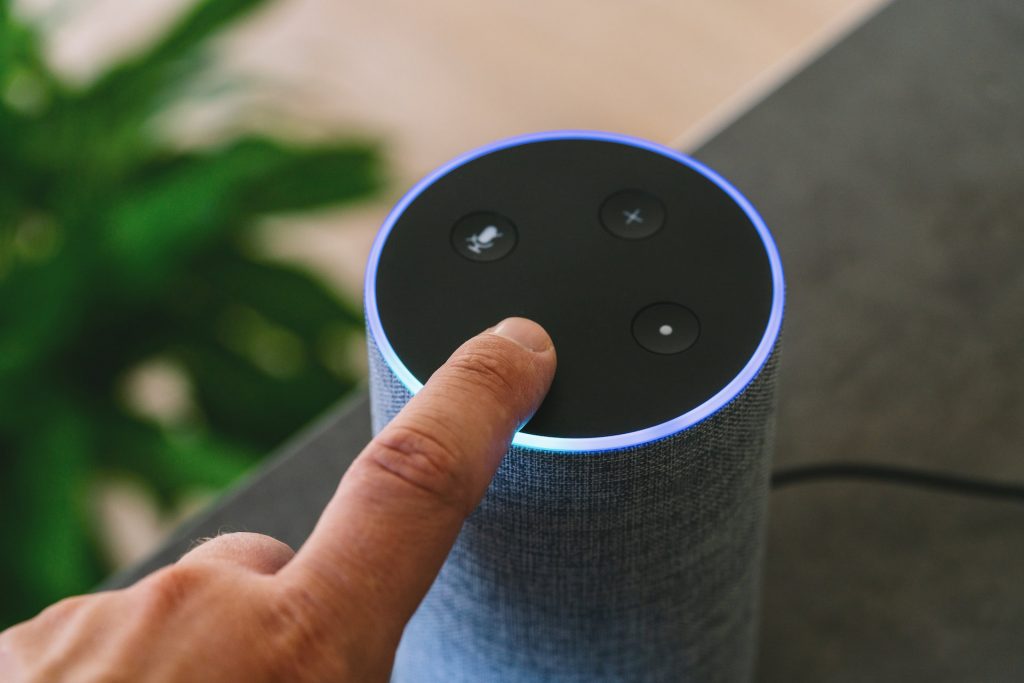
From DSC:
How might this trend impact learning spaces? For example, I am interested in using voice to intuitively “drive” smart classroom control systems:
The AR Cloud will infuse meaning into every object in the real world — from venturebeat.com by Amir Bozorgzadeh
Excerpt:
Indeed, if you haven’t yet heard of the “AR Cloud”, it’s time to take serious notice. The term was coined by Ori Inbar, an AR entrepreneur and investor who founded AWE. It is, in his words, “a persistent 3D digital copy of the real world to enable sharing of AR experiences across multiple users and devices.”
Augmented reality invades the conference room — from zdnet.com by Ross Rubin
Spatial extends the core functionality of video and screen sharing apps to a new frontier.
The 5 most innovative augmented reality products of 2018 — from next.reality.news by Adario Strange
Augmented, virtual reality major opens at Shenandoah U. next fall — from edscoop.com by by Betsy Foresman
Excerpt:
“It’s not about how virtual reality functions. It’s about, ‘How does history function in virtual reality? How does biology function in virtual reality? How does psychology function with these new tools?’” he said.
The school hopes to prepare student for careers in a field with a market size projected to grow to $209.2 billion by 2022, according to Statista. Still at its advent, Whelan compared VR technology to the introduction of the personal computer.
VR is leading us into the next generation of sports media — from venturebeat.com by Mateusz Przepiorkowski
Accredited surgery instruction now available in VR — from zdnet.com by Greg Nichols
The medical establishment has embraced VR training as a cost-effective, immersive alternative to classroom time.
Toyota is using Microsoft’s HoloLens to build cars faster — from cnn.comby Rachel Metz
From DSC:
But even in that posting the message is mixed…some pros…some cons. Some things going well for XR-related techs…but for other things, things are not going very well.
Is the Current Generation of VR Already Dead? — from medium.com by Andreas Goeldi
Excerpt:
Four years later, things are starting to look decidedly bleak. Yes, there are about 5 million Gear VR units and 3 million Sony Playstation VR headsets in market, plus probably a few hundred thousand higher-end Oculus and HTC Vive systems. Yes, VR is still being demonstrated at countless conferences and events, and big corporations that want to seem innovative love to invest in a VR app or two. Yes, Facebook just cracked an important low-end price point with its $200 Oculus Go headset, theoretically making VR affordable for mainstream consumers. Plus, there’s even more hype about Augmented Reality, which in a way could be a gateway drug to VR.
But it’s hard to ignore a growing feeling that VR is not developing as the industry hoped it would. So is that it again, we’ve seen this movie before, let’s all wrap it up and wait for the next wave of VR to come along about five years from now?
There are a few signs that are really worrying…
From DSC:
My take is that it’s too early to tell. We need to give things more time.