Microsoft's conference room of the future


From DSC:
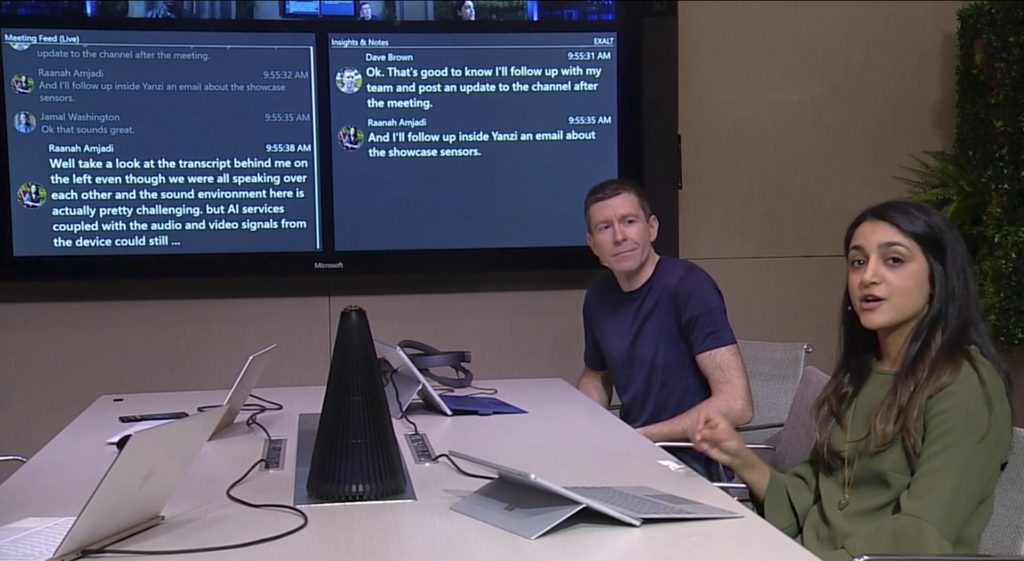
Microsoft’s conference room of the future “listens” to the conversations of the team and provides a transcript of the meeting. It also is using “artificial intelligence tools to then act on what meeting participants say. If someone says ‘I’ll follow up with you next week,’ then they’ll get a notification in Microsoft Teams, Microsoft’s Slack competitor, to actually act on that promise.”

This made me wonder about our learning spaces in the future. Will an #AI-based device/cloud-based software app — in real-time — be able to “listen” to the discussion in a classroom and present helpful resources in the smart classroom of the future (i.e., websites, online-based databases, journal articles, and more)?

Will this be a feature of a next generation learning platform as well (i.e., addressing the online-based learning realm)? Will this be a piece of an intelligent tutor or an intelligent system?

Hmmm…time will tell.


Also see this article out at Forbes.com entitled, “There’s Nothing Artificial About How AI Is Changing The Workplace.” 

Here is an excerpt:

The New Meeting Scribe: Artificial Intelligence

As I write this, AI has already begun to make video meetings even better. You no longer have to spend time entering codes or clicking buttons to launch a meeting. Instead, with voice-based AI, video conference users can start, join or end a meeting by simply speaking a command (think about how you interact with Alexa).

Voice-to-text transcription, another artificial intelligence feature offered by Otter Voice Meeting Notes (from AISense, a Zoom partner), Voicefox and others, can take notes during video meetings, leaving you and your team free to concentrate on what’s being said or shown. AI-based voice-to-text transcription can identify each speaker in the meeting and save you time by letting you skim the transcript, search and analyze it for certain meeting segments or words, then jump to those mentions in the script. Over 65% of respondents from the Zoom survey said they think AI will save them at least one hour a week of busy work, with many claiming it will save them one to five hours a week.


Skype chats are coming to Alexa devices — from engadget.com by Richard Lawlor
Voice controlled internet calls to or from any device with Amazon’s system in it.

Excerpt:

Aside from all of the Alexa-connected hardware, there’s one more big development coming for Amazon’s technology: integration with Skype. Microsoft and Amazon said that voice and video calls via the service will come to Alexa devices (including Microsoft’s Xbox One) with calls that you can start and control just by voice.


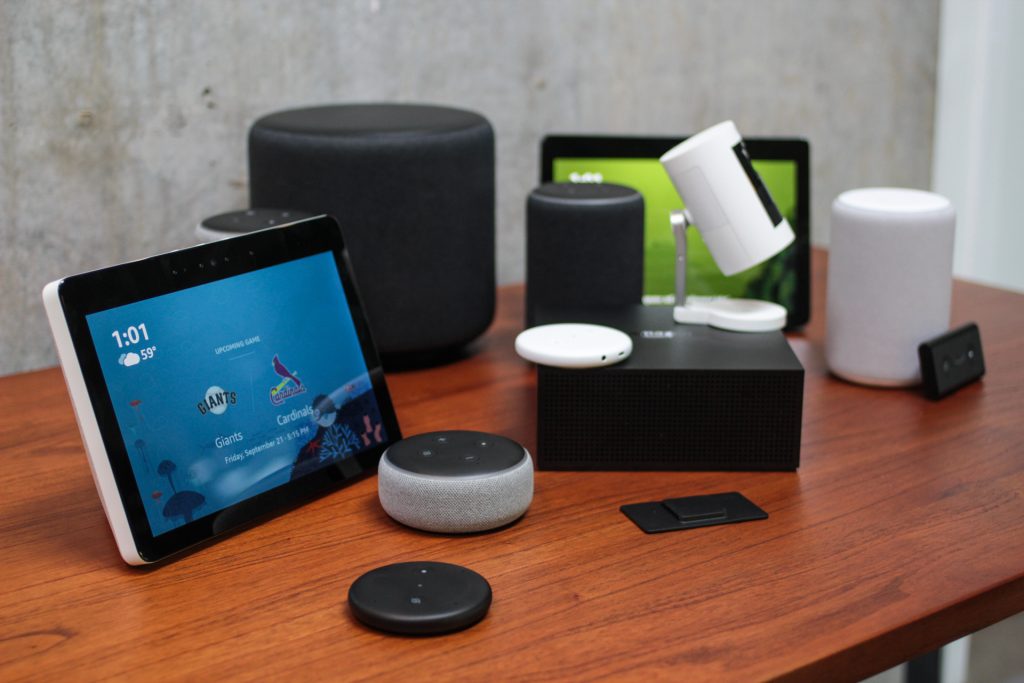
Amazon Hardware Event 2018
From techcrunch.com


Echo HomePod? Amazon wants you to build your own — by Brian Heater
One of the bigger surprises at today’s big Amazon event was something the company didn’t announce. After a couple of years of speculation that the company was working on its own version of the Home…


The long list of new Alexa devices Amazon announced at its hardware event — by Everyone’s favorite trillion-dollar retailer hosted a private event today where they continued to…


Amazon introduces APL, a new design language for building Alexa skills for devices with screensAlong with the launch of the all-new Echo Show, the Alexa-powered device with a screen, Amazon also introduced a new design language for developers who want to build voice skills that include multimedia…

Excerpt:

Called Alexa Presentation Language, or APL, developers will be able to build voice-based apps that also include things like images, graphics, slideshows and video, and easily customize them for different device types – including not only the Echo Show, but other Alexa-enabled devices like Fire TV, Fire Tablet, and the small screen of the Alexa alarm clock, the Echo Spot.


From DSC:
This is a great move by Amazon — as NLP and our voices become increasingly important in how we “drive” and utilize our computing devices.


Amazon launches an Echo Wall Clock, because Alexa is gonna be everywhere — by Sarah Perez


Amazon’s new Echo lineup targets Google, Apple and Sonos — from engadget.com by Nicole Lee
Alexa, dominate the industry.

The business plan from here is clear: Companies pay a premium to be activated when users pose questions related to their products and services. “How do you cook an egg?” could pull up a Food Network tutorial; “How far is Morocco?” could enable the Expedia app.
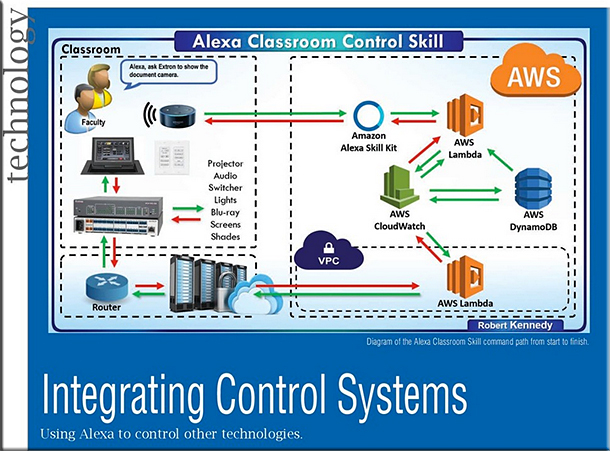
Also see how Alexa might be a key piece of smart classrooms in the future:
 

Courses in VR and AR will now be available thanks to Amazon Sumerian partnership — from vrfocus.com by Rebecca Hills-Duty
The Royal Melbourne Institute of Technology (RMIT) have announced a partnership with Amazon Web Services.

Excerpt:

Last year Amazon announced a new feature for its Amazon Web Services called Amazon Sumerian, a platform that would allow anyone to create full-featured virtual reality experiences. The Royal Melbourne Institute of Technology (RMIT) have now announced that it will be offering short courses in artificial intelligence (AI), augmented reality (AR) and VR thanks to a partnership with Amazon Web Services.

The new partnership between RMIT and Amazon Web Services was announced at the AWS Public Sector Summit and Canberra, Australia on Wednesday. The new courses will be using the Amazon Sumerian platform.

The newly launched courses includes Developing AI Strategy, Developing AR and VR Strategy and Developing AR and VR Applications. All of these have been adapted from the AWS Educate program, which was created to react to the changing nature of the workplace, and how immersive technology is increasingly relevant.


My team’s mission is to build a community of lifelong learners, successfully navigating the world of work … yes, sometimes your degree is the right solution education wise for a person, but throughout our lives, certainly I know in my digital career, constantly we need to be updating our skills and understand the new, emerging technology and talk with experts.”


Six tech giants sign health data interoperability pledge — from medicaldevice-network.com by GlobalData Healthcare

Excerpt:

Google, Amazon, and IBM joined forces with Microsoft, Salesforce, and Oracle to pledge to speed up the progress of health data standards and interoperability.

This big new alliance’s pledge will have a very positive impact on healthcare as it will become easier to share medical data among hospitals. Both physicians and patients will have easier access to information, which will lead to faster diagnosis and treatment.

The companies claim that this project will lead to better outcomes, higher patient satisfaction, and lower costs—a so-called “Triple Aim.”


From DSC:
No doubt that security will have to be very tight around these efforts.


Three AI and machine learning predictions for 2019 — from forbes.com by Daniel Newman

Excerpt:

What could we potentially see next year? New and innovative uses for machine learning? Further evolution of human and machine interaction? The rise of AI assistants? Let’s dig deeper into AI and machine learning predictions for the coming months.


2019 will be a year of development for the AI assistant, showing us just how powerful and useful these tools are. It will be in more places than your home and your pocket too. Companies such as Kia and Hyundai are planning to include AI assistants in their vehicles starting in 2019. Sign me up for a new car! I’m sure that Google, Apple, and Amazon will continue to make advancements to their AI assistants making our lives even easier.


DeepMind AI matches health experts at spotting eye diseases — from endgadget.com by Nick Summers

Excerpt:

DeepMind has successfully developed a system that can analyze retinal scans and spot symptoms of sight-threatening eye diseases. Today, the AI division — owned by Google’s parent company Alphabet — published “early results” of a research project with the UK’s Moorfields Eye Hospital. They show that the company’s algorithms can quickly examine optical coherence tomography (OCT) scans and make diagnoses with the same accuracy as human clinicians. In addition, the system can show its workings, allowing eye care professionals to scrutinize the final assessment.


Microsoft and Amazon launch Alexa-Cortana public preview for Echo speakers and Windows 10 PCs — from venturebeat.com by Khari Johnson

Excerpt:

Microsoft and Amazon will bring Alexa and Cortana to all Echo speakers and Windows 10 users in the U.S. [on 8/15/18]. As part of a partnership between the Seattle-area tech giants, you can say “Hey Cortana, open Alexa” to Windows 10 PCs and “Alexa, open Cortana” to a range of Echo smart speakers.

The public preview bringing the most popular AI assistant on PCs together with the smart speaker with the largest U.S. market share will be available to most people today but will be rolled out to all users in the country over the course of the next week, a Microsoft spokesperson told VentureBeat in an email.

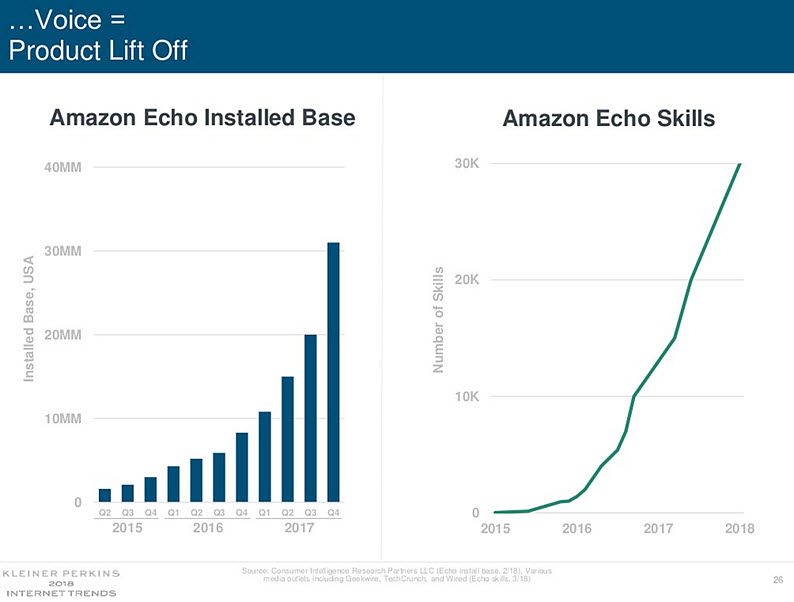
Each of the assistants brings unique features to the table. Cortana, for example, can schedule a meeting with Outlook, create location-based reminders, or draw on LinkedIn to tell you about people in your next meeting. And Alexa has more than 40,000 voice apps or skills made to tackle a broad range of use cases.


What Alexa can and cannot do on a PC — from venturebeat.com by Khari Johnson

Excerpt:

Whatever happened to the days of Alexa just being known as a black cylindrical speaker? Since the introduction of the first Echo in fall 2014, Amazon’s AI assistant has been embedded in a number of places, including car infotainment systems, Alexa smartphone apps, wireless headphones, Echo Show and Fire tablets, Fire TV Cube for TV control, the Echo Look with an AI-powered fashion assistant, and, in recent weeks, personal computers.

Select computers from HP, Acer, and others now make Alexa available to work seamlessly alongside Microsoft’s Cortana well ahead of the Alexa-Cortana partnership for Echo speakers and Windows 10 devices, a project that still has no launch date.


‘The Beginning of a Wave’: A.I. Tiptoes Into the Workplace — from nytimes.com by Steve Lohr

Excerpt:

There is no shortage of predictions about how artificial intelligence is going to reshape where, how and if people work in the future.

But the grand work-changing projects of A.I., like self-driving cars and humanoid robots, are not yet commercial products. A more humble version of the technology, instead, is making its presence felt in a less glamorous place: the back office.

New software is automating mundane office tasks in operations like accounting, billing, payments and customer service. The programs can scan documents, enter numbers into spreadsheets, check the accuracy of customer records and make payments with a few automated computer keystrokes.

The technology is still in its infancy, but it will get better, learning as it goes. So far, often in pilot projects focused on menial tasks, artificial intelligence is freeing workers from drudgery far more often than it is eliminating jobs.


AI for Virtual Medical Assistants – 4 Current Applications — from techemergence.com by Kumba Sennaar

Excerpt:

In an effort to reduce the administrative burden of medical transcription and clinical documentation, researchers are developing AI-driven virtual assistants for the healthcare industry.

This article will set out to determine the answers to the following questions:

  • What types of AI applications are emerging to improve management of administrative tasks, such as logging medical information and appointment notes, in the medical environment?
  • How is the healthcare market implementing these AI applications?


Amazon’s Facial Recognition Wrongly Identifies 28 Lawmakers, A.C.L.U. Says — from nytimes.com by Natasha Singer

Excerpt:

In the test, the Amazon technology incorrectly matched 28 members of Congress with people who had been arrested, amounting to a 5 percent error rate among legislators.

The test disproportionally misidentified African-American and Latino members of Congress as the people in mug shots.

“This test confirms that facial recognition is flawed, biased and dangerous,” said Jacob Snow, a technology and civil liberties lawyer with the A.C.L.U. of Northern California.

On Thursday afternoon, three of the misidentified legislators — Senator Edward J. Markey of Massachusetts, Representative Luis V. Gutiérrez of Illinois and Representative Mark DeSaulnier of California, all Democrats — followed up with a letter to Jeff Bezos, the chief executive of Amazon, saying there are “serious questions regarding whether Amazon should be selling its technology to law enforcement at this time.”


Back from January:


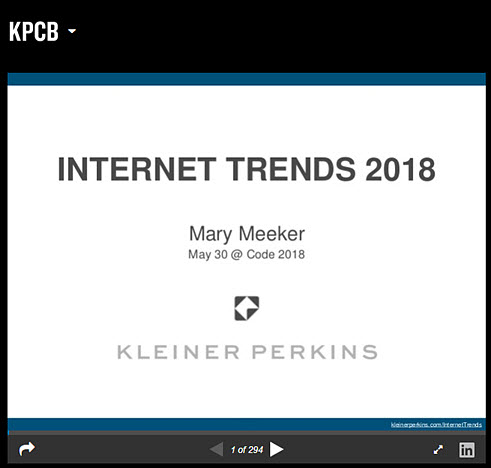
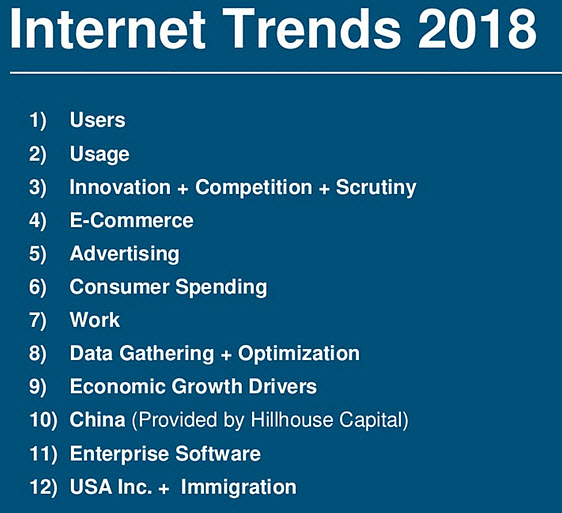
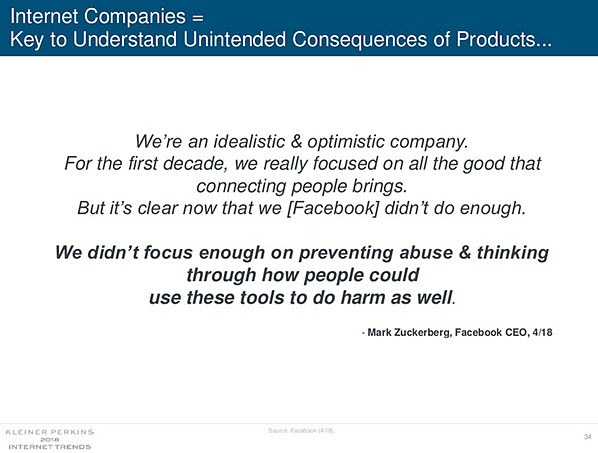
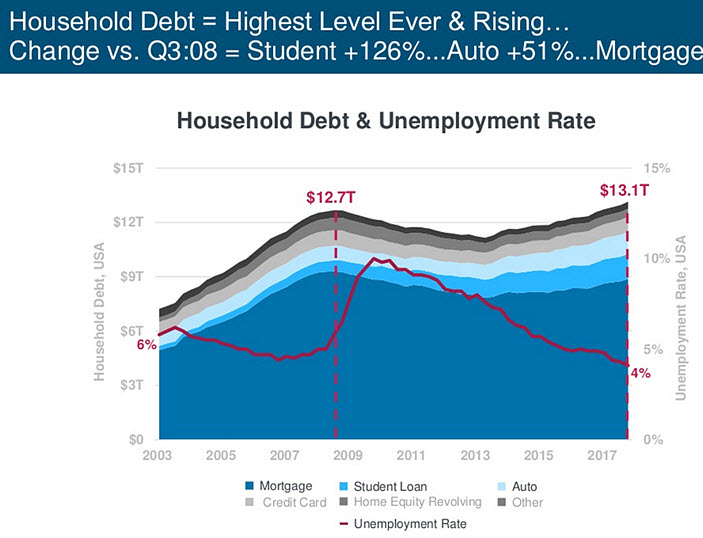
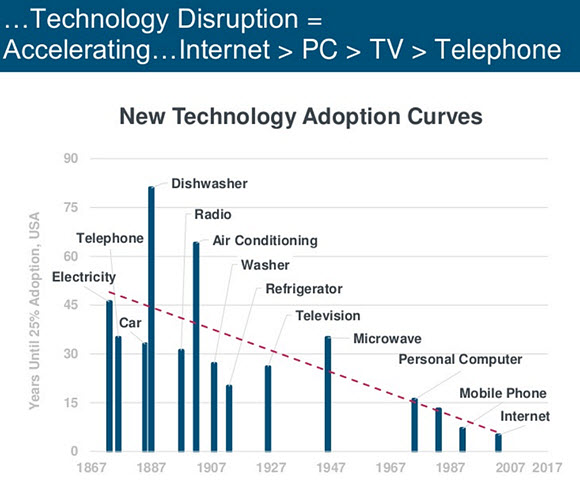
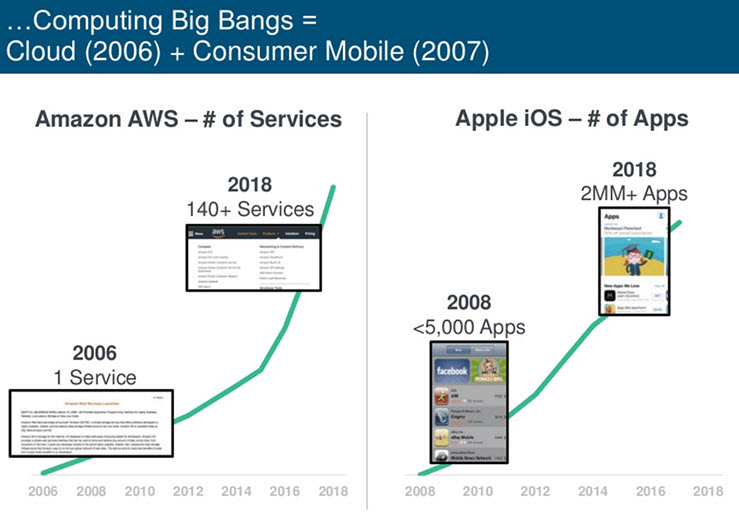
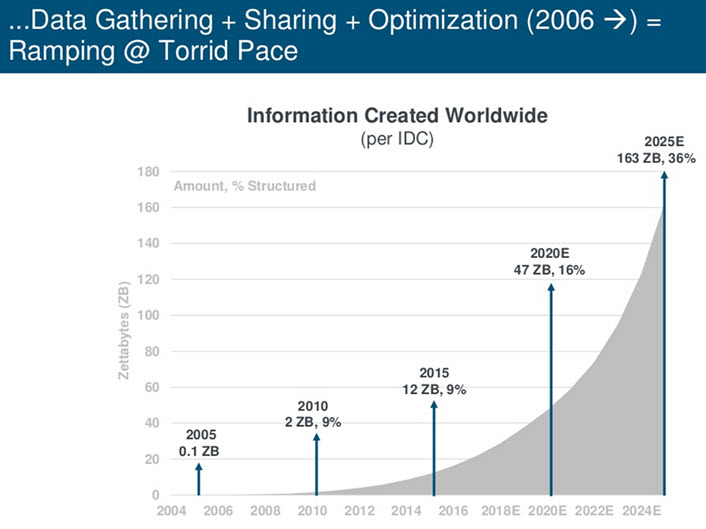
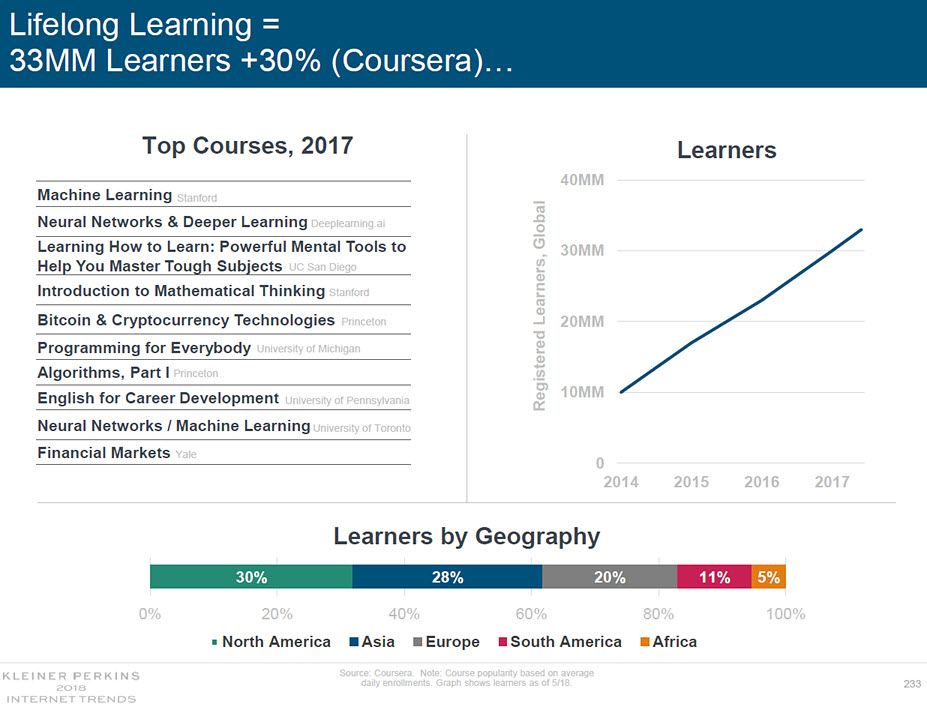
Below are some excerpted slides from her presentation…


Also see:

  • 20 important takeaways for learning world from Mary Meeker’s brilliant tech trends – from donaldclarkplanb.blogspot.com by Donald Clark
    Excerpt:
    Mary Meeker’s slide deck has a reputation of being the Delphic Oracle of tech. But, at 294 slides it’s a lot to take in. Don’t worry, I’ve been through them all. It has tons on economic stuff that is of marginal interest to education and training but there’s plenty to to get our teeth into. We’re not immune to tech trends, indeed we tend to follow in lock-step, just a bit later than everyone else. Among the data are lots of fascinating insights that point the way forward in terms of what we’re likely to be doing over the next decade. So here’s a really quick, top-end summary for folk in the learning game.


“Educational content usage online is ramping fast” with over 1 billion daily educational videos watched. There is evidence that use of the Internet for informal and formal learning is taking off.


10 Big Takeaways From Mary Meeker’s Widely-Read Internet Report — from fortune.com by  Leena Rao


Alexa creepily recorded a family’s private conversations, sent them to business associate — from usatoday.com by Elizabeth Weise

Excerpt:

In this instance, a random series of disconnected conversations got interpreted by Alexa as a specific and connected series of commands.

It doesn’t appear that the family members actually heard Alexa asking who it should send a message to, or confirming that it should be sent.

That’s probably a function of how good the Echo’s far field voice recognition is. Each speaker has seven microphones which are arrayed so the cylindrical speaker can pick up voice commands from far away or even in noisy rooms with lots of conversations going on.

Amazon says it is evaluating options to make cases such as happened to the Portland family less likely.

But given that Forrester predicts by 2020 almost 50% of American households will contain a smart speaker, expect more such confusions in the future.


Google’s robot assistant now makes eerily lifelike phone calls for you — from theguardian.com by Olivia Solon
Google Duplex contacts hair salon and restaurant in demo, adding ‘er’ and ‘mmm-hmm’ so listeners think it’s human

Excerpt:

Google’s virtual assistant can now make phone calls on your behalf to schedule appointments, make reservations in restaurants and get holiday hours.

The robotic assistant uses a very natural speech pattern that includes hesitations and affirmations such as “er” and “mmm-hmm” so that it is extremely difficult to distinguish from an actual human phone call.

The unsettling feature, which will be available to the public later this year, is enabled by a technology called Google Duplex, which can carry out “real world” tasks on the phone, without the other person realising they are talking to a machine. The assistant refers to the person’s calendar to find a suitable time slot and then notifies the user when an appointment is scheduled.


Google employees quit over the company’s military AI project — from thenextweb.com by Tristan Greene

Excerpt:

About a dozen Google employees reportedly left the company over its insistence on developing AI for the US military through a program called Project Maven. Meanwhile 4,000 others signed a petition demanding the company stop.

It looks like there’s some internal confusion over whether the company’s “Don’t Be Evil” motto covers making machine learning systems to aid warfare.


The link between big tech and defense work — from wired.com by Nitasha Tiku

Except:

FOR MONTHS, A growing faction of Google employees has tried to force the company to drop out of a controversial military program called Project Maven. More than 4,000 employees, including dozens of senior engineers, have signed a petition asking Google to cancel the contract. Last week, Gizmodo reported that a dozen employees resigned over the project. “There are a bunch more waiting for job offers (like me) before we do so,” one engineer says. On Friday, employees communicating through an internal mailing list discussed refusing to interview job candidates in order to slow the project’s progress.

Other tech giants have recently secured high-profile contracts to build technology for defense, military, and intelligence agencies. In March, Amazon expanded its newly launched “Secret Region” cloud services supporting top-secret work for the Department of Defense. The same week that news broke of the Google resignations, Bloomberg reported that Microsoft locked down a deal with intelligence agencies. But there’s little sign of the same kind of rebellion among Amazon and Microsoft workers.


Amazon urged not to sell facial recognition tool to police — from wpxi.com by Gene Johnson

Excerpt:

Facebook SEATTLE (AP) – The American Civil Liberties Union and other privacy advocates are asking Amazon to stop marketing a powerful facial recognition tool to police, saying law enforcement agencies could use the technology to “easily build a system to automate the identification and tracking of anyone.”

The tool, called Rekognition, is already being used by at least one agency – the Washington County Sheriff’s Office in Oregon – to check photographs of unidentified suspects against a database of mug shots from the county jail, which is a common use of such technology around the country.


From DSC:
Google’s C-Suite — as well as the C-Suites at Microsoft, Amazon, and other companies — needs to be very careful these days, as they could end up losing the support/patronage of a lot of people — including more of their own employees. It’s not an easy task to know how best to build and use technologies in order to make the world a better place…to create a dream vs. a nightmare for our future. But just because we can build something, doesn’t mean we should.


The Complete Guide to Conversational Commerce | Everything you need to know. — from chatbotsmagazine.com by Matt Schlicht

Excerpt:

What is conversational commerce? Why is it such a big opportunity? How does it work? What does the future look like? How can I get started? These are the questions I’m going to answer for you right now.
…
The guide covers:

  • An introduction to conversational commerce.
  • Why conversational commerce is such a big opportunity.
  • Complete breakdown of how conversational commerce works.
  • Extensive examples of conversational commerce using chatbots and voicebots.
  • How artificial intelligence impacts conversational commerce.
  • What the future of conversational commerce will look like.


Definition: Conversational commerce is an automated technology, powered by rules and sometimes artificial intelligence, that enables online shoppers and brands to interact with one another via chat and voice interfaces.


Notes from the AI frontier: Applications and value of deep learning — from mckinsey.com by Michael Chui, James Manyika, Mehdi Miremadi, Nicolaus Henke, Rita Chung, Pieter Nel, and Sankalp Malhotra

Excerpt:

Artificial intelligence (AI) stands out as a transformational technology of our digital age—and its practical application throughout the economy is growing apace. For this briefing, Notes from the AI frontier: Insights from hundreds of use cases (PDF–446KB), we mapped both traditional analytics and newer “deep learning” techniques and the problems they can solve to more than 400 specific use cases in companies and organizations. Drawing on McKinsey Global Institute research and the applied experience with AI of McKinsey Analytics, we assess both the practical applications and the economic potential of advanced AI techniques across industries and business functions. Our findings highlight the substantial potential of applying deep learning techniques to use cases across the economy, but we also see some continuing limitations and obstacles—along with future opportunities as the technologies continue their advance. Ultimately, the value of AI is not to be found in the models themselves, but in companies’ abilities to harness them.

It is important to highlight that, even as we see economic potential in the use of AI techniques, the use of data must always take into account concerns including data security, privacy, and potential issues of bias.

  1. Mapping AI techniques to problem types
  2. Insights from use cases
  3. Sizing the potential value of AI
  4. The road to impact and value


AI for Good — from re-work.co by Ali Shah, Head of Emerging Technology and Strategic Direction – BBC


Algorithms are making the same mistakes assessing credit scores that humans did a century ago — from qz.com by Rachel O’Dwyer


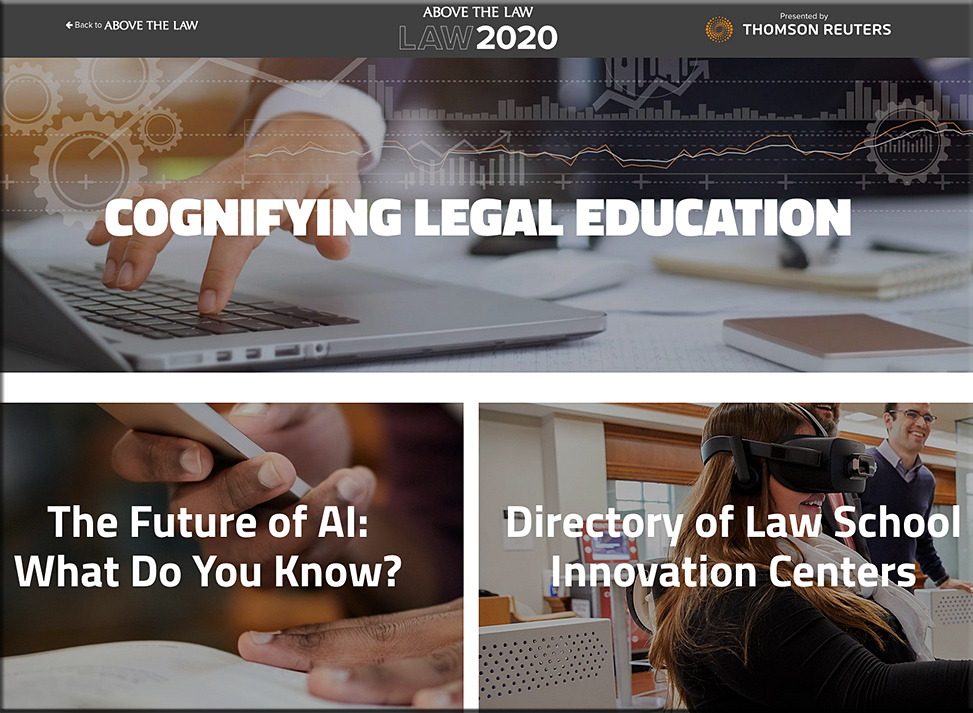
Welcome to Law2020: Artificial Intelligence and the Legal Profession — from abovethelaw.com by David Lat and Brian Dalton
What do AI, machine learning, and other cutting-edge technologies mean for lawyers and the legal world?

Excerpt:

Artificial intelligence has been declared “[t]he most important general-purpose technology of our era.” It should come as no surprise to learn that AI is transforming the legal profession, just as it is changing so many other fields of endeavor.

What do AI, machine learning, and other cutting-edge technologies mean for lawyers and the legal world? Will AI automate the work of attorneys — or will it instead augment, helping lawyers to work more efficiently, effectively, and ethically?


How artificial intelligence is transforming the world — from brookings.edu by Darrell M. West and John R. Allen

Summary

Artificial intelligence (AI) is a wide-ranging tool that enables people to rethink how we integrate information, analyze data, and use the resulting insights to improve decision making—and already it is transforming every walk of life. In this report, Darrell West and John Allen discuss AI’s application across a variety of sectors, address issues in its development, and offer recommendations for getting the most out of AI while still protecting important human values.

Table of Contents

I. Qualities of artificial intelligence
II. Applications in diverse sectors
III. Policy, regulatory, and ethical issues
IV. Recommendations
V. Conclusion

…
In order to maximize AI benefits, we recommend nine steps for going forward:

  • Encourage greater data access for researchers without compromising users’ personal privacy,
  • invest more government funding in unclassified AI research,
  • promote new models of digital education and AI workforce development so employees have the skills needed in the 21st-century economy,
  • create a federal AI advisory committee to make policy recommendations,
  • engage with state and local officials so they enact effective policies,
  • regulate broad AI principles rather than specific algorithms,
  • take bias complaints seriously so AI does not replicate historic injustice, unfairness, or discrimination in data or algorithms,
  • maintain mechanisms for human oversight and control, and
  • penalize malicious AI behavior and promote cybersecurity.


Seven Artificial Intelligence Advances Expected This Year  — from forbes.com

Excerpt:

Artificial intelligence (AI) has had a variety of targeted uses in the past several years, including self-driving cars. Recently, California changed the law that required driverless cars to have a safety driver. Now that AI is getting better and able to work more independently, what’s next?


Google Cofounder Sergey Brin Warns of AI’s Dark Side — from wired.com by Tom Simonite

Excerpt (emphasis DSC):

When Google was founded in 1998, Brin writes, the machine learning technique known as artificial neural networks, invented in the 1940s and loosely inspired by studies of the brain, was “a forgotten footnote in computer science.” Today the method is the engine of the recent surge in excitement and investment around artificial intelligence. The letter unspools a partial list of where Alphabet uses neural networks, for tasks such as enabling self-driving cars to recognize objects, translating languages, adding captions to YouTube videos, diagnosing eye disease, and even creating better neural networks.
…
As you might expect, Brin expects Alphabet and others to find more uses for AI. But he also acknowledges that the technology brings possible downsides. “Such powerful tools also bring with them new questions and responsibilities,” he writes. AI tools might change the nature and number of jobs, or be used to manipulate people, Brin says—a line that may prompt readers to think of concerns around political manipulation on Facebook. Safety worries range from “fears of sci-fi style sentience to the more near-term questions such as validating the performance of self-driving cars,” Brin writes.


“The new spring in artificial intelligence is the most significant development in computing in my lifetime,” Brin writes—no small statement from a man whose company has already wrought great changes in how people and businesses use computers.


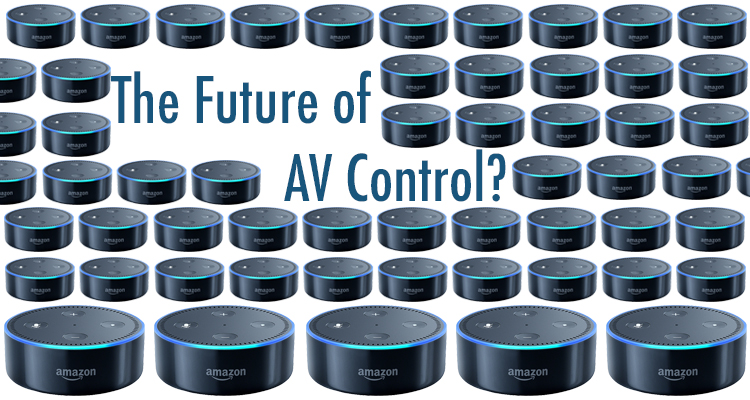
Amazon CEO Jeff Bezos’ personal AV tech controls the future of AV and doesn’t even realize it — from ravepubs.com by Gary Kayye

Excerpt:

But it dawned on me today that the future of our very own AV market may not be in the hands of any new product, new technology or even an AV company at all. In fact, there’s likely one AV guy (or girl) out there, today, that controls the future of AV for all of us, but doesn’t even know it, yet.

I’m talking about Jeff Bezos’ personal AV technician. Yes, that Jeff Bezos — the one who started Amazon.

Follow my logic.

The Amazon Alexa is AMAZING. Probably the most amazing thing since Apple’s iPhone. And, maybe even more so. The iPhone was revolutionary as it was a handheld phone, an email client, notes taker, voice recorder, calendar, to-do list, wrist watch and flashlight — all in one. It replaced like 10 things I was using every single day. And I didn’t even mention the camera!
…
Alexa seamlessly and simply connects to nearly everything you want to connect it to. And, it’s updated weekly — yes, weekly — with behind-the-scenes Friday-afternoon firmware and software upgrades. So, just when you think Alexa doesn’t do something you want it to do, she can — you just have to wait until an upcoming Friday — as someone will add that functionality. And, at any time, you can add Alexa SKILLS to yours and have third-party control of your Lutron lighting system, your shades and blinds, your HVAC, your TV, your DVR, your CableTV box, your SONOS, your home security system, your cameras and even your washer and dryer (yes, I have that functionality — even though I can’t find a use for it yet). It can even call people, play any radio station in the world, play movie previews, play Jeopardy!, play Sirius/XM radio — I mean, it can do nearly anything. It’s squarely aimed at the average consumer or home application — all to simplify your life.

But it could EASILY be upgraded to control everything. I mean everything. Projectors, digital signage networks, AV-over-IP systems, scalers, switchers, audio systems, commercial-grade lighting systems, rooms, buildings, etc. — you get the idea.


From DSC:
By the way, I wouldn’t be so sure that Bezos doesn’t realize this; there’s very little that gets by that guy.


Also see:

Crestron to Ship AirBoard Whiteboarding Solution — from ravepubs.com by Sara Abrons

Excerpt:

Crestron will soon be shipping the Crestron AirBoard PoE electronic whiteboard technology. Crestron AirBoard enables viewing of electronic whiteboard content on any display device, thereby solving the problem of meeting participants — remote participants, especially — not being able to see the whiteboard unless they’re seated with a direct line of sight.
…
With Crestron AirBoard, annotations can be saved and then posted, emailed, or texted to either a central web page (education applications) or to invited participants (corporate applications). Meeting participants simply choose “whiteboard” as a source on the in-room Crestron TSW or Crestron Mercury touch screen to start the session. When “end meeting” is selected, the user is prompted to save and send the file.


Pixar co-founder teleported live into a virtual classroom with students in Slough — from pressreleases.responsesource.com
Game-changing ENGAGE platform beams in the best teachers from around the world.

Excerpt:

25 April 2018: Today, the boring classroom lesson finally gets consigned to the history books when technology pioneers, Immersive VR Education, beam experts from California and Dubai into a virtual classroom to teach students at Langley College near Slough, via a short trip to the moon.

Pixar co-founder, Loren Carpenter, will be ‘beamed’ in to the virtual reality (VR) classroom live from the US so that IT and gaming students at Langley College, part of the Windsor Forest Colleges Group, can learn from one of the founding fathers of computer programming for animation and film.

David Whelan, CEO of Immersive VR Education, says, “This is a pivotal moment in the history of learning. ENGAGE allows students to not only experience the environment they are learning about in virtual reality, but have the best teachers from around the globe join them in a virtual classroom.”


Unleash the Power of Storytelling With These New AR and VR Tools — from edsurge.com by Jaime Donally

Excerpt:

A compelling use for using immersive technology, like augmented and virtual reality, is learning through storytelling. Stories are a powerful way to deliver meaningful and relevant content. The learning is heightened when paired with a story that penetrates the heart of the student. Let’s explore some of the newest and best tools out there and see if we can’t get students to create their happily ever after.


Amazon Embraces AR and VR With Sumerian Platform — from vrfocus.com by Rebecca Hills-Duty
Amazon is developing a new platform for creating VR and AR apps as part of Amazon Web Services.

Excerpt:

Amazon is no stranger to changing company direction and expanding into new markets. Starting out as an online bookstore, Amazon is now one of the giants of technology, with fingers in almost every conceivable pie. Small wonder, then, that the company is working towards a new platform for augmented reality (AR) and virtual reality (VR).

The platform has been named Sumerian, and is designed to be an all-in-one development platform for the building for VR and AR apps for both smartphones and VR headsets, and eventually, VR and AR apps that can run direct from the web browser.


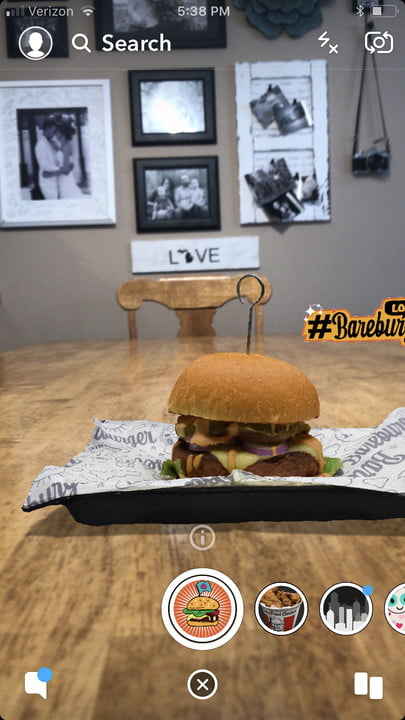
You AR what you eat — augmented reality menus are coming to Snapchat — from digitaltrends.com by Hillary Grigonis

Excerpt:

The smells wafting from the kitchen, a crinkled and torn paper menu, and the fleeting glimpses of orders the waiter is deftly balancing on his way to another table may no longer be the only ways to preview what you eat at a restaurant. Start-up Kabaq is aiming to bring the next big technology-influenced change for restaurants and foodies since Instagram sparked a surge in food photography: an augmented reality menu.

Burger chain Bareburger will be among the first restaurants to allow customers to see their meal right in front of them — before ever placing an order.


An AI Bot for the Teacher — with thanks to Karthik Reddy for this resource

Artificial intelligence is the stuff of science fiction – if you are old enough, you will remember those Terminator movies a good few years ago, where mankind was systematically being wiped out by computers.

The truth is that AI, though not quite at Terminator level yet, is already a fact and something that most of us have encountered already. If you have ever used the virtual assistant on your phone or the Ask Google feature, you have used AI.

Some companies are using it as part of their sales and marketing strategies. An interesting example is Lowe’s Home Improvement that, instead of chatbots, uses actual robots into their physical stores. These robots are capable of helping customers locate products that they’re interested in, taking a lot of the guesswork out of the entire shopping experience.

Of course, there are a lot of different potential applications for AI that are very interesting. Imagine an AI teaching assistant, for example. They could help grade papers, fact check and assist with lesson planning, etc., all to make our harassed teachers’ lives a little easier.

Chatbots could be programmed as tutors to help kids better understand core topics if they are struggling with them, ensuring that they don’t hold the rest of the class up. And, for kids who have a real affinity with the subject, help them learn more about what they are interested in.

It could also help enhance long distance training.  Imagine if your students could get instant answers to basic questions through a simple chatbot. Sure, if they were still not getting it, they would come through to you – the chatbot cannot replace a real, live, teacher after all. But it could save you a lot of time and frustration.

Here, of course, we have only skimmed the surface of what artificial intelligence is capable of. Why not look through this infographic to see how different brands have been using this tech, and see what possible applications of it we might expect.


Brands that use AI to enhance marketing (infographic) 2018
From 16best.net with thanks to Karthik Reddy for this resource


From DSC:
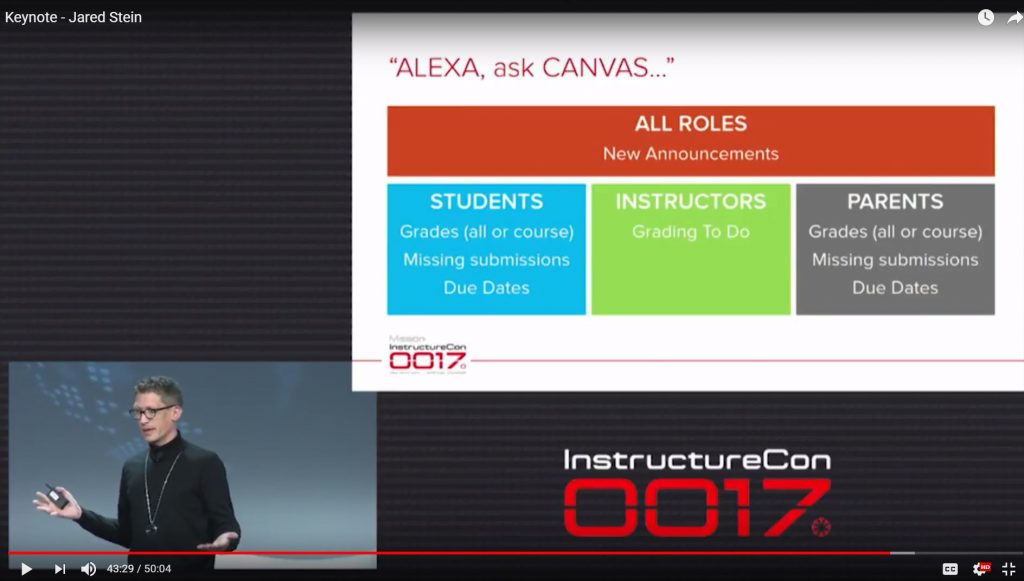
Check out the 2 items below regarding the use of voice as it pertains to using virtual assistants: 1 involves healthcare and the other involves education (Canvas).


1) Using Alexa to go get information from Canvas:

“Alexa Ask Canvas…”

Example questions as a student:

  • What grades am I getting in my courses?
  • What am I missing?

Example question as a teacher:

  • How many submissions do I need to grade?

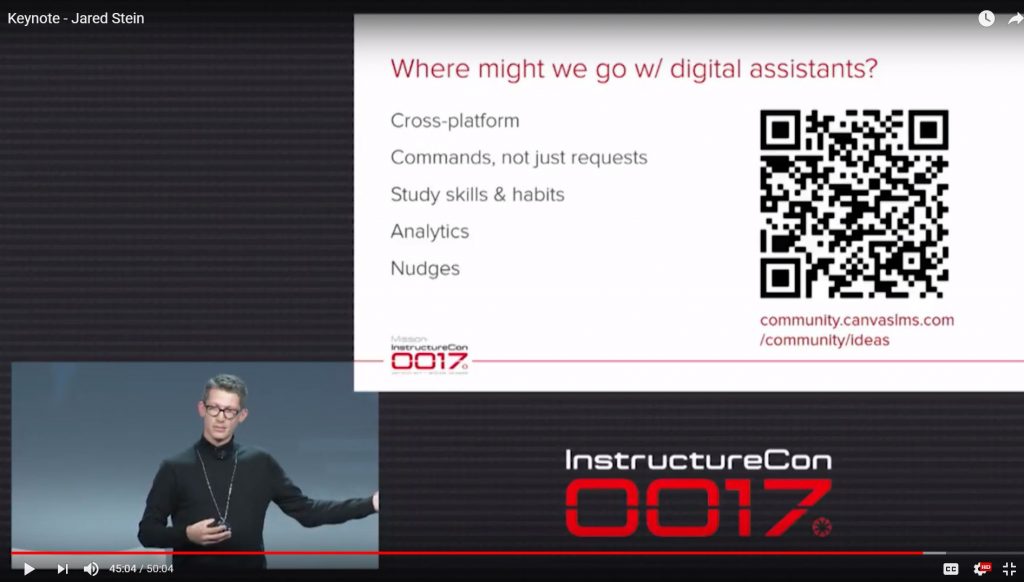
See the section on asking Alexa questions…roughly between http://www.youtube.com/watch?v=e-30ixK63zE &t=38m18s through http://www.youtube.com/watch?v=e-30ixK63zE &t=46m42s


2) Why voice assistants are gaining traction in healthcare — from samsungnext.com by Pragati Verma

Excerpt (emphasis DSC):

The majority of intelligent voice assistant platforms today are built around smart speakers, such as the Amazon Echo and Google Home. But that might change soon, as several specialized devices focused on the health market are slated to be released this year.

One example is ElliQ, an elder care assistant robot from Samsung NEXT portfolio company Intuition Robotics. Powered by AI cognitive technology, it encourages an active and engaged lifestyle. Aimed at older adults aging in place, it can recognizing their activity level and suggest activities, while also making it easier to connect with loved ones.

Pillo is an example of another such device. It is a robot that combines machine learning, facial recognition, video conferencing, and automation to work as a personal health assistant. It can dispense vitamins and medication, answer health and wellness questions in a conversational manner, securely sync with a smartphone and wearables, and allow users to video conference with health care professionals.

“It is much more than a smart speaker. It is HIPAA compliant and it recognizes the user; acknowledges them and delivers care plans,” said Rogers, whose company created the voice interface for the platform.

Orbita is now working with toSense’s remote monitoring necklace to track vitals and cardiac fluids as a way to help physicians monitor patients remotely. Many more seem to be on their way.

“Be prepared for several more devices like these to hit the market soon,” Rogers predicted.


From DSC:

I see the piece about Canvas and Alexa as a great example of where a piece of our future learning ecosystems are heading towards — in fact, it’s been a piece of my Learning from the Living [Class] Room vision for a while now. The use of voice recognition/NLP is only picking up steam; look for more of this kind of functionality in the future. 


The Living [Class] Room -- by Daniel Christian -- July 2012 -- a second device used in conjunction with a Smart/Connected TV


AWS unveils ‘Transcribe’ and ‘Translate’ machine learning services — from business-standard.com

Excerpts:

  • Amazon “Transcribe” provides grammatically correct transcriptions of audio files to allow audio data to be analyzed, indexed and searched.
  • Amazon “Translate” provides natural sounding language translation in both real-time and batch scenarios.


Google’s ‘secret’ smart city on Toronto’s waterfront sparks row — from bbc.com by Robin Levinson-King BBC News, Toronto

Excerpt:

The project was commissioned by the publically funded organisation Waterfront Toronto, who put out calls last spring for proposals to revitalise the 12-acre industrial neighbourhood of Quayside along Toronto’s waterfront.

Prime Minister Justin Trudeau flew down to announce the agreement with Sidewalk Labs, which is owned by Google’s parent company Alphabet, last October, and the project has received international attention for being one of the first smart-cities designed from the ground up.

But five months later, few people have actually seen the full agreement between Sidewalk and Waterfront Toronto.

As council’s representative on Waterfront Toronto’s board, Mr Minnan-Wong is the only elected official to actually see the legal agreement in full. Not even the mayor knows what the city has signed on for.

“We got very little notice. We were essentially told ‘here’s the agreement, the prime minister’s coming to make the announcement,'” he said.

“Very little time to read, very little time to absorb.”

Now, his hands are tied – he is legally not allowed to comment on the contents of the sealed deal, but he has been vocal about his belief it should be made public.

“Do I have concerns about the content of that agreement? Yes,” he said.

“What is it that is being hidden, why does it have to be secret?”

From DSC:
Google needs to be very careful here. Increasingly so these days, our trust in them (and other large tech companies) is at stake.


Addendum on 4/16/18 with thanks to Uros Kovacevic for this resource:
Human lives saved by robotic replacements — from injuryclaimcoach.com

Excerpt:

For academics and average workers alike, the prospect of automation provokes concern and controversy. As the American workplace continues to mechanize, some experts see harsh implications for employment, including the loss of 73 million jobs by 2030. Others maintain more optimism about the fate of the global economy, contending technological advances could grow worldwide GDP by more than $1.1 trillion in the next 10 to 15 years. Whatever we make of these predictions, there’s no question automation will shape the economic future of the nation – and the world.

But while these fiscal considerations are important, automation may positively affect an even more essential concern: human life. Every day, thousands of Americans risk injury or death simply by going to work in dangerous conditions. If robots replaced them, could hundreds of lives be saved in the years to come?

In this project, we studied how many fatal injuries could be averted if dangerous occupations were automated. To do so, we analyzed which fields are most deadly and the likelihood of their automation according to expert predictions. To see how automation could save Americans’ lives, keep reading.

Also related to this item is :
How AI is improving the landscape of work  — from forbes.com by Laurence Bradford

Excerpts:

There have been a lot of sci-fi stories written about artificial intelligence. But now that it’s actually becoming a reality, how is it really affecting the world? Let’s take a look at the current state of AI and some of the things it’s doing for modern society.

  • Creating New Technology Jobs
  • Using Machine Learning To Eliminate Busywork
  • Preventing Workplace Injuries With Automation
  • Reducing Human Error With Smart Algorithms

From DSC:
This is clearly a pro-AI piece. Not all uses of AI are beneficial, but this article mentions several use cases where AI can make positive contributions to society.


It’s About Augmented Intelligence, not Artificial Intelligence — from informationweek.com
The adoption of AI applications isn’t about replacing workers but helping workers do their jobs better.


From DSC:
This article is also a pro-AI piece. But again, not all uses of AI are beneficial. We need to be aware of — and involved in — what is happening with AI.


Investing in an Automated Future — from clomedia.com by Mariel Tishma
Employers recognize that technological advances like AI and automation will require employees with new skills. Why are so few investing in the necessary learning?


© 2025 | Daniel Christian