The Impact of Technology on Modern Legal Services — from smdailyjournal.com

In an ever-evolving digital landscape, the fusion of technology and legal services has ushered in a new era of efficiency, accessibility, and innovation. The traditional image of legal professionals buried in stacks of paperwork and endless research has been transformed by cutting-edge technologies that promise to revolutionize how legal services are delivered, accessed, and executed. From artificial intelligence to blockchain, cloud computing to automation, the impact of technology on modern legal services is palpable and profound.

Technology Trends Shaping Legal Services
The legal industry is experiencing a seismic shift driven by technology, with key trends reshaping legal services. Artificial Intelligence (AI) is revolutionizing legal research, document analysis, and predictive analytics, enabling legal professionals to streamline their workflow and deliver more accurate and timely insights to clients. Blockchain technology improves the safety and transparency of legal transactions, while cloud computing optimizes data storage and accessibility in the legal sector.


Clients Care About Legal Tech: Dig Into Legal Tech and Tech Related Careers. — from legaltalknetwork.com by Dan Lear and Adriana Linares
A new survey proves clients care about a lawyer’s tech skills. Hear about adding the latest tech and about emerging jobs in the legal tech field.

A new survey finds that clients care deeply about their attorney’s tech tools and tech skills. The numbers don’t lie: Legal tech matters. An efficient, integrated system is no longer “nice to have.” It’s table stakes, from case management to client communications to online filing and billing. 


17 so that Christ may dwell in your hearts through faith. And I pray that you, being rooted and established in love, 18 may have power, together with all the Lord’s holy people, to grasp how wide and long and high and deep is the love of Christ, 19 and to know this love that surpasses knowledge—that you may be filled to the measure of all the fullness of God.

1 Chronicles 29:11 (New International Version) 

Yours, Lord, is the greatness and the power and the glory and the majesty and the splendor, for everything in heaven and earth is yours. Yours, Lord, is the kingdom; you are exalted as head over all.

Proverbs 30:7-9 (NIV)

7 “Two things I ask of you, Lord;
do not refuse me before I die:
8 Keep falsehood and lies far from me;
give me neither poverty nor riches,
but give me only my daily bread.
9 Otherwise, I may have too much and disown you
and say, ‘Who is the Lord?’
Or I may become poor and steal,
and so dishonor the name of my God.

2 Corinthians 9:6 (NIV)
Generosity Encouraged

Remember this: Whoever sows sparingly will also reap sparingly, and whoever sows generously will also reap generously.

Bear with each other and forgive one another if any of you has a grievance against someone. Forgive as the Lord forgave you.
 

A Right to Warn about Advanced Artificial Intelligence — from righttowarn.ai

We are current and former employees at frontier AI companies, and we believe in the potential of AI technology to deliver unprecedented benefits to humanity.

We also understand the serious risks posed by these technologies. These risks range from the further entrenchment of existing inequalities, to manipulation and misinformation, to the loss of control of autonomous AI systems potentially resulting in human extinction. AI companies themselves have acknowledged these risks [1, 2, 3], as have governments across the world [4, 5, 6] and other AI experts [7, 8, 9].

We are hopeful that these risks can be adequately mitigated with sufficient guidance from the scientific community, policymakers, and the public. However, AI companies have strong financial incentives to avoid effective oversight, and we do not believe bespoke structures of corporate governance are sufficient to change this.


Doing Stuff with AI: Opinionated Midyear Edition — from oneusefulthing.org by Ethan Mollick

Every six months or so, I write a guide to doing stuff with AI. A lot has changed since the last guide, while a few important things have stayed the same. It is time for an update.
…
To learn to do serious stuff with AI, choose a Large Language Model and just use it to do serious stuff – get advice, summarize meetings, generate ideas, write, produce reports, fill out forms, discuss strategy – whatever you do at work, ask the AI to help. A lot of people I talk to seem to get the most benefit from engaging the AI in conversation, often because it gives good advice, but also because just talking through an issue yourself can be very helpful. I know this may not seem particularly profound, but “always invite AI to the table” is the principle in my book that people tell me had the biggest impact on them. You won’t know what AI can (and can’t) do for you until you try to use it for everything you do. And don’t sweat prompting too much, though here are some useful tips, just start a conversation with AI and see where it goes.

You do need to use one of the most advanced frontier models, however.


Introducing Stable Audio Open – An Open Source Model for Audio Samples and Sound Design — from stability.ai; via Rundown AI

Key Takeaways:

  • Stable Audio Open is an open source text-to-audio model for generating up to 47 seconds of samples and sound effects.
  • Users can create drum beats, instrument riffs, ambient sounds, foley and production elements.
  • The model enables audio variations and style transfer of audio samples.

Some comments from Rundown AI:

Why it matters: While the AI advances in text-to-image models have been the most visible (literally), both video and audio are about to take the same leap. Putting these tools in the hands of creatives will redefine traditional workflows — from musicians brainstorming new beats to directors crafting sound effects for film and TV.


Exclusive: AI isn’t a daily habit yet for teens, young adults — from axios.com by Scott Rosenberg

Young Americans are quickly embracing generative AI as a tool, but few have yet made it a part of their daily lives, according to new data shared exclusively with Axios from Common Sense Media, Hopelab and the Harvard Graduate School of Education’s Center for Digital Thriving.

Why it matters: Since the rise of the web 30 years ago, young users have typically adopted and shaped each new dominant tech platform.

By the numbers: The survey of 1,274 U.S.-based teens and young adults, conducted in October and November 2023, found that only 4% of respondents, all aged 14-22, said they use AI tools daily or almost daily.

As cited in the above article, also see:


Can Microsoft Copilot Replace Popular AI Tools Like ChatGPT, Gamma AI, and Midjourney? — from flexos.work by Daan van Rossum
Can Microsoft Copilot win from popular AI tools like ChatGPT, Gamma AI, and Midjourney, and which AI best fits your business?

From DSC:
The article talks about the pros and cons of Microsoft Copilot. But I really appreciated the following table/information:


Also regarding Microsoft and AI, see:

Windows Recall stores all your history UNENCRYPTED. — from bensbites.beehiiv.com by Ben Tossell

Remember Microsoft’s shiny new AI tool, “Recall”? It’s like your personal time machine, answering questions about your browsing history and laptop activity by taking screenshots every 5 seconds. Sounds cool, right? Well, it gets problematic.

What’s going on here?
Security researchers have found a potential privacy nightmare lurking within this seemingly convenient tool.

What does this mean?
Recall stores all those screenshots in an unencrypted database on your laptop. This means anyone with access to your device could potentially see everything you’ve been doing. Cybersecurity experts are already comparing it to spyware, and one ethical hacker even built a tool called “TotalRecall” (yes, like the movie) that can pull all the information Recall saves. Yikes.


Hybrid learning through podcasts: a practical approach — from timeshighereducation.com by Catherine Chambers
Adapting practice-based learning to a blend of synchronous and asynchronous delivery gives learners more control and creates opportunities for real-world learning of skills such as podcast production, writes Catherine Chambers

Hybrid learning provides students with greater control over their learning and enables the development of employability skills, supporting practice-based group work through in situ activities.

Aligned with Keele’s curriculum expectations framework, the module was designed around podcasts to support inclusivity, active learning, digital capability and external engagement.


Is College Worth It? — from pewresearch.org by Richard Fry, Dana Braga, and Kim Parker
As economic outcomes for young adults with and without degrees have improved, Americans hold mixed views on the value of college


From DSC:
I post items like this in the hopes that those working within the world of higher education will lower the price of obtaining a degree while moving much more aggressively to offer more affordable ways of learning throughout one’s life.


A relevant addendum on 6/6/24:


Universities Try 3-Year Degrees To Save Students Time, Money — from the74million.org by Elaine S. Povich
As states explore shorter degrees, some faculty say they undercut students’ education.

With college costs rising and some students and families questioning the return on investment of a four-year degree, a few pioneering state universities are exploring programs that would grant certain bachelor’s degrees in three years.

The programs, which also are being tried at some private schools, would require 90 credits instead of the traditional 120 for a bachelor’s degree, and wouldn’t require summer classes or studying over breaks. In some cases, the degrees would be designed to fit industry needs.


12 Shifts to Move from Teacher-Led to Student-Centered Environments — from gettingsmart.com by Kyle Wagner

Key Points

  • Despite modern technological advancements in classroom tools, many educational settings still center around a traditional model where the teacher is the primary source of information and students passively receive content.
  • Slowly, learning environments are inviting students to actively participate and take ownership of their learning through collaborative projects, inquiry-based experiences, and real-world problem-solving, thereby transforming traditional educational roles and practices.
 

How Humans Do (and Don’t) Learn— from drphilippahardman.substack.com by Dr. Philippa Hardman
One of the biggest ever reviews of human behaviour change has been published, with some eye-opening implications for how we design & deliver learning experiences

Excerpts (emphasis DSC):

This month, researchers from the University of Pennsylvania published one of the biggest ever reviews of behaviour change efforts – i.e. interventions which do (and don’t) lead to behavioural change in humans.
…
Research into human behaviour change suggests that, in order to impact capability in real, measurable terms, we need to rethink how we typically design and deliver training.

The interventions which we use most frequently to behaviour change – such as video + quiz approaches and one off workshops – have a negligible impact on measurable changes in human behaviour.

For learning professionals who want to change how their learners think and behave, this research shows conclusively the central importance of:

    1. Shifting attention away from the design of content to the design of context.
    2. Delivering sustained cycles of contextualised practice, support & feedback.


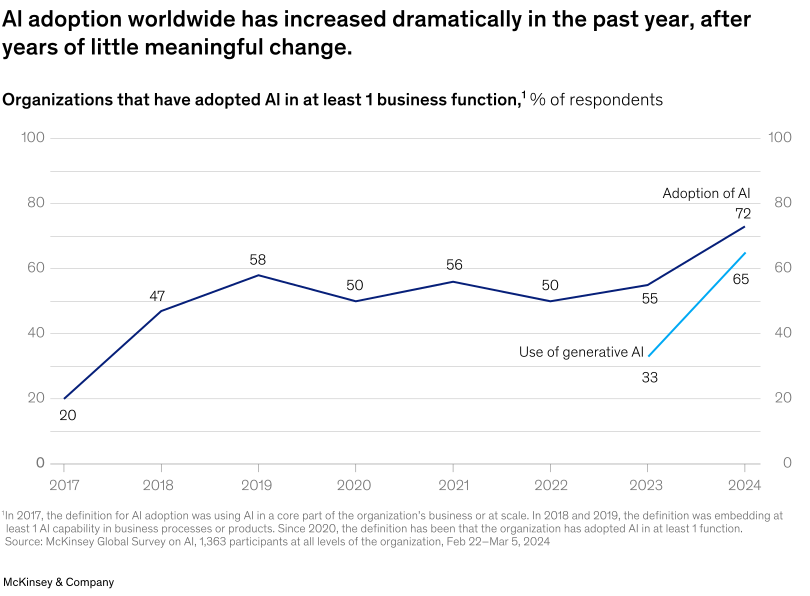
The state of AI in early 2024: Gen AI adoption spikes and starts to generate value — from mckinsey.com
As generative AI adoption accelerates, survey respondents report measurable benefits and increased mitigation of the risk of inaccuracy. A small group of high performers lead the way.

If 2023 was the year the world discovered generative AI (gen AI), 2024 is the year organizations truly began using—and deriving business value from—this new technology. In the latest McKinsey Global Survey on AI, 65 percent of respondents report that their organizations are regularly using gen AI, nearly double the percentage from our previous survey just ten months ago. Respondents’ expectations for gen AI’s impact remain as high as they were last year, with three-quarters predicting that gen AI will lead to significant or disruptive change in their industries in the years ahead.

Organizations are already seeing material benefits from gen AI use, reporting both cost decreases and revenue jumps in the business units deploying the technology. The survey also provides insights into the kinds of risks presented by gen AI—most notably, inaccuracy—as well as the emerging practices of top performers to mitigate those challenges and capture value.
.


.


What’s the future of AI? — from mckinsey.com
AI is here to stay. To outcompete in the future, organizations and individuals alike need to get familiar fast. This series of McKinsey Explainers dives deep into the seven technologies that are already shaping the years to come.

We’re in the midst of a revolution. Just as steam power, mechanized engines, and coal supply chains transformed the world in the 18th century, AI technology is currently changing the face of work, our economies, and society as we know it. We don’t know exactly what the future will look like. But we do know that these seven technologies will play a big role.
.


Generate an e-book in minutes with groqbook — from heatherbcooper.substack.com by Heather Cooper
Plus new Canva workflow tools, Perplexity Pages, and more
.

Introducing a whole new Canva, designed for work

The new Canva
Canva announced “a whole new Canva” to improve workplace collaborative creation and a revamped platform to simplify its tools for anyone to use.

At Canva Create, several AI features were announced that enhance the design and content creation process:

  1. Magic Design: Upload an image and select a style to get a curated selection of personalized templates.
  2. Magic Write: An AI-powered copywriting assistant that can generate written content from a text prompt, useful for presentations and website copy.
  3. Magic Eraser: This feature can remove unwanted objects or backgrounds from images.
  4. Magic Edit: Users can swap an object with something else entirely using generative AI.
  5. Beat Sync: Automatically matches video footage to a soundtrack of your choice.
  6. Translate: Automatically translates text in designs to over 100 different languages.

Tools are the next big thing in AI — from link.wired.com by Will Knight

Things might get more interesting in business settings as AI companies start deploying so-called “AI agents,” which can take action by operating other software on a computer or via the internet.

Anthropic, a competitor to OpenAI, announced a major new product today that attempts to prove the thesis that tool use is needed for AI’s next leap in usefulness.


Microsoft teams with Khan Academy to make its AI tutor free for K-12 educators and will develop a Phi-3 math model — from venturebeat.com by Ken Yeung

Microsoft is partnering with Khan Academy in a multifaceted deal to demonstrate how AI can transform the way we learn. The cornerstone of today’s announcement centers on Khan Academy’s Khanmigo AI agent. Microsoft says it will migrate the bot to its Azure OpenAI Service, enabling the nonprofit educational organization to provide all U.S. K-12 educators free access to Khanmigo.

In addition, Microsoft plans to use its Phi-3 model to help Khan Academy improve math tutoring and collaborate to generate more high-quality learning content while making more courses available within Microsoft Copilot and Microsoft Teams for Education.


One-Third of Teachers Have Already Tried AI, Survey Finds — from the74million.org by Kevin Mahnken
A RAND poll released last month finds English and social studies teachers embracing tools like ChatGPT.

One in three American teachers have used artificial intelligence tools in their teaching at least once, with English and social studies teachers leading the way, according to a RAND Corporation survey released last month. While the new technology isn’t yet transforming how kids learn, both teachers and district leaders expect that it will become an increasingly common feature of school life.


Professors Try ‘Restrained AI’ Approach to Help Teach Writing — from edsurge.com by Jeffrey R. Young
Can ChatGPT make human writing more efficient, or is writing an inherently time-consuming process best handled without AI tools?

This article is part of the guide: For Education, ChatGPT Holds Promise — and Creates Problems.

When ChatGPT emerged a year and half ago, many professors immediately worried that their students would use it as a substitute for doing their own written assignments — that they’d click a button on a chatbot instead of doing the thinking involved in responding to an essay prompt themselves.

But two English professors at Carnegie Mellon University had a different first reaction: They saw in this new technology a way to show students how to improve their writing skills.

“They start really polishing way too early,” Kaufer says. “And so what we’re trying to do is with AI, now you have a tool to rapidly prototype your language when you are prototyping the quality of your thinking.”

He says the concept is based on writing research from the 1980s that shows that experienced writers spend about 80 percent of their early writing time thinking about whole-text plans and organization and not about sentences.


On Building AI Models for Education — from aieducation.substack.com by Claire Zau
Google’s LearnLM, Khan Academy/MSFT’s Phi-3 Models, and OpenAI’s ChatGPT Edu

This piece primarily breaks down how Google’s LearnLM was built, and takes a quick look at Microsoft/Khan Academy’s Phi-3 and OpenAI’s ChatGPT Edu as alternative approaches to building an “education model” (not necessarily a new model in the latter case, but we’ll explain). Thanks to the public release of their 86-page research paper, we have the most comprehensive view into LearnLM. Our understanding of Microsoft/Khan Academy small language models and ChatGPT Edu is limited to the information provided through announcements, leaving us with less “under the hood” visibility into their development.


AI tutors are quietly changing how kids in the US study, and the leading apps are from China — from techcrunch.com by Rita Liao

Answer AI is among a handful of popular apps that are leveraging the advent of ChatGPT and other large language models to help students with everything from writing history papers to solving physics problems. Of the top 20 education apps in the U.S. App Store, five are AI agents that help students with their school assignments, including Answer AI, according to data from Data.ai on May 21.


Is your school behind on AI? If so, there are practical steps you can take for the next 12 months — from stefanbauschard.substack.com by Stefan Bauschard

If your school (district) or university has not yet made significant efforts to think about how you will prepare your students for a World of AI, I suggest the following steps:

July 24 – Administrator PD & AI Guidance
In July, administrators should receive professional development on AI, if they haven’t already. This should include…

August 24 –Professional Development for Teachers and Staff…
Fall 24 — Parents; Co-curricular; Classroom experiments…
December 24 — Revision to Policy…


New ChatGPT Version Aiming at Higher Ed — from insidehighered.com by Lauren Coffey
ChatGPT Edu, emerging after initial partnerships with several universities, is prompting both cautious optimism and worries.

OpenAI unveiled a new version of ChatGPT focused on universities on Thursday, building on work with a handful of higher education institutions that partnered with the tech giant.

The ChatGPT Edu product, expected to start rolling out this summer, is a platform for institutions intended to give students free access. OpenAI said the artificial intelligence (AI) toolset could be used for an array of education applications, including tutoring, writing grant applications and reviewing résumés.


The Magic of Storytelling: Lessons from Penn Jillette — from learningguild.com by David Kelly
This fall we’re celebrating 20 Years of DevLearn. As part of that celebration, I’m reflecting on the insights I’ve gained from some of my favorite DevLearn keynote speakers over the years. I kick off this series by revisiting The Magic of Storytelling and Learning from Penn Jillette, from DevLearn 2016.

At the heart of Jillette’s message is the power of storytelling. He demonstrates that, much like a magician’s performance, effective learning experiences are crafted from engaging narratives. These stories, although selectively told, can ethically captivate and teach, making the learning process more impactful. Jillette’s career itself is a story of transformation and adaptation, one that resonates deeply with the ongoing journey of a learning professional.


Also from The Learning Guild, see:

AI’s Fusion with Hands-On Workshops Is Transforming Learning — from learningguild.com by Markus Bernhardt

Complementing these conversational approaches are learning experiences enhanced with AI. I highlighted the fast-growing role of immersive scenarios and simulations, produced in tandem with AI and powered through AI in their delivery.

Moreover, the integration of voice interactions, advanced image processing, and augmented reality (AR) and virtual reality (VR) technologies provides additional tools to enrich learning experiences.
…
The rapid adoption of AI signifies a real shift for our industry, and we are able to see sparks of what is coming our way throughout 2024 and beyond.

Practicing difficult conversations
One of the most compelling applications I’ve seen lies in managerial and leadership training, specifically in navigating complex interpersonal dynamics: practicing difficult conversations. Through interactions with sophisticated avatars capable of mimicking a diverse range of employee personalities and behaviors, learners can engage in realistic scenarios that challenge their communication skills.

Beyond AI: Why Technical Skill Development is Your Next Strategic Advantage — from learningguild.com by Bill Brandon

Table 1. Most Important Transferable Skills 2024–2028

Transferable Skill Description 
Problem-solving The ability to identify, analyze, and solve complex problems.
Critical thinking The ability to think objectively, analyze information, and form sound judgments.
Communication (written & verbal) The ability to effectively convey ideas and information to others, both in writing and verbally.
Collaboration The ability to work effectively with others to achieve a common goal.
Creativity & innovation The ability to think creatively and come up with new ideas and solutions.
Digital literacy & competency The ability of everyone from CEO to workers to use digital tools and technologies effectively.
Data analysis & interpretation The ability to collect, analyze, and interpret data to draw meaningful conclusions.
Self-directed learning & adaptability The ability to take initiative to learn new things and adapt to change.
Time management & organization The ability to manage time effectively and stay organized.
Emotional intelligence & empathy The ability to understand and manage one’s own emotions, and the emotions of others.

Also for the L&D world, see:

When Business Is Just a Game — from bloomberg.com by Robb Mandelbaum
Corporate trainer Abilitie uses simulations to teach lessons in management.

When is the high-stakes, high-pressure world of the C-suite just a game? When executives at emerging companies Compuline and Nanotel met on a Wednesday evening in May to manage existing products and roll out new ones, that’s exactly what it was. The “executives” were students in…

 
© 2025 | Daniel Christian