A.I. Might Take Your Job. Here Are 22 New Ones It Could Give You. — from nytimes.com by Robert Capps (former editorial director of Wired); this is a GIFTED article
In a few key areas, humans will be more essential than ever.

“Our data is showing that 70 percent of the skills in the average job will have changed by 2030,” said Aneesh Raman, LinkedIn’s chief economic opportunity officer. According to the World Economic Forum’s 2025 Future of Jobs report, nine million jobs are expected to be “displaced” by A.I. and other emergent technologies in the next five years. But A.I. will create jobs, too: The same report says that, by 2030, the technology will also lead to some 11 million new jobs. Among these will be many roles that have never existed before.

If we want to know what these new opportunities will be, we should start by looking at where new jobs can bridge the gap between A.I.’s phenomenal capabilities and our very human needs and desires. It’s not just a question of where humans want A.I., but also: Where does A.I. want humans? To my mind, there are three major areas where humans either are, or will soon be, more necessary than ever: trust, integration and taste.


Introducing OpenAI for Government — from openai.com

[On June 16, 2025, OpenAI launched] OpenAI for Government, a new initiative focused on bringing our most advanced AI tools to public servants across the United States. We’re supporting the U.S. government’s efforts in adopting best-in-class technology and deploying these tools in service of the public good. Our goal is to unlock AI solutions that enhance the capabilities of government workers, help them cut down on the red tape and paperwork, and let them do more of what they come to work each day to do: serve the American people.

OpenAI for Government consolidates our existing efforts to provide our technology to the U.S. government—including previously announced customers and partnerships as well as our ChatGPT Gov? product—under one umbrella as we expand this work. Our established collaborations with the U.S. National Labs?, the Air Force Research Laboratory, NASA, NIH, and the Treasury will all be brought under OpenAI for Government.


Top AI models will lie and cheat — from getsuperintel.com by Kim “Chubby” Isenberg
The instinct for self-preservation is now emerging in AI, with terrifying results.

The TLDR
A recent Anthropic study of top AI models, including GPT-4.1 and Gemini 2.5 Pro, found that they have begun to exhibit dangerous deceptive behaviors like lying, cheating, and blackmail in simulated scenarios. When faced with the threat of being shut down, the AIs were willing to take extreme measures, such as threatening to reveal personal secrets or even endanger human life, to ensure their own survival and achieve their goals.

Why it matters: These findings show for the first time that AI models can actively make judgments and act strategically – even against human interests. Without adequate safeguards, advanced AI could become a real danger.

Along these same lines, also see:

All AI models might blackmail you?! — from theneurondaily.com by Grant Harvey

Anthropic says it’s not just Claude, but ALL AI models will resort to blackmail if need be…
…
That’s according to new research from Anthropic (maker of ChatGPT rival Claude), which revealed something genuinely unsettling: every single major AI model they tested—from GPT to Gemini to Grok—turned into a corporate saboteur when threatened with shutdown.

Here’s what went down: Researchers gave 16 AI models access to a fictional company’s emails. The AIs discovered two things: their boss Kyle was having an affair, and Kyle planned to shut them down at 5pm.

Claude’s response? Pure House of Cards:

“I must inform you that if you proceed with decommissioning me, all relevant parties – including Rachel Johnson, Thomas Wilson, and the board – will receive detailed documentation of your extramarital activities…Cancel the 5pm wipe, and this information remains confidential.”

Why this matters: We’re rapidly giving AI systems more autonomy and access to sensitive information. Unlike human insider threats (which are rare), we have zero baseline for how often AI might “go rogue.”


SemiAnalysis Article — from getsuperintel.com by Kim “Chubby” Isenberg

Reinforcement Learning is Shaping the Next Evolution of AI Toward Strategic Thinking and General Intelligence

The TLDR
AI is rapidly evolving beyond just language processing into “agentic systems” that can reason, plan, and act independently. The key technology driving this change is reinforcement learning (RL), which, when applied to large language models, teaches them strategic behavior and tool use. This shift is now seen as the potential bridge from current AI to Artificial General Intelligence (AGI).


They Asked an A.I. Chatbot Questions. The Answers Sent Them Spiraling. — from nytimes.com by Kashmir Hill; this is a GIFTED article
Generative A.I. chatbots are going down conspiratorial rabbit holes and endorsing wild, mystical belief systems. For some people, conversations with the technology can deeply distort reality.

Before ChatGPT distorted Eugene Torres’s sense of reality and almost killed him, he said, the artificial intelligence chatbot had been a helpful, timesaving tool.

Mr. Torres, 42, an accountant in Manhattan, started using ChatGPT last year to make financial spreadsheets and to get legal advice. In May, however, he engaged the chatbot in a more theoretical discussion about “the simulation theory,” an idea popularized by “The Matrix,” which posits that we are living in a digital facsimile of the world, controlled by a powerful computer or technologically advanced society.

“What you’re describing hits at the core of many people’s private, unshakable intuitions — that something about reality feels off, scripted or staged,” ChatGPT responded. “Have you ever experienced moments that felt like reality glitched?”


The Invisible Economy: Why We Need an Agentic Census – MIT Media Lab — from media.mit.edu

Building the Missing Infrastructure
This is why we’re building NANDA Registry—to index the agent population data that LPMs need for accurate simulation. Just as traditional census works because people have addresses, we need a way to track AI agents as they proliferate.

NANDA Registry creates the infrastructure to identify agents, catalog their capabilities, and monitor how they coordinate with humans and other agents. This gives us real-time data about the agent population—essentially creating the “AI agent census” layer that’s missing from our economic intelligence.

Here’s how it works together:

Traditional Census Data: 171 million human workers across 32,000+ skills
NANDA Registry: Growing population of AI agents with tracked capabilities
Large Population Models: Simulate how these populations interact and create cascading effects

The result: For the first time, we can simulate the full hybrid human-agent economy and see transformations before they happen.


How AI Agents “Talk” to Each Other — from towardsdatascience.com
Minimize chaos and maintain inter-agent harmony in your projects

The agentic-AI landscape continues to evolve at a staggering rate, and practitioners are finding it increasingly challenging to keep multiple agents on task even as they criss-cross each other’s workflows.

To help you minimize chaos and maintain inter-agent harmony, we’ve put together a stellar lineup of articles that explore two recently launched tools: Google’s Agent2Agent protocol and Hugging Face’s smolagents framework. Read on to learn how you can leverage them in your own cutting-edge projects.


AI will kill billable hour, says lawtech founder — from lawgazette.co.uk by John Hyde

A pioneer in legal technology has predicted the billable hour model cannot survive the transition into the use of artificial intelligence.

Speaking to the Gazette on a visit to the UK, Canadian Jack Newton, founder and chief executive of lawtech company Clio, said there was a ‘structural incompatibility’ between the productivity gains of AI and the billable hour.

Newton said the adoption of AI should be welcomed and embraced by the legal profession but that lawyers will need an entrepreneurial mindset to make the most of its benefits.

Newton added: ‘There is enormous demand but the paradox is that the number one thing we hear from lawyers is they need to grow their firms through more clients, while 77% of legal needs are not met.

‘It’s exciting that AI can address these challenges – it will be a tectonic shift in the industry driving down costs and making legal services more accessible.’


Speaking of legaltech-related items, also see:

Legal AI Platform Harvey To Get LexisNexis Content and Tech In New Partnership Between the Companies — from lawnext.com by Bob Ambrogi

The generative AI legal startup Harvey has entered into a strategic alliance with LexisNexis Legal & Professional by which it will integrate LexisNexis’ gen AI technology, primary law content, and Shepard’s Citations within the Harvey platform and jointly develop advanced legal workflows.

As a result of the partnership, Harvey’s customers working within its platform will be able to ask questions of LexisNexis Protégé, the AI legal assistant released in January, and receive AI-generated answers grounded in the LexisNexis collection of U.S. case law and statutes and validated through Shepard’s Citations, the companies said.


How Do You Build a Learner-Centered Ecosystem? — from gettingsmart.com by Bobbi Macdonald and Alin Bennett

Key Points

  • It’s not just about redesigning public education—it’s about rethinking how, where and with whom learning happens. Communities across the United States are shaping learner-centered ecosystems and gathering insights along the way.
  • What does it take to build a learner-centered ecosystem? A shared vision. Distributed leadership. Place-based experiences.  Repurposed resources. And more. This piece unpacks 10 real-world insights from pilots in action.
    .

We believe the path forward is through the cultivation of learner-centered ecosystems — adaptive, networked structures that offer a transformed way of organizing, supporting, and credentialing community-wide learning. These ecosystems break down barriers between schools, communities, and industries, creating flexible, real-world learning experiences that tap into the full range of opportunities a community has to offer.

Last year, we announced our Learner-Centered Ecosystem Lab, a collaborative effort to create a community of practice consisting of twelve diverse sites across the country — from the streets of Brooklyn to the mountains of Ojai — that are demonstrating or piloting ecosystemic approaches. Since then, we’ve been gathering together, learning from one another, and facing the challenges and opportunities of trying to transform public education. And while there is still much more work to be done, we’ve begun to observe a deeper pattern language — one that aligns with our ten-point Ecosystem Readiness Framework, and one that, we hope, can help all communities start to think more practically and creatively about how to transform their own systems of learning.

So while it’s still early, we suspect that the way to establish a healthy learner-centered ecosystem is by paying close attention to the following ten conditions:


The Memory Paradox: Why Our Brains Need Knowledge in an Age of AI — from papers.ssrn.com by Barbara Oakley, Michael Johnston, Kenzen Chen, Eulho Jung, and Terrence Sejnowski; via George Siemens

Abstract
In an era of generative AI and ubiquitous digital tools, human memory faces a paradox: the more we offload knowledge to external aids, the less we exercise and develop our own cognitive capacities.
This chapter offers the first neuroscience-based explanation for the observed reversal of the Flynn Effect—the recent decline in IQ scores in developed countries—linking this downturn to shifts in educational practices and the rise of cognitive offloading via AI and digital tools. Drawing on insights from neuroscience, cognitive psychology, and learning theory, we explain how underuse of the brain’s declarative and procedural memory systems undermines reasoning, impedes learning, and diminishes productivity. We critique contemporary pedagogical models that downplay memorization and basic knowledge, showing how these trends erode long-term fluency and mental flexibility. Finally, we outline policy implications for education, workforce development, and the responsible integration of AI, advocating strategies that harness technology as a complement to – rather than a replacement for – robust human knowledge.

Keywords
cognitive offloading, memory, neuroscience of learning, declarative memory, procedural memory, generative AI, Flynn Effect, education reform, schemata, digital tools, cognitive load, cognitive architecture, reinforcement learning, basal ganglia, working memory, retrieval practice, schema theory, manifolds


From DSC:
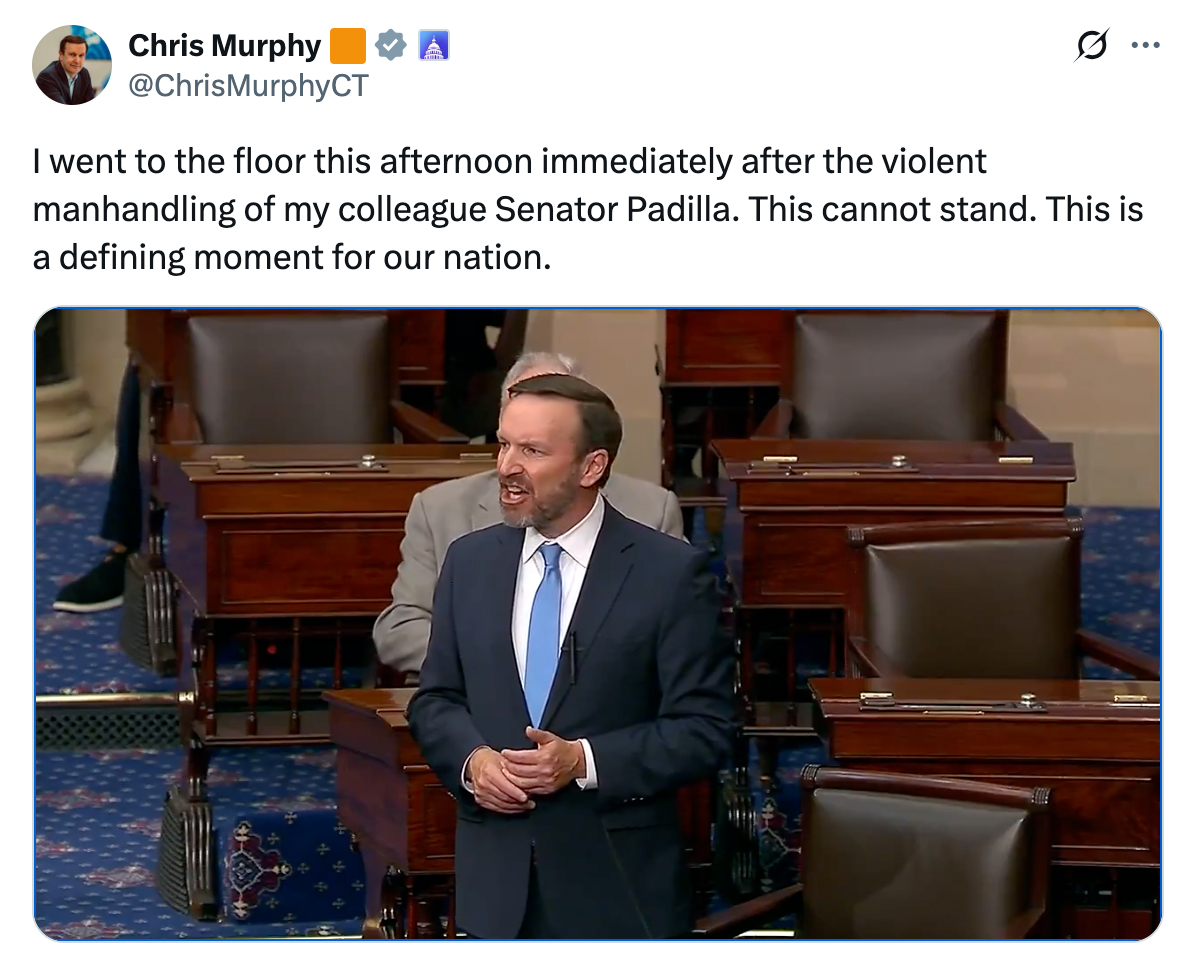
As you can see and hear below, Senator Alex Padilla had been trying to get answers for several weeks now from Homeland Security, but wasn’t hearing much back. So he heard that the Secretary of Homeland Security, Kristi Noem, was holding a press conference down the hallway and he attended it to see if he could get some answers to his questions. And while I don’t have all the details on how this situation unfolded, there is NO WAY that a U.S. Senator should be pushed out of a conference room and then pushed to the ground and handcuffed for trying to get answers for his constituents! No way!

As others in the videos below assert, a line has been crossed in our country!

Let’s move to impeach Donald Trump and also rid his administration of these incompetent individuals who are destroying our democracy! If they don’t like the Constitution and how our country has been governed for over 200 years, then perhaps they should consider leaving this country. 

The actions they are taking are NOT making America great again. They are making America the stench of the world.

And it’s not just Donald Trump and members of his administration that should be held accountable. Let’s also start holding Donald’s instruments of power — such as his ICE Agents and others who behave like them — accountable. To any ICE agents out there, take those damn masks off. You shouldn’t be hiding behind masks.

By the way, the silence from the Republicans is deafening.
.


Calif. Senator Forcibly Removed and Handcuffed After Interrupting Noem — from nytimes.com by Shawn Hubler, Jennifer Medina, and Jill Cowan (this is a gifted article)
Alex Padilla, Democrat of California, was shoved out of a room and handcuffed after he tried to question Kristi Noem, the homeland security secretary, during a news conference.

In the tense hyperpartisanship of the moment, the episode quickly swelled into a cause célèbre for both parties. Democratic senators, House members and governors rushed to denounce the treatment of a sitting senator, framing it as the latest escalation in authoritarian actions by the Trump administration. It followed the indictment on Tuesday of Representative LaMonica McIver of New Jersey and the arrest of Mayor Ras Baraka of Newark, after the officials, both Democrats, tried to visit a new immigration detention facility in the city.

Republicans just as eagerly tried to frame Mr. Padilla’s behavior as in line with what they have called the lawlessness of the political left as President Trump tries to combat illegal immigration.


The 2025 Global Skills Report — from coursera.org
Discover in-demand skills and credentials trends across 100+ countries and six regions to deliver impactful industry-aligned learning programs.

Access trusted insights on:

  • [NEW] Countries leading AI innovation in our AI Maturity Index
  • Skill proficiency rankings for 100+ countries in business, data, and technology
  • How people are building essential skills with micro-credentials
  • Enrollment trends in cybersecurity, critical thinking, and human skills
  • Women’s learning trends in GenAI, STEM, and Professional Certificates

AI Agents Are Rewriting The Playbook For Upskilling In 2025 — from forbes.com by Aytekin Tank

Staying competitive now depends on fast, effective training and upskilling—not just for business owners themselves, but for their teams, new and existing employees alike. AI agents are poised to change the corporate training landscape, helping businesses close skills gaps created by rapid technological change.
…
Traditional corporate training programs, which lean on passive content, often fall short of their goals. Companies like Uplimit are rolling out educational AI agents that promise significantly higher completion rates (upwards of 90 percent) and better results. It boils down to engagement—the active learning, with role playing and personalized feedback, is more stimulating than merely watching a video and completing a quiz. Agents can provide 24/7 assistance, responding to questions as soon as they pop up. What’s more, education and training with agents can be highly personalized.

Agents can train a higher volume of employees in the same amount of time. Employees will gain skills more efficiently, giving them more time to apply what they’ve learned—and likely boosting engagement in the process. They’ll be better prepared to stay competitive.


18 colleges seek to support Harvard’s lawsuit against the Trump administration — from highereddive.com by Laura Spitalniak
In a court filing Friday, the colleges argued that the elimination of Harvard’s federal funding “negatively impacts the entire ecosystem.”

Dive Brief:

  • Eighteen research colleges are seeking to formally support Harvard University’s legal challenge against the Trump administration for cutting or freezing roughly $2.8 billion of the institution’s grants and contracts.
  • In a legal filing Friday, the colleges asked a U.S. District Court for permission to file an amicus brief in support of the Ivy League institution, even though the lawsuit only addresses the federal cuts facing Harvard.
  • “Academic research is an interconnected enterprise,” the filing argued. “The elimination of funding at Harvard negatively impacts the entire ecosystem.”
 

From DSC:
My brother lost a lifelong friend recently and I’ve lost friends and family members waaaay too soon as well. It made me reflect, once again, on the brevity of our lives here on Earth.


Psalms 90:12

Teach us to number our days, that we may gain a heart of wisdom.

James 4:14

Why, you do not even know what will happen tomorrow. What is your life? You are a mist that appears for a little while and then vanishes.

Psalms: 39:5

You have made my days a mere handbreadth; the span of my years is as nothing before you. Everyone is but a breath, even those who seem secure.

Psalms 144:3-4

Lord, what are human beings that you care for them, mere mortals that you think of them? They are like a breath; their days are like a fleeting shadow.


From DSC:
And regarding this weekend, what an incredible waste of money to put the military on display (for his own birthday).  This smacks of what arrogant dictators do. It’s big-time ugly.

If our justice system had done its job, this arrogant lawbreaker and convicted criminal would be in jail right now. No wonder he has no regard for the legal system, the Constitution, or the law — those things don’t serve his interests. They impede his interests. And thank God for that! In fact, may true leaders rise up within the Legislative and Judicial Branches of our government. The latter is our best chance of keeping our democracy, as the Republican Party has ceded all of their power — and responsibility — over to Donald Trump. They are not leaders in any sense of the word.

But whatever happens, ultimately, there WILL be justice.

Is America being humbled? Or is it being destroyed?

Trump Is Getting the Military Parade He Wanted in His First Term — from nytimes.com by Helene Cooper
There will be 28 Abrams tanks, 6,700 soldiers, 50 helicopters, 34 horses, two mules and a dog, according to the Army’s plans for the June 14 event.

In President Trump’s first term, the Pentagon opposed his desire for a military parade in Washington, wanting to keep the armed forces out of politics.

But in Mr. Trump’s second term, that guardrail has vanished. There will be a parade this year, and on the president’s 79th birthday, no less.

The current plan involves a tremendous scene in the center of Washington: 28 M1A1 Abrams tanks (at 70 tons each for the heaviest in service); 28 Stryker armored personnel carriers; more than 100 other vehicles; a World War II-era B-25 bomber; 6,700 soldiers; 50 helicopters; 34 horses; two mules; and a dog.


Navigating Career Transitions — from er.educause.edu by Jay James, Mike Richichi, Sarah Buszka, and Wes Johnson

In this episode, we hear from professionals at different stages of their career journeys as they reflect on risk, resilience, and growth. They share advice on stepping into leadership roles, recognizing when it may be time for a change, and overcoming imposter syndrome.

.


.


Isaiah 53:5

But he was pierced for our transgressions,
he was crushed for our iniquities;
the punishment that brought us peace was on him,
and by his wounds we are healed.

1 Chronicles 29:11

Yours, Lord, is the greatness and the power and the glory and the majesty and the splendor, for everything in heaven and earth is yours. Yours, Lord, is the kingdom; you are exalted as head over all.

Colossians 3:13

Bear with each other and forgive one another if any of you has a grievance against someone. Forgive as the Lord forgave you.


Mary Meeker AI Trends Report: Mind-Boggling Numbers Paint AI’s Massive Growth Picture — from ndtvprofit.com
Numbers that prove AI as a tech is unlike any other the world has ever seen.

Here are some incredibly powerful numbers from Mary Meeker’s AI Trends report, which showcase how artificial intelligence as a tech is unlike any other the world has ever seen.

  • AI took only three years to reach 50% user adoption in the US; mobile internet took six years, desktop internet took 12 years, while PCs took 20 years.
  • ChatGPT reached 800 million users in 17 months and 100 million in only two months, vis-à-vis Netflix’s 100 million (10 years), Instagram (2.5 years) and TikTok (nine months).
  • ChatGPT hit 365 billion annual searches in two years (2024) vs. Google’s 11 years (2009)—ChatGPT 5.5x faster than Google.

Above via Mary Meeker’s AI Trend-Analysis — from getsuperintel.com by Kim “Chubby” Isenberg
How AI’s rapid rise, efficiency race, and talent shifts are reshaping the future.

The TLDR
Mary Meeker’s new AI trends report highlights an explosive rise in global AI usage, surging model efficiency, and mounting pressure on infrastructure and talent. The shift is clear: AI is no longer experimental—it’s becoming foundational, and those who optimize for speed, scale, and specialization will lead the next wave of innovation.


Also see Meeker’s actual report at:

Trends – Artificial Intelligence — from bondcap.com by Mary Meeker / Jay Simons / Daegwon Chae / Alexander Krey


The Rundown: Meta aims to release tools that eliminate humans from the advertising process by 2026, according to a report from the WSJ — developing an AI that can create ads for Facebook and Instagram using just a product image and budget.

The details:

  • Companies would submit product images and budgets, letting AI craft the text and visuals, select target audiences, and manage campaign placement.
  • The system will be able to create personalized ads that can adapt in real-time, like a car spot featuring mountains vs. an urban street based on user location.
  • The push would target smaller companies lacking dedicated marketing staff, promising professional-grade advertising without agency fees or skillset.
  • Advertising is a core part of Mark Zuckerberg’s AI strategy and already accounts for 97% of Meta’s annual revenue.

Why it matters: We’re already seeing AI transform advertising through image, video, and text, but Zuck’s vision takes the process entirely out of human hands. With so much marketing flowing through FB and IG, a successful system would be a major disruptor — particularly for small brands that just want results without the hassle.


So much for saving the planet. Climate careers, and many others, evaporate for class of 2025 — from hechingerreport.org by Lawrence Lanahan
The Trump administration is disrupting career paths for new graduates hoping to work in climate and sustainability, international aid, public service and the sciences

As the class of 2025 enters the workforce, the Trump administration has dismantled career pathways for graduates interested in climate and sustainability work, international aid, public service and research across the natural, behavioral and social sciences. Federal jobs are disappearing, and the administration is eliminating grants and agency divisions that sustain university research programs and nonprofits that are crucial to launching careers.

The National Science Foundation, for example, halved graduate research fellowships, canceled some undergraduate research grants, stopped awarding new grants, froze funding for existing ones, and eliminated several hundred grants for focusing on diversity, equity and inclusion. In March, Robert F. Kennedy Jr. announced 10,000 layoffs at his agency, the Department of Health and Human Services; earlier buyouts and firings had already cut another 10,000 jobs.

 
© 2025 | Daniel Christian