Transform Public Speaking with Yoodli: Your AI Coach — from rdene915.com by Paula Johnson

Yoodli is an AI tool designed to help users improve their public speaking skills. It analyzes your speech in real-time or after a recording and gives you feedback on things like:

    • Filler words (“um,” “like,” “you know”)
    • Pacing (Are you sprinting or sedating your audience?)
    • Word choice and sentence complexity
    • Eye contact and body language (with video)
    • And yes, even your “uhhh” to actual word ratio

Yoodli gives you a transcript and a confidence score, plus suggestions that range from helpful to brutally honest. It’s basically Simon Cowell with AI ethics and a smiley face interface.


[What’s] going on with AI and education? — from theneuron.ai by Grant Harvey
With students and teachers alike using AI, schools are facing an “assessment crisis” where the line between tool and cheating has blurred, forcing a shift away from a broken knowledge economy toward a new focus on building human judgment through strategic struggle.

What to do about it: The future belongs to the “judgment economy,” where knowledge is commoditized but taste, agency, and learning velocity become the new human moats. Use the “Struggle-First” principle: wrestle with problems for 20-30 minutes before turning to AI, then use AI as a sparring partner (not a ghostwriter) to deepen understanding. The goal isn’t to avoid AI, but to strategically choose when to embrace “desirable difficulties” that build genuine expertise versus when to leverage AI for efficiency.
…
The Alpha-School Program in brief:

    • Students complete core academics in just 2 hours using AI tutors, freeing up 4+ hours for life skills, passion projects, and real-world experiences.
    • The school claims students learn at least 2x faster than their peers in traditional school.
    • The top 20% of students show 6.5x growth. Classes score in the top 1-2% nationally across the board.
    • Claims are based on NWEA’s Measures of Academic Progress (MAP) assessments… with data only available to the school. Hmm…

Austen Allred shared a story about the school, which put it on our radar.


Featured Report:  Teaching for Tomorrow: Unlocking Six Weeks a Year With AI — from gallup.com
.
.
In the latest installment of Gallup and the Walton Family Foundation’s research on education, K-12 teachers reveal how AI tools are transforming their workloads, instructional quality and classroom optimism. The report finds that 60% of teachers used an AI tool during the 2024–25 school year. Weekly AI users report reclaiming nearly six hours per week — equivalent to six weeks per year — which they reinvest in more personalized instruction, deeper student feedback and better parent communication.

Despite this emerging “AI dividend,” adoption is uneven: 40% of teachers aren’t using AI at all, and only 19% report their school has a formal AI policy. Teachers with access to policies and support save significantly more time.

Educators also say AI improves their work. Most report higher-quality lesson plans, assessments and student feedback. And teachers who regularly use AI are more optimistic about its benefits for student engagement and accessibility — mirroring themes from the Voices of Gen Z: How American Youth View and Use Artificial Intelligence report, which found students hesitant but curious about AI’s classroom role. As AI tools grow more embedded in education, both teachers and students will need the training and support to use them effectively.

Also see:

  • 2-Hour Learning
    • What if children could crush academics in 2 hours, 2x faster? 
    • What if children could get back their most valuable resource, which is time?
    • What if children could pursue the things they want during their afternoons and develop life skills?

Amira Learning: Teaching With The AI-Powered Reading Tool — from techlearning.com by Erik Ofgang
Amira Learning is a research-backed AI reading tutor that incorporates the science of reading into its features.

What Is Amira Learning?
Amira Learning’s system is built upon research led by Jack Mostow, a professor at Carnegie Mellon who helped pioneer AI literacy education. Amira uses Claude AI to power its AI features, but these features are different than many other AI tools on the market. Instead of focusing on chat and generative response, Amira’s key feature is its advanced speech recognition and natural language processing capabilities, which allow the app to “hear” when a student is struggling and tailor suggestions to that student’s particular mistakes.

Though it’s not meant to replace a teacher, Amira provides real-time feedback and also helps teachers pinpoint where a student is struggling. For these reasons, Amira Learning is a favorite of education scientists and advocates for science of reading-based literacy instruction. The tool currently is used by more than 4 million students worldwide and across the U.S.


Mark 3:4-6

4 Then Jesus asked them, “Which is lawful on the Sabbath: to do good or to do evil, to save life or to kill?” But they remained silent.

5 He looked around at them in anger and, deeply distressed at their stubborn hearts, said to the man, “Stretch out your hand.” He stretched it out, and his hand was completely restored. 6 Then the Pharisees went out and began to plot with the Herodians how they might kill Jesus.

Micah 6:8

He has shown you, O mortal, what is good.
And what does the Lord require of you?
To act justly and to love mercy
and to walk humbly with your God.

Psalm 19:1-2
For the director of music. A psalm of David.

1 The heavens declare the glory of God;
the skies proclaim the work of his hands.
2 Day after day they pour forth speech;
night after night they reveal knowledge.

Psalm 91:2

I will say of the Lord, “He is my refuge and my fortress,
my God, in whom I trust.”


What enterprise leaders can learn from LinkedIn’s success with AI agents — from venturebeat.com by Taryn Plumb

LinkedIn is taking a multi-agent approach, using what Agarwal described as a collection of agents collaborating to get the job done. A supervisor agent orchestrates all the tasks among other agents, including intake and sourcing agents that are “good at one and only one job.”

All communication occurs through the supervisor agent, which receives input from human users regarding role qualifications and other details. That agent then provides context to a sourcing agent, which culls through recruiter search stacks and sources candidates along with descriptions on why they might be a good fit for the job. That information is then returned to the supervisor agent, which begins actively interacting with the human user.

“Then you can collaborate with it, right?” said Agarwal. “You can modify it. No longer do you have to talk to the platform in keywords. You can talk to the platform in natural language, and it’s going to answer you back, it’s going to have a conversation with you.”


The EU’s Legal Tech Tipping Point – AI Regulation, Data Sovereignty, and eDiscovery in 2025 — from jdsupra.com by Melina Efstathiou

The Good, the Braver and the Curious.
As we navigate through 2025, the European legal landscape is undergoing a significant transformation, particularly in the realms of artificial intelligence (AI) regulation and data sovereignty. These changes are reshaping how legal departments and more specifically eDiscovery professionals operate, compelling them to adapt to new compliance requirements and technological advancements.

Following on from our blog post on Navigating eDisclosure in the UK and Practice Direction 57AD, we are now moving on to explore AI regulation in the greater European spectrum, taking a contrasting glance towards the UK and the US as well, at the close of this post.


LegalTech’s Lingering Hurdles: How AI is Finally Unlocking Efficiency in the Legal Sector — from techbullion.co by Abdul Basit

However, as we stand in mid-2025, a new paradigm is emerging. Artificial Intelligence, once a buzzword, is now demonstrably addressing many of the core issues that have historically plagued LegalTech adoption and effectiveness, ushering in an era of unprecedented efficiency. Legal tech specialists like LegalEase are leading the way with some of these newer solutions, such as Ai powered NDA drafting.

Here’s how AI is making profound efficiencies:

    • Automated Document Review and Analysis:
    • Intelligent Contract Lifecycle Management (CLM):
    • Enhanced Legal Research:
    • Predictive Analytics for Litigation and Risk:
    • Streamlined Practice Management and Workflow Automation:
    • Personalized Legal Education and Training:
    • Improved Client Experience:

The AI Strategy Potluck: Law Firms Showing Up Empty-Handed, Hungry, And Weirdly Proud Of It — from abovethelaw.com by Joe Patrice
There’s a $32 billion buffet of time and money on the table, and the legal industry brought napkins.

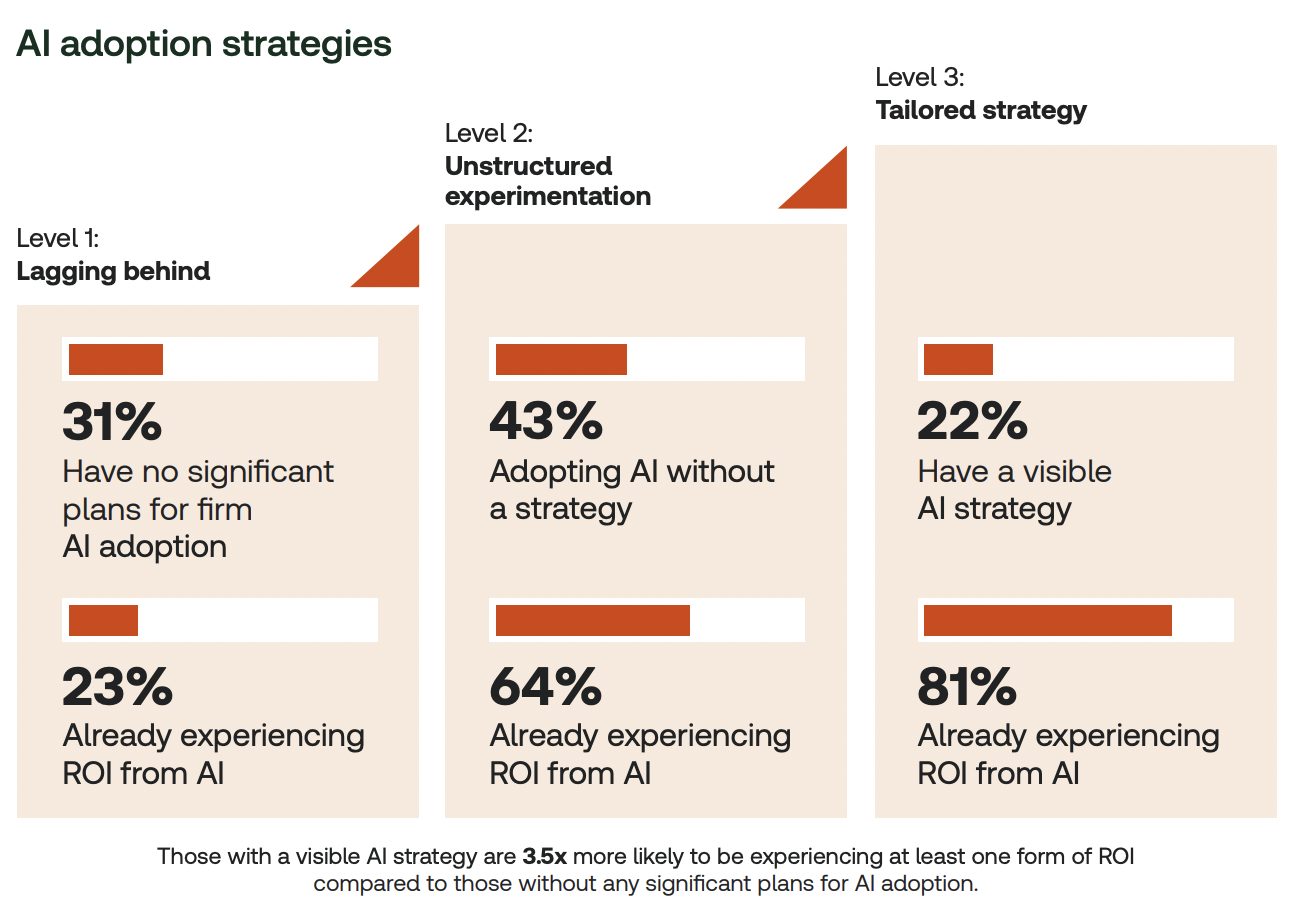
The Thomson Reuters “Future of Professionals” report(Opens in a new window) just dropped and one stat standing out among its insights is that organizations with a visible AI strategy are not only twice as likely to report growth, they’re also 3.5 times more likely to see actual, tangible benefits from AI adoption.

AI Adoption Strategies


Speaking of legal-related items as well as tech, also see:

  • Landmark AI ruling is a blow to authors and artists — from popular.info by Judd Legum
    This week, a federal judge, William Alsup, rejected Anthropic’s effort to dismiss the case and found that stealing books from the internet is likely a copyright violation. A trial will be scheduled in the future. If Anthropic loses, each violation could come with a fine of $750 or more, potentially exposing the company to billions in damages. Other AI companies that use stolen work to train their models — and most do — could also face significant liability.
 

Tech Nvidia CEO says robotics is chipmaker’s biggest opportunity after AI — from cnbc.com by Kif Leswing

Key Points
  • Nvidia CEO Jensen Huang said robotics was one of the two largest growth opportunities for the AI chipmaker.
  • In May, Nvidia said its robotics unit had $567 million in quarterly sales, or about 1% of the company’s total revenue.
  • “We stopped thinking of ourselves as a chip company long ago,” Huang said at Nvidia’s annual shareholders meeting.
 

2025 Learning System Top Picks — from elearninfo247.com by Craig Weiss

Who is leading the pack? Who is setting themselves apart here in the mid-year?

Are they an LMS? LMS/LXP? Talent Development System? Mentoring? Learning Platform?

Something else?

Are they solely customer training/education, mentoring, or coaching? Are they focused only on employees? Are they an amalgamation of all or some?

Well, they cut across the board – hence, they slide under the “Learning Systems” umbrella, which is under the bigger umbrella term – “Learning Technology.”
…
Categories: L&D-specific, Combo (L&D and Training, think internal/external audiences), and Customer Training/Education (this means customer education, which some vendors use to mean the same as customer training).


The résumé is dying, and AI is holding the smoking gun — from arstechnica.com by Benj Edwards
As thousands of applications flood job posts, ‘hiring slop’ is kicking off an AI arms race.

Employers are drowning in AI-generated job applications, with LinkedIn now processing 11,000 submissions per minute—a 45 percent surge from last year, according to new data reported by The New York Times.

Due to AI, the traditional hiring process has become overwhelmed with automated noise. It’s the résumé equivalent of AI slop—call it “hiring slop,” perhaps—that currently haunts social media and the web with sensational pictures and misleading information. The flood of ChatGPT-crafted résumés and bot-submitted applications has created an arms race between job seekers and employers, with both sides deploying increasingly sophisticated AI tools in a bot-versus-bot standoff that is quickly spiraling out of control.

The Times illustrates the scale of the problem with the story of an HR consultant named Katie Tanner, who was so inundated with over 1,200 applications for a single remote role that she had to remove the post entirely and was still sorting through the applications three months later.


Job seekers are leaning into AI — and other happenings in the world of work — from LinkedIn News

Job growth is slowing — and for many professionals, that means longer job hunts and more competition. As a result, more job seekers are turning to AI to streamline their search and stand out.

From optimizing resumes to preparing for interviews, AI tools are becoming a key part of today’s job hunt. Recruiters say it’s getting harder to sift through application materials and identify what is AI-generated and decipher which applicants are actually qualified — but they also say they prefer candidates with AI skills.

The result? Job seekers are growing their familiarity with AI faster than their non-job-seeking counterparts and it’s shifting how they view the workplace. According to LinkedIn’s latest Workforce Confidence survey, over half of active job seekers (52%) believe AI will eventually take on some of the mundane, manual tasks that they’re currently focused on, compared to 46% of others not actively job seeking.


OpenAI warns models with higher bioweapons risk are imminent — from axios.com by Ina Fried

OpenAI cautioned Wednesday that upcoming models will head into a higher level of risk when it comes to the creation of biological weapons — especially by those who don’t really understand what they’re doing.

Why it matters: The company, and society at large, need to be prepared for a future where amateurs can more readily graduate from simple garage weapons to sophisticated agents.

Driving the news: OpenAI executives told Axios the company expects forthcoming models will reach a high level of risk under the company’s preparedness framework.

    • As a result, the company said in a blog post, it is stepping up the testing of such models, as well as including fresh precautions designed to keep them from aiding in the creation of biological weapons.
    • OpenAI didn’t put an exact timeframe on when the first model to hit that threshold will launch, but head of safety systems Johannes Heidecke told Axios “We are expecting some of the successors of our o3 (reasoning model) to hit that level.”

.


Getting (and Keeping) Early Learners’ Attention — from edutopia.org by Heather Sanderell
These ideas for lesson hooks—like using songs, video clips, and picture walks—can motivate young students to focus on learning.

How do you grasp and maintain the attention of a room full of wide-eyed students with varying interests and abilities? Do you use visuals and games or interactive activities? Do you use art and sports and music or sounds? The answer is yes, to all!

When trying to keep the attention of your learners, it’s important to stimulate their senses and pique their diverse interests. Educational theorist and researcher Robert Gagné devised his nine events of instructional design, which include grabbing learners’ attention with a lesson hook. This is done first to set the tone for the remainder of the lesson.


3 Ways to Help Students Overcome the Forgetting Curve — from edutopia.org  by Cathleen Beachboard
Our brains are wired to forget things unless we take active steps to remember. Here’s how you can help students hold on to what they learn.

You teach a lesson that lights up the room. Students are nodding and hands are flying up, and afterward you walk out thinking, “They got it. They really got it.”

And then, the next week, you ask a simple review question—and the room falls silent.

If that situation has ever made you question your ability to teach, take heart: You’re not failing, you’re simply facing the forgetting curve. Understanding why students forget—and how we can help them remember—can transform not just our lessons but our students’ futures.

The good news? You don’t have to overhaul your curriculum to beat the forgetting curve. You just need three small, powerful shifts in how you teach.

From DSC:
Along these same lines, also see:

.


7 Nature Experiments to Spark Student Curiosity — from edutopia.org by Donna Phillips
Encourage your students to ask questions about and explore the world around them with these hands-on lessons.

Children are natural scientists—they ask big questions, notice tiny details, and learn best through hands-on exploration. That’s why nature experiments are a classroom staple for me. From growing seeds to using the sun’s energy, students don’t just learn science, they experience it. Here are my favorite go-to nature experiments that spark curiosity.


Live Your Creed, Langston Hughes — via a recent e-newsletter from Getting Smart

I’d rather see a sermon than to hear one any day.
I’d rather one walk with me than just to show the way.
The eye is a better pupil and more willing than the ear.
Advice may be misleading but examples are always clear.
And the very best of teachers are the ones who live their
creed,
For to see good put into action is what everybody needs.
I can soon learn to do it if you let me see it done.
I can watch your hand in motion but your tongue too fast
may run
And the lectures you deliver may be very fine and true
But I’d rather get my lesson by observing what you do.
For I may misunderstand you and the fine advice you give
But there’s no misunderstanding how you act and how
you live.


Agentic AI use cases in the legal industry — from legal.thomsonreuters.com
What legal professionals need to know now with the rise of agentic AI

While GenAI can create documents or answer questions, agentic AI takes intelligence a step further by planning how to get multi-step work done, including tasks such as consuming information, applying logic, crafting arguments, and then completing them.? This leaves legal teams more time for nuanced decision-making, creative strategy, and relationship-building with clients—work that machines can’t do.


The AI Legal Landscape in 2025: Beyond the Hype — from akerman.com by Melissa C. Koch

What we’re witnessing is a profession in transition where specific tasks are being augmented or automated while new skills and roles emerge.

The data tells an interesting story: approximately 79% of law firms have integrated AI tools into their workflows, yet only a fraction have truly transformed their operations. Most implementations focus on pattern recognition tasks such as document review, legal research, contract analysis. These implementations aren’t replacing lawyers; they’re redirecting attention to higher-value work.

This technological shift doesn’t happen in isolation. It’s occurring amid client pressure for efficiency, competition from alternative providers, and the expectations of a new generation of lawyers who have never known a world without AI assistance.


LexisNexis and Harvey team up to revolutionize legal research with artificial intelligence — from abajournal.com by Danielle Braff

Lawyers using the Harvey artificial intelligence platform will soon be able to tap into LexisNexis’ vast legal research capabilities.

Thanks to a new partnership announced Wednesday, Harvey users will be able to ask legal questions and receive fast, citation-backed answers powered by LexisNexis case law, statutes and Shepard’s Citations, streamlining everything from basic research to complex motions. According to a press release, generated responses to user queries will be grounded in LexisNexis’ proprietary knowledge graphs and citation tools—making them more trustworthy for use in court or client work.


10 Legal Tech Companies to Know — from builtin.com
These companies are using AI, automation and analytics to transform how legal work gets done.
.


Four months after a $3B valuation, Harvey AI grows to $5B — from techcrunch.com by Marina Temkin

Harvey AI, a startup that provides automation for legal work, has raised $300 million in Series E funding at a $5 billion valuation, the company told Fortune. The round was co-led by Kleiner Perkins and Coatue, with participation from existing investors, including Conviction, Elad Gil, OpenAI Startup Fund, and Sequoia.


The billable time revolution — from jordanfurlong.substack.com by Jordan Furlong
Gen AI will bring an end to the era when lawyers’ value hinged on performing billable work. Grab the coming opportunity to re-prioritize your daily activities and redefine your professional purpose.

Because of Generative AI, lawyers will perform fewer “billable” tasks in future; but why is that a bad thing? Why not devote that incoming “freed-up” time to operating, upgrading, and flourishing your law practice? Because this is what you do now: You run a legal business. You deliver good outcomes, good experiences, and good relationships to clients. Humans do some of the work and machines do some of the work and the distinction that matters is not billable/non-billable, it’s which type of work is best suited to which type of performer.


How the national debt affects the U.S. — and you — in 10 charts — from washingtonpost.com by Jacob Bogage; this is a GIFTED article
The national debt already exceeds $36 trillion and is growing at historic rates. That has cascading consequences for the government and economy.

The federal government is taking on record amounts of debt year after year.

The U.S. owes lenders more than $36 trillion. That is close to an all-time high when comparing the debt to the country’s total economic output — a leading indicator of the nation’s ability to pay it all back.

Debt and annual deficits have colored much of the debate around President Donald Trump and Republicans’ One Big Beautiful Bill Act, the mammoth tax and immigration measure the GOP hopes to pass through Congress before July 4. It would add $3 trillion to the debt over the next decade, factoring in the cost of the bill plus interest on the added borrowing, according to nonpartisan estimates.

But how does the national debt affect the U.S. economy and the government? Here are 10 charts to explain.


“Using AI Right Now: A Quick Guide” [Molnick] + other items re: AI in our learning ecosystems

Thoughts on thinking — from dcurt.is by Dustin Curtis

Intellectual rigor comes from the journey: the dead ends, the uncertainty, and the internal debate. Skip that, and you might still get the insight–but you’ll have lost the infrastructure for meaningful understanding. Learning by reading LLM output is cheap. Real exercise for your mind comes from building the output yourself.

The irony is that I now know more than I ever would have before AI. But I feel slightly dumber. A bit more dull. LLMs give me finished thoughts, polished and convincing, but none of the intellectual growth that comes from developing them myself. 


Using AI Right Now: A Quick Guide — from oneusefulthing.org by Ethan Mollick
Which AIs to use, and how to use them

Every few months I put together a guide on which AI system to use. Since I last wrote my guide, however, there has been a subtle but important shift in how the major AI products work. Increasingly, it isn’t about the best model, it is about the best overall system for most people. The good news is that picking an AI is easier than ever and you have three excellent choices. The challenge is that these systems are getting really complex to understand. I am going to try and help a bit with both.

First, the easy stuff.

Which AI to Use
For most people who want to use AI seriously, you should pick one of three systems: Claude from Anthropic, Google’s Gemini, and OpenAI’s ChatGPT.

Also see:


Student Voice, Socratic AI, and the Art of Weaving a Quote — from elmartinsen.substack.com by Eric Lars Martinsen
How a custom bot helps students turn source quotes into personal insight—and share it with others

This summer, I tried something new in my fully online, asynchronous college writing course. These classes have no Zoom sessions. No in-person check-ins. Just students, Canvas, and a lot of thoughtful design behind the scenes.

One activity I created was called QuoteWeaver—a PlayLab bot that helps students do more than just insert a quote into their writing.

Try it here

It’s a structured, reflective activity that mimics something closer to an in-person 1:1 conference or a small group quote workshop—but in an asynchronous format, available anytime. In other words, it’s using AI not to speed students up, but to slow them down.
…
The bot begins with a single quote that the student has found through their own research. From there, it acts like a patient writing coach, asking open-ended, Socratic questions such as:

What made this quote stand out to you?
How would you explain it in your own words?
What assumptions or values does the author seem to hold?
How does this quote deepen your understanding of your topic?
It doesn’t move on too quickly. In fact, it often rephrases and repeats, nudging the student to go a layer deeper.


The Disappearance of the Unclear Question — from jeppestricker.substack.com Jeppe Klitgaard Stricker
New Piece for UNESCO Education Futures

On [6/13/25], UNESCO published a piece I co-authored with Victoria Livingstone at Johns Hopkins University Press. It’s called The Disappearance of the Unclear Question, and it’s part of the ongoing UNESCO Education Futures series – an initiative I appreciate for its thoughtfulness and depth on questions of generative AI and the future of learning.

Our piece raises a small but important red flag. Generative AI is changing how students approach academic questions, and one unexpected side effect is that unclear questions – for centuries a trademark of deep thinking – may be beginning to disappear. Not because they lack value, but because they don’t always work well with generative AI. Quietly and unintentionally, students (and teachers) may find themselves gradually avoiding them altogether.

Of course, that would be a mistake.

We’re not arguing against using generative AI in education. Quite the opposite. But we do propose that higher education needs a two-phase mindset when working with this technology: one that recognizes what AI is good at, and one that insists on preserving the ambiguity and friction that learning actually requires to be successful.


Leveraging GenAI to Transform a Traditional Instructional Video into Engaging Short Video Lectures — from er.educause.edu by Hua Zheng

By leveraging generative artificial intelligence to convert lengthy instructional videos into micro-lectures, educators can enhance efficiency while delivering more engaging and personalized learning experiences.


This AI Model Never Stops Learning — from link.wired.com by Will Knight

Researchers at Massachusetts Institute of Technology (MIT) have now devised a way for LLMs to keep improving by tweaking their own parameters in response to useful new information.

The work is a step toward building artificial intelligence models that learn continually—a long-standing goal of the field and something that will be crucial if machines are to ever more faithfully mimic human intelligence. In the meantime, it could give us chatbots and other AI tools that are better able to incorporate new information including a user’s interests and preferences.

The MIT scheme, called Self Adapting Language Models (SEAL), involves having an LLM learn to generate its own synthetic training data and update procedure based on the input it receives.


Edu-Snippets — from scienceoflearning.substack.com by Nidhi Sachdeva and Jim Hewitt
Why knowledge matters in the age of AI; What happens to learners’ neural activity with prolonged use of LLMs for writing

Highlights:

  • Offloading knowledge to Artificial Intelligence (AI) weakens memory, disrupts memory formation, and erodes the deep thinking our brains need to learn.
  • Prolonged use of ChatGPT in writing lowers neural engagement, impairs memory recall, and accumulates cognitive debt that isn’t easily reversed.
 
 
© 2025 | Daniel Christian