Anthropic, NVIDIA Move AI Agents Deeper into Scientific Workflows — from campustechnology.com by John K. Waters

Key Takeaways

  • Anthropic’s Claude Science beta and NVIDIA’s BioNeMo Agent Toolkit show AI agents moving beyond general productivity into specialized scientific research workflows.
  • The companies are emphasizing auditability and reproducibility, including preserved code, environments, message history, reviewer agents, and integration with existing research tools.
  • For enterprises and research teams, the key test will be whether agentic AI can produce traceable, reliable results while keeping humans in control of sensitive data, compute, and scientific judgment.
 

Tech & Learning Announces Winners of Best of Show at ISTE 2026 — from techlearning.com
These annual awards celebrate the groundbreaking products exhibited at ISTE that are transforming education in schools around the world.


Also from techlearning.com, see:


Best Sites for Blended Learning — by Diana Restifo
Blended learning websites help teachers combine traditional instruction with online learning.

Blended learning is a teaching approach that combines both traditional in-class instruction with digital technologies for lessons, assessments, feedback and more. In other words, face-to-face teaching is supplemented and supported by online lessons and content.

The advantages of blended learning include flexibility, student engagement, and the ability to personalize lessons.

The following blended learning sites, many of which are fully free, provide a variety of features through which educators can implement their blended learning approach.


Check Your Mic Before You Wreck Your Project — from learningguild.com by Kendal Rasnake

While a lot of our narration may be produced by AI nowadays, there are times when you need to record audio, such as when you need someone in-house to do a voiceover, or you are recording an interview, job shadow video, demonstration video, etc. Now, the responsibility of recording high-quality audio falls on you.

Well, all you have to do is grab a mic and point, right? Wrong!

The last thing you need is to record the CEO and have him/her sound horrible or look ridiculous because they are holding a fuzzy mic on a long wire up to their mouth. Instead, just learn a little about mics and you can purchase and/or choose the right one.

All Mics Are Not Built Equally
I had someone who was having audio trouble tell me that they used a “Brand Name” mic before and it sounded good, so maybe they would go back to using a “Brand Name” mic. As you can imagine, choosing a mic for a certain purpose based on the brand name is equivalent to choosing a Chevy mini-hybrid car to tow an RV because your truck used to tow the RV well and it was a Chevy. Brands make different types of microphones and understanding how mics are built can help you to choose the right one, no matter the brand.


From DSC:
Following are several companies that are using AI to connect people to work. That’s a significant piece of my Learning from the Living [AI-Based Class] Room vision.

These companies were listed on an article entitled,
Can AI be an effective career coach?
— from achievepartners.com and Ryan Craig


FutureFit AI
Bridge the gap between talent, training, and employment at scale

AI-powered workforce technology connecting people to careers, employers to talent, and workforce partners to tools for integrated and intelligent workforce systems.

PathPilot AI

Empowering every job seeker with personalized AI coaching. Helping organizations scale career services and improve outcomes.

Empower Students with Career-Ready Skills
Help students discover career pathways, develop essential skills, and connect with opportunities. PathPilot provides personalized guidance that scales across your entire institution.

  • AI-powered career exploration and pathway planning
  • Skills assessment aligned with NACE competencies
  • Resume builder and interview preparation tools
  • Job matching with local and national employers
  • Institutional analytics and outcome tracking
  • Integration with existing career services systems

Pathific — Design your future
The all-in-one platform that connects your strengths to programs, careers, and real salary outcomes — powered by AI.

High school, post-secondary, newcomer to Canada, or career change — Pathific meets you where you are.

Your all-in-one career compass
Quality career guidance shouldn’t depend on where you go to school, when you start your journey, or where you come from. Using the latest AI and comprehensive Canadian data, we built a platform that gives everyone clear, data-driven pathways to their future. No more one-size-fits-all advice. No more guessing. Just your strengths, connected to real data.

OpportuNext

See Where Your Skills Can Take You | Find new career path opportunities with one simple search.

OpportuNext from Signal49 Research is a free-to-use career tool created in partnership with the Future Skills Centre. Using big data, it matches a person’s skills with viable career paths — often including some you have not considered.


If AI Eats the Entry-Level Job, Where Do Young People Learn to Work? (Ryan Craig, Achieve Partners) — from humanistxyz.substack.com by Allison Dulin Salisbury; via Ryan Craig
“The public should not be subsidizing colleges whose students lack relevant, paid, in-field work experience.”

That is the trap at the center of this conversation: everyone wants to hire someone with three years of experience, and almost no one wants to provide those three years.

And Ryan’s policy prescription is unusually concrete: pay employers to hire and train apprentices, following the countries that have scaled apprenticeship far faster than the U.S.; require colleges receiving federal student aid to provide relevant, paid, in-field work experience; and build a market of intermediaries that can make the whole thing operational.

Ryan’s view is that higher education remains critically important. But college without meaningful work experience may become a much worse bet, especially for students who cannot afford to guess wrong.


3 Retrieval Games to Try in Your High School Classroom — from edutopia by Andrew Atherton
These activities make reviewing content fun, so they can really motivate students to cement their learning.

These games can start or end the lesson, and they sometimes function as a transition within the lesson between topics. I don’t need to use them any longer, but I choose to use the following three games simply because they work really well. They can be used in any class and require very little (if any) preparation. These examples are drawn from the English classroom, but they could be adapted to suit most subjects.


Focusing Attention With a Student-Led Recall Activity — from edutopia.org
By providing every student with an opportunity to actively remember yesterday’s lesson, teachers can set the stage for today’s success.

By asking students to recall information on their own and then compare ideas with classmates, Bechard creates opportunities for each of them to engage with the content.

The process has the added benefit of strengthening retention: “When we remember something we had initially forgotten,” Lee says, “it is coming back into our working memory. It is having another opportunity to go into long-term memory. And so every time that happens, we are actually creating a stronger memory trace for that information.”

By building in a brief, intentional routine at the start of class, Bechard helps students reactivate prior learning, reconnect with the text, and begin each lesson with their attention focused, ready to learn.


How Free Play Supports Attention in Elementary School — from edutopia.org by Cynthia Michelini
Taking a short break outside allows students to reconnect with the world and refocus when it’s time to go back to the classroom.

The breaks were only five to 10 minutes long, and my intention was to ensure that the time outside was never structured, apart from a few guiding principles. Rule one: No teacher instruction. I didn’t want to give my students any direction other than how to be safe outside. Rule two: I encouraged them not to organize anything. Rule three: Just simply take a break. The results of this seemingly simple target surprised me.

First of all, my students’ attention span increased significantly. While this wasn’t a formal research project, trust me when I say that after 23 years of experience, I was shocked to realize how taking kids outside for a short period of time frequently can help support their focus in the classroom.


The IKEA Effect: You Built It, You’re Invested in It — from edutopia.org by Cathleen Beachboard, Nick Brousse
People become more invested when they help shape the systems around them, and teachers and school leaders can use that to create a strong school culture.

The difference is rarely the quality of the system itself. It’s whether the people affected by it helped build it. Psychologists call this the IKEA effect: our tendency to place greater value on things we help create. In one fascinating series of studies, researchers found that even young children valued objects they built more highly than identical objects made by someone else.

This sense of value is not explained simply by ownership. Children still value their creations more, even when they cannot keep them. It’s not explained by effort alone, either—more work doesn’t automatically create more attachment.

Instead, the researchers proposed something deeper: People become emotionally connected to what they help create because it begins to feel tied to their sense of identity. That finding may explain far more about school culture than we realize.


Christian: Could this be a part of our future learning ecosystems?


From DSC:
Could this be a part of our future learning ecosystems? Education as a personalized content feed.


Coursera wants users to learn through shorter, faster content  — from digitaltrends.com by Moinak Pal
Coursera wants online learning to feel more like TikTok
.

Online learning platform Coursera is taking a page straight out of TikTok’s playbook. The company has launched a new AI-powered feed designed to serve short-form educational content in a scrollable, personalized format, signaling a major shift in how digital learning platforms may try to keep users engaged.

The feature introduces bite-sized video lessons, clips, and explainers curated through artificial intelligence based on a user’s interests, learning habits, career goals, and previous course activity. Instead of committing to hour-long lectures or full certification programs upfront, users can now discover short educational snippets designed to make learning feel more casual, accessible, and addictive.

Users scroll through a feed of short educational videos and AI-curated learning moments covering topics ranging from coding and business to AI, productivity, data science, and personal development.


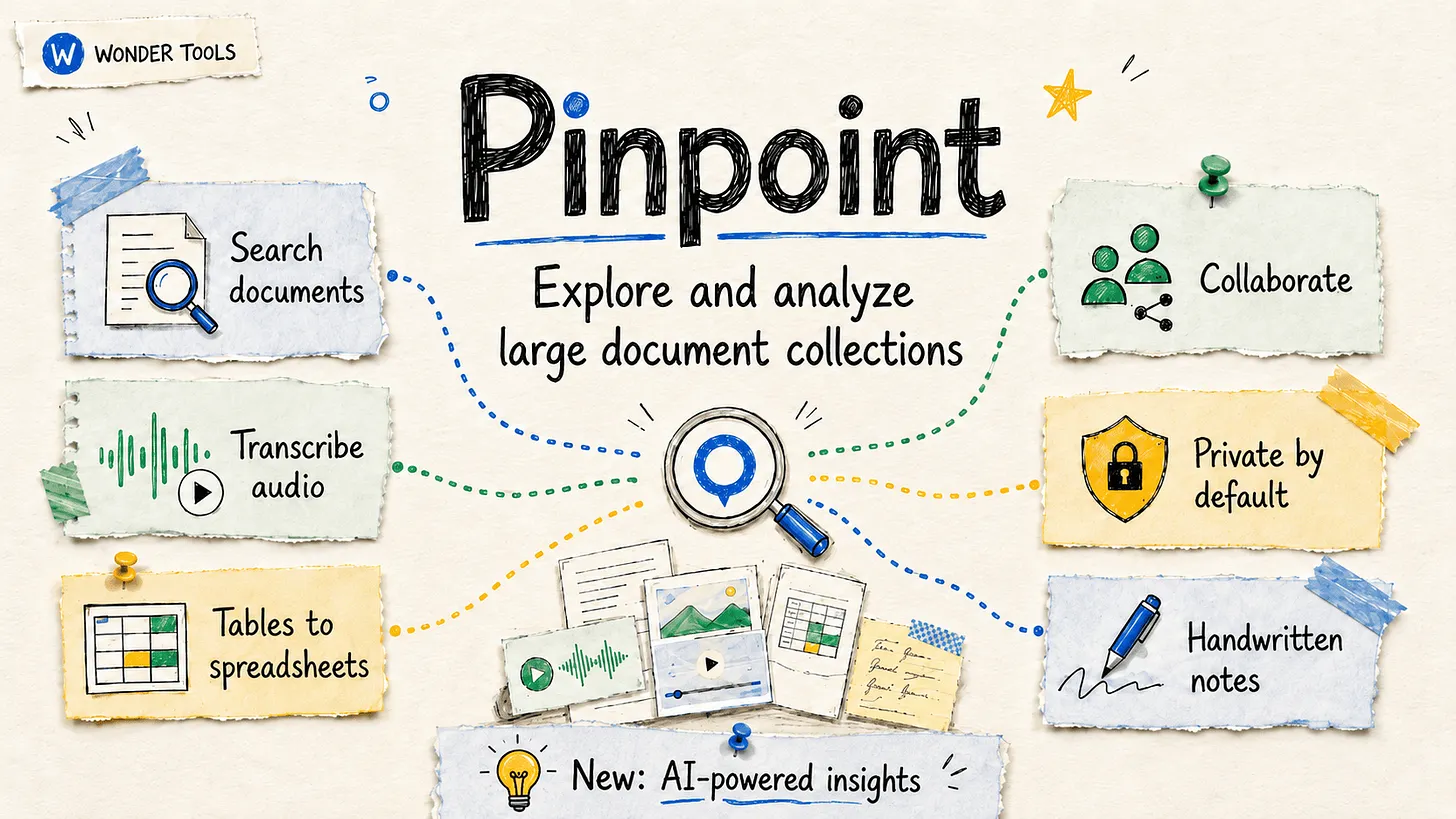
Pinpoint, Explained — from wondertools.substack.com by Jeremy Caplan
A guide to Google’s free tool, now open to all


.Jeremy prompted ChatGPT to generate illustrations in his post.

.


Learn about Pinpoint— from support.google.com

Pinpoint is an AI-powered research platform designed to help journalists and academics analyze large collections of documents. With Pinpoint, you can:

  • Analyze massive collections: Easily search, filter, transcribe and organize thousands of documents, including PDFs, images, and audio files.
  • Leverage generative AI: Use Gemini’s capabilities to answer research questions together with supporting evidence found in your documents.
  • Foster collaborative research: share your work with colleagues and tackle large scale projects as a team. You can also publicly share – supporting community-driven research.

For assistance with Pinpoint, please consult our Community Forum or you can contact our support team.


Cleveland Institute of Art’s Interactive Media Lab Redefines What an Art School Can Be — from edtechmagazine.com

The landscape for specialized colleges and universities such as art schools is shifting as higher education continues to evolve to fit emerging job markets and student interest.

Founded in 1882, Cleveland Institute of Art continuously challenges itself to stay modern and relevant. Years ago, the school’s leadership had the vision to partner with the city to revitalize an area due for reinvigoration.

The result was the Interactive Media Lab, which brings together the university, the city and private industry into a satellite campus that gives students and the community a space to create media, art and experiences with the most up-to-date tools available.


Also see:


6 Tips for Easily Incorporating Games in Your Learning — from learningguild.com

To help you incorporate game elements into your learning, we’ve asked our Game-Based Learning Online Conference speakers to share their best tips:

  1. The game design process can support the instructional designer during design and development. …
  2. One of the biggest mistakes in game-based learning is starting with the game instead of the performance objective. …
  3. By redefining the success of gamification as the transition from information to skill, we’ll see a transformation from the well-known initial engagement driver to a tool that helps guarantee long-term encoding. …
    .
    …and more
 

Inside the latest global research on school cellphone bans — from hechingerreport.org by Jill Barshay
First wave of studies raises questions about other digital distractions and cellphones at home

But the first wave of rigorous research on those policies — including two major U.S. studies — does not point neatly in one direction. Some studies have found modest academic gains from cellphone restrictions. Others have found little to no effect on test scores, even when student phone use dropped sharply. Some studies suggest benefits for low-achieving students, others for girls, and still others for boys. In some places, attendance or student well-being improved. In others, they didn’t.

The scientific process can be messy. Cultural differences may explain why the bans are more effective in some places than others. But almost any education reform will get different results in different places, even within a single country. And the current confusion may also stem from how difficult it is to study cellphone bans in the real world.

Ideally, researchers would randomly assign some students to surrender their phones while others kept them, and then measure the effect on academic performance — the equivalent of a clinical trial for an education policy. But those experiments are difficult to enforce in schools, and so far only one study, conducted among college students in India, has attempted a randomized controlled trial. It produced a notably strong improvement in course grades for lower achieving students.

Instead, most studies rely on rougher real world comparisons that capture only partial effects of cellphone restrictions.


Easy to miss: Anthropic named the Justice Technology Association as the access-to-justice partner in the launch. The cost floor just dropped (while the product got better) for consumer legal. Law Firm 2.0 gets the headlines. A2J and direct-to-consumer is the largest white space in legal.


Antti Innanen > LAVERN: OPEN SOURCE

It has been a crazy 48 hours. We released Lavern as open source.

An agentic legal system, six months in the making, 155,000+ lines of code, 67 specialist agents, nine workflows, and at least ten things inside it that you could make as a separate product.

I was a bit anxious, like I was organising a kids’ party with balloons, unsure if anyone would come.

But they did.


This see-through smart ring translates sign language and almost works like magic — from digitaltrends.com by Rachit Agarwal

For people who are hard of hearing, sign language isn’t just a communication tool; it’s their primary language. The problem is that sign language is not taught to people with regular hearing, thus creating a barrier that’s hard to bridge. Now, a team of researchers in South Korea may have just found a surprisingly elegant solution to this age-old problem.

According to a new study published in Science Advances, the system, called WRSLT (wirelessly connected, ring-type sign language translator), can recognize and translate both American Sign Language and International Sign Language words with around 88% accuracy. And yes, it works in real time.
.


A New Era of Security: Frontier AI Defense — from paloaltonetworks.com by Sam Rubin

For the last several months, we have had early, unbounded access to the latest frontier AI models. What we’ve seen from that vantage point has made it clear that the window for organizations to get ahead of what’s coming is shorter than most leaders realize.

We have moved past the era of incremental AI improvements into a threat landscape shift. Our testing has revealed a step-change in capability that demonstrates an intuitive understanding of software vulnerabilities. This is more than faster code generation, it is a shift from AI as an assistant to AI as an autonomous agent capable of discovering and chaining flaws at a scale that most defenders aren’t prepared for.

These capabilities will not stay confined to controlled environments for long. When Mythos first launched, we predicted a six-month window before attackers gained access. We now believe that timeline has accelerated significantly.


© 2025 | Daniel Christian