10 steps to achieving active learning on a budget — from campustechnology.com by Dian Schaffhauser Active learning often means revamping classrooms to enable more collaborative, hands-on student work — and that can be costly. Here’s how to achieve the pedagogical change without the high expense.
Excerpt:
Active learning is a great way to increase student excitement and participation, facilitate different kinds of learning activities, help people develop skills in small group work, promote discussion, boost attendance and give an outlet for technology usage that stays on track. It also requires remaking classrooms to enable that hands-on, collaborative student work — and that can often mean a six-figure price tag. But at Saint Anselm College in Manchester, NH, a $12,000 experiment proved successful enough that the institution now sports two permanent active learning classrooms as well as a brand-new active learning lab. Here are the 10 steps this school with just under 2,000 students followed on its road to active learning victory.
Overhyped by some, drastically underestimated by others, few emerging technologies have generated the digital ink like virtual reality (VR), augmented reality (AR), and mixed reality (MR). Still lumbering through the novelty phase and roller coaster-like hype cycles, the technologies are only just beginning to show signs of real world usefulness with a new generation of hardware and software applications aimed at the enterprise and at end users like you. On the line is what could grow to be a $108 billion AR/VR industry as soon as 2021. Here’s what you need to know.
The reason is that VR environments by nature demand a user’s full attention, which make the technology poorly suited to real-life social interaction outside a digital world. AR, on the other hand, has the potential to act as an on-call co-pilot to everyday life, seamlessly integrating into daily real-world interactions. This will become increasingly true with the development of the AR Cloud.
The AR Cloud Described by some as the world’s digital twin, the AR Cloud is essentially a digital copy of the real world that can be accessed by any user at any time.
For example, it won’t be long before whatever device I have on me at a given time (a smartphone or wearable, for example) will be equipped to tell me all I need to know about a building just by training a camera at it (GPS is operating as a poor-man’s AR Cloud at the moment).
What the internet is for textual information, the AR Cloud will be for the visible world. Whether it will be open source or controlled by a company like Google is a hotly contested issue.
Augmented reality will have a bigger impact on the market and our daily lives than virtual reality — and by a long shot. That’s the consensus of just about every informed commentator on the subject.
Despite all the hype in recent years about the potential for virtual reality in education, an emerging technology known as mixed reality has far greater promise in and beyond the classroom.
Unlike experiences in virtual reality, mixed reality interacts with the real world that surrounds us. Digital objects become part of the real world. They’re not just digital overlays, but interact with us and the surrounding environment.
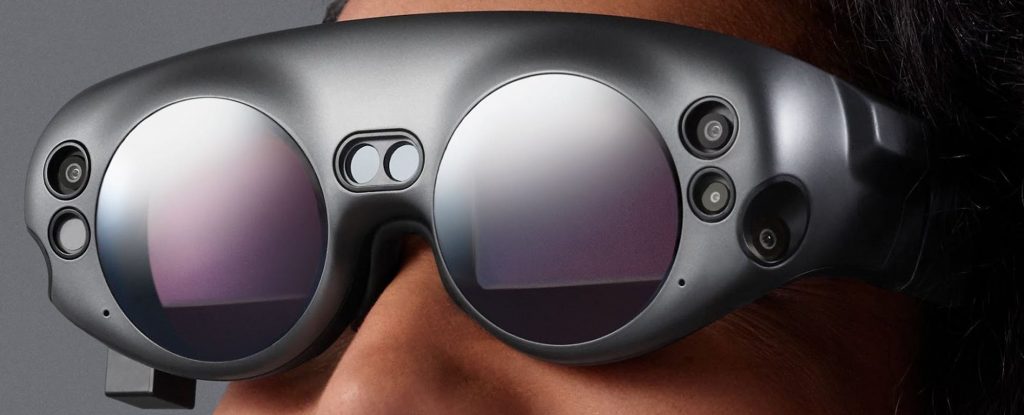
If all that sounds like science fiction, a much-hyped device promises some of those features later this year. The device is by a company called Magic Leap, and it uses a pair of goggles to project what the company calls a “lightfield” in front of the user’s face to make it look like digital elements are part of the real world. The expectation is that Magic Leap will bring digital objects in a much more vivid, dynamic and fluid way compared to other mixed-reality devices such as Microsoft’s Hololens.
Now think about all the other things you wished you had learned this way and imagine a dynamic digital display that transforms your environment and even your living room or classroom into an immersive learning lab. It is learning within a highly dynamic and visual context infused with spatial audio cues reacting to your gaze, gestures, gait, voice and even your heartbeat, all referenced with your geo-location in the world. Unlike what happens with VR, where our brain is tricked into believing the world and the objects in it are real, MR recognizes and builds a map of your actual environment.
Also see:
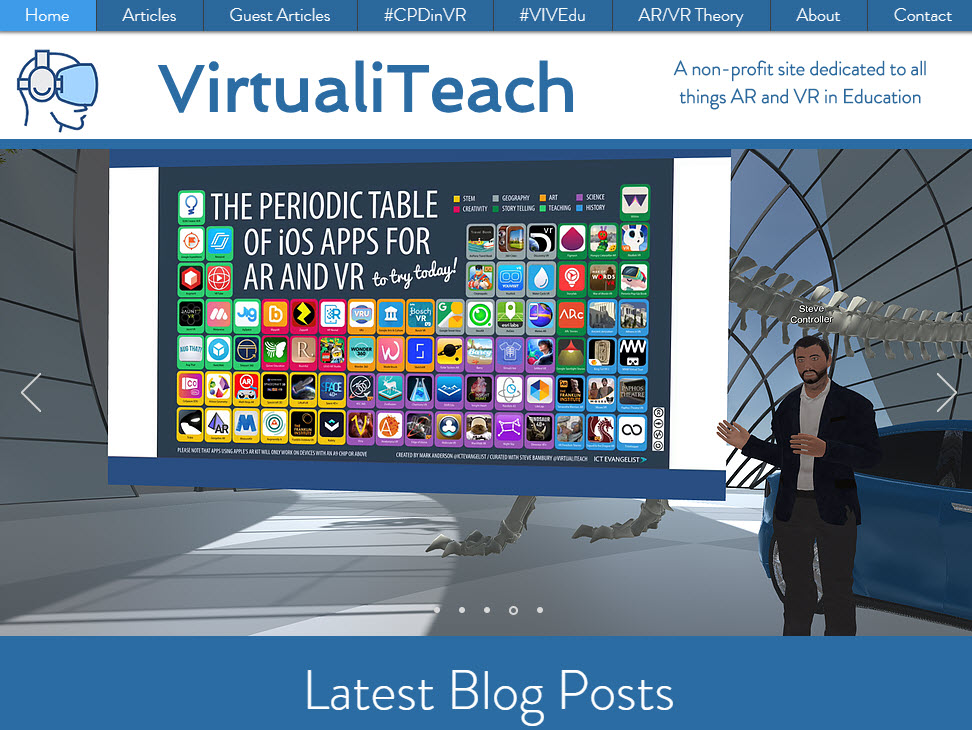
virtualiteach.com Exploring The Potential for the Vive Focus in Education
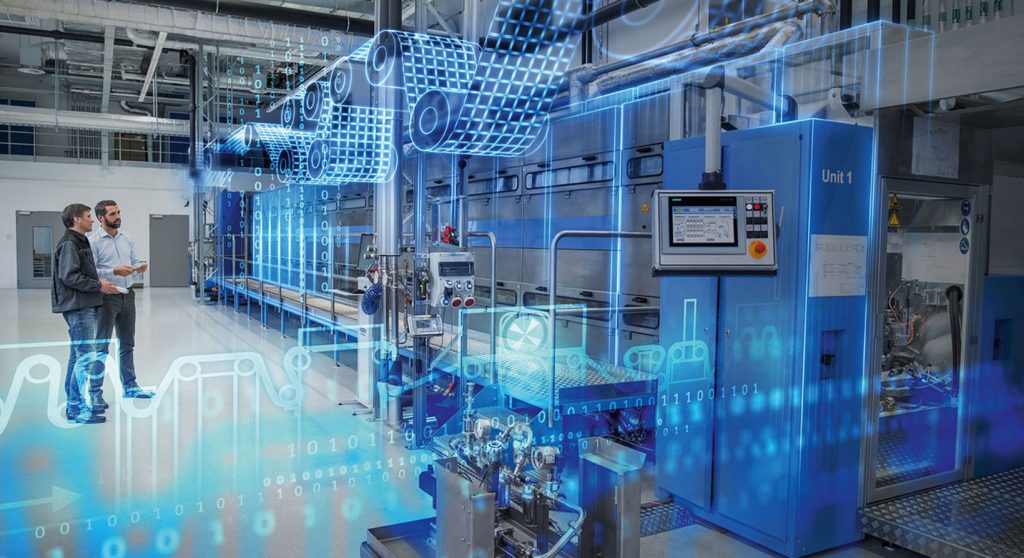
On the big screen it’s become commonplace to see a 3D rendering or holographic projection of an industrial floor plan or a mechanical schematic. Casual viewers might take for granted that the technology is science fiction and many years away from reality. But today we’re going to outline where these sophisticated virtual replicas – Digital Twins – are found in the real world, here and now. Essentially, we’re talking about a responsive simulated duplicate of a physical object or system. When we first wrote about Digital Twin technology, we mainly covered industrial applications and urban infrastructure like transit and sewers. However, the full scope of their presence is much broader, so now we’re going to break it up into categories.
Digital twin refers to a digital replica of physical assets (physical twin), processes and systems that can be used for various purposes.[1] The digital representation provides both the elements and the dynamics of how an Internet of Things device operates and lives throughout its life cycle.[2]
Digital twins integrate artificial intelligence, machine learning and software analytics with data to create living digital simulation models that update and change as their physical counterparts change. A digital twin continuously learns and updates itself from multiple sources to represent its near real-time status, working condition or position. This learning system, learns from itself, using sensor data that conveys various aspects of its operating condition; from human experts, such as engineers with deep and relevant industry domain knowledge; from other similar machines; from other similar fleets of machines; and from the larger systems and environment in which it may be a part of. A digital twin also integrates historical data from past machine usage to factor into its digital model.
In various industrial sectors, twins are being used to optimize the operation and maintenance of physical assets, systems and manufacturing processes.[3] They are a formative technology for the Industrial Internet of Things, where physical objects can live and interact with other machines and people virtually.[4]
Walt Disney Animation Studio is set to debut its first VR short film, Cycles, this August in Vancouver, the Association for Computing Machinery announced today. The plan is for it to be a headliner at the ACM’s computer graphics conference (SIGGRAPH), joining other forms of VR, AR and MR entertainment in the conference’s designated Immersive Pavilion.
This film is a first for both Disney and its director, Jeff Gipson, who joined the animation team in 2013 to work as a lighting artist on films like Frozen, Zootopia and Moana. The objective of this film, Gipson said in the statement released by ACM, is to inspire a deep emotional connection with the story.
“We hope more and more people begin to see the emotional weight of VR films, and with Cycles in particular, we hope they will feel the emotions we aimed to convey with our story,” said Gipson.
Technology and innovation are transforming the legal profession in manifold ways. According to Professor Richard Susskind, author of The Future of Law, “Looking 30 years ahead, I think it unimaginable that our legal systems will not undergo vast change.” Indeed, this revolution is already underway – and to serve their clients effectively and ethically, law firms must adapt to these changing realities.
One thing that remains unchanged, however, is the importance of legal research. In the words of Don MacLeod, Manager of Knowledge Management at Debevoise & Plimpton and author of How to Find Out Anything and The Internet Guide for the Legal Researcher:
As lawyers, you need to be on top of the current legal landscape. Legal research will allow you to advise your client on the standards of the law at this moment, whether they come from case law, statutes, or regulations.
The importance of legal research persists, but how it’s conducted is constantly advancing and evolving. Just as attorneys who used hard-copy books for all of their legal research would be amazed by online legal research services like Westlaw, attorneys using current services will be amazed by the research tools of tomorrow, powered by artificial intelligence and analytics.
ZHENGZHOU, China — In the Chinese city of Zhengzhou, a police officer wearing facial recognition glasses spotted a heroin smuggler at a train station.
In Qingdao, a city famous for its German colonial heritage, cameras powered by artificial intelligence helped the police snatch two dozen criminal suspects in the midst of a big annual beer festival.
In Wuhu, a fugitive murder suspect was identified by a camera as he bought food from a street vendor.
With millions of cameras and billions of lines of code, China is building a high-tech authoritarian future. Beijing is embracing technologies like facial recognition and artificial intelligence to identify and track 1.4 billion people. It wants to assemble a vast and unprecedented national surveillance system, with crucial help from its thriving technology industry.
In some cities, cameras scan train stations for China’s most wanted. Billboard-size displays show the faces of jaywalkers and list the names of people who don’t pay their debts. Facial recognition scanners guard the entrances to housing complexes. Already, China has an estimated 200 million surveillance cameras — four times as many as the United States.
Such efforts supplement other systems that track internet use and communications, hotel stays, train and plane trips and even car travel in some places.
From DSC: A veeeeery slippery slope here. The usage of this technology starts out as looking for criminals, but then what’s next? Jail time for people who disagree w/ a government official’s perspective on something? Persecution for people seen coming out of a certain place of worship?
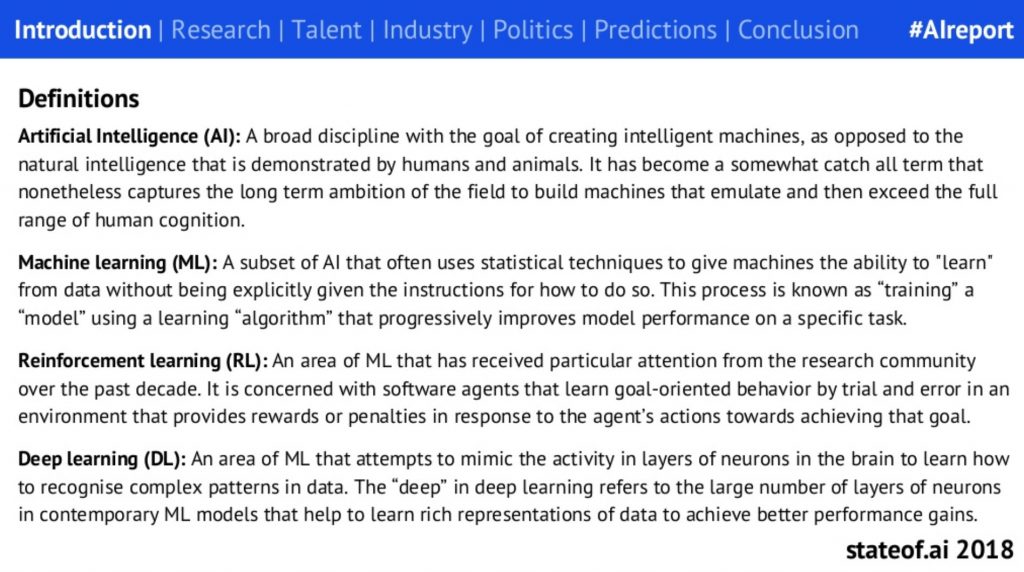
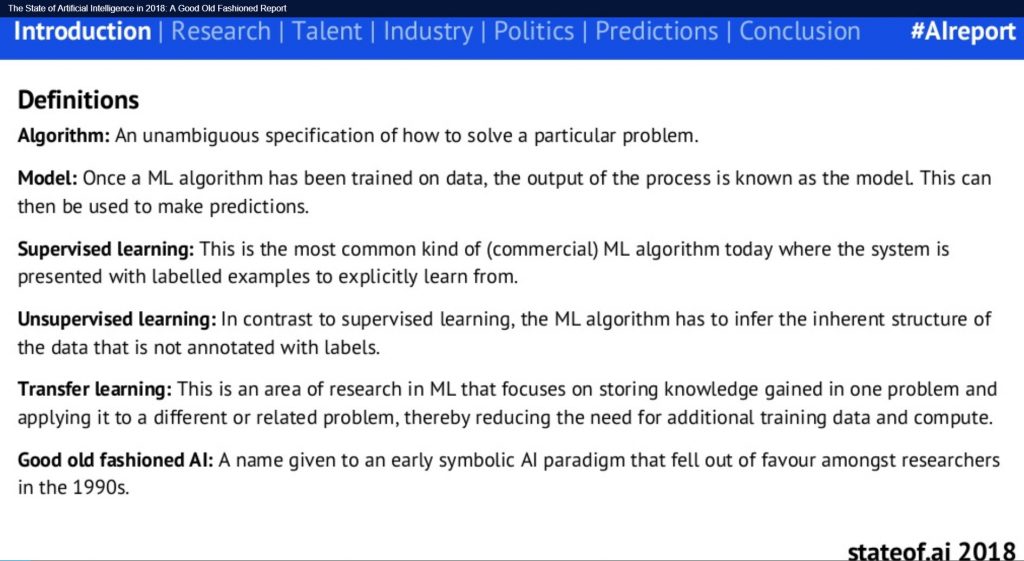
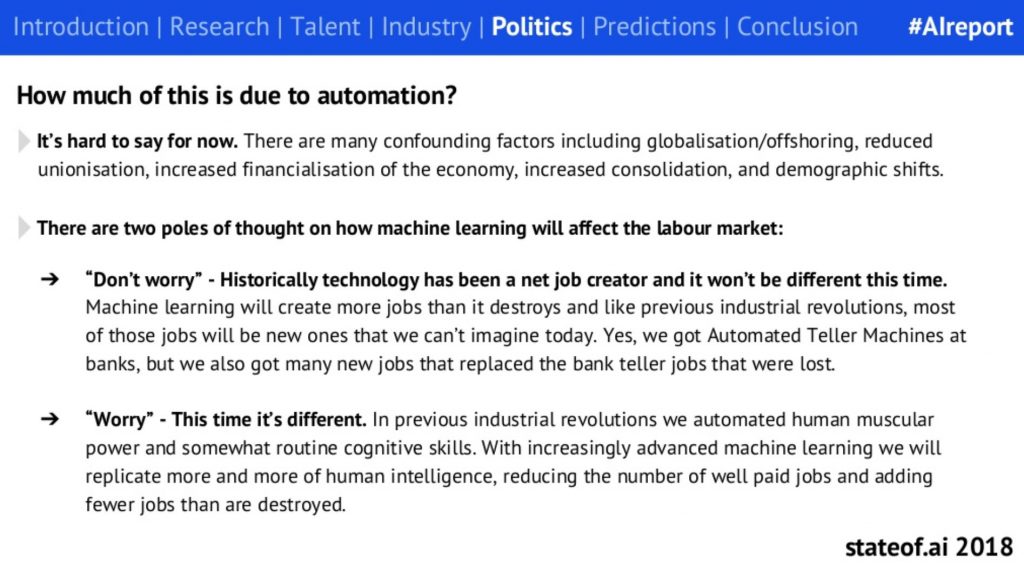
In this report, we set out to capture a snapshot of the exponential progress in AI with a focus on developments in the past 12 months. Consider this report as a compilation of the most interesting things we’ve seen that seeks to trigger informed conversation about the state of AI and its implication for the future.
We consider the following key dimensions in our report:
Research: Technology breakthroughs and their capabilities.
Talent: Supply, demand and concentration of talent working in the field.
Industry: Large platforms, financings and areas of application for AI-driven innovation today and tomorrow.
Politics: Public opinion of AI, economic implications and the emerging geopolitics of AI.
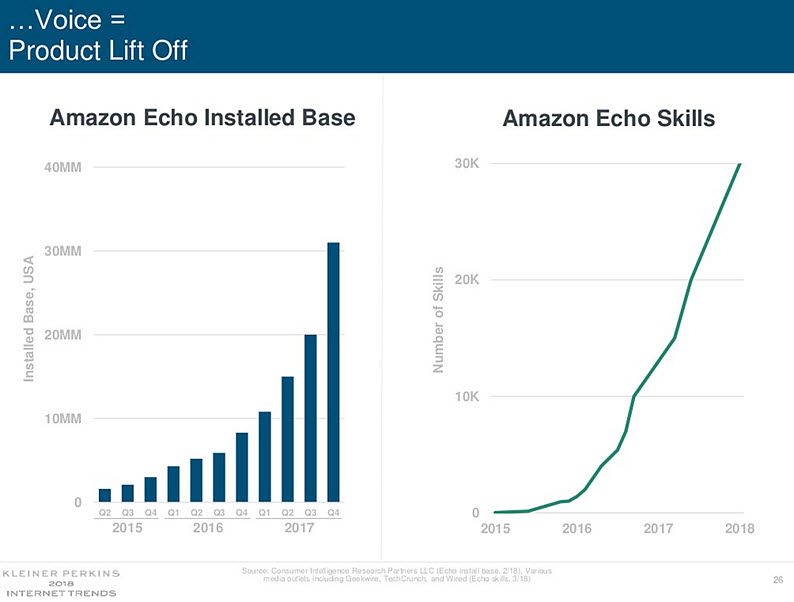
As I write this, AI has already begun to make video meetings even better. You no longer have to spend time entering codes or clicking buttons to launch a meeting. Instead, with voice-based AI, video conference users can start, join or end a meeting by simply speaking a command (think about how you interact with Alexa).
Voice-to-text transcription, another artificial intelligence feature offered by Otter Voice Meeting Notes (from AISense, a Zoom partner), Voicefox and others, can take notes during video meetings, leaving you and your team free to concentrate on what’s being said or shown. AI-based voice-to-text transcription can identify each speaker in the meeting and save you time by letting you skim the transcript, search and analyze it for certain meeting segments or words, then jump to those mentions in the script. Over 65% of respondents from the Zoom survey said they think AI will save them at least one hour a week of busy work, with many claiming it will save them one to five hours a week.
It is this noiseless sound, though, that says a lot about how machines function.
Helsinki-based Noiseless Acoustics and Amsterdam-based OneWatt are relying on artificial intelligence (AI) to better understand the sound patterns of troubled machines. Through AI they are enabling faster and easier problem detection.
Making sound visible even when it can’t be heard. With the aid of non-invasive sensors, machine learning algorithms, and predictive maintenance solutions, failing components can be recognized at an early stage before they become a major issue.
A number of higher education institutions in China have deployed biometric solutions for access and payments in recent months, and adding to the list is Peking University. The university has now installed facial recognition readers at perimeter access gates to control access to its Beijing campus.
As reported by the South China Morning Post, anyone attempting to enter through the southwestern gate of the university will no longer have to provide a student ID card. Starting this month, students will present their faces to a camera as part of a trial run of the system ahead of full-scale deployment.
From DSC: I’m not sure I like this one at all — and the direction that this is going in.
How can we get smarter about machine learning?
As I said earlier, we’ve reached an important crossroads. Will we use new technologies to improve life for everyone, or to fuel the agendas of powerful people and organizations?
I certainly hope it’s the former. Few of us will run for president or lead a social media empire, but we can all help to move the needle.
Consume information with a critical eye.
Most people won’t stop using Facebook, Google, or social media platforms, so proceed with a healthy dose of skepticism. Remember that the internet can never be objective. Ask questions and come to your own conclusions.
Get your headlines from professional journalists.
Seek credible outlets for news about local, national and world events. I rely on the New York Times and the Wall Street Journal. You can pick your own sources, but don’t trust that the “article” your Aunt Marge just posted on Facebook is legit.
Oculus is officially launching Oculus TV, its dedicated hub for watching flatscreen video in virtual reality, on the standalone Oculus Go headset. Oculus TV was announced at last month’s F8 conference, and it ties together a lot of existing VR video options, highlighting Oculus’ attempts to emphasize non-gaming uses of VR. The free app features a virtual home theater with what Oculus claims is the equivalent of a 180-inch TV screen. It offers access to several streaming video services, including subscription-based platforms like Showtime and free web television services like Pluto TV as well as video from Oculus’ parent company Facebook.
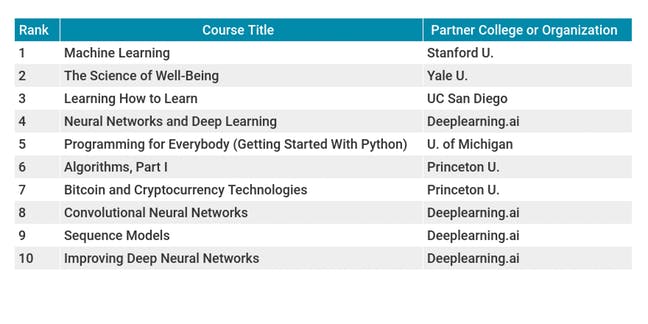
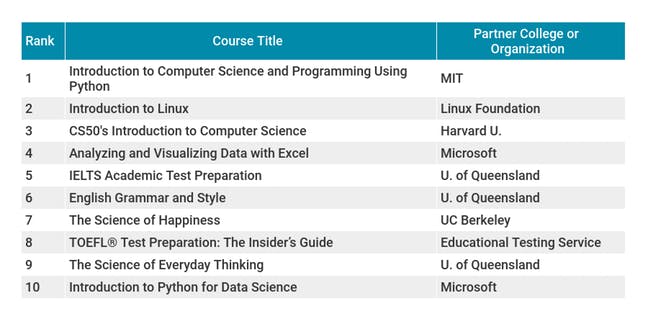
There isn’t a New York Times bestseller list for online courses, but perhaps there should be. After all, so-called MOOCs, or massive open online courses, were meant to open education to as many learners as possible, and in many ways they are more like books (digital ones, packed with videos and interactive quizzes) than courses.
The colleges and companies offering MOOCs can be pretty guarded these days about releasing specific numbers on how many people enroll or pay for a “verified certificate” or microcredential showing they took the course. But both Coursera and EdX, two of the largest providers, do release lists of their most popular courses. And those lists offer a telling snapshot of how MOOCs are evolving and what their impact is on the instructors and institutions offering them.
Here are the top 10 most popular courses for each provider:
Coursera Top 10 Most Popular Courses (over past 12 months)
edX Top 10 Most Popular Courses (all time)
So what are these blockbuster MOOCs, then? Experiential textbooks? Gateways to more rigorous college courses? A new kind of entertainment program?
Reimagining the Higher Education Ecosystem — from edu2030.agorize.com How might we empower people to design their own learning journeys so they can lead purposeful and economically stable lives?
Excerpts:
The problem
Technology is rapidly transforming the way we live, learn, and work. Entirely new jobs are emerging as others are lost to automation. People are living longer, yet switching jobs more often. These dramatic shifts call for a reimagining of the way we prepare for work and life—specifically, how we learn new skills and adapt to a changing economic landscape.
The changes ahead are likely to hurt most those who can least afford to manage them: low-income and first generation learners already ill-served by our existing postsecondary education system. Our current system stifles economic mobility and widens income and achievement gaps; we must act now to ensure that we have an educational ecosystem flexible and fair enough to help all people live purposeful and economically stable lives. And if we are to design solutions proportionate to this problem, new technologies must be called on to scale approaches that reach the millions of vulnerable people across the country.
The challenge How might we empower people to design their own learning journeys so they can lead purposeful and economically stable lives?
The Challenge—Reimagining the Higher Education Ecosystem—seeks bold ideas for how our postsecondary education system could be reimagined to foster equity and encourage learner agency and resilience. We seek specific pilots to move us toward a future in which all learners can achieve economic stability and lead purposeful lives. This Challenge invites participants to articulate a vision and then design pilot projects for a future ecosystem that has the following characteristics:
Expands access:The educational system must ensure that all people—including low-income learners who are disproportionately underserved by the current higher education system—can leverage education to live meaningful and economically stable lives.
Draws on a broad postsecondary ecosystem:While college and universities play a vital role in educating students, there is a much larger ecosystem in which students learn. This ecosystem includes non-traditional “classes” or alternative learning providers, such as MOOCs, bootcamps, and online courses as well as on-the-job training and informal learning. Our future learning system must value the learning that happens in many different environments and enable seamless transitions between learning, work, and life.
From DSC: This is where I could see a vision similar to Learning from the Living [Class] Room come into play. It would provide a highly affordable, accessible platform, that would offer more choice, and more control to learners of all ages. It would be available 24×7 and would be a platform that supports lifelong learning. It would combine a variety of AI-enabled functionalities with human expertise, teaching, training, motivation, and creativity.
It could be that what comes out of this challenge will lay the groundwork for a future, massive new learning platform.
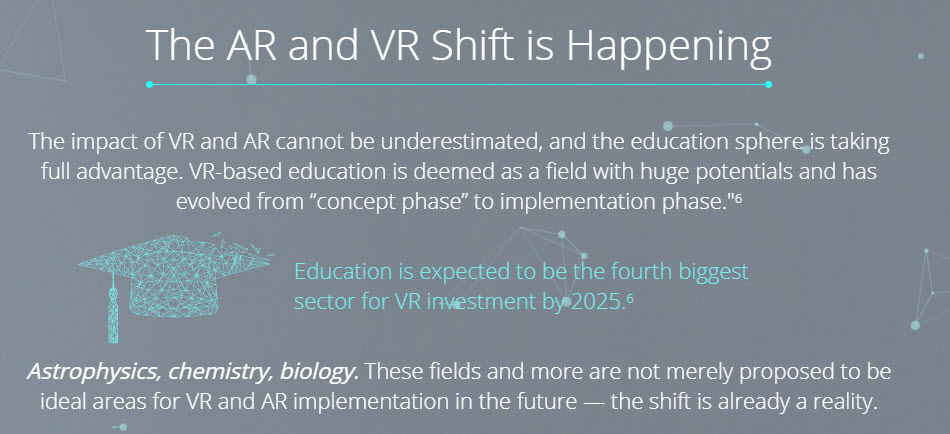
Virtual Reality (VR) and Augmented Reality (AR), often used in video games and mobile apps, are transforming the world—and with that, the way we learn. These technologies have the capability to change students’ outlook on the world and the way they engage with it. After all, why would you learn about outer space from a classroom when you could learn about it from the International Space Station?
As AR and VR technology become more widely available and user-friendly, interest and market value have spiked across the world. In 2017, interest in VR hardware such as PlayStation VR, HTC Vive, Oculus Rift, and Samsung Gear VR spiked around the globe.2 In China in particular, AR and VR are booming.
…
With AR and VR, geographical distances are no longer an obstacle. Interactive experiences, tutorial videos, and learning apps work just as well, whether the teacher and student are in the same room, or across the world from each other.
…
From their site, here are some additional resources:
I have argued that several conditions for good learning are likely to be enhanced by VR. First there’s increased attention, where the learner is literally held fast within the created environment and cannot be distracted by external stimuli. Second is experiential learning, where one has to ‘do’ something where that active component leads to higher retention. Third is emotion, the affective component in learning, which is better achieved where the power to induce empathy, excitement, calm and so on is easier. Fourth is context, where providing an albeit simulated context aids retention and recall. Fifth is transfer, where all of these conditions lead to greater transfer of knowledge and skills to the real world.
In August, the U.S. Customs and Border Protection will roll out new technology that will scan the faces of drivers as they enter and leave the United States. For years, accomplishing that kind of surveillance through a car windshield has been difficult. But technology is quickly advancing. This system, activated by ambient light sensors, range finders and remote speedometers, uses smart cameras and AI-powered facial recognition technology to compare images in government files with people behind the wheel.
Biometric borders are just the beginning. Faceprints are quickly becoming our new fingerprints, and this technology is marching forward with haste. Faceprints are now so advanced that machine learning algorithms can recognize your unique musculatures and bone structures, capillary systems, and expressions using thousands of data points. All the features that make up a unique face are being scanned, captured and analyzed to accurately verify identities. New hairstyle? Plastic surgery? They don’t interfere with the technology’s accuracy.
Why you should care. Faceprints are already being used across China for secure payments. Soon, they will be used to customize and personalize your digital experiences. Our Future Today Institute modeling shows myriad near-future applications, including the ability to unlock your smart TV with your face. Retailers will use your face to personalize your in-store shopping experience. Auto manufacturers will start using faceprints to detect if drivers are under the influence of drugs or alcohol and prevent them from driving. It’s plausible that cars will soon detect if a driver is distracted and take the wheel using an auto-pilot feature. On a diet but live with others? Stash junk food in a drawer and program the lock to restrict your access. Faceprints will soon create opportunities for a wide range of sectors, including military, law enforcement, retail, manufacturing and security. But as with all technology, faceprints could lead to the loss of privacy and widespread surveillance.
It’s possible for both risk and opportunity to coexist. The point here is not alarmist hand-wringing, or pointless calls for cease-and-desist demands on the development and use of faceprint technology. Instead, it’s to acknowledge an important emerging trend––faceprints––and to think about the associated risks and opportunities for you and your organization well in advance. Approach biometric borders and faceprints with your (biometrically unique) eyes wide open.
Near-Futures Scenarios (2018 – 2028):
Optimistic: Faceprints make us safer, and they bring us back to physical offices and stores.
Pragmatic:As faceprint adoption grows, legal challenges mount.
In April, a U.S. federal judge ruled that Facebook must confront a class-action lawsuit that alleges its faceprint technology violates Illinois state privacy laws. Last year, a U.S. federal judge allowed a class-action suit to go forth against Shutterfly, claiming the company violated the Illinois Biometric Information Privacy Act, which ensures companies receive written releases before collecting biometric data, including faces. Companies and device manufacturers, who are early developers but late to analyzing legal outcomes, are challenged to balance consumer privacy with new security benefits.
Catastrophic: Faceprints are used for widespread surveillance and authoritative control.
How AI is helping sports teams scout star play — from nbcnews.com by Edd Gent Professional baseball, basketball and hockey are among the sports now using AI to supplement traditional coaching and scouting.
The workplace of the future will be marked by unprecedentedly advanced technologies, as well as a focus on incorporating artificial intelligence to drive higher levels of production with fewer resources. Employers and education stakeholders, noting the reality of this trend, are turning a reflective eye toward current students and questioning whether they will be workforce ready in the years to come.
This has become a significant concern for higher education executives, who find their business models could be disrupted as they fail to meet workforce demands. A 2018 Gallup-Northeastern University survey shows that of 3,297 U.S. citizens interviewed, only 22% with a bachelor’s degree said their education left them “well” or “very well prepared” to use AI in their jobs.
…
In his book “Robot-Proof: Higher Education in the Age of Artificial Intelligence,” Northeastern University President Joseph Aoun argued that for higher education to adapt advanced technologies, it has to focus on life-long learning, which he said says prepares students for the future by fostering purposeful integration of technical literacies, such as coding and data literacy, with human literacies, such as creativity, ethics, cultural agility and entrepreneurship.
“When students combine these literacies with experiential components, they integrate their knowledge with real life settings, leading to deep learning,” Aoun told Forbes.
We’re going to talk to our technology, and everyone else’s too. Google proved that earlier this month with a demonstration of artificial intelligence that can hop on the phone to book a restaurant reservation or appointment at the hair salon.
Now it’s just a matter of who can build that technology fastest. To reach that goal, Microsoft has acquired conversational AI startup Semantic Machines for an undisclosed amount. Founded in 2014, the startup’s goal was to build AI that can converse with humans through speech or text, with the ability to be trained to converse on any language or subject.
A team of researchers from the State University of New York (SUNY) recently developed a method for detecting whether the people in a video are AI-generated. It looks like DeepFakes could meet its match.
What it means: Fear over whether computers will soon be able to generate videos that are indistinguishable from real footage may be much ado about nothing, at least with the currently available methods.
The SUNY team observed that the training method for creating AI that makes fake videos involves feeding it images – not video. This means that certain human physiological quirks – like breathing and blinking – don’t show up in computer-generated videos. So they decided to build an AI that uses computer vision to detect blinking in fake videos.
Without even knowing it, we are interacting with pragmatic AI day in and day out. It is used in the automated chatbots that answer our calls and questions and the customer service rep that texts with us on a retail site, providing a better and faster customer experience.
Below are four key categories of pragmatic AI and ways they are being applied today.
1. Speech Recognition And Natural Language Processing (NLP)
2. Predictive Analytics
3. Image Recognition And Computer Vision
4. Self-Driving Cars And Robots
Artificial intelligence (AI) is transforming the practice of law, and “data is the new oil” of the legal industry, panelist Dennis Garcia said at a recent American Bar Association conference.Garcia is an assistant general counsel for Microsoft in Chicago. Robert Ambrogi, a Massachusetts lawyer and blogger who focuses on media, technology, and employment law, moderated the program.“The next generation of lawyers is going to have to understand how AI works” as part of the duty of competence, panelist Anthony E. Davis told the audience. Davis is a partner with Hinshaw & Culbertson LLP in New York.
…
Davis said AI will result in dramatic changes in law firms’ hiring and billing, among other things. The hourly billing model, he said, “makes no sense in a universe where what clients want is judgment.” Law firms should begin to concern themselves not with the degrees or law schools attended by candidates for employment but with whether they are “capable of developing judgment, have good emotional intelligence, and have a technology background so they can be useful” for long enough to make hiring them worthwhile, he said.
HomeCourt is built on tools announced by Federighi last summer, when he launched Apple’s bid to become a preferred playground for AI-curious developers. Known as Core ML, those tools help developers who’ve trained machine learning algorithms deploy them on Apple’s mobile devices and PCs.
At Apple’s Worldwide Developer Conference on Monday, Federighi revealed the next phase of his plan to enliven the app store with AI. It’s a tool called Create ML that’s something like a set of training wheels for building machine learning models in the first place. In a demo, training an image-recognition algorithm to distinguish different flavors of ice cream was as easy as dragging and dropping a folder containing a few dozen images and waiting a few seconds. In a session for developers, Apple engineers suggested Create ML could teach software to detect whether online comments are happy or angry, or predict the quality of wine from characteristics such as acidity and sugar content. Developers can use Create ML now but can’t ship apps using the technology until Apple’s latest operating systems arrive later this year.
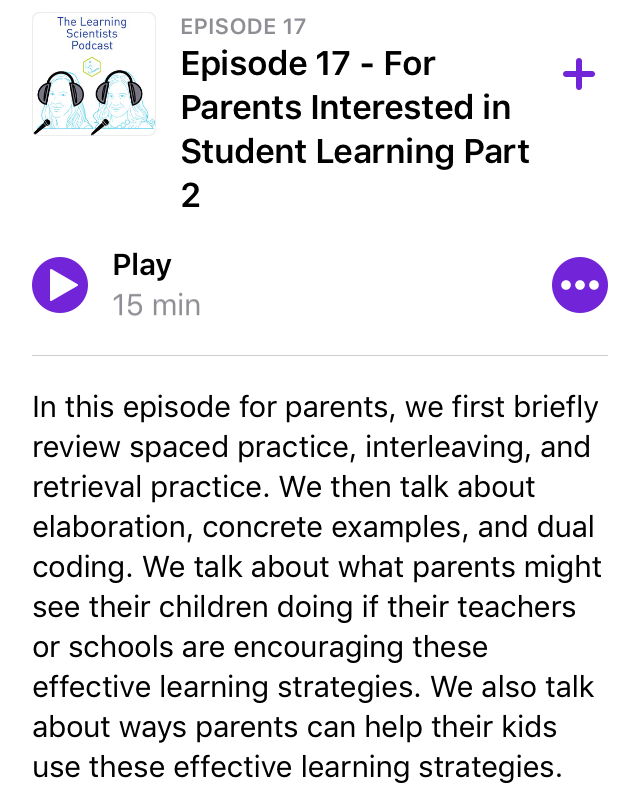
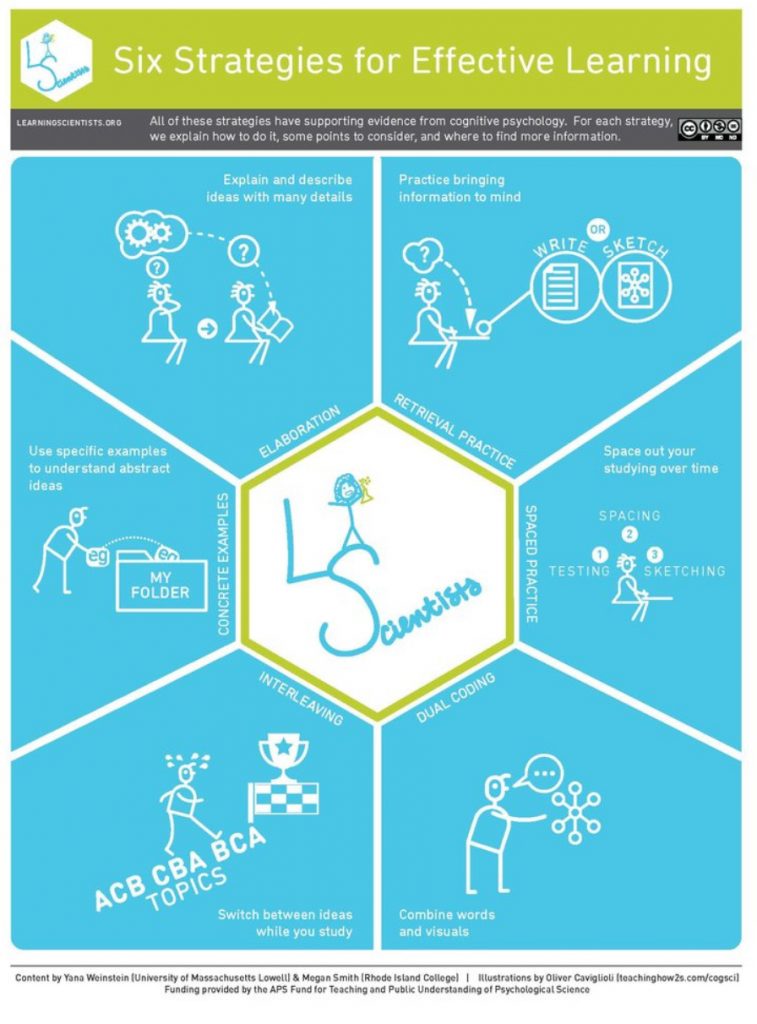
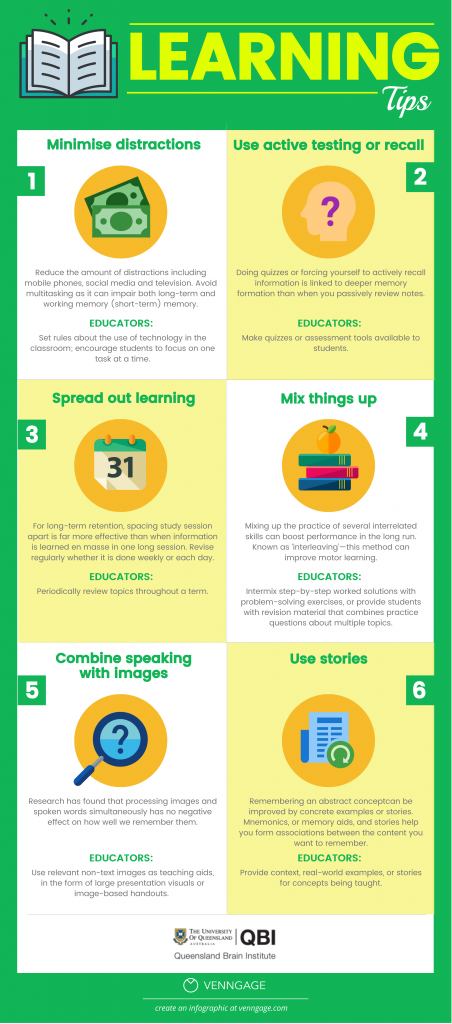
I was very impressed after my initial review of their materials! What I really appreciate about their work is that they are serious in identifying some highly effective means of how we learn best — pouring over a great deal of research in order to do so. But they don’t leave things there. They help translate that research into things that teachers can then try out in the classroom. This type of practical, concrete help is excellent and needed!
Daniel Willingham and some of his colleagues take research and help teachers apply it as well
We are cognitive psychological scientists interested in research on education. Our main research focus is on the science of learning. (Hence, “The Learning Scientists”!)
Our Vision is to make scientific research on learning more accessible to students, teachers, and other educators.
Click the button below to learn more about us. You can also check out our social media pages: Facebook, Twitter, Instagram, & Tumblr.
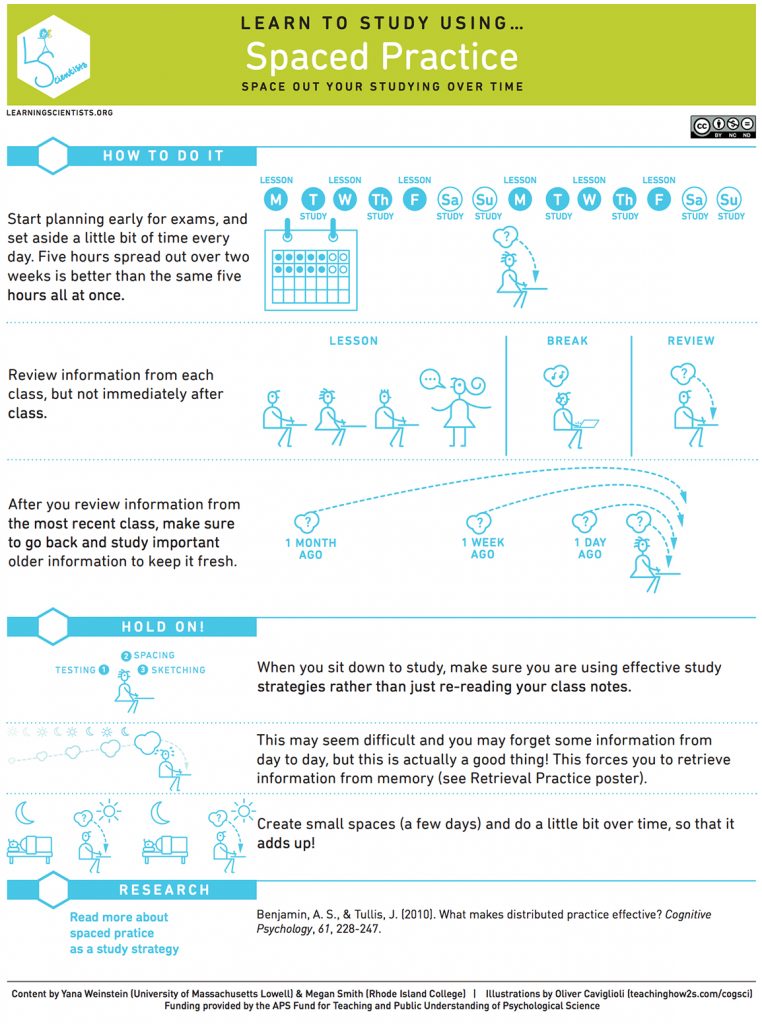
In the downloadable content area, the posters that they’ve created (or ones like them) should be posted at every single facility where learning occurs — K-12 schools, community colleges, colleges, universities, libraries of all kinds, tutoring centers, etc. It may be that such posters — and others like them that encourage the development of metacognitive skills of our students — are out there. I just haven’t run into them.
For example, here’s a poster on learning how to study using spaced practice:
Lehi, UT, May 29, 2018 (GLOBE NEWSWIRE) — Today, fast-growing augmented reality startup, Seek, is launching Seek Studio, the world’s first mobile augmented reality studio, allowing anybody with a phone and no coding expertise required, to create their own AR experiences and publish them for the world to see. With mobile AR now made more readily available, average consumers are beginning to discover the magic that AR can bring to the palm of their hand, and Seek Studio turns everyone into a creator.
To make the process incredibly easy, Seek provides templates for users to create their first AR experiences. As an example, a user can select a photo on their phone, outline the portion of the image they want turned into a 3D object and then publish it to Seek. They will then be able to share it with their friends through popular social networks or text. A brand could additionally upload a 3D model of their product and publish it to Seek, providing an experience for their customers to easily view that content in their own home. Seek Studio will launch with 6 templates and will release new ones every few days over the coming months to constantly improve the complexity and types of experiences possible to create within the platform.
Apple unveiled its new augmented reality file format, as well as ARKit 2.0, at its annual WWDC developer conference today. Both will be available to users later this year with iOS 12.
The tech company partnered with Pixar to develop the AR file format Universal Scene Description (USDZ) to streamline the process of sharing and accessing augmented reality files. USDZ will be compatible with tools like Adobe, Autodesk, Sketchfab, PTC, and Quixel. Adobe CTO Abhay Parasnis spoke briefly on stage about how the file format will have native Adobe Creative Cloud support, and described it as the first time “you’ll be able to have what you see is what you get (WYSIWYG) editing” for AR objects.
With a starting focus on University-level education and vocational schools in sectors such as mechanical engineering, VivEdu branched out to K-12 education in 2018, boasting a comprehensive VR approach to learning science, technology, engineering, mathematics, and art for kids.
That roadmap, of course, is just beginning. Which is where the developers—and those arm’s-length iPads—come in. “They’re pushing AR onto phones to make sure they’re a winner when the headsets come around,” Miesnieks says of Apple. “You can’t wait for headsets and then quickly do 10 years’ worth of R&D on the software.”
To fully realize the potential will require a broad ecosystem. Adobe is partnering with technology leaders to standardize interaction models and file formats in the rapidly growing AR ecosystem. We’re also working with leading platform vendors, open standards efforts like usdz and glTF as well as media companies and the creative community to deliver a comprehensive AR offering. usdz is now supported by Apple, Adobe, Pixar and many others while glTF is supported by Google, Facebook, Microsoft, Adobe and other industry leaders.
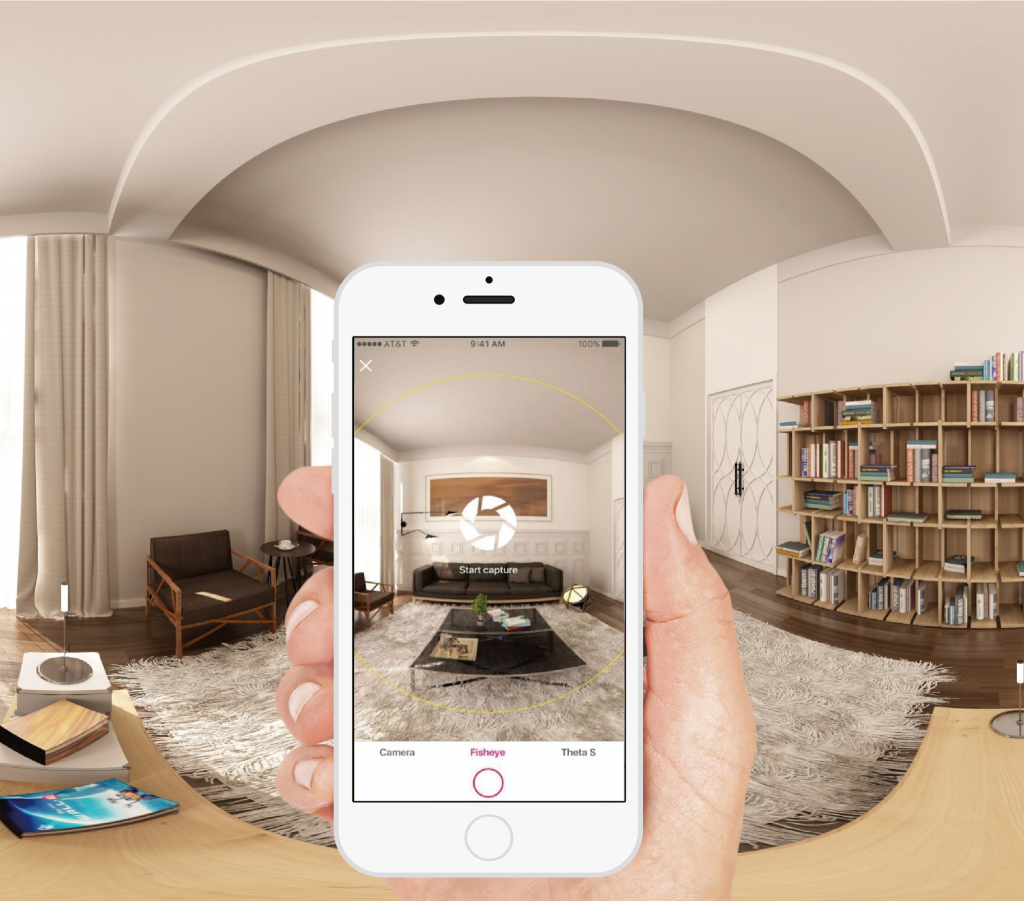
There are a number of professionals who would find the ability to quickly and easily create floor plans to be extremely useful. Estate agents, interior designers and event organisers would all no doubt find such a capability to be extremely valuable. For those users, the new feature added to iStaging’s VR Maker app might be of considerable interest.
The new VR Maker feature utilises Apple’s ARKit toolset to recognise spaces, such as walls and floors and can provide accurate measurements. By scanning each wall of a space, a floor plan can be produced quickly and easily.
I’ve interviewed nine investors who have provided their insights on where the VR industry has come, as well as the risks and opportunities that exist in 2018 and beyond. We’ve asked them what opportunities are available in the space — and what tips they have for startups.
Augmented reality (AR) hasn’t truly permeated the mainstream consciousness yet, but the technology is swiftly being adopted by global industries. It’ll soon be unsurprising to find a pair of AR glasses strapped to a helmet sitting on the heads of service workers, and RealWear, a company at the forefront on developing these headsets, thinks it’s on the edge of something big.
…
VOICE ACTIVATION
What’s most impressive about the RealWear HMT-1Z1 is how you control it. There’s no touch-sensitive gestures you need to learn — it’s all managed with voice, and better yet, there’s no need for a hotword like “Hey Google.” The headset listens for certain commands. For example, from the home screen just say “show my files” to see files downloaded to the device, and you can go back to the home screen by saying “navigate home.” When you’re looking at documents — like schematics — you can say “zoom in” or “zoom out” to change focus. It worked almost flawlessly, even in a noisy environment like the AWE show floor.
David Scowsill‘s experience in the aviation industry spans over 30 years. He has worked for British Airways, American Airlines, Easy Jet, Manchester Airport, and most recently the World Travel and Tourism Council, giving him a unique perspective on how Augmented and Virtual Reality (AVR) can impact the aviation industry.
These technologies have the power to transform the entire aviation industry, providing benefits to companies and consumers. From check-in, baggage drop, ramp operations and maintenance, to pilots and flight attendants, AVR can accelerate training, improve safety, and increase efficiency.
London-based design studio Marshmallow Laser Feast is using VR to let us reconnect with nature. With headsets, you can see a forest through the eyes of different animals and experience the sensations they feel. Creative Director Ersinhan Ersin took the stage at TNW Conference last week to show us how and why they created the project, titled In the Eyes of the Animal.
Have you already taken a side when it comes to XR wearables? Whether you prefer AR glasses or VR headsets likely depends on the application you need. But wouldn’t it be great to have a device that could perform as both? As XR tech advances, we think crossovers will start popping up around the world.
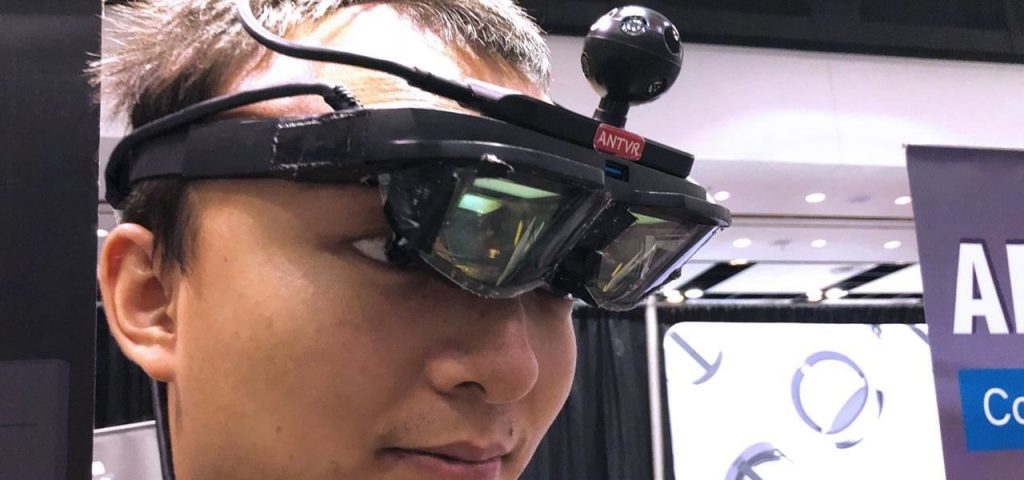
A Beijing startup called AntVR recently rocketed past its Kickstarter goal for an AR/VR visor. Their product, the Mix, uses tinted lenses to toggle between real world overlay and full immersion. It’s an exciting prospect. But rather than digging into the tech (or the controversy surrounding their name, their marketing, and a certain Marvel character) we’re looking at what this means for how XR devices are developed and sold.
Google is bringing AR tech to its Expeditions app with a new update going live today. Last year, the company introduced its GoogleExpeditions AR Pioneer Program, which brought the app into classrooms across the country; with this launch the functionality is available to all.
Expeditions will have more than 100 AR tours in addition to the 800 VR tours already available. Examples include experiences that let users explore Leonardo Da Vinci’s inventions and ones that let you interact with the human skeletal system.
At four recent VR conferences and events there was a palpable sense that despite new home VR devices getting the majority of marketing and media attention this year, the immediate promise and momentum is in the location-based VR (LBVR) attractions industry. The VR Arcade Conference (April 29th and 30th), VRLA (May 4th and 5th), the Digital Entertainment Group’s May meeting (May 1), and FoIL (Future of Immersive Leisure, May 16th and 17th) all highlighted a topic that suddenly no one can stop talking about: location-based VR (LBVR). With hungry landlords giving great deals for empty retail locations, VRcades, which are inexpensive to open (like Internet Cafes), are popping up all over the country. As a result, VRcade royalties for developers are on the rise, so they are shifting their attention accordingly to shorter experiences optimized for LBVR, which is much less expensive than building a VR app for the home.
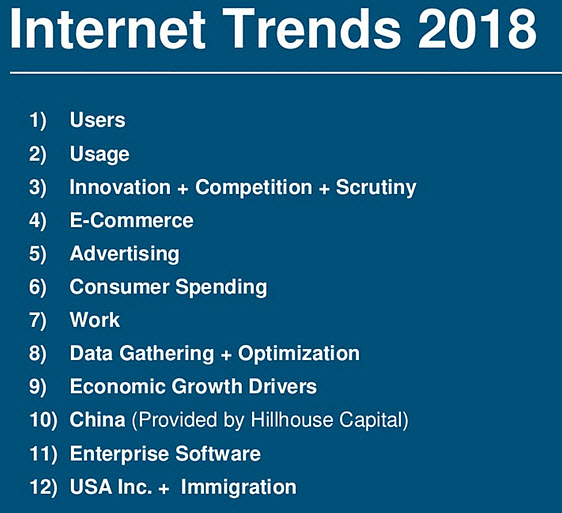
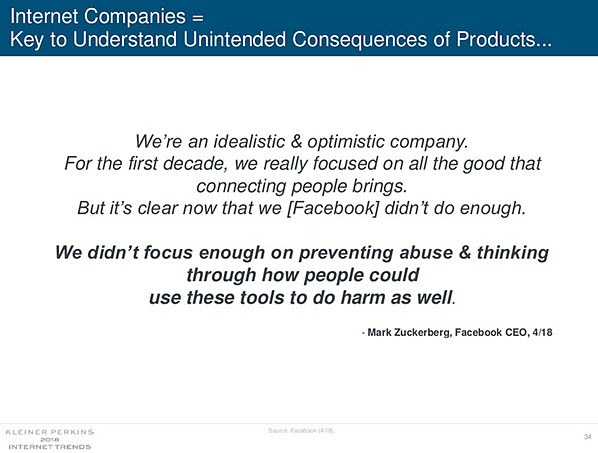
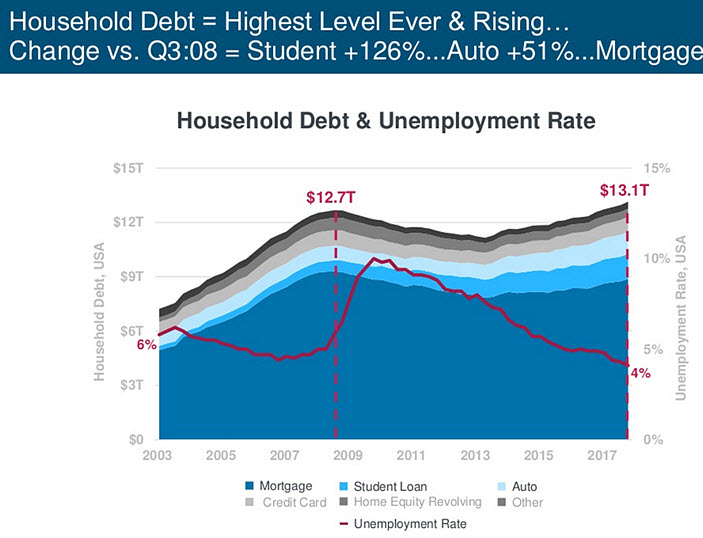
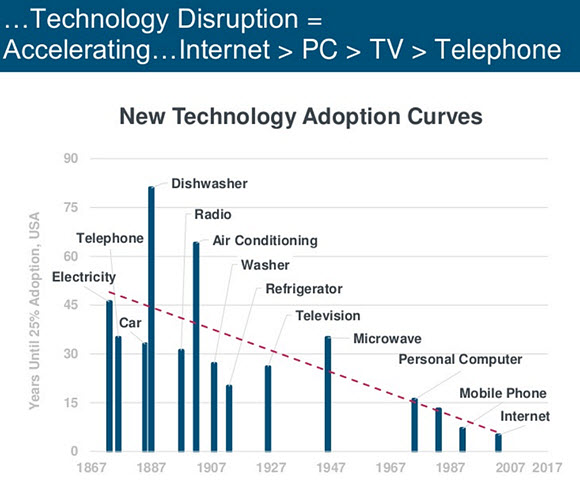
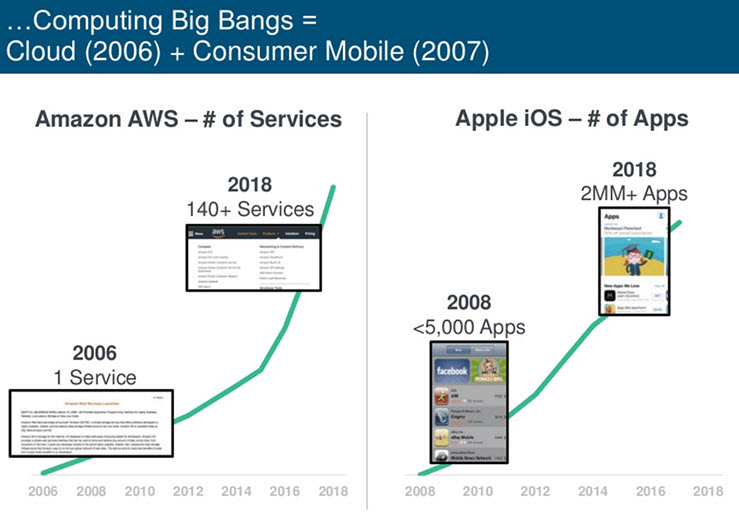
Below are some excerpted slides from her presentation…
Also see:
20 important takeaways for learning world from Mary Meeker’s brilliant tech trends – from donaldclarkplanb.blogspot.com by Donald Clark
Excerpt:
Mary Meeker’s slide deck has a reputation of being the Delphic Oracle of tech. But, at 294 slides it’s a lot to take in. Don’t worry, I’ve been through them all. It has tons on economic stuff that is of marginal interest to education and training but there’s plenty to to get our teeth into. We’re not immune to tech trends, indeed we tend to follow in lock-step, just a bit later than everyone else. Among the data are lots of fascinating insights that point the way forward in terms of what we’re likely to be doing over the next decade. So here’s a really quick, top-end summary for folk in the learning game.
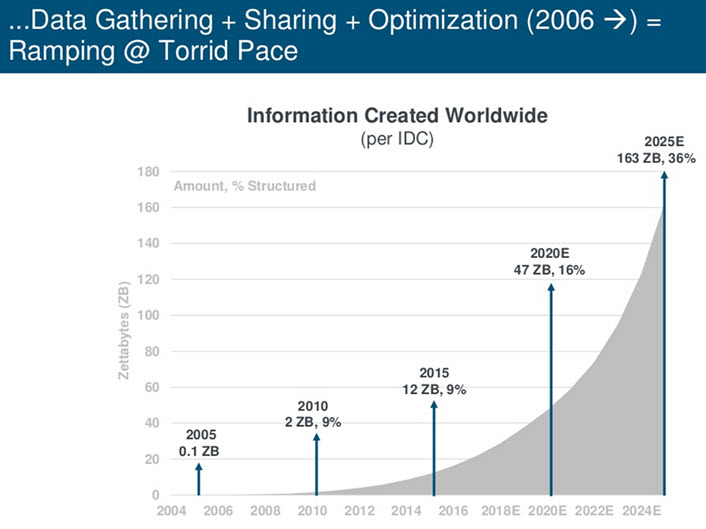
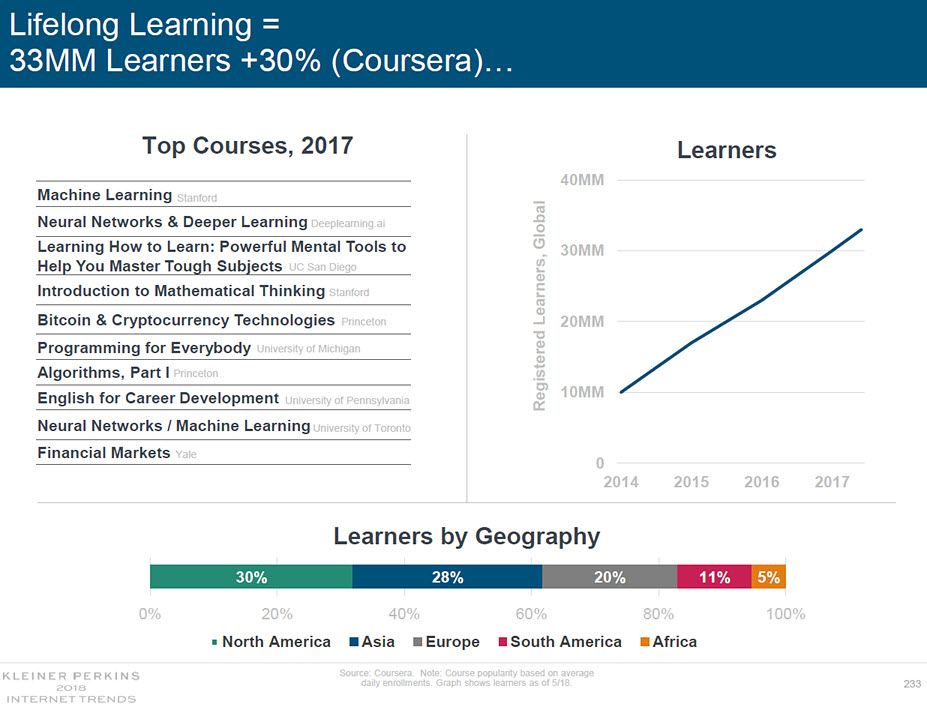
“Educational content usage online is ramping fast” with over 1 billion daily educational videos watched. There is evidence that use of the Internet for informal and formal learning is taking off.





![The Living [Class] Room -- by Daniel Christian -- July 2012 -- a second device used in conjunction with a Smart/Connected TV](http://danielschristian.com/learning-ecosystems/wp-content/uploads/2012/07/The-Living-Class-Room-Daniel-S-Christian-July-2012.jpg)