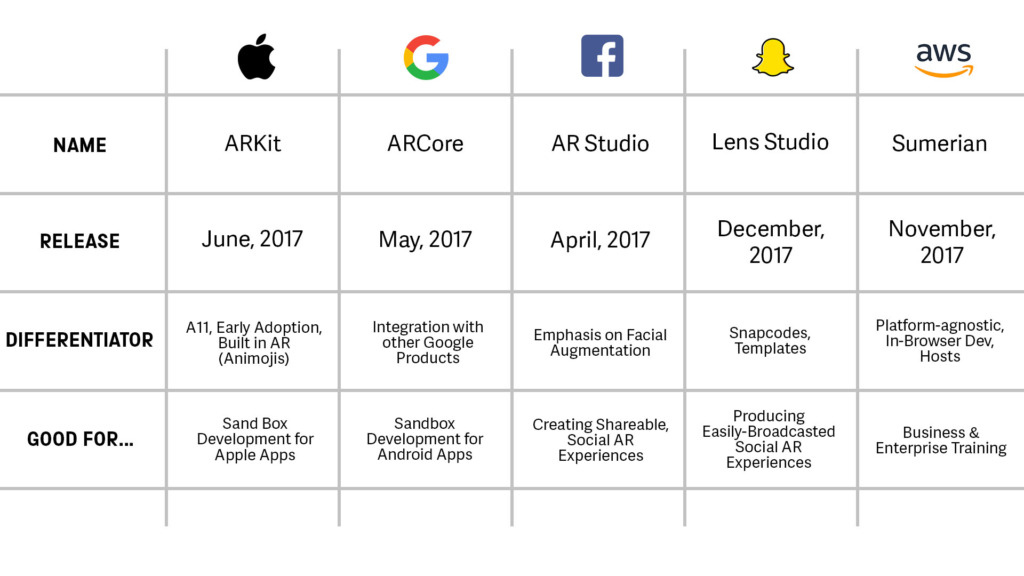
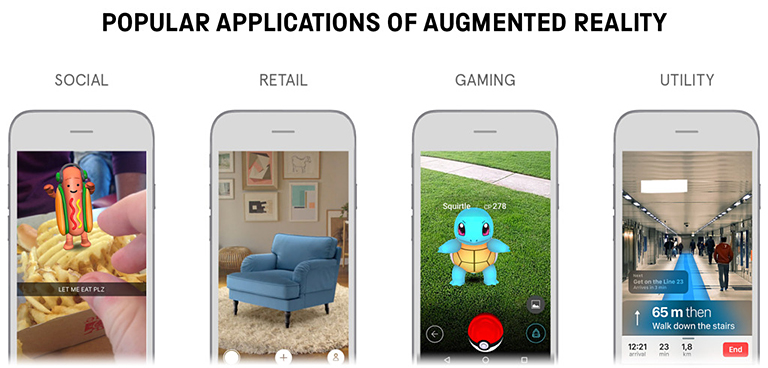
Augmented Reality: Everything You Need to Know for 2018 — from isl.co by Josh Strupp

Excerpt:

Here’s the trade-off: what we gain in development ease-of-use (native SDKs, integration into existing workflows) and performance enhancements (load times, battery efficiency, render quality, integration with native apps), we lose in universality; naturally, each company wants you staying within its own ecosystem.

In a nutshell: new AR platforms from today’s tech giants are aimed at reducing technical headache so you can focus on creating amazing experiences… but they also want you creating more apps for their respective mobile ecosystems.

…


This AR App Teaches You How To Play The Piano — from vrscout.com by Steve Ip & Sydney Wuu
AR piano learning system with improvised jam sessions.

Excerpt:

Learning to play the piano is getting an immersive upgrade with a new augmented reality (AR) piano training software called Music Everywhere. The HoloLens app aims to help students of all talent levels build fundamental music theory and performance skills. While traditional piano lessons can cost upwards of $100 per hour, Music Everywhere is free on the Microsoft store and offers a cost effective tutoring solution that provides students with immediate interaction feedback, making it differ greatly from watching a video tutorial.

Founded in 2017, Music Everywhere began at Carnegie Mellon’s ETC with Seth Glickman, Fu Yen Hsiao, and Byunghwan Lee realizing the nascent technology could be used for skills training. The app was the first Augmented Reality music learning platform to take first prize in Microsoft’s HoloLens Developer Contest, beating more than one-thousand submissions.


Making Virtual Reality a Reality in Today’s Classrooms — from thejournal.com by Meredith Thompson

Excerpt:

The market for virtual reality applications is growing at a rapid pace, and is expected to double in the next five years (Bolkan, 2017). As the cost of equipment falls and schools have greater access to technology, there is great interest in virtual reality as an educational tool. A small but growing group of educators have started to integrate virtual reality in their classrooms, with promising results (Castaneda, Cechony & Bautista, 2017). We reached out to teachers and administrators who are currently using virtual reality in their classrooms to hear their perspectives and practical strategies for infusing this resource into their classrooms.

Teachers have creative ideas for how to incorporate immersive education in current classrooms: how to select activities, how to set up the classroom, how to get support during the activity and how to transport devices. Teachers also shared their ideas for future applications of VR, including how to deepen the learning experience and to expand the reach of these technologies to a greater population of students.

Here we share three vignettes of three different approaches: a social studies class in a suburban school district, a district-wide perspective from an urban school district and a class designed entirely around understanding and implementing VR for other classrooms. We also share how we are using these ideas to inform our own project in designing a collaborative immersive virtual reality educational game for introductory high school biology.


3 best practices from VR implementation across departments — from ecampusnews.com by Andrew Woodberry
Professors across many disciplines are embracing VR technology as an integral part of their learning tools

Excerpts:

VR is already being used for many real-world applications–hiring, training, marketing/sales, medical purposes, entertainment, and more–and is worth considering for many different university departments.
…
At German University in Cairo, architecture students used our platform to create tours of historical Cairo buildings, complete with educational hotspot overlays on particularly interesting features. This multimedia approach educated students without them having to travel to the buildings. It also made for a more “stickier” learning experience for the students involved in creating it.
…
At Emporia State University, for example, the forensic science students view virtual crime scenes recorded at the Kansas Bureau of Investigation in Topeka. Forensic-science students can look for clues and learn facts via voiceover, mimicking an actual crime-scene inquiry quite impressively.


Augmented and virtual reality products to get excited about in 2018 — from gearbrain.com by Alistair Charlton
CES 2018 showed us the way forward for AR and VR this year

Excerpt:

Just as televisions and driverless cars have become part of the furniture at the CES technology show, so too have virtual and augmented reality headsets.

Although the momentum behind VR’s growth slowed in 2017 – the industry seemingly unsure if it should progress with a technology destined to remain a niche – AR is being welcomed into the spotlight with open arms.
…
Here are six AR and VR highlights from CES 2018.


Looking to boost AR and VR technology, University of Washington establishes center in Seattle — from edscoop.com by Emily Tate
The UW Reality Lab will focus on “core research advances” in augmented and virtual reality.

Excerpt:

The University of Washington, hoping to get ahead in the burgeoning field of augmented reality (AR) and virtual reality (VR), has launched the UW Reality Lab, a center for research, education and innovation in AR and VR.
…
One of the first research centers in the world built for AR and VR projects, the UW Reality Lab is also located in Seattle — a hotspot for technology companies, from behemoths like Amazon and Microsoft to startups still trying to get off the ground.


“We’re seeing some really compelling and high-quality AR and VR experiences being built today,” Steve Seitz, center co-lead and Allen School professor, said in the university’s statement. “But, there are still many core research advances needed to move the industry forward — tools for easily creating content, infrastructure solutions for streaming 3D video, and privacy and security safeguards — that university researchers are uniquely positioned to tackle.”


Augmented Reality: Is it the Future of eLearning

Excerpt:

Why Augmented Reality is Important for eLearning
According to a report released by CCS Insight, augmented and virtual reality hardware is set to become a $4 billion market by 2018. Let’s take a look at how augmented reality can be leveraged in the online learning space:

Simulated working environments
One of the most common advantages of online learning is the ability to form an environment in which the users have the freedom to experiment. As people usually learn from their mistakes, when they work in a consequence-free environment, they are most likely to remember the right way to do things.

Support Gamification
As online learning management systems (LMSs) use gamification widely, augmented reality can be directly applied. In AR reality training module, employees will be rewarded for effectively performing their routine tasks in the right way, which will eventually improve performance.

Immersive Learning Environments
Using a tablet, smartphone for the online training software means the users are constantly distracted with emails, notifications from social channels etc. This is one of the reasons why elearning content uses interactive multimedia elements to engage students. With augmented reality, elearning courses can be supported with 360° video, which will engage the user and remove distractions for them.

Motion tracking
Motion and gesture tracking are part of the AR experience. They are commonly leveraged for choosing menu items or engaging with video game-based environments.

In the online learning domain, LMSs can use this technology to track learner’s progress to ensure that they are achieving the set targets without fail. This will boost real-time training performance and improve interactivity with instant feedback.

Simply put, with augmented reality the possibilities are endless. With the growing number of Bring Your Own Device (BYOD) workplaces, it is expected that employees and learners will be delighted to use augmented reality.


Virtual Reality And Beyond: The Future Of Music Experiences — from hypebot.com by Jen Sako

Excerpt:

The Musical Future of VR
VR technology is still in its earliest stages, but musicians are already seeing how they will be able to connect to fans and make news ones without the expense of touring. In artificial environments, bands can invite music lovers into their world.

But beyond the obvious entertainment factor, VR has the potential to become a tool for education. Music students could enter a studio space using VR gear for lessons and practice. The immediate feedback provided and game-like atmosphere may keep students more motivated and engaged. Imagine methods for teaching that include ways to slow down and loop difficult parts or bringing in the composer for lessons.

VR can also connect music lovers to the many people behind the scenes involved in producing the music they enjoy. Listeners can learn about the industry and how a song comes to life. They’ll understand why it’s important to play a part in sustaining the music business.

For this technology to become a reality in itself inside consumers’ listening and learning spaces, obstacles need addressing. The hardware is still pricey, bulky and requires a power source. Apps need creators who will need more in the way of artificial intelligence.


ARiA, The AR Conference At MIT, Is The Anti-CES — from forbes.com by Charlie Fink

Excerpt:

“The ability to combine digital information with the real world is going to disrupt every business model, transform human/machine interaction, and generate innovative use cases across every discipline and in every vertical including education, healthcare, manufacturing,” Werner continued. “I see ARiA as the TED for AR, where the best minds come together to solve real work problems and share ideas to capitalize on the huge opportunity.”


Broadcast news and sports now routinely lay data, graphics, and animation onto the physical world. AR has become ubiquitous in ways that have nothing to do with smart glasses. “AR is on the verge.


2017 Augmented Reality Year in Review — from wikitude.com


Microsoft Education unveils new Windows 10 devices starting at $189, Office 365 tools for personalized learning, and curricula to ignite a passion for STEM — from blogs.windows.com by Yusuf Mehdi

Excerpt:

In regards to mixed reality for immersive learning:

  • Pearson – the world’s largest education company – will begin rolling out in March curriculum that will work on both HoloLens and Windows Mixed Reality immersive VR headsets. These six new applications will deliver seamless experiences across devices and further illustrate the value of immersive educational experiences.
  • We are expanding our mixed media reality curriculum offerings through a new partnership with WGBH’s Bringing the Universe to America’s Classrooms project****, for distribution nationally on PBS LearningMedia™. This effort brings cutting-edge Earth and Space Science content into classrooms through digital learning resources that increase student engagement with science phenomena and practices.
  • To keep up with growing demand for HoloLens in the classroom we are committed to providing affordable solutions. Starting on January 22, we are making available a limited-time academic pricing offer for HoloLens. To take advantage of the limited-time academic pricing offer, please visit, hololens.com/edupromo.


Microsoft Education unveils new Windows 10 devices starting at $189, Office 365 tools for personalized learning, and curricula to ignite a passion for STEM — from blogs.windows.com by Yusuf Mehdi

Excerpt:

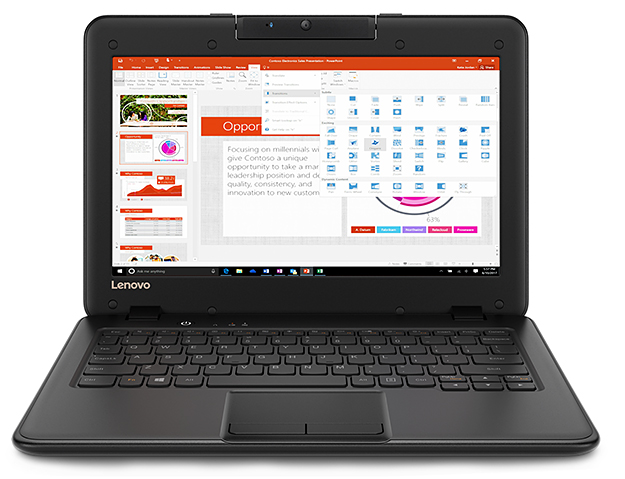
This week at Bett, we’ll show new Windows 10 and Windows 10 S devices from Lenovo and JP, starting at just $189, providing more options for schools who don’t want to compromise on Chromebooks. We’ll add new capabilities to our free Office 365 for Education software, enabling any student to write a paper using only their voice and making it easier to access Teams via mobile devices. And we’re making STEM learning fun with a new Chemistry update to Minecraft: Education Edition and new mixed reality and video curricula from partners like BBC Worldwide Learning, LEGO®* Education, PBS, NASA, and Pearson.


Starting in February, we will introduce dictation in Office 365
to help students write more easily by using their voice.


In regards to mixed reality for immersive learning:

  • Pearson – the world’s largest education company – will begin rolling out in March curriculum that will work on both HoloLens and Windows Mixed Reality immersive VR headsets. These six new applications will deliver seamless experiences across devices and further illustrate the value of immersive educational experiences.
  • We are expanding our mixed media reality curriculum offerings through a new partnership with WGBH’s Bringing the Universe to America’s Classrooms project****, for distribution nationally on PBS LearningMedia™. This effort brings cutting-edge Earth and Space Science content into classrooms through digital learning resources that increase student engagement with science phenomena and practices.
  • To keep up with growing demand for HoloLens in the classroom we are committed to providing affordable solutions. Starting on January 22, we are making available a limited-time academic pricing offer for HoloLens. To take advantage of the limited-time academic pricing offer, please visit, hololens.com/edupromo.


The next era of human|machine partnerships
From delltechnologies.com by the Institute for the Future and Dell Technologies


From DSC:
Though this outlook report paints a rosier picture than I think we will actually encounter, there are several interesting perspectives in this report. We need to be peering out into the future to see which trends and scenarios are most likely to occur…then plan accordingly. With that in mind, I’ve captured a few of the thoughts below.


At its inception, very few people anticipated the pace at which the internet would spread across the world, or the impact it would have in remaking business and culture. And yet, as journalist Oliver Burkeman wrote in 2009, “Without most of us quite noticing when it happened, the web went from being a strange new curiosity to a background condition of everyday life.”1


In Dell’s Digital Transformation Index study, with 4,000 senior decision makers across the world, 45% say they are concerned about becoming obsolete in just 3-5 years, nearly half don’t know what their industry will look like in just three years’ time, and 73% believe they need to be more ‘digital’ to succeed in the future.

With this in mind, we set out with 20 experts to explore how various social and technological drivers will influence the next decade and, specifically, how emerging technologies will recast our society and the way we conduct business by the year 2030. As a result, this outlook report concludes that, over the next decade, emerging technologies will underpin the formation of new human-machine partnerships that make the most of their respective complementary strengths. These partnerships will enhance daily activities around the coordination of resources and in-the-moment learning, which will reset expectations for work and require corporate structures to adapt to the expanding capabilities of human-machine teams.

…
For the purpose of this study, IFTF explored the impact that Robotics, Artificial Intelligence (AI) and Machine Learning, Virtual Reality (VR) and Augmented Reality (AR), and Cloud Computing, will have on society by 2030. These technologies, enabled by significant advances in software, will underpin the formation of new human-machine partnerships.
…
On-demand access to AR learning resources will reset expectations and practices around workplace training and retraining, and real-time decision-making will be bolstered by easy access to information flows. VR-enabled simulation will immerse people in alternative scenarios, increasing empathy for others and preparation for future situations. It will empower the internet of experience by blending physical and virtual worlds.


Already, the number of digital platforms that are being used to orchestrate either physical or human resources has surpassed 1,800.9 They are not only connecting people in need of a ride with drivers, or vacationers with a place to stay, but job searchers with work, and vulnerable populations with critical services. The popularity of the services they offer is introducing society to the capabilities of coordinating technologies and resetting expectations about the ownership of fixed assets.


Human-machine partnerships won’t spell the end of human jobs, but work will be vastly different.
…
The U.S. Bureau of Labor Statistics says that today’s learners will have 8 to 10 jobs by the time they are 38. Many of them will join the workforce of freelancers. Already 50 million strong, freelancers are projected to make up 50% of the workforce in the United States by 2020.12 Most freelancers will not be able to rely on traditional HR departments, onboarding processes, and many of the other affordances of institutional work.


By 2030, in-the-moment learning will become the modus operandi, and the ability to gain new knowledge will be valued higher than the knowledge people already have.


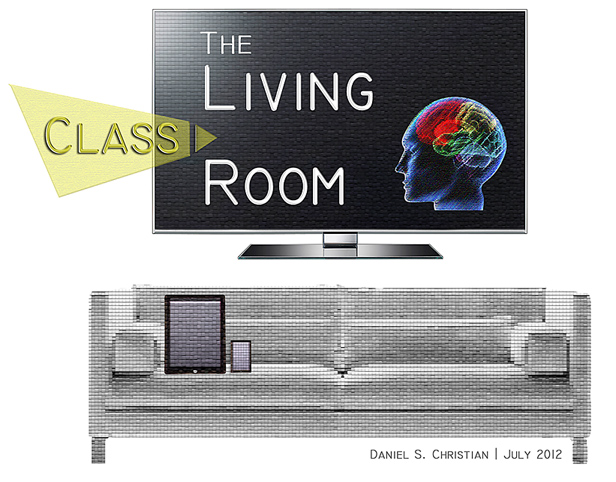
The Living [Class] Room -- by Daniel Christian -- July 2012 -- a second device used in conjunction with a Smart/Connected TV


From DSC:
I have been trying to blog more about learning how to learn — and to provide some more resources on metacognition and the like.

Along these lines — and with permission from the author — the following excerpt is from Quentin Schultze’s solid book, Communicate like a True Leader (pages 35 & 36).  I asked Quin if I could share this excerpt because I think it could be a great strategy to share with students (at least for them to experiment with, and try it out to see if it helps them). Whether they know it or not, learning how to learn is THEE key skill these days.

Quin would also emphasize some other items such as listening, attending to reality, communicating effectively with others, and more…but my focus here is on learning strategies.  So I share it in the hope that it will help some of you students out there just as it helped Quin.


During the beginning of my sophomore year, I started reviewing each day’s class notes after classes were over. I soon realized how little I recalled even of that day’s lectures and discussions. It dawned on me that normal note-taking merely gave me the impression that I was learning. I implemented a strategy that revolutionized my learning, launched me successfully into graduate school, helped me become a solid teacher, equipped me to be a productive researcher-writer, and made it possible for me to be an engaging speaker.

I not only reviewed my notes daily. I rewrote them from scratch within a couple of hours of each class meeting. I used my actual course notes as prompts to recall more of the lecture and to help me organize my own reactions to the material. My notes expanded. My retention swelled.

My revised notes became a kind of journal of my dialogue with the instructor and the readings. I integrated into my revised course notes my daily reading notes, reworking them into language that was meaningful to me and preparing to ask the instructor at the next class anything that I was uncertain about. From then on I earned nearly straight A’s with far less cramming for exams.

Moreover, I had begun journaling about my learning — one of the most important communication skills. I became a real learner by discovering how to pay attention to others and myself.

In a broad sense, I learned how to listen.


“Rise of the machines” — from January 2018 edition of InAVate magazine
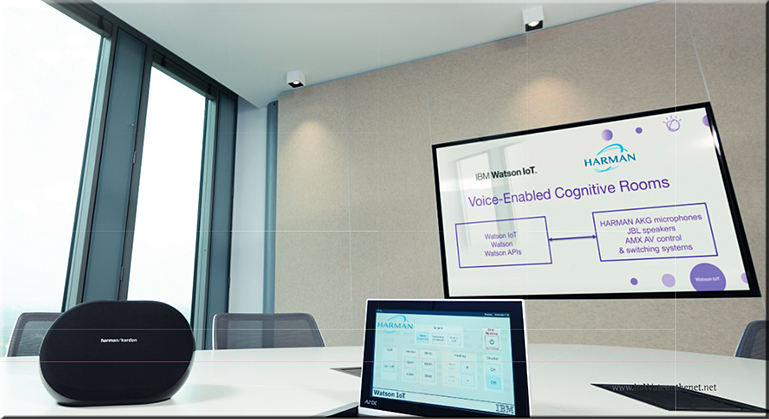
AI is generating lots of buzz in other verticals, but what can AV learn from those? Tim Kridel reports.


From DSC:
Learning spaces are relevant as well in the discussion of AI and AV-related items.


Also in their January 2018 edition, see
an incredibly detailed project at the London Business School.

Excerpt:

A full-width frosted glass panel sits on the desk surface, above it fixed in the ceiling is a Wolfvision VZ-C12 visualiser. This means the teaching staff can write on the (wipeclean) surface and the text appears directly on two 94-in screens behind them, using Christie short-throw laser 4,000 lumens projectors. When the lecturer is finished or has filled up the screen with text, the image can be saved on the intranet or via USB. Simply wipe with a cloth and start again. Not only is the technology inventive, but it allows the teaching staff to remain in face-to-face contact with the students at all times, instead of students having to stare at the back of the lecturer’s head whilst they write.


Also relevant, see:


TV is (finally) an app: The goods, the bads and the uglies for learning — from thejournal.com by Cathie Norris, Elliot Soloway

Excerpts:

Television. TV. There’s an app for that. Finally! TV — that is, live shows such as the news, specials, documentaries (and reality shows, if you must) — is now just like Candy Crunch and Facebook. TV apps (e.g., DirecTV Now) are available on all devices — smartphones, tablets, laptops, Chromebooks. Accessing streams upon streams of videos is, literally, now just a tap away.

…

Plain and simple: readily accessible video can be a really valuable resource for learners and learning.

…

Not everything that needs to be learned is on video. Instruction will need to balance the use of video with the use of printed materials. That balance, of course, needs to take in cost and accessibility.

…

Now for the 800 pound gorilla in the room: Of course, that TV app could be a huge distraction in the classroom. The TV app has just piled yet another classroom management challenge onto a teacher’s back.

…

That said, it is early days for TV as an app. For example, HD (High Definition) TV demands high bandwidth — and we can experience stuttering/skipping at times. But, when 5G comes around in 2020, just two years from now, POOF, that stuttering/skipping will disappear. “5G will be as much as 1,000 times faster than 4G.”  Yes, POOF!


From DSC:
Learning via apps is here to stay. “TV” as apps is here to stay. But what’s being described here is but one piece of the learning ecosystem that will be built over the next 5-15 years and will likely be revolutionary in its global impact on how people learn and grow. There will be opportunities for social-based learning, project-based learning, and more — with digital video being a component of the ecosystem, but is and will be insufficient to completely move someone through all of the levels of Bloom’s Taxonomy.

I will continue to track this developing learning ecosystem, but voice-driven personal assistants are already here. Algorithm-based recommendations are already here. Real-time language translation is already here.  The convergence of the telephone/computer/television continues to move forward.  AI-based bots will only get better in the future. Tapping into streams of up-to-date content will continue to move forward. Blockchain will likely bring us into the age of cloud-based learner profiles. And on and on it goes.

We’ll still need teachers, professors, and trainers. But this vision WILL occur. It IS where things are heading. It’s only a matter of time.


The Living [Class] Room -- by Daniel Christian -- July 2012 -- a second device used in conjunction with a Smart/Connected TV


3 ways augmented reality will find its way into your life in 2018 and beyond — from entrepreneur.com by Han-Gwon Lung
Up to 40 percent of nurses miss the patient’s vein on their first attempt at taking blood. That’s changing, because of augmented reality.

Excerpt:

  1. A pair of glasses you can’t live without
  2. More immersive (and personalized) marketing
  3. Less guesswork in health care


The race for AR glasses starts now — from wired.com by Steven Levy

Excerpt:

Though the Next Big Thing won’t appear for a while, we know pretty much what it will look like: a lightweight, always-on wearable that obliterates the divide between the stuff we see on screens and the stuff we see when we look up from our screens.
…
Not every company working on post-reality glasses shares an identical vision; some have differing views of how immersive it should be. But all have quietly adopted the implicit assumption that a persistent, wearable artificial reality is the next big thing. The pressure of the competition has forced them to begin releasing interim products, now.


And he added that “these glasses will offer AR, VR, and everything in between, and we’ll wear them all day and we’ll use them in every aspect of our lives.”


Meet the scientists immortalizing African heritage in virtual reality — from by Chris Giles

Excerpt:

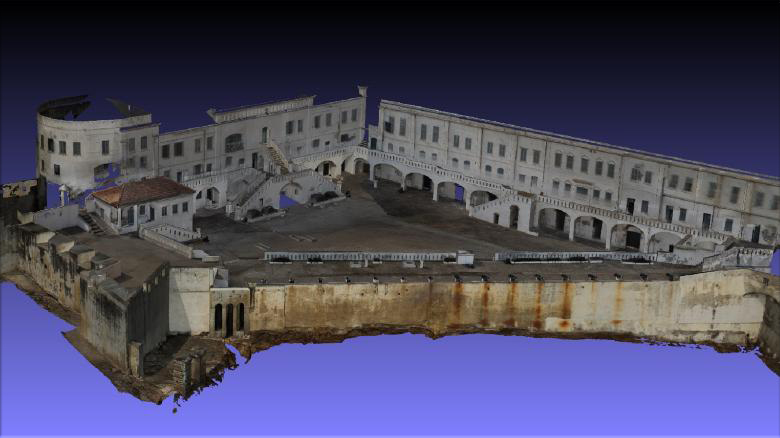
Concerned with the decay of African heritage sites, The Zamani Project, based at the University of Cape Town, South Africa, is seeking to immortalize historic spots in three-dimensional, virtual reality-ready models.

Professor Heinz Ruther steers the project. He ventures up and down the continent — visiting Ghana, Tanzania, Mali, Ethiopia, Kenya and elsewhere — recording in remarkable detail the structure and condition of tombs, churches and other buildings.

“I’ve seen how sites are deteriorating visibly,” Ruther told CNN.

The project’s aim is to build a database of complex, lifelike 3-D models. Presently, they’ve mapped around 16 sites including Lalibela in Ethiopia, Timbuktu in Mali and Kilwa in Tanzania.


4 augmented and virtual reality projects that point to the future of education — from edsurge.com by Justin Hendrix

Excerpt:

Education has been a recurring theme throughout the many programs of the NYC Media Lab, a public-private partnership where I serve as an Executive Director. How will virtual and augmented reality change the classroom? How can teachers use immersive media to educate citizens and keep our communities vibrant? In what ways can enterprises leverage innovation to better train employees and streamline workflows?

These are just a few of the top-of-mind questions that NYC Media Lab’s consortium is thinking about as we enter the next wave of media transformation.

Researchers and professionals at work across the VR/AR community in New York City are excited for what comes next. At NYC Media Lab’s recent Exploring Future Reality conference, long-time educators including Agnieszka Roginska of New York University and Columbia University’s Steven Feiner pointed to emerging media as a way to improve multi-modal learning for students and train computer systems to understand the world around us.

NYC Media Lab merges engineering and design research happening at the city’s universities with resources and opportunities from the media and technology industry—to produce new prototypes, launch new companies and advocate for the latest thinking.

In the past year, the Lab has completed dozens of rapid prototyping projects; exhibited hundreds of demos from the corporate, university and entrepreneurship communities; helped new startups make their mark; and hosted three major events, all to explore emerging media technologies and their evolving impact.


4 virtual reality desktops for Vive, Rift, and Windows VR compared — from roadtovr.com by Dominic Brennan

Excerpt:

While it’s all too easy to lose ourselves in the countless VR worlds at our fingertips, sometimes we just need to access the desktop and get things done in Windows. Thanks to a few innovative apps, this is possible without removing your headset.


The legal and ethical minefield of AI: ‘Tech has the power to do harm as well as good’ — from theguardian.com by Joanna Goodman

Excerpt:

Artificial intelligence and machine learning tools are already embedded in our lives, but how should businesses that use such technology manage the associated risks?

As artificial intelligence (AI) penetrates deeper into business operations and services, even supporting judicial decision-making, are we approaching a time when the greatest legal mind could be a machine? According to Prof Dame Wendy Hall, co-author of the report Growing the Artificial Intelligence Industry in the UK, we are just at the beginning of the AI journey and now is the time to set boundaries.

“All tech has the power to do harm as well as good,” Hall says. “So we have to look at regulating companies and deciding what they can and cannot do with the data now.”

AI and robotics professor Noel Sharkey highlights the “legal and moral implications of entrusting human decisions to algorithms that we cannot fully understand”. He explains that the narrow AI systems that businesses currently use (to draw inferences from large volumes of data) apply algorithms that learn from experience and feed back to real-time and historical data. But these systems are far from perfect.

Potential results include flawed outcomes or reasoning, but difficulties also arise from the lack of transparency. This supports Hall’s call for supervision and regulation. Businesses that use AI in their operations need to manage the ethical and legal risks, and the legal profession will have a major role to play in assessing and apportioning risk, responsibility and accountability.


Also see:


Inmates use VR to prepare for life on the outside — from vrscout.com by Kyle Melnick
A new early-release program in Colorado helps prisoners convicted as teenagers adjust to the world they missed 20-plus years ago.

Excerpt:

The three year program encompasses a variety of beneficial training and invaluable mentorship, but the most popular aspect by far, at least for the first six inmates enrolled, has been the interactive VR element developed by NSENA CEO Ethan Moeller.

By introducing inmates to VR technology, Moeller and Colorado correctional facilities hope to expose inmates to the significant changes made in society over the past 20 years, as well as the new technology being developed. Prisoners are first given Samsung Gear VR headsets to enjoy a selection of spectator experiences such as running with wild elephants and sitting in the cockpit of a Blue Angel fighter jet. They’re also exposed to more informative experiences such as dealing with conflict and handling self-checkout at the grocery store.

After being eased into the immersive technology with casual 360-videos, the selected convicts are then given access to more interactive applications via an HTC Vive. Moeller has designed an eclectic catalogue of instructional VR applications that educate users in everything from bagging groceries and using a debit card, to doing laundry and de escalating potentially violent confrontations. The idea is to prepare these soon-to-be released prisoners with the necessary life skills they missed while incarcerated as teenagers.


From Elliott Masie’s Learning TRENDS – January 3, 2018.
#986 – Updates on Learning, Business & Technology Since 1997.

2. Curation in Action – Meural Picture Frame of Endless Art. 
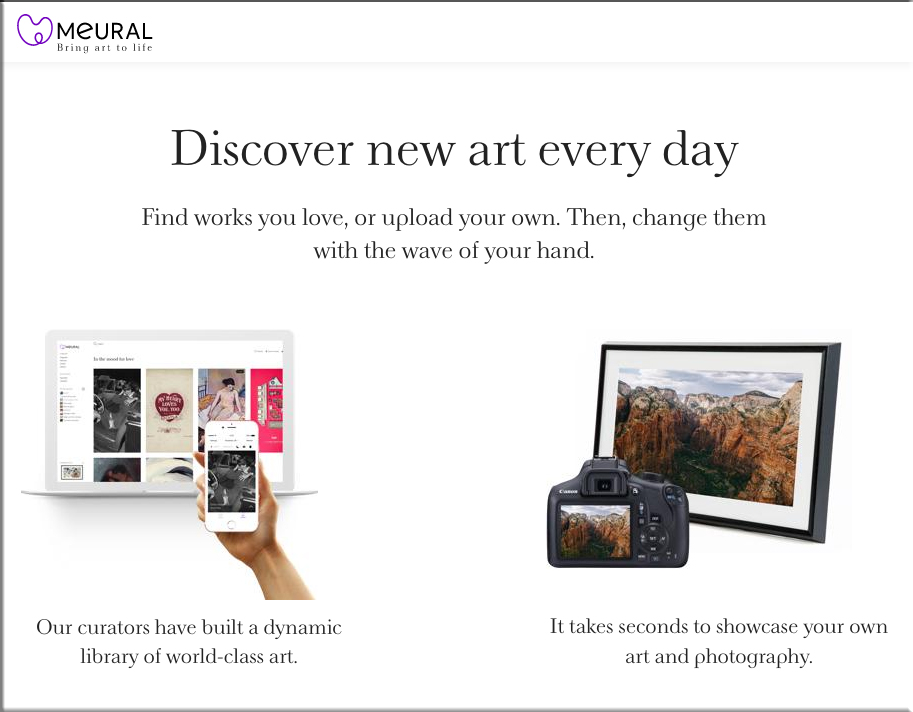
What a cool Curation Holiday Gift that arrived.  The Meural Picture Frame is an amazing digital display, 30 inches by 20 inches, that will display any of over 10,000 classical or modern paintings or photos from the world’s best museums.

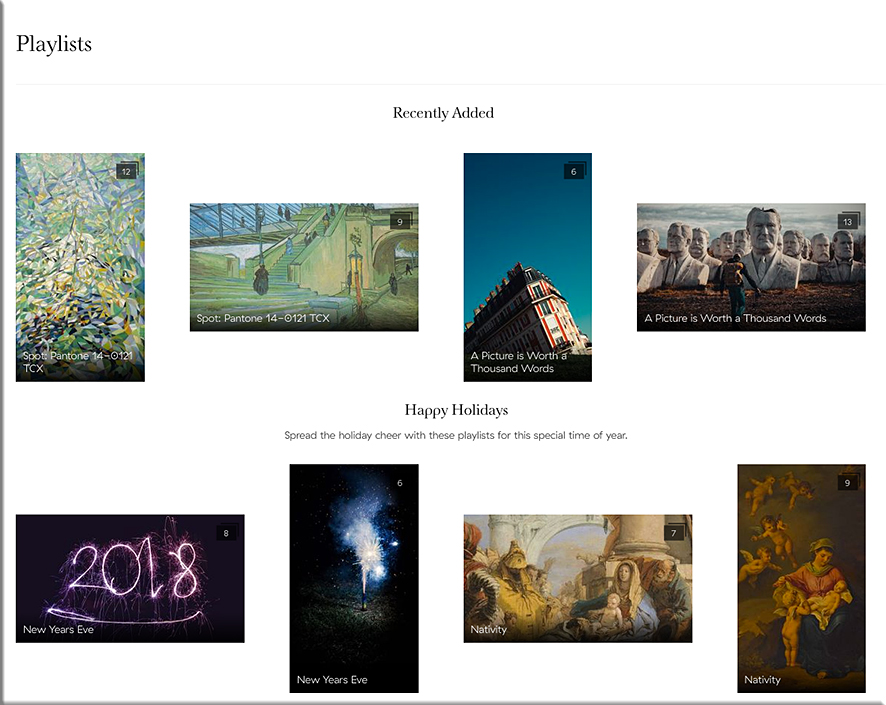
A few minutes of setup to the WiFi and my Meural became a highly personalized museum in the living room.  I selected collections of an era, a specific artist, a theme or used someone else’s art “playlist”.

It is curation at its best!  A personalized and individualized selection from an almost limitless collection.  Check it out at http://www.meural.com


Also see:


Discover new art every day with Meural


Discover new artwork with Meural -- you can browse playlists of artwork and/or add your own


From DSC:
As I understand it, you can upload your own artwork and photography into this platform. As such, couldn’t we put such devices/frames in schools?!

Wouldn’t it be great to have each classroom’s artwork available as a playlist?! And not just the current pieces, but archived pieces as well!

Wouldn’t it be cool to be able to walk down the hall and swish through a variety of pieces?

Wouldn’t such a dynamic, inspirational platform be a powerful source of creativity in our hallways?  The frames could display the greatest works of art from around the world!

Wouldn’t such a platform give young/budding artists and photographers incentive to do their best work, knowing many others can see their creative works as a part of a playlist?

Wouldn’t it be cool to tap into such a service and treasure chest of artwork and photography via your Smart/Connected TV?

Here’s to creativity!


18 striking AI Trends to watch in 2018 – Part 1 as well as 18 striking AI Trends to watch in 2018 – Part 2 — from datahub.packtpub.com by Sugandha Lahoti

Excerpt:

Artificial Intelligence is the talk of the town. It has evolved past merely being a buzzword in 2016, to be used in a more practical manner in 2017. As 2018 rolls out, we will gradually notice AI transitioning into a necessity. We have prepared a detailed report, on what we can expect from AI in the upcoming year. So sit back, relax, and enjoy the ride through the future. (Don’t forget to wear your VR headgear! )

Here are 18 things that will happen in 2018 that are either AI driven or driving AI:

  1. Artificial General Intelligence may gain major traction in research.
  2. We will turn to AI enabled solution to solve mission-critical problems.
  3. Machine Learning adoption in business will see rapid growth.
  4. Safety, ethics, and transparency will become an integral part of AI application design conversations.
  5. Mainstream adoption of AI on mobile devices
  6. Major research on data efficient learning methods
  7. AI personal assistants will continue to get smarter
  8. Race to conquer the AI optimized hardware market will heat up further
  9. We will see closer AI integration into our everyday lives.
  10. The cryptocurrency hype will normalize and pave way for AI-powered Blockchain applications.
  11. Advancements in AI and Quantum Computing will share a symbiotic relationship18 striking AI Trends to watch in 2018 – Part 1
  12. Deep learning will continue to play a significant role in AI development progress.
  13. AI will be on both sides of the cybersecurity challenge.
  14. Augmented reality content will be brought to smartphones.
  15. Reinforcement learning will be applied to a large number of real-world situations.
  16. Robotics development will be powered by Deep Reinforcement learning and Meta-learning
  17. Rise in immersive media experiences enabled by AI.
  18. A large number of organizations will use Digital Twin.


Inside AI — from inside.com
The year 2017 has been full of interesting news about Artificial Intelligence, so to close out the year, we’re doing two special retrospective issues covering the highlights.

Excerpt:

A Reality Check For IBM’s A.I. Ambitions. MIT Tech Review.
This is a must read piece about the failures, and continued promise, of Watson. Some of the press about Watson has made IBM appear behind some of the main tech leaders, but, keep in mind that Google, Amazon, Facebook, and others don’t do the kinds of customer facing projects IBM is doing with Watson. When you look at how the tech giants are positioned, I think IBM has been vastly underestimated, given that they have the one thing few others do – large scale enterprise A.I. projects. Whether it all works today, or not, doesn’t matter. The experience and expertise they are building is a competitive advantage in a market that is very young where no other companies are doing these types of projects that will soon enough be mainstream.

The Business of Artificial Intelligence. Harvard Business Review.
This cover story for the latest edition of HBR explains why artificial intelligence is the most powerful general purpose technology to come around in a long time. It also looks into some of the key ways to think about applying A.I. at work, and how to expect the next phase of this technology to play out.

The Robot Revolution Is Coming. Just Be Patient. Bloomberg.
We keep hearing that robots and A.I. are about to make us super productive. But when? Sooner than we think, according to this.


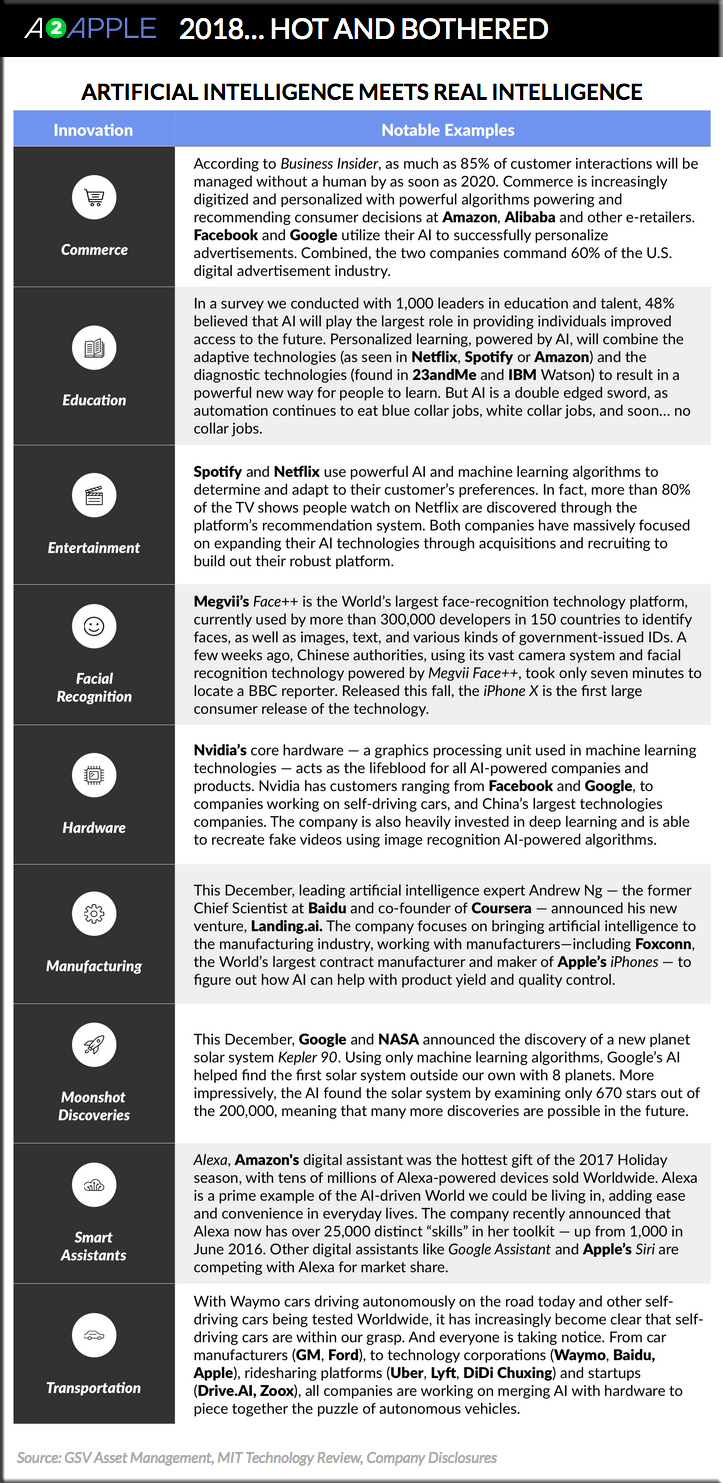
An excerpt from A2Apple.com:


Alexa Wants You to Talk to Your Ads — from wired.com by Ricki Harris

Excerpt:

There are few electronic devices with which you cannot order a Domino’s pizza. When the craving hits, you can place an order via Twitter, Slack, Facebook Messenger, SMS, your tablet, your smartwatch, your smart TV, and even your app-enabled Ford. This year, the pizza monger added another ordering tool: If your home is one of the 20 million with a voice assistant, you can place a regular order through Alexa or Google Home. Just ask for a large extra-cheese within earshot, and voila—your pizza is in the works.

Amazon’s Alexa offers more than 25,000 skills—the set of actions that serve as applications for voice technology. Yet Domino’s is one of a relatively small number of brands that has seized the opportunity to enter your home by creating a skill of its own. Now that Amazon Echoes and Google Homes are in kitchens and living rooms across the country, they open a window into user behavior that marketers previously only dreamt of. But brands’ efforts to engage consumers directly via voice have been scattershot. The list of those that have tried is sparse: some banks; a couple of fast food chains; a few beauty companies; retailers here and there. Building a marketing plan for Alexa has been a risky venture. That’s because, when it comes to our virtual assistants, no one knows what the *&^& is going on.

But if 2017 was the year that Alexa hit the mainstream, 2018 will be the year that advertisers begin to take her seriously by investing time and money in figuring out how to make use of her.


8 emerging AI jobs for IT pros — from enterprisersproject.com by Kevin Casey
What IT jobs will be hot in the age of AI? Take a sneak peek at roles likely to be in demand

Excerpt:

If you’re watching the impact of artificial intelligence on the IT organization, your interest probably starts with your own job. Can robots do what you do? But more importantly, you want to skate where the puck is headed. What emerging IT roles will AI create? We talked to AI and IT career experts to get a look at some emerging roles that will be valuable in the age of AI.


Getting Intelligent About Artificial Intelligence: 6 Ways Executives Can Start — from forbes.comby Davia Temin

Excerpt:

This past June, Fortune Magazine asked all the CEOs of the Fortune 500 what they believed the biggest challenge facing their companies was. Their biggest concern for 2017: “The rapid pace of technological change” said 73% of those polled, up from 64% in 2016. Cyber security came in only a far second, at 61%, even after all the mega hacks of the past year.

So, what does “technological change” entail? For almost all Fortune 500 CEOs, it means, in part, artificial intelligence. And, as we wrote in our piece yesterday on Forbes.com, “Forget The Hype: What Every Business Leader Needs To Know About Artificial Intelligence Now,”  AI is on the lips of almost every global CEO and Board of Directors.

But apart from the Big 8 technology companies – Google, Facebook, Microsoft, Amazon, IBM, Baidu, Tencent, and Alibaba – business leaders, especially of earlier generations, may feel they don’t know enough about AI to make informed decisions.


Artificial intelligence is helping astronomers discover new planets — from wired.co.uk
AI could help us discover planet nine, dark matter and more gravitational waves

Excerpt:

For the first time, artificial intelligence has been used to discover two new exoplanets. One of the discoveries, made by Nasa’s Kepler mission, brings the Kepler-90 solar system to a total of 8 planets – the first solar system found with the same number as our own.


DC: The next generation learning platform will likely offer us such virtual reality-enabled learning experiences such as this “flight simulator for teachers.”

Virtual reality simulates classroom environment for aspiring teachers — from phys.org by Charles Anzalone, University at Buffalo

Excerpt (emphasis DSC):

Two University at Buffalo education researchers have teamed up to create an interactive classroom environment in which state-of-the-art virtual reality simulates difficult student behavior, a training method its designers compare to a “flight simulator for teachers.”

The new program, already earning endorsements from teachers and administrators in an inner-city Buffalo school, ties into State University of New York Chancellor Nancy L. Zimpher’s call for innovative teaching experiences and “immersive” clinical experiences and teacher preparation.
…
The training simulator Lamb compared to a teacher flight simulator uses an emerging computer technology known as virtual reality. Becoming more popular and accessible commercially, virtual reality immerses the subject in what Lamb calls “three-dimensional environments in such a way where that environment is continuous around them.” An important characteristic of the best virtual reality environments is a convincing and powerful representation of the imaginary setting.


Also related/see:


  • TeachLive.org
    TLE TeachLivE™ is a mixed-reality classroom with simulated students that provides teachers the opportunity to develop their pedagogical practice in a safe environment that doesn’t place real students at risk.  This lab is currently the only one in the country using a mixed reality environment to prepare or retrain pre-service and in-service teachers. The use of TLE TeachLivE™ Lab has also been instrumental in developing transition skills for students with significant disabilities, providing immediate feedback through bug-in-ear technology to pre-service teachers, developing discrete trial skills in pre-service and in-service teachers, and preparing teachers in the use of STEM-related instructional strategies.


This start-up uses virtual reality to get your kids excited about learning chemistry — from Lora Kolodny and Erin Black

  • MEL Science raised $2.2 million in venture funding to bring virtual reality chemistry lessons to schools in the U.S.
  • Eighty-two percent of science teachers surveyed in the U.S. believe virtual reality content can help their students master their subjects.


This start-up uses virtual reality to get your kids excited about learning chemistry from CNBC.


From DSC:
It will be interesting to see all the “places” we will be able to go and interact within — all from the comfort of our living rooms! Next generation simulators should be something else for teaching/learning & training-related purposes!!!

The next gen learning platform will likely offer such virtual reality-enabled learning experiences, along with voice recognition/translation services and a slew of other technologies — such as AI, blockchain*, chatbots, data mining/analytics, web-based learner profiles, an online-based marketplace supported by the work of learning-based free agents, and others — running in the background. All of these elements will work to offer us personalized, up-to-date learning experiences — helping each of us stay relevant in the marketplace as well as simply enabling us to enjoy learning about new things.

But the potentially disruptive piece of all of this is that this next generation learning platform could create an Amazon.com of what we now refer to as “higher education.”  It could just as easily serve as a platform for offering learning experiences for learners in K-12 as well as the corporate learning & development space.


I’m tracking these developments at:
http://danielschristian.com/thelivingclassroom/


The Living [Class] Room -- by Daniel Christian -- July 2012 -- a second device used in conjunction with a Smart/Connected TV


*  Also see:


Blockchain, Bitcoin and the Tokenization of Learning — from edsurge.com by Sydney Johnson

Excerpt:

In 2014, Kings College in New York became the first university in the U.S. to accept Bitcoin for tuition payments, a move that seemed more of a PR stunt than the start of some new movement. Much has changed since then, including the value of Bitcoin itself, which skyrocketed to more than $19,000 earlier this month, catapulting cryptocurrencies into the mainstream.

A handful of other universities (and even preschools) now accept Bitcoin for tuition, but that’s hardly the extent of how blockchains and tokens are weaving their way into education: Educators and edtech entrepreneurs are now testing out everything from issuing degrees on the blockchain to paying people in cryptocurrency for their teaching.


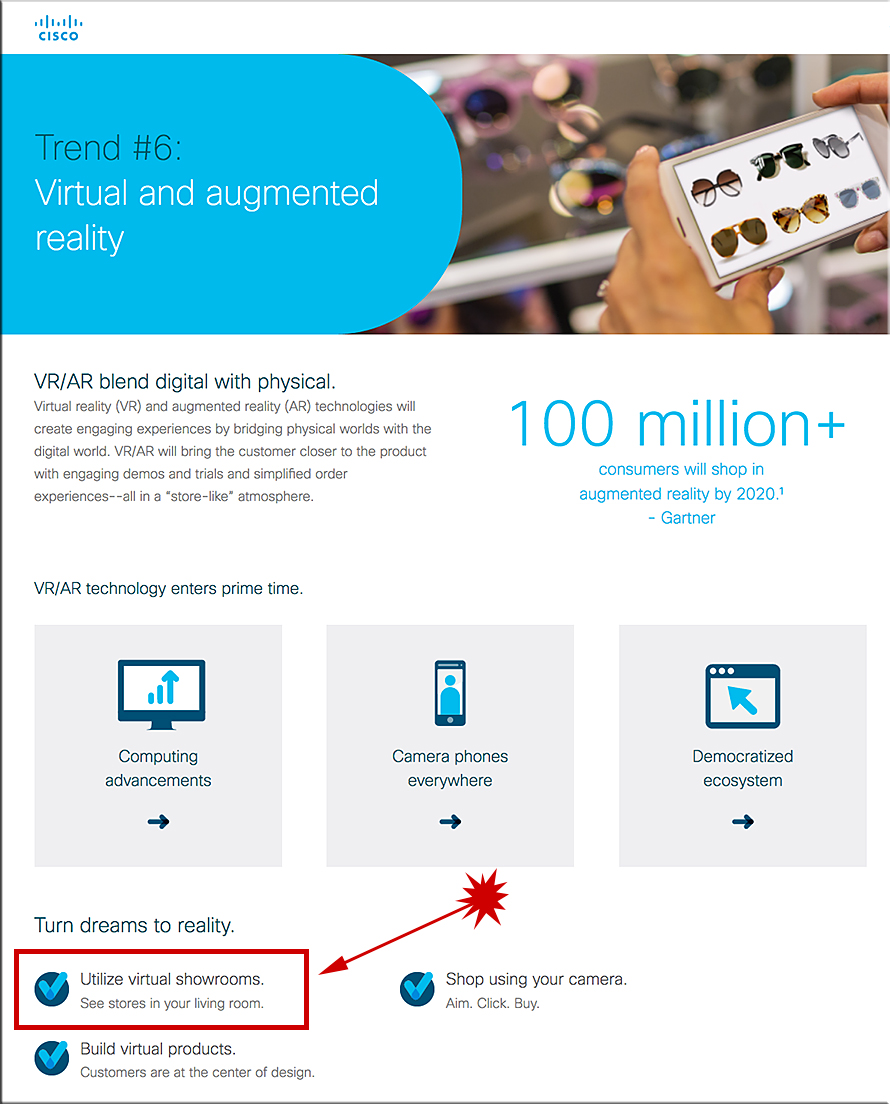
Cisco:
“Utilize virtual showrooms | See stores in your living room.”

DC:
If this is how retail could go, what might be the ramifications for learning-related environments & for learners’ expectations?

See Cisco’s whitepaper and the vision that I’m tracking along these lines.


Utilize virtual showrooms|See stores in your living room.


From DSC:
Looking at the trends below, again I wonder…how might learners’ expectations be impacted by these developments on the landscapes?


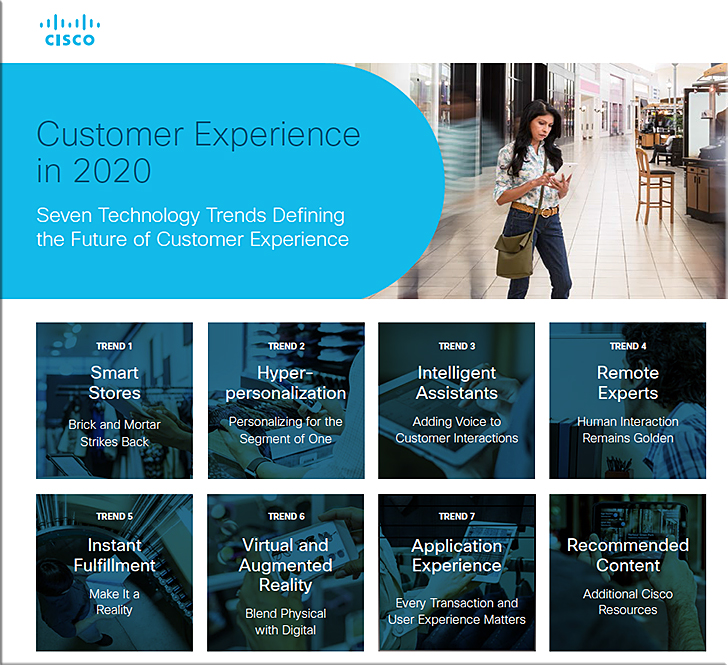
Customer Experience in 2020 according to Cisco


Also see:


The Living [Class] Room -- by Daniel Christian


How a Flipped Syllabus, Twitter and YouTube Made This Professor Teacher of the Year — from edsurge.com by Bruce Anderson

Excerpt:

A few years after John Boyer began teaching world geography at Virginia Tech, a survey revealed that 58 percent of college-aged Americans could not locate Japan on a map. Sixty-nine percent could not find the United Kingdom.

Boyer raced ahead undaunted. He loved the scope and implications of his subject. “The great thing about geography is . . . everything happens somewhere,” he explains. “Geography is the somewhere.”

Boyer is now a senior instructor and researcher at Virginia Tech. He took over World Regions, an entry-level geography class, while he was working on a master’s degree nearly 20 years ago. The class then had 50 students. Now the course is offered each semester and a whopping 3,000 students take it in any given school year.

What has made it so popular? Innovative pedagogy, for starters. Boyer uses a “flipped syllabus” in which students’ final grades are based on the points they’ve earned—not lost—throughout the semester. His legendary assignments range from reviewing films to tweeting on behalf of world leaders (more on that below). Mostly, Boyer himself has made the class a rite of passage for undergraduates, who typically find him funny, passionate, and consummately engaging. Boyer even created a comic alter ego called the Plaid Avenger, who has narrated textbooks and podcasts but is now largely retired—though Boyer still sports his famous plaid jackets and drives a plaid Scion.


Given the disparity in knowledge levels as well as the disparity in what they like to do in terms of work, whether that be watching international film or writing papers, I wanted to increase the flexibility of what the students could do to achieve a grade in this class.


Tell us about the Twitter World Leaders.
You can choose to be a true, real world leader. Of course, they’re fake accounts and we make sure everyone knows you’re the fake Donald Trump or the fake Angela Merkel of Germany. Once you take on that role, you will tweet as the world leader for the entire semester, and you have to tweet two to three times a day. And it’s not silly stuff. What is the chancellor of Germany working on right now? What other world leaders is Angela Merkel meeting with? What’s going on in Germany or the EEU?


Alexa, how can you improve teaching and learning? — from edscoop.com by Kate Roddy with thanks to eduwire for their post on this
Special report:? Voice command platforms from Amazon, Google and Microsoft are creating new models for learning in K-12 and higher education — and renewed privacy concerns.

Excerpt:

We’ve all seen the commercials: “Alexa, is it going to rain today?” “Hey, Google, turn up the volume.” Consumers across the globe are finding increased utility in voice command technology in their homes. But dimming lights and reciting weather forecasts aren’t the only ways these devices are being put to work.

Educators from higher ed powerhouses like Arizona State University to small charter schools like New Mexico’s Taos Academy are experimenting with Amazon Echo, Google Home or Microsoft Invoke and discovering new ways this technology can create a more efficient and creative learning environment.

The devices are being used to help students with and without disabilities gain a new sense for digital fluency, find library materials more quickly and even promote events on college campuses to foster greater social connection.

Like many technologies, the emerging presence of voice command devices in classrooms and at universities is also raising concerns about student privacy and unnatural dependence on digital tools. Yet, many educators interviewed for this report said the rise of voice command technology in education is inevitable — and welcome.

…

“One example,” he said, “is how voice dictation helped a student with dysgraphia. Putting the pencil and paper in front of him, even typing on a keyboard, created difficulties for him. So, when he’s able to speak to the device and see his words on the screen, the connection becomes that much more real to him.”

The use of voice dictation has also been beneficial for students without disabilities, Miller added. Through voice recognition technology, students at Taos Academy Charter School are able to perceive communication from a completely new medium.


© 2025 | Daniel Christian