Microsoft President: Democracy Is At Stake. Regulate Big Tech — from npr.org by Aarti Shahani

Excerpts:

Regulate us. That’s the unexpected message from one of the country’s leading tech executives. Microsoft President Brad Smith argues that governments need to put some “guardrails” around engineers and the tech titans they serve.

If public leaders don’t, he says, the Internet giants will cannibalize the very fabric of this country.

“We need to work together; we need to work with governments to protect, frankly, something that is far more important than technology: democracy. It was here before us. It needs to be here and healthy after us,” Smith says.

“Almost no technology has gone so entirely unregulated, for so long, as digital technology,” Smith says.


What enterprises intend to do with artificial intelligence — from zdnet.com by Joe McKendrick
Survey shows business process automation and customer support are the low-hanging fruit with initial AI rollouts, but many organizations are moving on to tackle data analytics.

Excerpt:

The leading categories of use cases seeing AI investments and work include the following:

  • Business process automation 49%
  • Customer support/Chatbots 47%
  • Data extraction 43%
  • Contract analytics 28%
  • Voice/video processing/imaging 25%


Technology as Part of the Culture for Legal Professionals -- a Q&A with Mary Grush and Daniel Christian


Technology as Part of the Culture for Legal Professionals A Q&A with Daniel Christian — from campustechnology.com by Mary Grush and Daniel Christian

Excerpt (emphasis DSC):

Mary Grush: Why should new technologies be part of a legal education?

Daniel Christian: I think it’s a critical point because our society, at least in the United States — and many other countries as well — is being faced with a dramatic influx of emerging technologies. Whether we are talking about artificial intelligence, blockchain, Bitcoin, chatbots, facial recognition, natural language processing, big data, the Internet of Things, advanced robotics — any of dozens of new technologies — this is the environment that we are increasingly living in, and being impacted by, day to day.

It is so important for our nation that legal professionals — lawyers, judges, attorney generals, state representatives, and legislators among them — be up to speed as much as possible on the technologies that surround us: What are the issues their clients and constituents face? It’s important that legal professionals regularly pulse check the relevant landscapes to be sure that they are aware of the technologies that are coming down the pike. To help facilitate this habit, technology should be part of the culture for those who choose a career in law. (And what better time to help people start to build that habit than within the law schools of our nation?)


There is a real need for the legal realm to catch up with some of these emerging technologies, because right now, there aren’t many options for people to pursue. If the lawyers, and the legislators, and the judges don’t get up to speed, the “wild wests” out there will continue until they do.


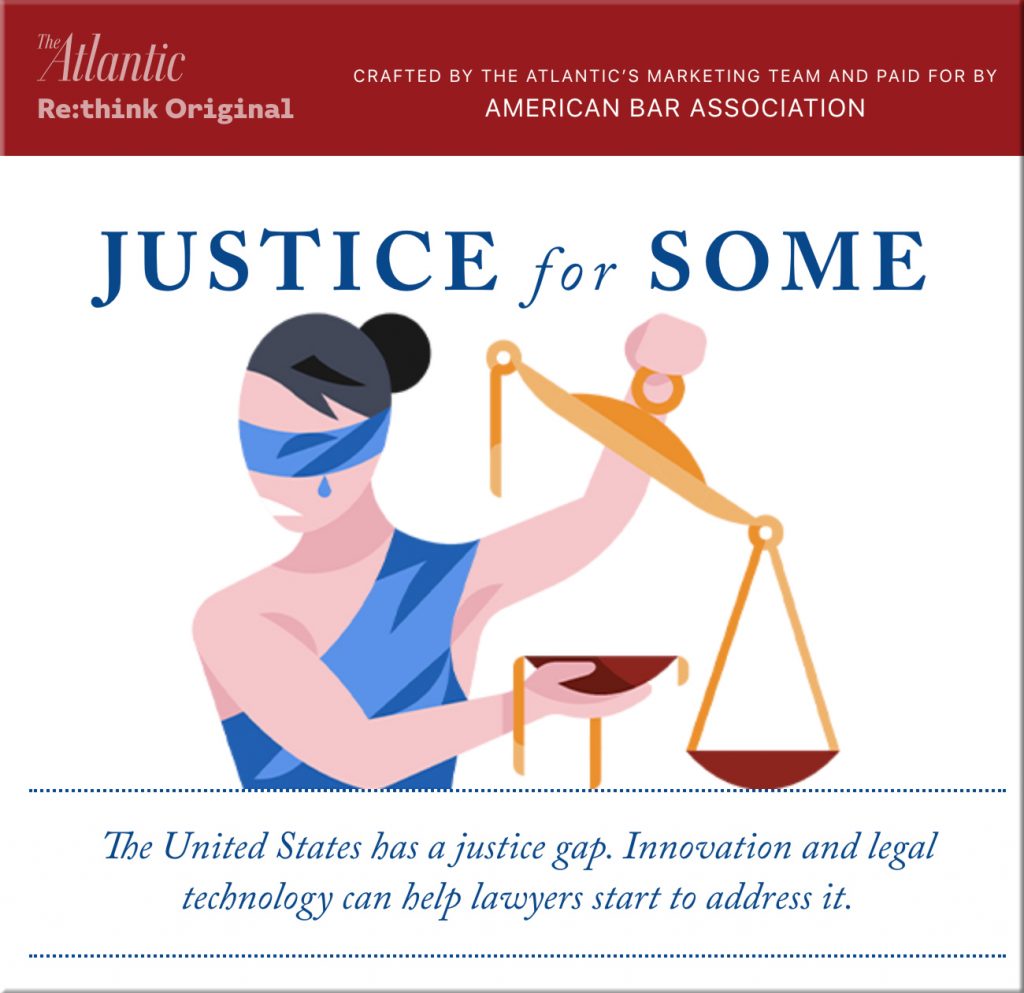
Justice for Some — from theatlantic.com and the American Bar Association (ABA)

Excerpts:

Today in the United States, millions of people like Carol lack access to basic legal resources for a variety of reasons. They forgo legal action because they find the system too overwhelming, for example, or because they perceive it to be too expensive. Many simply do not know when they qualify for legal services in the first place. And it isn’t an issue that affects only the elderly. Middle-class Americans, recent college graduates, first-generation immigrants, and new parents can all experience barriers to accessing the legal resources they need.

This issue affects lawyers, too.

DEFENDANTS FACING JAIL TIME in criminal cases have a constitutional right to be provided an attorney, but many people are surprised to learn there is no equivalent guarantee for individuals in civil cases. Typically, defendants in such cases—including divorces, domestic violence orders, home foreclosures, evictions, wills, and immigration applications—are responsible for attaining their own legal representation. And therein lies the gap.

By one estimate from the Legal Services Corporation1, 86 percent of low-income people with civil legal problems received inadequate or no legal help in the past year. Between 2015 and 2018, roughly 80 percent to 90 percent of domestic relations cases in Philadelphia involved at least one self-represented party. In 2016, 75 percent of low-income rural households experienced a civil legal problem, but only 22 percent sought professional legal help. And in 2017, 90 percent of evicted tenants in New York City never made an appearance in court.


“Search results have a huge influence on what people trust,” Hagan says. “If Google tells someone that an answer to their legal question is the number-one hit, people assume that it’s correct, unaware that it may be based on laws in another state. We have seen people click on Australian legal advice even if they’re in California.”


“We know the most successful technological solutions to the access-to-justice gap involve collaboration with lawyers, with technologists, with entrepreneurs and, hopefully to an increasing extent, with consumers,” Rodriguez says. “The object of what we’re doing is to improve the ability of lawyers to provide representation, not to supplant their businesses.”


After 40 Years of Constant Change, What’s Next for the Legal Industry?  — from law.com by Dan Packel
Few could have anticipated the dramatic shift in scope and scale the industry has undergone since The American Lawyer’s founding 40 years ago. We asked some of the law’s brightest thinkers what we can expect over the next 10.

Excerpts (emphasis DSC):

Technology and Upheaval
While it’s easy to conclude that the technological revolution that’s already been unleashed will continue to drive transformation over the next 10 years, it’s harder to pinpoint how.

Expect more and more tasks to become subject to automation—not just contracts and e-discovery but also areas like trademarks and due diligence for mergers, for starters.

Technology and artificial intelligence on their own are noteworthy, but what’s more compelling is the impact they will have on how firms are structured.

“Everything that can be taken out of the hands of subject-matter experts and handed over to the process experts and technologists will be,” says Orrick, Herrington & Sutcliffe Chairman and CEO Mitch Zuklie. “There will be far fewer associates sitting in rooms with documents and more strategic partnerships among law firms and legal tech providers.”

This transition could help chip away at the supremacy of the billable hour.

Not only will technology move up the value chain for litigation, it will also emerge as a greater player on the deal side. Jae Um, director of pricing strategy at Baker McKenzie, expects to see a much greater focus on compliance and regulatory technology in the next five years.

As AI solutions, which depend upon machine learning, are slowly deployed in the marketplace, their efficacy will inevitably grow.


How about a little wild speculation to wrap this up?  With more nonlawyer specialists finding professional homes in law firms, it’s a short leap to hybrids between law firms and professional services operations. Imagine consultants and accountants working together with lawyers and technologists to solve clients’ increasingly complex problems. And what about a high-profile merger between a Big Four firm and a global law firm? I wouldn’t rule it out.


What to expect at IFA 2019, Europe’s colossal tech show — from digitaltrends.com by Josh Levenson

Excerpt:

This week, the world’s leading manufacturers will take to the stage at IFA 2019 in Berlin, Germany, to showcase their latest innovations. Here’s what you need to know about this year’s show, including when it’s set to start, how long it will run for, where it’s held, the schedule, and all the devices we’re expecting to see unveiled by the likes of LG, Sony, Samsung, and more.


How Artificial Intelligence and Machine Learning Transforms Video Technology — from datafloq.com

AI and machine learning have many use cases in digital video technology. Here are several of them…


From DSC:
After reviewing the item below — and after trying to limit the screen time of our youngest daughter these days — I am again reflecting on how difficult it is to raise kids today. I’m not going to get on the technology bashing train, but I’m just going to say that — at least in this area of life — my parents had it much easier!  🙂  It’s not easy to cut off the kids’ access to the Internet these days…as the article below illustrates!

Teen goes viral for tweeting from LG smart fridge after mom confiscates all electronics — from cbsnews.com by Caitlin O’Kane

Excerpt (emphasis DSC):

Dorothy said she was boiling rice one night and was too preoccupied by her phone, so the stove burst into flames. “So my mom took all my tech so i’d pay more attention to my surroundings,” she said.

Then she explained that both the DS and Wii allow image share, so she could send images from those devices to Twitter, adding messages.

Sometime after finding her DS, it was taken again, so Dorothy started tweeting from yet another connected device: her fridge. “My mom uses it to google recipes for baking so I just googled Twitter,” she told CBS News.


Why teaching is still the best job in the world — from teachthought.com by Paul Moss

Excerpt:

…introducing students to new technologies and ways of presenting, curating, and collaborating with others with what they know is truly exciting and truly invigorating. Modern teachers are actually pioneering pedagogy, and can and will be able to hold their heads up high in the future when we look back and see how learning in this day and age took a radical but enormously beneficial turn for the better.

Engaging students in greater collaboration, and instilling initiative in curation and the promotion of information leads to truly independent learning, and setting up such learning environments is an opportunity that all teachers now have before them. There are few more gratifying feelings that being needed.


The Legal Industry is Starting to Collaborate — Why Now and Why It Matters — from forbes.com by Mark Cohen

Excerpt:

Law Is No Longer Is Immune To Broader Forces Driving Global Change
Law’s insularity—if not its culture—has changed during the past decade with the convergence of the global financial crisis, technology, and globalism. These powerful global macro-economic forces have produced legal disaggregation, segmentation, and a separation of legal practice from the business of delivering legal services-among, other things. Technology has enabled the creation of new legal delivery models whose DNA resembles business more than law.

Some common characteristics among leading new-model legal providers include: a flatter, corporate organizational structure; an economic model aligned with client value; tech-enabled platforms; focus on net promoter score (client satisfaction); institutional capital; agile, multi-generational, multidisciplinary, diverse workforces; data-driven internal and client-facing operations; proactive risk identification/mitigation; and a customer-centric focus. These providers are often referred to as “legal tech” companies. While they are tech-enabled, technology is only part of a broader, holistic process of customer-centric reorganization that drives enterprise value and responds to enterprise challenges.


What will happen when 28 billion devices are connected online? — from fastcompany.com
The Internet of Things is already well on its way. Here’s how it will impact our future.

Excerpt:

The Internet of Things (IoT) is the network that connects a staggering array of devices, from household appliances to factory machines. During a panel discussion at Cisco Live 2019 in June, two leading figures in IoT shared their thoughts on this rapidly evolving technology that has already transformed the world.


Governments take first, tentative steps at regulating AI — from heraldnet.com by James McCusker
Can we control artificial intelligence’s potential for disrupting markets? Time will tell.

Excerpt:

State legislatures in New York and New Jersey have proposed legislation that represents the first, tentative steps at regulation. While the two proposed laws are different, they both have elements of information gathering about the risks to such things as privacy, security and economic fairness.


Why law faculty need to learn about legal tech and what they need to know — from aals.org by Catherine Sanders Reach and Michael Robak — with special thanks to Kim O’Leary, Tenured Professor at WMU-Cooley Law School for this resource

Excerpts:

Technology is playing an ever-increasing role in the profession of law and the delivery of legal services. Legal educators must give real consideration to the role of technology in the legal profession if legal educators are going to sufficiently prepare law students to practice law in the 21st century. In this webinar, the presenters will explain why law faculty need to learn about legal tech and what they need to know.

Click here to watch this webinar on-demand. You will be asked for your contact information before viewing.

Presentation Slides


Also see:

Tech Competence That Solo and Small Firm Lawyers Really Need: Resources Here

Excerpt:

DIGITAL ASSETS AND ESTATE PLANNING
Many estate planning lawyers are hopelessly behind on assisting clients in making provisions for digital assets. In so doing, they expose themselves to malpractice. Without proper provision for digital assets, beneficiaries can lose out on substantial sums of money that they cannot locate or access. Many lawyers I’ve spoken with have dismissed digital assets figuring that most older clients aren’t using the Internet. But that’s not necessarily the case. To the contrary, older clients may indeed be using the Internet but not be aware of the need to make provisions for disposing of assets. At some point, lawyers will be sued for failing to advise on digital assets- and deservedly so.


Also see:


Top 10 Digital Transformation Trends For 2020 –from forbes.com by Daniel Newman

Excerpt (emphasis DSC):

A faster WiFi for a faster world: Although WiFi 6 and 5G are completely different technologies, both will be bringing us much faster processing and wireless connection speeds in 2020. 5G and WiFi 6 working in concert will create the perfect end-to-end combination of ultra-fast connectivity for home and office. Expect download speeds up to 3x faster than were achievable with WiFi 5, but that isn’t the best measure of the new standard’s value. The real value of WiFi 6 will be its ability to extend faster data speeds to far more devices than WiFi 5 was able to manage.


Amazon pledges $700 million to teach its workers to code — from wired.com by Louise Matsakis

Excerpt:

Amazon announced Thursday that it will spend up to $700 million over the next six years retraining 100,000 of its US employees, mostly in technical skills like software engineering and IT support. Amazon is already one of the largest employers in the country, with almost 300,000 workers (and many more contractors) and it’s particularly hungry for more new talent. The company currently has more than 20,000 vacant US roles, over half of which are at its headquarters in Seattle. Meanwhile, the US economy is booming, and there are now more open jobs than there are unemployed people who can fill them, according to the Bureau of Labor Statistics.


Against that backdrop, Amazon’s jobs skills efforts provide some reassurance that—in theory at least—you could be retrained into a new role when the robots arrive.


From the announcement:

Based on a review of its workforce and analysis of U.S. hiring, Amazon’s fastest growing highly skilled jobs over the last five years include data mapping specialist, data scientist, solutions architect and business analyst, as well as logistics coordinator, process improvement manager and transportation specialist within our customer fulfillment network.


Also see:

  • Amazon to Invest $700M to Retrain 100,000 Workers for New Jobs — from pcmag.com by Michael Kan Icon
    ‘There is a greater need for technical skills in the workplace than ever before. Amazon is no exception,’ the company said. The goal is to ‘upskill’ one third of Amazon’s total work force by 2025 through free retraining programs.
 
© 2025 | Daniel Christian