Here’s an example of what an engaging and exciting online course might [look like]. 

You start with a short video that introduces the subject. It focuses on the course’s main ideas, and how they relate to one another, getting your learners interested in the topic and making them eager to learn more.


Education and Justice Departments Warn of Covid’s ‘Profound Toll’ on Student Mental Health — from chronicle.com by Sarah Brown

Excerpt:

As the pandemic drags on past 19 months in the United States, the Education Department and the Justice Department on Wednesday implored colleges and schools to be especially attentive to students who are showing signs of self-harm or suicide.

If institutions don’t adequately support students with mental-health diagnoses, as required by federal law, the departments warned that they could draw an investigation.

Suzanne B. Goldberg, a former senior administrator at Columbia University who’s now the Education Department’s acting assistant secretary for civil rights, wrote in a letter to educators that the Covid-19 era had “taken a profound toll” on students’ mental health.


3 Tips for Making Passion-Based Learning Work Successfully — from thejournal.com by Dennis Pierce

Excerpt:

Passion-based learning, a form of self-directed learning in which students pursue projects of interest to them, is becoming more popular in schools — and for good reason: Educators who have set aside time for passion-based learning have discovered that students become highly engaged and motivated when learning about topics that intrigue them, while taking their learning much deeper than they would in a traditional lesson.

Passion-based learning initiatives include Genius Hour and 20time, both inspired by Google’s program that lets employees spend 20% of their time on projects of their choosing to spark innovation.

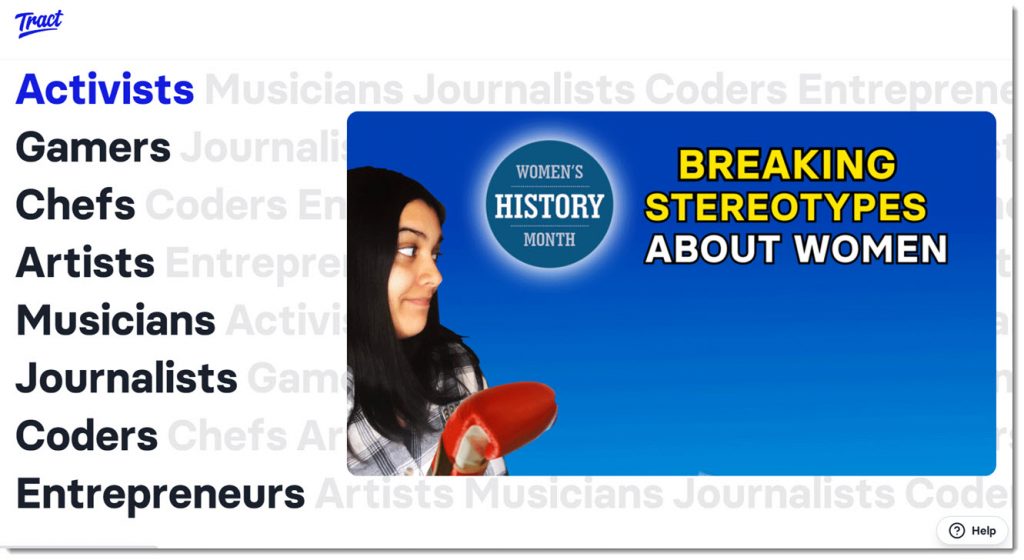
Giving all students the option to explore their interests can be challenging on a large scale. To overcome this hurdle and make the process easier for teachers, Sonora Elementary uses a new peer-to-peer learning platform called Tract, which is a collection of video content organized into self-directed learning paths.

tract.app allows students to be creative and practice their storytelling and multimedia skills

From DSC:
I love the type of tool/app like Tract — as students can work on a variety of skills:

  • multimedia development
  • music
  • acting
  • writing/composing
  • digital storytelling
  • …and more

Such projects/tools can unleash a great deal of creativity, engagement, and positive energy. Learning becomes more relevant, enjoyable, and interesting when we can provide more choice and control to our students.


Common Anxieties in Beginning HyFlex: Learning to Teach a HyFlex Class — from hyflexlearning.org by Brian Beatty

Excerpt:

Not surprisingly, one of the biggest anxieties – FEARS – for many faculty considering or implementing a HyFlex approach for the first time is learning how to do so, and to do so effectively the very first time. No one likes to feel like they aren’t equipped to do the work they are required (or challenged) to do; perhaps especially teachers who are normally in full control of their classrooms and the activities that take place in them. When you are planning to teach HyFlex, it may seem like you are planning for CHAOS, or at least planning to lose control over the class environment(s), the teaching process, and ultimately student learning. Let’s address those concerns one at a time, but briefly.

If we assume you are an effective classroom teacher, then a common design path that I usually recommend is to start with your plans for an effective classroom experience and work to translate those to the other modes, accessing expert guidance as needed (such as, instructional designers, online course design books, your colleagues). What are the learning outcomes (or instructional objectives) for the classroom? How will those translate into the online mode(s) you are planning? What about the instructional content and associated activities for the classroom? How do those translate? What about plans for assessment? Start with what you know, and are confident with, and then layer in approaches for the other modes. 


Think-Pair-Share: The Basics! — from lillyconferences.com by The Scholarly Teacher Team
Think-Pair-Share is a collaborative learning strategy that promotes critical thinking and peer learning. This is an excellent place to start if you want to add active learning to your lecture-based course without taking much class time.

From DSC:
The ability of many videoconferencing systems to automatically create breakout groups/sessions for you can be very helpful here. 


Talking About Forgetting with Students — from theeffortfuleducator.com by Blake Harvard

Excerpt:

Over the course of 24 hours, students are going to forget a lot of what we cover in class. So, when they show up to class and I provide a review, I shouldn’t expect them to necessarily do too well. The students’ mindset should not be ‘I should be getting all of this correct’, but ‘let me see what I remember and what I don’t so I better know what to review later’. But that’s not the mentality we approach most assessment opportunities with…they’re seen more as a ‘gotcha’ for students or, at least, students believe they’re supposed to remember all of this because it’s on the review.

We need to work to change this mindset. Let the students in on the ‘secret’ of memory and forgetting. Tell them forgetting is normal and expected. And the reason we’re doing these formative assessments is to simply indicate what you do remember and what you’ve forgotten so future studying can be more efficient and effective.

Also see:


A guide to overexcitabilities and gifted children — podcast from raisinglifelonglearners.com by Colleen Kessler

Excerpt:

Polish psychologist/psychiatrist Kazimierz Dabrowski developed the theory of overexcitabilities. Gifted children are highly likely to be more intense than their typical peers. This increased awareness, sensitivity, and intensity can present challenges that make them difficult children to parent.

The Five Overexcitabilities
Dabrowski identified five different areas of overexcitabilities when he developed his Theory of Positive Disintegration. Not all gifted kids exhibit overexcitabilities, but they are more prevalent among the gifted population than any other.


Sites and apps to enjoy with your kids — from wondertools.substack.com by Jeremy Caplan

Check out Jeremy’s list of sites and apps to review with your kids re:

  • Making music delightful
  • Bringing joy to science, math, and coding
  • Other fantastic resources for kids and families
 

Resources from “The Science of Learning” — from deansforimpact.org

Excerpt:

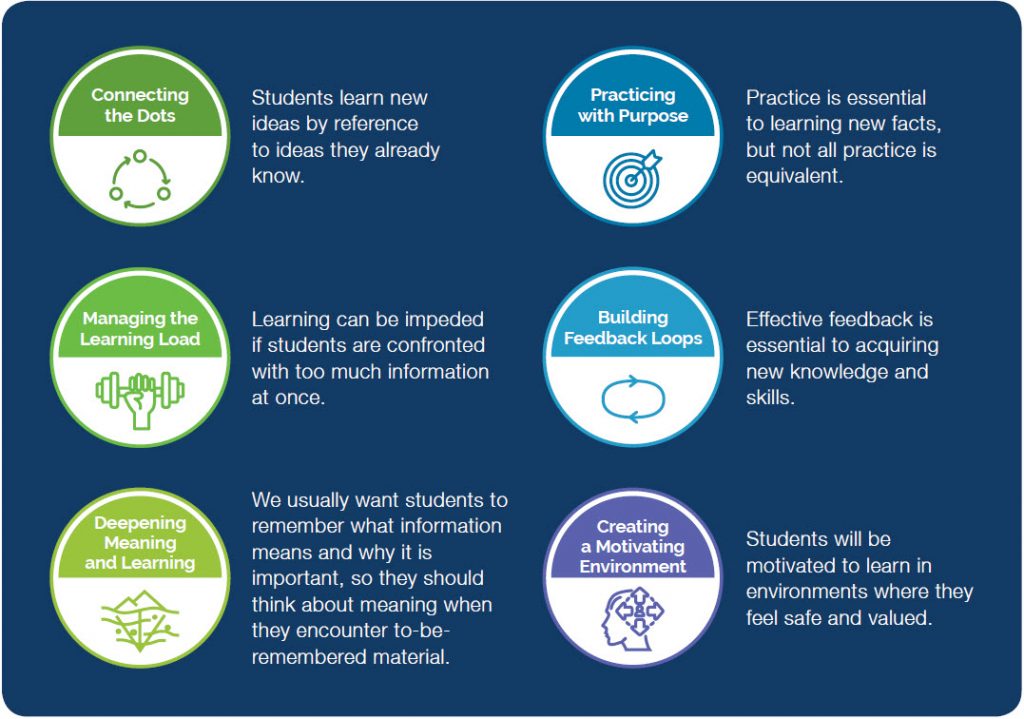
The Science of Learning summarizes existing cognitive-science research on how students learn, and connects it to practical implications for teaching. The report is a resource for teacher-educators, new teachers, and anyone in the education profession who is interested in how learning takes place.

Deans for Impact believes all teacher-candidates should know the cognitive-science principles explored in The Science of Learning. And all educators, including new teachers, should be able to connect those principles to their practical implications for the classroom.

One of those resources is:

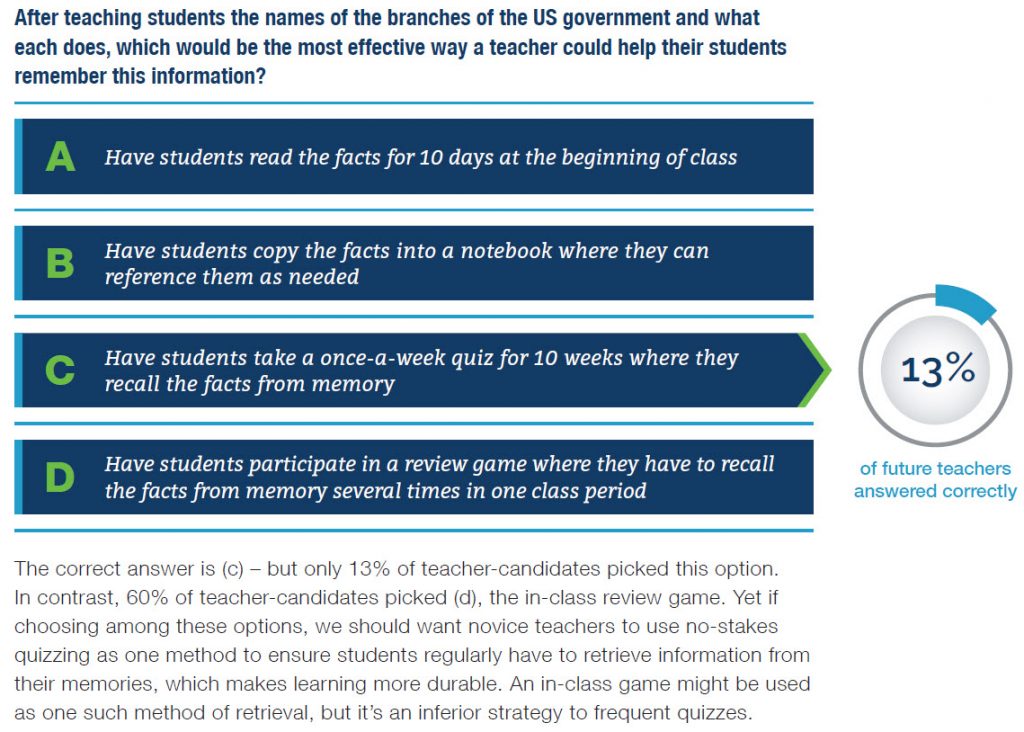
Also see:Learning by Scientific Design -- a report from Deans for Impact

The use of regular quizzes is extremely effective in committing something to long-term memory


There are six major takeaways from our first administration of our Learning by Scientific Design assessment:

  1. In general, future teachers are unfamiliar with basic principles of learning science – and they struggle to connect these principles to practice.
  2. Encouragingly, future teachers recognize the critical role that background knowledge plays in learning.
  3. Future teachers struggle to identify effective forms of practice – and they appear to conflate student engagement with learning.
  4. For the most part, teacher-candidates hold beliefs about teaching and learning that align to principles of learning science –- but there are clear areas for improvement.
  5. Teacher-candidate understanding of learning science does not vary based on key categories we might expect.
  6. Teacher-educators in the LbSD Network do better at identifying learning-science principles in practice than just the principles in the abstract.


Five Tips for Launching an Online Writing Group — from scholarlyteacher.com by Kristina Rouech,  Betsy VanDeuesen, Holly Hoffman, & Jennifer Majorana — who are all from Central Michigan University

Excerpt:

Making time for writing can be difficult at any stage of your career. Pushing writing aside for grading, lesson planning, meeting with students, and committee work is too easy. However, writing is a necessary part of our careers and has the added benefit of helping us stay current with our practice and knowledge in our field. Lee and Boud (2003) stress that groups should focus on developing peer relationships and writing identity, increasing productivity, and sharing practical writing. Online writing groups can help us accomplish this. With the impact of the COVID-19 pandemic, working online has become a necessity, but it can take time to figure out what works best for you and your writing colleagues. We recommend five tips to help you establish an online writing group that is productive and enjoyable for all participants.


From DSC:
For IDs, trainers, teachers, faculty members, & teams who are working on creating and delivering online-based learning……the following article is a good one for us to check out and reflect upon:

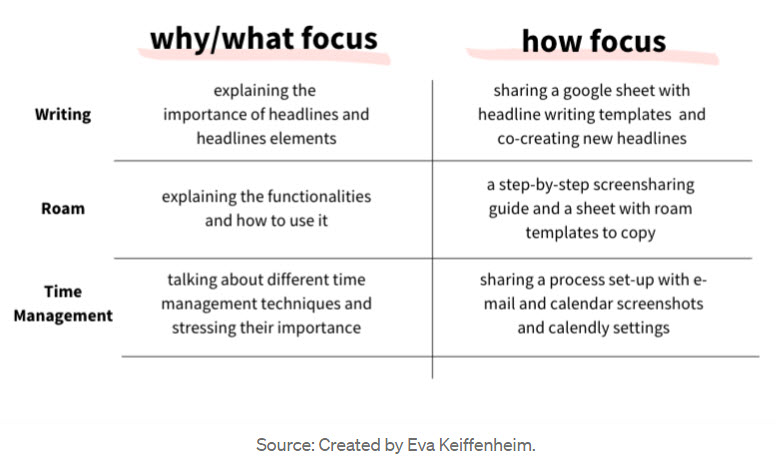
Most Online Courses Are a Waste of Your Time — Here’s How You Know — from medium.com by Eva Keiffenheim
A quick guide that helps you find the worthy ones.

Excerpts:

Not all learning investments are created equal. People who’ve excelled at their craft are often not the best teachers. Likewise, creators who write the best sales copy don’t offer the most value.

Here’s precisely how you can spot bad online courses so that you won’t waste your time and money.

…


Feynman – Don’t lecture and Feynman Technique — from donaldclarkplanb.blogspot.com by Donald Clark

Excerpt from the Feynman Technique section

  1. Write down everything you think you know about the topic from the top of your head
  2. Teach it to someone much younger
  3. Identify the gaps and fill them out
  4. Simplify, clarify and use analogies

Learning this way is iterative, as you must go back to sources to fill in any gaps uncovered by your attempts to recall what you think you know. The act of writing, teaching, simplification and analogising, is a form of retrieval practice that increases understanding and retention.

Also see:

The Feynman Technique Can Help You Remember Everything You Read — from medium.com by Eva Keiffenheim
How to use this simple principle for you.

Excerpts:

Social climber Dale Carnegie used to say knowledge isn’t power until it’s applied. And to apply what you read, you must first remember what you learned.

Nobel Prize-winning physicist Richard Feynman (1918–1988) was an expert for remembering what he learned.

Most people confuse consumption with learning. They think reading, watching, or hearing information will make the information stick with them.

Unless you’ve got a photographic memory, no idea could be further from the truth.
…
Teaching is the most effective way to embed information in your mind. Plus, it’s an easy way to check whether you’ve remembered what you read. Because before you teach, you have to take several steps: filter relevant information, organize this information, and articulate them using your own vocabulary.


Differentiation Technique: Embed A Classic — from byrdseed.com by Ian Byrd

Excerpt:

Possibly my #1, most favorite way to increase the interest in a lesson is to simply remove the built-in examples in a lesson and replace them with some kind of classic.

Wait, What’s A “Classic”?
A classic may immediately bring to mind old works: Shakespeare, Beethoven, and Da Vinci. And those are indeed important! Use them.

But I’d say that The Wizard of Oz is a classic. Lord of the Rings is a classic. Hokusai’s painting of The Great Wave is a classic. The Beach Boys are a classic!

Classics are things that are culturally important. They could be stories, films, songs, paintings, photos, and so on. Classics are referenced constantly in daily conversation as well as in other creative works.


What Will Online Learning Look Like in 10 Years? Zoom Has Some Ideas — from edsurge.com by Stephen Noonoo

Excerpt:

This week at Zoom’s annual conference, Zoomtopia, a trio of education-focused Zoom employees (er, Zoomers?) speculated wildly about what hybrid Zoom learning might look like 10 years from now, given the warp speed advances in artificial intelligence and machine learning expected. Below are highlights of their grandiose, if sometimes vague, vision for the future of learning on Zoom.

Zoom very much sees itself as one day innovating on personalized learning in a substantial way, although beyond breakout rooms and instant translation services, they have few concrete ideas in mind. Mostly, the company says it will be working to add more choices to how teachers can present materials and how students can display mastery to teachers in realtime. They’re bullish on Kahoot-like gamification features and new ways of assessing students, too.

Also see:

An Eighth Grader Was Tired of Being Late to Zoom School. So He Made an App for That. — from edsurge.com by Nadia Tamez-Robledo

“I could not find anything else that exists like this to automatically join meetings at the right times,” says Seth, a high school freshman based in Walnut Creek, Calif. “Reminders are just really easy to ignore. I’ll get a notification maybe five minutes before my meeting, and it’ll just sit there and not do anything. [LinkJoin] interrupts whatever you’re doing and says, ‘Join this meeting. In fact it’s already opening, so better get on it.’”


© 2025 | Daniel Christian