Course Awareness in HyFlex: Managing unequal participation numbers — from hyflexlearning.org by Candice Freeman

Excerpt:

How do you teach a HyFlex course when the number of students in various participation modes is very unequal? How do you teach one student in a mode – often in the classroom? Conversely, you could ask how do you teach 50 asynchronous students with very few in the synchronous mode(s)? Answers will vary greatly depending from teacher to teacher. This article suggests a strategy called Course Awareness, a mindfulness technique designed to help teachers envision each learner as being in the instructor’s presence and engaged in the instruction regardless of participation (or attendance) mode choice.
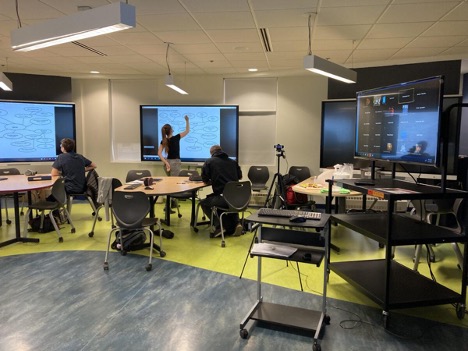
Teaching HyFlex in an active learning classroom

From DSC:
I had understood the hyflex teaching model as addressing both online-based (i.e., virtual/not on-site) and on-site/physically-present students at the same time — and that each student could choose the manner in which they wanted to attend that day’s class. For example, on one day, a student could take the course in room 123 of Anderson Hall. The next time the class meets, that same student could attend from their dorm room.

But this article introduces — at least to me — the idea that we have a third method of participating in the hyflex model — asynchronously (i.e., not at the same time). So rather than making their way to Anderson Hall or attending from their dorm, that same student does not attend at the same time as other students (either virtually or physically). That student will likely check in with a variety of tools to catch up with — and contribute to — the discussions. As the article mentions:

Strategically, you need to employ web-based resources designed to gather real-time information over a specified period of time, capturing all students and not just students engaging live. For example, Mentimeter, PollEverywhere, and Sli.do allow the instructor to pose engaging, interactive questions without limiting engagement time to the instance the question is initially posed. These tools are designed to support both synchronous and asynchronous participation. 

So it will be interesting to see how our learning ecosystems morph in this area. Will there be other new affordances, pedagogies, and tools that take into consideration that the faculty members are addressing synchronous and asynchronous students as well as online and physically present students? Hmmm…more experimentation is needed here, as well as more:

  • Research
  • Instructional design
  • Design thinking
  • Feedback from students and faculty members

Will this type of model work best in the higher education learning ecosystem but not the K-12 learning ecosystem? Will it thrive with employees within the corporate realm? Hmmm…again, time will tell.


And to add another layer to the teaching and learning onion, now let’s talk about multimodal learning. This article, How to support multimodal learning” by Monica Burns, mentions that:

Multimodal learning is a teaching concept where using different senses simultaneously helps students interact with content at a deeper level. In the same way we learn through multiple types of media in our own journey as lifelong learners, students can benefit from this type of learning experience.

The only comment I have here is that if you think that throwing a warm body into a K12 classroom fixes the problem of teachers leaving the field, you haven’t a clue how complex this teaching and learning onion is. Good luck to all of those people who are being thrown into the deep end — and essentially being told to sink or swim.
 

Future of Learning Council on Statewide Grassroots Strategies & Pathways — from gettingsmart.com

Description of podcast:

On this episode of the Getting Smart Podcast Shawnee Caruthers is joined by Dr. Dave Richards, the Executive Learning Strategist for Michigan Virtual and a key part of Future of Learning Council, a partner that we’ve loved working alongside over the last year.

We are also joined by two superintendents who are a part of this project – Dr. Christopher Timmis, Superintendent of Dexter Community Schools and Dr. John VanWagoner of Traverse City Area Public Schools.


What’s next for online education? — from educationalist.substack.com by Alexandra Mihai

Excerpt:

An ecosystem not a dichotomy
As you’re hopefully already getting from my thoughts so far, I personally see our options for quality education in the future more like an ecosystem and not a series of mutually exclusive paths. It’s time to discard- or at least question-the “online vs. in person” dichotomy, almost always unfavourable to online education. It’s time to think in a more nuanced way about this. And, yes, you’ve guessed, more nuanced is always more difficult. Seeing the shades of grey requires a critical lens that we don’t need to see black and white.

The extent to which online education will be used in the future does not depend only on people (micro level), it depends on institutions (meso level) and policies (macro level).

The learning ecosystem, in my view:

  • includes various modalities used in a complementary way and as a continuum;
  • serves a multitude of audiences, at different stages of learning, with different aims and degrees of engagement;
  • requires comprehensive and interconnected support structures at institutional level, for students and faculty.
 

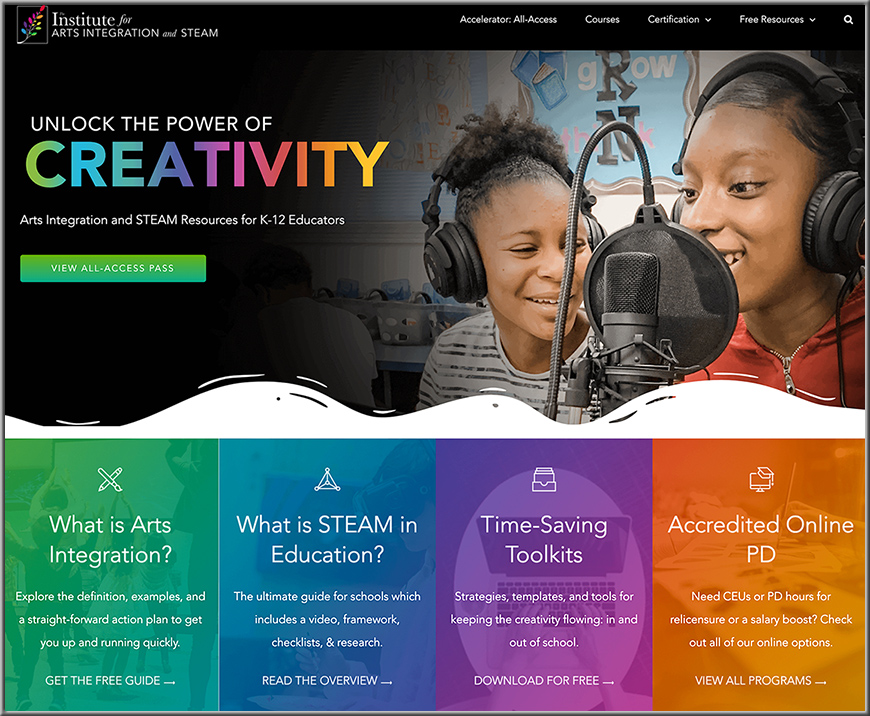
Arts Integration and STEAM Resources for K-12 Educators

Unlock the power of creativity -- arts integration and STEAM resources for K-12 educators

Official Trailer (Art Works for Teachers)

Excerpt:

Introducing the Art Works for Teacher Podcast Trailer! Get a quick sneak peek at what you can expect from this new show, launching September 22, 2022. New episodes will be available each Thursday on your favorite podcast platform, on YouTube, and right here on our site.


From DSC:
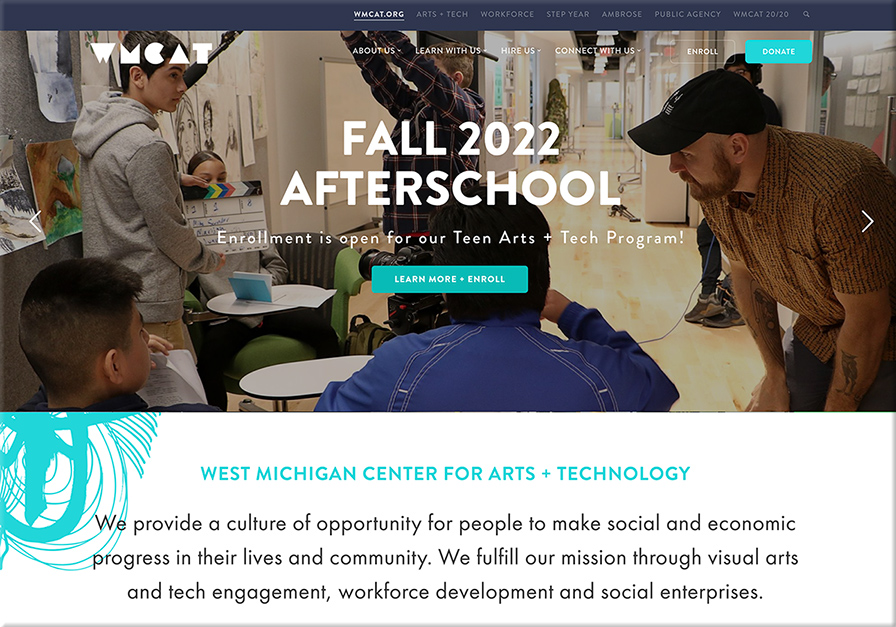
Along these lines, also see WEST MICHIGAN CENTER FOR ARTS + TECHNOLOGY. Such a learning environment builds skills and creativity while supercharging participation and engagement!


Teachers Are Ready for Systemic Change. Are Schools? — from edweek.org by Madeline Will
Schools need effective, transformative change. Leaders must be ready to take it on

Excerpt:

So many people in education—from teachers to U.S. Secretary of Education Miguel Cardona—have called this moment, as schools emerge from the darkest shadow of the coronavirus pandemic, our chance for a “reset in education.”

It’s a sentiment that repeatedly comes up in my interviews with teachers. They wonder if the pandemic’s disruption of schools was a once-in-a-generation chance to transform the education system, which is riddled with inequities and pedagogical practices that date back decades.

Some educators also wonder if we’re on the verge of squandering such a chance. That may be; in the rush to get students back on track, we’re at risk for overlooking many of the lessons learned from the last couple years.

“The teachers know what works,” Kelly said. “We need more people to not only listen to teachers, but we also need them to implement the things that teachers say.”

From DSC:
If the K12 learning ecosystems out there don’t change, students, families — and teachers — may let their feet do the walking. We’re seeing a similar situation within higher education, with mostly students’ feet who are starting to do the walking (to alternatives). Some employers’ feet are getting itchy to walk as well.

If you were going to weigh the power that each area holds, what would you put on the weight employers have to effect change these days? Institutions of higher education? Students and their families? Hmmm…change needs to be in the air. The status quo hasn’t been working well within K-12 or within higher education.

Also relevant within K-12, see:

Exit Interview: Why This Veteran Teacher is Leaving the Profession — from edsurge.com by Jennifer Yoo-Brannon

Excerpt:

It’s a frank and sometimes emotional conversation between Jennifer Yoo-Brannon, an instructional coach at El Monte Union High School District in California, and Diana Bell, a veteran teacher of more than 18 years who recently decided to leave the profession. They talk about what led to that departure and how teaching could change to better support educators.

Many Eyes Are on the Teachers Who Leave. What About the Ones Who Stay? — from edsurge.com by Patrick Harris II

Excerpt:

My own experience sits among countless narratives from other teachers, including teachers of the year, revealing the difficulty and the emotion behind the decision to leave a school—and for some, the choice to part ways with a system that never had their best interest at heart.

A lesser told story is the plight of the teachers who stay behind. The emotional narratives about their experiences, their feelings and the pressures they carry.


How I Learned (Almost) Everything I Know — from byrdseed.com by Ian Bryd

You’ve Got To See It
In short, the great educational leaders in my life did one of two things:

  1. Showed me exactly what to do.
  2. Sent me to the right person so I could watch it in action.


The next chapter for Learning on YouTube — from blog.youtube by Jonathan Katzman

Next year, qualified creators can begin offering free or paid Courses to provide in-depth, structured learning experiences for viewers. Viewers who choose to buy a Course can watch the video ad-free and play it in the background.
…
…to help learners apply what they’ve learned, we’re introducing Quizzes — a new way for creators to help viewers test their knowledge.”

.


To Improve Outcomes for Students, We Must Improve Support for Faculty — from campustechnology.com by Dr. David Wiley
The doctoral programs that prepare faculty for their positions often fail to train them on effective teaching practices. We owe it to our students to provide faculty with the professional development they need to help learners realize their full potential.

Excerpts:

Why do we allow so much student potential to go unrealized? Why are well-researched, highly effective teaching practices not used more widely?

The doctoral programs that are supposed to prepare them to become faculty in physics, philosophy, and other disciplines don’t require them to take a single course in effective teaching practices. 

The entire faculty preparation enterprise seems to be caught in a loop, unintentionally but consistently passing on an unawareness that some teaching practices are significantly more effective than others. How do we break this cycle and help students realize their full potential as learners?

From DSC:
First of all, I greatly appreciate the work of Dr. David Wiley. His career has been dedicated to teaching and learning, open educational resources, and more. I also appreciate and agree with what David is saying here — i.e., that professors need to be taught how to teach as well as what we know about how people learn at this point in time. 

For years now, I’ve been (unpleasantly) amazed that we hire and pay our professors primarily for their research capabilities — vs. their teaching competence. At the same time, we continually increase the cost of tuition, books, and other fees. Students have the right to let their feet do the walking. As the alternatives to traditional institutions of higher education increase, I’m quite sure that we’ll see that happen more and more.

While I think that training faculty members about effective teaching practices is highly beneficial, I also think that TEAM-BASED content creation and delivery will deliver the best learning experiences that we can provide. I say this because multiple disciplines and specialists are involved, such as:

  • Subject Matter Experts (i.e., faculty members)
  • Instructional Designers
  • Graphic Designers
  • Web Designers
  • Learning Scientists; Cognitive Learning Researchers
  • Audio/Video Specialists  and Learning Space Designers/Architects
  • CMS/LMS Administrators
  • Programmers
  • Multimedia Artists who are skilled in working with digital audio and digital video
  • Accessibility Specialists
  • Librarians
  • Illustrators and Animators
  • and more

The point here is that one person can’t do it all — especially now that the expectation is that courses should be offered in a hybrid format or in an online-based format. For a solid example of the power of team-based content creation/delivery, see this posting.

One last thought/question here though. Once a professor is teaching, are they open to working with and learning from the Instructional Designers, Learning Scientists, and/or others from the Teaching & Learning Centers that do exist on their campus? Or do they, like many faculty members, think that such people are irrelevant because they aren’t faculty members themselves? Oftentimes, faculty members look to each other and don’t really care what support is offered (unless they need help with some of the technology.)


Also relevant/see:


What if smart TVs’ new killer app was a next-generation learning-related platform? [Christian]

TV makers are looking beyond streaming to stay relevant — from protocol.com by Janko Roettgers and Nick Statt

A smart TV's main menu listing what's available -- application wise

Excerpts:

The search for TV’s next killer app
TV makers have some reason to celebrate these days: Streaming has officially surpassed cable and broadcast as the most popular form of TV consumption; smart TVs are increasingly replacing external streaming devices; and the makers of these TVs have largely figured out how to turn those one-time purchases into recurring revenue streams, thanks to ad-supported services.
…
What TV makers need is a new killer app. Consumer electronics companies have for some time toyed with the idea of using TV for all kinds of additional purposes, including gaming, smart home functionality and fitness. Ad-supported video took priority over those use cases over the past few years, but now, TV brands need new ways to differentiate their devices.

Turning the TV into the most useful screen in the house holds a lot of promise for the industry. To truly embrace this trend, TV makers might have to take some bold bets and be willing to push the envelope on what’s possible in the living room.


From DSC:
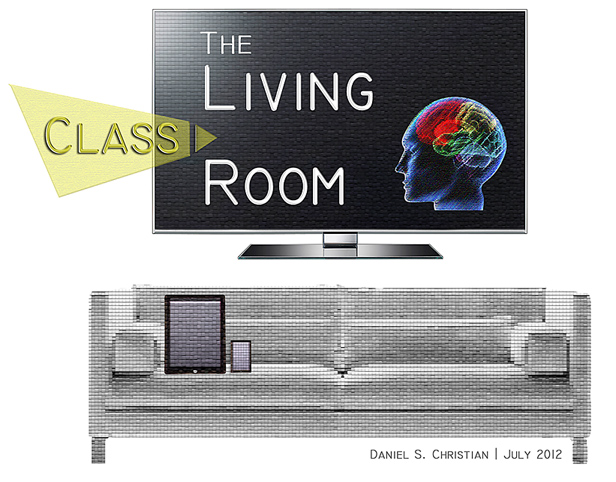
What if smart TVs’ new killer app was a next-generation learning-related platform? Could smart TVs deliver more blended/hybrid learning? Hyflex-based learning?
.

The Living [Class] Room -- by Daniel Christian -- July 2012 -- a second device used in conjunction with a Smart/Connected TV

.

Or what if smart TVs had to do with delivering telehealth-based apps? Or telelegal/virtual courts-based apps?


Learning by Scientific Design podcast, Ep. 4: Empowering educators & elevating the teaching profession — from by Deans for Impact

Description of podcast:
Learning by Scientific Design is a podcast series by Deans for Impact that explores how an understanding of cognitive science, or the science of how students learn, can lead to more rigorous, equitable and inclusive teaching.

How can the growing adoption of learning science in teacher preparation contribute to systemic change in U.S. education? In this episode, you’ll hear from:

  • Louise Vose, Adjunct Professor, School of Education, Endicott College
  • Peter Fishman, Vice President of Strategy, Deans for Impact
  • Leah Brown, Assistant Professor, School of Education, University of Alaska Fairbanks

From DSC:
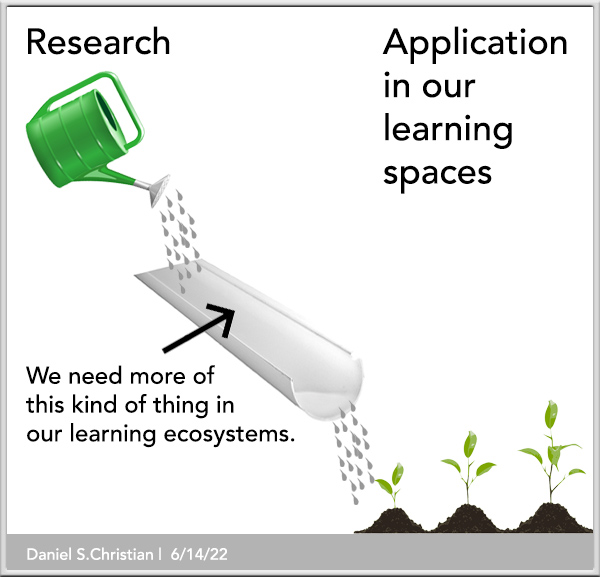
This podcast reminds me of the graphic (below) that I created not too long ago…

We need to take more of the research from learning science and apply it in our learning spaces.

.


Also see:

.


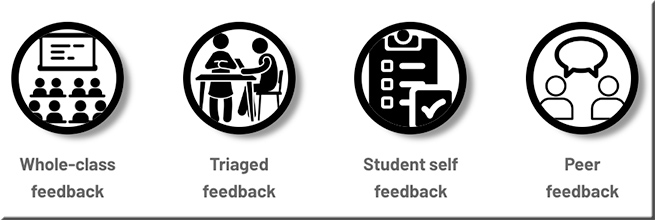
How do I give feedback to 100+ students? — from ditchthattextbook.com

Excerpt:

How do we modify our instructions to meet ALL of their needs? How do we make the most of our time and theirs?

That’s what we want to tackle with you.

As part of the EfficienTEACH project, we are looking at assessment and the feedback we can provide in the most manageable, effective and efficient way possible.
.

Table of Contents


Also see:


The Decomposition of School and Regeneration of Learning — from gettingsmart.com by  Maggie Favretti

Key points

  • Industrial schooling has been smelling funky for a while.
  • The fragmentation of time prevents deep learning.
  • Splitting school off from ‘real life’ undermines meaning and purpose.

5 Strategies for a Successful Start to the School Year — from gettingsmart.com by Abby Dorsey

Key Points:

  • AVID principles can be applied across grade levels and subjects to empower students to meet their goals.
  • The following five AVID strategies can help you ensure a successful start to the school year for students and educators on your campus.
 

How to Use Edtech to Engage Introverted Learners — from edsurge.com by Stacey Roshan

Excerpts:

But we can leverage technology to create more equitable and empowering forums for discussion—to shift from a culture that praises the first person to raise their hand, to one where every individual has a platform to make their ideas seen and heard. I’m talking about using simple web apps.

As an introverted perfectionist who needed time to process and formulate a response before I was ready to share, I began to confuse faster with smarter. Because I saw my peers answering more questions than I was in class—and getting praised for it—I struggled to feel like I measured up.

And so, as a math teacher, it has become my mission to find ways to spotlight all of the unique voices and personalities in my classroom, and to celebrate the diverse approaches students choose to share, rather than valuing one.


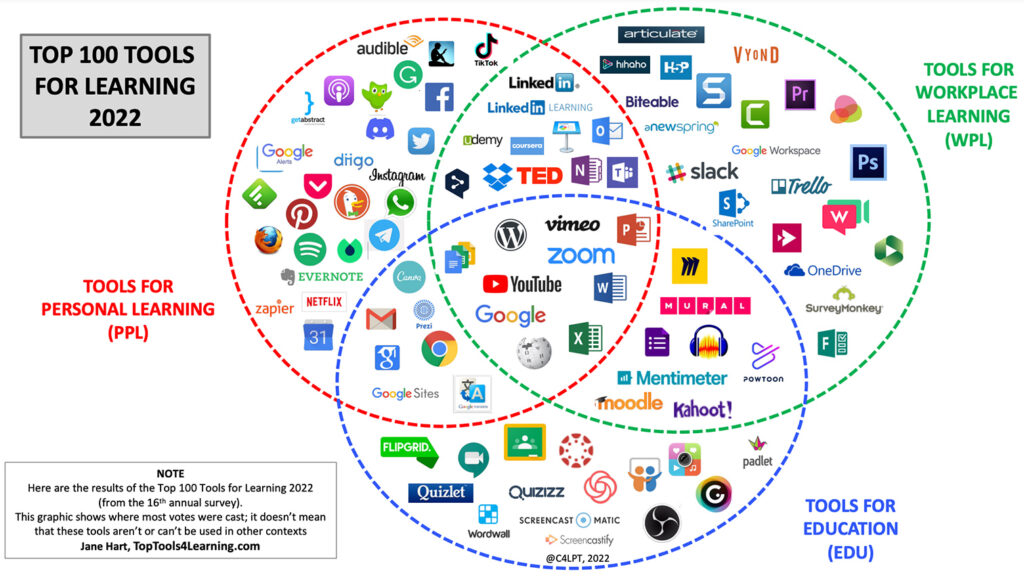
Top Tools for Learning 2022 [Jane Hart]

Top Tools for Learning 2022


Top tools for learning 2022 — from toptools4learning.com by Jane Hart

Excerpt:

In fact, it has become clear that whilst 2021 was the year of experimentation – with an explosion of tools being used as people tried out new things, 2022 has been the year of consolidation – with people reverting to their trusty old favourites. In fact, many of the tools that were knocked off their perches in 2021, have now recovered their lost ground this year.


Also somewhat relevant/see:


Test proctoring room scans violated college student’s privacy, judge rules — from highereddive.com by Natalie Schwartz

Excerpt from Dive Brief: 

  • Cleveland State University violated the Fourth Amendment’s protection against unreasonable government searches and seizures by scanning rooms via online proctoring software before students took exams, a federal judge ruled Monday.
 

Future of Higher Education: Fully Shift to Hybrid Model by 2025 — from fierceeducation.com by Susan Fourtané, with thanks to Ray Schroeder for this resource out on LinkedIn

Excerpt:

The full shift to a blended teaching and learning model for higher education will become effective by 2025, according to a new report.

The pandemic acted as a catalyst to change the higher education landscape accelerating online learning adoption. Chief Online Officers (COOs) who took part in the CHLOE 7: Tracking Online Learning from Mainstream Acceptance to Universal Adoption, The Changing Landscape of Online Education report indicated that student interest in online learning has increased substantially in the past two years. The majority of COOs predict that is a trend that will continue to grow in the next several years.

 
© 2025 | Daniel Christian