On the K-12 side of things:

6 Ways to Use ChatGPT to Save Time — from edutopia.org by Todd Finley
Teachers can use the artificial intelligence tool to effectively automate some routine tasks.

Excerpt:

In the paragraphs that follow, I’ve divided these tasks into the following categories: planning instruction, handouts and materials, differentiation, correspondence, assessment, and writing instruction and feedback. Welcome to the revolution.

Lesson plans: Ask ChatGPT to write a lesson plan on, say, Westward Expansion. The tool composes assessments, activities, scaffolding, and objectives. Want that in the form of problem-based learning or revised for a flipped classroom? ChatGPT can adjust the lesson plan according to your instructions. 

I’m a high school math and science teacher who uses ChatGPT, and it’s made my job much easier — from businessinsider-com.cdn.ampproject.org by Aaron Mok; with thanks to Robert Gibson on LinkedIn for this resource

Shannon Ahern teaching her class with the help of a ChatGPT-generated slide. Photo courtesy of Shannon Ahern

Excerpt:

  • Shannon Ahern, a high school math and science teacher, was afraid that ChatGPT would take her job.
  • But her mind changed after she started using the AI for class prep, which saved her hours of time.
  • Here’s how Ahern is using ChatGPT to make her job easier, as told to Insider’s Aaron Mok.

On the higher education side of things:

Using AI to make teaching easier & more impactful — from oneusefulthing.substack.com by Ethan Mollick
Here are five strategies and prompts that work for GPT-3.5 & GPT-4

Excerpt:

But one thing that is not changing is the best way for people to learn. We have made large advances in recent years in understanding pedagogy – the science of learning. We know some of the most effective techniques for making sure material sticks and that it can be retrieved and used when needed most.

Unfortunately, many of these advanced pedagogical techniques are time-consuming to prepare, and many instructors are often overworked and do not have the resources and time to add them to their teaching repertoire. But AI can help. In the rush to deliver AI benefits directly to students, the role of teachers is often overlooked.

Teaching: What You Need to Know About ChatGPT — from chronicle.com by Beth McMurtrie

Excerpt:

Digital literacy is more important than ever. Artificial-intelligence tools, and generative AI in particular, raise a host of ethical, political, economic, and social questions. Plus, this tech is soon going to be everywhere, including students’ future professions. (The technology behind ChatGPT, in fact, just got an upgrade this week.) Colleges need to figure out how to graduate digitally savvy students in all disciplines.

“The integration of technology into our lives is so pervasive that the restriction of education about AI to the computer scientists and the computer engineers makes no more sense than the restriction of taking English classes by English majors,” said Weber.


ChatGPT could be an effective and affordable tutor — from theconversation-com.cdn.ampproject.org by Anne Trumbore

Excerpt:

Yet the history and research of intelligent tutors show that using the right design to harness the power of chatbots like ChatGPT can make deeper, individualized learning available to almost anyone. For example, if people use ChatGPT to ask students questions that prompt them to revise or explain their work, students will have better learning gains. Since ChatGPT has access to far more knowledge than Aristotle ever did, it has great potential for providing tutoring to students to help them learn more than they would otherwise.


Designing Virtual Edtech Faculty Development Workshops That Stick: 10 Guiding Principles — from er.educause.edu by Tolulope (Tolu) Noah
These ten principles offer guidance on ways to design and facilitate effective and engaging virtual workshops that leave faculty feeling better equipped to implement new edtech tools.

Excerpt:

I share here ten guiding principles that have shaped my design and facilitation of virtual synchronous edtech workshops. These guiding principles are based on lessons learned in both my previous role as a professional learning specialist at a major technology company and my current role as a faculty developer at a university. In the spirit of James M. Lang’s book Small Teaching, my hope is that the principles shared here may prompt reflection on the small yet impactful moves academic technology specialists, instructional designers, and educational developers can make to create virtual learning experiences whereby faculty leave feeling better equipped to implement the edtech tools they have learned.


Somewhat relevant/see:

Evidence-Based Learning Design 101 — by Dr. Philippa Hardman
A practical guide on how to bake the science of learning into the art of course design

Excerpt:

As I reflect on the experience and what I’ve learned so far, I thought I’d share a response to the question I probably get asked most: what process do you use to go from an idea to a designed learning experience?

So, let’s do a rapid review of the four step process I and my bootcamp alumni use – aka the DOMS™? process – to go from zero to a designed learning experience.


Description of video:

Sal Khan walks through Khan Academy’s GPT-4 integration (not generally available yet). Folks can join the waitlist at Khanacademy.org. To learn more about Khanmigo, visit: khanacademy.org/khan-labs

We believe that AI has the potential to transform learning in a positive way, but we are also keenly aware of the risks. To test the possibilities, we’re inviting our district partners to opt in to Khan Labs, a new space for testing learning technology. We want to ensure that our work always puts the needs of students and teachers first, and we are focused on ensuring that the benefits of AI are shared equally across society. In addition to teachers and students, we’re inviting the general public to join a waitlist to test Khanmigo. Teachers, students and donors will be our partners on this learning journey, helping us test AI to see if we can harness it as a learning tool for all.


GPT-4 has arrived. It will blow ChatGPT out of the water. — from washingtonpost.com by Drew Harwell and Nitasha Tiku
The long-awaited tool, which can describe images in words, marks a huge leap forward for AI power — and another major shift for ethical norms


Introducing Our Virtual Volunteer Tool for People who are Blind or Have Low Vision, Powered by OpenAI’s GPT-4 — from bemyeyes.com
We are thrilled to announce Be My Eyes Virtual Volunteer™, the first-ever digital visual assistant powered by OpenAI’s new GPT-4 language model.


For example, [GPT-4] passes a simulated bar exam with a score around the top 10% of test takers; in contrast, GPT-3.5’s score was around the bottom 10%. 

Source


ChatGPT as a teaching tool, not a cheating tool — from timeshighereducation.com by Jennifer Rose
How to use ChatGPT as a tool to spur students’ inner feedback and thus aid their learning and skills development

Excerpt:

Use ChatGPT to spur student’s inner feedback
One way that ChatGPT answers can be used in class is by asking students to compare what they have written with a ChatGPT answer. This draws on David Nicol’s work on making inner feedback explicit and using comparative judgement. His work demonstrates that in writing down answers to comparative questions students can produce high-quality feedback for themselves which is instant and actionable. Applying this to a ChatGPT answer, the following questions could be used:

  • Which is better, the ChatGPT response or yours? Why?
  • What two points can you learn from the ChatGPT response that will help you improve your work?
  • What can you add from your answer to improve the ChatGPT answer?
  • How could the assignment question set be improved to allow the student to demonstrate higher-order skills such as critical thinking?
  • How can you use what you have learned to stay ahead of AI and produce higher-quality work than ChatGPT?
 

Exploring generative AI and the implications for universities — from universityworldnews.com

Excerpt:

This is part of a weekly University World News special report series on ‘AI and higher education’. The focus is on how universities are engaging with ChatGPT and other generative artificial intelligence tools. The articles from academics and our journalists around the world are exploring developments and university work in AI that have implications for higher education institutions and systems, students and staff, and teaching, learning and research.

AI and higher education -- a report from University World News


Teaching: A University-Wide Language for Learning — from chronicle.com by Beckie Supiano

Excerpt (emphasis DSC):

Last week, as I was interviewing Shaun Vecera about a new initiative he directs at the University of Iowa, he made a comment that stopped me in my tracks. The initiative, Learning at Iowa, is meant to create a common vocabulary, based on cognitive science, to support learning across the university. It focuses on “the three M’s for effective learning”: mind-set, metacognition, and memory.

“Not because those are the wrong ways of talking about that. But when you talk about learning, I think you can easily see how these skills transfer across not just courses, but also transfer from the university into a career.”


From DSC:
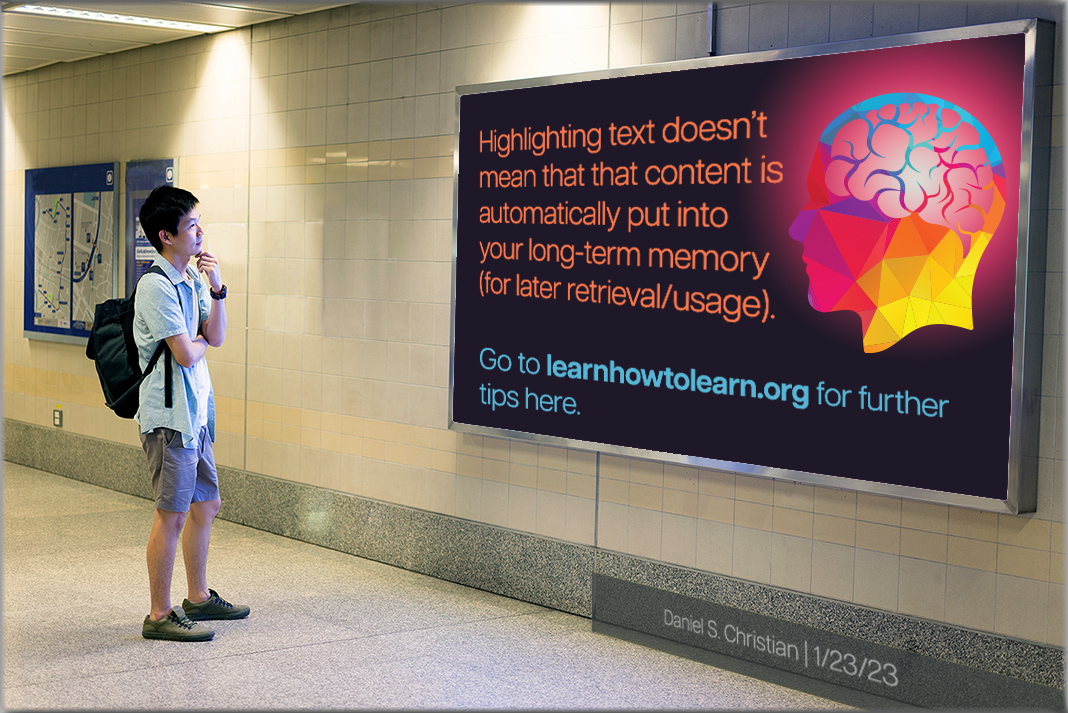
This reminds me of what I was trying to get at here — i.e., let’s provide folks with more information on learning how to learn.

Lets provide folks with more information on learning how to learn

Lets provide folks with more information on learning how to learn

Lets provide folks with more information on learning how to learn


Also relevant/see:

Changing your teaching takes more than a recipe — — from chronicle.com by Beckie Supiano
Professors have been urged to adopt more effective practices. Why are their results so mixed?

Excerpts:

When the researchers asked their interview subjects how they first learned about peer instruction, many more cited informal discussions with colleagues than cited more formal channels like workshops. Even fewer pointed to a book or an article.

So even when there’s a really well-developed recipe, professors aren’t necessarily reading it.
…
In higher ed, teaching is often seen as something anyone who knows the content can automatically do. But the evidence suggests instead that teaching is an intellectual exercise that adds to subject-matter expertise.

This teaching-specific math knowledge, the researchers note, could be acquired in teacher preparation or professional development, however, it’s usually created on the job.

“Now, I’m much more apt to help them develop a deeper understanding of how people learn from a neuroscientific and cognitive-psychology perspective, and have them develop a model for how students learn.”

Erika Offerdahl, associate vp and director of the Transformational Change Initiative at WSU

From DSC:
I love this part too:

There’s a role here, too, for education researchers. Not every evidence-based teaching practice has been broken into its critical components in the literature,


The Librarian: Can we prompt ChatGPT to generate reliable references? — from drphilippahardman.substack.com by Dr. Philippa Hardman

Lessons Learned

  • Always assume that ChatGPT is wrong until you prove otherwise.
  • Validate everything (and require your students to validate everything too).
  • Google Scholar is a great tool for validating ChatGPT outputs rapidly.
  • The prompt works better when you provide a subject area, e.g. visual anthropology, and then a sub-topic, e.g. film making.
  • Ignore ChatGPT’s links – validate by searching for titles & authors, not URLs.
  • Use intentional repetition, e.g. of Google Scholar, to focus ChatGPT’s attention.
  • Be aware: ChatGPT’s outputs end at 2021. You need to fill in the blanks since then.
 

ChatGPT is Everywhere — from chronicle.com by Beth McMurtrie
Love it or hate it, academics can’t ignore the already pervasive technology.

Excerpt:

Many academics see these tools as a danger to authentic learning, fearing that students will take shortcuts to avoid the difficulty of coming up with original ideas, organizing their thoughts, or demonstrating their knowledge. Ask ChatGPT to write a few paragraphs, for example, on how Jean Piaget’s theories on childhood development apply to our age of anxiety and it can do that.

Other professors are enthusiastic, or at least intrigued, by the possibility of incorporating generative AI into academic life. Those same tools can help students — and professors — brainstorm, kick-start an essay, explain a confusing idea, and smooth out awkward first drafts. Equally important, these faculty members argue, is their responsibility to prepare students for a world in which these technologies will be incorporated into everyday life, helping to produce everything from a professional email to a legal contract.

“Artificial-intelligence tools present the greatest creative disruption to learning that we’ve seen in my lifetime.”

Sarah Eaton, associate professor of education at the University of Calgary


Artificial intelligence and academic integrity, post-plagiarism — from universityworldnews.com Sarah Elaine Eaton; with thanks to Robert Gibson out on LinkedIn for the resource

Excerpt:

The use of artificial intelligence tools does not automatically constitute academic dishonesty. It depends how the tools are used. For example, apps such as ChatGPT can be used to help reluctant writers generate a rough draft that they can then revise and update.

Used in this way, the technology can help students learn. The text can also be used to help students learn the skills of fact-checking and critical thinking, since the outputs from ChatGPT often contain factual errors.

When students use tools or other people to complete homework on their behalf, that is considered a form of academic dishonesty because the students are no longer learning the material themselves. The key point is that it is the students, and not the technology, that is to blame when students choose to have someone – or something – do their homework for them.

There is a difference between using technology to help students learn or to help them cheat. The same technology can be used for both purposes.

From DSC:
These couple of sentences…

In the age of post-plagiarism, humans use artificial intelligence apps to enhance and elevate creative outputs as a normal part of everyday life. We will soon be unable to detect where the human written text ends and where the robot writing begins, as the outputs of both become intertwined and indistinguishable.

…reminded me of what’s been happening within the filmmaking world for years (i.e., such as in Star Wars, Jurrasic Park, and many others). It’s often hard to tell what’s real and what’s been generated by a computer.
 

From DSC:
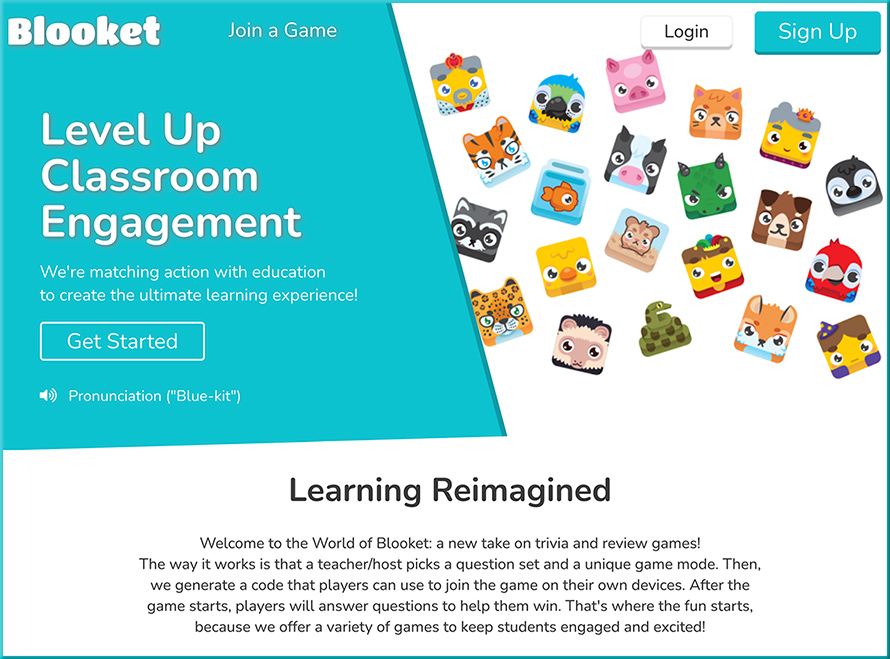
I’m told by a reliable source (i.e., our oldest daughter, who is now a third-grade teacher) that Blooket is an effective, highly-engaging tool! She said students find these online-based games to be fun. She said it’s competitive, so you may want to make a note of that as well.

Level up classroom engagement with Blooket -- online-based games that are fun and engaging for younger students


Introducing Q-Chat, the world’s first AI tutor built with OpenAI’s ChatGPT — from quizlet.com by Lex Bayer

Excerpt:

Modeled on research demonstrating that the most effective form of learning is one-on-one tutoring1, Q-Chat offers students the experience of interacting with a personal AI tutor in an effective and conversational way. Whether they’re learning French vocabulary or Roman History, Q-Chat engages students with adaptive questions based on relevant study materials delivered through a fun chat experience. Pulling from Quizlet’s massive educational content library and using the question-based Socratic method to promote active learning, Q-Chat has the ability to test a student’s knowledge of educational content, ask in-depth questions to get at underlying concepts, test reading comprehension, help students learn a language and encourage students on healthy learning habits.

Quizlet's Q-Chat -- choose a study prompt to be quizzed on the material, to deepen your understanding or to learn through a story.


Using Stories to Support Mathematical Thinking in Young Students — from edutopia.org by Kathleen Crawford-McKinney and Asli Özgün-Koca
Children’s books often contain valuable lessons that can help young students begin to think like mathematicians.

Excerpt:

Many students and teachers view math as a subject for numbers and computation, instead of one that benefits from discussion and interpretation. Based on our experience as children’s literature and mathematics teacher-educators, we’ve found that providing the context to mathematical problems through literature supports students’ learning—children’s books can be used to integrate math and literacy and to provide context for math.

Also from edutopia.org, see:

Things Professional Writers Do That Students Should Too — by Andrew Boryga
Everyone gets stumped when they begin a new writing project—even the professionals. Here are some strategies the world’s best writers use to push past the doldrums and generate higher-quality writing.

Excerpt:

Asking students to read aloud, while focusing on things like tone, sentence structure, and cadence, is a simple, effective, and researched-backed way to improve their writing—particularly during the revision stage.

That insight got us thinking about other easy strategies—used by real pros—that students can also employ to improve their writing.

The Power of a Compliment — by Scott Wisniewski
A project that invites students to anonymously compliment their classmates and teachers has improved the culture at one high school.

Excerpt:

A small act of kindness can change the complexion of someone’s day. Giving someone a compliment, telling them how much they mean to you, or just sharing words of encouragement can change a person’s overall outlook.


One County Is Making Tutors ‘Co-Teachers.’ Will That Help With Teacher Burnout? — from edsurge.com by Daniel Mollenkamp

Excerpt:

Teachers can sign up specific students for one-on-one or small group online tutoring sessions during class, as part of the school day, as if there were another teacher in the room. (Though, those tutors are sourced through the company that designed the program, Varsity Tutors, and not the school.) Schools also have access to more standard on-demand tutoring, outside of school hours, as part of the deal.

Teachers are usually the ones who know when a student needs help, but they’re already stretched thin, Heid says. This way, teachers can use assessment and testing data to identify students who are struggling and get them in front of tutors, he adds.

On a somewhat related note, also see:

The Current State of Teacher Pay, in Charts — from edweek.org by Libby Stanford


Some Ideas for Using ChatGPT in Middle and High School Classes — from edutopia.org by Geoff Richman
Teachers can use tools like ChatGPT as one strategy in their efforts to teach students how to think critically and write effectively.

Excerpts:

There can be an upside, however.  In a social studies classroom, students might craft a prompt about a topic they’ve been considering and then examine the machine’s response in forensic detail. This may involve a sentence-by-sentence dissection of what the AI has written. By unearthing possible inconsistencies or straight-up inaccuracies, students reinforce their correct understanding of the topic.
…
For a playful exercise, share two or three pieces of human writing from the past year or two and slip in an example from ChatGPT, and have students discuss what makes these examples human—or decidedly not. Nuance, passion, and, perhaps, even fallibility will be clues that students can investigate.


AI starter tools for video content creation — from techthatmatters.beehiiv.com by Harsh Makadia

Excerpt:

One of the most exciting applications of AI is in the realm of content creation. What if I told you there are tools to generate videos in mins?

Try these tools today:

  • Supercreator AI: Create short form videos 10x faster
  • Lumen5: Automatically turn blog posts into videos
  • InVideo: Idea to YouTube video
  • Synthesia: Create videos from plain text in minutes
  • Narakeet: Get a professionally sounding audio or video in minutes
  • Movio: Create engaging video content
 
© 2025 | Daniel Christian