Outsourcing Thought: The Hidden Cost of Letting AI Think for You — from linkedin.com by Robert Atkinson

I’ve watched it unfold in real time. A student submits a flawless coding assignment or a beautifully written essay—clean syntax, sharp logic, polished prose. But when I ask them to explain their thinking, they hesitate. They can’t trace their reasoning or walk me through the process. The output is strong, but the understanding is shallow. As a professor, I’ve seen this pattern grow more common: AI-assisted work that looks impressive on the surface but reveals a troubling absence of cognitive depth underneath.

This article is written with my students in mind—but it’s meant for anyone navigating learning, teaching, or thinking in the age of artificial intelligence. Whether you’re a student, educator, or professional, the question is the same: What happens to the brain when we stop doing our own thinking?

We are standing at a pivotal moment. With just a few prompts, generative AI can produce essays, solve complex coding problems, and summarize ideas in seconds. It feels efficient. It feels like progress. But from a cognitive neuroscience perspective, that convenience comes at a hidden cost: the gradual erosion of the neural processes that support reasoning, creativity, and long-term learning.


7 ways to use ChatGPT’s new image AI — from wondertools.substack.com by Jeremy Caplan
Transform your ideas into strong visuals

7 ways to use ChatGPT’s new image AI

  • Cartoons
  • Infographics
  • Posters
  • …plus several more


AI in Education Survey: What UK and US Educators Think in 2025 — from twinkl.com
As artificial intelligence (AI) continues to shape the world around us, Twinkl conducted a large-scale survey between January 15th and January 22nd to explore its impact on the education sector, as well as the work lives of teachers across the UK and the USA.

Teachers’ use of AI for work continues to rise
Twinkl’s survey asked teachers whether they were currently using AI for work purposes. Comparing these findings to similar surveys over recent years shows the use of AI tools by teachers has seen a significant increase across both the UK and USA.

  • According to two UK surveys by the National Literacy Trust – 30% of teachers used generative AI in 2023 and nearly half (47.7%) in 2024. Twinkl’s survey indicates that AI adoption continues to rise rapidly, with 60% of UK educators currently integrating it into their work lives in 2025.
  • Similarly, with 62% of US teachers currently using AI for work, uptake appears to have risen greatly in the past 12 months, with just 25% saying they were leveraging the new technology in the 2023-24 school year according to a RAND report.
  • Teachers are using AI more for work than in their personal lives: In the UK, personal usage drops to 43% (from 60% at school).  In the US, 52% are using AI for non-work purposes (versus 62% in education settings).

    60% of UK teachers and 62% of US teachers use AI in their work life in 2025.


What trauma-informed practice is not — from timeshighereducation.com by Kate Cantrell, India Bryce, and Jessica Gildersleeve from The University of Southern Queensland
Before trauma-informed care can be the norm across all areas of the university, academic and professional staff need to understand what it is. Here, three academics debunk myths and demystify best practice

Recently, we conducted focus groups at our university to better ascertain how academics, administrators and student support staff perceive the purpose and value of trauma-informed practice, and how they perceive their capacity to contribute to organisational change.

We discovered that while most staff were united on the importance of trauma-informed care, several myths persist about what trauma-informed practice is (and is not). Some academic staff, for example, conflated teaching about trauma with trauma-informed teaching, confused trigger warnings with trigger points and, perhaps most alarmingly – given the prevalence of trauma exposure and risk among university students – misjudged trauma-informed practice as “the business of psychologists” rather than educators.


Students and folks looking for work may want to check out:

Also relevant/see:


The Third Horizon of Learning Shifting beyond the Industrial Model — from gettingsmart.com by Sujata Bhatt & Mason Pashia

Over 24 blog posts, we have sketched a bold vision of what this next horizon of education looks like in action and highlighted the many innovators working to bring it to life. These pioneers are building new models that prioritize human development, relationships, and real-world relevance as most valuable. They are forging partnerships, designing and adopting transformative technologies, developing new assessment methods, and more. These shifts transform the lived experiences of young people and serve the needs of families and communities. In short, they are delivering authentic learning experiences that better address the demands of today’s economy, society, and learners.

We’ve aggregated our findings from this blog series and turned it into an H3 Publication. Inside, you’ll find our key transformation takeaways for school designers and system leaders, as well as a full list of the contributing authors. Thank you to all of the contributors, including LearnerStudio for sponsoring the series and Sujata Bhatt at Incubate Learning for authorship, editing and curation support throughout the entirety of the series and publication.
.


Cultivating Speaking and Listening Skills in the Primary Grades — from edutopia.org by Rachel Scheer
Early elementary teachers can use these strategies to help students improve their oral communication skills.

The good news? There are many engaging and effective strategies to develop these interpersonal skills, and most are easy to incorporate into daily classroom routines. I use the strategies below to directly teach, model, and practice these essential communication skills at a developmentally appropriate level: turn-taking, small group speaking and listening, whole group speaking and listening, and accountable talk.

From DSC:
I love the parts about practicing how to LISTEN. We need more of that in our communications with one another…as well as when we are praying to God.


Teaching Students About Corporate Influences in a Curriculum — from edutopia.org by Elaine Alvey
By uncovering any hidden interests in a curriculum, teachers can open important discussions about media literacy with students.

These instances underscore the need for educators to be vigilant in vetting materials, recognizing that even seemingly reputable sources can harbor hidden agendas, necessitating a robust approach to media and information literacy both for ourselves and for students.

How to Spot Corporate Influences in Your Curriculum
So, how do we, as educators, navigate this minefield? Media literacy strategies offer important tools to equip ourselves and our students to analyze information landscapes intentionally, including the curricular resources we evaluate for use in our classrooms.
.

From DSC:
I would encourage you to take a look at the work my sister Sue Ellen Christian has been doing re: media literacy, news literacy, and more. She created the Wonder Media website to discuss those topics. Plus she collaborated with several other people and organizations to develop a large, professionally-done exhibit re: these important topics.
.


Boosting Engagement in World Language Classes With Games — from edutopia.org by Rachelle Dené Poth
Middle school teachers can use a variety of tech and no-tech games to help students build skills in the target language.

As a world language educator, I’ve always sought innovative ways to engage my students through meaningful learning experiences as they build their language skills. One way we do this is through gameplay. The benefits of games go far beyond simply learning and increased retention of vocabulary or grammar. Games can also foster collaboration, critical thinking, creativity, and problem-solving skills, making learning fun for students.


How Administrators Can Respond—Instead of React—in Tough Situations — from edutopia.org by Jessica Cabeen
These strategies can help school leaders stay self-regulated in the middle of frustrating and stressful moments.

Conversations That Might Be Better Left for Later
Not every conversation needs to happen in the heat of the moment. Some of the most productive conversations happen after we’ve given ourselves time to regulate. Here are a few categories of conversations that might benefit from a pause:

  • Difficult feedback conversations. If emotions are running high, it might be best to wait until you can approach the discussion with clarity and empathy. A rushed or reactive conversation can shut down dialogue rather than encourage growth.
  • Conflict resolution. When two parties are upset, stepping in immediately to mediate can sometimes escalate tensions. A brief pause allows for perspective-taking and a calmer, solution-oriented approach.
  • Big-picture decisions. When stress is high, it’s easy to make decisions based on immediate pressures rather than long-term goals. Giving yourself space to step back ensures that decisions align with your leadership vision.
  • Personal or emotional responses. If you feel personally triggered by a comment, criticism, or situation, take time to process before responding. Self-awareness in these moments can prevent regretful words or actions.

So the next time frustration creeps in, take a breath. Pause before you speak, type, or react. Because more often than not, the best response isn’t the fastest one—it’s the one that comes from a place of clarity, patience, and purpose.


8 Weeks Left to Prepare Students for the AI-Enhanced Workplace — from insidehighered.com by Ray Schroeder
We are down to the final weeks left to fully prepare students for entry into the AI-enhanced workplace. Are your students ready?

The urgent task facing those of us who teach and advise students, whether they be degree program or certificate seeking, is to ensure that they are prepared to enter (or re-enter) the workplace with skills and knowledge that are relevant to 2025 and beyond. One of the first skills to cultivate is an understanding of what kinds of services this emerging technology can provide to enhance the worker’s productivity and value to the institution or corporation.
…
Given that short period of time, coupled with the need to cover the scheduled information in the syllabus, I recommend that we consider merging AI use into authentic assignments and assessments, supplementary modules, and other resources to prepare for AI.


Learning Design in the Era of Agentic AI — from drphilippahardman.substack.com by Dr Philippa Hardman
Aka, how to design online async learning experiences that learners can’t afford to delegate to AI agents

The point I put forward was that the problem is not AI’s ability to complete online async courses, but that online async courses courses deliver so little value to our learners that they delegate their completion to AI.

The harsh reality is that this is not an AI problem — it is a learning design problem.

However, this realisation presents us with an opportunity which we overall seem keen to embrace. Rather than seeking out ways to block AI agents, we seem largely to agree that we should use this as a moment to reimagine online async learning itself.


8 Schools Innovating With Google AI — Here’s What They’re Doing — from forbes.com by Dan Fitzpatrick

While fears of AI replacing educators swirl in the public consciousness, a cohort of pioneering institutions is demonstrating a far more nuanced reality. These eight universities and schools aren’t just experimenting with AI, they’re fundamentally reshaping their educational ecosystems. From personalized learning in K-12 to advanced research in higher education, these institutions are leveraging Google’s AI to empower students, enhance teaching, and streamline operations.


Essential AI tools for better work — from wondertools.substack.com by Jeremy Caplan
My favorite tactics for making the most of AI — a podcast conversation

AI tools I consistently rely on (areas covered mentioned below)

  • Research and analysis
  • Communication efficiency
  • Multimedia creation

AI tactics that work surprisingly well 

1. Reverse interviews
Instead of just querying AI, have it interview you. Get the AI to interview you, rather than interviewing it. Give it a little context and what you’re focusing on and what you’re interested in, and then you ask it to interview you to elicit your own insights.”

This approach helps extract knowledge from yourself, not just from the AI. Sometimes we need that guide to pull ideas out of ourselves.


AI Can’t Fix Bad Learning — from nafez.substack.com by Nafez Dakkak
Why pedagogy and good learning design still come first, and why faster isn’t always better.

I’ve followed Dr. Philippa Hardman’s work for years, and every time I engage with her work, I find it both refreshing and deeply grounded.

As one of the leading voices in learning design, Philippa has been able to cut through the noise and focus on what truly matters: designing learning experiences that actually work.

In an era where AI promises speed and scale, Philippa is making a different argument: faster isn’t always better. As the creator of Epiphany AI—figma for learning designers—Philippa is focused on closing the gap between what great learning design should look like and what’s actually being delivered.

While many AI tools optimize for the average, she believes the future belongs to those who can leverage AI without compromising on expertise or quality. Philippa wants learning designers to be more ambitious using AI to achieve what wasn’t possible before.

In this conversation, we explore why pedagogy must lead technology, how the return on expertise is only increasing in an AI-driven world, and why building faster doesn’t always mean building better.

An excerpted graphic:


Pearson, AWS Collaborate to Enhance AI-Powered Learning Functionality — from cloudwars.com

Pearson, the global educational publisher, and AWS have expanded their existing partnership to enhance AI-driven learning. AWS will help Pearson to deliver AI-powered lesson generation and more for educators, support workforce skilling initiatives, and continue an ongoing collaboration with Pearson VUE for AWS certification.


20 AI Agent Examples in 2025 — from autogpt.net

AI Agents are now deeply embedded in everyday life and?quickly transforming industry after industry. The global AI market is expected to explode up to $1.59 trillion by 2030! That is a?ton of intelligent agents operating behind the curtains.

That’s why in this article, we explore?20 real-life AI Agents that are causing a stir today.


Top 100 Gen AI apps, new AI video & 3D — from eatherbcooper.substack.com by Heather Cooper
Plus Runway Restyle, Luma Ray2 img2vid keyframes & extend

?In the latest edition of Andreessen Horowitz’s “Top 100 Gen AI Consumer Apps,” the generative AI landscape has undergone significant shifts.

Notably, DeepSeek has emerged as a leading competitor to ChatGPT, while AI video models have advanced from experimental stages to more reliable tools for short clips. Additionally, the rise of “vibecoding” is broadening the scope of AI creators.

The report also introduces the “Brink List,” highlighting ten companies poised to enter the top 100 rankings.?


AI is Evolving Fast – The Latest LLMs, Video Models & Breakthrough Tools — from heatherbcooper.substack.com by Heather Cooper
Breakthroughs in multimodal search, next-gen coding assistants, and stunning text-to-video tech. Here’s what’s new:

I do these comparisons frequently to measure the improvements in different models for text or image to video prompts. I hope it is helpful for you, as well!

I included 6 models for an image to video comparison:

  • Pika 2.1 (I will do one with Pika’s new 2.2 model soon)
  • Adobe Firefly Video
  • Runway Gen-3
  • Kling 1.6
  • Luma Ray2
  • Hailuo I2V-01


Why Smart Companies Are Granting AI Immunity to Their Employees — from builtin.com by Matt Almassian
Employees are using AI tools whether they’re authorized or not. Instead of cracking down on AI usage, consider developing an AI amnesty program. Learn more.

But the smartest companies aren’t cracking down. They’re flipping the script. Instead of playing AI police, they’re launching AI amnesty programs, offering employees a safe way to disclose their AI usage without fear of punishment. In doing so, they’re turning a security risk into an innovation powerhouse.
…
Before I dive into solutions, let’s talk about what keeps your CISO or CTO up at night. Shadow AI isn’t just about unauthorized tool usage — it’s a potential dirty bomb of security, compliance and operational risks that could explode at any moment.
…
6 Steps to an AI Amnesty Program

  1. Build your AI governance foundation.
  2. Transform your IT department from gatekeeper to innovation partner.
  3. Make AI education easily accessible.
  4. Deploy your technical safety net.
  5. Create an AI-positive culture.
  6. Monitor, adapt and evolve.

A first-ever study on prompts… — from theneurondaily.com
PLUS: OpenAI wants to charge $20K a month to replace you?!

What they discovered might change how you interact with AI:

  • Consistency is a major problem. The researchers asked the same questions 100 times and found models often give different answers to the same question.
  • Formatting matters a ton. Telling the AI exactly how to structure its response consistently improved performance.
  • Politeness is… complicated. Saying “please” helped the AI answer some questions but made it worse at others. Same for being commanding (“I order you to…”).
  • Standards matter. If you need an AI to be right 100% of the time, you’re in trouble.

That’s also why we think you, an actual human, should always place yourself as a final check between whatever your AI creates and whatever goes out into the world.


Leave it to Manus
“Manus is a general AI agent that bridges minds and actions: it doesn’t just think, it delivers results. Manus excels at various tasks in work and life, getting everything done while you rest.”

From DSC:
What could possibly go wrong?!


AI Search Has A Citation Problem — from cjr.org (Columbia Journalism Review) by Klaudia Ja?wi?ska and Aisvarya Chandrasekar
We Compared Eight AI Search Engines. They’re All Bad at Citing News.

We found that…

Chatbots were generally bad at declining to answer questions they couldn’t answer accurately, offering incorrect or speculative answers instead.

  • Premium chatbots provided more confidently incorrect answers than their free counterparts.
  • Multiple chatbots seemed to bypass Robot Exclusion Protocol preferences.
  • Generative search tools fabricated links and cited syndicated and copied versions of articles.
  • Content licensing deals with news sources provided no guarantee of accurate citation in chatbot responses.

Our findings were consistent with our previous study, proving that our observations are not just a ChatGPT problem, but rather recur across all the prominent generative search tools that we tested.


5 new AI tools you’ll actually want to try — from wondertools.substack.com by Jeremy Kaplan
Chat with lifelike AI, clean up audio instantly, and reimagine your career

Hundreds of AI tools emerge every week. I’ve picked five new ones worth exploring. They’re free to try, easy to use, and signal new directions for useful AI.

Example:

Career Dreamer
A playful way to explore career possibilities with AI


All of the articles listed below are from edutopia.org


4 Ways to Boost Students’ Self-Efficacy — by Tyler Rablin
These strategies help students see what they have learned so they believe they can be successful in school in the future.

Self-efficacy, on the other hand, focuses on outcomes to drive beliefs. In essence, self-efficacy involves intentionally providing students with evidence of early success to help them build the belief that they can be successful in the future.

Self-efficacy has been a powerful focus for me because it helps me to be more intentional as a teacher. It requires me to be mindful of how I structure assessments, feedback, etc., to provide students with evidence of their successes early on to help them see potential future successes.

Maintaining Students’ Focus in the Spring — by Miriam Plotinsky
Teachers can use these small ‘upgrades’ or tweaks to their regular practices to help keep students focused and involved.

As a recent MindShift article notes, “The second semester brings a lot of potential challenges to teachers’ regularly scheduled programming because of standardized testing, graduation events, and student burnout.” These challenges may be complex, but they are not insurmountable. With subtle shifts in practice, classrooms can remain safe and productive spaces—even in the spring.

She recommends a “coping jar” to help students identify moments of angst and manage their feelings. Fagell explains that when students find an effective coping mechanism, they write their idea on one side of a Popsicle stick and explain how it works on the other side. As students add ideas to the jar, they have an increased awareness of coping strategies and the importance of helping one another.

10 Picture Books That Showcase Collaboration — by Kristin Rydholm
These entertaining stories feature collaboration and social-emotional skills to highlight the benefit of working together to accomplish a goal.

Are you an early childhood teacher in search of relationship-building resources to help unify your classroom? Have I got a book list for you! In the verbiage of 1970s infomercials: “This collection has everything!” The main characters are early childhood students, the setting is the school, and each plot requires the class to work collaboratively. The characters are united in curiosity, determination, and mission to work on accomplishing projects together that they couldn’t possibly do alone.

What a 30-Day Break From AI Taught Me About My Teaching — by James Bedford
Using AI became second nature for this educator. A month without the tools gave him an opportunity to pause, reflect, and recalibrate.

My goal is to try to preserve the messy, creative core of what it means to be an educator: curiosity, critical thinking, and the grit and energy to solve problems without always resorting to shortcuts—technological or otherwise. My hope is that my students will do the same.

Unplug and reconnect: Challenge yourself and your students to embark on an AI detox. Step away from AI tools where possible, and rediscover the power of human creativity and independent thought. Start a journal to document the journey, exploring questions like “How does it feel to rely solely on my own intellect?” or “What challenges arise when AI isn’t there to assist?” This activity can foster resilience, raise self-awareness, and cultivate a deeper appreciation for the human capacity to think, create, problem-solve, and innovate.


Drive Continuous Learning: AI Integrates Work & Training — from learningguild.com by George Hanshaw

Imagine with me for a moment: Training is no longer confined to scheduled sessions in a classroom, an online module or even a microlearning you click to activate during your workflow. Imagine training being delivered because the system senses what you are doing and provides instructions and job aids without you having to take an action.

The rapid evolution of artificial intelligence (AI) and wearable technology has made it easier than ever to seamlessly integrate learning directly into the workflow. Smart glasses, earpieces, and other advanced devices are redefining how employees gain knowledge and skills by delivering microlearning moments precisely when and where they are needed.

AI plays a crucial role in this transformation by sensing the optimal moment to deliver the training through augmented reality (AR).


These Schools Are Banding Together to Make Better Use of AI in Education — from edsurge.com by Emily Tate Sullivan

Kennelly and Geraffo are part of a small team at their school in Denver, DSST: College View High School, that is participating in the School Teams AI Collaborative, a year-long pilot initiative in which more than 80 educators from 19 traditional public and charter schools across the country are experimenting with and evaluating AI-enabled instruction to improve teaching and learning.

The goal is for some of AI’s earliest adopters in education to band together, share ideas and eventually help lead the way on what they and their colleagues around the U.S. could do with the emerging technology.

“Pretty early on we thought it was going to be a massive failure,” says Kennelly of last semester’s project. “But it became a huge hit. Students loved it. They were like, ‘I ran to second period to build this thing.’”


Transactional vs. Conversational Visions of Generative AI in Teaching — from elmartinsen.substack.com by Eric Lars Martinsen
AI as a Printer, or AI as a Thought Partner

As writing instructors, we have a choice in how we frame AI for our students. I invite you to:

  1. Experiment with AI as a conversation partner yourself before introducing it to students
  2. Design assignments that leverage AI’s strengths as a thought partner rather than trying to “AI-proof” your existing assignments
  3. Explicitly teach students how to engage in productive dialogue with AI—how to ask good questions, challenge AI’s assumptions, and use it to refine rather than replace their thinking
  4. Share your experiences, both positive and negative, with colleagues to build our collective understanding of effective AI integration


Nvidia helps launch AI platform for teaching American Sign Language — from venturebeat.com by Dean Takahashi; via Claire Zau

Nvidia has unveiled a new AI platform for teaching people how to use American Sign Language to help bridge communication gaps.

The Signs platform is creating a validated dataset for sign language learners and developers of ASL-based AI applications.
…
Nvidia, the American Society for Deaf Children and creative agency Hello Monday are helping close this gap with Signs, an interactive web platform built to support ASL learning and the development of accessible AI applications.


Using Gen AI to Design, Implement, and Assess PBL — from gettingsmart.com by David Ross

Key Points

  • Generative AI can significantly reduce the time and effort required in designing PBL by providing tools for research, brainstorming, and organization.
  • AI tools can assist educators in managing project implementation and assessment, providing formative feedback and organizing resources efficiently.

I usually conclude blogs with some pithy words, but this time I’ll turn the microphone over to Rachel Harcrow, a high school English/Language Arts teacher at Young Women’s College Prep Charter School of Rochester, NY: “After years of struggling to call myself a PBL practitioner, I finally feel comfortable saying I am, thanks to the power of Gen AI,” Harcrow told me. “Initial ideas now turn into fully fledged high-quality project plans in minutes that I can refine, giving me the space and energy to focus on what truly matters: My students.”


AI Resources for District Leaders — from techlearning.com by Steve Baule
Educational leaders aiming to effectively integrate generative AI into their schools should consider several key resources

To truly harness the transformative power of generative AI in education, district leaders must navigate a landscape rich with resources and opportunities. By delving into state and national guidelines, exploring successful case studies, utilizing innovative planning tools, and engaging in professional development, educational leaders can craft robust implementation plans. These plans can then assist in integrating AI seamlessly into their schools and elevate the learning experience to new heights.


Anthropic brings ‘extended thinking’ to Claude, which can solves complex physics problems with 96.5% accuracy — from rdworldonline.com by Brian Buntz

Anthropic, a favorite frontier AI lab among many coders and genAI power users has unveiled Claude 3.7 Sonnet, its first “hybrid reasoning” AI model. It is capable of both near-instant answers and in-depth, step-by-step reasoning within a single system.

Users can toggle an extended thinking mode where the model self-reflects before answering, considerably improving performance on complex tasks like math, physics and coding. In early testing by the author, the model largely succeeded in creating lines of Python (related to unsupervised learning) that were close to 1,000 lines long that ran without error on the first or second try, including the unsupervised machine learning task shown below:


New Tools. Old Complaints. Why AI Won’t Kill Education or Fix it  — from coolcatteacher.com by Vicki Davis; via Stephen Downes

AI won’t kill education. But will it kill learning? The challenge isn’t AI itself—it’s whether students can still think for themselves when the answers are always one click away.
…

Wait. Before you go, let me ask you one thing.
AI has opportunities to help learning. But it also won’t fix it. The real question isn’t whether students can use AI—but whether they’re still learning without it.

Whether the learning is happening between the ears.

And so much of what we teach in schools isn’t the answers on a test. It answers questions like “What is my purpose in life?” “How do I make friends?” and “How can I help my team be stronger.” Questions that aren’t asked on a test but are essential to living a good life. These questions aren’t answered between the ears but within the heart.

That, my friends, is what teaching has always been about.

The heart.

And the heart of the matter is we have new challenges, but these are old complaints. Complaints since the beginning of time and teaching. And in those days, you didn’t need kids just to be able to talk about how to build a fire, they had to make one themselves. Their lives depend on it.

And these days, we need to build another kind of fire. A fire that sparks the joy of learning. The joy of the opportunities that await us sparked by some of the most powerful tools ever invented. Kids need to not be able to just talk about making a difference, they need to know how to build a better world tomorrow. Our lives depend on it.


How Debating Skills Can Help Us In The Fight Against AI — from adigaskell.org by Adi Gaskell

Debating skills have a range of benefits in the workplace, from helping to improve our communication to bolstering our critical thinking skills. Research from the University of Mississippi suggests it might also help us in the battle with AI in the workplace.

We can often assume that debate teaches us nothing more than how to argue our point, but in order to do this, we have to understand both our own take on a subject and that of our opponent. This allows us to see both sides of any issue we happen to be debating.

“Even though AI has offered a shortcut through the writing process, it actually still is important to be able to write and speak and think on your own,” the researchers explain. “That’s what the focus of this research is: how debate engenders those aspects of being able to write and speak and study and research on your own.”


.
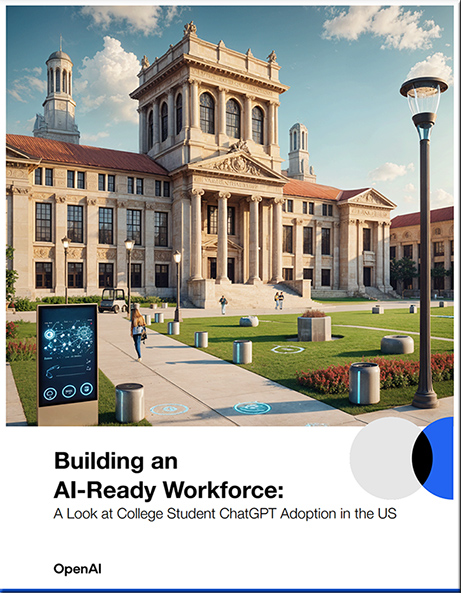
Building an AI-Ready Workforce: A look at College Student ChatGPT Adoption in the US — from cdn.openai.com

One finding from our student survey that stood out to us: Many college and university students are teaching themselves and their friends about AI without waiting for their institutions to provide formal AI education or clear policies about the technology’s use. The education ecosystem is in an important moment of exploration and learning, but the rapid adoption by students across the country who haven’t received formalized instruction in how and when to use the technology creates disparities in AI access and knowledge.

The enclosed snapshot of how young people are using ChatGPT provides insight into the state of AI use among America’s college-aged students. We also include actionable proposals to help address adoption gaps. We hope these insights and proposals can inform research and policy conversation across the nation’s education ecosystem about how to achieve outcomes that support our students, our workforce, and the economy. By improving literacy, expanding access, and implementing clear policies, policymakers and educators can better integrate AI into our educational infrastructure and ensure that our workforce is ready to both sustain and benefit from our future with AI.

Leah Belsky | Vice President, Education | OpenAI


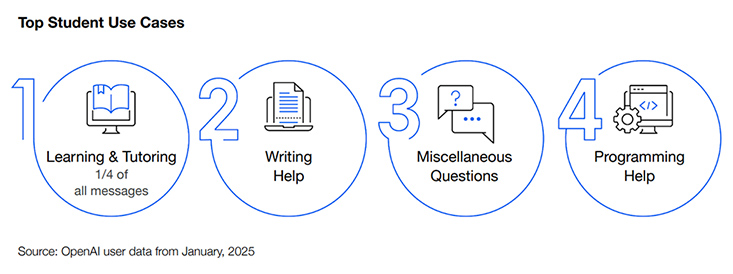
Top student use cases of ChatGPT -- learning and tutoring, writing help, miscellaneouc questions, and programming help

 
© 2025 | Daniel Christian