Here are five AI activities to explore this summer to help you and your students navigate artificial intelligence with an ethical, responsible, and creative approach.
… 1. Use Google’s Quick, Draw! to have fun and get curious about AI. We all have a desire to doodle–even students and adults who say, “I can’t even draw a stick figure!” Bring lots of light-hearted energy into your art room with Google’s Quick Draw! tool. This platform allows you to draw simple prompts, such as a bike, a cat, or a cup, in 20 seconds. While you’re drawing, AI attempts to recognize the subject.
This tool works with any skill level and is a space to draw freely without overthinking. Beyond quick sketching, this activity demonstrates that human input builds machine learning, and it’s only as “smart” as the information (or in this case, drawings) we feed it. It’s a fun way to explore the evolving role of AI in our visual world!
No tech? No problem! Use paper to run the same activity. You can even use the Thumbnail Sketches template in FLEX Curriculum. Students sketch quick prompts in groups and then guess the drawings to spark conversation about how AI “learns.”
What is Study Mode?
Study Mode is OpenAI’s take on a smarter study partner – a version of the ChatGPT experience designed to guide users through problems with Socratic prompts, scaffolded reasoning, and adaptive feedback (instead of just handing over the answer).
Built with input from learning scientists, pedagogy experts, and educators, it was also shaped by direct feedback from college students. While Study Mode is designed with college students in mind, it’s meant for anyone who wants a more learning-focused, hands-on experience across a wide range of subjects and skill levels.
Who can access it? And how?
Starting July 29, Study Mode is available to users on Free, Plus, Pro, and Team plans. It will roll out to ChatGPT Edu users in the coming weeks.
ChatGPT became your tutor— from theneurondaily.com by Grant Harvey PLUS: NotebookLM has video now & GPT 4o-level AI runs on laptop
Here’s how it works: instead of asking “What’s 2+2?” and getting “4,” study mode asks questions like “What do you think happens when you add these numbers?” and “Can you walk me through your thinking?” It’s like having a patient tutor who won’t let you off the hook that easily.
The key features include:
Socratic questioning: It guides you with hints and follow-up questions rather than direct answers.
Scaffolded responses: Information broken into digestible chunks that build on each other.
Personalized support: Adjusts difficulty based on your skill level and previous conversations.
Knowledge checks: Built-in quizzes and feedback to make sure concepts actually stick.
Toggle flexibility: Switch study mode on and off mid-conversation depending on your goals.
Try study mode yourself by selecting “Study and learn” from tools in ChatGPT and asking a question.
Introducing study mode— from openai.com A new way to learn in ChatGPT that offers step by step guidance instead of quick answers.
[On 7/29/25, we introduced] study mode in ChatGPT—a learning experience that helps you work through problems step by step instead of just getting an answer. Starting today, it’s available to logged in users on Free, Plus, Pro, Team, with availability in ChatGPT Edu coming in the next few weeks.
ChatGPT is becoming one of the most widely used learning tools in the world. Students turn to it to work through challenging homework problems, prepare for exams, and explore new concepts. But its use in education has also raised an important question: how do we ensure it is used to support real learning, and doesn’t just offer solutions without helping students make sense of them?
We’ve built study mode to help answer this question. When students engage with study mode, they’re met with guiding questions that calibrate responses to their objective and skill level to help them build deeper understanding. Study mode is designed to be engaging and interactive, and to help students learn something—not just finish something.
“We know that true learning takes friction. It takes struggle,” said Mills. “You have to engage with the materials, and if students offload all of that work to a tool like ChatGPT, they will not learn those skills and they will not gain that critical thinking. That said, when ChatGPT is used correctly as a learning assistant and as a tutor, the results are powerful.”
Given that 40 percent of ChatGPT users are under the age of 24—and that learning is the platform’s number one use case, according to Mills—the need to fine-tune guardrails is becoming increasingly urgent. Pew Research reports that twice as many teens now use ChatGPT for schoolwork compared to 2023, with nearly one-third of teen respondents saying it’s acceptable to use the tool to solve math problems.
In response, Mills said OpenAI is actively researching what appropriate A.I. use in education looks like, with plans to share that guidance widely and rapidly with educators around the world.
15 Quick (and Mighty) Retrieval Practices — from edutopia.org by Daniel Leonard From concept maps to flash cards to Pictionary, these activities help students reflect on—and remember—what they’ve learned.
But to genuinely commit information to long-term memory, there’s no replacement for active retrieval—the effortful practice of recalling information from memory, unaided by external sources like notes or the textbook. “Studying this way is mentally difficult,” Willingham acknowledged, “but it’s really, really good for memory.”
…
From low-stakes quizzes to review games to flash cards, there are a variety of effective retrieval practices that teachers can implement in class or recommend that students try at home. Drawing from a wide range of research, we compiled this list of 15 actionable retrieval practices.
When Zach Groshell zoomed in as a guest on a longstanding British education podcast last March, a co-host began the interview by telling listeners he was “very well-known over in the U.S.”
Groshell, a former Seattle-area fourth-grade teacher, had to laugh: “Nobody knows me here in the U.S.,” he said in an interview.
But in Britain, lots of teachers know his name. An in-demand speaker at education conferences, he flies to London “as frequently as I can” to discuss Just Tell Them, his 2024 book on explicit instruction. Over the past year, Groshell has appeared virtually about once a month and has made two personal appearances at events across England.
The reason? A discipline known as cognitive science. Born in the U.S., it relies on decades of research on how kids learn to guide teachers in the classroom, and is at the root of several effective reforms, including the Science of Reading.
We need a coherent approach grounded in understanding how the technology works, where it is going and what it will be used for.
From DSC: I almost feel like Meghan should right the words “this week” or “this month” after the above sentence. Whew! Things are moving fast.
For example, we’re now starting to see more agents hitting the scene — software that can DO things. But that can open up a can of worms too.
Students know the ground has shifted — and that the world outside the university expects them to shift with it. A.I. will be part of their lives regardless of whether we approve. Few issues expose the campus cultural gap as starkly as this one.ce
From DSC: Universities and colleges have little choice but to integrate AI into their programs and offerings. There’s enough pressure on institutions of traditional higher education to prove their worth/value. Students and their families want solid ROI’s. Students know that they are going to need AI-related skills (see the link immediately below for example), or they are going to be left out of the competitive job search process.
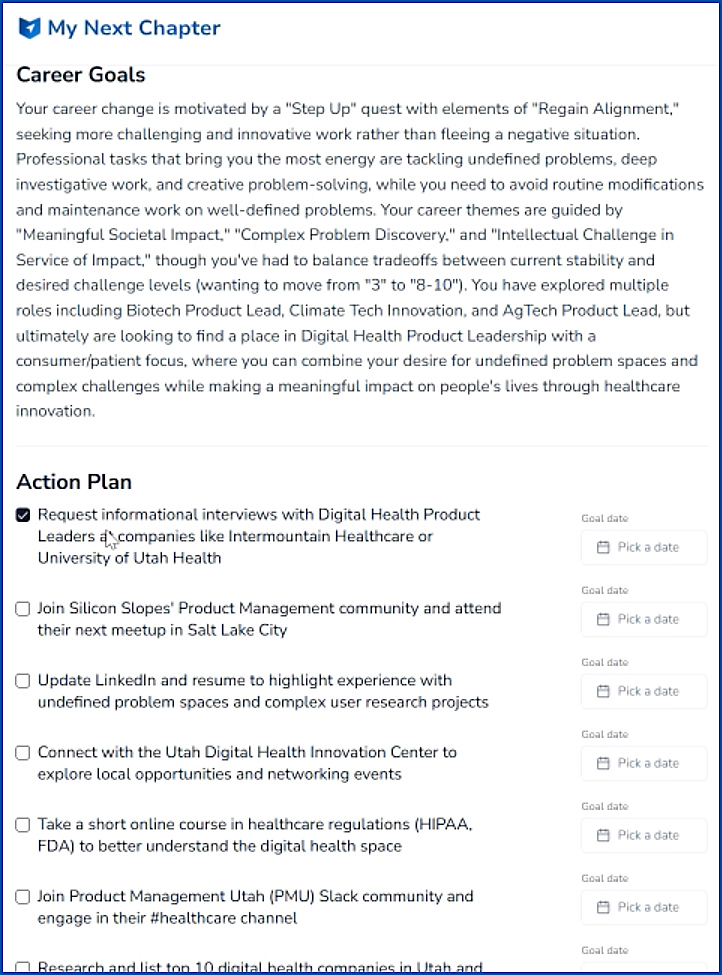
From DSC: In looking atMyNextChapter.ai— THIS TYPE OF FUNCTIONALITY of an AI-based chatbot talking to you re: good fits for a future job — is the kind of thing that could work well in this type of vision/learning platform. The AI asks you relevant career-oriented questions, comes up with some potential job fits, and then gives you resources about how to gain those skills, who to talk with, organizations to join, next steps to get your foot in the door somewhere, etc.
The next gen learning platform would provide links to online-based courses, blogs, peoples’ names on LinkedIn, courses from L&D organizations or from institutions of higher education or from other entities/places to obtain those skills (similar to the ” Action Plan” below from MyNextChapter.ai).
In Episode 5 of The Neuron Podcast, Corey Noles and Grant Harvey tackle the education crisis head-on. We explore the viral UCLA “CheatGPT” controversy, MIT’s concerning brain study, and innovative solutions like Alpha School’s 2-hour learning model. Plus, we break down OpenAI’s new $10M teacher training initiative and share practical tips for using AI to enhance learning rather than shortcut it. Whether you’re a student, teacher, or parent, you’ll leave with actionable insights on the future of education.
Supreme Court green-lights Education Department layoffs— from k12dive.com by Naaz Modan The decision is a significant victory for the Trump administration as it seeks to close the department to the greatest extent possible.
The U.S. Supreme Court on Monday allowed the Trump administration to proceed with laying off nearly half the U.S. Department of Education’s staff — a significant victory for the administration’s mission to dissolve the department to the greatest extent possible.
The decision in New York v. McMahon green-lights the department’s reduction in force initiated in March as the original question of the layoffs’ legality works its way through the lower courts. The layoffs closed department offices and spurred concerns from public school advocates that the education system would descend into chaos with little federal oversight.
For today’s chief learning officer, the days of just rolling out compliance training are long gone. In 2025, learning and development leaders are architects of innovation, crafting ecosystems that are agile, automated and AI-infused. This quarter’s Tech Check invites us to pause, assess and get strategic about where tech is taking us. Because the goal isn’t more tools—it’s smarter, more human learning systems that scale with the business.
Sections include:
The state of AI in L&D: Hype vs. reality
AI in design: From static content to dynamic experiences
AI in development: Redefining production workflows
NEW YORK – The AFT, alongside the United Federation of Teachers and lead partner Microsoft Corp., founding partner OpenAI, and Anthropic, announced the launch of the National Academy for AI Instruction today. The groundbreaking $23 million education initiative will provide access to free AI training and curriculum for all 1.8 million members of the AFT, starting with K-12 educators. It will be based at a state-of-the-art bricks-and-mortar Manhattan facility designed to transform how artificial intelligence is taught and integrated into classrooms across the United States.
The academy will help address the gap in structured, accessible AI training and provide a national model for AI-integrated curriculum and teaching that puts educators in the driver’s seat.
In an era when the college-going rate of high school graduates has dropped from an all-time high of 70 percent in 2016 to roughly 62 percent now, AI seems to be heightening the anxieties about the value of college.
According to the survey, two-thirds of parents say AI is impacting their view of the value of college. Thirty-seven percent of parents indicate they are now scrutinizing college’s “career-placement outcomes”; 36 percent say they are looking at a college’s “AI-skills curriculum,” while 35 percent respond that a “human-skills emphasis” is important to them.
This echoes what I increasingly hear from college leadership: Parents and students demand to see a difference between what they are getting from a college and what they could be “learning from AI.”
Culture matters here. Organizations that foster psychological safety—where experimentation is welcomed and mistakes are treated as learning—are making the most progress. When leaders model curiosity, share what they’re trying, and invite open dialogue, teams follow suit. Small tests become shared wins. Shared wins build momentum.
Career development must be part of this equation. As roles evolve, people will need pathways forward. Some will shift into new specialties. Others may leave familiar roles for entirely new ones. Making space for that evolution—through upskilling, mobility, and mentorship—shows your people that you’re not just investing in AI, you’re investing in them.
And above all, people need transparency. Teams don’t expect perfection. But they do need clarity. They need to understand what’s changing, why it matters, and how they’ll be supported through it. That kind of trust-building communication is the foundation for any successful change.
These shifts may play out differently across sectors—but the core leadership questions will likely be similar.
AI marks a turning point—not just for technology, but for how we prepare our people to lead through disruption and shape the future of learning.
At least 85% of students with disabilities can learn and achieve on grade level.
14% of all U.S. students have a disability.
No belief is more damaging in education than the misperception that children with disabilities cannot really succeed and shouldn’t be challenged to reach the same high standards as all children.
Arne Duncan, former U.S. Secretary of Education
From DSC: One of our kids — actually, who is no longer a kid anymore — was born with Mosaic Down Syndrome. Looking back on her K-12 years, first through fifth grade went very well — which my wife and I were very grateful for. (We didn’t know what each year would bring and whether she would be able to move on to the next grade.)
But sixth and seventh grades were very rough. At the end of seventh grade, we decided to homeschool our daughter. The system she was in — like so many school systems across the nation — was meant to address the 80% of students who are neither gifted nor have special needs. The quickly-moving trains leave at such and such a time and then stop at such and such a time. One better keep up. This traditional system is a one-size-fits-all approach, and it’s something we do for administrative purposes — it’s not for the benefit of the kids within K-12 schools.
After a few years of both homeschooling and Christian education, it turned out that our daughter was able to learn almost all of the subjects in high school. But she needed to learn ON HER TIMELINE…AT HER OWN PACE of learning.
We’re proud of her. She has had a couple of jobs already and is doing quite well overall. Her motivation has been very low at times, which made homeschooling very tough. But, overall, I would agree with Karla Phillips-Krivicka’s key point that at least 85% of students with disabilities can learn and achieve at grade level. That’s been true for our daughter who has some special needs.
The microschooling sector’s robust diversity of educational approaches is often described by the families who choose it as among its most appealing attributes. The wide range of approaches offered, and the many ways different approaches are combined within different microschooling models, offer families options usually not currently available in the communities they live.
And while many of these approaches, like project-based learning, are popular across all of American education, within the smaller, more personalized and responsive context of a microschool, educators are able to take advantage of their flexibility to delve more deeply into the possibilities of each than they were in the more rigid structures of most traditional schools.
According to 2025 research published by the National Microschooling Center, microschool leaders reported that project-based learning is the most popular educational approach used (72 percent). Respondents were asked to indicate all that apply, so microschools typically indicated incorporating multiple approaches.
Get yourself unstuck: overthinking is boring and perfectionism is a trap — from timeshighereducation.com by David Thompson The work looks flawless, the student seems fine. But underneath, perfectionism is doing damage. David Thompson unpacks what educators can do to help high-performing students navigate the pressure to succeed and move from stuck to started
That’s why I encourage imperfection, messiness and play and build these ideas into how I teach.
…
These moments don’t come from big breakthroughs. They come from removing pressure and replacing it with permission.