Corporate Training Solutions That Actually Improve Performance — from blog.upsidelearning.com by Unnati Umare

Designing Learning Around Performance in the Flow of Work
Once it becomes clear that completion does not reliably translate into changed behavior, the next question tends to surface on its own. If training is not failing outright, then what it should be designed around becomes harder to ignore.

In most organizations, the answer remains content. Content is easier to define, easier to build, and easier to track, even when it explains very little about how work actually gets done.

Performance-aligned learning design shifts that starting point by paying closer attention to how work unfolds in practice. Instead of organizing learning around topics or courses, design decisions begin with what a role requires people to notice, decide, and act on during real situations.  


How Your Learners *Actually* Learn with AI — from drphilippahardman.substack.com by Dr. Philippa Hardman
What 37.5 million AI chats show us about how learners use AI at the end of 2025 — and what this means for how we design & deliver learning experiences in 2026

Last week, Microsoft released a similar analysis of a whopping 37.5 million Copilot conversations. These conversation took place on the platform from January to September 2025, providing us with a window into if and how AI use in general — and AI use among learners specifically – has evolved in 2025.

Microsoft’s mass behavioural data gives us a detailed, global glimpse into what learners are actually doing across devices, times of day and contexts. The picture that emerges is pretty clear and largely consistent with what OpenAI’s told us back in the summer:

AI isn’t functioning primarily as an “answers machine”: the majority of us use AI as a tool to personalise and differentiate generic learning experiences and – ultimately – to augment human learning.

Let’s dive in!

Learners don’t “decide” to use AI anymore. They assume it’s there, like search, like spellcheck, like calculators. The question has shifted from “should I use this?” to “how do I use this effectively?”


8 AI Agents Every HR Leader Needs To Know In 2026 — from forbes.com by Bernard Marr

So where do you start? There are many agentic tools and platforms for AI tasks on the market, and the most effective approach is to focus on practical, high-impact workflows. So here, I’ll look at some of the most compelling use cases, as well as provide an overview of the tools that can help you quickly deliver tangible wins.

Some of the strongest opportunities in HR include:

  • Workforce management, administering job satisfaction surveys, monitoring and tracking performance targets, scheduling interventions, and managing staff benefits, medical leave, and holiday entitlement.
  • Recruitment screening, automatically generating and posting job descriptions, filtering candidates, ranking applicants against defined criteria, identifying the strongest matches, and scheduling interviews.
  • Employee onboarding, issuing new hires with contracts and paperwork, guiding them to onboarding and training resources, tracking compliance and completion rates, answering routine enquiries, and escalating complex cases to human HR specialists.
  • Training and development, identifying skills gaps, providing self-service access to upskilling and reskilling opportunities, creating personalized learning pathways aligned with roles and career goals, and tracking progress toward completion.


Making the case for arts and humanities — from timeshighereducation.com by campus contributors, Eliza Compton
The arts and humanities are often dismissed as an unaffordable luxury, when these disciplines underpin vital human skills such as critical thinking, creativity and communication. This collection explores many ways in which arts and humanities can be harnessed for the benefit of all – students, universities and wider society

Yet, amid the threat of AI-driven automation in the workforce, fierce competition for entry-level jobs, and complex global problems such as climate change, the skills that humanities disciplines are built upon are vital. These skills – such as critical thinking, communication and creativity – are also key to universities’ capacity to share knowledge with industry, policymakers and the public. When it comes to understanding how high-tech solutions can best be applied in the real world, often the barriers are not technical but human, as low vaccine take-ups show.

These human skills are not unique to disciplines such as history, philosophy, literature, linguistics, performance and visual arts, of course. The need for deep thinking and analysis across all areas of academic enquiry is embedded in interdisciplinarity and STEAM initiatives, which integrate science, technology, mathematics and engineering with arts and humanities.

At their core, the arts and humanities interrogate what makes us human and how we understand and communicate with the world. In this collection, contributors from around the globe articulate the value that these disciplines bring to students, industry, government and society, when taught and designed effectively. It also considers how arts-based research can drive discovery, the role of interdisciplinarity in teaching and research, and how humanities-led expertise supports sustainability and inclusion.


Beyond Infographics: How to Use Nano Banana to *Actually* Support Learning — from drphilippahardman.substack.com by Dr Philippa Hardman
Six evidence-based use cases to try in Google’s latest image-generating AI tool

While it’s true that Nano Banana generates better infographics than other AI models, the conversation has so far massively under-sold what’s actually different and valuable about this tool for those of us who design learning experiences.

What this means for our workflow:

Instead of the traditional “commission ? wait ? tweak ? approve ? repeat” cycle, Nano Banana enables an iterative, rapid-cycle design process where you can:

  • Sketch an idea and see it refined in minutes.
  • Test multiple visual metaphors for the same concept without re-briefing a designer.
  • Build 10-image storyboards with perfect consistency by specifying the constraints once, not manually editing each frame.
  • Implement evidence-based strategies (contrasting cases, worked examples, observational learning) that are usually too labour-intensive to produce at scale.

This shift—from “image generation as decoration” to “image generation as instructional scaffolding”—is what makes Nano Banana uniquely useful for the 10 evidence-based strategies below.


Celebrating International Day of Persons with Disabilities — from joshbersin.com by Josh Bersin

Today I want to celebrate the International Day of Persons with Disabilities, an important day that recognizes the needs of millions of people. My perspective, as a professional entering my later years, is that many of us are likely to have disabilities over time, so the more we understand the diversity of disabilities the better for everyone.

First, let me point out that this is a massive population. The US Department of Labor and Census estimates that 11-13% of the working age population has some form of disability (more on what that means below), yet only 5-6% of workers. This points out that the employment ratio (percent of people with jobs) is far lower. People with disabilities are one-third as likely to have a job, which is quite a disparity and loss of economic potential.

Second, people with disabilities suffer a 15% lower average wage.


Josh linked to the item below:


Celebrating International Day of persons with disabilities
International Day of Persons with Disabilities (IDPD) is a UN day that is celebrated every year on 3 December.

The day is about promoting the rights and well-being of persons with disabilities at every level of society and development, and to raise awareness of the situation of persons with disabilities in all aspects of political, social, economic, and cultural life. WHO joins the UN in observing this day each year, reinforcing the importance of securing the rights of people with disabilities, so they can participate fully, equally and effectively in society with others, and face no barriers in all aspects of their lives.

At its headquarters in Geneva, WHO organizes an annual IDPD event to educate the public, raise awareness, advocate for political will and resources, and celebrate WHO’s achievements. In 2022, the WHO launched the Global Report on health equity for persons with disabilities. This report sets forth the approaches and actions that countries can take to address the health inequities that persons with disabilities experience.


From DSC:
I just want to add that one of our daughters has some special needs. So Josh’s posting caught my eye. He’s right to point out these things. You and I will likely have a period of disability in our lives. It’s not just relevant for “other people.” (And by the way…in the learning world, practicing Universal Design for Learning (UDL) is good for everyone!)

People with disabilities face enormous challenges that neurotypical people never have to deal with. They face unfair wage situations and a lack of opportunities. Our family has experienced — and continues to experience — this firsthand.

So thanks Josh for your posting here.


Agents, robots, and us: Skill partnerships in the age of AI — from mckinsey.com by Lareina Yee, Anu Madgavkar, Sven Smit, Alexis Krivkovich, Michael Chui, María Jesús Ramírez, and Diego Castresana
AI is expanding the productivity frontier. Realizing its benefits requires new skills and rethinking how people work together with intelligent machines.

At a glance

  • Work in the future will be a partnership between people, agents, and robots—all powered by AI. …
  • Most human skills will endure, though they will be applied differently. …
  • Our new Skill Change Index shows which skills will be most and least exposed to automation in the next five years….
  • Demand for AI fluency—the ability to use and manage AI tools—has grown sevenfold in two years…
  • By 2030, about $2.9 trillion of economic value could be unlocked in the United States…

Also related/see:


State of AI: December 2025 newsletter — from nathanbenaich.substack.com by Nathan Benaich
What you’ve got to know in AI from the last 4 weeks.

Welcome to the latest issue of the State of AI, an editorialized newsletter that covers the key developments in AI policy, research, industry, and start-ups over the last month.


AI’s Role in Online Learning > Take It or Leave It with Michelle Beavers, Leo Lo, and Sara McClellan — from intentionalteaching.buzzsprout.com by Derek Bruff

You’ll hear me briefly describe five recent op-eds on teaching and learning in higher ed. For each op-ed, I’ll ask each of our panelists if they “take it,” that is, generally agree with the main thesis of the essay, or “leave it.” This is an artificial binary that I’ve found to generate rich discussion of the issues at hand.


Gen AI Is Going Mainstream: Here’s What’s Coming Next — from joshbersin.com by Josh Bersin

I just completed nearly 60,000 miles of travel across Europe, Asia, and the Middle East meeting with hundred of companies to discuss their AI strategies. While every company’s maturity is different, one thing is clear: AI as a business tool has arrived: it’s real and the use-cases are growing.

A new survey by Wharton shows that 46% of business leaders use Gen AI daily and 80% use it weekly. And among these users, 72% are measuring ROI and 74% report a positive return. HR, by the way, is the #3 department in use cases, only slightly behind IT and Finance.

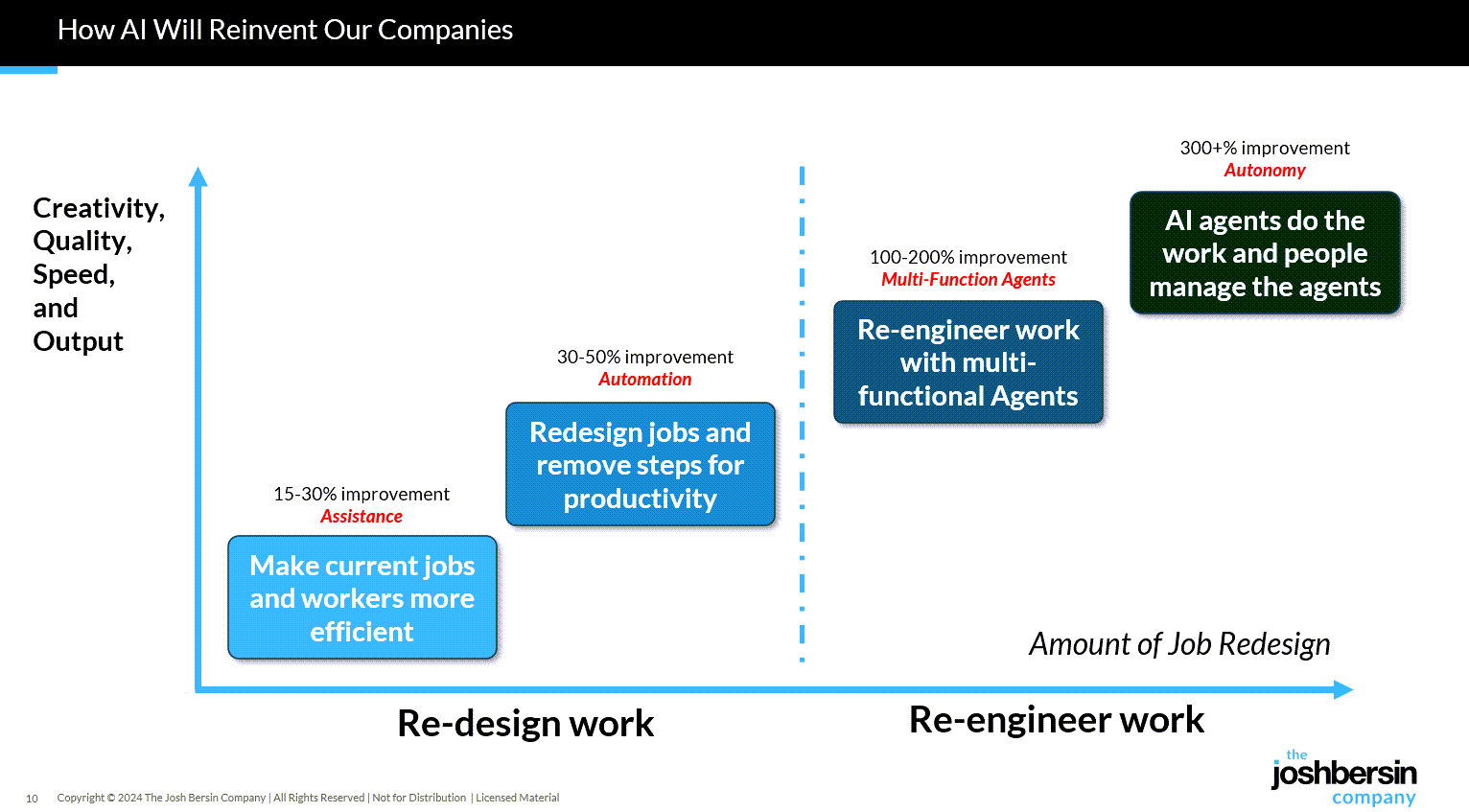
What are companies getting out of all this? Productivity. The #1 use case, by far, is what we call “stage 1” usage – individual productivity. 

.


From DSC:
Josh writes: “Many of our large clients are now implementing AI-native learning systems and seeing 30-40% reduction in staff with vast improvements in workforce enablement.

While I get the appeal (and ROI) from management’s and shareholders’ perspective, this represents a growing concern for employment and people’s ability to earn a living. 

And while I highly respect Josh and his work through the years, I disagree that we’re over the problems with AI and how people are using it: 

Two years ago the NYT was trying to frighten us with stories of AI acting as a romance partner. Well those stories are over, and thanks to a $Trillion (literally) of capital investment in infrastructure, engineering, and power plants, this stuff is reasonably safe.

Those stories are just beginning…they’re not close to being over. 


“… imagine a world where there’s no separation between learning and assessment…” — from aiedusimplified.substack.com by Lance Eaton, Ph.D. and Tawnya Means
An interview with Tawnya Means

So let’s imagine a world where there’s no separation between learning and assessment: it’s ongoing. There’s always assessment, always learning, and they’re tied together. Then we can ask: what is the role of the human in that world? What is it that AI can’t do?

Imagine something like that in higher ed. There could be tutoring or skill-based work happening outside of class, and then relationship-based work happening inside of class, whether online, in person, or some hybrid mix.

The aspects of learning that don’t require relational context could be handled by AI, while the human parts remain intact. For example, I teach strategy and strategic management. I teach people how to talk with one another about the operation and function of a business. I can help students learn to be open to new ideas, recognize when someone pushes back out of fear of losing power, or draw from my own experience in leading a business and making future-oriented decisions.

But the technical parts such as the frameworks like SWOT analysis, the mechanics of comparing alternative viewpoints in a boardroom—those could be managed through simulations or reports that receive immediate feedback from AI. The relational aspects, the human mentoring, would still happen with me as their instructor.

Part 2 of their interview is here:


How Coworking Spaces Are Becoming The Learning Ecosystems Of The Future — from hrfuture.net

What if your workspace helped you level up your career? Coworking spaces are becoming learning hubs where skills grow, ideas connect, and real-world education fits seamlessly into the workday.

Continuous learning has become a cornerstone of professional longevity, and flexible workspaces already encourage it through workshops, talks, and mentoring. Their true potential, however, may lie in becoming centers of industry-focused education that help professionals stay adaptable in a rapidly changing world of work.
.


.

What if forward-thinking workspaces and coworking centers became hubs of lifelong learning, integrating job-relevant training with accessible, real-world education?

For coworking operators, this raises important questions: Which types of learning thrive best in these environments, and how much do the design and layout of a space influence how people learn?

By exploring these questions and combining innovative programs with cutting-edge technology aligned to the future workforce, could coworking spaces ultimately become the classrooms of tomorrow?


A New AI Career Ladder — from ssir.org (Stanford Social Innovation Review) by Bruno V. Manno; via Matt Tower
The changing nature of jobs means workers need new education and training infrastructure to match.

AI has cannibalized the routine, low-risk work tasks that used to teach newcomers how to operate in complex organizations. Without those task rungs, the climb up the opportunity ladder into better employment options becomes steeper—and for many, impossible. This is not a temporary glitch. AI is reorganizing work, reshaping what knowledge and skills matter, and redefining how people are expected to acquire them.

The consequences ripple from individual career starts to the broader American promise of economic and social mobility, which includes both financial wealth and social wealth that comes from the networks and relationships we build. Yet the same technology that complicates the first job can help us reinvent how experience is earned, validated, and scaled. If we use AI to widen—not narrow—access to education, training, and proof of knowledge and skill, we can build a stronger career ladder to the middle class and beyond. A key part of doing this is a redesign of education, training, and hiring infrastructure.

What’s needed is a redesigned model that treats work as a primary venue for learning, validates capability with evidence, and helps people keep climbing after their first job. Here are ten design principles for a reinvented education and training infrastructure for the AI era.

  1. Create hybrid institutions that erase boundaries. …
  2. Make work-based learning the default, not the exception. …
  3. Create skill adjacencies to speed transitions. …
  4. Place performance-based hiring at the core. 
  5. Ongoing supports and post-placement mobility. 
  6. Portable, machine-readable credentials with proof attached. 
  7. …plus several more…
 

Adobe Reinvents its Entire Creative Suite with AI Co-Pilots, Custom Models, and a New Open Platform — from theneuron.ai by Grant Harvey
Adobe just put an AI co-pilot in every one of its apps, letting you chat with Photoshop, train models on your own style, and generate entire videos with a single subscription that now includes top models from Google, Runway, and Pika.

Adobe came to play, y’all.

At Adobe MAX 2025 in Los Angeles, the company dropped an entire creative AI ecosystem that touches every single part of the creative workflow. In our opinion, all these new features aren’t about replacing creators; it’s about empowering them with superpowers they can actually control.

Adobe’s new plan is to put an AI co-pilot in every single app.

  • For professionals, the game-changer is Firefly Custom Models. Start training one now to create a consistent, on-brand look for all your assets.
  • For everyday creators, the AI Assistants in Photoshop and Express will drastically speed up your workflow.
  • The best place to start is the Photoshop AI Assistant (currently in private beta), which offers a powerful glimpse into the future of creative software—a future where you’re less of a button-pusher and more of a creative director.

Adobe MAX Day 2: The Storyteller Is Still King, But AI Is Their New Superpower — from theneuron.ai by Grant Harvey
Adobe’s Day 2 keynote showcased a suite of AI-powered creative tools designed to accelerate workflows, but the real message from creators like Mark Rober and James Gunn was clear: technology serves the story, not the other way around.

On the second day of its annual MAX conference, Adobe drove home a message that has been echoing through the creative industry for the past year: AI is not a replacement, but a partner. The keynote stage featured a powerful trio of modern storytellers—YouTube creator Brandon Baum, science educator and viral video wizard Mark Rober, and Hollywood director James Gunn—who each offered a unique perspective on a shared theme: technology is a powerful tool, but human instinct, hard work, and the timeless art of storytelling remain paramount.

From DSC:
As Grant mentioned, the demos dealt with ideation, image generation, video generation, audio generation, and editing.


Adobe Max 2025: all the latest creative tools and AI announcements — from theverge.com by Jess Weatherbed

The creative software giant is launching new generative AI tools that make digital voiceovers and custom soundtracks for videos, and adding AI assistants to Express and Photoshop for web that edit entire projects using descriptive prompts. And that’s just the start, because Adobe is planning to eventually bring AI assistants to all of its design apps.


Also see Adobe Delivers New AI Innovations, Assistants and Models Across Creative Cloud to Empower Creative Professionals plus other items from the News section from Adobe


Entrepreneurship: The New Core Curriculum — from gettingsmart.com by Tom Vander Ark

Key Points

  • Entrepreneurship education fosters resilience, creativity, and financial literacy—skills critical for success in an unpredictable, tech-driven world.
  • Programs like NFTE, Junior Achievement, and Uncharted Learning empower students by offering real-world entrepreneurial experiences and mentorship.

“Entrepreneurship is the job of the future.”

— Charles Fadel, Education for the Age of AI

This shift requires a radical re-evaluation of what we teach. Education leaders across the country are realizing that the most valuable skill we can impart is not accounting or marketing, but the entrepreneurial mindset. This mindset—built on resilience, creative problem-solving, comfort with ambiguity, and the ability to pivot—is essential in startups, as an intrapreuer in big organizations, or as a citizen working for the common good.


Why Co-Teaching Will Be A Hot New Trend In Higher Education — from forbes.com by Brandon Busteed

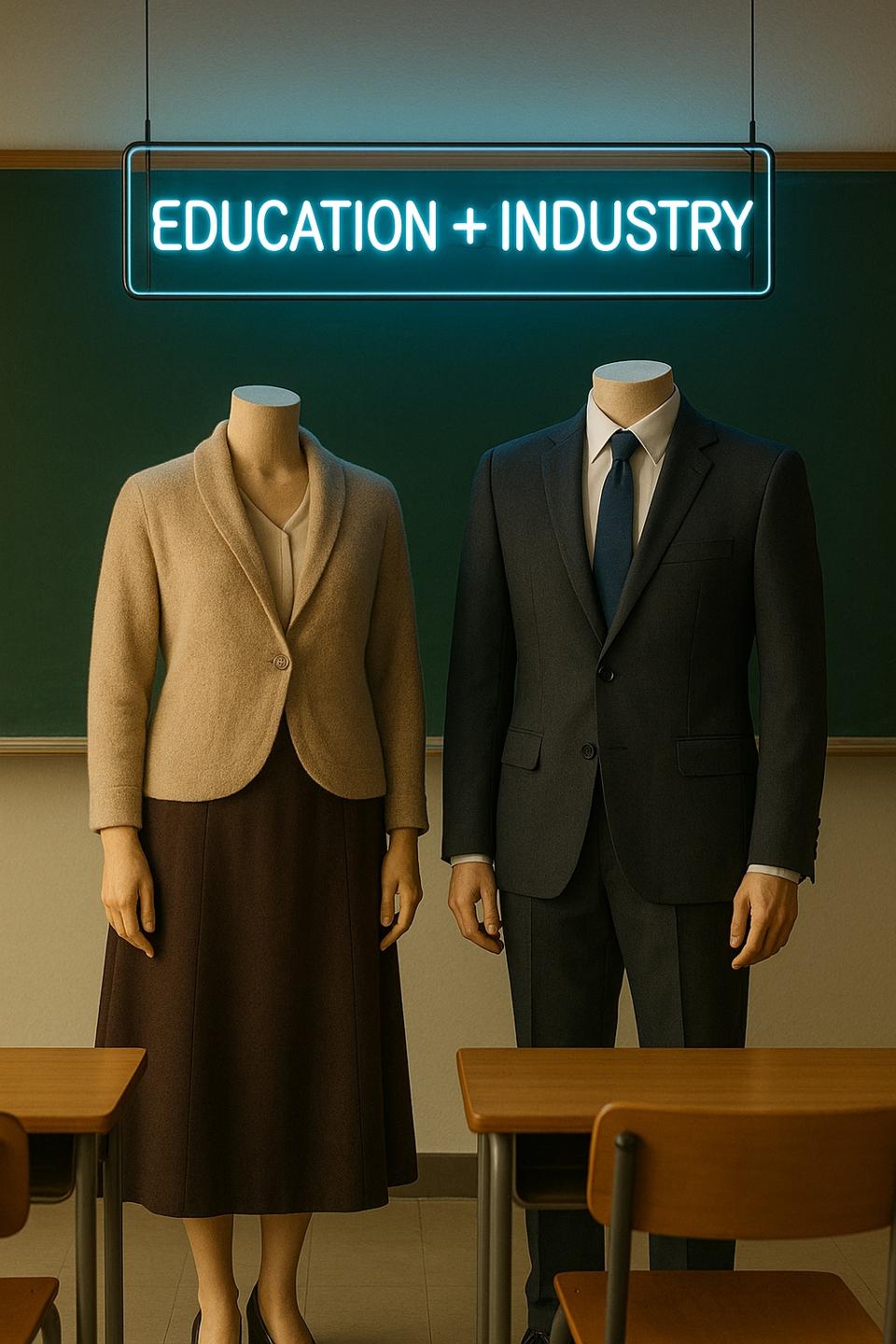
When it comes to innovation in higher education, most bets are being placed on technology platforms and AI. But the innovation students, faculty and industry need most can be found in a much more human dimension: co-teaching. And specifically, a certain kind of co-teaching – between industry experts and educators.

While higher education has largely embraced the value of interdisciplinary teaching across different majors or fields of study, it has yet to embrace the value of co-teaching between industry and academia. Examples of co-teaching through industry-education collaborations are rare and underutilized across today’s higher ed landscape. But they may be the most valuable and relevant way to prepare students for success. And leveraging these collaborations can help institutions struggling to satisfy unfulfilled student demand for immersive work experiences such as internships.


From DSC:
It’s along these lines that I think that ADJUNCT faculty members should be highly sought after and paid much better — as the up-to-date knowledge and experience they bring into the classroom is very valuable. They should have equal say in terms of curriculum/programs and in the way a college or university is run.


When Heads Butt — from kathleendelaski.substack.com by Kathlee deLaski
An actual debate at LinkedIn Headquarters on the value of the college degree

Coincidentally published the same day, our books do take opposing views in parts. Scott is very strong on the value of the traditional degree, but wants to help students see beyond “the major,” telling them not to rely on what essentially amounts to a minority of the courses you’ll take in college to find your path to passion and employment. He urges them to find a “field of study,” to build in a broader range of self-directed experiences and classes to find your purpose and profession. (I love this and recommend his book.)

WhiIe I don’t recommend against college, “Who Needs College Anymore?” points to the growing number of employers and colleges that are offering skills-based career paths, that can be achieved with shorter term programs…that can be a stepladder to a degree, but don’t leave you credential-less if life gets in the way. I call on colleges to embrace all the market share they are leaving on the table, the 60% plus of Americans who are not getting a four-year degree, and to consider providing more modular professional pathway opportunities in addition to degrees.


Also re: higher education, see:

After years of quietly falling, college tuition is on the rise again — from hechingerreport.org
As colleges also pare back services, many students are paying more and getting less

Students nationwide are facing increases in tuition this fall of as high as 10 percent, along with new fees and rising costs for dorms and dining. And as in Pennsylvania, it’s an abrupt change from a period during which something happened that most Americans probably didn’t notice: Tuition had actually been falling, when adjusted for inflation, after decades of outpacing the cost of almost everything else.

That’s among the conclusions of The Hechinger Report’s update of its Tuition Tracker tool, which shows what students pay to go to individual colleges and universities based on their families’ incomes.

Considering the growing skepticism that college is “the magic ticket to the American dream,” said Gillen, raising tuition, for many higher education institutions, “definitely has the potential to be penny-wise and pound-foolish.” 

But universities and colleges are confronting unprecedented problems on the funding side. 


“A new L&D operating system for the AI Era?” [Hardman] + other items re: AI in our learning ecosystems

From 70/20/10 to 90/10 — from drphilippahardman.substack.com by Dr Philippa Hardman
A new L&D operating system for the AI Era?

This week I want to share a hypothesis I’m increasingly convinced of: that we are entering an age of the 90/10 model of L&D.

90/10 is a model where roughly 90% of “training” is delivered by AI coaches as daily performance support, and 10% of training is dedicated to developing complex and critical skills via high-touch, human-led learning experiences.

Proponents of 90/10 argue that the model isn’t about learning less, but about learning smarter by defining all jobs to be done as one of the following:

  • Delegate (the dead skills): Tasks that can be offloaded to AI.
  • Co-Create (the 90%): Tasks which well-defined AI agents can augment and help humans to perform optimally.
  • Facilitate (the 10%): Tasks which require high-touch, human-led learning to develop.

So if AI at work is now both real and material, the natural question for L&D is: how do we design for it? The short answer is to stop treating learning as an event and start treating it as a system.


My daughter’s generation expects to learn with AI, not pretend it doesn’t exist, because they know employers expect AI fluency and because AI will be ever-present in their adult lives.

— Jenny Maxell

The above quote was taken from this posting.


Unlocking Young Minds: How Gamified AI Learning Tools Inspire Fun, Personalized, and Powerful Education for Children in 2025 — from techgenyz.com by Sreyashi Bhattacharya

Table of Contents

Highlight

  • Gamified AI Learning Tools personalize education by adapting the difficulty and content to each child’s pace, fostering confidence and mastery.
  • Engaging & Fun: Gamified elements like quests, badges, and stories keep children motivated and enthusiastic.
  • Safe & Inclusive: Attention to equity, privacy, and cultural context ensures responsible and accessible learning.

How to test GenAI’s impact on learning — from timeshighereducation.com by Thibault Schrepel
Rather than speculate on GenAI’s promise or peril, Thibault Schrepel suggests simple teaching experiments to uncover its actual effects

Generative AI in higher education is a source of both fear and hype. Some predict the end of memory, others a revolution in personalised learning. My two-year classroom experiment points to a more modest reality: Artificial intelligence (AI) changes some skills, leaves others untouched and forces us to rethink the balance.

This indicates that the way forward is to test, not speculate. My results may not match yours, and that is precisely the point. Here are simple activities any teacher can use to see what AI really does in their own classroom.

4. Turn AI into a Socratic partner
Instead of being the sole interrogator, let AI play the role of tutor, client or judge. Have students use AI to question them, simulate cross-examination or push back on weak arguments. New “study modes” now built into several foundation models make this kind of tutoring easy to set up. Professors with more technical skills can go further, design their own GPTs or fine-tuned models trained on course content and let students interact directly with them. The point is the practice it creates. Students learn that questioning a machine is part of learning to think like a professional.


Assessment tasks that support human skills — from timeshighereducation.com by Amir Ghapanchi and Afrooz Purarjomandlangrudi
Assignments that focus on exploration, analysis and authenticity offer a road map for university assessment that incorporates AI while retaining its rigour and human elements

Rethinking traditional formats

1. From essay to exploration 
When ChatGPT can generate competent academic essays in seconds, the traditional format’s dominance looks less secure as an assessment task. The future lies in moving from essays as knowledge reproduction to assessments that emphasise exploration and curation. Instead of asking students to write about a topic, challenge them to use artificial intelligence to explore multiple perspectives, compare outputs and critically evaluate what emerges.

Example: A management student asks an AI tool to generate several risk plans, then critiques the AI’s assumptions and identifies missing risks.


What your students are thinking about artificial intelligence — from timeshighereducation.com by Florencia Moore and Agostina Arbia
GenAI has been quickly adopted by students, but the consequences of using it as a shortcut could be grave. A study into how students think about and use GenAI offers insights into how teaching might adapt

However, when asked how AI negatively impacts their academic development, 29 per cent noted a “weakening or deterioration of intellectual abilities due to AI overuse”. The main concern cited was the loss of “mental exercise” and soft skills such as writing, creativity and reasoning.

The boundary between the human and the artificial does not seem so easy to draw, but as the poet Antonio Machado once said: “Traveller, there is no path; the path is made by walking.”


Jelly Beans for Grapes: How AI Can Erode Students’ Creativity — from edsurge.com by Thomas David Moore

There is nothing new about students trying to get one over on their teachers — there are probably cuneiform tablets about it — but when students use AI to generate what Shannon Vallor, philosopher of technology at the University of Edinburgh, calls a “truth-shaped word collage,” they are not only gaslighting the people trying to teach them, they are gaslighting themselves. In the words of Tulane professor Stan Oklobdzija, asking a computer to write an essay for you is the equivalent of “going to the gym and having robots lift the weights for you.”


Deloitte will make Claude available to 470,000 people across its global network — from anthropic.com

As part of the collaboration, Deloitte will establish a Claude Center of Excellence with trained specialists who will develop implementation frameworks, share leading practices across deployments, and provide ongoing technical support to create the systems needed to move AI pilots to production at scale. The collaboration represents Anthropic’s largest enterprise AI deployment to date, available to more than 470,000 Deloitte people.

Deloitte and Anthropic are co-creating a formal certification program to train and certify 15,000 of its professionals on Claude. These practitioners will help support Claude implementations across Deloitte’s network and Deloitte’s internal AI transformation efforts.


How AI Agents are finally delivering on the promise of Everboarding: driving retention when it counts most — from premierconstructionnews.com

Everboarding flips this model. Rather than ending after orientation, everboarding provides ongoing, role-specific training and support throughout the employee journey. It adapts to evolving responsibilities, reinforces standards, and helps workers grow into new roles. For high-turnover, high-pressure environments like retail, it’s a practical solution to a persistent challenge.

AI agents will be instrumental in the success of everboarding initiatives; they can provide a much more tailored training and development process for each individual employee, keeping track of which training modules may need to be completed, or where staff members need or want to develop further. This personalisation helps staff to feel not only more satisfied with their current role, but also guides them on the right path to progress in their individual careers.

Digital frontline apps are also ideal for everboarding. They offer bite-sized training that staff can complete anytime, whether during quiet moments on shift or in real time on the job, all accessible from their mobile devices.


TeachLM: insights from a new LLM fine-tuned for teaching & learning — from drphilippahardman.substack.com by Dr Philippa Hardman
Six key takeaways, including what the research tells us about how well AI performs as an instructional designer

As I and many others have pointed out in recent months, LLMs are great assistants but very ineffective teachers. Despite the rise of “educational LLMs” with specialised modes (e.g. Anthropic’s Learning Mode, OpenAI’s Study Mode, Google’s Guided Learning) AI typically eliminates the productive struggle, open exploration and natural dialogue that are fundamental to learning.

This week, Polygence, in collaboration with Stanford University researcher Prof Dora Demszky. published a first-of-its-kind research on a new model — TeachLM — built to address this gap.

In this week’s blog post, I deep dive what the research found and share the six key findings — including reflections on how well TeachLM performs on instructional design.


The Dangers of using AI to Grade — from marcwatkins.substack.com by Marc Watkins
Nobody Learns, Nobody Gains

AI as an assessment tool represents an existential threat to education because no matter how you try and establish guardrails or best practices around how it is employed, using the technology in place of an educator ultimately cedes human judgment to a machine-based process. It also devalues the entire enterprise of education and creates a situation where the only way universities can add value to education is by further eliminating costly human labor.

For me, the purpose of higher education is about human development, critical thinking, and the transformative experience of having your ideas taken seriously by another human being. That’s not something we should be in a rush to outsource to a machine.

 
© 2025 | Daniel Christian