Quiet People in Meetings Are Incredible — from medium.com by Tim Denning
Knowing when not to talk is an art.

Excerpts:

But it’s not all bad. Meetings have taught me one valuable lesson: watch the quiet people.

Job titles make people do stupid things. One of those misdemeanors is talking too much. You can have a title today and have it gone tomorrow.

What ruins business is people that don’t listen. They think they know the market but actually they don’t know anything at all.

The brightest spark in the room says nothing at all. They are there taking notes and paying attention to what is going on. They watch the duel of egos and see no room to interrupt.


‘Accessibility is a journey’: A DEI expert on disability rights — from hrdive.com by Caroline Colvin
Employers can wait for a worker to request reasonable accommodation under the ADA, but Kelly Hermann asks: Why not be accommodating from the start?

Excerpt:

Often, employers jump to the obstacles that exist in physical spaces: nonexistent ramps for wheelchairs, manual doors that lack motion sensors, and the like. But the digital world presents challenges as well. Hermann and the U Phoenix accessibility team likes to “demystify” disability for campus members seeking their counsel, she said.

“Are you making those links descriptive and are you using keywords? Or are you just saying ‘click here’ and that’s your link?” Hermann asked. Like a sighted person, an individual with a disability can also scan a webpage for links with assistive technology, but this happens audibly, Hermann said, “They tell that tool to skip by link and this is what they hear: ‘Click here.’ ‘Click here.’ ‘Click here.’ ‘Click here.’ With four links on the page all hyperlinked with ‘click here,’ [they] don’t know where [they’re] going.”


5 creative ways to share your passions (with classroom ideas, too!) — from classtechtips.com by Dr. Monica Burns

Excerpt:

If we’re anything alike, there are topics you just can’t stop talking about. I am definitely guilty of being “that” person who talks about the latest piece of advice they heard on a podcast or a recipe from TikTok that they can’t wait to try out. You might also find me going on and on about how fun it was to visit a new school, a new lesson idea I want to try out, or an EdTech tool that totally changed the way I think about [fill in the blank]. In today’s blog post, I put together a list of five creative ways to share your passions. You’ll also find creative classroom ideas to go along with each one.

Some of these are part of my regular practice of sharing things I’m passionate about. Others I’ve tried a few times and loved, even if they’re not my daily, weekly, or monthly way of sharing.

Best of all… all of these ideas are ones your students can try, too.


Also relevant/see:

Liven up your lesson with a comic strip twist — from classtechtips.com by Dr. Monica Burns


Top Sites for Educator Professional Development — from techlearning.com by Diana Restifo
These professional development sites for education will help teachers refresh and update their practice

Excerpt:

The learning never stops for teachers. Even if continuing education were not required by law, educators would still strive toward deepening their subject knowledge, keeping up with the latest research, sharpening their classroom skills, and learning to use education technology tools.

The following professional development sites for education will help teachers refresh and update their practice, connect with fellow educators and, in some cases, earn continuing education credits. All provide substantial free or modestly priced content.


And for you higher ed folks, see the Tweet below; my thanks to Becky Supiano for this resource out at The Chronicle of Higher Education


Coursera’s Global Skills Report

Excerpt from the Executive Summary:

Here are some of our top findings:

  • Digital skills are the shared language of the modern economy.
  • Women’s participation continued to rise.
  • The developing world had the highest rate of learner growth.
  • Lower levels of internet access mean lower levels of skills proficiency.
  • Courses in human skills had more learners from developed countries, while those in digital skills had more from developing ones.
  • The U.S. held steady in its overall skills proficiency ranking—yet it lost meaningful ground in core technology and data science skills.
  • Europe leads the world in skills proficiency.
  • Proficiency in technology and data science skills varies widely across the Asia-Pacific region.
  • Learners used Coursera to understand the pandemic.
 

Slido Lesson Plan — from techlearning.com by Stephanie Smith Budhai, Ph.D.
This Slido Lesson Plan is designed to help educators implement the digital tool into their instruction

Excerpt:

Slido is an exciting online engagement edtech tool that can be used to connect all students with academic content while getting them involved in the lesson.

While Slido is often used to incorporate polling into virtual workshops and presentations, there are a wide range of student engagement features within the Slido platform that can be used by teachers during lessons.

Also see:

Slido -- your go-to interaction app for hybrid meetings


How to Learn about Learning Science — from christytuckerlearning.com by Christy Tucker
How do you learn about learning science? Recommendations for people to follow, books to read, and other resources.

Excerpt:

I have written before about how research informs my work. As instructional designers, LXDs, and other L&D professionals, I think it’s important for us to learn how to design more effective learning experiences. Our work should be informed by research and evidence. But, how do you learn about learning science, especially if you don’t have a graduate degree in instructional design? These are my recommendations for people to follow, books to read, and other resources.


GreenLight Means Go: Where Learner and Employment Records Are Headed — from gettingsmart.com by Getting Smart Staff

Excerpt:

New solutions present a unique solution to these challenges by providing a user-controlled technology to store, share, search, and match acquired competency with opportunity. One of the key players in this space is GreenLight Credentials, a frictionless, user-controlled talent search and credential-communicator that addresses these issues. On the outbound side, institutions and their learners can store any type of verified record including transcripts, credentials, badges, or other documentation of learning. These learning experiences are then translated into data – competencies, skills, interests, and accomplishments that are then matched with scholarship, university and employment opportunities. Universities and employers can join the network to discover and connect with prospective students or employees.

The vast majority of students who graduate from high school in the United States typically have their learning diluted to a single one-page transcript that lists courses and grades – and often a GPA.

What young people need now are repetitions in design thinking – to repeatedly find, frame, address complex problems and deliver value to a community.

— Getting Smart Staff

Also relevant/see from Getting Smart:

Innovating Together: the Geopolitical and Educational Path Forward — by Tom Vander Ark

Key Points

  • The new mission of school is cultivating curiosity, purpose and problem solving by inviting learners into real world challenges in diverse teams using smart tools.
  • The path forward is innovating together.

The VUCA world (volatile, uncertain, complex, and ambiguous) is now hyper-connected (VUCAH).

Also relevant/see:


The Science of Learning: Research Meets Practice — from the-learning-agency-lab.com by Alisa Cook and Ulrich Boser; with thanks to Learning Now TV for this resource
Six Research-Based Teaching Practices Are Put Into Practice

Excerpt:

For the nation’s education system, though, the bigger question is: How do we best educate our children so that they learn better, and learn how to learn, in addition to learning what to learn? Additionally, and arguably just as challenging, is: How do we translate this body of research into classroom practice effectively?

Enter the “Science of Learning: Research Meets Practice.” The goal of the project is to get the science of learning into the hands of teaching professionals as well as to parents, school leaders, and students.


Opportunities for Education in the Metaverse -- from downes.ca by Stephen Downes

Opportunities for Education in the Metaverse — from downes.ca by Stephen Downes

Excerpt:

This short presentation introduces major elements of the metaverse, outlines some applications for education, discusses how it may be combined with other technologies for advanced applications, and outlines some issues and concerns.

Also relevant/see:

What Should Higher Ed in the Metaverse Look like? – from linkedin.com by Joe Schaefer

Excerpt:

The Metaverse is coming whether we like it or not, and it is time for educators to think critically about how it can benefit students. As higher education continues to evolve, I believe every learning product and platform working with or within the Metaverse should, at least, have these functionalities:


Addendum on 5/23/22:


Michigan Learning Channel: A Free Tool for Summer Learning — from michiganvirtual.org

Excerpt:

In this course, you will:

  • Recognize the what, why, and how of Michigan Learning Channel (MLC) resources.
  • Identify opportunities for family engagement that align with literacy, math, and science learning goals.
  • Consider ways to share these fun and free activities with students and families.

Also relevant/see:

FUTURE OF ME — from michiganlearning.org
Explore STEM careers by meeting women who work in those fields.

AGE RANGE: 6th – 12th Grade
SUBJECT: Career Exploration, Math, Science

TV Schedule — from michiganlearning.org


From DSC:
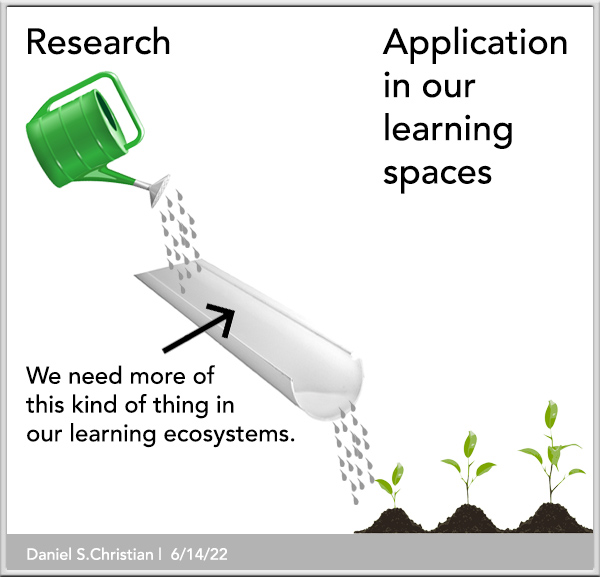
For the last few years, I’ve been thinking that we need to make learning science-related information more accessible to students, teachers, professors, trainers, and employees — no matter what level they are at.

One idea on how to do this — besides putting posters up in the hallways, libraries, classrooms, conference rooms, cafeterias, etc. — is that we could put a How best to study/learn link in all of the global navigation bars and/or course navigation bars out there in organizations’ course management systems and learning management systems. Learners of all ages could have 24 x 7 x 365, easy, instant access as to how to be more productive as they study and learn about new things.

For example, they could select that link in their CMS/LMS to access information on:

  • Retrieval practice
  • Spacing
  • Interleaving
  • Metacognition
  • Elaboration
  • The Growth Mindset
  • Accessibility-related tools / assistive technologies
  • Links to further resources re: learning science and learning theories

What do you think? If we started this in K12, kept it up in higher ed and vocational programs, and took the idea into the corporate world, valuable information could be relayed and absorbed. This is the kind of information that is highly beneficial these days — as all of us need to be lifelong learners now.


Become a Wi-Fi wizard — from advisorator.com by Jared Newman; or see this page

Excerpt:

Wi-Fi is fundamentally at odds, then, with my desire to answer questions with specific recommendations. The best I can do is walk you through how I diagnose Wi-Fi problems myself. That way, you can make better decisions on whether (and how) to upgrade your own gear.

In this guide:

  • Size up the problem
  • Know your router
  • Try some smaller fixes
  • Extenders: a last resort
  • Picking a new Wi-Fi router
  • Deciphering Wi-Fi jargon


The rise of alternative credentials in hiring — from shrm.org; with thanks to Ryan Craig for this resource
Increasingly, U.S. workers are turning to alternative credentials as a way to enhance and demonstrate skills and work readiness. But can certifications, badges and apprenticeships stand in for traditional education and work experience when seeking a new job?

Excerpts:

Alternative credentials can be defined as any microcredential, industry or professional certification, acknowledgment of apprenticeship (registered or nonregistered), or badging that indicates one’s competencies and skills within a particular field. Alternative credentials do not include traditional academic degrees or required occupational licensures.

However, one potential barrier to employers’ wider recognition of alternative credentials is actually a technical one. Automated applicant tracking systems (ATS) frequently don’t pick up on them, because often there is still no standard approach to collecting this information as systems do for traditional education and work experience. Only one-third of HR professionals whose organizations use automated prescreening say this prescreening even recognizes alternative credentials. Such inconsistency offers a clear direction for both HR and the providers of applicant screening tools to improve the ways alternative credentials are captured in the application process.

 
© 2025 | Daniel Christian