


NotebookLM is one of my favorite AI tools for reading scholarly articles. — from linkedin.com by Med Kharbach, PhD
On 07/12/2025,
in Artificial Intelligence/Agents/LLMs/and Related, content development, aggregation, repositories, corporate / business world, corporate universities / corporate training, education, education technology, faculty/staff, future of higher education, game-changing environment, generational differences, higher education, human-computer interaction (HCI), instructional design, intelligent systems, IT in HE, learning ecosystem, Learning Experience Design, liberal arts, Microsoft, Open AI, parents/guardians, pedagogy, productivity / tips and tricks, professional development, teachers, teaching & learning, tools, training / L&D, United States, universities, using teams, vendors, writing,
by Daniel Christian
Tech check: Innovation in motion: How AI is rewiring L&D workflows — from chieflearningofficer.com by Gabrielle Pike
AI isn’t here to replace us. It’s here to level us up.
For today’s chief learning officer, the days of just rolling out compliance training are long gone. In 2025, learning and development leaders are architects of innovation, crafting ecosystems that are agile, automated and AI-infused. This quarter’s Tech Check invites us to pause, assess and get strategic about where tech is taking us. Because the goal isn’t more tools—it’s smarter, more human learning systems that scale with the business.
Sections include:
- The state of AI in L&D: Hype vs. reality
- AI in design: From static content to dynamic experiences
- AI in development: Redefining production workflows
- Strategic questions CLOs should be asking
- Future forward: What’s next?
- Closing thought
NEW YORK – The AFT, alongside the United Federation of Teachers and lead partner Microsoft Corp., founding partner OpenAI, and Anthropic, announced the launch of the National Academy for AI Instruction today. The groundbreaking $23 million education initiative will provide access to free AI training and curriculum for all 1.8 million members of the AFT, starting with K-12 educators. It will be based at a state-of-the-art bricks-and-mortar Manhattan facility designed to transform how artificial intelligence is taught and integrated into classrooms across the United States.
The academy will help address the gap in structured, accessible AI training and provide a national model for AI-integrated curriculum and teaching that puts educators in the driver’s seat.
Students Are Anxious about the Future with A.I. Their Parents Are, Too. — from educationnext.org by Michael B. Horn
The fast-growing technology is pushing families to rethink the value of college
In an era when the college-going rate of high school graduates has dropped from an all-time high of 70 percent in 2016 to roughly 62 percent now, AI seems to be heightening the anxieties about the value of college.
According to the survey, two-thirds of parents say AI is impacting their view of the value of college. Thirty-seven percent of parents indicate they are now scrutinizing college’s “career-placement outcomes”; 36 percent say they are looking at a college’s “AI-skills curriculum,” while 35 percent respond that a “human-skills emphasis” is important to them.
This echoes what I increasingly hear from college leadership: Parents and students demand to see a difference between what they are getting from a college and what they could be “learning from AI.”
This next item on LinkedIn is compliments of Ray Schroeder:
How to Prepare Students for a Fast-Moving (AI)World — from rdene915.com by Dr. Rachelle Dené Poth
Preparing for a Future-Ready Classroom
Here are the core components I focus on to prepare students:
1. Unleash Creativity and Problem-Solving.
2. Weave in AI and Computational Thinking.
3. Cultivate Resilience and Adaptability.
AI Is Reshaping Learning Roles—Here’s How to Future-Proof Your Team — from onlinelearningconsortium.org by Jennifer Mathes, Ph.D., CEO, Online Learning Consortium; via Robert Gibson on LinkedIn
Culture matters here. Organizations that foster psychological safety—where experimentation is welcomed and mistakes are treated as learning—are making the most progress. When leaders model curiosity, share what they’re trying, and invite open dialogue, teams follow suit. Small tests become shared wins. Shared wins build momentum.
Career development must be part of this equation. As roles evolve, people will need pathways forward. Some will shift into new specialties. Others may leave familiar roles for entirely new ones. Making space for that evolution—through upskilling, mobility, and mentorship—shows your people that you’re not just investing in AI, you’re investing in them.
And above all, people need transparency. Teams don’t expect perfection. But they do need clarity. They need to understand what’s changing, why it matters, and how they’ll be supported through it. That kind of trust-building communication is the foundation for any successful change.
These shifts may play out differently across sectors—but the core leadership questions will likely be similar.
AI marks a turning point—not just for technology, but for how we prepare our people to lead through disruption and shape the future of learning.
.
On 07/12/2025,
in art, creativity, design, graphics, productivity / tips and tricks, tools, vendors,
by Daniel Christian
The No Bulls**t Guide To Drawing Tablets — from booooooom.com
SO WHICH DEVICE SHOULD YOU BUY?
If you’re anything like me, the answer is an iPad AND a drawing display. I heavily rely on both my desktop apps and Procreate, so limiting myself to only one device doesn’t cut it for my creative workflow.
However, it all comes down to personal preference and understanding which apps you rely on, whether portability is essential, how vital ergonomics are, and ultimately what you can afford. Once you answer those questions, everything falls into place.


“How AI is Finally Unlocking Efficiency in the Legal Sector” [Basit] + other legaltech-related items
On 06/27/2025,
in Artificial Intelligence/Agents/LLMs/and Related, change, copyright/ownership/NFTs, corporate / business world, emerging technologies, Europe, law schools, Legal operations, legal reform, legal technologies, legislatures / government / legal, productivity / tips and tricks, UK, United States, vendors,
by Daniel Christian
The EU’s Legal Tech Tipping Point – AI Regulation, Data Sovereignty, and eDiscovery in 2025 — from jdsupra.com by Melina Efstathiou
The Good, the Braver and the Curious.
As we navigate through 2025, the European legal landscape is undergoing a significant transformation, particularly in the realms of artificial intelligence (AI) regulation and data sovereignty. These changes are reshaping how legal departments and more specifically eDiscovery professionals operate, compelling them to adapt to new compliance requirements and technological advancements.
Following on from our blog post on Navigating eDisclosure in the UK and Practice Direction 57AD, we are now moving on to explore AI regulation in the greater European spectrum, taking a contrasting glance towards the UK and the US as well, at the close of this post.
LegalTech’s Lingering Hurdles: How AI is Finally Unlocking Efficiency in the Legal Sector — from techbullion.co by Abdul Basit
However, as we stand in mid-2025, a new paradigm is emerging. Artificial Intelligence, once a buzzword, is now demonstrably addressing many of the core issues that have historically plagued LegalTech adoption and effectiveness, ushering in an era of unprecedented efficiency. Legal tech specialists like LegalEase are leading the way with some of these newer solutions, such as Ai powered NDA drafting.
Here’s how AI is making profound efficiencies:
-
- Automated Document Review and Analysis:
- Intelligent Contract Lifecycle Management (CLM):
- Enhanced Legal Research:
- Predictive Analytics for Litigation and Risk:
- Streamlined Practice Management and Workflow Automation:
- Personalized Legal Education and Training:
- Improved Client Experience:
The AI Strategy Potluck: Law Firms Showing Up Empty-Handed, Hungry, And Weirdly Proud Of It — from abovethelaw.com by Joe Patrice
There’s a $32 billion buffet of time and money on the table, and the legal industry brought napkins.
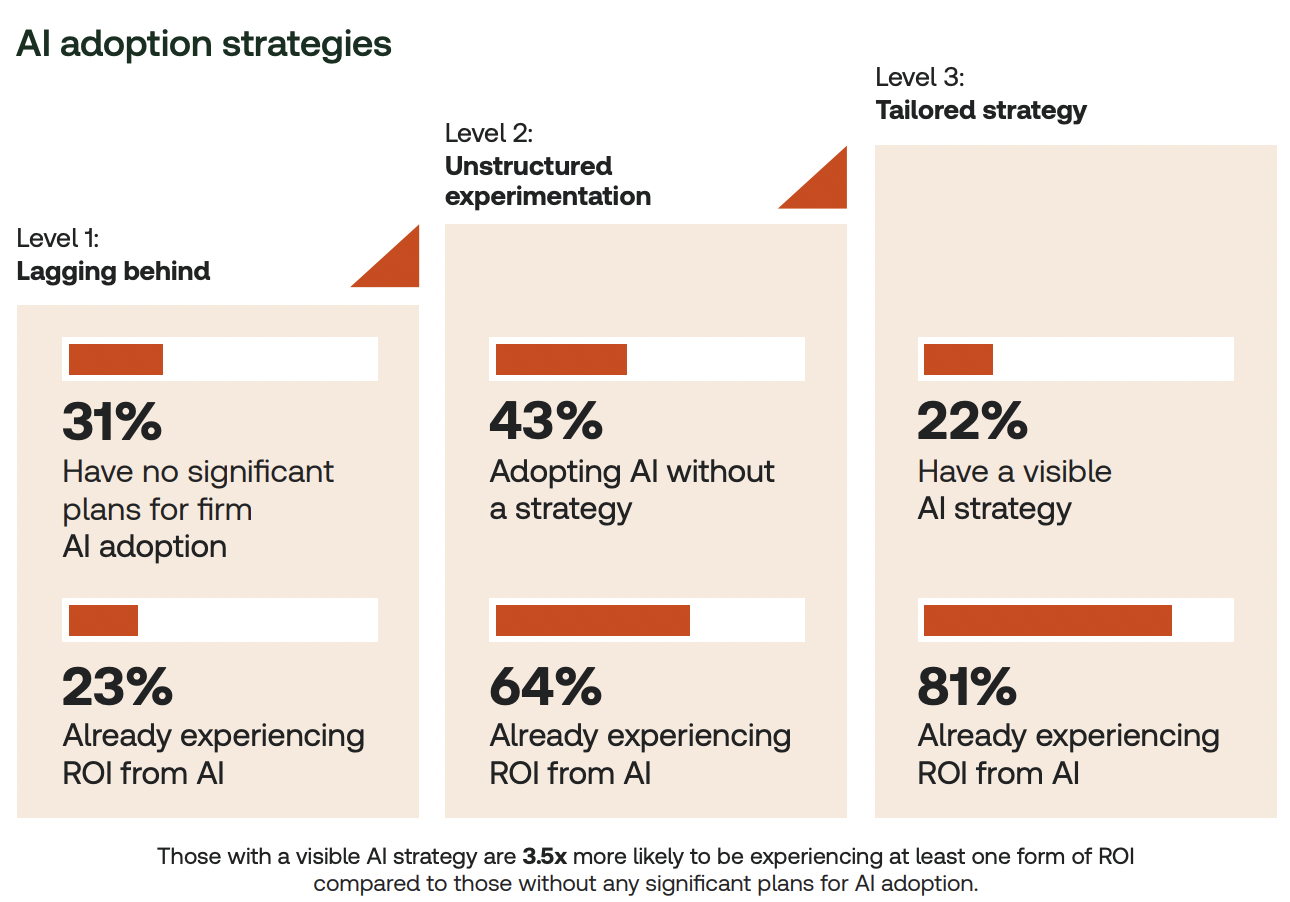
The Thomson Reuters “Future of Professionals” report(Opens in a new window) just dropped and one stat standing out among its insights is that organizations with a visible AI strategy are not only twice as likely to report growth, they’re also 3.5 times more likely to see actual, tangible benefits from AI adoption.
Speaking of legal-related items as well as tech, also see:
- Landmark AI ruling is a blow to authors and artists — from popular.info by Judd Legum
This week, a federal judge, William Alsup, rejected Anthropic’s effort to dismiss the case and found that stealing books from the internet is likely a copyright violation. A trial will be scheduled in the future. If Anthropic loses, each violation could come with a fine of $750 or more, potentially exposing the company to billions in damages. Other AI companies that use stolen work to train their models — and most do — could also face significant liability.
On 06/25/2025,
in 21st century, Artificial Intelligence/Agents/LLMs/and Related, business, emerging technologies, entrepreneurship, experimentation, innovation, law schools, Legal operations, legal reform, legal technologies, legislatures / government / legal, platforms, productivity / tips and tricks, tools, trends, United States, vendors, vision/possibilities,
by Daniel Christian
Agentic AI use cases in the legal industry — from legal.thomsonreuters.com
What legal professionals need to know now with the rise of agentic AI
While GenAI can create documents or answer questions, agentic AI takes intelligence a step further by planning how to get multi-step work done, including tasks such as consuming information, applying logic, crafting arguments, and then completing them.? This leaves legal teams more time for nuanced decision-making, creative strategy, and relationship-building with clients—work that machines can’t do.
The AI Legal Landscape in 2025: Beyond the Hype — from akerman.com by Melissa C. Koch
What we’re witnessing is a profession in transition where specific tasks are being augmented or automated while new skills and roles emerge.
The data tells an interesting story: approximately 79% of law firms have integrated AI tools into their workflows, yet only a fraction have truly transformed their operations. Most implementations focus on pattern recognition tasks such as document review, legal research, contract analysis. These implementations aren’t replacing lawyers; they’re redirecting attention to higher-value work.
This technological shift doesn’t happen in isolation. It’s occurring amid client pressure for efficiency, competition from alternative providers, and the expectations of a new generation of lawyers who have never known a world without AI assistance.
LexisNexis and Harvey team up to revolutionize legal research with artificial intelligence — from abajournal.com by Danielle Braff
Lawyers using the Harvey artificial intelligence platform will soon be able to tap into LexisNexis’ vast legal research capabilities.
Thanks to a new partnership announced Wednesday, Harvey users will be able to ask legal questions and receive fast, citation-backed answers powered by LexisNexis case law, statutes and Shepard’s Citations, streamlining everything from basic research to complex motions. According to a press release, generated responses to user queries will be grounded in LexisNexis’ proprietary knowledge graphs and citation tools—making them more trustworthy for use in court or client work.
10 Legal Tech Companies to Know — from builtin.com
These companies are using AI, automation and analytics to transform how legal work gets done.
.

Four months after a $3B valuation, Harvey AI grows to $5B — from techcrunch.com by Marina Temkin
Harvey AI, a startup that provides automation for legal work, has raised $300 million in Series E funding at a $5 billion valuation, the company told Fortune. The round was co-led by Kleiner Perkins and Coatue, with participation from existing investors, including Conviction, Elad Gil, OpenAI Startup Fund, and Sequoia.
The billable time revolution — from jordanfurlong.substack.com by Jordan Furlong
Gen AI will bring an end to the era when lawyers’ value hinged on performing billable work. Grab the coming opportunity to re-prioritize your daily activities and redefine your professional purpose.
Because of Generative AI, lawyers will perform fewer “billable” tasks in future; but why is that a bad thing? Why not devote that incoming “freed-up” time to operating, upgrading, and flourishing your law practice? Because this is what you do now: You run a legal business. You deliver good outcomes, good experiences, and good relationships to clients. Humans do some of the work and machines do some of the work and the distinction that matters is not billable/non-billable, it’s which type of work is best suited to which type of performer.
On 06/23/2025,
in 21st century, 24x7x365 access, adjunct faculty, adult learning, Artificial Intelligence/Agents/LLMs/and Related, bots, change, cloud-based computing / apps / other cloud-related, CMS/LMS, colleges, communities of practice, community colleges, content development, aggregation, repositories, corporate / business world, corporate universities / corporate training, digital learning, digital video, education, education technology, emerging technologies, engagement / engaging students, experimentation, face-to-face, faculty/staff, game-changing environment, Google, heutagogy, higher education, homeschooling/homeschoolers, human-computer interaction (HCI), ideas, innovation, instructional design, intelligent systems, intelligent tutoring, IT in HE, K-12 related, law schools, learning, learning agents, learning ecosystem, Learning Experience Design, Learning from the Living [Class] Room, liberal arts, library / librarians, lifelong learning, memory, metacognition / metacognitive skills, multimedia, Natural Language Processing (NLP), new media literacies, online learning, online media, Open AI, personalized/customized learning, platforms, productivity / tips and tricks, professional development, student-related, teachers, teaching & learning, teaching online, technologies for your home, tools, traditional / tradition, training / L&D, trends, United States, universities, user experience (UX), vendors, vision/possibilities, writing,
by Daniel Christian
Thoughts on thinking — from dcurt.is by Dustin Curtis
Intellectual rigor comes from the journey: the dead ends, the uncertainty, and the internal debate. Skip that, and you might still get the insight–but you’ll have lost the infrastructure for meaningful understanding. Learning by reading LLM output is cheap. Real exercise for your mind comes from building the output yourself.
The irony is that I now know more than I ever would have before AI. But I feel slightly dumber. A bit more dull. LLMs give me finished thoughts, polished and convincing, but none of the intellectual growth that comes from developing them myself.
Using AI Right Now: A Quick Guide — from oneusefulthing.org by Ethan Mollick
Which AIs to use, and how to use them
Every few months I put together a guide on which AI system to use. Since I last wrote my guide, however, there has been a subtle but important shift in how the major AI products work. Increasingly, it isn’t about the best model, it is about the best overall system for most people. The good news is that picking an AI is easier than ever and you have three excellent choices. The challenge is that these systems are getting really complex to understand. I am going to try and help a bit with both.
First, the easy stuff.
Which AI to Use
For most people who want to use AI seriously, you should pick one of three systems: Claude from Anthropic, Google’s Gemini, and OpenAI’s ChatGPT.

Also see:
Student Voice, Socratic AI, and the Art of Weaving a Quote — from elmartinsen.substack.com by Eric Lars Martinsen
How a custom bot helps students turn source quotes into personal insight—and share it with others
This summer, I tried something new in my fully online, asynchronous college writing course. These classes have no Zoom sessions. No in-person check-ins. Just students, Canvas, and a lot of thoughtful design behind the scenes.
One activity I created was called QuoteWeaver—a PlayLab bot that helps students do more than just insert a quote into their writing.
It’s a structured, reflective activity that mimics something closer to an in-person 1:1 conference or a small group quote workshop—but in an asynchronous format, available anytime. In other words, it’s using AI not to speed students up, but to slow them down.
…
The bot begins with a single quote that the student has found through their own research. From there, it acts like a patient writing coach, asking open-ended, Socratic questions such as:
What made this quote stand out to you?
How would you explain it in your own words?
What assumptions or values does the author seem to hold?
How does this quote deepen your understanding of your topic?
It doesn’t move on too quickly. In fact, it often rephrases and repeats, nudging the student to go a layer deeper.
The Disappearance of the Unclear Question — from jeppestricker.substack.com Jeppe Klitgaard Stricker
New Piece for UNESCO Education Futures
On [6/13/25], UNESCO published a piece I co-authored with Victoria Livingstone at Johns Hopkins University Press. It’s called The Disappearance of the Unclear Question, and it’s part of the ongoing UNESCO Education Futures series – an initiative I appreciate for its thoughtfulness and depth on questions of generative AI and the future of learning.
Our piece raises a small but important red flag. Generative AI is changing how students approach academic questions, and one unexpected side effect is that unclear questions – for centuries a trademark of deep thinking – may be beginning to disappear. Not because they lack value, but because they don’t always work well with generative AI. Quietly and unintentionally, students (and teachers) may find themselves gradually avoiding them altogether.
Of course, that would be a mistake.
We’re not arguing against using generative AI in education. Quite the opposite. But we do propose that higher education needs a two-phase mindset when working with this technology: one that recognizes what AI is good at, and one that insists on preserving the ambiguity and friction that learning actually requires to be successful.
Leveraging GenAI to Transform a Traditional Instructional Video into Engaging Short Video Lectures — from er.educause.edu by Hua Zheng
By leveraging generative artificial intelligence to convert lengthy instructional videos into micro-lectures, educators can enhance efficiency while delivering more engaging and personalized learning experiences.
This AI Model Never Stops Learning — from link.wired.com by Will Knight
Researchers at Massachusetts Institute of Technology (MIT) have now devised a way for LLMs to keep improving by tweaking their own parameters in response to useful new information.
The work is a step toward building artificial intelligence models that learn continually—a long-standing goal of the field and something that will be crucial if machines are to ever more faithfully mimic human intelligence. In the meantime, it could give us chatbots and other AI tools that are better able to incorporate new information including a user’s interests and preferences.
The MIT scheme, called Self Adapting Language Models (SEAL), involves having an LLM learn to generate its own synthetic training data and update procedure based on the input it receives.
Edu-Snippets — from scienceoflearning.substack.com by Nidhi Sachdeva and Jim Hewitt
Why knowledge matters in the age of AI; What happens to learners’ neural activity with prolonged use of LLMs for writing
Highlights:
- Offloading knowledge to Artificial Intelligence (AI) weakens memory, disrupts memory formation, and erodes the deep thinking our brains need to learn.
- Prolonged use of ChatGPT in writing lowers neural engagement, impairs memory recall, and accumulates cognitive debt that isn’t easily reversed.