


On 02/17/2022,
in 21st century, 24x7x365 access, 3D, A/V -- audio/visual, Bias | Diversity Equity & Inclusion (DE&I), communications, content development, aggregation, repositories, creativity, digital learning, distance education, experimentation, future, game-changing environment, human-computer interaction (HCI), ideas, immersion, innovation, instructional design, learning, learning ecosystem, Learning Experience Design, Learning from the Living [Class] Room, learning hubs & pods & microschooling, learning preferences, learning spaces, learning theories, multimedia, platforms, play, teachers, teaching & learning, vendors, Virtual Reality (VR) / worlds / learning, vision/possibilities, XR - extended reality,
by Daniel Christian
A whole new world: Education meets the metaverse — from brookings.edu by Kathy Hirsh-Pasek, Jennifer M. Zosh, Helen Shwe Hadani, Roberta Michnick Golinkoff, Kevin Clark, Chip Donohue, and Ellen Wartella
Excerpt:
The metaverse is upon us. Soon it will be as omnipresent as TikTok, Instagram, and Facebook (now Meta). As technology advances to bring us new immersive and imaginary worlds, how we educate children and prepare teachers must also advance to meet these new opportunities. When education lags the digital leaps, the technology rather than educators defines what counts as educational opportunity. This is largely what happened with the introduction of “educational” apps designed to be used on smartphones and tablets meant for adults. Today, as the metaverse infrastructure is still under construction, researchers, educators, policymakers, and digital designers have a chance to lead the way rather than get caught in the undertow. To leverage the potential of the metaverse as a 3D, global, interconnected, immersive, and real-time online space, we need new ways to connect the physical world with augmented and virtual reality (VR) experiences.
In the end, we challenge those creating educational products for the metaverse to partner with educators and scientists to ensure that children experience real human social interaction as they navigate virtual spaces, children’s agency is supported as they explore these spaces, and there is a real eye to diversity in the representation and access to what is created.
Also relevant/see:
The metaverse can provide a whole new opportunity for education. Here’s what to consider — from fastcompany.com by Stephen Fromkin
The cofounder of Talespin looks at an existing immersive learning program that delivers results and says our next priority should be getting it into the hands of as many learners as possible through the metaverse.
On 01/14/2022,
in 21st century, 24x7x365 access, Apple, changing business models, cloud-based computing / apps / other cloud-related, emerging technologies, ideas, internet, Microsoft, multimedia, new business models, NVIDIA, play,
by Daniel Christian
DC: I need to understand this better. Are we saying NVIDIA servers — and the like — can/will replace the App Stores out there for gaming-related apps?
https://t.co/8mKvtENIoN— Daniel Christian (he/him/his) (@dchristian5) January 13, 2022
Addendum on 1/17/22:
- Fortnite Is Back On Apple iOS, for Some Users — from threstreet.com by Tony Owusu
Beta testers for Fortnite on streaming cloud gaming service GeForce Now will have access to the third-person shooter through Apple’s Safari web browser.
On 01/14/2022,
in art, CMS/LMS, collaboration, communications, creativity, digital learning, education technology, educational games / serious games, ideas, innovation, interactivity, K-12 related, learning, learning ecosystem, Learning Experience Design, learning preferences, more voice more choice more control, multimedia, project-based learning, skills, student-related, teachers, teaching & learning, tools, vendors, youth,
by Daniel Christian
Methods and tools to develop future-ready skills — from blog.neolms.com by Rachelle Dene Poth
Excerpt:
Because of the changes that we experienced in the past year, I believe that it is important to have various options, whether teaching in-person, hybrid, or virtually. Choosing methods like Genius hour or project-based learning, activities such as scavenger hunts or learning stations, or selecting digital tools that promote more interaction with and between students will help foster the development of essential future-ready and SEL skills.
There are many methods and tools to explore, but it’s important to focus on the why behind the choices we make for our students. The use of digital tools promotes collaboration, communication, creativity and many more essential skills while also promoting the power of choice for students to share what they have learned.

Also see:
- What is Breakout EDU and How Can It Be Used for Teaching? Tips and Tricks — from techlearning.com by Luke Edwards
Breakout EDU is a puzzle game based in the real world and digitally that’s great for team-based learning
Escape rooms have become very popular as a place teams can go to work out how to get free from the room in which they are “trapped.” It’s like a real-world version of a computer game that makes you work together to solve puzzles to escape from somewhere.
Breakout EDU helps to bring that experience to educators so as to better engage students and help them learn while having fun.
On 01/05/2022,
in 21st century, 24x7x365 access, A/V -- audio/visual, media/film, multimedia, music, play, technologies for your home, television, tools, TVs, vendors,
by Daniel Christian
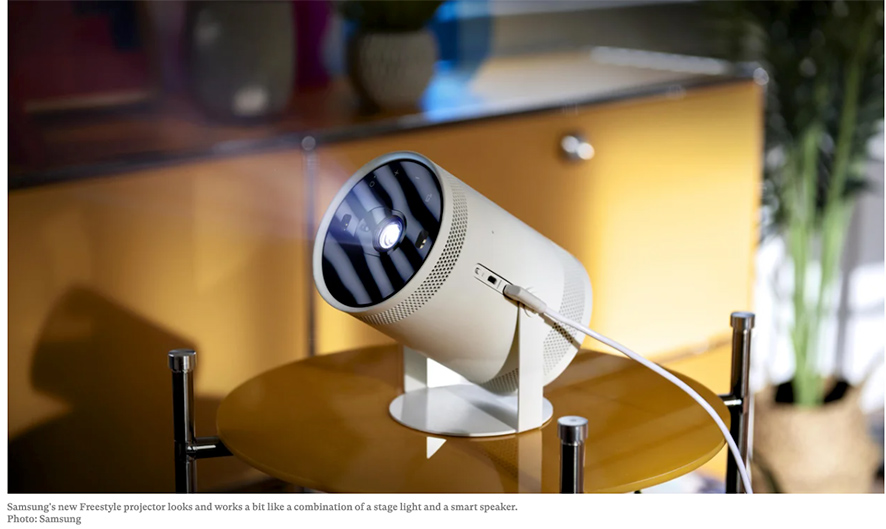
Samsung just made the TV disappear — from protocol.com by Janko Roettgers
Samsung’s Freestyle projector is a smart TV. And not a TV at all. And a smart speaker. And … a lamp?
Excerpt:
Samsung’s TV R&D team seemingly never runs out of ideas: After giving the world a TV the size of a wall, a TV that looked like a giant phone and a TV that doubles as art, at this year’s CES, the company debuted a TV that’s capable of turning anything and everything into a screen.
The new Samsung Freestyle is a portable projector capable of projecting video from 30 inches to 100 inches. It offers access to the very same UI and apps as any of the company’s other 2022 smart TVs, but that’s pretty much where the similarities to a traditional TV end.
This is a Screen — And It Could be the Biggest Product Launch at CES 2022 — from interestingengineering.com by Grant Currin
Samsung is letting users re-imagine what their spaces can be.
Excerpt:
The new hyperflexible, hyperportable, hypercustomizable, hyperpersonalizable projector is all about what it can be for the individual user. Unconstrained by cables or presets, the Freestyle is marketed as an anything-you-want-it-to-be machine. Samsung says it will ship in the next few months.
Samsung Electronics Launches The Freestyle, a Portable Screen for Entertainment Wherever You Are — from news.samsung.com
- First-of-its-kind technology delivers optimal viewing and entertainment in a compact form factor
- Features auto-level, auto-focus and auto-keystone capabilities for perfect picture every time
On 12/27/2021,
in 21st century, 24x7x365 access, career development, computer science, digital learning, education, elearning, engagement / engaging students, homeschooling/homeschoolers, instructional design, internet, K-12 related, languages and translation, learning, learning ecosystem, Learning Experience Design, Learning from the Living [Class] Room, learning hubs & pods & microschooling, learning preferences, library / librarians, Michigan, more voice more choice more control, multimedia, online learning, platforms, remote teaching and learning, skills, society, streams of content, student-related, teachers, teaching & learning, technologies for your home, television, tools, TVs, United States, workplace, youth,
by Daniel Christian
On 12/22/2021,
in 21st century, 24x7x365 access, A/V -- audio/visual, adult learning, Apple, cloud-based computing / apps / other cloud-related, communities of practice, digital audio, digital learning, digital storytelling, digital video, e-publishing related items (EPUB and more), e-readers, education, education technology, engagement / engaging students, Google, homeschooling/homeschoolers, ideas, innovation, K-12 related, learning, learning ecosystem, Learning from the Living [Class] Room, learning hubs & pods & microschooling, library / librarians, media/film, mobile learning, multimedia, music, online media, passions, play, reading, story, storytelling, student-related, television, tools, United States, vendors,
by Daniel Christian
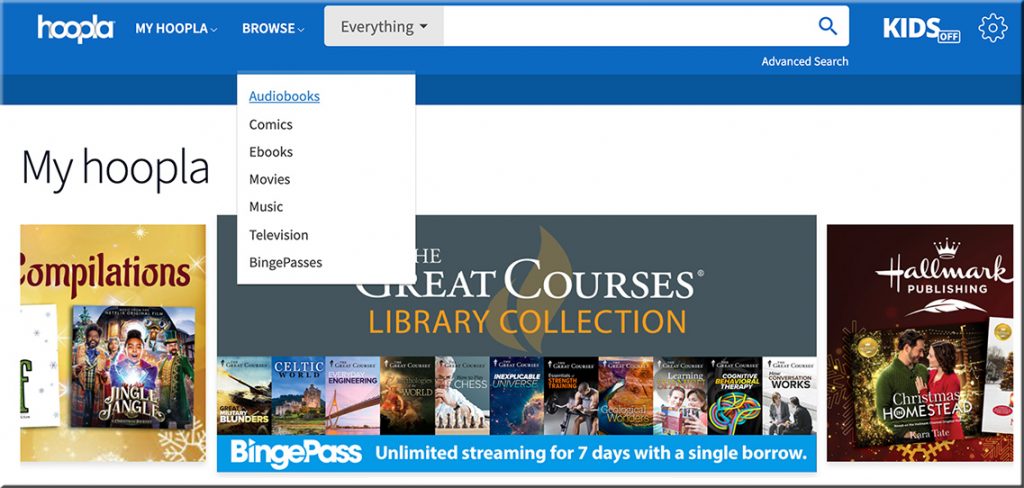
hoopla digital is a digital streaming service for library users to access eBooks, eAudiobooks, music, movies, and TV shows using portable devices like smartphones and tablets.
From DSC:
I downloaded this app yesterday and borrowed a classical Christmas album on the spot. Our local library gives us 10 items per month:
- Books are available for 21 days
- Videos are available for 72 hours
- Music titles are available for 7 days
NOTE: hoopla is available on desktops, phones, tablets, Alexa devices, Rokus, Apple TVs, Fire TVs, and Android TVs.
On 12/21/2021,
in animation, art, attention, Canada, communications, creativity, design, digital audio, digital learning, digital storytelling, digital video, education technology, educational games / serious games, elearning, engagement / engaging students, Google, graphics, mathematics, media/film, more voice more choice more control, motivation, multimedia, music, online learning, online media, participation, pedagogy, platforms, play, presentations, productivity / tips and tricks, professional development, remote teaching and learning, science, society, STEAM-related, story, storytelling, student-related, teachers, teaching & learning, teaching online, tools, vendors, youth,
by Daniel Christian
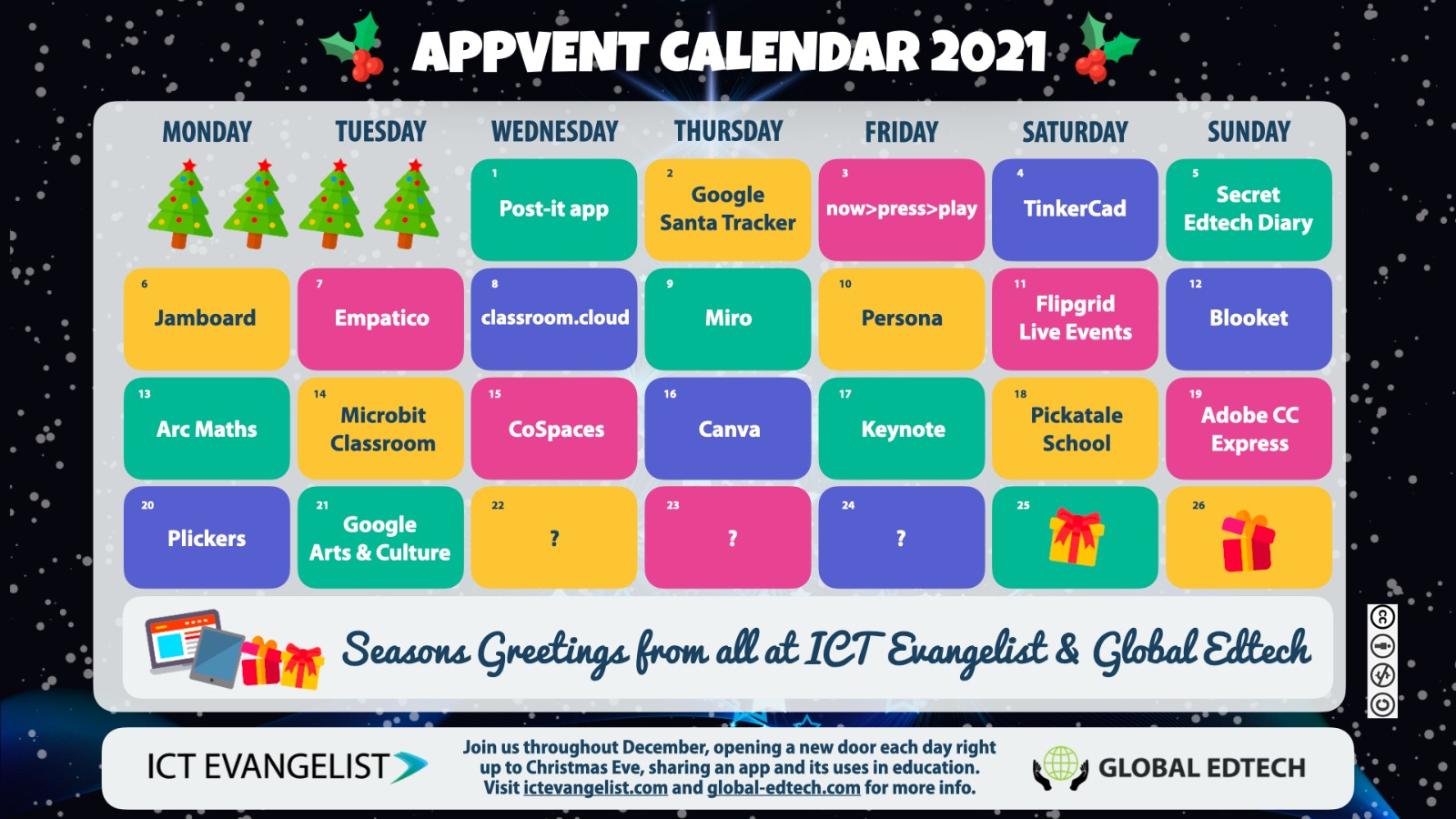
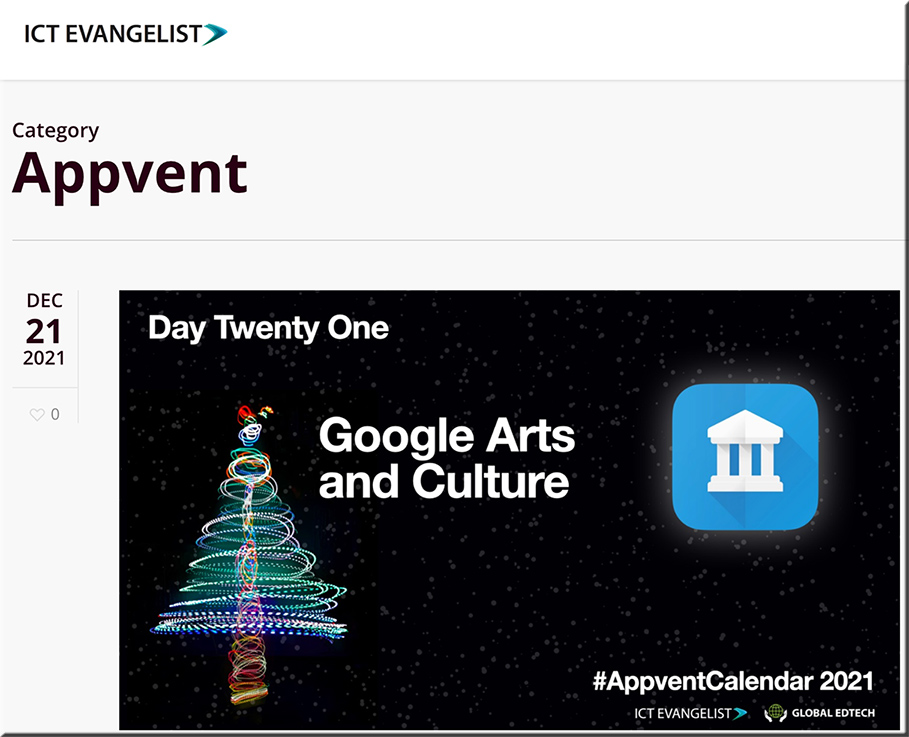
Excerpt from this posting:
Welcome to day 21 of the 2021 Appvent Calendar. It’s been so much fun sharing all of these amazing tools each day across the month so far. With Google featuring twice already on the calendar, it’s great to share again the awe and wonder of human history in the arts and within our cultures with the sharing of this amazing free app. Thanks to Gustavo Calderón De Anda for suggesting it!
Also see:
- 14 measurement apps for teaching math & science — from teachthought and Glenda Stewart-Smith
Glenda Stewart-Smith of Surrey School District #36 in Canada, along with TeachThought staff, helped put together this collection of iPhone and iPad apps that offer all of these measuring abilities and more.
On 12/17/2021,
in change, digital audio, digital learning, digital video, journalism, multimedia,
by Daniel Christian
Journalism program sees positive changes in move from traditional Journalistic Writing courses to Multimedia Communication Model — from jeadigitalmedia.org by Jason Block
Excerpt:
Change is hard.
Change after 15 years? Now that can be downright painful.
Yet that was the exact situation I was in when my district in suburban Chicago decided that we were doing away with our traditional Journalistic Writing courses and shifting to a Multimedia Communication model. This was a part of our larger mission to create a “career pathway” for prospective journalists in our building and district, and while I was excited about that possibility, it made me itchy to remove both the words “journalism” and “writing” from my course titles.
Without getting into the logistics of the shift — that should definitely not be the purpose of this post, unless my purpose is to put you all to sleep — I can tell you definitively and without hesitation that this has been a blessing in disguise, a journalistic silver lining that has not only invigorating me, but also my program as a whole.
The most notable change has been in my enrollment numbers. Whereas I used to struggle to fill one section of “J1,” I now for the first time in my 18 years at Prospect have two full sections of the Introduction to Multimedia Comm course. With all of us fighting the constant recruiting battle to keep our numbers up, having a broader base of students to appeal to has made that job infinitely easier.