Light Field Lab Unveils Modular Holographic Video Wall — from vrscout.com by Kyle Melnick

Along these lines…see:
- Bank of America turns to VR for soft skills training — from vrscout.com by Bobby Carlton
Light Field Lab Unveils Modular Holographic Video Wall — from vrscout.com by Kyle Melnick
Along these lines…see:
3 Promising Opportunities to Teach Your Kids From Home — from medium.com by Eva Keiffenheim
These organizations innovate homeschooling.
Excerpt:
What follows are three organizations that rethink the way children learn from home.
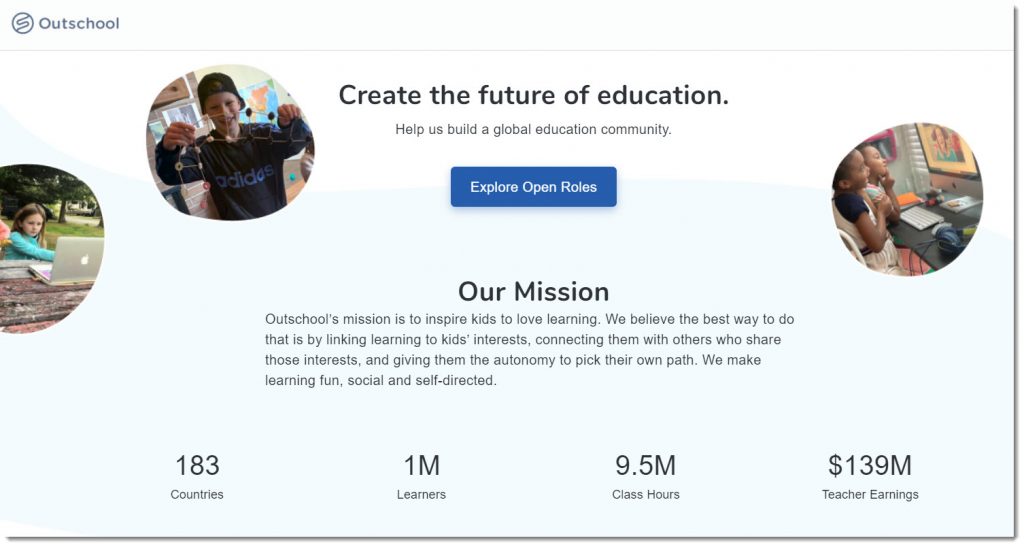
From DSC:
My wife teaches for Outschool and really enjoys it! She develops solid relationships with her students and is able to personalize things (as she deals with 1-3 students at a time). She doesn’t charge much at all, but she enjoys it.
3 Tips for Making Passion-Based Learning Work Successfully — from thejournal.com by Dennis Pierce
Excerpt:
Passion-based learning, a form of self-directed learning in which students pursue projects of interest to them, is becoming more popular in schools — and for good reason: Educators who have set aside time for passion-based learning have discovered that students become highly engaged and motivated when learning about topics that intrigue them, while taking their learning much deeper than they would in a traditional lesson.
Passion-based learning initiatives include Genius Hour and 20time, both inspired by Google’s program that lets employees spend 20% of their time on projects of their choosing to spark innovation.
Giving all students the option to explore their interests can be challenging on a large scale. To overcome this hurdle and make the process easier for teachers, Sonora Elementary uses a new peer-to-peer learning platform called Tract, which is a collection of video content organized into self-directed learning paths.
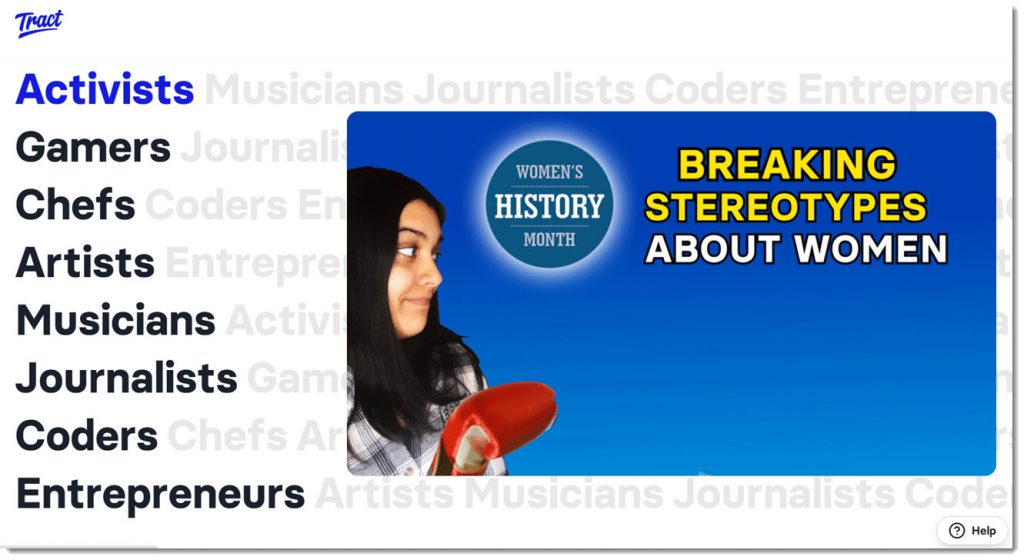
From DSC:
I love the type of tool/app like Tract — as students can work on a variety of skills:
Such projects/tools can unleash a great deal of creativity, engagement, and positive energy. Learning becomes more relevant, enjoyable, and interesting when we can provide more choice and control to our students.
8 ways to keep learning and developing new skills while at home — from babbel.com by Alice Austin
Being stuck inside doesn’t have to mean an end to personal development. Here’s how to keep learning new things while staying at home.
Excerpt:
Free Code Camp has been assembling a long list of courses that span multiple disciplines, from Data Science and Business to Personal Development and Art. They’re all Massive Open Online Courses (MOOCs), and they allow you to take university-created online classes through providers such as Coursera or Udacity.
So that class you missed out your first time going to college? Now would be the time to go back and really enjoy it.
There are tons of online tutorials on YouTube and many apps that can help you hone your skills. Yousician is an app that provides video tutorials to learn piano, guitar, bass and ukulele. There are other apps that specialize in one area, like Flowkey for piano, or SingTrue for vocals. Whatever instrument you have lying around, there are definitely resources out there for you to improve your skills.
Common Anxieties in Beginning HyFlex: Learning to Teach a HyFlex Class — from hyflexlearning.org by Brian Beatty
Excerpt:
Not surprisingly, one of the biggest anxieties – FEARS – for many faculty considering or implementing a HyFlex approach for the first time is learning how to do so, and to do so effectively the very first time. No one likes to feel like they aren’t equipped to do the work they are required (or challenged) to do; perhaps especially teachers who are normally in full control of their classrooms and the activities that take place in them. When you are planning to teach HyFlex, it may seem like you are planning for CHAOS, or at least planning to lose control over the class environment(s), the teaching process, and ultimately student learning. Let’s address those concerns one at a time, but briefly.
If we assume you are an effective classroom teacher, then a common design path that I usually recommend is to start with your plans for an effective classroom experience and work to translate those to the other modes, accessing expert guidance as needed (such as, instructional designers, online course design books, your colleagues). What are the learning outcomes (or instructional objectives) for the classroom? How will those translate into the online mode(s) you are planning? What about the instructional content and associated activities for the classroom? How do those translate? What about plans for assessment? Start with what you know, and are confident with, and then layer in approaches for the other modes.
Resources from “The Science of Learning” — from deansforimpact.org
Excerpt:
The Science of Learning summarizes existing cognitive-science research on how students learn, and connects it to practical implications for teaching. The report is a resource for teacher-educators, new teachers, and anyone in the education profession who is interested in how learning takes place.
Deans for Impact believes all teacher-candidates should know the cognitive-science principles explored in The Science of Learning. And all educators, including new teachers, should be able to connect those principles to their practical implications for the classroom.
One of those resources is:
Also see:
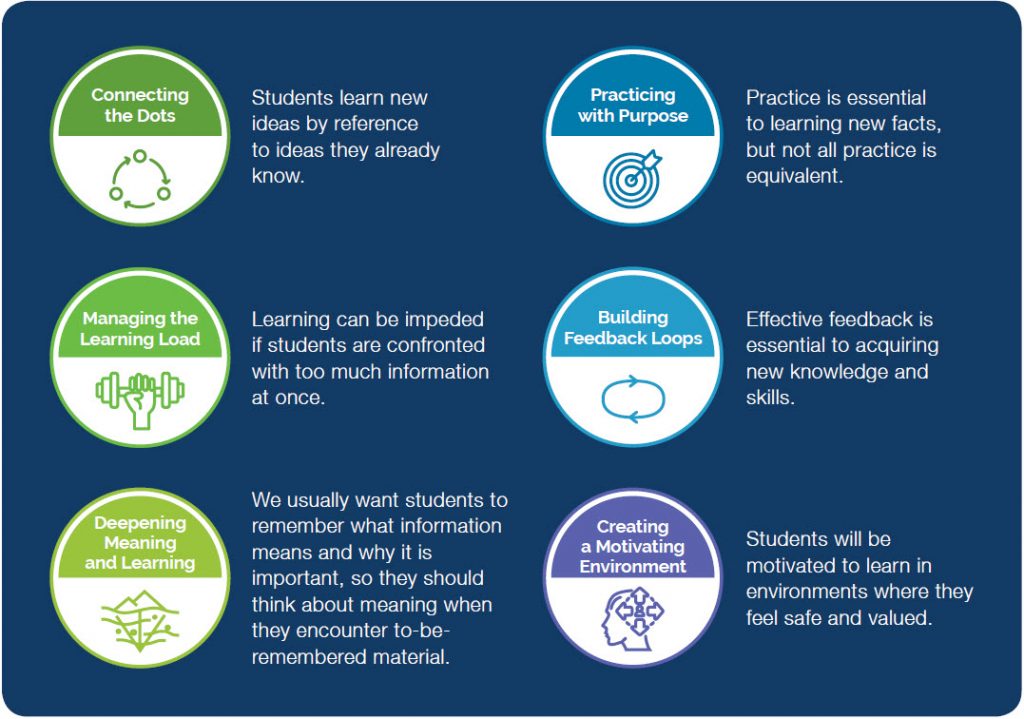
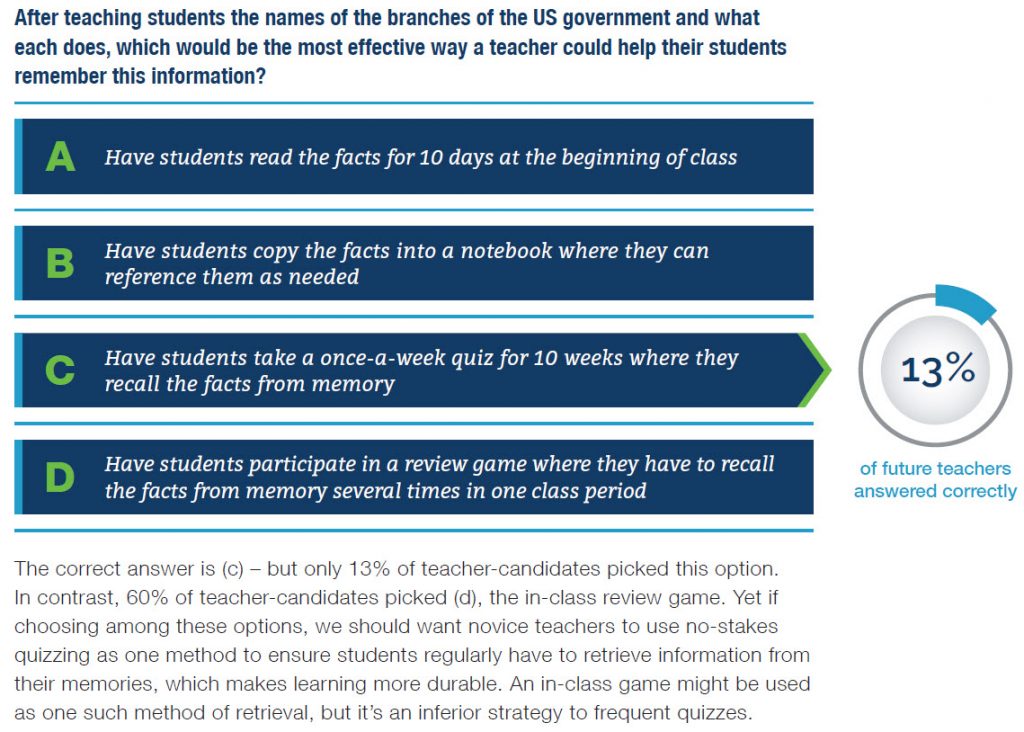
There are six major takeaways from our first administration of our Learning by Scientific Design assessment:
Surviving Among the Giants — from chronicle.com by Scott Carlson
As growth has become higher ed’s mantra, some colleges seek to stay small.
Excerpts:
The pressures on the higher-education business model are changing those attitudes. The Council of Independent Colleges’ fastest-growing initiative is the Online Course Sharing Consortium, which allows small colleges to offer certain courses to students at other institutions. Currently, there are 2,200 enrollments among almost 6,000 courses on the platform.
“The higher-ed business model is broken,” says Jeffrey R. Docking, who has been president of Adrian College for 16 years. “But where it’s most broken — and the first ones that are going to walk the plank — are the small private institutions. The numbers just don’t work.” Combining some backroom functions or arranging consortial purchases is just “dabbling around the edges” — and won’t get close to driving down the cost of tuition by 30 to 40 percent over the next several years, which is what Docking believes is necessary.
From DSC:
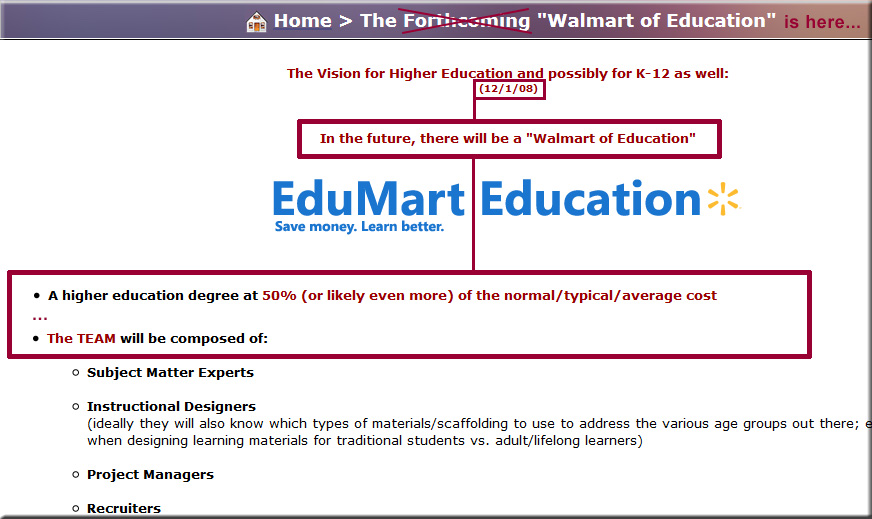
Docking’s last (highlighted) sentence above reminds me of what I predicted back in 2008 when I was working for Calvin College. The vision I relayed in 2008 continues to come to fruition — albeit I’ve since changed the name of the vision.
From DSC (cont’d):
I was trying to bring down the cost of higher education — which we did with Calvin Online for 4-5 years…before the administration, faculty members, and even the leadership within our IT and HR Departments let Calvin Online die on the vine. This was a costly mistake for Calvin, as they later became a university — thus requiring that they get into more online-based learning in order to address the adult learner. Had they supported getting the online-based learning plane off the runway, they could have dovetailed nicely into becoming a university. But instead, they dissed the biggest thing to happen within education in the last 500 years (since the invention of the printing press).
Which brings me to one last excerpted quote here:
“For so many years,” Docking says, “all of these really smart people in Silicon Valley, at the University of Phoenix, at for-profits were saying, We’re going to do it better” — and they came around with their “solutions” in the form of MOOCs, or massive open online courses, and other scaling plans. Small colleges didn’t want to hear it, and, Docking says, maybe it was to their peril.
Could Coursera become as prestigious as Harvard? This expert thinks so. — from edsurge.com by Jeffrey R. Young
Excerpt:
Big changes are coming to higher education, and those changes will be bigger and more disruptive than many college leaders realize as online education grows in both size and prestige.
That’s the view of Arthur Levine, in a new book called “The Great Upheaval: Higher Education’s Past, Present, and Uncertain Future,” which he co-wrote with Scott Van Pelt, a lecturer and associate director of the Communication Program for the University of Pennsylvania’s Wharton School.
As more students turn to these degrees for their credentials, they may come to see these corporate platforms as the provider of learning rather than worry about which college is the one behind the scenes doing the teaching, Levine says.