K-12 education in America is like quickly moving trains that stop for no one.

K-12 education in America is like quickly moving trains that stop for no one.

From DSC:
A family member struggles with spelling — big time. This causes her major amounts of anxiety in school.

Another family member had some learning disabilities and reflects back on school with some bad memories.

Another family member struggles with social graces and learns at a much different pace than her peers — the move to her education being (predominantly) done via homeschooling has helped significantly.

A friend of mine has Dyslexia. He recently said that school was hell for him.

Another person I know doesn’t understand his daughter’s learning disabilities — at all. He’s asking a fish to climb the tree and yells at his daughter when she doesn’t produce like the other kids do. Her school is for college-bound learners, and there’s always pressure to maintain the school’s “blue-ribbon” status (i.e., sorry if you don’t fit in…but please board the train anyway, as it’s about to depart).

These people and stories about their educations got me to reflect on all the people who went through the school systems in the United States (over the last few decades) that didn’t work well for them. In fact, not only did the systems not work well for them, they were the sources of a great deal of pain, anxiety, depression, anger, frustration, and embarrassment.  Instead of being a place of wonder or joy, school was a painful, constant struggle to get through.

For those who can keep up or even excel at the pace that the trains travel at, school isn’t that much of a problem. There are likely different levels of engagement involved here, but school is manageable and it doesn’t cause nearly the stress for someone who struggles with it.

For those with learning disabilities, I’d like to apologize to you on behalf of all the people who legislated or created rigid, one-size-fits-all school systems that didn’t understand and/or meet your needs. (Why we allow legislators — who aren’t the ones on the front lines — to control so much of what happens in our school systems is beyond me.) I’d like to apologize on behalf of all of the teachers, administrators, and staff who just accept the systems as they are.

Please help us reinvent our school systems. Help us develop the future of education. Help us develop a more personalized, customized approach. For those who are working to provide that, thank you! Thank you! Thank you!

To everyone working within Pre-K through 12th grade, help us offer: More voice. More choice. More control. The status quo has to go. School should not be a constant source of pain and anxiety.
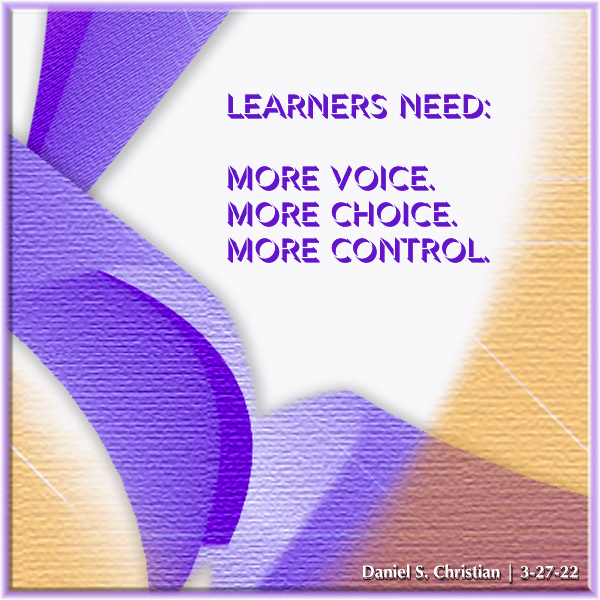
Learners need: More voice. More choice. More control. -- this image was created by Daniel Christian


What Educators Need to Know About Assistive Tech Tools: Q&A with Texthelp CEO — from thejournal.com by Kristal Kuykendall and Texthelp CEO Martin McKay

Excerpts (emphasis DSC):

THE Journal: What are some examples of the types of assistive technology tools now available for K–12 schools?
McKay: There are a broad range of disabilities, and accordingly, a broad range of learning and access difficulties that assistive technology can help with. Just considering students with dyslexia — since that is the largest group among students who can benefit from assistive tech tools — the main problems they have are around reading comprehension and writing. Assistive technology can provide text-to-speech, talking dictionaries, picture dictionaries, and text simplification tools to help with comprehension.

It’s important that these tools need to work everywhere — not just in their word processor. Assistive technology must work in their learning management systems, and must work in their online assessment environment, so that the student can use the assistive tech tools not only in class, but at home as they work on their homework, and perhaps most importantly on test day when they are using a secure assessment environment.


We need to use more tools — that go beyond screen sharing — where we can collaborate regardless of where we’re at. [Christian]

From DSC:
Seeing the functionality in Freehand — it makes me once again think that we need to use more tools where faculty/staff/students can collaborate with each other REGARDLESS of where they’re coming in to partake in a learning experience (i.e., remotely or physically/locally). This is also true for trainers and employees, teachers and students, as well as in virtual tutoring types of situations. We need tools that offer functionalities that go beyond screen sharing in order to collaborate, design, present, discuss, and create things.  (more…)


From DSC:
Hmmm…many colleges and universities keep a close eye on their peers and often respond with similar strategies that their peers are pursuing. But who is an organization’s peer? The Chronicle of Higher Education‘s posting below — “How a College Decides Who Its Peers Are” — stated that “there is clearly no shared definition of what constitutes a peer institution.” 

Plus, I found this item especially interesting:

Harvard University selected only three peer institutions: Yale, Princeton, and Stanford. But 22 institutions, including Bowdoin, named Harvard as a peer. Bowdoin, a small, liberal-arts college with about 1,800 undergraduate students and no graduate programs, chose 98 “peers,” including the entire Ivy League and many large universities, some of which enroll more than 10,000 students. Bowdoin itself was picked by 35 institutions as a peer. All of them were small, liberal-arts colleges or universities that primarily serve undergraduates.

I have often thought that colleges and universities should care far less about what their peers are doing. Rather, they should move forward with their own solid visions, bold actions, and well-thought-through strategies — as there can be a great deal of danger and risk in the status quo.

Too many alternatives have been appearing — and will likely continue to appear — on the lifelong learning landscapes. Most likely, these new organizations will offer in-demand credentials/skills as well as the capabilities of helping people constantly reinvent themselves — with far less expensive price tags associated with these types of offerings.


How a College Decides Who Its Peers Are — from chronicle.com by Susan Poser
Questions of institutional identity are at the core of the process.

Excerpt (emphasis DSC):

The mismatch between whom an institution chose as peers, and the colleges that reciprocated, pervades the data set. It raises the question of how institutions designate peers, which is a mystery. In some cases it is likely to be decided by someone in the Office of Institutional Research or the provost’s office in response to the Ipeds survey, while in others perhaps some process leads to a consensus among administrators. Regardless, there is clearly no shared definition of what constitutes a peer institution.

Also relevant/see:


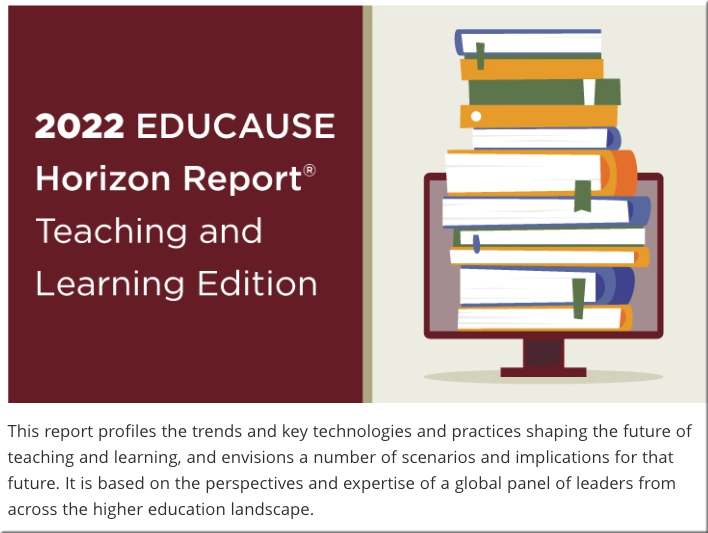
2022 EDUCAUSE Horizon Report | Teaching and Learning Edition


2022 EDUCAUSE Horizon Report | Teaching and Learning Edition — from library.educause.edu

Sections include:

  • Trends: Scanning the Horizon
  • Key Technologies & Practices
  • Scenarios
  • Implications: What Do We Do Now?

 Also relevant/see:


Also relevant/see:

2022 Educause Horizon Report Suggests Change Is Here to Stay; No Return to ‘Normal’ — from campustechnology.com by Rhea Kelly

Excerpt:

If the COVID-19 pandemic has been a time of unprecedented change in higher education — characterized by rapid pivots to remote work and learning and an explosion in the use of technology across the institution — the future is about reframing those changes into long-term realities, according to the 2022 Educause Horizon Report Teaching and Learning Edition, released this week. Colleges and universities are shifting their mindsets to “reflect an evolution from short-term ’emergency’ or ‘reactive’ modes of offering education during extraordinary circumstances to making strategic and sustainable investments in a future that will be very much unlike our past,” the report suggested.

6 Technologies and Practices Impacting the Future of Higher Education — from campustechnology.com by Rhea Kelly


The Digital versus Brick-and-Mortar Balancing Game — from educause.edu

Excerpt:

The blended campus required after two years of upheaval calls for out-of-the box thinking about what to keep and what to discard from both digital and physical work and learning spaces. Technology leaders face critical decisions regarding workplace culture, physical classroom design, and traditional campus spaces.

Making the move from fully in-person instruction to a learning environment that also accommodates remote students (and remote faculty) requires rethinking and redesigning physical learning spaces to provide an equitable experience for all learners. Technology leaders will need to overcome sizable obstacles to create inclusive classrooms that enable faculty and students to reap the many benefits of hybrid [hyflex] learning.

Also see some of the other most urgent issues in higher education here:

The EDUCAUSE showcase series spotlights the most urgent issues in higher education.


Teaching: Fresh Approaches to Faculty Development — from chronicle.com by Beckie Supiano

Excerpt:

Baranovic can’t imagine returning to the old model: He’s sticking to panels in Zoom. Among the benefits, he says: “This arrangement breaks institutional silos, allows faculty to talk more about their experiences, shares effective practices from sources faculty trust (their peers), creates a stronger sense of community, makes it easy for panelists (they receive the questions ahead of time if they want to prepare, but because they’re speaking to experience, they don’t really have to prepare), and creates a form of support that works like therapy but doesn’t feel like therapy.”

Next, Baranovic hopes to turn the panels into a podcast format for professors unable to attend in real time.

From DSC:
As someone who had been involved with Teaching & Learning Centers for years, I can tell you that it’s very disheartening to put together a training session for faculty members and have very few — if any — people show up for it. It’s a waste of time and it leaves the T&L staff and/or IT staff members feeling discouraged and unvalued.

Over the years, I developed a preference for putting things into an asynchronous digital format for faculty members and adjunct faculty members to access per their own schedules. The institutions that I was working for got a greater ROI from those sessions and they were able to visit an internal “course” or website to reference those materials on-demand.

I also like the idea of podcasting here, but that takes a lot of time and effort — and isn’t always possible when you are one person trying to assist hundreds of faculty members (from a technical support and an LMS admin standpoint).

As an Instructional Designer, I also want to comment that it’s hard to help steer a car if you can’t even get into the car. Those institutions that are using team-based approaches will be far more successful in designing and developing more polished, effective, accessible learning experiences. Very few people can do it all.


Play-based learning in your homeschool: It’s more than just board games — from raisinglifelonglearners.com by Colleen Kessler

Excerpts:

Play-based learning doesn’t have to fit in a box!  There are many wonderful resources in the homeschool community to help you discover what works best for your family.

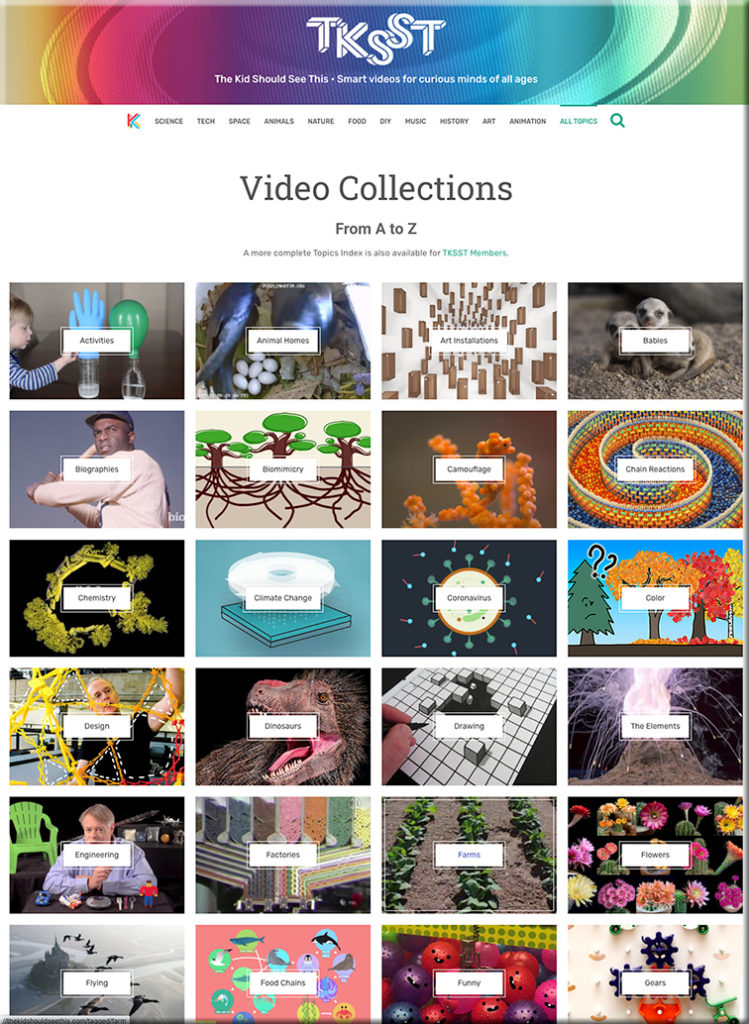
In addition to the various suggestions I have included in today’s episode of the podcast, you’ll find excellent recommendations from these sites, dedicated to creating out of the box approaches to learning:

In a nutshell, this means that kids learn best when they’re mentally active, engaged socially, and when they can make connections to their lives.

Also relevant/see:

Financial literacy games provide fun ways for students of all ages to learn about finances on various topics. Some websites have grade bands with interactive ways for students to explore creating a bank account, setting a budget, applying for a loan, and many others. Many of the options available include financial literacy games for the classroom.

From DSC:
Although the following resource isn’t about learning, it reminds me of the topic of “play”:


Some Colleges Are Ending Hybrid Learning. Students Are Pushing Back. — from chronicle.com by Adrienne Lu
Daily Briefing: Is the End of Hybrid Learning Leaving Disabled and High-Risk Students Behind?

Excerpt:

Some students, though, want their colleges to make hybrid learning permanent. They argue that scaling up remote learning during the pandemic made higher education more accessible — not only for students with disabilities and the immunocompromised, but also commuter students, those balancing schoolwork with jobs, and students with caregiving responsibilities — and helped to protect vulnerable faculty members.


The Future Trends Forum Topics page — from forum.futureofeducation.us by Bryan Alexander

Excerpt:

The Future Trends Forum has explored higher education in depth and breadth. Over six years of regular live conversations we have addressed many aspects of academia.

On this page you’ll find a list of our topics.  Consider it a kind of table of contents, or, better yet, an index to the Forum’s themes.

Also see:

Since we launched in early February, 2016, the Forum has successfully published three hundred videos to YouTube.  Week after week, month by month, over more than six years we’ve held great conversations, then shared them with the world, free of charge.


It’s (Past) Time to Redesign the Teaching Profession — from gettingsmart.com by Katie Kimbrell

Excerpts (emphasis DSC):

I don’t care if you don’t have kids, if your kids are grown, or if you think for some reason you’re shielded from this threat: This crisis should concern everyone. Just like when any core institution is threatened to subsist, reinvention is not just an opportunity to do better, but an imperative to survive—both for an institution, but more importantly, for our collective humanity.

Please note that this piece is not making an argument for the concept of agency teaching (ie. please don’t send me your theses on why my idea is bad), but rather to demonstrate a point about the need to rethink the teaching profession and to treat educators as humans and critical stakeholders in the way we redesign it.

Asking a critical mass of past, present, and future educators these questions is where the empathy work begins—and therein the only way we will be on the right track in designing a system that works for all the humans inside of it.

Also relevant/see:

Who is Going to Teach the Kids? — from by Cameron Paterson

Key Points:

  • There have been profound changes in the work and workload of teachers.
  • During remote learning, both teachers and students discovered a new sense of autonomy.
  • Reprioritizing the focus of work for teachers is critical to the success of schools.
 

Learning Disorders and Law School: Strategies and Resources — from onlinemasteroflegalstudies.com with thanks to Allegra Balmadier for these resources

Excerpt:

Law schools across the country with all kinds of students and faculty could fairly be described by a single word: rigor. Juris Doctor (J.D.) degree programs are traditionally known for copious amounts of required reading and semester-end exams that count for a student’s whole grade. A legal education is an intensive course of study that would challenge any student.

A student with a learning disorder or disability (LD) may struggle for a particular reason—not for lack of effort but because of the conventional structure of class, assignments and tests. LDs can cause difficulty with processing information, a problem that is exacerbated when universities and colleges fail to offer support.

However, with appropriate strategies, students with LDs can succeed in law school and in the legal profession. Learn more about learning disorders and find resources below.


Homeschool math doesn’t have to be intimidating! — from raisinglifelonglearners.com by Colleen Kessler

Excerpt:

Finding The Right Math Program For Your Child
There are so many choices on the market. Some with manipulatives, some with thick workbooks, some on online learning platforms.

While it may seem overwhelming, its actually good news! You don’t have to worry about all of them – you only have to find the one that works for you!

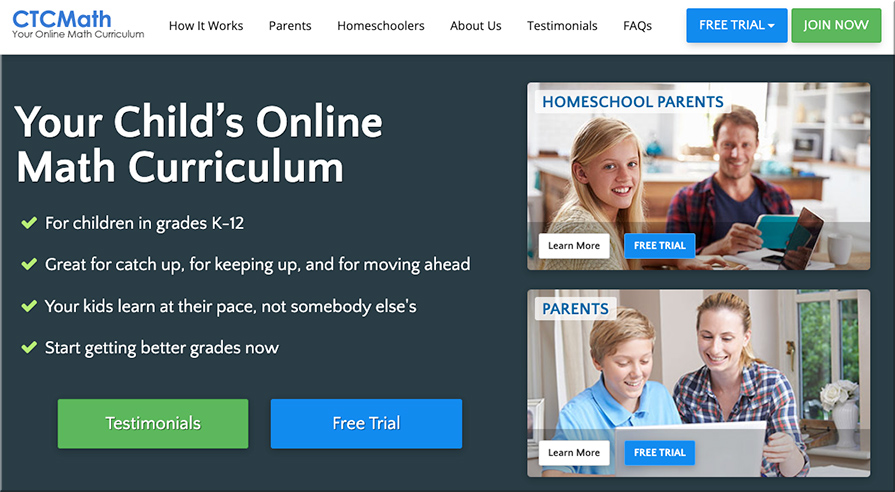
That’s exactly what’s happened for my family this year with CTCMath.

CTCMath is an online program developed by a father of ten children, with twenty years teaching experience. It is a subscription math service that provides learning from Kindergarten all the way through Calculus. CTCMath specializes in providing online video tutorials that take a multi-sensory approach to learning.


The number one thing we’ve loved most about CTCMath this year is that it teaches math in short, bite sized amounts.

I LOVE the shorter lessons approach. Not only is it the best way to teach children with attention issues, but it also makes it easy for parents who struggle with math themselves!

Colleen Kessler


45 Next Generation Learning Tools That Kids Will Love — from ireviews.com with thanks to Alex Ward for this resource

Excerpts:

There’s a wide range of tools designed to support curriculum and help teachers and students achieve their goals. These are our top picks for school students of every age, due to their impressive functionality and simple integration into the classroom.


From DSC:
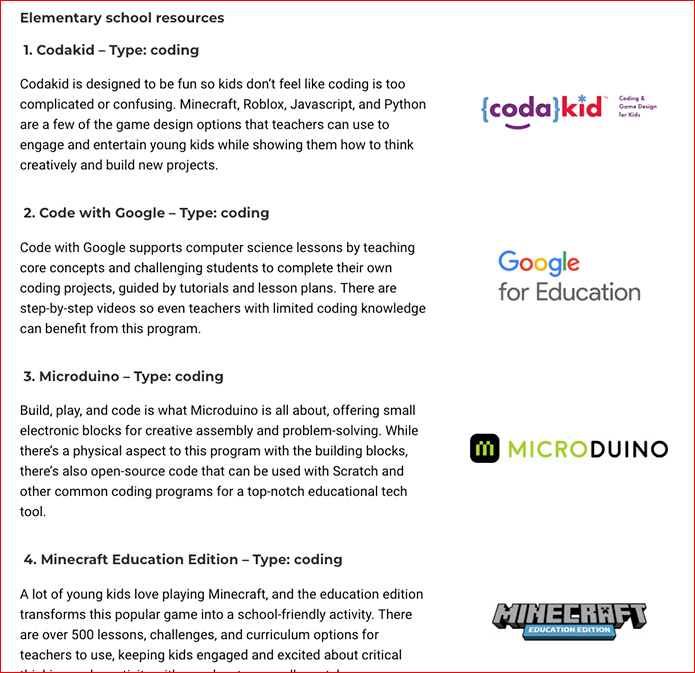
Below is a sample screenshot from the Elementary school resources section. They also have resources for middle schoolers and high schoolers.


45 Next Generation Learning Tools That Kids Will Love

 
© 2025 | Daniel Christian