


Will learning curated by employers replace degrees? — from universityworldnews.com by Louise Nicol
If universities do not future-proof their offer through deeper and more credible partnerships with employers and industry, what exactly prevents employers from educating and training people themselves?
This is why the future of higher education depends on far deeper and more operational partnerships with industry. Not symbolic advisory boards or occasional guest lectures but genuine co-design of curricula, shared ownership of applied projects and clear accountability for graduate capability.
Universities that integrate live industry problems, cross-faculty collaboration and work-based learning into the core of their programmes make themselves harder to replace. Those that acknowledge the existence of external learning platforms and deliberately build them into a broader educational journey strengthen rather than weaken their position.
The real risk for universities is not replacement but marginalisation. Employers will not abandon universities out of hostility or ideology. They will do so pragmatically if universities fail to add distinctive value beyond what employers can now deliver themselves.
The Current State of Play: AI in Higher Education and the Road Ahead — from er.educause.edu by Tanya Gamby, David Kil, Rachel Koblic, Paul LeBlanc, Mihnea Moldoveanu and George Siemens
The conventional explanation for this strategic vacuum points to the speed of technological change; it is moving too fast for institutions built for deliberation. That is true. . . and incomplete. The deeper issue is cultural. In fairness to higher education, many industries are struggling to keep up with the pace of AI advances. Higher education, however, moves even more slowly and is not built for the kind of transformational speed now underway. Getting institutional stakeholders to engage, rethink the work, and move faster may be the central challenge facing presidents and chancellors today, and that’s saying a lot in such volatile times.
From DSC:
I highlighted this paragraph because it hits upon the key item involved here — culture. “The deeper issue is cultural.” I think that’s a very true statement.
Part of the culture and setup of many institutions includes giving faculty members full rein of their classes and their departments. Faculty members have a great deal of leeway and power in how they do things. So trying to get X faculty members to get on board — including the Department Chairs — is not an easy task.
Another part of culture involves being willing — or not — to change in the first place. Some institutions are like Google and are used to making changes and being more innovative. But those institutions are not the norm, at least in my experience. And this doesn’t even address another topic the article mentioned — the pace of these changes. As the authors point out, most institutions of traditional higher education are not equipped to deal with the current pace of change (nor are most of our other types of institutions and our corporations as well).
I’m going to end this posting with another brief excerpt from the article:
Institutions rooted in human relationships, committed to truth-seeking, and oriented toward the full development of persons play a central role. AI cannot manufacture the experience of mattering to another human being. It cannot model intellectual courage or ethical discernment. It cannot build the kind of community in which students discover who they are and what they believe.
These are not small things. They are, in fact, the things most worth doing. At their best, colleges and universities are not only preparing better workers but shaping individuals and strengthening society.
From DSC:
I used to be able to bring up Firefly on the web and use it “free” of charge — I didn’t have to go purchase tokens or credits. (I was actually paying for the Adobe Creative Cloud Pro suite of tools…so it wasn’t really free.)
But the other day I was trying to figure out what the latest pricing is at Adobe with that suite of tools and the use of credits for AI-based features. They say Adobe Creative Cloud Pro users get 4000 credits a month. Well, I have that suite and I’m still getting prompted to purchase credits. Firefly for individuals runs from $9.99 (2,000 credits/month) to $139.91 per month (50,000 credits per month). Not inexpensive, right? Below are other items along these lines.
The Era of Affordable AI Is Over. What Comes Next? — from builtin.com by Ameya Kanitkar
AI providers are shifting to usage-based billing for their services. AI fluency is more important now than ever to make the most of your tools to avoid unnecessary spending.
Summary: The era of cheap, flat-rate AI is ending as providers shift to usage-based billing. Every prompt now carries a direct cost, turning casual use into major budget risks, as seen when Uber depleted its 2026 AI budget in four months. Leaders must now track real-time value and token efficiency.
For a brief window, companies had access to the most transformative technology in a generation at the cost of a streaming subscription. Tools like ChatGPT put AI within reach of anyone with a browser and time for experimentation, while GitHub Copilot came in at just $10 a month, with token costs remaining relatively low. In the beginning, experimentation felt cost-effective, easy and relatively low-risk.
But that era is ending, and the bill is coming due faster than a lot of enterprise leaders anticipated.
The Fable of AI in Education — from downes.ca by Stephen Downes
Marc Watkins, Rhetorica, Jun 17, 2026
Tokenomics will be a hot topic of discussion on university campuses because, as Marc Watkins notes in this article, there is no realistic path forward to providing all students with access to advanced AI.
From this posting on LinkedIn.com from Dr. Nick Jackson:
And now there is a third layer emerging. Institutions are waking up to a systems-level question they are likely not remotely prepared for. Who pays for AI? How are budgets managed when there are unclear token consumption pricing models? How is AI procured? Who decides what tools get used and by whom and who gets access and at what level?
.
What a disco ball teaches us about learning and leadership — from timeshighereducation.com by Lauren Flannery
By acknowledging that perspectives are evolving and relational, educators and leaders can encourage contribution and connection without sacrificing what makes people distinct
It also shows us that difference does not always need to be resolved. In teaching, learning and leadership, the aim is not to create uniformity but to create conditions in which different people can contribute, connect and shine without losing what makes them distinct.
In classrooms, inclusion is sometimes approached as ensuring access to the same knowledge, resources and opportunities for all students. The beach ball helps here: it encourages us to explore multiple perspectives. But the disco ball pushes us further to explore how learning environments can support students to bring their experiences, identities and knowledge into the room – not to smooth them out but to draw from them.
Designing for multiple perspectives also means recognising that expressing an opinion is not only about confidence; it is also about conditions. People are more likely to speak when they feel their contribution will be heard without being dismissed, appropriated or flattened. Creating those conditions may involve discussing uncertainty, welcoming challenge, slowing down decision-making or making space for quieter forms of participation. The aim is not to make everyone agree, but to allow different reflections to interact in ways that generate richer understanding.
If AI Eats the Entry-Level Job, Where Do Young People Learn to Work? (Ryan Craig, Achieve Partners) — from humanistxyz.substack.com by Allison Dulin Salisbury; via Ryan Craig
“The public should not be subsidizing colleges whose students lack relevant, paid, in-field work experience.”
That is the trap at the center of this conversation: everyone wants to hire someone with three years of experience, and almost no one wants to provide those three years.
And Ryan’s policy prescription is unusually concrete: pay employers to hire and train apprentices, following the countries that have scaled apprenticeship far faster than the U.S.; require colleges receiving federal student aid to provide relevant, paid, in-field work experience; and build a market of intermediaries that can make the whole thing operational.
Ryan’s view is that higher education remains critically important. But college without meaningful work experience may become a much worse bet, especially for students who cannot afford to guess wrong.
A screenplay written by a Calvin Prison Initiative student while incarcerated is now screening at film festivals across the country. — from linkedin.com by the Calvin Prison Initiative
From DSC:
I used to work with Calvin film and media professor Geert Heetebrij — who was behind this endeavor. I went to the same church that he and his family attended. I can’t say enough good things about him. He’s just fantastic! By the way, he was there for me when twelve of us didn’t survive the fourth round of layoffs at Calvin (back then it was Calvin College). He periodically — but consistently — checked in on me as the job search continued. He prayed for me (and for my family). His steadfast encouragement meant a lot to me.
I also worked with Sam Smartt, who was also mentioned in the article. Go Geert! Go Sam! And go Calvin for continuing to do your prison ministries! You were one of the first to do this, if not thee first.
Two years ago, AI broke assessment. Now, it’s helping us to reinvent it. — from linkedin.com by Dr. Philippa Hardman
Also from Dr. Hardman, see:
A new study shows AI helped deliver 1.5 years of maths progress in 8 weeks — here’s how. — from linkedin.com by Dr. Philippa Hardman
…a new study shows AI helped deliver 1.5 years of maths progress in 8 weeks — here’s how.
Google DeepMind just shared the results of a randomised trial involving 1,763 students. Half used Gemini’s “Guided Learning” to learn maths; half didn’t.
The result: the group working with AI gained the equivalent of 1.2 to 1.7 years of extra progress compared to those who didn’t.
It’s tempting to read this as “Gemini’s Guided Learning mode works!” But the key point here is that Gemini didn’t work alone….
Look closer, and what made the difference wasn’t just the tech — it was a great teacher making expert use of it.
The Tyranny of College Admissions: Why It’s So Challenging to Have Real Change in K-12 Education — from gettingsmart.com by Jon Alfuth
Key Points
- College admissions policy shapes K-12 practice. If colleges continue to privilege course sequences, seat time, and grades, high schools will remain constrained in how far they can move toward competency-based learning.
- States and institutions already offer models for change. Wisconsin, Colorado, Indiana, and pilots like CUNY and Michigan Ross show that admissions can incorporate portfolios, demonstrations of learning, and durable skills.
If we could instead orient K-12 education around skill development and application rather than Carnegie Units and grades, we could create a new paradigm for where, when and how students demonstrate college and career readiness. Competency-based education moves schools and systems towards this desirable future that balances knowledge with skills.
Despite tremendous evidence of its potential, efforts to accelerate this shift have been stymied by the tyranny of college admissions requirements and processes. Parents, teachers, administrators and policymakers end up in a quandary. Anyone attempting to shift away from this traditional course sequence is criticized as trying to lock kids out of higher education and we snap back to the way things have always been done.
Why Students Aren’t All In on AI—And What They Want From Colleges — from insidehighered.com by Colleen Flaherty
New Student Voice data reveal students are embracing AI as a learning tool while worrying about dependence, career disruption and inconsistent institutional responses.
Read on for six takeaways from the survey and additional insights—including how institutions can start to close the gap between students’ optimism about AI as a learning tool and their faith in their colleges’ ability to help them navigate change.
Takeaway 1: More students are using AI than ever for coursework, while a significant share—20 percent—remain resisters.
Takeaway 2: “Worried about dependence” is the most common student stance on AI.
Takeaway 3: A majority of all students expect AI to somewhat (39 percent) or very (16 percent) negatively impact their career prospects.
Takeaway 4: Just one in 10 students says that their institution is handling AI’s rise very well, in a thoughtful and proactive way.
How Constructivism Learning Theory Shapes Modern Instructional Design And L&D Strategy — from elearningindustry.com by Christopher Pappas
.
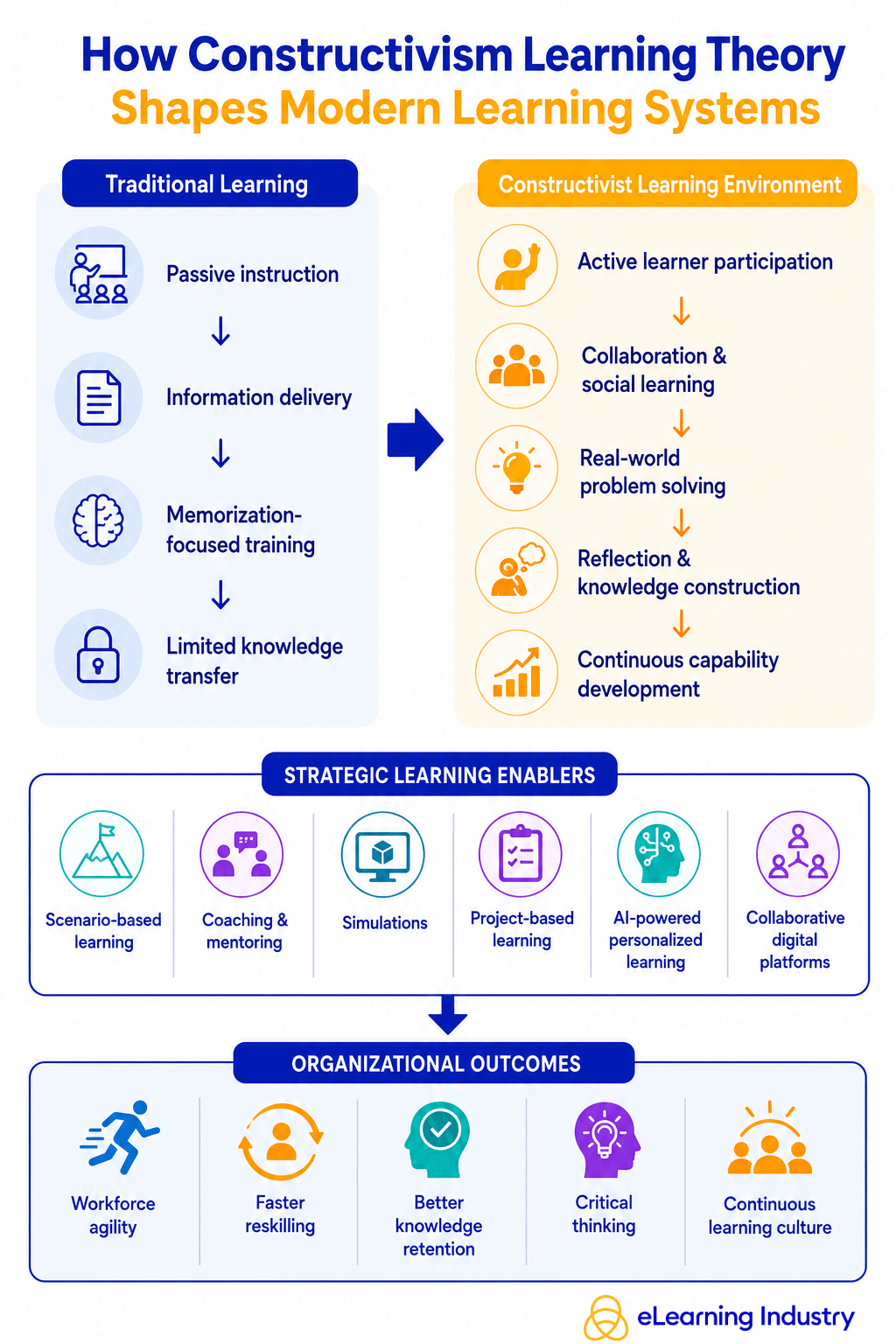
Also see:
- Microlearning Trends And Strategies In 2026 — from elearningindustry.com by Christopher Pappas
Rethinking Learning Design in Elementary Schools — from edcircuit.com
Why K–5 leaders must redesign—not just adopt—technology to restore attention, deepen thinking, and align AI with how children actually learn
Rethinking learning design in elementary schools is critical as screen time and AI reshape attention, thinking, and student engagement.
Designing for Thinking, Not Just Doing
At its core, learning design must shift from task completion to thinking development.
This requires creating environments where students:
- Spend time processing ideas
- Work through confusion without immediate answers
- Build persistence through challenge
It also requires clarity around the role of technology.
Technology should:
- Extend thinking
- Provide meaningful feedback
- Support exploration
It should not:
- Replace effort
- Short-circuit reasoning
- Eliminate productive struggle
The goal is not to reduce technology use.
It is to ensure that students remain the ones doing the thinking.
Should We Integrate AI into Our Teaching?: Evidence-Based Guidelines for Deciding When AI Belongs — from Faculty Focus by Norman Eng, EdD
Four Questions for Deciding Whether to Use AI
Question 1: Will this AI tool help students use, recall, and demonstrate understanding of core disciplinary content?
Question 2: Will this AI tool require students to apply their learning to a new context?
Question 3: Will this AI tool support—not replace—independent, evidence-based reasoning?
Question 4: Will this AI integration preserve meaningful human interaction?
Majority of law school faculty self-censor, think legal education headed in wrong direction, new survey finds — from abajournal.com by Julianne Hill
A majority of law school faculty said legal education is headed in the wrong direction and feel unable to freely express their opinions for fear of how students, colleagues or administrators would respond.
That’s according to the finding of a new survey of nearly 2,000 law school faculty at 192 ABA-accredited law schools by the Foundation for Individual Rights and Expression, a nonprofit organization that defends free speech.
Released Tuesday, 57% identified as liberal leaning, 18% identified as conservative leaning, 16% identified as moderate, and 10% identified as something else, according to the survey.
OPINION: If higher education wants to rebuild public trust, start with making college affordable — from hechingerreport.org by John B. King, Jr.
Addressing high tuition, food insecurity and child care needs are important first steps
Higher education is under siege, with many students and parents balking at high costs. In a series of op-eds, university leaders lay out their efforts to keep college affordable. This is the first in the series.
For many people across the country, paying for college is the largest investment they will ever make. Increasingly, it’s one that feels out of reach.
Over the past two decades, tuition and fees at private, national universities have jumped by 112 percent; at some “elite” and highly selective schools the annual cost of attendance now approaches $100,000.
If higher education is to rebuild public trust, affordability can’t be an afterthought. It must be at the center of our strategic focus.
Also from The Hechinger Report, see:
- What it’s like to enter the job market in the middle of an AI revolution — from hechingerreport.org by Neal Morton
‘It’s not looking good’: The unemployment rate for recent grads is the highest in five years, but AI is not primarily to blame — at least not yet
Addendum on 6/10/25:
The Real Mission of Higher Education Is Hiding in Plain Sight — from insidehighered.com by John Warner
A guest post laying out a path forward for all institutions.
Most colleges and universities are not actually organized around learning. They’re organized around teaching, research productivity, rankings, revenue, and the preservation of institutional prestige. Students sense this, even when they can’t articulate it. The public senses it, too. Academic researchers themselves have been making this argument for decades, but it has rarely felt more urgent than it does right now.
The Yale report says, wisely, that “trust is earned by doing what you say you’re going to do.” Universities say they’re about learning. The way to rebuild trust is to actually mean it and to build institutions that prove it.
The Yale committee is right that trust must be rebuilt through action over messaging. The most fundamental action, and the one most often overlooked, is this: Get learning right.