2025 Survey of College and University Presidents
Learn about presidents’ takes on topics such as financial confidence, the 2024 election’s impact on higher ed & more.

Inside Higher Ed’s 2025 Survey of College and University Presidents was conducted by Hanover Research. The survey asked presidents from 298 public and private, largely nonprofit two- and four-year institutions timely questions on the following issues:

  • General financial and economic confidence, plus mergers and acquisitions
  • Politics, policy and the 2024 election’s impact on higher education
  • Public perceptions of higher ed and the value of a degree
  • Campus speech
  • Race on campus
  • Artificial intelligence
  • Environmental sustainability goals
  • Campus health and wellness, including student mental health
  • Management, governance and the hardest part about being a president
 

How can college leaders navigate mergers and closures in 2025? — from highereddive.com by Ricardo Azziz
A consolidation expert urges officials to face the facts, explore their strategic options and be willing to accept external help.

This work leads me to desire three wishes for higher education leaders in 2025, namely that they:

  • Be disposed to accepting the facts.
  • Be willing to explore all strategic options.
  • Be agreeable to accepting external help.

Northland College to close after turnaround falls short — from highereddive.com by Ben Unglesbee
Despite recent restructuring efforts, the Wisconsin nonprofit’s board chair said it couldn’t weather “economic and demographic storms” hitting the sector.


12 Trump moves in 4 weeks: What college leaders need to know— from highereddive.com by Natalie Schwartz
The new administration has implemented several policies that have sparked outcry from university researchers and student advcocates.


.
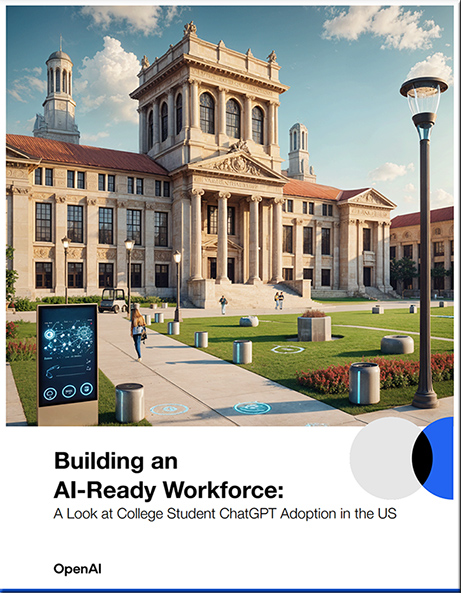
Building an AI-Ready Workforce: A look at College Student ChatGPT Adoption in the US — from cdn.openai.com

One finding from our student survey that stood out to us: Many college and university students are teaching themselves and their friends about AI without waiting for their institutions to provide formal AI education or clear policies about the technology’s use. The education ecosystem is in an important moment of exploration and learning, but the rapid adoption by students across the country who haven’t received formalized instruction in how and when to use the technology creates disparities in AI access and knowledge.

The enclosed snapshot of how young people are using ChatGPT provides insight into the state of AI use among America’s college-aged students. We also include actionable proposals to help address adoption gaps. We hope these insights and proposals can inform research and policy conversation across the nation’s education ecosystem about how to achieve outcomes that support our students, our workforce, and the economy. By improving literacy, expanding access, and implementing clear policies, policymakers and educators can better integrate AI into our educational infrastructure and ensure that our workforce is ready to both sustain and benefit from our future with AI.

Leah Belsky | Vice President, Education | OpenAI


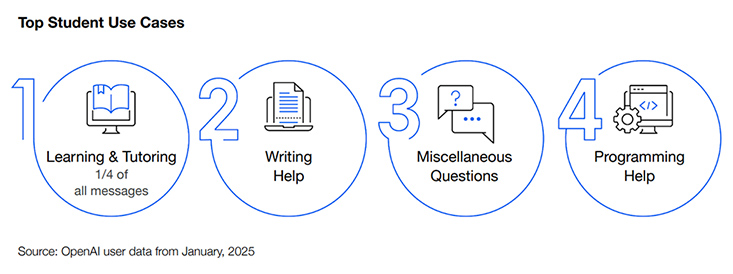
Top student use cases of ChatGPT -- learning and tutoring, writing help, miscellaneouc questions, and programming help


The Learning & Development Global Sentiment Survey 2025 — from donaldhtaylor.co.uk by Don Taylor

The L&D Global Sentiment Survey, now in its 12th year, once again asked two key questions of L&D professionals worldwide:

  • What will be hot in workplace learning in 2025?
  • What are your L&D challenges in 2025?

For the obligatory question on what they considered ‘hot’ topics, respondents voted for one to three of 15 suggested options, plus a free text ‘Other’ option. Over 3,000 voters participated from nearly 100 countries. 85% shared their challenges for 2025.

The results show more interest in AI, a renewed focus on showing the value of L&D, and some signs of greater maturity around our understanding of AI in L&D.


AI in K12: Today’s Breakthroughs and Tomorrow’s Possibilities (webinar)
How AI is Transforming Classrooms Today and What’s Next


Audio-Based Learning 4.0 — from drphilippahardman.substack.com by Dr. Philippa Hardman
A new & powerful way to leverage AI for learning?

At the end of all of this my reflection is that the research paints a pretty exciting picture – audio-based learning isn’t just effective, it’s got some unique superpowers when it comes to boosting comprehension, ramping up engagement, and delivering feedback that really connects with learners.

While audio has been massively under-used as a mode of learning, especially compared to video and text, we’re at an interesting turning point where AI tools are making it easier than ever to tap into audio’s potential as a pedagogical tool.

What’s super interesting is how the solid research backing audio’s effectiveness is and how well this is converging with these new AI capabilities.

From DSC:
I’ve noticed that I don’t learn as well via audio-only based events. It can help if visuals are also provided, but I have to watch the cognitive loads. My processing can start to get overloaded — to the point that I have to close my eyes and just listen sometimes. But there are people I know who love to listen to audiobooks and prefer to learn that way. They can devour content and process/remember it all. Audio is a nice change of pace at times, but I prefer visuals and reading often times. It needs to be absolutely quiet if I’m tackling some new information/learning. 


In Conversation With… Ashton Cousineau — from drphilippahardman.substack.com by Dr. Philippa Hardman
A new video series exploring how L&D professionals are working with AI on the ground

In Conversation With… Ashton Cousineau by Dr Philippa Hardman

A new video series exploring how L&D professionals are working with AI on the ground

Read on Substack


The Learning Research Digest vol. 28 — from learningsciencedigest.substack.com by Dr. Philippa Hardman

Hot Off the Research Press This Month:

  • AI-Infused Learning Design – A structured approach to AI-enhanced assignments using a three-step model for AI integration.
  • Mathematical Dance and Creativity in STEAM – Using AI-powered motion capture to translate dance movements into mathematical models.
  • AI-Generated Instructional Videos – How adaptive AI-powered video learning enhances problem-solving and knowledge retention.
  • Immersive Language Learning with XR & AI – A new framework for integrating AI-driven conversational agents with Extended Reality (XR) for task-based language learning.
  • Decision-Making in Learning Design – A scoping review on how instructional designers navigate complex instructional choices and make data-driven decisions.
  • Interactive E-Books and Engagement – Examining the impact of interactive digital books on student motivation, comprehension, and cognitive engagement.
  • Elevating Practitioner Voices in Instructional Design – A new initiative to amplify instructional designers’ contributions to research and innovation.

Deep Reasoning, Agentic AI & the Continued Rise of Specialised AI Research & Tools for Education — from learningfuturesdigest.substack.com by Dr. Philippa Hardman

Here’s a quick teaser of key developments in the world of AI & learning this month:

  • DeepSeek R-1, OpenAI’s Deep Seek & Perplexity’s ‘Deep Research’ are the latest additions to a growing number of “reasoning models” with interesting implications for evidence-based learning design & development.
  • The U.S. Education Dept release an AI Toolkit and a fresh policy roadmap enabling the adoption of AI use in schools.
  • Anthropic Release “Agentic Claude”, another AI agent that clicks, scrolls, and can even successfully complete e-learning courses…
  • Oxford University Announce the AIEOU Hub, a research-backed research lab to support research and implementation on AI in education.
  • “AI Agents Everywhere”: A Forbes peek at how agentic AI will handle the “boring bits” of classroom life.
  • [Bias klaxon!] Epiphany AI: My own research leads to the creation of a specialised, “pedagogy first” AI co-pilot for instructional design marking the continued growth of specialised AI tools designed for specific industries and workflows.

AI is the Perfect Teaching Assistant for Any Educator — from unite.ai by Navi Azaria, CPO at Kaltura

Through my work with leading educational institutions at Kaltura, I’ve seen firsthand how AI agents are rapidly becoming indispensable. These agents alleviate the mounting burdens on educators and provide new generations of tech-savvy students with accessible, personalized learning, giving teachers the support they need to give their students the personalized attention and engagement they deserve.


Learning HQ — from ai-disruptor-hq.notion.site

This HQ includes all of my AI guides, organized by tool/platform. This list is updated each time a new one is released, and outdated guides are removed/replaced over time.


How AI Is Reshaping Teachers’ Jobs — from edweek.org

Artificial intelligence is poised to fundamentally change the job of teaching. AI-powered tools can shave hours off the amount of time teachers spend grading, lesson-planning, and creating materials. AI can also enrich the lessons they deliver in the classroom and help them meet the varied needs of all students. And it can even help bolster teachers’ own professional growth and development.

Despite all the promise of AI, though, experts still urge caution as the technology continues to evolve. Ethical questions and practical concerns are bubbling to the surface, and not all teachers feel prepared to effectively and safely use AI.

In this special report, see how early-adopter teachers are using AI tools to transform their daily work, tackle some of the roadblocks to expanded use of the technology, and understand what’s on the horizon for the teaching profession in the age of artificial intelligence.


2025 EDUCAUSE AI Landscape Study: Into the Digital AI Divide — from library.educause.edu

The higher education community continues to grapple with questions related to using artificial intelligence (AI) in learning and work. In support of these efforts, we present the 2025 EDUCAUSE AI Landscape Study, summarizing our community’s sentiments and experiences related to strategy and leadership, policies and guidelines, use cases, the higher education workforce, and the institutional digital divide.


Law Prawfs Statement Regarding an Urgent Constitutional Crisis — from thefacultylounge.org
Over 400 law professors have signed the Call to Urgency below. The authors invite others to join in here.

A CALL TO URGENCY

The opening weeks of the second Trump administration convince us, as law professors who have spent years studying the American legal system, that we are beginning to see unfold the gravest threat to the rule of law and its constituent principles – the separation of governmental powers, the independence of prosecutorial authority, the inviolability of human rights, the transparency of government action, and the sanctity of constitutional accountability itself – ever presented in our lifetimes. The president’s and his associates’ actions, and threats of action, profoundly undermine the bedrock principle of our federal government system – that the Chief Executive and his agents are constrained by the United States Constitution. The fundamental guardrails of our constitutional democracy itself are threatened and notably battered. They are, as we write, at risk of complete collapse.


Half A Million Students Given ChatGPT As CSU System Makes AI History — from forbes.com by Dan Fitzpatrick

The California State University system has partnered with OpenAI to launch the largest deployment of AI in higher education to date.

The CSU system, which serves nearly 500,000 students across 23 campuses, has announced plans to integrate ChatGPT Edu, an education-focused version of OpenAI’s chatbot, into its curriculum and operations. The rollout, which includes tens of thousands of faculty and staff, represents the most significant AI deployment within a single educational institution globally.

We’re still in the early stages of AI adoption in education, and it is critical that the entire ecosystem—education systems, technologists, educators, and governments—work together to ensure that all students globally have access to AI and develop the skills to use it responsibly

Leah Belsky, VP and general manager of education at OpenAI.


HOW educators can use GenAI – where to start and how to progress — from aliciabankhofer.substack.com by Alicia Bankhofer
Part of 3 of my series: Teaching and Learning in the AI Age

As you read through these use cases, you’ll notice that each one addresses multiple tasks from our list above.

1. Researching a topic for a lesson
2. Creating Tasks For Practice
3. Creating Sample Answers
4. Generating Ideas
5. Designing Lesson Plans
6. Creating Tests
7. Using AI in Virtual Classrooms
8. Creating Images
9. Creating worksheets
10. Correcting and Feedback


Degree in hand, jobs out of reach: Why recent grads are struggling in a competitive market — from cnn.com by Nayeli Jaramillo-Plata; via Ryan Craig

Bellebuono’s story isn’t unique. A recent study from the Federal Reserve Bank of New York reported the widest unemployment gap between new graduates and experienced degree holders since the 1990s.

The struggle to find work
The unemployment gap is partly due to the increase in competition and changing employer expectations, said David Deming, professor of public policy at the Harvard Kennedy School.

Skill requirements for entry-level roles are higher today than a decade ago, he said. But the change has been gradual from year to year.


How to Make Learning as Addictive as Social Media | Duolingo’s Luis Von Ahn | TED — from youtube.com; via Kamil Banc at AI Adopter

When technologist Luis von Ahn was building the popular language-learning platform Duolingo, he faced a big problem: Could an app designed to teach you something ever compete with addictive platforms like Instagram and TikTok? He explains how Duolingo harnesses the psychological techniques of social media and mobile games to get you excited to learn — all while spreading access to education across the world.
.


DeepSeek: How China’s AI Breakthrough Could Revolutionize Educational Technology — from nickpotkalitsky.substack.com by Nick Potkalitsky
Can DeepSeek’s 90% efficiency boost make AI accessible to every school?

The most revolutionary aspect of DeepSeek for education isn’t just its cost—it’s the combination of open-source accessibility and local deployment capabilities. As Azeem Azhar notes, “R-1 is open-source. Anyone can download and run it on their own hardware. I have R1-8b (the second smallest model) running on my Mac Mini at home.”

Real-time Learning Enhancement

  • AI tutoring networks that collaborate to optimize individual learning paths
  • Immediate, multi-perspective feedback on student work
  • Continuous assessment and curriculum adaptation

The question isn’t whether this technology will transform education—it’s how quickly institutions can adapt to a world where advanced AI capabilities are finally within reach of every classroom.


Over 100 AI Tools for Teachers — from educatorstechnology.com by Med Kharbach, PhD

I know through your feedback on my social media and blog posts that several of you have legitimate concerns about the impact of AI in education, especially those related to data privacy, academic dishonesty, AI dependence, loss of creativity and critical thinking, plagiarism, to mention a few. While these concerns are valid and deserve careful consideration, it’s also important to explore the potential benefits AI can bring when used thoughtfully.

Tools such as ChatGPT and Claude are like smart research assistants that are available 24/7 to support you with all kinds of tasks from drafting detailed lesson plans, creating differentiated materials, generating classroom activities, to summarizing and simplifying complex topics. Likewise, students can use them to enhance their learning by, for instance, brainstorming ideas for research projects, generating constructive feedback on assignments, practicing problem-solving in a guided way, and much more.

The point here is that AI is here to stay and expand, and we better learn how to use it thoughtfully and responsibly rather than avoid it out of fear or skepticism.


Beth’s posting links to:


Derek’s posting on LinkedIn


From Theory to Practice: How Generative AI is Redefining Instructional Materials — from edtechinsiders.substack.com by Alex Sarlin
Top trends and insights from The Edtech Insiders Generative AI Map research process about how Generative AI is transforming Instructional Materials

As part of our updates to the Edtech Insiders Generative AI Map, we’re excited to release a new mini market map and article deep dive on Generative AI tools that are specifically designed for Instructional Materials use cases.

In our database, the Instructional Materials use case category encompasses tools that:

  • Assist educators by streamlining lesson planning, curriculum development, and content customization
  • Enable educators or students to transform materials into alternative formats, such as videos, podcasts, or other interactive media, in addition to leveraging gaming principles or immersive VR to enhance engagement
  • Empower educators or students to transform text, video, slides or other source material into study aids like study guides, flashcards, practice tests, or graphic organizers
  • Engage students through interactive lessons featuring historical figures, authors, or fictional characters
  • Customize curriculum to individual needs or pedagogical approaches
  • Empower educators or students to quickly create online learning assets and courses

On a somewhat-related note, also see:


Five things to know before you launch a research podcast — from timeshighereducation.com by David Allan  and Andrew Murray
Starting a podcast can open up your research to a new audience. David Allan and Andrew Murray show how

Launching a podcast isn’t necessarily difficult. Sustaining it, on the other hand, is difficult. You’re entering a crowded market – it’s estimated that there are more than 4 million of them – and audience share is far from equal. An alarmingly high number fail to make it past their third episode before being scrapped, and the vast majority put out fewer than 20 episodes.

Despite these challenges, podcasts can be an astonishingly effective tool to promote research or academic knowledge. If you avoid the many pitfalls, you have a communication tool with full control of the message; a tool that exists in perpetuity, drawing attention to the work that you do.

Here, a highly experienced podcast producer and associate lecturer at the University of the West of Scotland and an award-winning former broadcast journalist draw on their experiences to share advice on how to successfully launch a research podcast.


Also from timeshighereducation.com:

An introvert’s guide to networking — from by Yalinu Poya
For academics, networking can greatly enhance your career. But if the very idea fills you with dread, Yalinu Poya offers her advice for putting yourself out there

In academia, meeting the right person can lead to a research collaboration, or it could lead to your work being shared with someone who can use it to make a difference. It could lead to public speaking opportunities or even mentorship. It all goes towards your long-term success.

For some of us, the idea of putting yourself out there in that way – of making an active effort to meet new people – is terrifying.


6% of Faculty Feel Supported on AI?! — from automatedteach.com by Graham Clay
Plus, a webinar on building AI tutors this Friday.

The Digital Education Council just released their Global AI Faculty Survey of 1,681 faculty members from 52 institutions across 28 countries, and the findings are eye-opening. (Click here if you missed their analogous survey of students.)

While 86% of faculty see themselves using AI in their future teaching [p. 21], only 6% strongly agree that their institutions have provided sufficient resources to develop their AI literacy [p. 35].

This is a concerning gap between the recognized power of AI and institutional support, and it’s a clear signal about where higher education needs to focus in 2025.

Speaking with faculty about AI around the world, I’ve seen this firsthand. But let’s dig into the survey’s findings.
.

Why the gap? Well, one explanation is that faculty lack institutional support.

The survey reveals that…

  • 80% of faculty don’t find their institutional AI guidelines comprehensive [p. 32]
  • 80% say their institutions haven’t made clear how AI can be used in teaching [p. 33]
  • The top barrier to AI adoption, at 40%? “I don’t have time or resources to explore AI” [p. 9]
  • The second-highest barrier, at 38%? “I am not sure how to use AI in my teaching” [p. 9]

From DSC:


I was in a teaching and learning group for 10+ years (and in several edtech-related positions before that). We had a senior staff established there but we were mainly called upon for edtech, instructional technology, learning spaces, or LMS types of tasks and questions. Though we could have brought a lot of value to the pedagogical table, the vast majority of the faculty wanted to talk to other faculty members. Our group’s hard-earned — and expensive — expertise didn’t count. We ourselves were teaching classes..but not enough to be on par with the faculty members (at least in their minds). They didn’t seek us out. Perhaps we should have gone door to door, but we didn’t have the resources to do that. 

Book groups were effective when the T&L group met with faculty members to discuss things. The discussions were productive. And in those groups, we DID have a seat at the pedagogical table.

But I’m not going to jump on the “we don’t have enough support” bandwagon. Faculty members seek out other faculty members. In many cases, if you aren’t faculty, you don’t count. 

So if I were still working and I was in a leadership position, I would sponsor some book study groups with faculty and personnel from teaching and learning centers. Topics for those books could be:

  • What AI is
  • What those techs can offer
  • What the LMS vendors are doing in this regard
  • and ideas on how to use AI in one’s teaching 
 

Your AI Writing Partner: The 30-Day Book Framework — from aidisruptor.ai by Alex McFarland and Kamil Banc
How to Turn Your “Someday” Manuscript into a “Shipped” Project Using AI-Powered Prompts

With that out of the way, I prefer Claude.ai for writing. For larger projects like a book, create a Claude Project to keep all context in one place.

  • Copy [the following] prompts into a document
  • Use them in sequence as you write
  • Adjust the word counts and specifics as needed
  • Keep your responses for reference
  • Use the same prompt template for similar sections to maintain consistency

Each prompt builds on the previous one, creating a systematic approach to helping you write your book.


Using NotebookLM to Boost College Reading Comprehension — from michellekassorla.substack.com by Michelle Kassorla and Eugenia Novokshanova
This semester, we are using NotebookLM to help our students comprehend and engage with scholarly texts

We were looking hard for a new tool when Google released NotebookLM. Not only does Google allow unfettered use of this amazing tool, it is also a much better tool for the work we require in our courses. So, this semester, we have scrapped our “old” tools and added NotebookLM as the primary tool for our English Composition II courses (and we hope, fervently, that Google won’t decide to severely limit its free tier before this semester ends!)

If you know next-to-nothing about NotebookLM, that’s OK. What follows is the specific lesson we present to our students. We hope this will help you understand all you need to know about NotebookLM, and how to successfully integrate the tool into your own teaching this semester.


Leadership & Generative AI: Hard-Earned Lessons That Matter — from jeppestricker.substack.com by Jeppe Klitgaard Stricker
Actionable Advice for Higher Education Leaders in 2025

AFTER two years of working closely with leadership in multiple institutions, and delivering countless workshops, I’ve seen one thing repeatedly: the biggest challenge isn’t the technology itself, but how we lead through it. Here is some of my best advice to help you navigate generative AI with clarity and confidence:

  1. Break your own AI policies before you implement them.
  2. Fund your failures.
  3. Resist the pilot program. …
  4. Host Anti-Tech Tech Talks
  5. …+ several more tips

While generative AI in higher education obviously involves new technology, it’s much more about adopting a curious and human-centric approach in your institution and communities. It’s about empowering learners in new, human-oriented and innovative ways. It is, in a nutshell, about people adapting to new ways of doing things.


Maria Anderson responded to Clay’s posting with this idea:

Here’s an idea: […] the teacher can use the [most advanced] AI tool to generate a complete solution to “the problem” — whatever that is — and demonstrate how to do that in class. Give all the students access to the document with the results.

And then grade the students on a comprehensive followup activity / presentation of executing that solution (no notes, no more than 10 words on a slide). So the students all have access to the same deep AI result, but have to show they comprehend and can iterate on that result.


Grammarly just made it easier to prove the sources of your text in Google Docs — from zdnet.com by Jack Wallen
If you want to be diligent about proving your sources within Google Documents, Grammarly has a new feature you’ll want to use.

In this age of distrust, misinformation, and skepticism, you may wonder how to demonstrate your sources within a Google Document. Did you type it yourself, copy and paste it from a browser-based source, copy and paste it from an unknown source, or did it come from generative AI?

You may not think this is an important clarification, but if writing is a critical part of your livelihood or life, you will definitely want to demonstrate your sources.

That’s where the new Grammarly feature comes in.

The new feature is called Authorship, and according to Grammarly, “Grammarly Authorship is a set of features that helps users demonstrate their sources of text in a Google doc. When you activate Authorship within Google Docs, it proactively tracks the writing process as you write.”


AI Agents Are Coming to Higher Education — from govtech.com
AI agents are customizable tools with more decision-making power than chatbots. They have the potential to automate more tasks, and some schools have implemented them for administrative and educational purposes.

Custom GPTs are on the rise in education. Google’s version, Gemini Gems, includes a premade version called Learning Coach, and Microsoft announced last week a new agent addition to Copilot featuring use cases at educational institutions.


Generative Artificial Intelligence and Education: A Brief Ethical Reflection on Autonomy — from er.educause.edu by Vicki Strunk and James Willis
Given the widespread impacts of generative AI, looking at this technology through the lens of autonomy can help equip students for the workplaces of the present and of the future, while ensuring academic integrity for both students and instructors.

The principle of autonomy stresses that we should be free agents who can govern ourselves and who are able to make our own choices. This principle applies to AI in higher education because it raises serious questions about how, when, and whether AI should be used in varying contexts. Although we have only begun asking questions related to autonomy and many more remain to be asked, we hope that this serves as a starting place to consider the uses of AI in higher education.

 
© 2025 | Daniel Christian