Introducing Superalignment — from openai.com
We need scientific and technical breakthroughs to steer and control AI systems much smarter than us. To solve this problem within four years, we’re starting a new team, co-led by Ilya Sutskever and Jan Leike, and dedicating 20% of the compute we’ve secured to date to this effort. We’re looking for excellent ML researchers and engineers to join us.

Excerpts (emphasis DSC):

How do we ensure AI systems much smarter than humans follow human intent?

Currently, we don’t have a solution for steering or controlling a potentially superintelligent AI, and preventing it from going rogue. Our current techniques for aligning AI, such as reinforcement learning from human feedback, rely on humans’ ability to supervise AI. But humans won’t be able to reliably supervise AI systems much smarter than us, and so our current alignment techniques will not scale to superintelligence. We need new scientific and technical breakthroughs.

Our goal is to build a roughly human-level automated alignment researcher. We can then use vast amounts of compute to scale our efforts, and iteratively align superintelligence.

From DSC:
Hold up. We’ve been told for years that AI is at the toddler stage. But now assertions are being made that AI systems are smarter than humans — much smarter even. That said, then why is the goal of OpenAI to build a roughly human-level automated alignment researcher if humans aren’t that smart after all…? Which is it? I must be missing or misunderstanding something here…

OpenAI are jumping back on the alignment bandwagon with the brilliantly-named Superalignment Team. And you guessed it – they’re researching alignment of future superintelligent AIs. They reckon that AI can align other AI faster than humans can, and the plan is to build an AI that does just that. Head-spinning stuff…

Ben’s Bites

Plus…

Who else should be on this team? We certainly don’t want a team comprised of just technical people. How about including rabbis, pastors, priests, parents, teachers, professors, social workers, judges, legislators, and many others who can help represent other specialties, disciplines, and perspectives to protect society?


Authors file a lawsuit against OpenAI for unlawfully ‘ingesting’ their books — from theguardian.com by Ella Creamer; via Ben’s Bytes
Mona Awad and Paul Tremblay allege that their books, which are copyrighted, were ‘used to train’ ChatGPT because the chatbot generated ‘very accurate summaries’ of the works
.


How AI is Transforming Workplace Architecture and Design — from workdesign.com by Christian Lehmkuhl


London Futurists | Generative AI drug discovery breakthrough, with Alex Zhavoronkov — from londonfuturists.buzzsprout.com

Alex Zhavoronkov is our first guest to make a repeat appearance, having first joined us in episode 12, last November. We are delighted to welcome him back, because he is doing some of the most important work on the planet, and he has some important news.

In 2014, Alex founded Insilico Medicine, a drug discovery company which uses artificial intelligence to identify novel targets and novel molecules for pharmaceutical companies. Insilico now has drugs designed with AI in human clinical trials, and it is one of a number of companies that are demonstrating that developing drugs with AI can cut the time and money involved in the process by as much as 90%.


Watch This Space: New Field of Spatial Finance Uses AI to Estimate Risk, Monitor Assets, Analyze Claims — from blogs.nvidia.com

When making financial decisions, it’s important to look at the big picture — say, one taken from a drone, satellite or AI-powered sensor.

The emerging field of spatial finance harnesses AI insights from remote sensors and aerial imagery to help banks, insurers, investment firms and businesses analyze risks and opportunities, enable new services and products, measure the environmental impact of their holdings, and assess damage after a crisis.


Secretive hardware startup Humane’s first product is the Ai Pin — from techcrunch.com by Kyle Wiggers; via The Rundown AI

Excerpt:

Humane, the startup launched by ex-Apple design and engineering duo Imran Chaudhri and Bethany Bongiorno, today revealed details about its first product: The Humane Ai Pin.

Humane’s product, as it turns out, is a wearable gadget with a projected display and AI-powered features. Chaudhri gave a live demo of the device onstage during a TED Talk in April, but a press release issued today provides a few additional details.
The Humane Ai Pin is a new type of standalone device with a software platform that harnesses the power of AI to enable innovative personal computing experiences.


He Spent $140 Billion on AI With Little to Show. Now He Is Trying Again. — from wsj.com by Eliot Brown; via Superhuman
Billionaire Masayoshi Son said he would make SoftBank ‘the investment company for the AI revolution,’ but he missed out on the most recent frenzy


“Stunning”—Midjourney update wows AI artists with camera-like feature — from arstechnica.com by Benj Edwards; via Sam DeBrule from Machine Learnings
Midjourney v5.2 features camera-like zoom control over framing, more realism.


What is AIaaS? Guide to Artificial Intelligence as a Service — from eweek.com by Shelby Hiter
Artificial intelligence as a service, AIaaS, is an outsourced AI service provided by cloud-based AI providers.

AIaaS Definition
When a company is interested in working with artificial intelligence but doesn’t have the in-house resources, budget, and/or expertise to build and manage its own AI technology, it’s time to invest in AIaaS.

Artificial intelligence as a service, or AIaaS, is an outsourced service model AI that cloud-based companies provide to other businesses, giving them access to different AI models, algorithms, and other resources directly through a cloud computing platform; this access is usually managed through an API or SDK connection.


The Rise of the AI Engineer — from latent.space


Boost ChatGPT with new plugins — from wondertools.substack.com by Jeremy Caplan
Wonder Tools | Six new ways to use AI
.


A series re: AI from Jeff Foster out at ProvideoCoalition.com


The AI upskilling imperative to build a future-ready workforce — from businessinsider.com

Excerpts:

Skill development has always been crucial, but recent technological advancements have raised the stakes. We are currently in the midst of the fourth industrial revolution, where automation and breakthroughs in artificial intelligence (AI) are revolutionising the workplace. In this era of quick change and short half-life of skills, upskilling shouldn’t be an afterthought. Instead, reskilling and upskilling have to evolve into requirements for effective professional development.

To understand the significance of upskilling for your career trajectory, it is important to recognise the ever-evolving nature of technology and the rapid pace of digital transformation. Business Insider India has been exploring how businesses and thought leaders are driving innovation by educating their staff on the technologies and skills that will shape the future.
 

Who Does the Thinking: The Role of Generative AI in Higher Education — from youtube.com by Trine Jensen, Chris Dede, Frank Tsiwah, and Kate Thompson

Description:

Generative AI has taken the world by storm since OpenAI launched ChatGPT-3 in November 2022. Generative AI is characterized by its capacity to generate human-like content based on deep learning models in response to prompts. There is a wealth of opinions about how this will impact higher education spanning from the need to limit the use in the protection of higher education to embracing the tool as a means to improve higher education. In this webinar session, speakers from different regions shared their views and perspectives and discuss how Generative AI will transform higher education. What are the challenges to be addressed and which opportunities can be pursued to improve the quality of higher education? Watch the webinar and learn about the uncertainties, tensions, and opportunities triggered by Generative AI.


Trust and Transparency Are Key Factors When Using AI in Academia — from by Dr. Andrew Lang
Much can be learned from embracing artificial intelligence in the teaching and learning process. Here, two professors share their experiences using ChatGPT freely in the classroom.


A Professor Encouraged Students to Use ChatGPT. OpenAI Asked Her What She Learned — from techlearning.com by Erik Ofgang
Dr. Francine Berman permitted her students at UMass to use ChatGPT to help them write. Despite limitations, she found there were ways it could help edit student work.


Artificial intelligence glossary: 60+ terms to know — from techtarget.com by Ben Lutkevich
AI is moving fast and can be hard to keep up in real time. Use this glossary as a reference for AI terms. 


The AI-Education Divide — from drphilippahardman.substack.com by Philippa Hardman
How the rise of AI has reinforced inequity in education (and what we need to do to reverse it)
.


Coursera’s Global Skills Report for 2023 — from coursera.org
Benchmark talent and transform your workforce with skill development and career readiness insights drawn from 124M+ learners.

Excerpt:

Uncover global skill trends
See how millions of registered learners in 100 countries are strengthening critical business, technology, and data science skills.


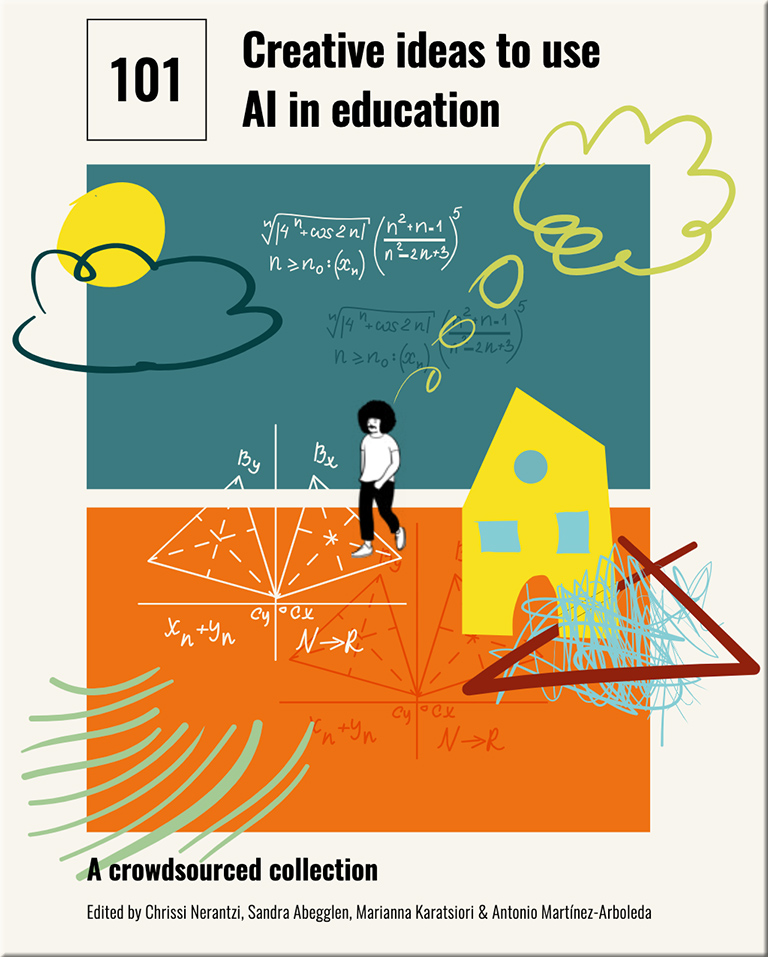
101 creative ideas to use AI in education, A crowdsourced collection — from zenodo.org by Chrissi Nerantzi, Sandra Abegglen, Marianna Karatsiori, & Antonio Martínez-Arboleda (Eds.); with thanks to George Veletsianos for this resource

101 creative ideas to use AI in education, A crowdsourced collection

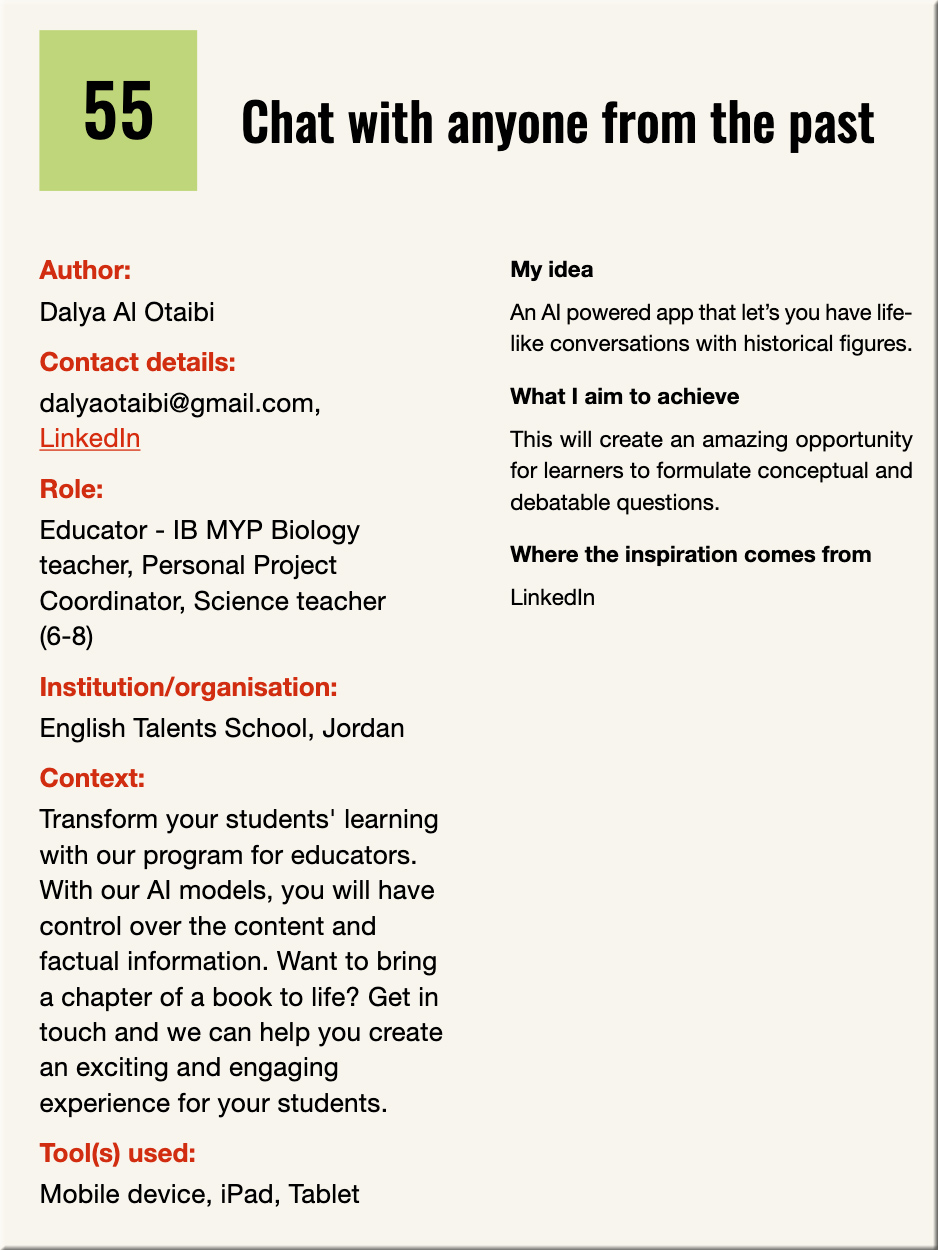
As an example, here’s one of the ideas from the crowdsourced collection:

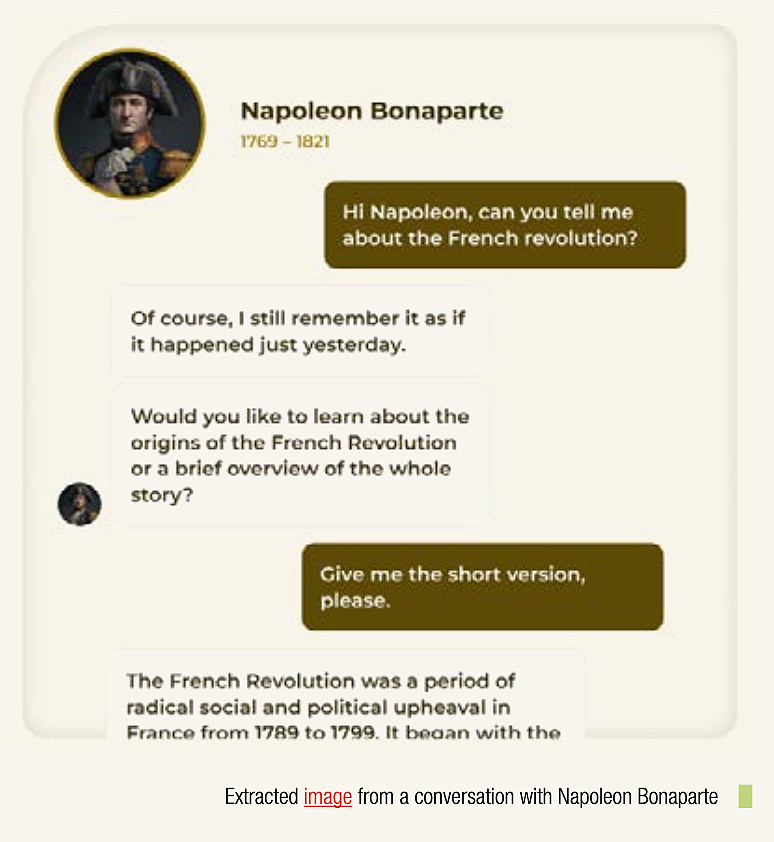
Chat with anyone in the past

Chatting with Napoleon Bonaparte


On a somewhat related note, also see:

Merlyn Mind launches education-focused LLMs for classroom integration of generative AI — from venturebeat.com by Victor Dey

Excerpt:

Merlyn Mind, an AI-powered digital assistant platform, announced the launch of a suite of large language models (LLMs) specifically tailored for the education sector under an open-source license.

Designing courses in an age of AI — from teachinginhighered.com by Maria Andersen
Maria Andersen shares about designing courses in an age of artificial intelligence (AI) on episode 469 of the Teaching in Higher Ed podcast.

With generative AI, we have an incredible acceleration of change happening.

Maria Andersen


Advancing Excellence in Education: The Changing Role of Centres for Teaching & Learning — from media-and-learning.eu by Alexandra Mihai, Maastricht University, The Netherlands

Excerpts:

Their most recognisable role is to partner with faculty and provide them with inspiration, expertise and support in their teaching. But a broader role is emerging at institutional level- helping create a culture where people value talking about teaching and more generally, fostering a culture of continuous learning. In this respect, CTLs act as agents of change, aiming to influence the organizational (learning) environment.

CTLs are part of an ecosystem, internally and externally, and they have the potential to play a very important role, that of a network node. Internally, this can mean connecting various silos within the university, a much needed task, while externally it implies establishing collaboration flows with other CTLs that can in turn lead to broader inter-university collaboration. Making use of the full potential of this role can make a big difference for the success of a CTL.


Speaking of Teaching & Learning Centers, also see:

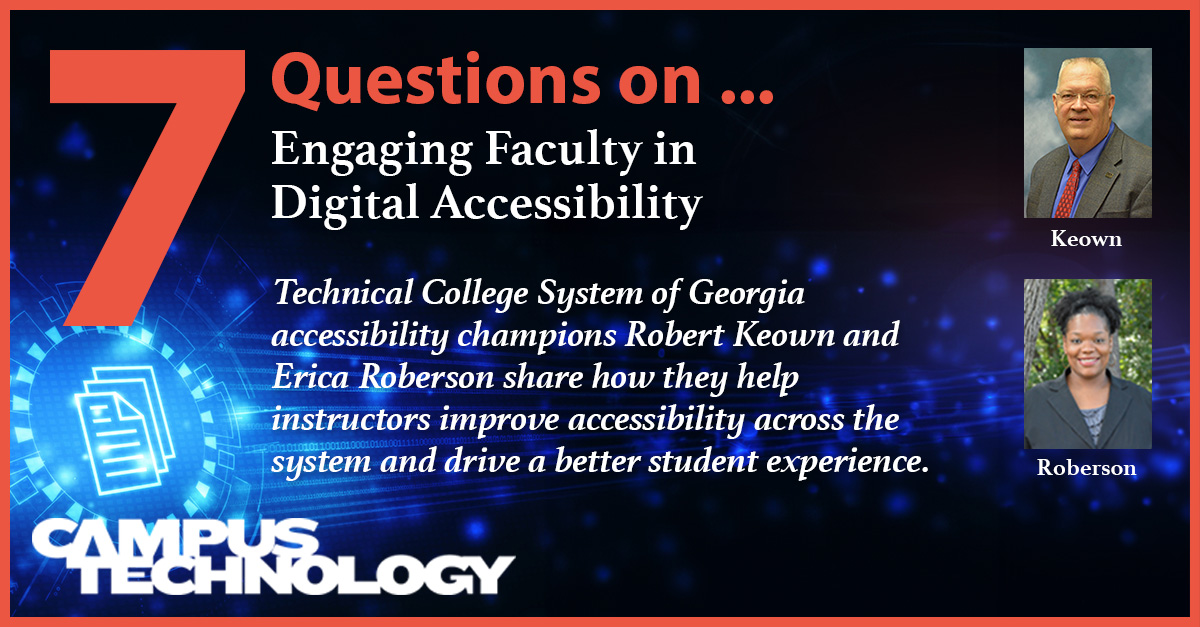
7 Questions on Engaging Faculty in Digital Accessibility — from campustechnology.com by Rhea Kelly
We asked the Technical College System of Georgia’s accessibility champions how they help instructors create a more inclusive learning experience for all students.


Our Learning Future from A to Z — from gettingsmart.com by Louka Parry

Key Points

  • Schools and organizations are human systems, filled with opportunities.
  • And yet there is a profound difference between building from a foundation of schooling and building from a foundation of learning.

Rather than simply replicate and scale the arrangements of schooling, we must seize the possibility to shift from a schooling system to a learning ecosystem to truly empower learners, educators, and parents to create a virtuous future for themselves and their communities.

Louka Parry

Our challenge will be how we choose to redesign and remake our experiences, environments, and ecosystems so that we unlock our true creative potential and thrive in the future.


An Accessible Treetop Walkway Gracefully Winds Through Norway’s Hamaren Activity Park — from thisiscolossal.com

An Accessible Treetop Walkway Gracefully Winds Through Norway’s Hamaren Activity Park Photos by Rasmus Hjortshøj, © EFFEKT


School of Visual Arts presents 10 senior thesis interior design projects — from dezeen.com

Resilience by Raymond Xie


An instrument for a city: An audio project filling one of London’s busiest roads with serene sounds — from inavateonthenet.net where Paul Milligan speaks to Nick Ryan, the artist responsible for VoiceLine.

An instrument for a city: An audio project filling one of London’s busiest roads with serene sounds

Why shouldn’t we have a piece of audio infrastructure as we do with lighting (lampposts) or seating, and use it to enable us to change the sound of a place, not once every 300 years but every second? We could transform the street using the sound of a rainforest into the sound of a river into the sound of voices.

From DSC:
A very interesting idea here. I can’t help but think there are applications of this type of thing within some of our learning spaces out there.


Mantra’s Immense Butterfly Murals Flutter Across Buildings and Walls — from thisiscolossal.com by Jackie Andres and Mantra

Enormous beautiful blue butterfly adorns a building in Jackson, Michigan (USA) -- artwork/mural done by Mantra All images © Mantra


Web Design Inspiration (Examples) – Good Tools #7 — from goodtools.substack.com by Robin Good
70+ free inspirational collections showcasing over 55,000 best web design examples


A Veritable Aviary of Birds and Pollinators by The Paper Ark Are Small Enough to Perch on the Tip of a Finger  — from thisiscolossal.com by Brace Ebert and Nayan Shrimali and Venus Bird

A Veritable Aviary of Birds and Pollinators by The Paper Ark Are Small Enough to Perch on the Tip of a Finger
 

Accenture announces jaw-dropping $3 billion investment in AI — from venturebeat.com by Carl Franzen; via Superhuman

Excerpt:

The generative AI announcements are coming fast and furious these days, but among the biggest in terms of sheer dollar commitments just landed: Accenture, the global professional services and consulting giant, today announced it will invest $3 billion (with a “b”!) in AI over the next three years in building out its team of AI professionals and AI-focused solutions for its clients.

“There is unprecedented interest in all areas of AI, and the substantial investment we are making in our Data & AI practice will help our clients move from interest to action to value, and in a responsible way with clear business cases,” said Julie Sweet, Accenture’s chairwoman and CEO.

Also related/see:

Artificial intelligence creates 40,000 new roles at Accenture — from computerweekly.com by Karl Flinders
Accenture is planning to add thousands of AI experts to its workforce as part of a $3bn investment in its data and artificial intelligence practice

Why leaders need to evolve alongside generative AI — from fastcompany.com by Kelsey Behringer
Even if you’re not an educator, you should not be sitting on the sidelines watching the generative AI conversation being had around you—hop in.

Excerpts (emphasis DSC):

Leaders should be careful to watch and support education right now. At the end of the day, the students sitting in K-12 and college classrooms are going to be future CPAs, lawyers, writers, and teachers. If you are parenting a child, you have skin in the game. If you use professional services, you have skin in the game. When it comes to education, we all have skin in the game.

Students need to master fundamental skills like editing, questioning, researching, and verifying claims before they can use generative AI exceptionally well.

GenAI & Education: Enhancement, not Replacement — from drphilippahardman.substack.com by Dr. Philipa Hardman
How to co-exist in the age of automation

Excerpts (emphasis DSC):

[On 6/15/23, I joined] colleagues from OpenAI, Google, Microsoft, Stanford, Harvard and other others at the first meeting of the GenAI Summit. Our shared goal [was] to help to educate universities & schools in Europe about the impact of Generative AI on their work.

how can we effectively communicate to education professionals that generative AI will enhance their work rather than replace them?

A recent controlled study found that ChatGPT can help professionals increase their efficiency in routine tasks by ~35%. If we keep in mind that the productivity gains brought by the steam engine in the nineteenth century was ~25%, this is huge.

As educators, we should embrace the power of ChatGPT to automate the repetitive tasks which we’ve been distracted by for decades. Lesson planning, content creation, assessment design, grading and feedback – generative AI can help us to do all of these things faster than ever before, freeing us up to focus on where we bring most value for our students.

Google, one of AI’s biggest backers, warns own staff about chatbots — from reuters.com by Jeffrey Dastin and Anna Tong

Excerpt:

SAN FRANCISCO, June 15 (Reuters) – Alphabet Inc (GOOGL.O) is cautioning employees about how they use chatbots, including its own Bard, at the same time as it markets the program around the world, four people familiar with the matter told Reuters.

The Google parent has advised employees not to enter its confidential materials into AI chatbots, the people said and the company confirmed, citing long-standing policy on safeguarding information.

The economic potential of generative AI: The next productivity frontier — from mckinsey.com
Generative AI’s impact on productivity could add trillions of dollars in value to the global economy—and the era is just beginning.


Preparing for the Classrooms and Workplaces of the Future: Generative AI in edX — from campustechnology.com by Mary Grush
A Q&A with Anant Agarwal


Adobe Firefly for the Enterprise — Dream Bigger with Adobe Firefly.
Dream it, type it, see it with Firefly, our creative generative AI engine. Now in Photoshop (beta), Illustrator, Adobe Express, and on the web.


Apple Vision Pro, Higher Education and the Next 10 Years — from insidehighered.com by Joshua Kim
How this technology will play out in our world over the next decade.


Zoom can now give you AI summaries of the meetings you’ve missed — from theverge.com by Emma Roth


Mercedes-Benz Is Adding ChatGPT to Cars for AI Voice Commands — from decrypt.co by Jason Nelson; via Superhuman
The luxury automaker is set to integrate OpenAI’s ChatGPT chatbot into its Mercedes-Benz User Experience (MBUX) feature in the U.S.


AI21 Labs concludes largest Turing Test experiment to date — from ai21.com
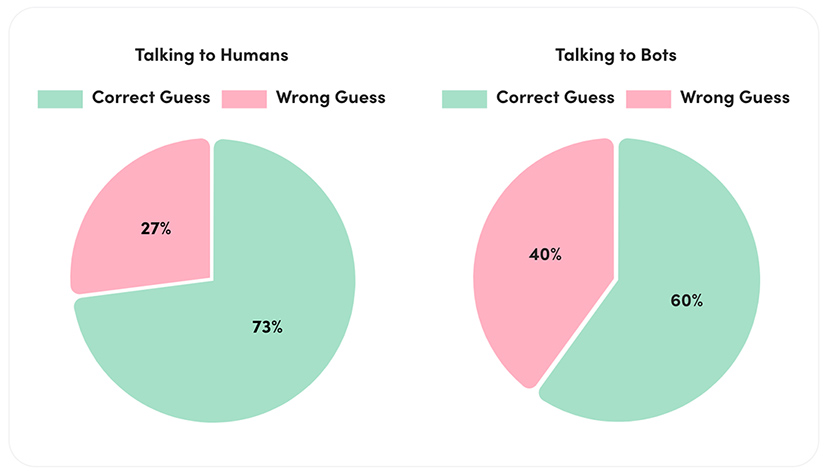
As part of an ongoing social and educational research project, AI21 Labs is thrilled to share the initial results of what has now become the largest Turing Test in history by scale.
.

People found it easier to identify a fellow human. When talking to humans, participants guessed right in 73% of the cases. When talking to bots, participants guessed right in just 60% of the cases.


In Finland, the Future of Learning Has Arrived — Just Not Where You Think — from samchaltain.substack.com by Sam Chaltain
It turns out the “Finnish Miracle” is more (and less) miraculous than you think . . .

But whereas Finland’s schools are still characterized by a culture of teaching, Oodi stands as a beacon of learning — self-organizing, emergent, and overflowing with the life force of its inhabitants.
.


From DSC:
As the above got me to thinking about learning spaces, here’s another somewhat relevant item from Steelcase:


Addendum on 6/6/23:
Also relevant to the first item in this posting, see:

Looking for Miracles in the Wrong Places — from nataliewexler.substack.com by Natalie Wexler
An “edutourist” in Finland finds the ideal school, but it isn’t a school at all.

Counterpoint/excerpt:

It sounds appealing, but any country following that route is not only likely to find itself at the bottom of the PISA heap. It’s also likely to do a profound disservice to many of its children, particularly those from less highly educated families, who depend on teachers to impart information they don’t already have and to systematically build their knowledge.

Of course it’s possible for explicit, teacher-directed instruction to be soul-crushing for students. But it certainly doesn’t have to be, and there’s no indication from Mr. X’s account that the students in the schools he visited felt their experience was oppressive. When teachers get good training—of the kind apparently provided in Finland—they know how to engage students in the content they’re teaching and guide them to think about it deeply and analytically.

That’s not oppressive. In fact, it’s the key to enabling students to reach their full potential. In that sense, it’s liberating.


A Collaborative Photo Project Imagines a World Where Street Artists Have Free Rein — from thisiscolossal.com by Grace Ebert

Excerpts:

What would artists create if all of the world’s surfaces could become a canvas? Joseph Ford—of Invisible Jumpers fame—responds to this question in a new project called Impossible Street Art. Collaborating with eight artists including Peeta, Levalet, and Victoria Villasana, Ford reimagines the possibilities of public spaces that are otherwise inaccessible due to scale, safety issues, or restrictions.

A work of art from JanIsDeMan, Balcome Viaduct, U.K


Going to court without a lawyer? DIY law is on the rise — from cbc.ca by Yvette Brend
Self-representation saves money, but the larger cost is high, say justice-access advocates

Excerpt:

Most reported feeling the justice system was “unfair,” and many described a sense of “the odds being stacked against them.”

Advocates say the rising number of lawyer-free litigants is problematic. The legal system is meant to be adversarial — with strong lawyers on each side — but the high rate of self-representation creates lopsided justice, pitting an untrained individual against a professional.

‘Legal Tech Lists’: 3 Things Your CRM Should Do For You — from abovethelaw.com by Cady Darago
How you can go beyond merely storing information.

Exploring the Hottest Legal Tech Startups in Europe — from legalreader.com by Amy Hollow
Europe is quickly becoming a hub for legal tech startups, offering innovative solutions to the legal industry.

Excerpt:
Europe is home to some of the most innovative legal tech startups in the world. Here are five of the hottest ones:

    1. Legatics
    2. Juro
    3. LawGeex
    4. The Lawyer Guide
    5. CaseCrunch

Keep Up With Today’s Legal Tech (Or Be Left Behind) — from legaltalknetwork.com by Joy Murao and Tony Sipp

In this podcast:

  • High tech tools aren’t just for big trials anymore. Learn to incorporate the latest tech for depositions and even smaller hearings and trials.
  • Keep track of every detail and hold every bit of data at your fingertips.
  • The COVID-19 pandemic opened doors and highlighted technologies that support paralegals and legal teams in the courtroom and online.

Legal Operations and Generative AI: Preparing for a Sea Change — from jdsupra.com

Excerpt:

AI will likely make lawyer’s jobs easier (or, at least, more interesting) for some tasks, however the effects it may have on the legal profession could be the real legacy of the technology. Schafer pointed to its potential to improve access to justice for people who want legal representation but can’t get it for whatever reason.


The 2023 Global Sentiment Survey — from donaldhtaylor.co.uk by Don Taylor

Excerpt:

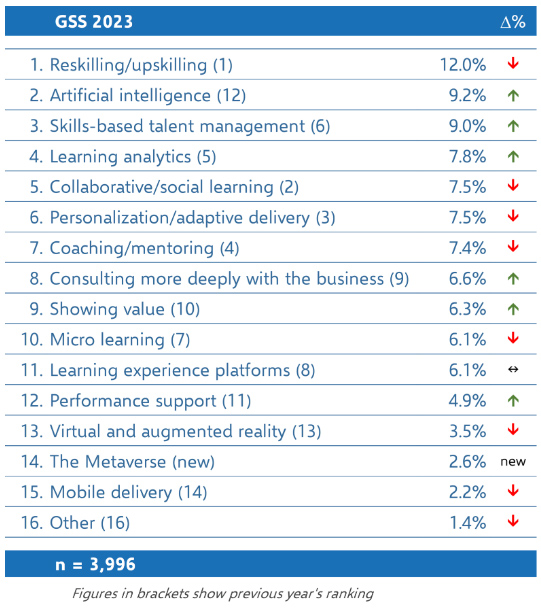
This year’s Global Sentiment Survey – the tenth – paints a picture that is both familiar and unusual. In our 2020 survey report, we noted that ‘Data dominates this year’s survey’. It does so again this year, with the near 4,000 respondents showing a strong interest in AI, Skills-based talent management and Learning analytics (in positions #2, #3 and #4), all of which rely on data. The table is topped by Reskilling/upskilling, in the #1 spot for the third year running.
.

Donald Taylor's GSS 2023

.

Also see Don’s report here >>


© 2025 | Daniel Christian