From DSC:
You and I both know that numerous militaries across the globe are working on killer robots equipped with AI. This is nothing new. But I don’t find this topic to be entertaining in the least. Because it could be part of how wars are fought in the near future. And most of us wouldn’t have a clue how to stop one of these things.


Digital Accessibility in 2025: A Screen Reader User’s Honest Take — from blog.usablenet.com by Michael Taylor

In this post, part of the UsableNet 25th anniversary series, I’m taking a look at where things stand in 2025. I’ll discuss the areas that have improved—such as online shopping, banking, and social media—and the ones that still make it challenging to perform basic tasks, including travel, healthcare, and mobile apps. I hope that by sharing what works and what doesn’t, I can help paint a clearer picture of the digital world as it stands today.


Why EAA Compliance and Legal Trends Are Shaping Accessibility in 2025 — from blog.usablenet.com by Jason Taylor

On June 28, 2025, the European Accessibility Act (EAA) officially became enforceable across the European Union. This law requires digital products and services—including websites, mobile apps, e-commerce platforms, and software to meet the defined accessibility standards outlined in EN 301 549, which aligns with the WCAG 2.1 Level AA.

Companies that serve EU consumers must be able to demonstrate that accessibility is built into the design, development, testing, and maintenance of their digital products and services.

This milestone also arrives as UsableNet celebrates 25 years of accessibility leadership—a moment to reflect on how far we’ve come and what digital teams must do next.


The US AI Action Plan, Explained — from theneurondaily.com by Grant Harvey
Sam’s 3 AI nightmares, Google hits 2B users, and Trump bans “woke” AI…

Meanwhile, at the Fed’s banking conference on Wednesday, Altman revealed his three nightmare AI scenarios. The first two were predictable: bad actors getting superintelligence first, and the classic “I’m afraid I can’t do that, Dave” situation.

But the third? AI accidentally steering us off course while we just…go along with it.

His example hit home: young people who can’t make decisions without ChatGPT (according to Sam, this is literally a thing). See, even when AI gives great advice, collectively handing over all decision-making feels “bad and dangerous” (even to Sam, who MADE this thing).

So yeah, Sam’s not really worried about the AI rebelling. He’s worried about AI becoming so good that we stop thinking for ourselves—and that might be scarier.

Also from The Neuron re: the environmental impacts of producing/offering AI:


Teach business students to write like executives — from timeshighereducation.com by José Ignacio Sordo Galarza
Many business students struggle to communicate with impact. Teach them to pitch ideas on a single page to build clarity, confidence and work-ready communication skills

Many undergraduate business students transition into the workforce equipped with communication habits that, while effective in academic settings, prove ineffective in professional environments. At university, students are trained to write for professors, not executives. This becomes problematic in the workplace where lengthy reports and academic jargon often obscure rather than clarify intent. Employers seek ideas they can absorb in seconds. This is where the one-pager – a single-page, high-impact document that helps students develop clarity of thought, concise expression and strategic communication – proves effective.


Also from Times Higher Education, see:


Is the dissertation dead? If so, what are the alternatives? — from timeshighereducation.com by Rushana Khusainova, Sarah Sholl, & Patrick Harte
Dissertation alternatives, such as capstone projects and applied group-based projects, could better prepare graduates for their future careers. Discover what these might look like

The traditional dissertation, a longstanding pillar of higher education, is facing increasing scrutiny. Concerns about its relevance to contemporary career paths, limitations in fostering practical skills and the changing nature of knowledge production in the GenAI age have fuelled discussions about its continued efficacy. So, is the dissertation dead?

The dissertation is facing a number of challenges. It can be perceived as having little relevance to career aspirations in increasingly competitive job markets. According to The Future of Jobs Report 2025 by the World Economic Forum, employers demand and indeed prioritise skills such as collaborative problem-solving in diverse and complex contexts, which a dissertation might not demonstrate.


Multiple Countries Just Issued Travel Warnings for the U.S. — from mensjournal.com by Rachel Dillin
In a rare reversal, several of America’s closest allies are now warning their citizens about traveling to the U.S., and it could impact your next trip.

For years, the U.S. has issued cautionary travel advisories to citizens heading overseas. But in a surprising twist, the roles have flipped. Several countries, including longtime allies like Australia, Canada, and the U.K., are now warning their citizens about traveling to the United States, according to Yahoo.

Australia updated its advisory in June, flagging gun violence, civil protests, and unpredictable immigration enforcement. While its guidance remains at Level 1 (“exercise normal safety precautions”), Australian officials urged travelers to stay alert in crowded places like malls, transit hubs, and public venues. They also warned about the Visa Waiver Program, noting that U.S. authorities can deny entry without explanation.

From DSC:
I’ve not heard of a travel warning against the U.S. in my lifetime. Thanks Trump. Making America Great Again. Sure thing….


Photos by Charly Broyez and Laurent Kronental Celebrate Architecture Ahead of Its Time — from thisiscolossal.com by Charly Broyez, Laurent Kronental, and Kate Mothes


The EU’s Legal Tech Tipping Point – AI Regulation, Data Sovereignty, and eDiscovery in 2025 — from jdsupra.com by Melina Efstathiou

The Good, the Braver and the Curious.
As we navigate through 2025, the European legal landscape is undergoing a significant transformation, particularly in the realms of artificial intelligence (AI) regulation and data sovereignty. These changes are reshaping how legal departments and more specifically eDiscovery professionals operate, compelling them to adapt to new compliance requirements and technological advancements.

Following on from our blog post on Navigating eDisclosure in the UK and Practice Direction 57AD, we are now moving on to explore AI regulation in the greater European spectrum, taking a contrasting glance towards the UK and the US as well, at the close of this post.


LegalTech’s Lingering Hurdles: How AI is Finally Unlocking Efficiency in the Legal Sector — from techbullion.co by Abdul Basit

However, as we stand in mid-2025, a new paradigm is emerging. Artificial Intelligence, once a buzzword, is now demonstrably addressing many of the core issues that have historically plagued LegalTech adoption and effectiveness, ushering in an era of unprecedented efficiency. Legal tech specialists like LegalEase are leading the way with some of these newer solutions, such as Ai powered NDA drafting.

Here’s how AI is making profound efficiencies:

    • Automated Document Review and Analysis:
    • Intelligent Contract Lifecycle Management (CLM):
    • Enhanced Legal Research:
    • Predictive Analytics for Litigation and Risk:
    • Streamlined Practice Management and Workflow Automation:
    • Personalized Legal Education and Training:
    • Improved Client Experience:

The AI Strategy Potluck: Law Firms Showing Up Empty-Handed, Hungry, And Weirdly Proud Of It — from abovethelaw.com by Joe Patrice
There’s a $32 billion buffet of time and money on the table, and the legal industry brought napkins.

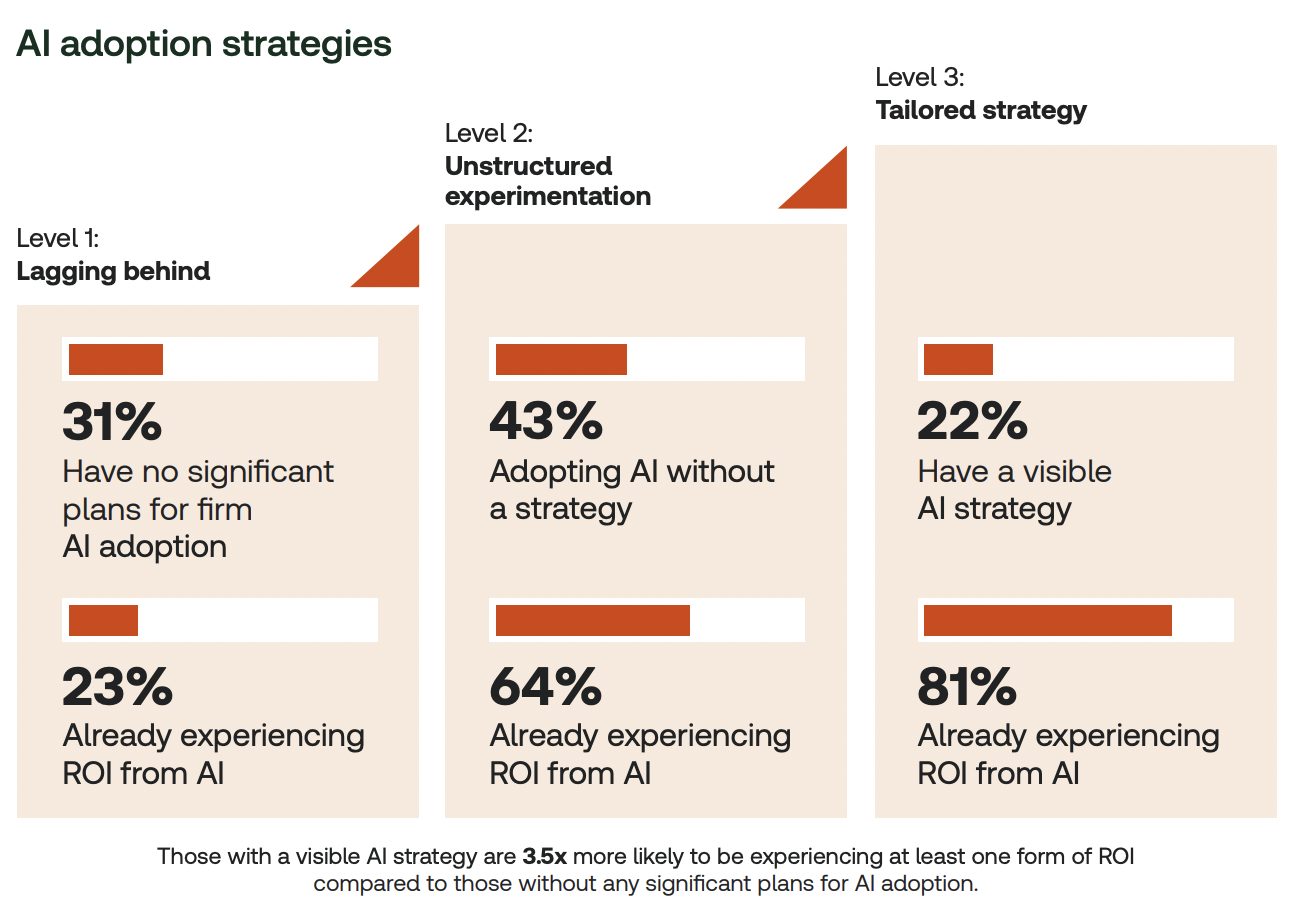
The Thomson Reuters “Future of Professionals” report(Opens in a new window) just dropped and one stat standing out among its insights is that organizations with a visible AI strategy are not only twice as likely to report growth, they’re also 3.5 times more likely to see actual, tangible benefits from AI adoption.

AI Adoption Strategies


Speaking of legal-related items as well as tech, also see:

  • Landmark AI ruling is a blow to authors and artists — from popular.info by Judd Legum
    This week, a federal judge, William Alsup, rejected Anthropic’s effort to dismiss the case and found that stealing books from the internet is likely a copyright violation. A trial will be scheduled in the future. If Anthropic loses, each violation could come with a fine of $750 or more, potentially exposing the company to billions in damages. Other AI companies that use stolen work to train their models — and most do — could also face significant liability.
 

The 2025 Global Skills Report— from coursera.org
Discover in-demand skills and credentials trends across 100+ countries and six regions to deliver impactful industry-aligned learning programs.

GenAI adoption fuels global skill demands
In 2023, early adopters flocked to GenAI, with approximately one person per minute enrolling in a GenAI course on Coursera —a rate that rose to eight per minute in 2024.  Since then, GenAI has continued to see exceptional growth, with global enrollment in GenAI courses surging 195% year-over-year—maintaining its position as one of the most rapidly growing skill domains on our platform. To date, Coursera has recorded over 8 million GenAI enrollments, with 12 learners per minute signing up for GenAI content in 2025 across our catalog of nearly 700 GenAI courses.

Driving this surge, 94% of employers say they’re likely to hire candidates with GenAI credentials, while 75% prefer hiring less-experienced candidates with GenAI skills over more experienced ones without these capabilities.8 Demand for roles such as AI and Machine Learning Specialists is projected to grow by up to 40% in the next four years.9 Mastering AI fundamentals—from prompt engineering to large language model (LLM) applications—is essential to remaining competitive in today’s rapidly evolving economy.

Countries leading our new AI Maturity Index— which highlights regions best equipped to harness AI innovation and translate skills into real-world applications—include global frontrunners such as Singapore, Switzerland, and the United States.

Insights in action

Businesses
Integrate role-specific GenAI modules into employee development programs, enabling teams to leverage AI for efficiency and innovation.

Governments
Scale GenAI literacy initiatives—especially in emerging economies—to address talent shortages and foster human-machine capabilities needed to future-proof digital jobs.

Higher education
Embed credit-eligible GenAI learning into curricula, ensuring graduates enter the workforce job-ready.

Learners
Focus on GenAI courses offering real-world projects (e.g., prompt engineering) that help build skills for in-demand roles.


Excerpt:


Thomson Reuters Survey: Over 95% of Legal Professionals Expect Gen AI to Become Central to Workflow Within Five Year — from lawnext.com by Bob Ambrogi

Thomson Reuters today released its 2025 Generative AI in Professional Services Report, and it reveals that legal professionals have become increasingly optimistic about generative AI, with adoption rates nearly doubling over the past year and a growing belief that the technology should be incorporated into legal work.

According to the report, 26% of legal organizations are now actively using gen AI, up from 14% in 2024. While only 15% of law firm respondents say gen AI is currently central to their workflow, a striking 78% believe it will become central within the next five years.


AI-Powered Legal Work Redefined: Libra Launches Major Update for Legal Professionals — from lawnext.com by Bob Ambrogi

Berlin, April 14, 2025 – Berlin-based Legal Tech startup Libra is launching its most comprehensive update to date, leveraging AI to relieve law firms and legal departments of routine tasks, accelerate research, and improve team collaboration. “Libra v2” combines highly developed AI, a modern user interface, and practical tools to set a new standard for efficient and precise work in all legal areas.

“We listened intently to feedback from law firms and in-house teams,” said Viktor von Essen, founder of Libra. “The result is Libra v2: an AI solution that intelligently supports every step of daily legal work – from initial research to final contract review. We want legal experts to be able to fully concentrate on what is essential: excellent legal advice.”


The Three Cs of Teaching Technology to Law Students — from lawnext.com by Bob Ambrogi

In law practice today, technology is no longer optional — it’s essential. As practicing attorneys increasingly rely on technology tools to serve clients, conduct research, manage documents and streamline workflows, the question is often debated: Are law schools adequately preparing students for this reality?

Unfortunately, for the majority of law schools, the answer is no. But that only begs the question: What should they be doing?

A coincidence of events last week had me thinking about law schools and legal tech, chief among them my attendance at LIT Con, Suffolk Law School’s annual conference to showcase legal innovation and technology — with a portion of it devoted to access-to-justice projects developed by Suffolk Law students themselves.


While not from Bob, I’m also going to include this one here:

Your AI Options: 7 Considerations Before You Buy — from artificiallawyer.com by Liza Pestillos-Ocat

But here’s the problem: not all AI is useful and not all of it is built for the way your legal team works.

Most firms aren’t asking whether they should use AI because they already are. The real question now is what comes next? How do you expand the value of AI across more teams, more matters, and more workflows without introducing unnecessary risk, complexity, or cost?

To get this right, legal professionals need to understand which tools will solve real problems and deliver the most value to their team. That starts with asking better questions, including the ones that follow, before making your next investment in AI for lawyers.


The 2025 AI Index Report — from Stanford University’s Human-Centered Artificial Intelligence Lab (hai.stanford.edu); item via The Neuron

Top Takeaways

  1. AI performance on demanding benchmarks continues to improve.
  2. AI is increasingly embedded in everyday life.
  3. Business is all in on AI, fueling record investment and usage, as research continues to show strong productivity impacts.
  4. The U.S. still leads in producing top AI models—but China is closing the performance gap.
  5. The responsible AI ecosystem evolves—unevenly.
  6. Global AI optimism is rising—but deep regional divides remain.
  7. …and several more

Also see:

The Neuron’s take on this:

So, what should you do? You really need to start trying out these AI tools. They’re getting cheaper and better, and they can genuinely help save time or make work easier—ignoring them is like ignoring smartphones ten years ago.

Just keep two big things in mind:

  1. Making the next super-smart AI costs a crazy amount of money and uses tons of power (seriously, they’re buying nuclear plants and pushing coal again!).
  2. Companies are still figuring out how to make AI perfectly safe and fair—cause it still makes mistakes.

So, use the tools, find what helps you, but don’t trust them completely.

We’re building this plane mid-flight, and Stanford’s report card is just another confirmation that we desperately need better safety checks before we hit major turbulence.


Addendum on 4/16:


The 2025 ABA Techshow Startup Alley Pitch Competition Ended In A Tie – Here Are The Winners — from lawnext.com by Bob Ambrogi

This year, two startups ended up with an equal number of votes for the top spot:

  • Case Crafter, a company from Norway that helps legal professionals build compelling visual timelines based on case files and evidence.
  • Querious, a product that provides attorneys with real-time insights during client conversations into legal issues, relevant content, and suggested questions and follow-ups.
    .


AI academy gives law students a head start on legal tech, says OBA innovator — from canadianlawyermag.com by Branislav Urosevic

The Ontario Bar Association has recently launched a hands-on AI learning platform tailored for lawyers. Called the AI Academy, the initiative is designed to help legal professionals explore, experiment with, and adopt AI tools relevant to their practice.

Colin Lachance, OBA’s innovator-in-residence and the lead designer of the platform, says that although the AI Academy was built for practising lawyers, it is also well-suited for law students.


Stat(s) Of The Week: A Big Gap In Legal Tech Satisfaction — from abovethelaw.com by Jeremy Barke
Comparing sentiment across the pond. 

Legal tech users in the U.S. and the U.K. report widely different levels of satisfaction with their systems, according to a new survey, raising questions about how companies are meeting lawyers’ needs.

According to “The State of Legal Tech Adoption” report by London-based Definely, 51% of U.S. respondents say they’re satisfied with the ROI of their legal technology, while only 22% of U.K. respondents say the same.


Legal tech company Clio acquires AI-focused platform specializing in large firms — from abajournal.com by Danielle Braff

Legal technology company Clio announced [on 3/13/25] that it acquired ShareDo, an artificial intelligence-focused platform specializing in large law firms.

The move represents a major departure for Clio, which was founded in 2008 and is based in Vancouver, British Columbia. The practice management software platform originally focused on solo, small and midsize firms.

“ShareDo has built a powerhouse, proving that large firms are hungry for smarter, faster and more flexible technology,” said Jack Newton, the CEO and founder of Clio, in a statement. “The large law firm market is on the brink of a major shift, and this acquisition cements our role in leading that change.”


How Wexler AI is transforming legal fact analysis and case strategy — from tech.eu by Cate Lawrence
Wexler AI has developed an AI-embedded platform that enables lawyers to uncover key facts, identify inconsistencies, and streamline case preparation. 

It core functionalities include:

  • Advanced fact extraction and analysis: The system can process up to 500,000 documents simultaneously, surfacing critical facts and connections that might otherwise go unnoticed.
  • Chronology creation: Lawyers collaborate with Wexler AI to construct detailed timelines from extensive document sets, ensuring transparency in how key facts are selected and connected.
  • Inconsistency mapping: The AI detects contradictions between testimony and evidence, enhancing cross-examination and case strategy development.


Essential AI tools for better work — from wondertools.substack.com by Jeremy Caplan
My favorite tactics for making the most of AI — a podcast conversation

AI tools I consistently rely on (areas covered mentioned below)

  • Research and analysis
  • Communication efficiency
  • Multimedia creation

AI tactics that work surprisingly well 

1. Reverse interviews
Instead of just querying AI, have it interview you. Get the AI to interview you, rather than interviewing it. Give it a little context and what you’re focusing on and what you’re interested in, and then you ask it to interview you to elicit your own insights.”

This approach helps extract knowledge from yourself, not just from the AI. Sometimes we need that guide to pull ideas out of ourselves.


OpenAI’s Deep Research Agent Is Coming for White-Collar Work — from wired.com by Will Knight
The research-focused agent shows how a new generation of more capable AI models could automate some office tasks.

Isla Fulford, a researcher at OpenAI, had a hunch that Deep Research would be a hit even before it was released.

Fulford had helped build the artificial intelligence agent, which autonomously explores the web, deciding for itself what links to click, what to read, and what to collate into an in-depth report. OpenAI first made Deep Research available internally; whenever it went down, Fulford says, she was inundated with queries from colleagues eager to have it back. “The number of people who were DMing me made us pretty excited,” says Fulford.

Since going live to the public on February 2, Deep Research has proven to be a hit with many users outside the company too.


Nvidia to open quantum computing research center in Boston — from seekingalpha.com by Ravikash Bakolia

Nvidia (NASDAQ:NVDA) will open a quantum computing research lab in Boston which is expected to start operations later this year.

The Nvidia Accelerated Quantum Research Center, or NVAQC, will integrate leading quantum hardware with AI supercomputers, enabling what is known as accelerated quantum supercomputing, said the company in a March 18 press release.

Nvidia’s CEO Jensen Huang also made this announcement on Thursday at the company’s first-ever Quantum Day at its annual GTC event.


French quantum computer firm Pasqal links up with NVIDIA — from reuters.com

PARIS, March 21 (Reuters) – Pasqal, a fast-growing French quantum computer start-up company, announced on Friday a partnership with chip giant Nvidia (NVDA.O), opens new tab whereby Pasqal’s customers would gain access to more tools to develop quantum applications.

Pasqal said it would connect its quantum computing units and cloud platform onto NVIDIA’s open-source platform called CUDA-Q.


Introducing next-generation audio models in the API — from openai.com
A new suite of audio models to power voice agents, now available to developers worldwide.

Today, we’re launching new speech-to-text and text-to-speech audio models in the API—making it possible to build more powerful, customizable, and intelligent voice agents that offer real value. Our latest speech-to-text models set a new state-of-the-art benchmark, outperforming existing solutions in accuracy and reliability—especially in challenging scenarios involving accents, noisy environments, and varying speech speeds. These improvements increase transcription reliability, making the models especially well-suited for use cases like customer call centers, meeting note transcription, and more.


The Learning & Development Global Sentiment Survey 2025 — from donaldhtaylor.co.uk by Don Taylor

The L&D Global Sentiment Survey, now in its 12th year, once again asked two key questions of L&D professionals worldwide:

  • What will be hot in workplace learning in 2025?
  • What are your L&D challenges in 2025?

For the obligatory question on what they considered ‘hot’ topics, respondents voted for one to three of 15 suggested options, plus a free text ‘Other’ option. Over 3,000 voters participated from nearly 100 countries. 85% shared their challenges for 2025.

The results show more interest in AI, a renewed focus on showing the value of L&D, and some signs of greater maturity around our understanding of AI in L&D.


© 2025 | Daniel Christian